GLP PRESENTATION
•
•
•
•
•
•
•
Group Members:-
Kanwal Zeb
Bakhtawar Amjad
Aleena Khan
Zainab Kalsoom
Sania Shafique
Sundas Azad
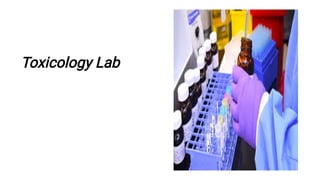
Toxicology Lab
Introduction:-


•
•
•
Generally toxicity testing referred to a series of toxicity testing
required by International regulation for compliance to Good
Laboratory Practices (GLP) for proof of safety in experimental
animal prior to their testing to human.
It comprises of:-
Acute
Sub-acute
Chronic toxicity.
Continued..




These studies are conducted based on ‘OECD guidelines of
testing of chemicals’
International regulations relating to human health requires that
all pharmaceuticals drugs undergo preclinical investigation.
One of the phases of the preclinical investigation is the
toxicology studies.
It is conducted following an appropriate guideline and quality
system (OECD GLP).
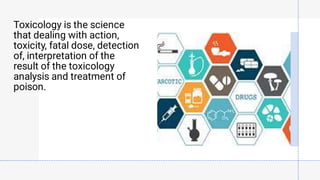
Toxicology is the science
that dealing with action,
toxicity, fatal dose, detection
of, interpretation of the
result of the toxicology
analysis and treatment of
poison.
History of Toxicology
Studies:-
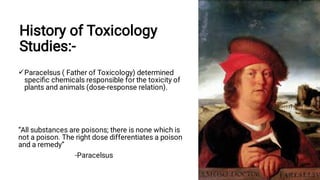
Paracelsus ( Father of Toxicology) determined
specific chemicals responsible for the toxicity of
plants and animals (dose-response relation).
“All substances are poisons; there is none which is
not a poison. The right dose differentiates a poison
and a remedy”
-Paracelsus
History:-
•
•
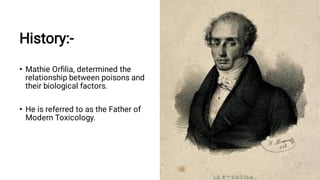
Mathie Orfilia, determined the
relationship between poisons and
their biological factors.
He is referred to as the Father of
Modern Toxicology.
Basic Principle:-
The goal of toxicity assessment is to iden fy adverse effects of a
substance. Adverse effects depend on two main factors:
i) routes of exposure (oral, inhala on, or dermal)
and
ii) dose (dura on and concentra on of exposure). To explore dose,
substances are tested in both acute and chronic models. Generally,
different sets of experiments are conducted to determine whether a
substance causes cancer and to examine other forms of toxicity
Toxicology Screening:- 


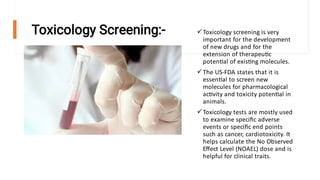
Toxicology screening is very
important for the development
of new drugs and for the
extension of therapeu c
poten al of exis ng molecules.
The US-FDA states that it is
essen al to screen new
molecules for pharmacological
ac vity and toxicity poten al in
animals.
Toxicology tests are mostly used
to examine specific adverse
events or specific end points
such as cancer, cardiotoxicity. It
helps calculate the No Observed
Effect Level (NOAEL) dose and is
helpful for clinical traits.
Toxicologist as a profession:-


A toxicologist is a scientist or medical personnel who specializes in the study
of symptoms, mechanisms, treatments and detection of venoms and toxins;
especially the poisoning of people.
Requirements:-
To work as a toxicologist one should obtain a degree in toxicology or a
related degree like biology,, chemistry, pharmacology or biochemistry.
Bachelor's degree programs in toxicology cover the chemical makeup of
toxins and their effects on biochemistry, physiology and ecology. After
introductory life science courses are complete, students typically enroll in
labs and apply toxicology principles to research and other studies. Advanced
students delve into specific sectors, like the pharmaceutical industry or law
enforcement, which apply methods of toxicology in their work.
Duties:-
•
•
Toxicologists perform many different du es including research in the academic, nonprofit and
industrial fields, product safety evalua on, consul ng, public service and legal regula on.
In order to research and assess the effects of chemicals, toxicologists perform carefully
designed studies and experiments. These experiments help iden fy the specific amount of a
chemical that may cause harm and poten al risks of being near or using products that
contain certain chemicals.
Research projects may range from assessing the effects of toxic pollutants on the
environment to evalua ng how the human immune system responds to chemical
compounds within pharmaceu cal drugs. While the basic du es of toxicologists are to
determine the effects of chemicals on organisms and their surroundings, specific job du es
may vary based on industry and employment. For example, forensic toxicologists may look
for toxic substances in a crime scene, whereas aqua c toxicologists may analyze the toxicity
level of water bodies.
Sources of Toxic Substances:-

•
•
•
Classified based on their
chemical nature
mode of action.
exposure class ( food, air, water or soil) or Use class ( drugs as
drugs of abuse, therapeutic drugs, agriculture chemicals,
pesticides , plants toxins, food additives and cosmetics.
Biomedical Ethics:-
• Before conducting any
toxicology testing in animals
or collecting tissues/cell lines
from animals, the study should
be approved by IAEC or the
protocol should satisfy the
guidelines of the local
governing body.
Toxicity Testing Methods:-



Acute toxicity testing.
Sub-chronic toxicity testing.
(repeated dose=/> 90 day)
Chronic toxicity testing
(repeated dose <90day)
Acute toxicity studies:-




Acute toxicity testing study the effect of a single dose on a particular
animal species.
Acute toxicity testing be carried out with two different animal
species( one rodent and one non-rodent)
In acute toxicology testing, the investigation product is administered
at different dose levels, and the effect is observed for 14 days.
All mortalities caused by the investigational product during the
experimental period are recorded and morphological, biochemical,
pathological, and histological changes in the dead animals are
investigated.
Sub-acute toxicity studies:-


Rodents and non-rodents are used to study the sub-acute
toxicity of substance.
This lab testing is used to determine maximum tolerable dose
and nature of toxicity.
Chronic toxicity studies:-



Chronic toxicity studies are conducted with minimum of one
rodent and one non rodent species.
A chronic toxicology studies provide inferences about the long
term effect of test substance in animals, and it may be
extrapolated to the human safety of test substance.
The test compound is administered over more than 90 days,
and the animals are observed periodically.
Laboratory of Toxicology:-

•
•
•
It mainly involve the following activities:
scientific research
public services(primarily forensic toxicology)
education
Objectives of Toxicology Lab
Key Goal:-
Conducted for public health to identify the virtually safe dose,
provides the foundation for the field of risk assessment for
chemical hazards.
Objective 1:-



To point out the difference between dose and effect.
For every substance there is a dose below which no effect occurs and
another above which poisoning occurs. Thus all the substances and
poten ally safe or poisonous.
This depends only on dose.
Objective 2:-


To point out that natural substances may be highly poisonous
and man made substances may be of low toxicity.
For example Clostridium botulinum toxin is poisonous at very
low dose but synthesized Sorbitol has a very low toxicity.





To explain fundamentals ideas in toxicology clearly so that
students can understand the hazards and risks associated with
chemicals.
To have an idea of toxic doses of xenobiotics for certain
organisms.
Fixation of sub lethal dose for long term toxicity test.
Evaluation of safe doses of those toxicants for certain organisms.
Recommendation of maximum permissible limits of those
substances on the ambient air and drinking water.
Main focus:-

•
•
•
•
•
•
Toxicologists mainly focus to get the following important
information about toxins:
Detection of toxin
Occurrence of toxin
Properties of toxin
Effects of toxin
Treatment
Toxin regulation.
Working of toxicology lab
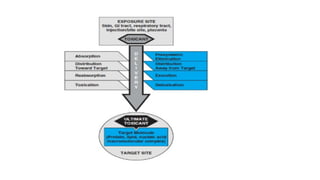
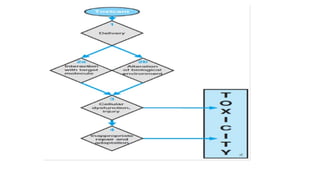
Working Mechanism:-
•
•
•
•
Delivery: site of exposure to the target.
Reaction of ultimate toxicant with the target molecule.
Cellular dysfunction and resultant toxicity.
Repair or disrepair.
How and where the Analysis is performed?
Forensic toxicologist employ a large number of analytical
techniques to determine the drugs or poisons relevant to a case
investigation, the capacity of a lab to conduct routine analysis
will vary dependent upon equipment, technical capability and
analyst experience.
How the evidence is collected?



Specimens sent for toxicology testing are usually collected by
the forensic pathologist.
Specimens must be clearly identified, labelled and sealed as
soon as practicable after collection.
Blood, urine, liver are the specimens often used for detecting,
quantifying and interpreting drugs and other toxicants.
Testing:-


Testing of biological fluids and tissues for durgs and other
substances is a complex process requiring sophisticated
instrumentation and specially trained analysis.
In the typical autopsy fluids and tissue samples are collected
specifically for toxicology testing and a series of tests will be
conducted.
Types of toxicology:
•
•
•
•
•
•
•
There are various types of toxicology as outlined below:
Analy cal toxicology
Applied toxicology
Clinical toxicology
Veterinary toxicology
Forensic toxicology
Environment toxicology
Industrial toxicology
Analytical toxicology:
• It is the branch of toxicology which deals with the study
of detec on and assay of poisonous chemicals including
their metabolites that could affect the biological system.
Applied toxicology:
• It is the applica on of new and modern methods or
technologies for early detec on of toxicants in the field
se ng or prac ce area.
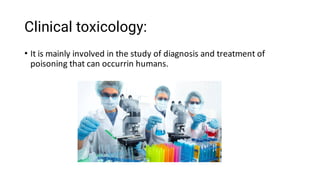
Clinical toxicology:
• It is mainly involved in the study of diagnosis and treatment of
poisoning that can occurrin humans.
Veterinary toxicology:
• Veterinary toxicology focus in the study of diagnosis and
treatment of animal poisoning including the transmission
of toxin from animals to humans via milk, meat, fish, food
stuff and etc.
Environmental toxicology:
• It is the branch of toxicology in which study of presence
of different toxicants including their metabolites and
degrada on products in the environment and their
effects on humans and animals.
Industrial toxicology:
• It is the study of selec ve and specific are of environmental
toxicology.
QUALITY ASSURANCE
•
•
•
Toxicity tes ng laboratories can employ quality management
systems to help meet test acceptability requirements and
ensure quality results. Cri cal components of quality
management systems for tes ng programs include:
emphasis on analyst training, par cularly with regard to culture
and maintenance of test organisms
maintenance of standardized opera ng procedures
•
•
•
•
•
•
maintenance of method-required environmental condi ons
use of standard reference toxicants
tes ng mul ple control or reference samples with each batch
of toxicity tests
keeping detailed records
performing appropriate sta s cal analyses
rou ne laboratory audits
• Environmental Standards provides a corporate liability
overview by documen ng the defensibility of the
quality assurance and quality control in your in-house or
contracted toxicity tes ng laboratories. We shield our
clients from undue exposure to liability from the use of
poor quality data
Technical Testing Specifications
• Quality Assurance professionals can prepare comprehensive
technical specifica ons covering QA/QC measures to be
followed by contracted toxicity tes ng laboratories. We employ
our exper se in specifying metrics that must be achieved when
tes ng client samples using EPA, ASTM or other published
toxicity test methods.
Risks of toxicology labs
• Working as a toxicologist entails some risk. Although modern
toxicology labs are typically equipped with all the latest safety
equipment, and toxicologists are extremely careful to follow
good laboratory prac ce, accidents do happen and people get
hurt. Although workplace accident sta s cs are not broken
down for toxicologists, they certainly have greater risks than the
average lab worker given they work almost exclusively with toxic
substances.
Long Hours in a Lab
• Most toxicologists spend long hours working in a lab,
some mes five days or more a week. The daily rou ne of lab
research and analyzing the results can become stul fying
over me, so it is important for toxicologists and other lab
researchers to take regular breaks and stay ac ve in their
lives outside of the lab. Back and eye strain can also become
issues with long hours using lab equipment and staring at a
computer monitor.

Good Laboratory practices - Toxicology Lab.pdf

  • 1.
    GLP PRESENTATION • • • • • • • Group Members:- KanwalZeb Bakhtawar Amjad Aleena Khan Zainab Kalsoom Sania Shafique Sundas Azad
  • 2.
  • 3.
    Introduction:-   • • • Generally toxicity testingreferred to a series of toxicity testing required by International regulation for compliance to Good Laboratory Practices (GLP) for proof of safety in experimental animal prior to their testing to human. It comprises of:- Acute Sub-acute Chronic toxicity.
  • 4.
    Continued..     These studies areconducted based on ‘OECD guidelines of testing of chemicals’ International regulations relating to human health requires that all pharmaceuticals drugs undergo preclinical investigation. One of the phases of the preclinical investigation is the toxicology studies. It is conducted following an appropriate guideline and quality system (OECD GLP).
  • 5.
    Toxicology is thescience that dealing with action, toxicity, fatal dose, detection of, interpretation of the result of the toxicology analysis and treatment of poison.
  • 6.
    History of Toxicology Studies:- Paracelsus( Father of Toxicology) determined specific chemicals responsible for the toxicity of plants and animals (dose-response relation). “All substances are poisons; there is none which is not a poison. The right dose differentiates a poison and a remedy” -Paracelsus
  • 7.
    History:- • • Mathie Orfilia, determinedthe relationship between poisons and their biological factors. He is referred to as the Father of Modern Toxicology.
  • 8.
    Basic Principle:- The goalof toxicity assessment is to iden fy adverse effects of a substance. Adverse effects depend on two main factors: i) routes of exposure (oral, inhala on, or dermal) and ii) dose (dura on and concentra on of exposure). To explore dose, substances are tested in both acute and chronic models. Generally, different sets of experiments are conducted to determine whether a substance causes cancer and to examine other forms of toxicity
  • 9.
    Toxicology Screening:-    Toxicologyscreening is very important for the development of new drugs and for the extension of therapeu c poten al of exis ng molecules. The US-FDA states that it is essen al to screen new molecules for pharmacological ac vity and toxicity poten al in animals. Toxicology tests are mostly used to examine specific adverse events or specific end points such as cancer, cardiotoxicity. It helps calculate the No Observed Effect Level (NOAEL) dose and is helpful for clinical traits.
  • 10.
    Toxicologist as aprofession:-   A toxicologist is a scientist or medical personnel who specializes in the study of symptoms, mechanisms, treatments and detection of venoms and toxins; especially the poisoning of people. Requirements:- To work as a toxicologist one should obtain a degree in toxicology or a related degree like biology,, chemistry, pharmacology or biochemistry. Bachelor's degree programs in toxicology cover the chemical makeup of toxins and their effects on biochemistry, physiology and ecology. After introductory life science courses are complete, students typically enroll in labs and apply toxicology principles to research and other studies. Advanced students delve into specific sectors, like the pharmaceutical industry or law enforcement, which apply methods of toxicology in their work.
  • 11.
    Duties:- • • Toxicologists perform manydifferent du es including research in the academic, nonprofit and industrial fields, product safety evalua on, consul ng, public service and legal regula on. In order to research and assess the effects of chemicals, toxicologists perform carefully designed studies and experiments. These experiments help iden fy the specific amount of a chemical that may cause harm and poten al risks of being near or using products that contain certain chemicals. Research projects may range from assessing the effects of toxic pollutants on the environment to evalua ng how the human immune system responds to chemical compounds within pharmaceu cal drugs. While the basic du es of toxicologists are to determine the effects of chemicals on organisms and their surroundings, specific job du es may vary based on industry and employment. For example, forensic toxicologists may look for toxic substances in a crime scene, whereas aqua c toxicologists may analyze the toxicity level of water bodies.
  • 12.
    Sources of ToxicSubstances:-  • • • Classified based on their chemical nature mode of action. exposure class ( food, air, water or soil) or Use class ( drugs as drugs of abuse, therapeutic drugs, agriculture chemicals, pesticides , plants toxins, food additives and cosmetics.
  • 13.
    Biomedical Ethics:- • Beforeconducting any toxicology testing in animals or collecting tissues/cell lines from animals, the study should be approved by IAEC or the protocol should satisfy the guidelines of the local governing body.
  • 14.
    Toxicity Testing Methods:-    Acutetoxicity testing. Sub-chronic toxicity testing. (repeated dose=/> 90 day) Chronic toxicity testing (repeated dose <90day)
  • 15.
    Acute toxicity studies:-     Acutetoxicity testing study the effect of a single dose on a particular animal species. Acute toxicity testing be carried out with two different animal species( one rodent and one non-rodent) In acute toxicology testing, the investigation product is administered at different dose levels, and the effect is observed for 14 days. All mortalities caused by the investigational product during the experimental period are recorded and morphological, biochemical, pathological, and histological changes in the dead animals are investigated.
  • 16.
    Sub-acute toxicity studies:-   Rodentsand non-rodents are used to study the sub-acute toxicity of substance. This lab testing is used to determine maximum tolerable dose and nature of toxicity.
  • 17.
    Chronic toxicity studies:-    Chronictoxicity studies are conducted with minimum of one rodent and one non rodent species. A chronic toxicology studies provide inferences about the long term effect of test substance in animals, and it may be extrapolated to the human safety of test substance. The test compound is administered over more than 90 days, and the animals are observed periodically.
  • 18.
    Laboratory of Toxicology:-  • • • Itmainly involve the following activities: scientific research public services(primarily forensic toxicology) education
  • 19.
  • 20.
    Key Goal:- Conducted forpublic health to identify the virtually safe dose, provides the foundation for the field of risk assessment for chemical hazards.
  • 21.
    Objective 1:-    To pointout the difference between dose and effect. For every substance there is a dose below which no effect occurs and another above which poisoning occurs. Thus all the substances and poten ally safe or poisonous. This depends only on dose.
  • 22.
    Objective 2:-   To pointout that natural substances may be highly poisonous and man made substances may be of low toxicity. For example Clostridium botulinum toxin is poisonous at very low dose but synthesized Sorbitol has a very low toxicity.
  • 23.
         To explain fundamentalsideas in toxicology clearly so that students can understand the hazards and risks associated with chemicals. To have an idea of toxic doses of xenobiotics for certain organisms. Fixation of sub lethal dose for long term toxicity test. Evaluation of safe doses of those toxicants for certain organisms. Recommendation of maximum permissible limits of those substances on the ambient air and drinking water.
  • 24.
    Main focus:-  • • • • • • Toxicologists mainlyfocus to get the following important information about toxins: Detection of toxin Occurrence of toxin Properties of toxin Effects of toxin Treatment Toxin regulation.
  • 25.
  • 26.
    Working Mechanism:- • • • • Delivery: siteof exposure to the target. Reaction of ultimate toxicant with the target molecule. Cellular dysfunction and resultant toxicity. Repair or disrepair.
  • 29.
    How and wherethe Analysis is performed? Forensic toxicologist employ a large number of analytical techniques to determine the drugs or poisons relevant to a case investigation, the capacity of a lab to conduct routine analysis will vary dependent upon equipment, technical capability and analyst experience.
  • 30.
    How the evidenceis collected?    Specimens sent for toxicology testing are usually collected by the forensic pathologist. Specimens must be clearly identified, labelled and sealed as soon as practicable after collection. Blood, urine, liver are the specimens often used for detecting, quantifying and interpreting drugs and other toxicants.
  • 31.
    Testing:-   Testing of biologicalfluids and tissues for durgs and other substances is a complex process requiring sophisticated instrumentation and specially trained analysis. In the typical autopsy fluids and tissue samples are collected specifically for toxicology testing and a series of tests will be conducted.
  • 32.
    Types of toxicology: • • • • • • • Thereare various types of toxicology as outlined below: Analy cal toxicology Applied toxicology Clinical toxicology Veterinary toxicology Forensic toxicology Environment toxicology Industrial toxicology
  • 33.
    Analytical toxicology: • Itis the branch of toxicology which deals with the study of detec on and assay of poisonous chemicals including their metabolites that could affect the biological system.
  • 34.
    Applied toxicology: • Itis the applica on of new and modern methods or technologies for early detec on of toxicants in the field se ng or prac ce area.
  • 35.
    Clinical toxicology: • Itis mainly involved in the study of diagnosis and treatment of poisoning that can occurrin humans.
  • 36.
    Veterinary toxicology: • Veterinarytoxicology focus in the study of diagnosis and treatment of animal poisoning including the transmission of toxin from animals to humans via milk, meat, fish, food stuff and etc.
  • 37.
    Environmental toxicology: • Itis the branch of toxicology in which study of presence of different toxicants including their metabolites and degrada on products in the environment and their effects on humans and animals.
  • 38.
    Industrial toxicology: • Itis the study of selec ve and specific are of environmental toxicology.
  • 39.
    QUALITY ASSURANCE • • • Toxicity tesng laboratories can employ quality management systems to help meet test acceptability requirements and ensure quality results. Cri cal components of quality management systems for tes ng programs include: emphasis on analyst training, par cularly with regard to culture and maintenance of test organisms maintenance of standardized opera ng procedures
  • 40.
    • • • • • • maintenance of method-requiredenvironmental condi ons use of standard reference toxicants tes ng mul ple control or reference samples with each batch of toxicity tests keeping detailed records performing appropriate sta s cal analyses rou ne laboratory audits
  • 41.
    • Environmental Standardsprovides a corporate liability overview by documen ng the defensibility of the quality assurance and quality control in your in-house or contracted toxicity tes ng laboratories. We shield our clients from undue exposure to liability from the use of poor quality data
  • 42.
    Technical Testing Specifications •Quality Assurance professionals can prepare comprehensive technical specifica ons covering QA/QC measures to be followed by contracted toxicity tes ng laboratories. We employ our exper se in specifying metrics that must be achieved when tes ng client samples using EPA, ASTM or other published toxicity test methods.
  • 43.
    Risks of toxicologylabs • Working as a toxicologist entails some risk. Although modern toxicology labs are typically equipped with all the latest safety equipment, and toxicologists are extremely careful to follow good laboratory prac ce, accidents do happen and people get hurt. Although workplace accident sta s cs are not broken down for toxicologists, they certainly have greater risks than the average lab worker given they work almost exclusively with toxic substances.
  • 44.
    Long Hours ina Lab • Most toxicologists spend long hours working in a lab, some mes five days or more a week. The daily rou ne of lab research and analyzing the results can become stul fying over me, so it is important for toxicologists and other lab researchers to take regular breaks and stay ac ve in their lives outside of the lab. Back and eye strain can also become issues with long hours using lab equipment and staring at a computer monitor.