Project Presentation
on
“Development of a MATLAB/
Simulink model of a Three phase
Grid Connected Solar PV System”
Under the supervision of:
Prof. M.P.DAVE
Department of Electrical & Electronics Engg.
AKGEC, Ghaziabad
Presented By:
SATYENDRA VISHWAKARMA
(Roll No.-110278511)
M.TECH(EPES) 4th SEMESTER
AKGEC, Ghaziabad
OUTLINE OF THE PRESENTATION
• INTRODUCTION
• LITERATURE REVIEW
• SYSTEM DESCRIPTION
• SOFTWARE IMPLEMENTATION
• SIMULATION RESULTS
• CONCLUSION
• FUTURE WORK
2
INTRODUCTION
 Energy plays an important role in our daily life. Power demand
is rapidly increased day by day due to increase urbanization
and industrialization. The world’s fossil fuels are conventional
resources of energy, which will be depleted in next few
decades.
 The rate of energy consumption increasing, supply is depleting
resulting energy shortage. This is known as energy crisis.
Hence renewable sources of energy, like solar, wind etc., have
to be developed to meet future power requirement.
3
NEED AN ADEQUATE SOLUTION &
This leads to the basic RESEARCH OBJECTIVE
Solar Power Sector
• India lies in a sunny tropical belt (High
insolation) Total approximate potential
annually over 5000 trillion kWh
• Over 70% of India’s households experience
significant power cuts every year
• National Solar Mission and other Generation
Based Incentives (GBI) are available
through Ministry of New and Renewable
Energy (MNRE)
• JNNSM have a mission to install 20 GW
solar PV plant by 2022
• Cost of PV module, land scarcity and
technological barrier is a main restriction.
• Current cost of production is ` 12/KWh and
expected cost is ` 6/KWh by 2020
4
Jawahar Lal Nehru National Solar
Mission Target
2010-2013
On grid PV power of 1000-2000 MW
Off grid PV application 200 MW
Solar collector 7 million sq. meter
2013-2017
On grid PV power of 4000-10000
MW
Off grid PV application 1000 MW
Solar collector 15 million sq. meter
2017-2022
On grid PV power of 22000 MW
Off grid PV application 2000 MW
Solar collector 20 million sq. meter
Need of Solar Energy
• Solar power generation has emerged as one of the
most rapidly growing renewable sources of
electricity.
• Solar power generation has several advantages
over other forms of electricity generation:-
1. Reduced Dependence on Fossil Fuels.
2. Environmental Advantages.
3. Matching Peak Time Output with Peak Time
Demand.
4. Modularity and Scalability.
5. Flexible Locations
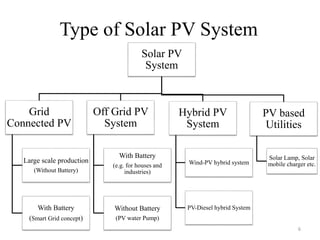
Type of Solar PV System
Solar PV
System
Grid
Connected PV
Large scale production
(Without Battery)
With Battery
(Smart Grid concept)
Off Grid PV
System
With Battery
(e.g. for houses and
industries)
Without Battery
(PV water Pump)
Hybrid PV
System
Wind-PV hybrid system
PV-Diesel hybrid System
PV based
Utilities
Solar Lamp, Solar
mobile charger etc.
6
LITERATURE REVIEW
 From the existing literature survey, it shows that only 30-
40% of energy incident on PV array is converts into
electrical energy. For enhance maximum power from panel
the algorithm is needed is Maximum Power Point Tracking
algorithm.
 Major literature survey has been done for the Solar PV
system. Review of some papers is described below which
are used in reference of this work:
 Sachin Jain and Vivek Agarwal, et al. [1] presents a highly
efficient inverter for PV systems which are linked with the
grid. The presented inverter configuration boosts the low
7
8
voltage across PV array. It convert the generate dc power into ac
power to supply power to utility. The presented configuration has
several advantageous such as compact size, low cost etc. The
array acts as a source to the grid. The design process and terms is
incorporated through steady state analysis.
 Trishan Esram, et al. [2] discussed different techniques for
extracting maximum power from photovoltaic arrays. There are
at least 19 different methods discussed in this paper, with many
different conditions and compare different characteristics. The
issue is study by all MPPT is to achieve the voltage or current it
should operate to generate the maximum output power under
variable atmospheric conditions.
Contd.
 Hiren Patel and Vivek Agarwal, et al. [3] studies the
performance of photovoltaic arrays under partially shaded
conditions. PV array characteristics are study. Most of the
available methods are not able to extract maximum power
when there is cloudy weather or under variable irradiation. The
authors presented a new algorithm to track the power under
such conditions.
 Bhim singh et al. [4] discussed the analysis and control aspects
of standalone solar PV system for low power applications. The
battery is used as energy storage system which is charged and
stores it. The stored energy is feed to the load using inverter by
converted into AC of 220 V, 50Hz.
9
Contd.
 Hao Qian et al. [5] proposes a high-efficiency battery based
energy storage system. The used energy storage system has a
bidirectional ac–dc converter. For applying active charge
equalization of the battery, energy management system
estimating the SOC and health condition of each cell.
Prototypes have been designed and implement to validate the
performance.
 Hamid R. Teymour et al. [6] presents the theoretical
framework of the proposed modulation technique. A new
control algorithm is also presented in order to control the
power delivery between the system and grid. This
simultaneously provides maximum power point tracking
(MPPT) operation for the solar PV.
10
Contd.
 Jung-Ming Kwon et al. [7] study a PV system along with
maximum power point tracking techniques. MPPT using a
power hysteresis tracks the MPP. Also a proportional and
integral controller is recommended to control the dc link
voltage faster.
 Yongsoon Park et al. [8] describe a grid synchronization
technique. This method is essential for grid connected power
converters. PLL has been widely used as a realization scheme,
but additional efforts are still required to deal with distorted
grid voltages. The results have shown that the proposed
method carried out a better phase tracking performance for
grid synchronization.
11
Contd.
Contd.
 Michael E. Ropp, et al. [9] focus on modeling of grid connected
PV system in MATLAB environment. Simulation results show
the behavior of PV would be of high value. On the other hand,
most of today’s models don’t precisely model, to study the
dynamics behavior of the maximum power point trackers
(MPPTs). The simulation results are compared with real time
results of the system.
 Guishi Wang et al. [10] proposes a power smoothing strategy for
1 MW grid connected solar PV power plant. A HESS composed
of battery and a super capacitor bank is used, to smooth the
unpredictable output power of the PV plant. The PV plant with
the HESS has been modeled using MATLAB/simulink and
PLECS software environment. 12
Objectives
The work can be summarized as follows:
 Use PV array to simulate grid connected PV system using the
MPPT technique.
 Design the control loops to regulate output power and the
injected currents respectively. The outer power loop is
responsible for setting the reference signal for the inner current
loop. The control signals will be used to drive a three phase
voltage source inverter (VSI) to regulate the power conversion
process from DC to AC.
 The maximum power point tracking (MPPT) controller and
algorithm for obtaining maximum power output at any given
temperature and any irradiance.
 Simulate solar system with battery energy storage system.
13
Main components of Solar PV system are:
(a) PV array
(b)Voltage Source Converters (VSC)
(c) Interfacing Inductor:
• To connect the VSC with the transmission line.
• It also helps to reduce the switching ripples.
(d) DC capacitor:
• It is used to provide constant DC voltage to the
VSC.
(e) Control of Inverter
(f) MPPT Techniques
14
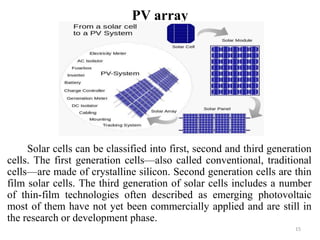
PV array
Solar cells can be classified into first, second and third generation
cells. The first generation cells—also called conventional, traditional
cells—are made of crystalline silicon. Second generation cells are thin
film solar cells. The third generation of solar cells includes a number
of thin-film technologies often described as emerging photovoltaic
most of them have not yet been commercially applied and are still in
the research or development phase.
15
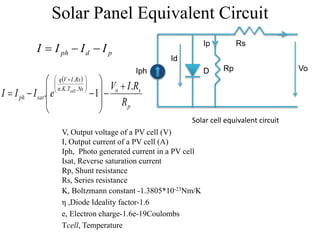
Solar Panel Equivalent Circuit
Rp
Rs
Iph D
p
d
ph I
I
I
I 


 
p
s
o
Ns
T
K
n
Rs
I
V
q
sat
ph
R
R
I
V
e
I
I
I cell
.
1
.
.
.
.
.




















 
Id
Vo
Ip
V, Output voltage of a PV cell (V)
I, Output current of a PV cell (A)
Iph, Photo generated current in a PV cell
Isat, Reverse saturation current
Rp, Shunt resistance
Rs, Series resistance
K, Boltzmann constant -1.3805*10-23Nm/K
η ,Diode Ideality factor-1.6
e, Electron charge-1.6e-19Coulombs
Tcell, Temperature
Solar cell equivalent circuit
Characteristics of PV array
The I-V (current-voltage) curve of a PV string (or module)
describes its energy conversion capability at the existing
conditions of irradiance (light level) and temperature.
Conceptually, the curve represents the combinations of current
and voltage at which the string could be operated or ‘loaded’, if
the irradiance and cell temperature could be held constant.
17
I-V & P-V characteristics of PV array
• Solar panel characteristic has non-linear
relationship with Temperature and Irradiance
• MPP also moves non-linearly
• MPPT can improve efficiency by 15-20%
Maximum Power Point Tracking
Incremental Conductance Based MPPT
19
The incremental conductance (IncCond) method is based on
the fact that the slope of the PV array power voltage curve is zero at
the MPP, positive on the left of the MPP, and negative on the right, as
given by, [9]
•dP/dV = 0, at MPP
•dP/dV > 0, left of MPP
•dP/dV < 0, right of MPP
Since
•ΔI/ΔV = −I/V, at MPP
•ΔI/ΔV > − I/V, left of MPP
•ΔI/ΔV < − I/V, right of MPP
V
I
V
I
dV
dI
V
I
dV
IV
d
dV
dP







)
(
᷉
P-V Characteristics for Incremental Conductance method
20
Flowchart of Incremental Conductance[9]
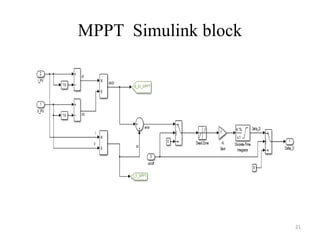
MPPT Simulink block
21
Power Electronics interface
22
DC-DC Converter & DC-AC Converter
• DC-DC converter needed for two reasons
– To implement the MPPT algorithm
– To bring the DC voltage to an acceptable level to
power the load
• Boost converter was chosen and designed
• DC-AC converter is use for convert DC input
into AC output.
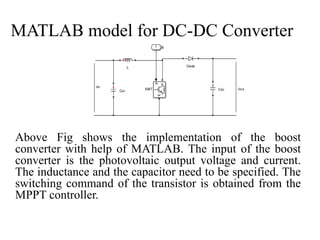
MATLAB model for DC-DC Converter
Above Fig shows the implementation of the boost
converter with help of MATLAB. The input of the boost
converter is the photovoltaic output voltage and current.
The inductance and the capacitor need to be specified. The
switching command of the transistor is obtained from the
MPPT controller.
Control for DC-AC Converter
• Fig shows the control of three phase inverter. The three-
level VSC regulates DC bus voltage at 1100 V and keeps
unity power factor. The control system uses two control
loops: an external control loop which regulates DC link
voltage and an internal control loop which regulates Id and
Iq grid currents.
• Id current reference is the output of the DC voltage external
controller. Iq current reference is set to zero in order to
maintain unity power factor. Vd and Vq voltage outputs of
the current controller are converted to three modulating
signals Uref_abc used by the PWM three-level pulse
generator. 24
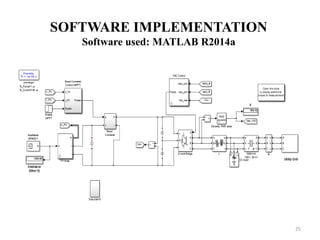
SOFTWARE IMPLEMENTATION
Software used: MATLAB R2014a
25
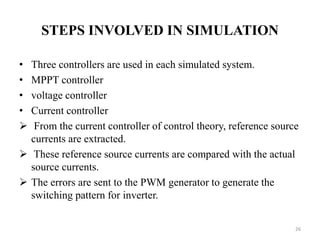
STEPS INVOLVED IN SIMULATION
• Three controllers are used in each simulated system.
• MPPT controller
• voltage controller
• Current controller
 From the current controller of control theory, reference source
currents are extracted.
 These reference source currents are compared with the actual
source currents.
 The errors are sent to the PWM generator to generate the
switching pattern for inverter.
26
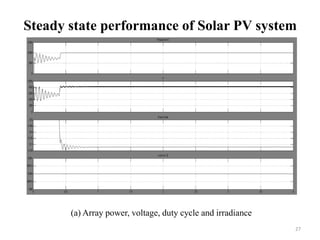
Steady state performance of Solar PV system
27
(a) Array power, voltage, duty cycle and irradiance
28
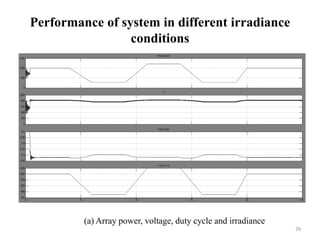
Performance of system in different irradiance
conditions
29
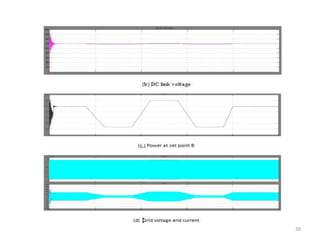
(a) Array power, voltage, duty cycle and irradiance
30
CONCLUSION
Following results are achieved in this project:
• Modeling of the PV system with MPP controller has been designed.
First, the simulation of the PV array is done. When the irradiance
varies, the PV models output voltage current change. Then, the
simulation shows that Incremental and Conductance algorithm can
track the MPP of the PV, it always runs at maximum power no
matter what is the operation condition.
• The simulations of the PV with maximum power point, boost
converter and inverter were performed by varying the irradiance and
with battery energy storage also. The battery control system was
also designed in order to show characteristics of the battery.
• Finally, the PV performance with constant irradiance and with
variable irradiance was analyzed. The MPP algorithm and the three
phase inverter were also simulated. The results shows that the DC
power generated by the PV array could produce an AC current and
voltage at the output of the inverter. “The amplitude of the current
depends on the PV power”.
31
Future Scope
• This work can be extended for more maximum power tracking
algorithms and performance of PV system can be studied.
• Performance of PV system can be studied for more
configurations of it.
• An investigation may be made in the direction to study the
fault ride through capabilities of investigated grid connected
solar, wind & hybrid systems.
• New control techniques for convertors and inverters should be
developed.
32
References
33
[1] Best practice guide-Photovoltaics PV
[2] Masters, Gilbert M., Renewable and efficient electric power systems. John Wiley & Sons, 2004
[3] http://en.wikipedia.org/wiki/Photovoltaic_system
[4] G.D.Rai, non-convenetinal energy sources, khanna publications.
[5] Sachin Jain and Vivek Agarwal, “A Single-Stage Grid Connected Inverter Topology for Solar PV Systems with
Maximum Power Point Tracking”, IEEE Trans. Power Electronics, vol. 22, no. 5, pp.1928-1940, September 2007
[6]Trishan Esram, “Comparison of Photovoltaic Array Maximum Power Point Tracking Techniques”, IEEE
TRANSACTIONS ON ENERGY CONVERSION, VOL. 22, NO. 2, PP. 439-449, JUNE 2007.
[7]Michael E. Roop, “Devlopment of a MATLAB simulink model of a single phase grid connected PV
system,”IEEE Trans. Energy Conversion, 2009.
[8] Sangita R Nandurkar ,”Design and simulation of three phase inverter for grid connected PV systems”,Third
biannual national conference, NCNTE-2012 FEB 24-25.
[9] Wang , “A novel single stage full bridge buck boost inverter” IEEE Trans. On Power Electronics, vol. 19, no 1,
jan 2014.
[10] Patel ,H. , “Maximum power point tracking scheme for PV systems operating under partially shaded
conditions”, IEEE Transon industrial Electronics vol 55april 2008.
[11] Bhim Singh, Design and control of small power standalone solar PV energy system”, Asian Power Electronics journal, oct
2012.
[12] Ramprabha R ,”Design and modeling of standalone solar PV charging system,” Int journal of computer applications vol 18
no 2, march 2011.
[13] Hao Qian A High-Efficiency Grid-Tie Battery Energy Storage System IEEE TRANSACTIONS ON POWER ELECTRONICS, VOL. 26,
NO. 3, MARCH 2011
[14] Hamid R, “Solar PV and battery storage integration using a new configuration of a three level NPC inverter with advanced
control strategy”, IEEE Trans on energy conversion, vol 29,no 2, june 2014.
[15]Sarina Adhikari, “Coordinated V-f and P-Q Control of Solar Photovoltaic Generators With MPPT and Battery Storage in
Microgrids”, IEEE TRANSACTIONS ON SMART GRID, VOL. 5, NO. 3, MAY 2014 pp 1270-1282.
[16] Huang-Jen Chiu,“Design and Implementation of a Photovoltaic High-Intensity-Discharge Street Lighting System, IEEE
TRANSACTIONS ON POWER ELECTRONICS, VOL. 26, NO. 12, DECEMBER 2011
[17]Jung-Min Kwon, “Three-Phase Photovoltaic System With Three-Level Boosting MPPT Control”, IEEE TRANSACTIONS ON
POWER ELECTRONICS, VOL. 23, NO. 5, SEPTEMBER 2008 pp 2319-2328.
[18]Yongsoon Park, Phase-Locked Loop Based on an Observer for Grid Synchronization”, Phase-Locked Loop Based on an
Observer for Grid Synchronization, IEEE TRANSACTIONS ON INDUSTRY APPLICATIONS, VOL. 50, NO. 2, MARCH/APRIL 2014
pp1256-1266.
[19]Guishi Wang, Power Smoothing of Large Solar PV Plant Using Hybrid Energy Storage”, IEEE TRANSACTIONS ON SUSTAINABLE
ENERGY, VOL. 5, NO. 3, JULY 2014 pp 834- 843.
[20]Boddu Veeraiah, “Co-ordinated control of renewable energy resources for grid connected and autonomous microgrid
modes”, M.Tech Thesis, May 2012, IIT-Delhi
[21]Frede Blaabjerg, “Overview of Control and Grid Synchronization for Distributed Power Generation Systems”, IEEE
TRANSACTIONS ON INDUSTRIAL ELECTRONICS, VOL. 53, NO. 5, OCTOBER 2006 ,pp1398-1410.
[22] http://www.mathworks.in
34
35

THREE PHASE GRID CONNECTED SOLAR PV SYSTEM

  • 1.
    Project Presentation on “Development ofa MATLAB/ Simulink model of a Three phase Grid Connected Solar PV System” Under the supervision of: Prof. M.P.DAVE Department of Electrical & Electronics Engg. AKGEC, Ghaziabad Presented By: SATYENDRA VISHWAKARMA (Roll No.-110278511) M.TECH(EPES) 4th SEMESTER AKGEC, Ghaziabad
  • 2.
    OUTLINE OF THEPRESENTATION • INTRODUCTION • LITERATURE REVIEW • SYSTEM DESCRIPTION • SOFTWARE IMPLEMENTATION • SIMULATION RESULTS • CONCLUSION • FUTURE WORK 2
  • 3.
    INTRODUCTION  Energy playsan important role in our daily life. Power demand is rapidly increased day by day due to increase urbanization and industrialization. The world’s fossil fuels are conventional resources of energy, which will be depleted in next few decades.  The rate of energy consumption increasing, supply is depleting resulting energy shortage. This is known as energy crisis. Hence renewable sources of energy, like solar, wind etc., have to be developed to meet future power requirement. 3 NEED AN ADEQUATE SOLUTION & This leads to the basic RESEARCH OBJECTIVE
  • 4.
    Solar Power Sector •India lies in a sunny tropical belt (High insolation) Total approximate potential annually over 5000 trillion kWh • Over 70% of India’s households experience significant power cuts every year • National Solar Mission and other Generation Based Incentives (GBI) are available through Ministry of New and Renewable Energy (MNRE) • JNNSM have a mission to install 20 GW solar PV plant by 2022 • Cost of PV module, land scarcity and technological barrier is a main restriction. • Current cost of production is ` 12/KWh and expected cost is ` 6/KWh by 2020 4 Jawahar Lal Nehru National Solar Mission Target 2010-2013 On grid PV power of 1000-2000 MW Off grid PV application 200 MW Solar collector 7 million sq. meter 2013-2017 On grid PV power of 4000-10000 MW Off grid PV application 1000 MW Solar collector 15 million sq. meter 2017-2022 On grid PV power of 22000 MW Off grid PV application 2000 MW Solar collector 20 million sq. meter
  • 5.
    Need of SolarEnergy • Solar power generation has emerged as one of the most rapidly growing renewable sources of electricity. • Solar power generation has several advantages over other forms of electricity generation:- 1. Reduced Dependence on Fossil Fuels. 2. Environmental Advantages. 3. Matching Peak Time Output with Peak Time Demand. 4. Modularity and Scalability. 5. Flexible Locations
  • 6.
    Type of SolarPV System Solar PV System Grid Connected PV Large scale production (Without Battery) With Battery (Smart Grid concept) Off Grid PV System With Battery (e.g. for houses and industries) Without Battery (PV water Pump) Hybrid PV System Wind-PV hybrid system PV-Diesel hybrid System PV based Utilities Solar Lamp, Solar mobile charger etc. 6
  • 7.
    LITERATURE REVIEW  Fromthe existing literature survey, it shows that only 30- 40% of energy incident on PV array is converts into electrical energy. For enhance maximum power from panel the algorithm is needed is Maximum Power Point Tracking algorithm.  Major literature survey has been done for the Solar PV system. Review of some papers is described below which are used in reference of this work:  Sachin Jain and Vivek Agarwal, et al. [1] presents a highly efficient inverter for PV systems which are linked with the grid. The presented inverter configuration boosts the low 7
  • 8.
    8 voltage across PVarray. It convert the generate dc power into ac power to supply power to utility. The presented configuration has several advantageous such as compact size, low cost etc. The array acts as a source to the grid. The design process and terms is incorporated through steady state analysis.  Trishan Esram, et al. [2] discussed different techniques for extracting maximum power from photovoltaic arrays. There are at least 19 different methods discussed in this paper, with many different conditions and compare different characteristics. The issue is study by all MPPT is to achieve the voltage or current it should operate to generate the maximum output power under variable atmospheric conditions. Contd.
  • 9.
     Hiren Pateland Vivek Agarwal, et al. [3] studies the performance of photovoltaic arrays under partially shaded conditions. PV array characteristics are study. Most of the available methods are not able to extract maximum power when there is cloudy weather or under variable irradiation. The authors presented a new algorithm to track the power under such conditions.  Bhim singh et al. [4] discussed the analysis and control aspects of standalone solar PV system for low power applications. The battery is used as energy storage system which is charged and stores it. The stored energy is feed to the load using inverter by converted into AC of 220 V, 50Hz. 9 Contd.
  • 10.
     Hao Qianet al. [5] proposes a high-efficiency battery based energy storage system. The used energy storage system has a bidirectional ac–dc converter. For applying active charge equalization of the battery, energy management system estimating the SOC and health condition of each cell. Prototypes have been designed and implement to validate the performance.  Hamid R. Teymour et al. [6] presents the theoretical framework of the proposed modulation technique. A new control algorithm is also presented in order to control the power delivery between the system and grid. This simultaneously provides maximum power point tracking (MPPT) operation for the solar PV. 10 Contd.
  • 11.
     Jung-Ming Kwonet al. [7] study a PV system along with maximum power point tracking techniques. MPPT using a power hysteresis tracks the MPP. Also a proportional and integral controller is recommended to control the dc link voltage faster.  Yongsoon Park et al. [8] describe a grid synchronization technique. This method is essential for grid connected power converters. PLL has been widely used as a realization scheme, but additional efforts are still required to deal with distorted grid voltages. The results have shown that the proposed method carried out a better phase tracking performance for grid synchronization. 11 Contd.
  • 12.
    Contd.  Michael E.Ropp, et al. [9] focus on modeling of grid connected PV system in MATLAB environment. Simulation results show the behavior of PV would be of high value. On the other hand, most of today’s models don’t precisely model, to study the dynamics behavior of the maximum power point trackers (MPPTs). The simulation results are compared with real time results of the system.  Guishi Wang et al. [10] proposes a power smoothing strategy for 1 MW grid connected solar PV power plant. A HESS composed of battery and a super capacitor bank is used, to smooth the unpredictable output power of the PV plant. The PV plant with the HESS has been modeled using MATLAB/simulink and PLECS software environment. 12
  • 13.
    Objectives The work canbe summarized as follows:  Use PV array to simulate grid connected PV system using the MPPT technique.  Design the control loops to regulate output power and the injected currents respectively. The outer power loop is responsible for setting the reference signal for the inner current loop. The control signals will be used to drive a three phase voltage source inverter (VSI) to regulate the power conversion process from DC to AC.  The maximum power point tracking (MPPT) controller and algorithm for obtaining maximum power output at any given temperature and any irradiance.  Simulate solar system with battery energy storage system. 13
  • 14.
    Main components ofSolar PV system are: (a) PV array (b)Voltage Source Converters (VSC) (c) Interfacing Inductor: • To connect the VSC with the transmission line. • It also helps to reduce the switching ripples. (d) DC capacitor: • It is used to provide constant DC voltage to the VSC. (e) Control of Inverter (f) MPPT Techniques 14
  • 15.
    PV array Solar cellscan be classified into first, second and third generation cells. The first generation cells—also called conventional, traditional cells—are made of crystalline silicon. Second generation cells are thin film solar cells. The third generation of solar cells includes a number of thin-film technologies often described as emerging photovoltaic most of them have not yet been commercially applied and are still in the research or development phase. 15
  • 16.
    Solar Panel EquivalentCircuit Rp Rs Iph D p d ph I I I I      p s o Ns T K n Rs I V q sat ph R R I V e I I I cell . 1 . . . . .                       Id Vo Ip V, Output voltage of a PV cell (V) I, Output current of a PV cell (A) Iph, Photo generated current in a PV cell Isat, Reverse saturation current Rp, Shunt resistance Rs, Series resistance K, Boltzmann constant -1.3805*10-23Nm/K η ,Diode Ideality factor-1.6 e, Electron charge-1.6e-19Coulombs Tcell, Temperature Solar cell equivalent circuit
  • 17.
    Characteristics of PVarray The I-V (current-voltage) curve of a PV string (or module) describes its energy conversion capability at the existing conditions of irradiance (light level) and temperature. Conceptually, the curve represents the combinations of current and voltage at which the string could be operated or ‘loaded’, if the irradiance and cell temperature could be held constant. 17 I-V & P-V characteristics of PV array
  • 18.
    • Solar panelcharacteristic has non-linear relationship with Temperature and Irradiance • MPP also moves non-linearly • MPPT can improve efficiency by 15-20% Maximum Power Point Tracking
  • 19.
    Incremental Conductance BasedMPPT 19 The incremental conductance (IncCond) method is based on the fact that the slope of the PV array power voltage curve is zero at the MPP, positive on the left of the MPP, and negative on the right, as given by, [9] •dP/dV = 0, at MPP •dP/dV > 0, left of MPP •dP/dV < 0, right of MPP Since •ΔI/ΔV = −I/V, at MPP •ΔI/ΔV > − I/V, left of MPP •ΔI/ΔV < − I/V, right of MPP V I V I dV dI V I dV IV d dV dP        ) ( ᷉ P-V Characteristics for Incremental Conductance method
  • 20.
  • 21.
  • 22.
    Power Electronics interface 22 DC-DCConverter & DC-AC Converter • DC-DC converter needed for two reasons – To implement the MPPT algorithm – To bring the DC voltage to an acceptable level to power the load • Boost converter was chosen and designed • DC-AC converter is use for convert DC input into AC output.
  • 23.
    MATLAB model forDC-DC Converter Above Fig shows the implementation of the boost converter with help of MATLAB. The input of the boost converter is the photovoltaic output voltage and current. The inductance and the capacitor need to be specified. The switching command of the transistor is obtained from the MPPT controller.
  • 24.
    Control for DC-ACConverter • Fig shows the control of three phase inverter. The three- level VSC regulates DC bus voltage at 1100 V and keeps unity power factor. The control system uses two control loops: an external control loop which regulates DC link voltage and an internal control loop which regulates Id and Iq grid currents. • Id current reference is the output of the DC voltage external controller. Iq current reference is set to zero in order to maintain unity power factor. Vd and Vq voltage outputs of the current controller are converted to three modulating signals Uref_abc used by the PWM three-level pulse generator. 24
  • 25.
  • 26.
    STEPS INVOLVED INSIMULATION • Three controllers are used in each simulated system. • MPPT controller • voltage controller • Current controller  From the current controller of control theory, reference source currents are extracted.  These reference source currents are compared with the actual source currents.  The errors are sent to the PWM generator to generate the switching pattern for inverter. 26
  • 27.
    Steady state performanceof Solar PV system 27 (a) Array power, voltage, duty cycle and irradiance
  • 28.
  • 29.
    Performance of systemin different irradiance conditions 29 (a) Array power, voltage, duty cycle and irradiance
  • 30.
  • 31.
    CONCLUSION Following results areachieved in this project: • Modeling of the PV system with MPP controller has been designed. First, the simulation of the PV array is done. When the irradiance varies, the PV models output voltage current change. Then, the simulation shows that Incremental and Conductance algorithm can track the MPP of the PV, it always runs at maximum power no matter what is the operation condition. • The simulations of the PV with maximum power point, boost converter and inverter were performed by varying the irradiance and with battery energy storage also. The battery control system was also designed in order to show characteristics of the battery. • Finally, the PV performance with constant irradiance and with variable irradiance was analyzed. The MPP algorithm and the three phase inverter were also simulated. The results shows that the DC power generated by the PV array could produce an AC current and voltage at the output of the inverter. “The amplitude of the current depends on the PV power”. 31
  • 32.
    Future Scope • Thiswork can be extended for more maximum power tracking algorithms and performance of PV system can be studied. • Performance of PV system can be studied for more configurations of it. • An investigation may be made in the direction to study the fault ride through capabilities of investigated grid connected solar, wind & hybrid systems. • New control techniques for convertors and inverters should be developed. 32
  • 33.
    References 33 [1] Best practiceguide-Photovoltaics PV [2] Masters, Gilbert M., Renewable and efficient electric power systems. John Wiley & Sons, 2004 [3] http://en.wikipedia.org/wiki/Photovoltaic_system [4] G.D.Rai, non-convenetinal energy sources, khanna publications. [5] Sachin Jain and Vivek Agarwal, “A Single-Stage Grid Connected Inverter Topology for Solar PV Systems with Maximum Power Point Tracking”, IEEE Trans. Power Electronics, vol. 22, no. 5, pp.1928-1940, September 2007 [6]Trishan Esram, “Comparison of Photovoltaic Array Maximum Power Point Tracking Techniques”, IEEE TRANSACTIONS ON ENERGY CONVERSION, VOL. 22, NO. 2, PP. 439-449, JUNE 2007. [7]Michael E. Roop, “Devlopment of a MATLAB simulink model of a single phase grid connected PV system,”IEEE Trans. Energy Conversion, 2009. [8] Sangita R Nandurkar ,”Design and simulation of three phase inverter for grid connected PV systems”,Third biannual national conference, NCNTE-2012 FEB 24-25. [9] Wang , “A novel single stage full bridge buck boost inverter” IEEE Trans. On Power Electronics, vol. 19, no 1, jan 2014. [10] Patel ,H. , “Maximum power point tracking scheme for PV systems operating under partially shaded conditions”, IEEE Transon industrial Electronics vol 55april 2008.
  • 34.
    [11] Bhim Singh,Design and control of small power standalone solar PV energy system”, Asian Power Electronics journal, oct 2012. [12] Ramprabha R ,”Design and modeling of standalone solar PV charging system,” Int journal of computer applications vol 18 no 2, march 2011. [13] Hao Qian A High-Efficiency Grid-Tie Battery Energy Storage System IEEE TRANSACTIONS ON POWER ELECTRONICS, VOL. 26, NO. 3, MARCH 2011 [14] Hamid R, “Solar PV and battery storage integration using a new configuration of a three level NPC inverter with advanced control strategy”, IEEE Trans on energy conversion, vol 29,no 2, june 2014. [15]Sarina Adhikari, “Coordinated V-f and P-Q Control of Solar Photovoltaic Generators With MPPT and Battery Storage in Microgrids”, IEEE TRANSACTIONS ON SMART GRID, VOL. 5, NO. 3, MAY 2014 pp 1270-1282. [16] Huang-Jen Chiu,“Design and Implementation of a Photovoltaic High-Intensity-Discharge Street Lighting System, IEEE TRANSACTIONS ON POWER ELECTRONICS, VOL. 26, NO. 12, DECEMBER 2011 [17]Jung-Min Kwon, “Three-Phase Photovoltaic System With Three-Level Boosting MPPT Control”, IEEE TRANSACTIONS ON POWER ELECTRONICS, VOL. 23, NO. 5, SEPTEMBER 2008 pp 2319-2328. [18]Yongsoon Park, Phase-Locked Loop Based on an Observer for Grid Synchronization”, Phase-Locked Loop Based on an Observer for Grid Synchronization, IEEE TRANSACTIONS ON INDUSTRY APPLICATIONS, VOL. 50, NO. 2, MARCH/APRIL 2014 pp1256-1266. [19]Guishi Wang, Power Smoothing of Large Solar PV Plant Using Hybrid Energy Storage”, IEEE TRANSACTIONS ON SUSTAINABLE ENERGY, VOL. 5, NO. 3, JULY 2014 pp 834- 843. [20]Boddu Veeraiah, “Co-ordinated control of renewable energy resources for grid connected and autonomous microgrid modes”, M.Tech Thesis, May 2012, IIT-Delhi [21]Frede Blaabjerg, “Overview of Control and Grid Synchronization for Distributed Power Generation Systems”, IEEE TRANSACTIONS ON INDUSTRIAL ELECTRONICS, VOL. 53, NO. 5, OCTOBER 2006 ,pp1398-1410. [22] http://www.mathworks.in 34
  • 35.