Solar Energy System Design
Deepthi Narayana Swamy
Manjunathaswamy Antharavally
Ajinkya Bobade
Mohammed Alaswad
2016-10-17
Outline
– Introduction to Solar Inverters
– Types of Solar Inverters
– Working Principle
– Inverter Sizing
– Types of Inverter Manufacturers
– Inverter connections
1
Inverters
➢ A power inverter, or inverter, is an electronic device or circuitry that changes
direct current (DC)to alternating current (AC).
➢ The inverter does not produce any power; the power is provided by the DC
source.
➢ A solar inverter is a component of a photovoltaic system and can be used for
both, grid-connected and off-grid systems.
➢ Solar inverters: Photovoltaic off-grid Inverters are used for electrically powering
remote houses. In case of grid-connected photovoltaic systems, surplus
electricity is fed back into the grid.
2
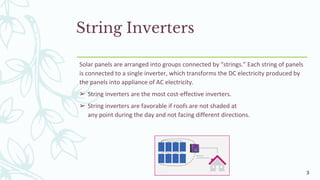
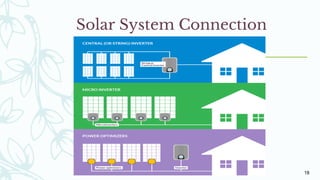
String Inverters
Solar panels are arranged into groups connected by “strings.” Each string of panels
is connected to a single inverter, which transforms the DC electricity produced by
the panels into appliance of AC electricity.
➢ String inverters are the most cost-effective inverters.
➢ String inverters are favorable if roofs are not shaded at
any point during the day and not facing different directions.
3
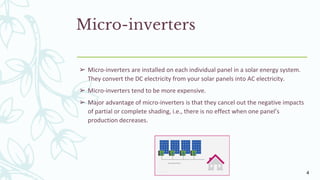
Micro-inverters
➢ Micro-inverters are installed on each individual panel in a solar energy system.
They convert the DC electricity from your solar panels into AC electricity.
➢ Micro-inverters tend to be more expensive.
➢ Major advantage of micro-inverters is that they cancel out the negative impacts
of partial or complete shading, i.e., there is no effect when one panel’s
production decreases.
4
Power Optimizers
➢ A power optimizer is a DC to DC converter technology developed to maximize
the energy harvest from solar photovoltaic systems.
➢ Power optimizers are located at each panel, usually integrated into the panels
themselves.
➢ Power optimizers reduce the impact of panel shading on system performance,
and also offer panel performance monitoring.
5
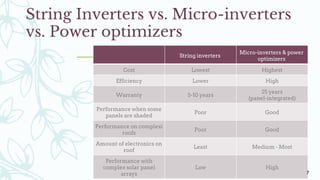
String inverters
Micro-inverters & power
optimizers
Cost Lowest Highest
Efficiency Lower High
Warranty 5-10 years
25 years
(panel-integrated)
Performance when some
panels are shaded
Poor Good
Performance on complexi
roofs
Poor Good
Amount of electronics on
roof
Least Medium - Most
Performance with
complex solar panel
arrays
Low High
String Inverters vs. Micro-inverters
vs. Power optimizers
7
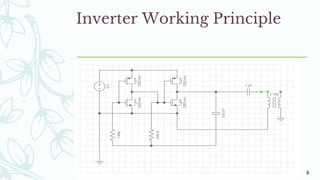
Inverter Working Principle
8
Inverter Sizing
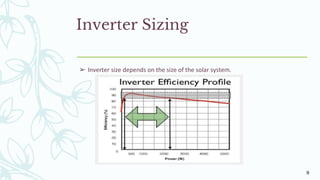
➢ Inverter size depends on the size of the solar system.
9
Inverter Sizing, Continued
➢ System size can be defined by the given equation,
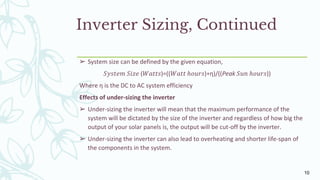
𝑆𝑦𝑠𝑡𝑒𝑚 𝑆𝑖𝑧𝑒 (𝑊𝑎𝑡𝑡𝑠)=((𝑊𝑎𝑡𝑡 ℎ𝑜𝑢𝑟𝑠)∗η)/((Peak 𝑆𝑢𝑛 ℎ𝑜𝑢𝑟𝑠))
Where η is the DC to AC system efficiency
Effects of under-sizing the inverter
➢ Under-sizing the inverter will mean that the maximum performance of the
system will be dictated by the size of the inverter and regardless of how big the
output of your solar panels is, the output will be cut-off by the inverter.
➢ Under-sizing the inverter can also lead to overheating and shorter life-span of
the components in the system.
10
Inverter Sizing, Continued
Effects of over-sizing the inverter.
➢ Inverter companies predicted that a natural choice would be to oversize the
inverters.
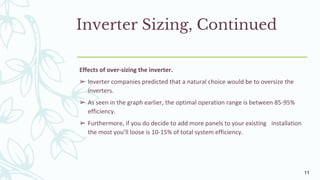
➢ As seen in the graph earlier, the optimal operation range is between 85-95%
efficiency.
➢ Furthermore, if you do decide to add more panels to your existing installation
the most you’ll loose is 10-15% of total system efficiency.
11
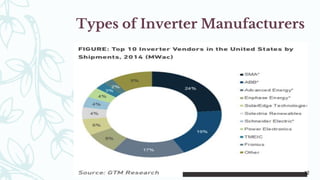
Types of Inverter Manufacturers
12
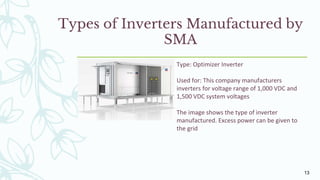
Types of Inverters Manufactured by
SMA
Type: Optimizer Inverter
Used for: This company manufacturers
inverters for voltage range of 1,000 VDC and
1,500 VDC system voltages
The image shows the type of inverter
manufactured. Excess power can be given to
the grid
13
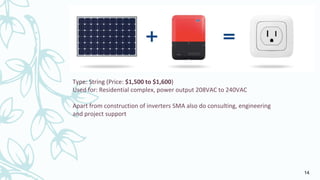
Type: String (Price: $1,500 to $1,600)
Used for: Residential complex, power output 208VAC to 240VAC
Apart from construction of inverters SMA also do consulting, engineering
and project support
14
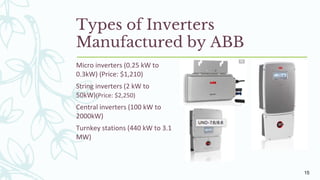
Types of Inverters
Manufactured by ABB
Micro inverters (0.25 kW to
0.3kW) (Price: $1,210)
String inverters (2 kW to
50kW)(Price: $2,250)
Central inverters (100 kW to
2000kW)
Turnkey stations (440 kW to 3.1
MW)
15
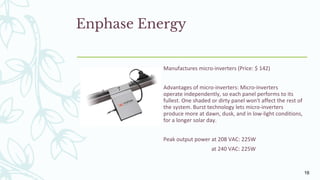
Enphase Energy
Manufactures micro-inverters (Price: $ 142)
Advantages of micro-inverters: Micro-inverters
operate independently, so each panel performs to its
fullest. One shaded or dirty panel won't affect the rest of
the system. Burst technology lets micro-inverters
produce more at dawn, dusk, and in low-light conditions,
for a longer solar day.
Peak output power at 208 VAC: 225W
at 240 VAC: 225W
16
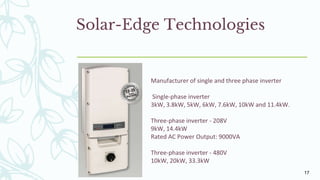
Solar-Edge Technologies
Manufacturer of single and three phase inverter
Single-phase inverter
3kW, 3.8kW, 5kW, 6kW, 7.6kW, 10kW and 11.4kW.
Three-phase inverter - 208V
9kW, 14.4kW
Rated AC Power Output: 9000VA
Three-phase inverter - 480V
10kW, 20kW, 33.3kW
17
Solar System Connection
18
19
20
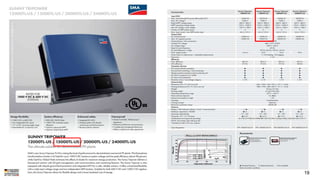
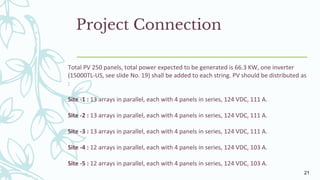
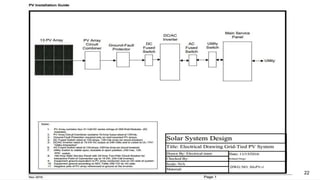
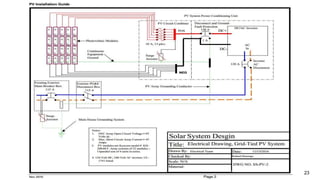
Total PV 250 panels, total power expected to be generated is 66.3 KW, one inverter
(15000TL-US, see slide No. 19) shall be added to each string. PV should be distributed as
:
Site -1 : 13 arrays in parallel, each with 4 panels in series, 124 VDC, 111 A.
Site -2 : 13 arrays in parallel, each with 4 panels in series, 124 VDC, 111 A.
Site -3 : 13 arrays in parallel, each with 4 panels in series, 124 VDC, 111 A.
Site -4 : 12 arrays in parallel, each with 4 panels in series, 124 VDC, 103 A.
Site -5 : 12 arrays in parallel, each with 4 panels in series, 124 VDC, 103 A.
Project Connection
21
22
23
References
➢ https://www.energysage.com/solar/101/string-inverters-microinverters-power-optimizers
➢ http://www.energymatters.com.au/components/micro-string-central-inverters/
➢ http://www.mpptsolar.com/en/how-does-an-inverter-work.html
➢ http://www.solar-facts.com/inverters/how-inverters-work.php
➢ https://en.wikipedia.org/wiki/Solar_inverter
➢ http://www.solarchoice.net.au/blog/optimizing-solar-panel-system-efficiency-through-inverter-
sizing/
➢ http://www.affordable-solar.com/solar-tools/inverter-sizing-guide/
24
References, Continued
➢ http://www.homepower.com/articles/solar-electricity/project-profiles/microinverters-make-
simple-diy-installation
➢ http://www.greentechmedia.com/articles/read/these-are-the-top-ten-inverter-vendors-in-the-
united-states
➢ http://www.sma-america.com
➢ http://new.abb.com
➢ https://enphase.com/en-us
➢ https://usa.krannich-solar.com/fileadmin/content/data_sheets/inverter/usa/STPTL-US12-24EXP-
DUS132533W.pdf
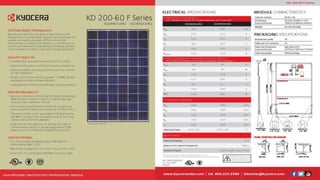
➢ https:// www.Kyocera-KD265GX-LFB2-solar-panel-datasheet.pdf
25
Thank you
Questions

Solar system design

  • 1.
    Solar Energy SystemDesign Deepthi Narayana Swamy Manjunathaswamy Antharavally Ajinkya Bobade Mohammed Alaswad 2016-10-17
  • 2.
    Outline – Introduction toSolar Inverters – Types of Solar Inverters – Working Principle – Inverter Sizing – Types of Inverter Manufacturers – Inverter connections 1
  • 3.
    Inverters ➢ A powerinverter, or inverter, is an electronic device or circuitry that changes direct current (DC)to alternating current (AC). ➢ The inverter does not produce any power; the power is provided by the DC source. ➢ A solar inverter is a component of a photovoltaic system and can be used for both, grid-connected and off-grid systems. ➢ Solar inverters: Photovoltaic off-grid Inverters are used for electrically powering remote houses. In case of grid-connected photovoltaic systems, surplus electricity is fed back into the grid. 2
  • 4.
    String Inverters Solar panelsare arranged into groups connected by “strings.” Each string of panels is connected to a single inverter, which transforms the DC electricity produced by the panels into appliance of AC electricity. ➢ String inverters are the most cost-effective inverters. ➢ String inverters are favorable if roofs are not shaded at any point during the day and not facing different directions. 3
  • 5.
    Micro-inverters ➢ Micro-inverters areinstalled on each individual panel in a solar energy system. They convert the DC electricity from your solar panels into AC electricity. ➢ Micro-inverters tend to be more expensive. ➢ Major advantage of micro-inverters is that they cancel out the negative impacts of partial or complete shading, i.e., there is no effect when one panel’s production decreases. 4
  • 6.
    Power Optimizers ➢ Apower optimizer is a DC to DC converter technology developed to maximize the energy harvest from solar photovoltaic systems. ➢ Power optimizers are located at each panel, usually integrated into the panels themselves. ➢ Power optimizers reduce the impact of panel shading on system performance, and also offer panel performance monitoring. 5
  • 7.
    String inverters Micro-inverters &power optimizers Cost Lowest Highest Efficiency Lower High Warranty 5-10 years 25 years (panel-integrated) Performance when some panels are shaded Poor Good Performance on complexi roofs Poor Good Amount of electronics on roof Least Medium - Most Performance with complex solar panel arrays Low High String Inverters vs. Micro-inverters vs. Power optimizers 7
  • 8.
  • 9.
    Inverter Sizing ➢ Invertersize depends on the size of the solar system. 9
  • 10.
    Inverter Sizing, Continued ➢System size can be defined by the given equation, 𝑆𝑦𝑠𝑡𝑒𝑚 𝑆𝑖𝑧𝑒 (𝑊𝑎𝑡𝑡𝑠)=((𝑊𝑎𝑡𝑡 ℎ𝑜𝑢𝑟𝑠)∗η)/((Peak 𝑆𝑢𝑛 ℎ𝑜𝑢𝑟𝑠)) Where η is the DC to AC system efficiency Effects of under-sizing the inverter ➢ Under-sizing the inverter will mean that the maximum performance of the system will be dictated by the size of the inverter and regardless of how big the output of your solar panels is, the output will be cut-off by the inverter. ➢ Under-sizing the inverter can also lead to overheating and shorter life-span of the components in the system. 10
  • 11.
    Inverter Sizing, Continued Effectsof over-sizing the inverter. ➢ Inverter companies predicted that a natural choice would be to oversize the inverters. ➢ As seen in the graph earlier, the optimal operation range is between 85-95% efficiency. ➢ Furthermore, if you do decide to add more panels to your existing installation the most you’ll loose is 10-15% of total system efficiency. 11
  • 12.
    Types of InverterManufacturers 12
  • 13.
    Types of InvertersManufactured by SMA Type: Optimizer Inverter Used for: This company manufacturers inverters for voltage range of 1,000 VDC and 1,500 VDC system voltages The image shows the type of inverter manufactured. Excess power can be given to the grid 13
  • 14.
    Type: String (Price:$1,500 to $1,600) Used for: Residential complex, power output 208VAC to 240VAC Apart from construction of inverters SMA also do consulting, engineering and project support 14
  • 15.
    Types of Inverters Manufacturedby ABB Micro inverters (0.25 kW to 0.3kW) (Price: $1,210) String inverters (2 kW to 50kW)(Price: $2,250) Central inverters (100 kW to 2000kW) Turnkey stations (440 kW to 3.1 MW) 15
  • 16.
    Enphase Energy Manufactures micro-inverters(Price: $ 142) Advantages of micro-inverters: Micro-inverters operate independently, so each panel performs to its fullest. One shaded or dirty panel won't affect the rest of the system. Burst technology lets micro-inverters produce more at dawn, dusk, and in low-light conditions, for a longer solar day. Peak output power at 208 VAC: 225W at 240 VAC: 225W 16
  • 17.
    Solar-Edge Technologies Manufacturer ofsingle and three phase inverter Single-phase inverter 3kW, 3.8kW, 5kW, 6kW, 7.6kW, 10kW and 11.4kW. Three-phase inverter - 208V 9kW, 14.4kW Rated AC Power Output: 9000VA Three-phase inverter - 480V 10kW, 20kW, 33.3kW 17
  • 18.
  • 19.
  • 20.
  • 21.
    Total PV 250panels, total power expected to be generated is 66.3 KW, one inverter (15000TL-US, see slide No. 19) shall be added to each string. PV should be distributed as : Site -1 : 13 arrays in parallel, each with 4 panels in series, 124 VDC, 111 A. Site -2 : 13 arrays in parallel, each with 4 panels in series, 124 VDC, 111 A. Site -3 : 13 arrays in parallel, each with 4 panels in series, 124 VDC, 111 A. Site -4 : 12 arrays in parallel, each with 4 panels in series, 124 VDC, 103 A. Site -5 : 12 arrays in parallel, each with 4 panels in series, 124 VDC, 103 A. Project Connection 21
  • 22.
  • 23.
  • 24.
    References ➢ https://www.energysage.com/solar/101/string-inverters-microinverters-power-optimizers ➢ http://www.energymatters.com.au/components/micro-string-central-inverters/ ➢http://www.mpptsolar.com/en/how-does-an-inverter-work.html ➢ http://www.solar-facts.com/inverters/how-inverters-work.php ➢ https://en.wikipedia.org/wiki/Solar_inverter ➢ http://www.solarchoice.net.au/blog/optimizing-solar-panel-system-efficiency-through-inverter- sizing/ ➢ http://www.affordable-solar.com/solar-tools/inverter-sizing-guide/ 24
  • 25.
    References, Continued ➢ http://www.homepower.com/articles/solar-electricity/project-profiles/microinverters-make- simple-diy-installation ➢http://www.greentechmedia.com/articles/read/these-are-the-top-ten-inverter-vendors-in-the- united-states ➢ http://www.sma-america.com ➢ http://new.abb.com ➢ https://enphase.com/en-us ➢ https://usa.krannich-solar.com/fileadmin/content/data_sheets/inverter/usa/STPTL-US12-24EXP- DUS132533W.pdf ➢ https:// www.Kyocera-KD265GX-LFB2-solar-panel-datasheet.pdf 25
  • 26.