Global WarmingGlobal Warming – What is it?
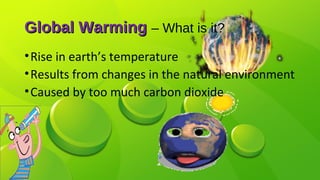
•Rise in earth’s temperature
•Results from changes in the natural environment
•Caused by too much carbon dioxide
The Greenhouse EffectThe Greenhouse Effect
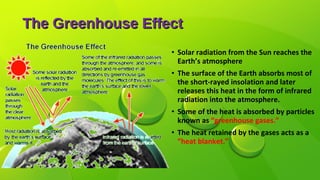
• Solar radiation from the Sun reaches the
Earth’s atmosphere
• The surface of the Earth absorbs most of
the short-rayed insolation and later
releases this heat in the form of infrared
radiation into the atmosphere.
• Some of the heat is absorbed by particles
known as “greenhouse gases.”
• The heat retained by the gases acts as a
“heat blanket.”
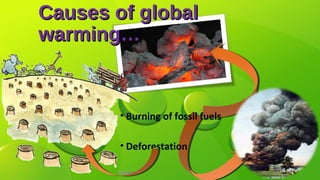
Causes of globalCauses of global
warming…warming…
• Burning of fossil fuels
• Deforestation
Burning of fossil fuelsBurning of fossil fuels
• The burning of fossil fuels releases Carbon dioxide in the
atmosphere.
• In the past 150 years, burning fossil fuels has caused
a 25 % increase in Carbon dioxide emissions.
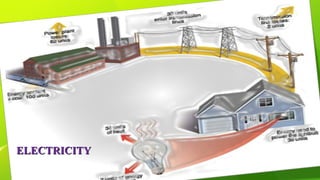
ELECTRICITYELECTRICITY
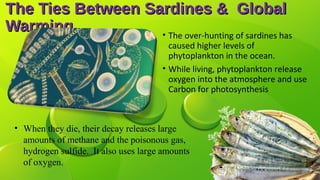
The Ties Between Sardines & GlobalThe Ties Between Sardines & Global
WarmingWarming • The over-hunting of sardines has
caused higher levels of
phytoplankton in the ocean.
• While living, phytoplankton release
oxygen into the atmosphere and use
Carbon for photosynthesis
• When they die, their decay releases large
amounts of methane and the poisonous gas,
hydrogen sulfide. It also uses large amounts
of oxygen.
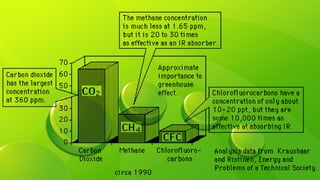
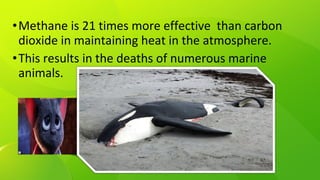
•Methane is 21 times more effective than carbon
dioxide in maintaining heat in the atmosphere.
•This results in the deaths of numerous marine
animals.
Effects of global warmingEffects of global warming
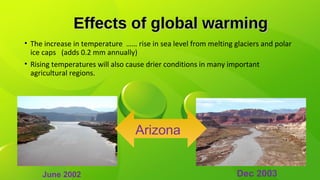
• The increase in temperature …… rise in sea level from melting glaciers and polar
ice caps (adds 0.2 mm annually)
• Rising temperatures will also cause drier conditions in many important
agricultural regions.
Dec 2003June 2002
Arizona
Effects on Sea Life
GLOBAL WARMING’S NEGATIVE IMPACT ON SEA LIFE—
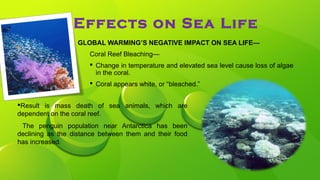
Coral Reef Bleaching—
 Change in temperature and elevated sea level cause loss of algae
in the coral.
 Coral appears white, or “bleached.”
Result is mass death of sea animals, which are
dependent on the coral reef.
The penguin population near Antarctica has been
declining as the distance between them and their food
has increased.
Rising Sea levels
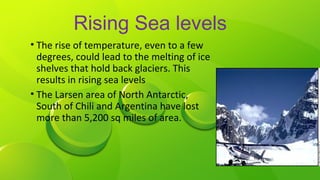
• The rise of temperature, even to a few
degrees, could lead to the melting of ice
shelves that hold back glaciers. This
results in rising sea levels
• The Larsen area of North Antarctic,
South of Chili and Argentina have lost
more than 5,200 sq miles of area.
The Effects of Global Warming onThe Effects of Global Warming on
Land animalsLand animals
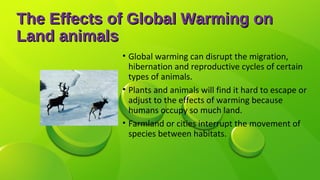
• Global warming can disrupt the migration,
hibernation and reproductive cycles of certain
types of animals.
• Plants and animals will find it hard to escape or
adjust to the effects of warming because
humans occupy so much land.
• Farmland or cities interrupt the movement of
species between habitats.
Tropical DiseasesTropical Diseases
• Global Warming increases drought which
lessens the supply of clean drinking
water.
• Cholera • It increases temperature providing an
ideal breeding environment for
mosquitoes.
• Dengue fever
• Malaria
• Yellow fever
IMPACT ON AIRIMPACT ON AIR
The atmosphere’s ultimate fate is unclear.
More evaporation  increase in cloud cover
How High Will the Clouds Be? It makes a difference!
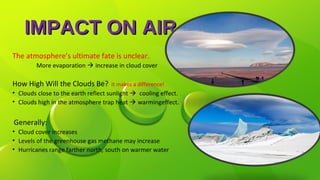
• Clouds close to the earth reflect sunlight  cooling effect.
• Clouds high in the atmosphere trap heat  warmingeffect.
Generally:
• Cloud cover increases
• Levels of the greenhouse gas methane may increase
• Hurricanes range farther north, south on warmer water
El Niño EffectEl Niño Effect
•Collapse of the monsoons in Asia 
severe drought to Indonesia and northern
Australia.
•Severe weather disturbances in other
parts of the world, such as droughts in
areas of Africa and central North America.
Kyoto Protocol
•The Kyoto Protocol is an amendment to the United Nations Framework
Convention on Climate Change (UNFCCC)
•UNFCCC, an international treaty on global warming
• Countries which ratify this protocol commit to reduce their emissions of
carbon dioxide and five other greenhouse gases
•A total of 141 countries have ratified the agreement. Notable exceptions
include the United States and Australia
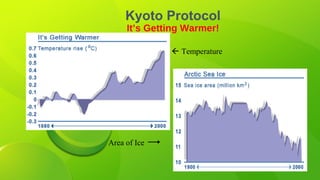
Kyoto Protocol
It’s Getting Warmer!
 Temperature
Area of Ice
•It was negotiated in Kyoto, Japan in December 1997, opened for signature
on March 16, 1998, and closed on March 15, 1999
•Current estimates are that even if successfully and completely
implemented, the Kyoto Protocol is predicted to reduce the average global
temperature by somewhere between 0.02°C and 0.28°C by the year 2050
PREVENTIONPREVENTION
 Buy energy efficient products
 Buy products that have reusable or
recyclable packaging
 Reduce use of car (walk instead)
 Plant trees
 Conserve energy:
(examples: 1. use low-energy, low-water-use washing
machines, 2. use a solar heated system for hot water, 3. use an
electric or push mower for gasoline powered mower)
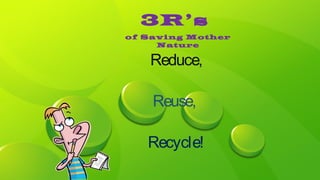
Reduce,
Reuse,
Recycle!
3R’s
of Saving Mother
Nature
Greenhouse ppt

Greenhouse ppt

  • 2.
    Global WarmingGlobal Warming– What is it? •Rise in earth’s temperature •Results from changes in the natural environment •Caused by too much carbon dioxide
  • 3.
    The Greenhouse EffectTheGreenhouse Effect • Solar radiation from the Sun reaches the Earth’s atmosphere • The surface of the Earth absorbs most of the short-rayed insolation and later releases this heat in the form of infrared radiation into the atmosphere. • Some of the heat is absorbed by particles known as “greenhouse gases.” • The heat retained by the gases acts as a “heat blanket.”
  • 6.
    Causes of globalCausesof global warming…warming… • Burning of fossil fuels • Deforestation
  • 7.
    Burning of fossilfuelsBurning of fossil fuels • The burning of fossil fuels releases Carbon dioxide in the atmosphere. • In the past 150 years, burning fossil fuels has caused a 25 % increase in Carbon dioxide emissions.
  • 8.
  • 9.
    The Ties BetweenSardines & GlobalThe Ties Between Sardines & Global WarmingWarming • The over-hunting of sardines has caused higher levels of phytoplankton in the ocean. • While living, phytoplankton release oxygen into the atmosphere and use Carbon for photosynthesis • When they die, their decay releases large amounts of methane and the poisonous gas, hydrogen sulfide. It also uses large amounts of oxygen.
  • 10.
    •Methane is 21times more effective than carbon dioxide in maintaining heat in the atmosphere. •This results in the deaths of numerous marine animals.
  • 11.
    Effects of globalwarmingEffects of global warming • The increase in temperature …… rise in sea level from melting glaciers and polar ice caps (adds 0.2 mm annually) • Rising temperatures will also cause drier conditions in many important agricultural regions. Dec 2003June 2002 Arizona
  • 12.
    Effects on SeaLife GLOBAL WARMING’S NEGATIVE IMPACT ON SEA LIFE— Coral Reef Bleaching—  Change in temperature and elevated sea level cause loss of algae in the coral.  Coral appears white, or “bleached.” Result is mass death of sea animals, which are dependent on the coral reef. The penguin population near Antarctica has been declining as the distance between them and their food has increased.
  • 13.
    Rising Sea levels •The rise of temperature, even to a few degrees, could lead to the melting of ice shelves that hold back glaciers. This results in rising sea levels • The Larsen area of North Antarctic, South of Chili and Argentina have lost more than 5,200 sq miles of area.
  • 14.
    The Effects ofGlobal Warming onThe Effects of Global Warming on Land animalsLand animals • Global warming can disrupt the migration, hibernation and reproductive cycles of certain types of animals. • Plants and animals will find it hard to escape or adjust to the effects of warming because humans occupy so much land. • Farmland or cities interrupt the movement of species between habitats.
  • 15.
    Tropical DiseasesTropical Diseases •Global Warming increases drought which lessens the supply of clean drinking water. • Cholera • It increases temperature providing an ideal breeding environment for mosquitoes. • Dengue fever • Malaria • Yellow fever
  • 16.
    IMPACT ON AIRIMPACTON AIR The atmosphere’s ultimate fate is unclear. More evaporation  increase in cloud cover How High Will the Clouds Be? It makes a difference! • Clouds close to the earth reflect sunlight  cooling effect. • Clouds high in the atmosphere trap heat  warmingeffect. Generally: • Cloud cover increases • Levels of the greenhouse gas methane may increase • Hurricanes range farther north, south on warmer water
  • 17.
    El Niño EffectElNiño Effect •Collapse of the monsoons in Asia  severe drought to Indonesia and northern Australia. •Severe weather disturbances in other parts of the world, such as droughts in areas of Africa and central North America.
  • 18.
    Kyoto Protocol •The KyotoProtocol is an amendment to the United Nations Framework Convention on Climate Change (UNFCCC) •UNFCCC, an international treaty on global warming • Countries which ratify this protocol commit to reduce their emissions of carbon dioxide and five other greenhouse gases •A total of 141 countries have ratified the agreement. Notable exceptions include the United States and Australia
  • 19.
    Kyoto Protocol It’s GettingWarmer!  Temperature Area of Ice
  • 20.
    •It was negotiatedin Kyoto, Japan in December 1997, opened for signature on March 16, 1998, and closed on March 15, 1999 •Current estimates are that even if successfully and completely implemented, the Kyoto Protocol is predicted to reduce the average global temperature by somewhere between 0.02°C and 0.28°C by the year 2050
  • 21.
    PREVENTIONPREVENTION  Buy energyefficient products  Buy products that have reusable or recyclable packaging  Reduce use of car (walk instead)  Plant trees  Conserve energy: (examples: 1. use low-energy, low-water-use washing machines, 2. use a solar heated system for hot water, 3. use an electric or push mower for gasoline powered mower)
  • 22.

Editor's Notes

  • #5 What do you guys think ??? is greenhouse effect good or bad for our earth ??? If bad why ??? If good why ???
  • #18 El Niño is defined by prolonged warming in the Pacific Ocean sea surface temperatures when compared with the average value When this warming occurs for seven to nine months, it is classified as El Niño "conditions"; when its duration is longer, it is classified as an El Niño "episode".[8] The first signs of an El Niño are a weakening of the Walker circulation and strengthening of the Hadley circulation[9] and may include[citation needed]: Rise in surface pressure over the Indian Ocean, Indonesia, and Australia Fall in air pressure over Tahiti and the rest of the central and eastern Pacific Ocean Trade winds in the south Pacific weaken or head east Warm air rises near Peru, causing rain in the northern Peruvian deserts