By…
Mayur S.Tade
FRM-2017-20-08 Dept. of AEM
Kerala university of fisheries & ocean studies
Concept of green house
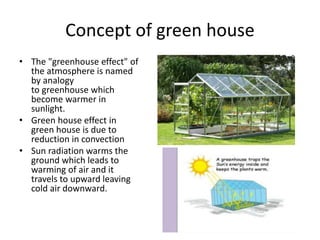
• The "greenhouse effect" of
the atmosphere is named
by analogy
to greenhouse which
become warmer in
sunlight.
• Green house effect in
green house is due to
reduction in convection
• Sun radiation warms the
ground which leads to
warming of air and it
travels to upward leaving
cold air downward.
In case of earth
• Earth receives energy
from the Sun in the
form
of ultraviolet, visible,
and near-
infrared radiation.
• 26% is reflected in the
space by atmosphere
and clouds and 19% has
been retained by clouds
and atmosphere.
In case of earth
• Because the Earth's
surface is colder than
the Sun, it radiates
at wavelengths that are
much longer than the
wavelengths that were
absorbed.
• Most of this thermal
radiation is absorbed
by the atmosphere and
warms it.
• The atmosphere also
gains heat by sensible
and latent heat fluxes
from the surface.
In case of earth
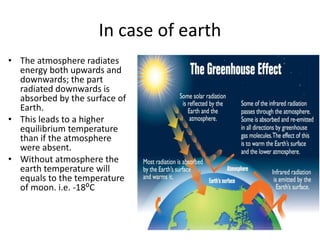
• The atmosphere radiates
energy both upwards and
downwards; the part
radiated downwards is
absorbed by the surface of
Earth.
• This leads to a higher
equilibrium temperature
than if the atmosphere
were absent.
• Without atmosphere the
earth temperature will
equals to the temperature
of moon. i.e. -18⁰C
Green house gases and Atmosphere of
earth
• A greenhouse
gas is a gas in an
atmosphere
that absorbs
and emits radiant
energy within
the thermal
infrared range.
This process is
the fundamental
cause of
the greenhouse
effect.
• Human activities since the beginning of the Industrial
Revolution (around 1750) have produced a 40% increase in
the atmospheric concentration of carbon dioxide (CO2),
from 280 ppm in 1750 to 406 ppm in early 2017.
• This increase has occurred despite the uptake of more than
half of the emissions by various natural "sinks" involved in
the carbon cycle.
• The vast majority of anthropogenic carbon dioxide
emissions (i.e., emissions produced by human activities)
come from combustion of fossil fuels, principally coal, oil,
and natural gas, with comparatively modest additional
contributions coming from deforestation, changes in land
use, soil erosion, and agriculture
Carbon footprint
• Every individual on Earth has a carbon footprint, which can
be defined as the amount of greenhouse gases emitted
directly and indirectly by an individual’s daily activities. For
example, a person would directly produce carbon dioxide
by burning firewood to cook his or her food.
• Another person might add to their footprint indirectly by
buying an industrially-made product whose
creation involved a lot of greenhouse gas emissions.
• Driving cars, flying in airplanes, buying an endless stream of
electronic devices, and even eating meat… all of this adds
up to your personal carbon footprint, i.e., your contribution
to the existing environmental crisis.
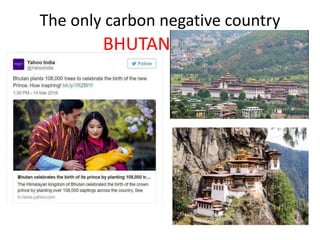
The only carbon negative country
BHUTAN
Disasters due to green house effects
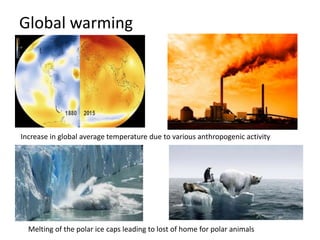
Global warming
Melting of the polar ice caps leading to lost of home for polar animals
Increase in global average temperature due to various anthropogenic activity
Sea Level Rise
COUNTRIES AT RISK OF DISAPPEARING
DUE TO CLIMATE CHANGE ( 9 COUNTRIES)
• Kiribati
• The Maldives
• Vanuatu(located towards the east of Australia)
• Tuvalu(towards the east of Australia)
• Solomon Islands( in between Australia and
Indonesia)
• Samoa(pacific ocean)
• Nauru(pacific ocean)
• Fiji Islands(pacific ocean)
• Marshall Islands(pacific ocean)
Ozone layer depletion
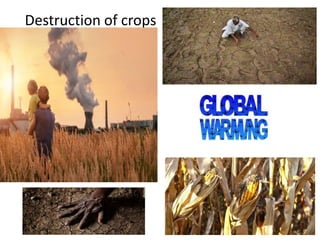
Destruction of crops
Conclusion
• Green house effect is unavoidable
and essential effect of the blue
planet(Earth) which is very essential
for the sustainability of life on the
earth
• But due to increase in anthropogenic
activity, it is leading to the imbalance
of global atmosphere cycle
• Humans thinks that they are
developing and growing year by year
but ultimately they are degrading the
natural home and its environment.
• Creating the eco-friendly source of
energy is the one of the hope to save
the mother earth.
Thank you…..

Green house effect.. A disaster

  • 1.
    By… Mayur S.Tade FRM-2017-20-08 Dept.of AEM Kerala university of fisheries & ocean studies
  • 2.
    Concept of greenhouse • The "greenhouse effect" of the atmosphere is named by analogy to greenhouse which become warmer in sunlight. • Green house effect in green house is due to reduction in convection • Sun radiation warms the ground which leads to warming of air and it travels to upward leaving cold air downward.
  • 3.
    In case ofearth • Earth receives energy from the Sun in the form of ultraviolet, visible, and near- infrared radiation. • 26% is reflected in the space by atmosphere and clouds and 19% has been retained by clouds and atmosphere.
  • 4.
    In case ofearth • Because the Earth's surface is colder than the Sun, it radiates at wavelengths that are much longer than the wavelengths that were absorbed. • Most of this thermal radiation is absorbed by the atmosphere and warms it. • The atmosphere also gains heat by sensible and latent heat fluxes from the surface.
  • 5.
    In case ofearth • The atmosphere radiates energy both upwards and downwards; the part radiated downwards is absorbed by the surface of Earth. • This leads to a higher equilibrium temperature than if the atmosphere were absent. • Without atmosphere the earth temperature will equals to the temperature of moon. i.e. -18⁰C
  • 6.
    Green house gasesand Atmosphere of earth • A greenhouse gas is a gas in an atmosphere that absorbs and emits radiant energy within the thermal infrared range. This process is the fundamental cause of the greenhouse effect.
  • 7.
    • Human activitiessince the beginning of the Industrial Revolution (around 1750) have produced a 40% increase in the atmospheric concentration of carbon dioxide (CO2), from 280 ppm in 1750 to 406 ppm in early 2017. • This increase has occurred despite the uptake of more than half of the emissions by various natural "sinks" involved in the carbon cycle. • The vast majority of anthropogenic carbon dioxide emissions (i.e., emissions produced by human activities) come from combustion of fossil fuels, principally coal, oil, and natural gas, with comparatively modest additional contributions coming from deforestation, changes in land use, soil erosion, and agriculture
  • 10.
    Carbon footprint • Everyindividual on Earth has a carbon footprint, which can be defined as the amount of greenhouse gases emitted directly and indirectly by an individual’s daily activities. For example, a person would directly produce carbon dioxide by burning firewood to cook his or her food. • Another person might add to their footprint indirectly by buying an industrially-made product whose creation involved a lot of greenhouse gas emissions. • Driving cars, flying in airplanes, buying an endless stream of electronic devices, and even eating meat… all of this adds up to your personal carbon footprint, i.e., your contribution to the existing environmental crisis.
  • 12.
    The only carbonnegative country BHUTAN
  • 13.
    Disasters due togreen house effects
  • 14.
    Global warming Melting ofthe polar ice caps leading to lost of home for polar animals Increase in global average temperature due to various anthropogenic activity
  • 16.
  • 17.
    COUNTRIES AT RISKOF DISAPPEARING DUE TO CLIMATE CHANGE ( 9 COUNTRIES) • Kiribati • The Maldives • Vanuatu(located towards the east of Australia) • Tuvalu(towards the east of Australia) • Solomon Islands( in between Australia and Indonesia) • Samoa(pacific ocean) • Nauru(pacific ocean) • Fiji Islands(pacific ocean) • Marshall Islands(pacific ocean)
  • 18.
  • 19.
  • 21.
    Conclusion • Green houseeffect is unavoidable and essential effect of the blue planet(Earth) which is very essential for the sustainability of life on the earth • But due to increase in anthropogenic activity, it is leading to the imbalance of global atmosphere cycle • Humans thinks that they are developing and growing year by year but ultimately they are degrading the natural home and its environment. • Creating the eco-friendly source of energy is the one of the hope to save the mother earth.
  • 22.