Global warming is the phenomenon of a gradual increase in the
temperature near the earth’s surface. This phenomenon has been
observed over the past one or two centuries. This change has
disturbed the climatic pattern of the earth. However, the concept of
global warming is quite controversial but the scientists have
provided relevant data in support of the fact that the temperature
of the earth is rising constantly.
What is Global Warming?
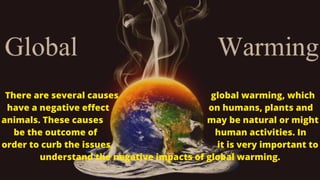
There are several causes global warming, which
have a negative effect on humans, plants and
animals. These causes may be natural or might
be the outcome of human activities. In
order to curb the issues, it is very important to
understand the negative impacts of global warming.
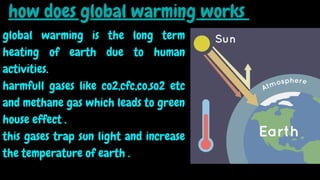
how does global warming works
global warming is the long term
heating of earth due to human
activities.
harmfull gases like co2,cfc,co,so2 etc
and methane gas which leads to green
house effect .
this gases trap sun light and increase
the temperature of earth .
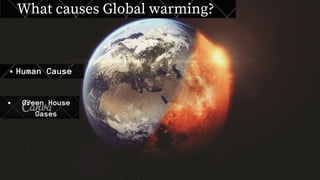
What causes Global warming?
Human Cause
Green House
Gases
Most scientists blame industrialization:
Automotive Industry (low fuel economy)
Oil companies(fossil fuels)
Power plants (coal)
Agri-Business(biofuels,deforestation,cattle
producing methane)
Logging industry (deforestation)
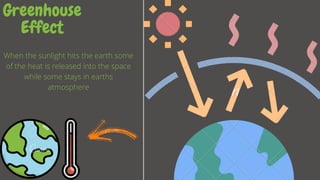
Greenhouse
Effect
When the sunlight hits the earth some
of the heat is released into the space
while some stays in earths
atmosphere
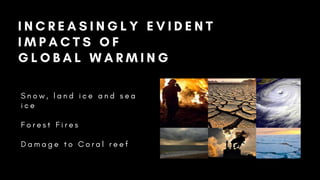
I N C R E A S I N G L Y E V I D E N T
I M P A C T S O F
G L O B A L W A R M I N G
S n o w , l a n d i c e a n d s e a
i c e
F o r e s t F i r e s
D a m a g e t o C o r a l r e e f
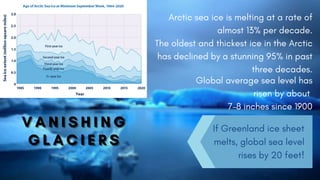
Arctic sea ice is melting at a rate of
almost 13% per decade.
The oldest and thickest ice in the Arctic
has declined by a stunning 95% in past
three decades.
Global average sea level has
risen by about
7–8 inches since 1900
If Greenland ice sheet
melts, global sea level
rises by 20 feet!
V A N I S H I N G
V A N I S H I N G
V A N I S H I N G
G L A C I E R S
G L A C I E R S
G L A C I E R S
W I L D F O R E S T
W I L D F O R E S T
W I L D F O R E S T
F I R E S
F I R E S
F I R E S
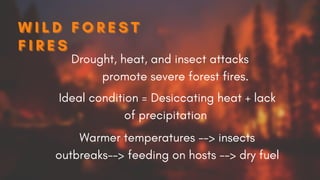
Drought, heat, and insect attacks
promote severe forest fires.
Ideal condition = Desiccating heat + lack
of precipitation
Warmer temperatures --> insects
outbreaks--> feeding on hosts --> dry fuel
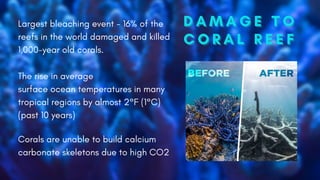
The rise in average
surface ocean temperatures in many
tropical regions by almost 2°F (1°C)
(past 10 years)
Corals are unable to build calcium
carbonate skeletons due to high CO2
Largest bleaching event - 16% of the
reefs in the world damaged and killed
1,000-year old corals.
D A M A G E T O
D A M A G E T O
D A M A G E T O
C O R A L R E E F
C O R A L R E E F
C O R A L R E E F
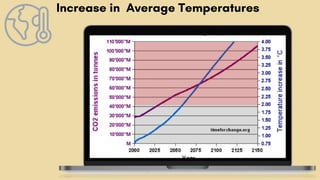
Increase in Average Temperatures
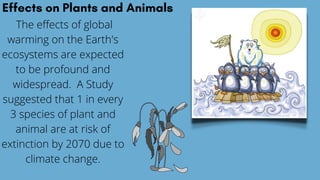
Effects on Plants and Animals
The effects of global
warming on the Earth's
ecosystems are expected
to be profound and
widespread. A Study
suggested that 1 in every
3 species of plant and
animal are at risk of
extinction by 2070 due to
climate change.
Higher Death Rates
Today's scientists point to climate change as "the biggest
global health threat of the 21st century." It's a threat that
impacts all of us—especially children, the elderly, low-
income communities, and minorities—and in a variety of
direct and indirect ways. Deaths occur each year due to
direct impacts and the indirect effects of heat-exacerbated,
life-threatening illnesses, such as heat exhaustion,
heatstroke, and cardiovascular and kidney diseases.
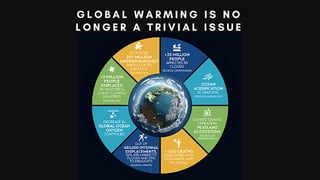
G L O B A L W A R M I N G I S N O
L O N G E R A T R I V I A L I S S U E
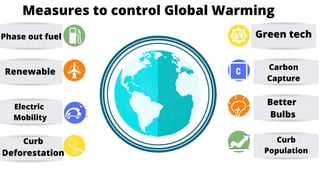
Renewable
Phase out fuel
Curb
Deforestation
Green tech
Carbon
Capture
Better
Bulbs
Curb
Population
Electric
Mobility
Measures to control Global Warming
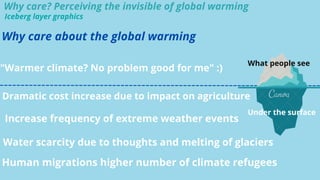
Why care? Perceiving the invisible of global warming
Iceberg layer graphics
Why care about the global warming
"Warmer climate? No problem good for me" :)
Dramatic cost increase due to impact on agriculture
Increase frequency of extreme weather events
Water scarcity due to thoughts and melting of glaciers
Human migrations higher number of climate refugees
What people see
Under the surface

Global warming and its effects .pdf

  • 1.
    Global warming isthe phenomenon of a gradual increase in the temperature near the earth’s surface. This phenomenon has been observed over the past one or two centuries. This change has disturbed the climatic pattern of the earth. However, the concept of global warming is quite controversial but the scientists have provided relevant data in support of the fact that the temperature of the earth is rising constantly. What is Global Warming?
  • 2.
    There are severalcauses global warming, which have a negative effect on humans, plants and animals. These causes may be natural or might be the outcome of human activities. In order to curb the issues, it is very important to understand the negative impacts of global warming.
  • 3.
    how does globalwarming works global warming is the long term heating of earth due to human activities. harmfull gases like co2,cfc,co,so2 etc and methane gas which leads to green house effect . this gases trap sun light and increase the temperature of earth .
  • 4.
    What causes Globalwarming? Human Cause Green House Gases
  • 5.
    Most scientists blameindustrialization: Automotive Industry (low fuel economy) Oil companies(fossil fuels)
  • 6.
  • 7.
    Greenhouse Effect When the sunlighthits the earth some of the heat is released into the space while some stays in earths atmosphere
  • 8.
    I N CR E A S I N G L Y E V I D E N T I M P A C T S O F G L O B A L W A R M I N G S n o w , l a n d i c e a n d s e a i c e F o r e s t F i r e s D a m a g e t o C o r a l r e e f
  • 9.
    Arctic sea iceis melting at a rate of almost 13% per decade. The oldest and thickest ice in the Arctic has declined by a stunning 95% in past three decades. Global average sea level has risen by about 7–8 inches since 1900 If Greenland ice sheet melts, global sea level rises by 20 feet! V A N I S H I N G V A N I S H I N G V A N I S H I N G G L A C I E R S G L A C I E R S G L A C I E R S
  • 10.
    W I LD F O R E S T W I L D F O R E S T W I L D F O R E S T F I R E S F I R E S F I R E S Drought, heat, and insect attacks promote severe forest fires. Ideal condition = Desiccating heat + lack of precipitation Warmer temperatures --> insects outbreaks--> feeding on hosts --> dry fuel
  • 11.
    The rise inaverage surface ocean temperatures in many tropical regions by almost 2°F (1°C) (past 10 years) Corals are unable to build calcium carbonate skeletons due to high CO2 Largest bleaching event - 16% of the reefs in the world damaged and killed 1,000-year old corals. D A M A G E T O D A M A G E T O D A M A G E T O C O R A L R E E F C O R A L R E E F C O R A L R E E F
  • 12.
    Increase in AverageTemperatures
  • 13.
    Effects on Plantsand Animals The effects of global warming on the Earth's ecosystems are expected to be profound and widespread. A Study suggested that 1 in every 3 species of plant and animal are at risk of extinction by 2070 due to climate change.
  • 14.
    Higher Death Rates Today'sscientists point to climate change as "the biggest global health threat of the 21st century." It's a threat that impacts all of us—especially children, the elderly, low- income communities, and minorities—and in a variety of direct and indirect ways. Deaths occur each year due to direct impacts and the indirect effects of heat-exacerbated, life-threatening illnesses, such as heat exhaustion, heatstroke, and cardiovascular and kidney diseases.
  • 15.
    G L OB A L W A R M I N G I S N O L O N G E R A T R I V I A L I S S U E
  • 18.
    Renewable Phase out fuel Curb Deforestation Greentech Carbon Capture Better Bulbs Curb Population Electric Mobility Measures to control Global Warming
  • 19.
    Why care? Perceivingthe invisible of global warming Iceberg layer graphics Why care about the global warming "Warmer climate? No problem good for me" :) Dramatic cost increase due to impact on agriculture Increase frequency of extreme weather events Water scarcity due to thoughts and melting of glaciers Human migrations higher number of climate refugees What people see Under the surface