By,
Jeevan kishore
Group : 16
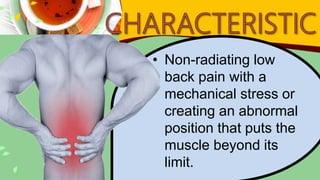
• Non-radiating low
back pain with a
mechanical stress or
creating an abnormal
position that puts the
muscle beyond its
limit.
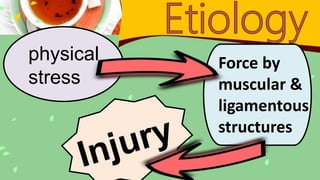
Force by
muscular &
ligamentous
structures
physical
stress
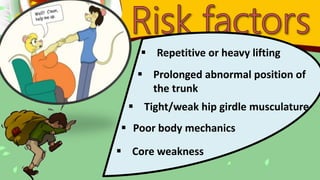
 Repetitive or heavy lifting
 Prolonged abnormal position of
the trunk
 Poor body mechanics
 Core weakness
 Tight/weak hip girdle musculature
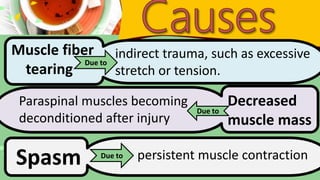
Due to
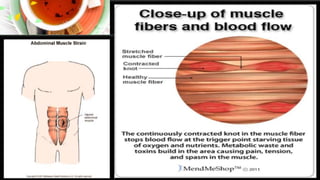
Spasm
Muscle fiber
tearing
indirect trauma, such as excessive
stretch or tension.
Due to
Decreased
muscle mass
Paraspinal muscles becoming
deconditioned after injury
persistent muscle contractionDue to
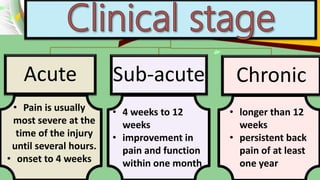
Acute Sub-acute Chronic
• Pain is usually
most severe at the
time of the injury
until several hours.
• onset to 4 weeks
• 4 weeks to 12
weeks
• improvement in
pain and function
within one month
• longer than 12
weeks
• persistent back
pain of at least
one year
 Degenerative disk – localized and diffused lumbar
pain in muscles
 Herniated disk – due to herniation
 Osteoarthritis – weak reflexes and decreased in
extension
 Ankylosing spondylosis – decreased back motion
& Sacro-iliac joint tenderness
 Spondylolysthesis – tight hamstrings.
• History of pain, numbness, tingling or weakness
are usually absent.
• Pain is usually worse with movement and better
with rest.
• Psychosocial factors and emotional distress
should also be assessed
• In standing - postural shift ( + ).
• Lumbar motion range - limited and painful.
• tenderness over the lumbar paraspinal muscles or
quadratus lumborum, with absence of spinous
process tenderness.
• Hip examination and special tests, including FABER’s
(flexion/ abduction/ external rotation) and Gaenslen’s
maneuver can help rule out other sources of pain.
• Access lumbopelvic strength core through observation of trunk and
hip control.
• Access mobility and function – can be impaired.
• The Oswestry Low Back Pain Disability Index is a questionnaire that
assesses the impact of low back pain on ten aspects of daily life (such
as lifting, walking, self-care, and work).
• A Functional Capacity Evaluation - evaluates persons capacity to
return to work.
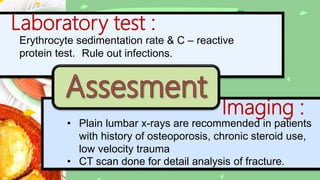
Laboratory test :
Erythrocyte sedimentation rate & C – reactive
protein test. Rule out infections.
Imaging :
• Plain lumbar x-rays are recommended in patients
with history of osteoporosis, chronic steroid use,
low velocity trauma
• CT scan done for detail analysis of fracture.
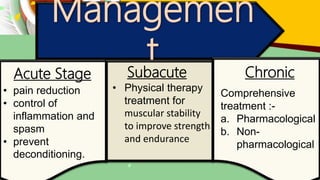
Managemen
tAcute Stage
• pain reduction
• control of
inflammation and
spasm
• prevent
deconditioning.
Subacute
• Physical therapy
treatment for
muscular stability
to improve strength
and endurance
Chronic
Comprehensive
treatment :-
a. Pharmacological
b. Non-
pharmacological
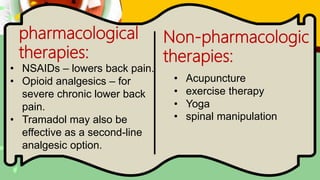
pharmacological
therapies:
Non-pharmacologic
therapies:
• NSAIDs – lowers back pain.
• Opioid analgesics – for
severe chronic lower back
pain.
• Tramadol may also be
effective as a second-line
analgesic option.
• Acupuncture
• exercise therapy
• Yoga
• spinal manipulation
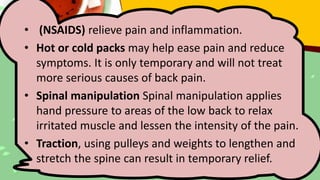
• (NSAIDS) relieve pain and inflammation.
• Hot or cold packs may help ease pain and reduce
symptoms. It is only temporary and will not treat
more serious causes of back pain.
• Spinal manipulation Spinal manipulation applies
hand pressure to areas of the low back to relax
irritated muscle and lessen the intensity of the pain.
• Traction, using pulleys and weights to lengthen and
stretch the spine can result in temporary relief.
• Massage treatments can restore people to their usual
activities of daily living and lessen pain.
• Acupuncture - fine needles are inserted into various
points around the body. naturally occurring chemicals
such as endorphins, serotonin, and acetylcholine are
released to relieve pain.
• Epidural steroid injections - These injections work by
reducing inflammation to relieve pain.
• Physical Therapy with stretching, strengthening, and low-
impact exercises is used to optimize short- and long-term
outcomes.
Thankyou for not
sleeping.

Lumbar strain

  • 1.
  • 2.
    • Non-radiating low backpain with a mechanical stress or creating an abnormal position that puts the muscle beyond its limit.
  • 3.
  • 5.
     Repetitive orheavy lifting  Prolonged abnormal position of the trunk  Poor body mechanics  Core weakness  Tight/weak hip girdle musculature
  • 6.
    Due to Spasm Muscle fiber tearing indirecttrauma, such as excessive stretch or tension. Due to Decreased muscle mass Paraspinal muscles becoming deconditioned after injury persistent muscle contractionDue to
  • 8.
    Acute Sub-acute Chronic •Pain is usually most severe at the time of the injury until several hours. • onset to 4 weeks • 4 weeks to 12 weeks • improvement in pain and function within one month • longer than 12 weeks • persistent back pain of at least one year
  • 9.
     Degenerative disk– localized and diffused lumbar pain in muscles  Herniated disk – due to herniation  Osteoarthritis – weak reflexes and decreased in extension  Ankylosing spondylosis – decreased back motion & Sacro-iliac joint tenderness  Spondylolysthesis – tight hamstrings.
  • 10.
    • History ofpain, numbness, tingling or weakness are usually absent. • Pain is usually worse with movement and better with rest. • Psychosocial factors and emotional distress should also be assessed
  • 11.
    • In standing- postural shift ( + ). • Lumbar motion range - limited and painful. • tenderness over the lumbar paraspinal muscles or quadratus lumborum, with absence of spinous process tenderness. • Hip examination and special tests, including FABER’s (flexion/ abduction/ external rotation) and Gaenslen’s maneuver can help rule out other sources of pain.
  • 12.
    • Access lumbopelvicstrength core through observation of trunk and hip control. • Access mobility and function – can be impaired. • The Oswestry Low Back Pain Disability Index is a questionnaire that assesses the impact of low back pain on ten aspects of daily life (such as lifting, walking, self-care, and work). • A Functional Capacity Evaluation - evaluates persons capacity to return to work.
  • 13.
    Laboratory test : Erythrocytesedimentation rate & C – reactive protein test. Rule out infections. Imaging : • Plain lumbar x-rays are recommended in patients with history of osteoporosis, chronic steroid use, low velocity trauma • CT scan done for detail analysis of fracture.
  • 14.
    Managemen tAcute Stage • painreduction • control of inflammation and spasm • prevent deconditioning. Subacute • Physical therapy treatment for muscular stability to improve strength and endurance Chronic Comprehensive treatment :- a. Pharmacological b. Non- pharmacological
  • 15.
    pharmacological therapies: Non-pharmacologic therapies: • NSAIDs –lowers back pain. • Opioid analgesics – for severe chronic lower back pain. • Tramadol may also be effective as a second-line analgesic option. • Acupuncture • exercise therapy • Yoga • spinal manipulation
  • 16.
    • (NSAIDS) relievepain and inflammation. • Hot or cold packs may help ease pain and reduce symptoms. It is only temporary and will not treat more serious causes of back pain. • Spinal manipulation Spinal manipulation applies hand pressure to areas of the low back to relax irritated muscle and lessen the intensity of the pain. • Traction, using pulleys and weights to lengthen and stretch the spine can result in temporary relief.
  • 17.
    • Massage treatmentscan restore people to their usual activities of daily living and lessen pain. • Acupuncture - fine needles are inserted into various points around the body. naturally occurring chemicals such as endorphins, serotonin, and acetylcholine are released to relieve pain. • Epidural steroid injections - These injections work by reducing inflammation to relieve pain. • Physical Therapy with stretching, strengthening, and low- impact exercises is used to optimize short- and long-term outcomes.
  • 18.