Global Warming
What is Global Warming?
An increase in the average temperature of the Earth’s atmosphere
and oceans
Global temperature on both
land and sea increased by
0.6 ± 0.2 °C over the past
century
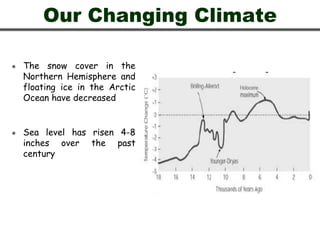
Our Changing Climate
 The snow cover in the
Northern Hemisphere and
floating ice in the Arctic
Ocean have decreased
 Sea level has risen 4-8
inches over the past
century
What causes it?
Human Impacts-
Atmospheric greenhouse gases trap some of the
outgoing energy, retaining heat
Natural Impacts-
Change in sun’s energy output
Volcanoes
The Carbon Cycle
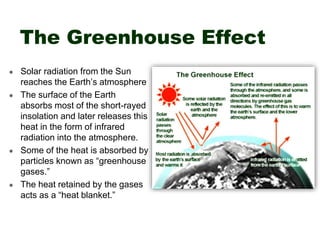
The Greenhouse Effect
 Solar radiation from the Sun
reaches the Earth’s atmosphere
 The surface of the Earth
absorbs most of the short-rayed
insolation and later releases this
heat in the form of infrared
radiation into the atmosphere.
 Some of the heat is absorbed by
particles known as “greenhouse
gases.”
 The heat retained by the gases
acts as a “heat blanket.”
Burning of fossil fuels
 The burning of fossil fuels releases
Carbon dioxide in the atmosphere.
 In the past 150 years, burning fossil
fuels has caused a 25 % increase in
Carbon dioxide emissions.
 Nitrous oxide has increased 17%.
 Methane has increased 150%!!
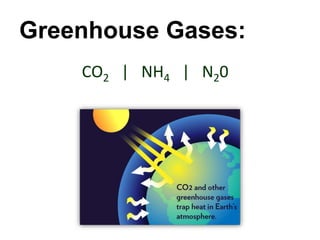
CO2 | NH4 | N20
Greenhouse Gases:
Effects of global warming
.
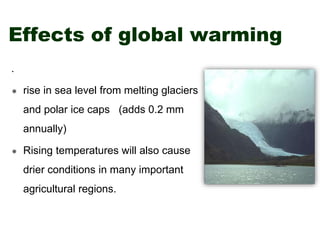
 rise in sea level from melting glaciers
and polar ice caps (adds 0.2 mm
annually)
 Rising temperatures will also cause
drier conditions in many important
agricultural regions.
Sea Life Effects
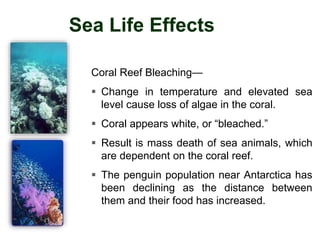
Coral Reef Bleaching—
 Change in temperature and elevated sea
level cause loss of algae in the coral.
 Coral appears white, or “bleached.”
 Result is mass death of sea animals, which
are dependent on the coral reef.
 The penguin population near Antarctica has
been declining as the distance between
them and their food has increased.
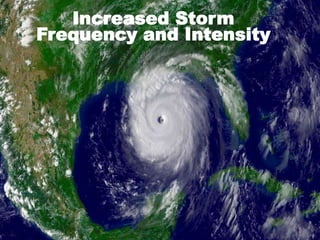
Increased Storm
Frequency and Intensity
Rising Sea levels
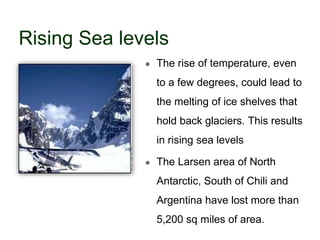
 The rise of temperature, even
to a few degrees, could lead to
the melting of ice shelves that
hold back glaciers. This results
in rising sea levels
 The Larsen area of North
Antarctic, South of Chili and
Argentina have lost more than
5,200 sq miles of area.
Effects Land animals
 Global warming can disrupt the
migration, hibernation and
reproductive cycles of certain types
of animals.
 Plants and animals will find it hard
to escape or adjust to the effects of
warming because humans occupy
so much land.
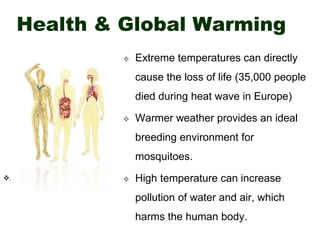
Health & Global Warming
 Extreme temperatures can directly
cause the loss of life (35,000 people
died during heat wave in Europe)
 Warmer weather provides an ideal
breeding environment for
mosquitoes.
 High temperature can increase
pollution of water and air, which
harms the human body.
.
Tropical Diseases
– Global Warming increases drought which
lessens the supply of clean drinking water.
 Cholera
– It increases temperature providing an ideal
breeding environment for mosquitoes.
 Dengue fever
 Malaria
 Yellow fever
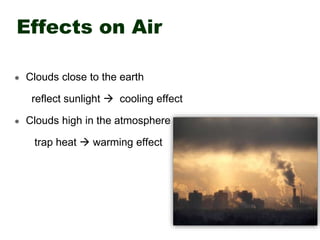
Effects on Air
 Clouds close to the earth
reflect sunlight  cooling effect
 Clouds high in the atmosphere
trap heat  warming effect
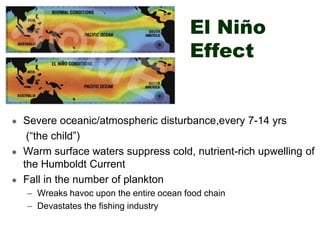
El Niño
Effect
 Severe oceanic/atmospheric disturbance,every 7-14 yrs
(“the child”)
 Warm surface waters suppress cold, nutrient-rich upwelling of
the Humboldt Current
 Fall in the number of plankton
– Wreaks havoc upon the entire ocean food chain
– Devastates the fishing industry
El Niño Effect
 Collapse of the monsoons in Asia  severe drought
to Indonesia and northern Australia.
 Severe weather disturbances in other parts of the
world, such as droughts in areas of Africa and central
North America.
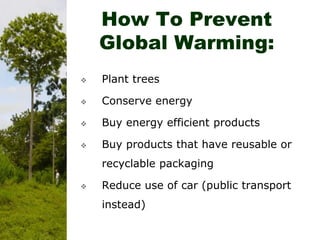
How To Prevent
Global Warming:
 Plant trees
 Conserve energy
 Buy energy efficient products
 Buy products that have reusable or
recyclable packaging
 Reduce use of car (public transport
instead)
Individual Actions Add Up!
1. If you are able to plant a tree, start digging!
2. Via photosynthesis, trees and other plants absorb
CO2 and give off Oxygen.
3. There are too few plants and trees to fully counter
the increase in CO2.
4. Think it won’t make a difference? Think again. Just
one tree can absorb one ton of CO2 in its lifetime.
What are you waiting for?
Plant a Tree
1. The amount of emissions and other types of
carbon dioxide pollutants being released in the
atmosphere annually would be reduced by
several billion tons!
2. On an individual scale, you can help limit your
carbon dioxide emissions, your
driving habits. and therefore your
global warming impact, by changing
Take Public Transportation
Educate Others to Take Action
Replace Incandescent
Bulbs
Fix Weather Stripping and
Caulking
Stop Water Leaks
Change your Thermostat
Buy Local , Sustainably
Produced Food
Take Action At Home
The Easy Stuff...
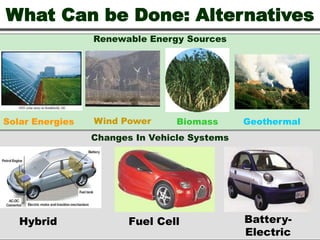
What Can be Done: Alternatives
Renewable Energy Sources
Solar Energies Wind Power Biomass Geothermal
Changes In Vehicle Systems
Hybrid Fuel Cell Battery-
Electric
3R’s
of Saving Mother Nature
1. Reduce waste by buying reusable products as
opposed to disposables.
2. You can also buy products with less packaging so that
you throw less away.
3. Whenever you can, recycle paper, plastic, glass and
metal (aluminium).
4. By recycling half of your household waste, you can
save up tons of CO2 every year from being released
into the atmosphere.
Reuse,Reduce,Recycle
Kyoto Protocol
 1997, Kyoto, Japan  developed countries
agreed to specific targets for cutting their
emissions of greenhouse gases
 Industrialized countries committed to an
overall reduction of emissions of greenhouse
gases to 5.2% below 1990 levels for the period
2008 - 2012
 Objective is the stabilization of greenhouse gas
concentrations in the atmosphere at a level that
would prevent dangerous anthropogenic
interference with the climate system
Thank You...!!!!
Try not to blow our Earth !!!!
Its Your Actions That Matters !!!!
Team members
 Kannappan karthik -16bmc017
 Riyas-16bmc004
 Radha Krishnan-16bmc003
 Subash-16bmc001
 Mummanah sasi kumar-16bmc002
 Bharat kumar-16bmc201

Global warming, effects and it's prevention

  • 1.
  • 2.
    What is GlobalWarming? An increase in the average temperature of the Earth’s atmosphere and oceans Global temperature on both land and sea increased by 0.6 ± 0.2 °C over the past century
  • 3.
    Our Changing Climate The snow cover in the Northern Hemisphere and floating ice in the Arctic Ocean have decreased  Sea level has risen 4-8 inches over the past century
  • 4.
    What causes it? HumanImpacts- Atmospheric greenhouse gases trap some of the outgoing energy, retaining heat Natural Impacts- Change in sun’s energy output Volcanoes
  • 5.
  • 6.
    The Greenhouse Effect Solar radiation from the Sun reaches the Earth’s atmosphere  The surface of the Earth absorbs most of the short-rayed insolation and later releases this heat in the form of infrared radiation into the atmosphere.  Some of the heat is absorbed by particles known as “greenhouse gases.”  The heat retained by the gases acts as a “heat blanket.”
  • 7.
    Burning of fossilfuels  The burning of fossil fuels releases Carbon dioxide in the atmosphere.  In the past 150 years, burning fossil fuels has caused a 25 % increase in Carbon dioxide emissions.  Nitrous oxide has increased 17%.  Methane has increased 150%!!
  • 8.
    CO2 | NH4| N20 Greenhouse Gases:
  • 9.
    Effects of globalwarming .  rise in sea level from melting glaciers and polar ice caps (adds 0.2 mm annually)  Rising temperatures will also cause drier conditions in many important agricultural regions.
  • 10.
    Sea Life Effects CoralReef Bleaching—  Change in temperature and elevated sea level cause loss of algae in the coral.  Coral appears white, or “bleached.”  Result is mass death of sea animals, which are dependent on the coral reef.  The penguin population near Antarctica has been declining as the distance between them and their food has increased.
  • 11.
  • 12.
    Rising Sea levels The rise of temperature, even to a few degrees, could lead to the melting of ice shelves that hold back glaciers. This results in rising sea levels  The Larsen area of North Antarctic, South of Chili and Argentina have lost more than 5,200 sq miles of area.
  • 13.
    Effects Land animals Global warming can disrupt the migration, hibernation and reproductive cycles of certain types of animals.  Plants and animals will find it hard to escape or adjust to the effects of warming because humans occupy so much land.
  • 14.
    Health & GlobalWarming  Extreme temperatures can directly cause the loss of life (35,000 people died during heat wave in Europe)  Warmer weather provides an ideal breeding environment for mosquitoes.  High temperature can increase pollution of water and air, which harms the human body. .
  • 15.
    Tropical Diseases – GlobalWarming increases drought which lessens the supply of clean drinking water.  Cholera – It increases temperature providing an ideal breeding environment for mosquitoes.  Dengue fever  Malaria  Yellow fever
  • 16.
    Effects on Air Clouds close to the earth reflect sunlight  cooling effect  Clouds high in the atmosphere trap heat  warming effect
  • 17.
    El Niño Effect  Severeoceanic/atmospheric disturbance,every 7-14 yrs (“the child”)  Warm surface waters suppress cold, nutrient-rich upwelling of the Humboldt Current  Fall in the number of plankton – Wreaks havoc upon the entire ocean food chain – Devastates the fishing industry
  • 18.
    El Niño Effect Collapse of the monsoons in Asia  severe drought to Indonesia and northern Australia.  Severe weather disturbances in other parts of the world, such as droughts in areas of Africa and central North America.
  • 19.
    How To Prevent GlobalWarming:  Plant trees  Conserve energy  Buy energy efficient products  Buy products that have reusable or recyclable packaging  Reduce use of car (public transport instead)
  • 20.
  • 21.
    1. If youare able to plant a tree, start digging! 2. Via photosynthesis, trees and other plants absorb CO2 and give off Oxygen. 3. There are too few plants and trees to fully counter the increase in CO2. 4. Think it won’t make a difference? Think again. Just one tree can absorb one ton of CO2 in its lifetime. What are you waiting for? Plant a Tree
  • 22.
    1. The amountof emissions and other types of carbon dioxide pollutants being released in the atmosphere annually would be reduced by several billion tons! 2. On an individual scale, you can help limit your carbon dioxide emissions, your driving habits. and therefore your global warming impact, by changing Take Public Transportation
  • 23.
    Educate Others toTake Action
  • 24.
    Replace Incandescent Bulbs Fix WeatherStripping and Caulking Stop Water Leaks Change your Thermostat Buy Local , Sustainably Produced Food Take Action At Home The Easy Stuff...
  • 25.
    What Can beDone: Alternatives Renewable Energy Sources Solar Energies Wind Power Biomass Geothermal Changes In Vehicle Systems Hybrid Fuel Cell Battery- Electric
  • 26.
  • 27.
    1. Reduce wasteby buying reusable products as opposed to disposables. 2. You can also buy products with less packaging so that you throw less away. 3. Whenever you can, recycle paper, plastic, glass and metal (aluminium). 4. By recycling half of your household waste, you can save up tons of CO2 every year from being released into the atmosphere. Reuse,Reduce,Recycle
  • 28.
    Kyoto Protocol  1997,Kyoto, Japan  developed countries agreed to specific targets for cutting their emissions of greenhouse gases  Industrialized countries committed to an overall reduction of emissions of greenhouse gases to 5.2% below 1990 levels for the period 2008 - 2012  Objective is the stabilization of greenhouse gas concentrations in the atmosphere at a level that would prevent dangerous anthropogenic interference with the climate system
  • 29.
    Thank You...!!!! Try notto blow our Earth !!!! Its Your Actions That Matters !!!!
  • 30.
    Team members  Kannappankarthik -16bmc017  Riyas-16bmc004  Radha Krishnan-16bmc003  Subash-16bmc001  Mummanah sasi kumar-16bmc002  Bharat kumar-16bmc201