SUBHASH S 2 ND  SEM ENVIRONMENTAL PLANNING SCHOOL OF PLANNING  AND A R CHITECTURE  NEW DELHI
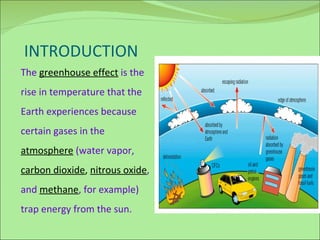
INTRODUCTION The  greenhouse effect  is the rise in temperature that the Earth experiences because certain gases in the  atmosphere  (water vapor,  carbon dioxide ,  nitrous oxide , and  methane , for example) trap energy from the sun.
Incoming Radiation Some trace gases are known as  “greenhouse" gases because they function like the glass in a greenhouse Incoming radiation strikes the earth and some is absorbed This heats the earth and the earth reradiates in the infrared portion of the spectrum
Greenhouse Gas Properties Greenhouse gases absorb infrared radiation that corresponds to the vibrational and rotational energy levels of their bonds Normally these gases have three or more atoms.
TYPES OF GREEN HOUSE GASES CARBON DIOXIDE  METHANE NITROUS OXIDE CHLOROFLUROCARBONS These gases--together with water vapor--create the natural greenhouse effect They trap some of the sun's energy and keep the Earth warm enough to sustain life
Carbon dioxide More than 80% of carbon dioxide emissions are caused by : Burning fossil fuels in industries Cutting down and burning trees  Thermal power plants and automobiles.  Deforestation accounts for about 20 percent of the carbon dioxide increase from human activities
Deforestation Until 50 years ago most of the carbon dioxide from deforestation was released from temperate zones Now tropical deforestation is the largest source Tropical forests are being burned and cut for farming, mining and raising cattle
Automobile Exhaust Burning One Gallon of Gasoline Generates 22 Pounds of Carbon Dioxide When gasoline is burned, the carbon in it combines with oxygen in the air to form carbon dioxide Because the oxygen adds weight, the newly formed carbon dioxide weighs more than the original unburned fuel
Cars and Population Increase There are over 600 million motor vehicles in the world today If present trends continue, the number of cars on Earth will double in the next 30 years
Methane Generated naturally by bacteria ,called methanogens which is habitat in marshes, swamp and wet land soils It also escapes from natural gas deposits Methane gas escapes from garbage landfills and open dumps It also leaks out during mining, extraction and transportation of coal, oil and natural gas
Adding Methane Each year we add 350 to 500 million tons of methane to the air mainly by: Raising livestock  Coal mining and drilling for oil and natural gas  Rice cultivation  Disposing of garbage in landfills  Burning forests and fields
New Source of Methane In 2006, research has shown that permafrost melting in the arctic is releasing methane trapped in formerly frozen sediments Permafrost melting is the result of global warming
Potential Source of Methane A great deal of natural gas is trapped as a solid clathrate complex These methane clathrates are found in bands under the coastal sediments offshore from continents in a number of areas They represent a possibly large new source of energy Utilization of this resource may resource in large releases of methane
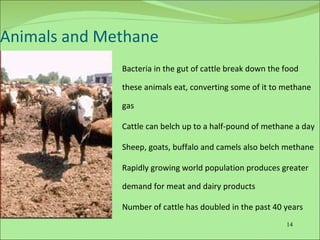
Animals and Methane Bacteria in the gut of cattle break down the food these animals eat, converting some of it to methane gas Cattle can belch up to a half-pound of methane a day Sheep, goats, buffalo and camels also belch methane Rapidly growing world population produces greater demand for meat and dairy products Number of cattle has doubled in the past 40 years
Nitrous Oxide Nitrous oxide is released naturally from oceans and by bacteria in soils Each year we add 7 to 13 million tons of nitrous oxide to the atmosphere mainly by: Using nitrogen-based fertilizers  Disposing of human and animal wastes  Automobile exhausts
Chemical Fertilizers Nitrogen-based fertilizer use has doubled in the past 15 years Nitrogen fertilizers provide nutrients for crops When these fertilizers break down in the soil, nitrous oxide is released into the air
Sewage  Human and animal wastes release nitrous oxide Sewage treatment plants may be a major source of this gas More research is needed Animal feed lots also contribute
Fluorocarbons Fluorocarbons come almost entirely from human activities  They are manufactured by humans  for refrigeration and other uses Some fluorocarbons, including chlorofluorocarbons (CFCs),CFC along with chlorine and bromine containing compounds also involve in acceleration of ozone hole formation . It also result in increasing the amount of hydrogen peroxide in the atmosphere and induce acid rain
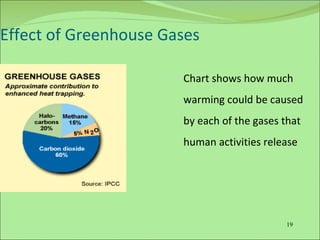
Effect of Greenhouse Gases Chart shows how much warming could be caused by each of the gases that human activities release
A Global Problem An increase in global temperature would bring changes to the entire planet, and therefore to every nation This makes it an international issue which needs worldwide study and responses Individual countries are each responsible for their own greenhouse gas production
CONSEQUENCES OF GREEN HOUSE EFFECT Global warming. Rise in sea level flooding low lying regions. Increase in rainfall. Disruption of whole ecosystem. Soil will become infertile. Plants wll be less in N2 susceptible to pests.
CONTROLING MEASURES Reducing the consumption of fossil fuels. Afforestation. Eco friendly alternative CFC. CO2 pumped into underground. Bioremediation Sulphate aerosols
THANK  YOU

green house gases

  • 1.
    SUBHASH S 2ND SEM ENVIRONMENTAL PLANNING SCHOOL OF PLANNING AND A R CHITECTURE NEW DELHI
  • 2.
    INTRODUCTION The greenhouse effect is the rise in temperature that the Earth experiences because certain gases in the atmosphere (water vapor, carbon dioxide , nitrous oxide , and methane , for example) trap energy from the sun.
  • 3.
    Incoming Radiation Sometrace gases are known as “greenhouse" gases because they function like the glass in a greenhouse Incoming radiation strikes the earth and some is absorbed This heats the earth and the earth reradiates in the infrared portion of the spectrum
  • 4.
    Greenhouse Gas PropertiesGreenhouse gases absorb infrared radiation that corresponds to the vibrational and rotational energy levels of their bonds Normally these gases have three or more atoms.
  • 5.
    TYPES OF GREENHOUSE GASES CARBON DIOXIDE METHANE NITROUS OXIDE CHLOROFLUROCARBONS These gases--together with water vapor--create the natural greenhouse effect They trap some of the sun's energy and keep the Earth warm enough to sustain life
  • 6.
    Carbon dioxide Morethan 80% of carbon dioxide emissions are caused by : Burning fossil fuels in industries Cutting down and burning trees Thermal power plants and automobiles. Deforestation accounts for about 20 percent of the carbon dioxide increase from human activities
  • 7.
    Deforestation Until 50years ago most of the carbon dioxide from deforestation was released from temperate zones Now tropical deforestation is the largest source Tropical forests are being burned and cut for farming, mining and raising cattle
  • 8.
    Automobile Exhaust BurningOne Gallon of Gasoline Generates 22 Pounds of Carbon Dioxide When gasoline is burned, the carbon in it combines with oxygen in the air to form carbon dioxide Because the oxygen adds weight, the newly formed carbon dioxide weighs more than the original unburned fuel
  • 9.
    Cars and PopulationIncrease There are over 600 million motor vehicles in the world today If present trends continue, the number of cars on Earth will double in the next 30 years
  • 10.
    Methane Generated naturallyby bacteria ,called methanogens which is habitat in marshes, swamp and wet land soils It also escapes from natural gas deposits Methane gas escapes from garbage landfills and open dumps It also leaks out during mining, extraction and transportation of coal, oil and natural gas
  • 11.
    Adding Methane Eachyear we add 350 to 500 million tons of methane to the air mainly by: Raising livestock Coal mining and drilling for oil and natural gas Rice cultivation Disposing of garbage in landfills Burning forests and fields
  • 12.
    New Source ofMethane In 2006, research has shown that permafrost melting in the arctic is releasing methane trapped in formerly frozen sediments Permafrost melting is the result of global warming
  • 13.
    Potential Source ofMethane A great deal of natural gas is trapped as a solid clathrate complex These methane clathrates are found in bands under the coastal sediments offshore from continents in a number of areas They represent a possibly large new source of energy Utilization of this resource may resource in large releases of methane
  • 14.
    Animals and MethaneBacteria in the gut of cattle break down the food these animals eat, converting some of it to methane gas Cattle can belch up to a half-pound of methane a day Sheep, goats, buffalo and camels also belch methane Rapidly growing world population produces greater demand for meat and dairy products Number of cattle has doubled in the past 40 years
  • 15.
    Nitrous Oxide Nitrousoxide is released naturally from oceans and by bacteria in soils Each year we add 7 to 13 million tons of nitrous oxide to the atmosphere mainly by: Using nitrogen-based fertilizers Disposing of human and animal wastes Automobile exhausts
  • 16.
    Chemical Fertilizers Nitrogen-basedfertilizer use has doubled in the past 15 years Nitrogen fertilizers provide nutrients for crops When these fertilizers break down in the soil, nitrous oxide is released into the air
  • 17.
    Sewage Humanand animal wastes release nitrous oxide Sewage treatment plants may be a major source of this gas More research is needed Animal feed lots also contribute
  • 18.
    Fluorocarbons Fluorocarbons comealmost entirely from human activities They are manufactured by humans for refrigeration and other uses Some fluorocarbons, including chlorofluorocarbons (CFCs),CFC along with chlorine and bromine containing compounds also involve in acceleration of ozone hole formation . It also result in increasing the amount of hydrogen peroxide in the atmosphere and induce acid rain
  • 19.
    Effect of GreenhouseGases Chart shows how much warming could be caused by each of the gases that human activities release
  • 20.
    A Global ProblemAn increase in global temperature would bring changes to the entire planet, and therefore to every nation This makes it an international issue which needs worldwide study and responses Individual countries are each responsible for their own greenhouse gas production
  • 21.
    CONSEQUENCES OF GREENHOUSE EFFECT Global warming. Rise in sea level flooding low lying regions. Increase in rainfall. Disruption of whole ecosystem. Soil will become infertile. Plants wll be less in N2 susceptible to pests.
  • 22.
    CONTROLING MEASURES Reducingthe consumption of fossil fuels. Afforestation. Eco friendly alternative CFC. CO2 pumped into underground. Bioremediation Sulphate aerosols
  • 23.

Editor's Notes

  • #8 Source: http://www.enviroweb.org/edf/ishappening/sources/sources_co2_facts2.html
  • #11 Source: http://www.enviroweb.org/edf/ishappening/sources/sources_ch4_facts1.html
  • #12 Source: http://www.enviroweb.org/edf/ishappening/sources/sources_ch4_facts2.html
  • #16 Source: http://www.enviroweb.org/edf/ishappening/sources/sources_n2o_facts1.html
  • #19 Source: http://www.enviroweb.org/edf/ishappening/sources/sources_fl_facts1.html
  • #20 Source: http://www.enviroweb.org/edf/ishappening/sources/index.html