IMPACTS OF
GLOBAL
WARMING ON
IRRIGATION
ENGINEERING
CONTENT
 Introduction of Global Warming
 Causes of Global Warming
 Impacts of Global Warming
 Droughts
 Floods
 Level Rising Temperatures of Oceans /sea
 Tornadoes
 Hurricanes
 The Melting of Mountain Glaciers
 The Reduction of Snow Cover
 Coastal Erosion
INTRODUCTION
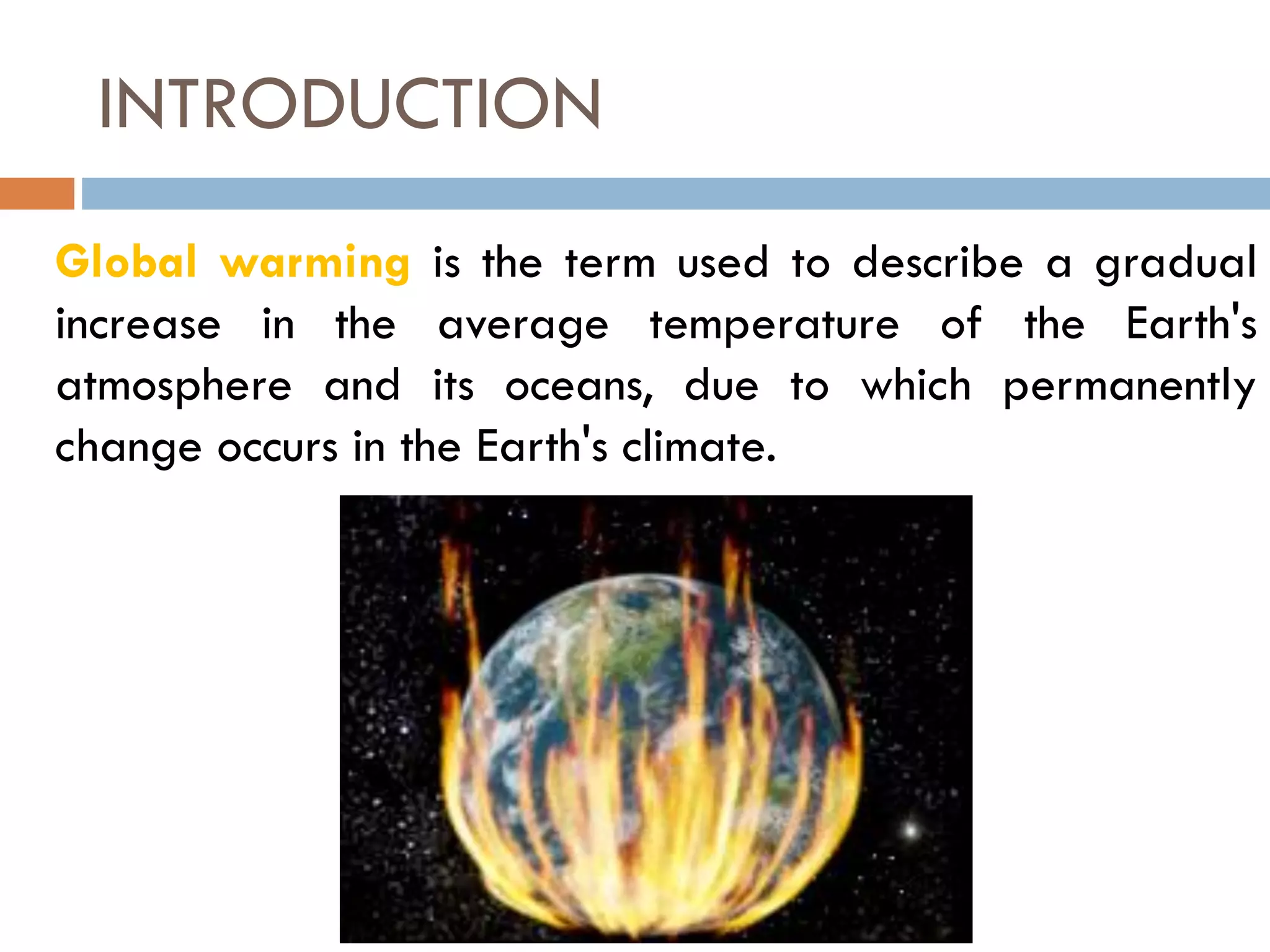
Global warming is the term used to describe a gradual
increase in the average temperature of the Earth's
atmosphere and its oceans, due to which permanently
change occurs in the Earth's climate.
CAUSES OF GLOBAL WARMING
 Most of the climate scientists are agree that the
main cause of the current global warming is due to the
"green house effect“
 There may be other causes like
 Respiration
 Mining activities
 Rapid industrialization
 Increased in auto mobile use
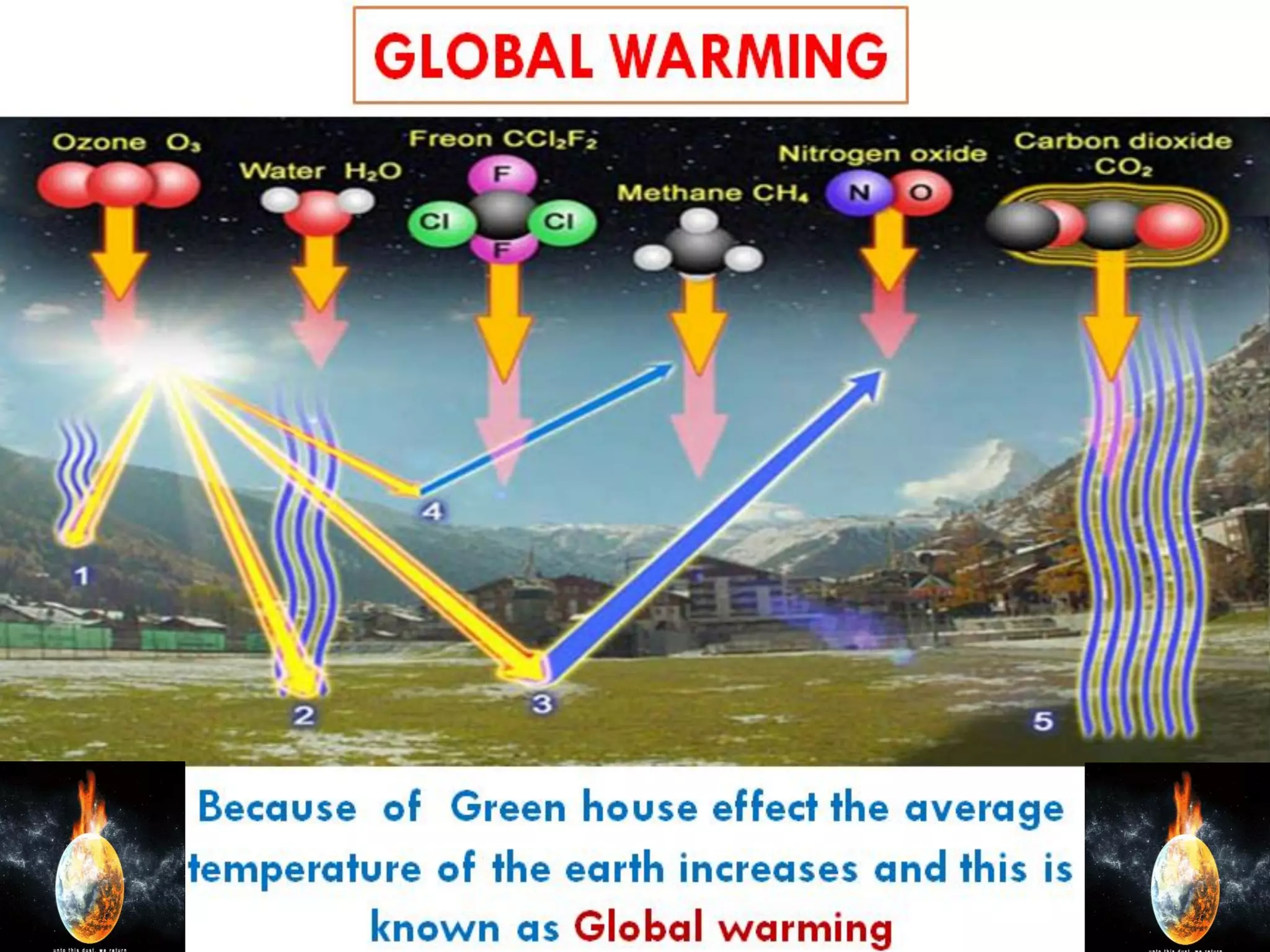
GREEN HOUSE EFFECT
 present in the atmosphere absorbs infrared radiations reflected from the surface
of the earth and heats up the atmosphere.
SOURCES OF GREEN HOUSE GASES
Sunlight’s energy remains trapped in the atmosphere
FLOODS & DROUGHTS
CAUSED BY GLOBAL
WARMING
DROUGHTS CAUSED BY GLOBAL
WARMING
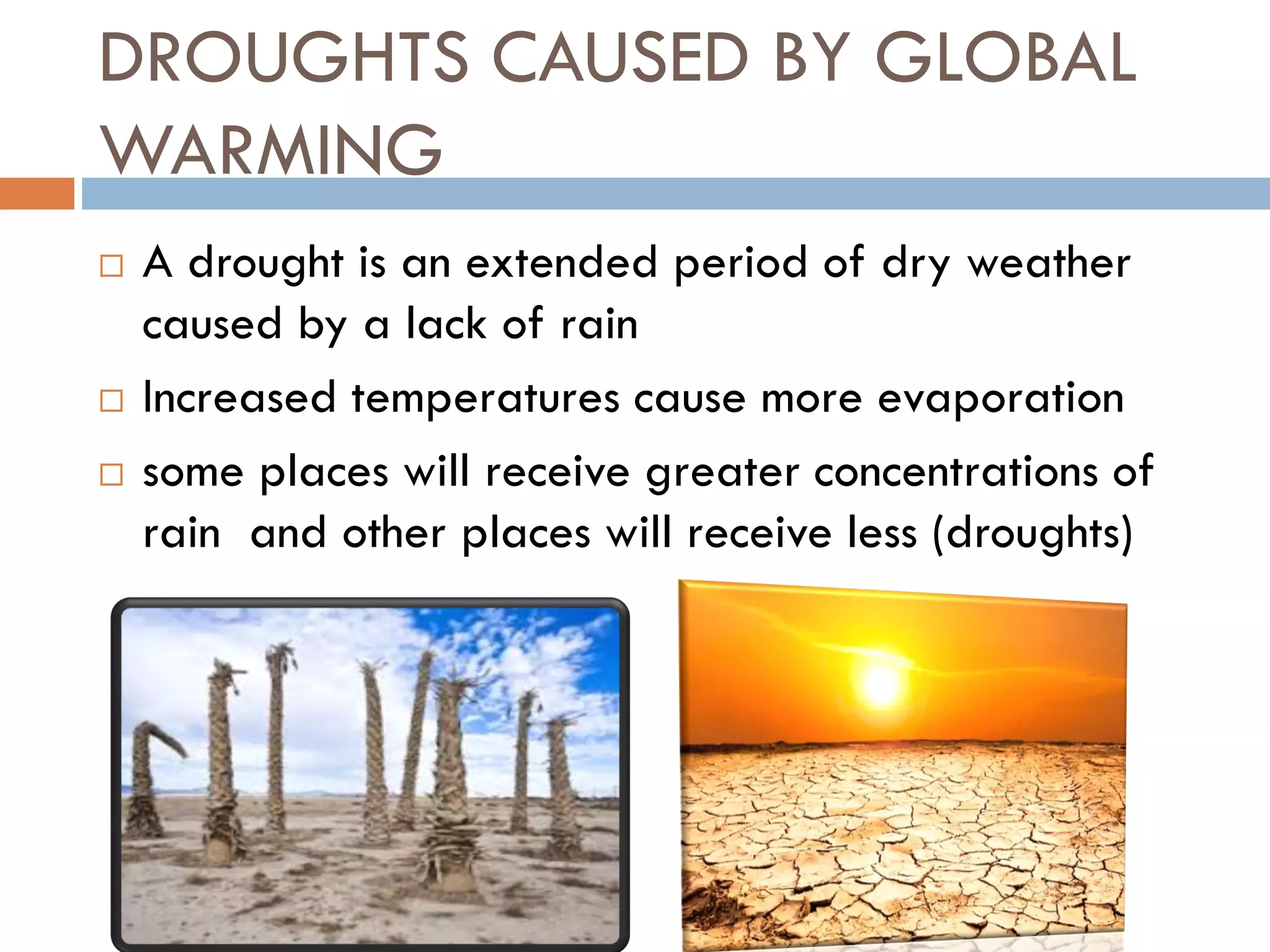
 A drought is an extended period of dry weather
caused by a lack of rain
 Increased temperatures cause more evaporation
 some places will receive greater concentrations of
rain and other places will receive less (droughts)
EFFECTS OF DROUGHTS TO
IRRIGATION
 Amount of water in lakes, rivers, and streams
 Crop Losses
 Drying of Irrigation Canals
 Affect the coastal Areas
 Cause Heat Waves
 Affect LiveStock
HOW FLOOD IS CAUSED BY
GLOBAL WARMING
 A flood is an overflow of water that submerges
land which is usually dry
 The rate of evaporation from the ocean seems to be
increasing
EFFECTS OF FLOOD TO
IRRIGATION
 Embankments of barrages and rivers
 Damages underground piping system
 Destroy agricultural crops
 Affect the water table
 Damage Head Canal
 Affect whole Irrigation System
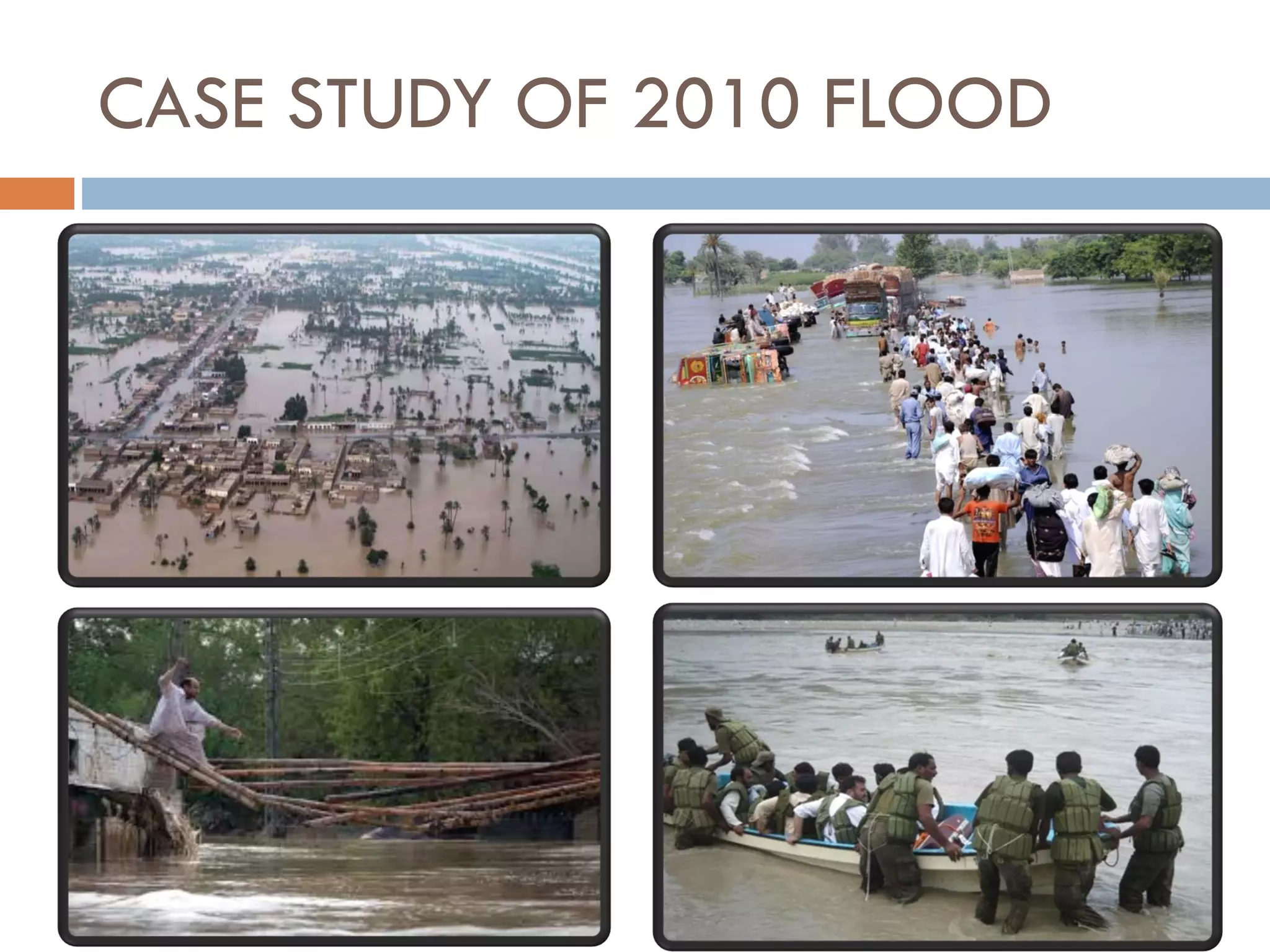
CASE STUDY OF 2010 FLOOD
DAMAGES OF 2010 FLOOD
 Affects the 79 Districts of Country
 20 Million people affected
 1600 Casualties
 1.89 Million homes Destroyed
 Huge Damages of Water Courses, Tube wells
 Damage the crops of Approximately
1.32 Million Hectares
CROPS DAMAGES OF 2010 FLOOD
IRRIGATION DAMAGES OF 2010
FLOOD
MAP OF FLOOD AFFECTED AREAS
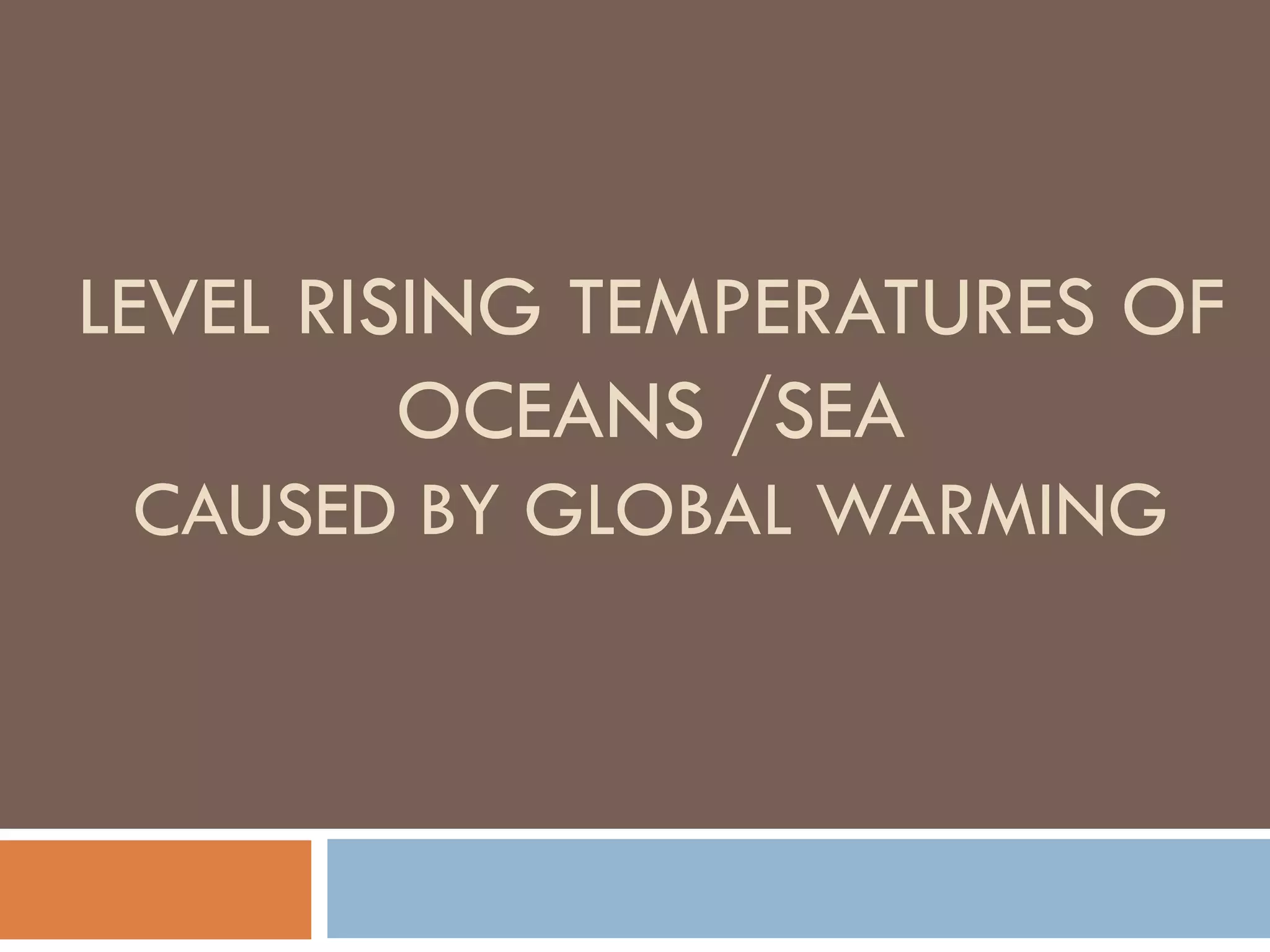
LEVEL RISING TEMPERATURES OF
OCEANS /SEA
CAUSED BY GLOBAL WARMING
RISING TEMPERATURE OF OCEANS
AND SEA
Rising temperature of ocean and sea may be more significant
than the direct effect of higher temperature.
Because….
• The world's agricultural output is heavily dependent on
irrigation.
• Out of a global cropped area of 1500 million ha, 16% is
irrigated.
• Global warming is likely to have a major impact on the
hydrological cycle and consequently on irrigated agriculture.
RISING TEMPERATURE OF OCEANS
AND SEA
As we have discussed that atmospheric temp raises due to
green house effects so it raises the temp of sea/ocean on the
following two mechanism
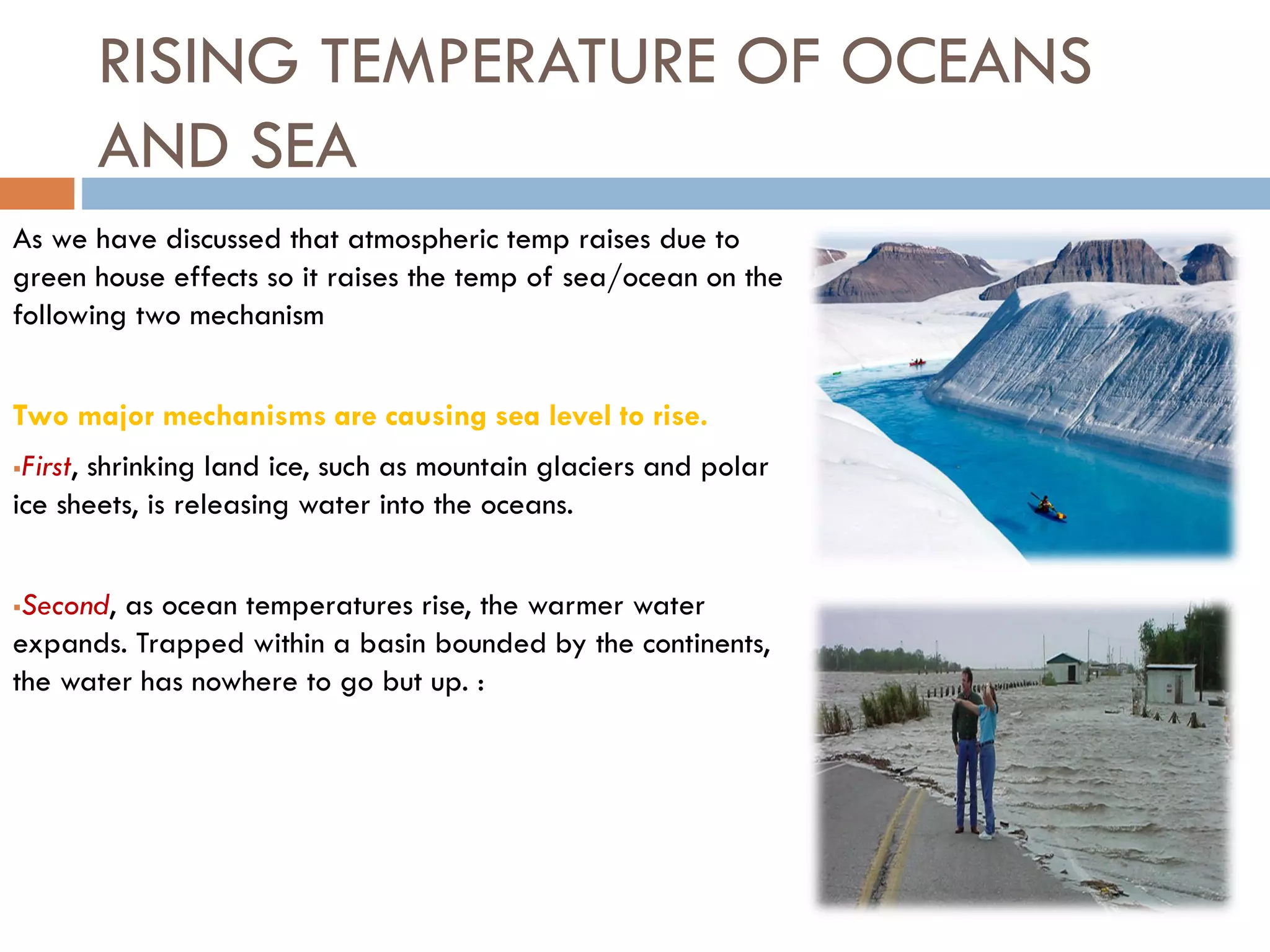
Two major mechanisms are causing sea level to rise.
First, shrinking land ice, such as mountain glaciers and polar
ice sheets, is releasing water into the oceans.
Second, as ocean temperatures rise, the warmer water
expands. Trapped within a basin bounded by the continents,
the water has nowhere to go but up. :
RISING TEMPERATURE OF OCEANS
AND SEA
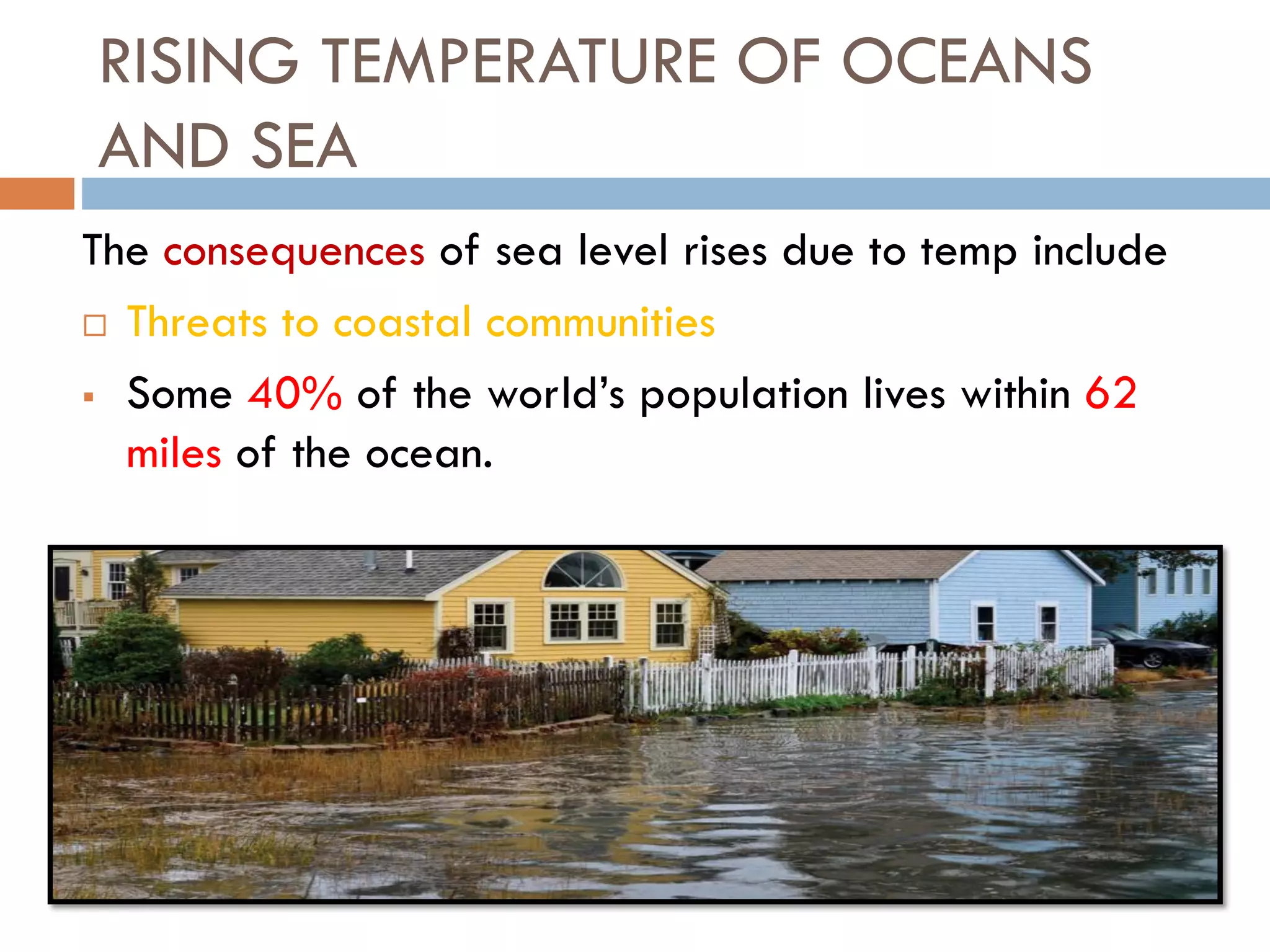
The consequences of sea level rises due to temp include
 Threats to coastal communities
 Some 40% of the world’s population lives within 62
miles of the ocean.
RISING TEMPERATURE OF OCEANS
AND SEA
 Saltwater intrusion
 Sea-level rise can mean that saltwater intrudes into
groundwater drinking supplies, contaminates irrigation
supplies, or overruns agriculture fields.
RISING TEMPERATURE OF OCEANS
AND SEA
TORNADOES AND HURRICANES
CAUSED BY GLOBAL
WARMING
 Tornadoes:
• A tornado is rapidly spinning air that develops from a
thunderstorms and is on the ground.
• The ingredients for a tornado are a thunderstorm, winds
changing speeds with height and rapidly rising air.
 Hurricanes:
• A hurricane is a huge organized thunderstorm
complex that develops over the ocean
• The ingredients are warm ocean water, weak upper
level winds, and low pressure
TORNADOES AND HURRICANES
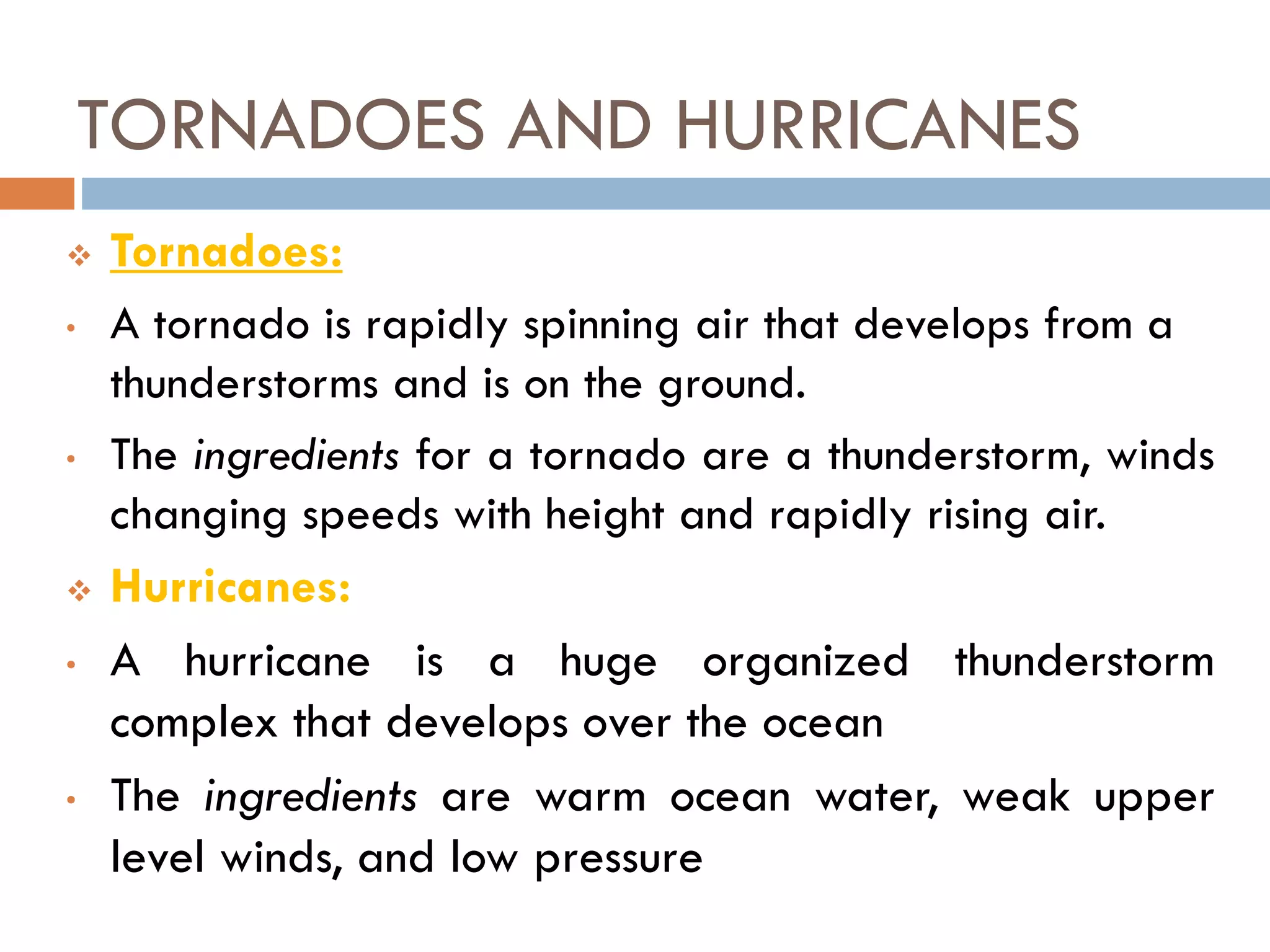
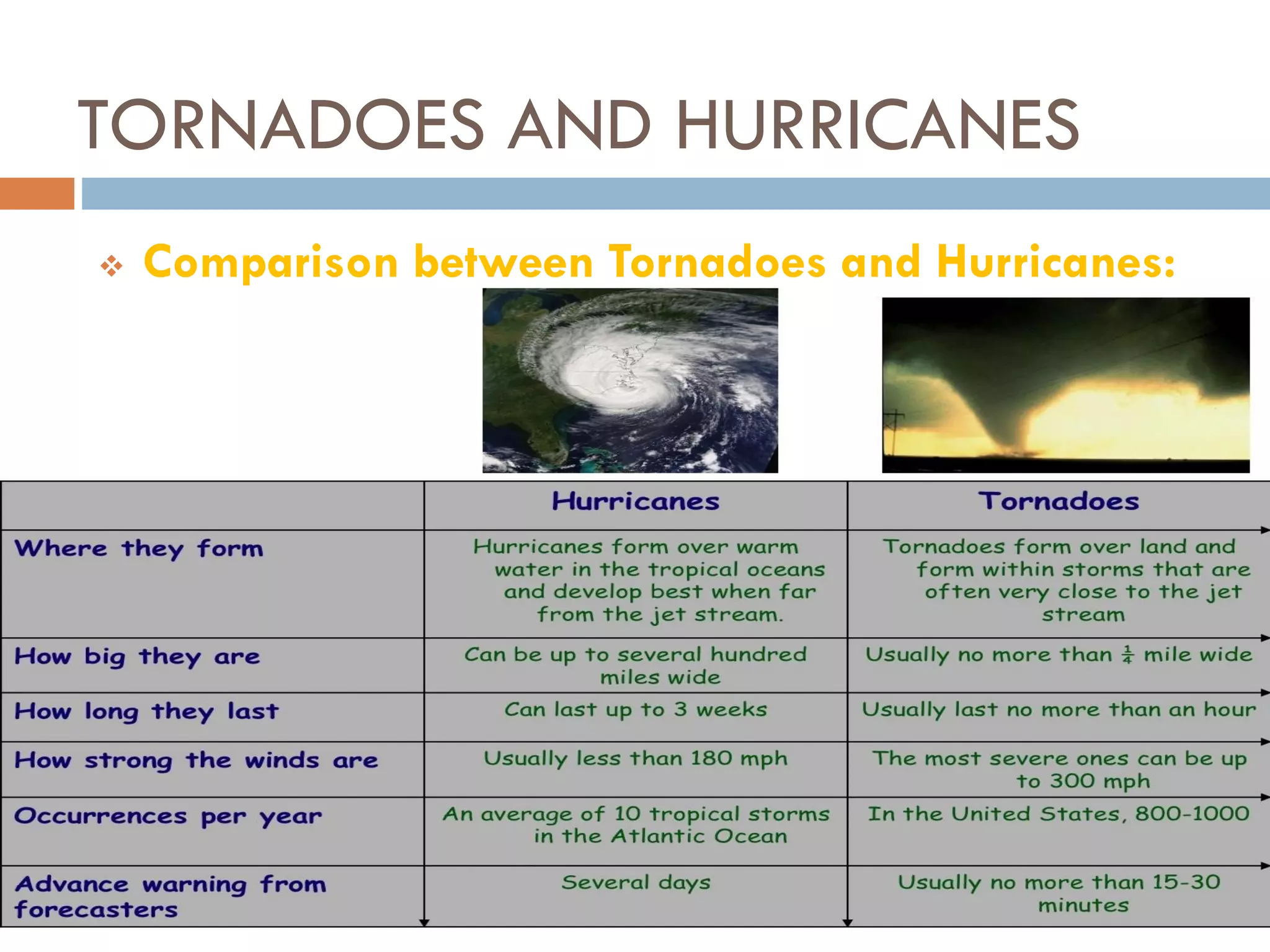
 Comparison between Tornadoes and Hurricanes:
TORNADOES AND HURRICANES
HOW DO TORNADOES FORM?
 The formation of tornadoes can be described into 3
steps:
1. Air Rotates Because of Wind Shear
2. Faster Spin Makes a Funnel Cloud
3. The Funnel Rotates and Touches Down
HOW DO HURRICANES FORM?
IMPACTS OF TORNADOES & HURRICANES
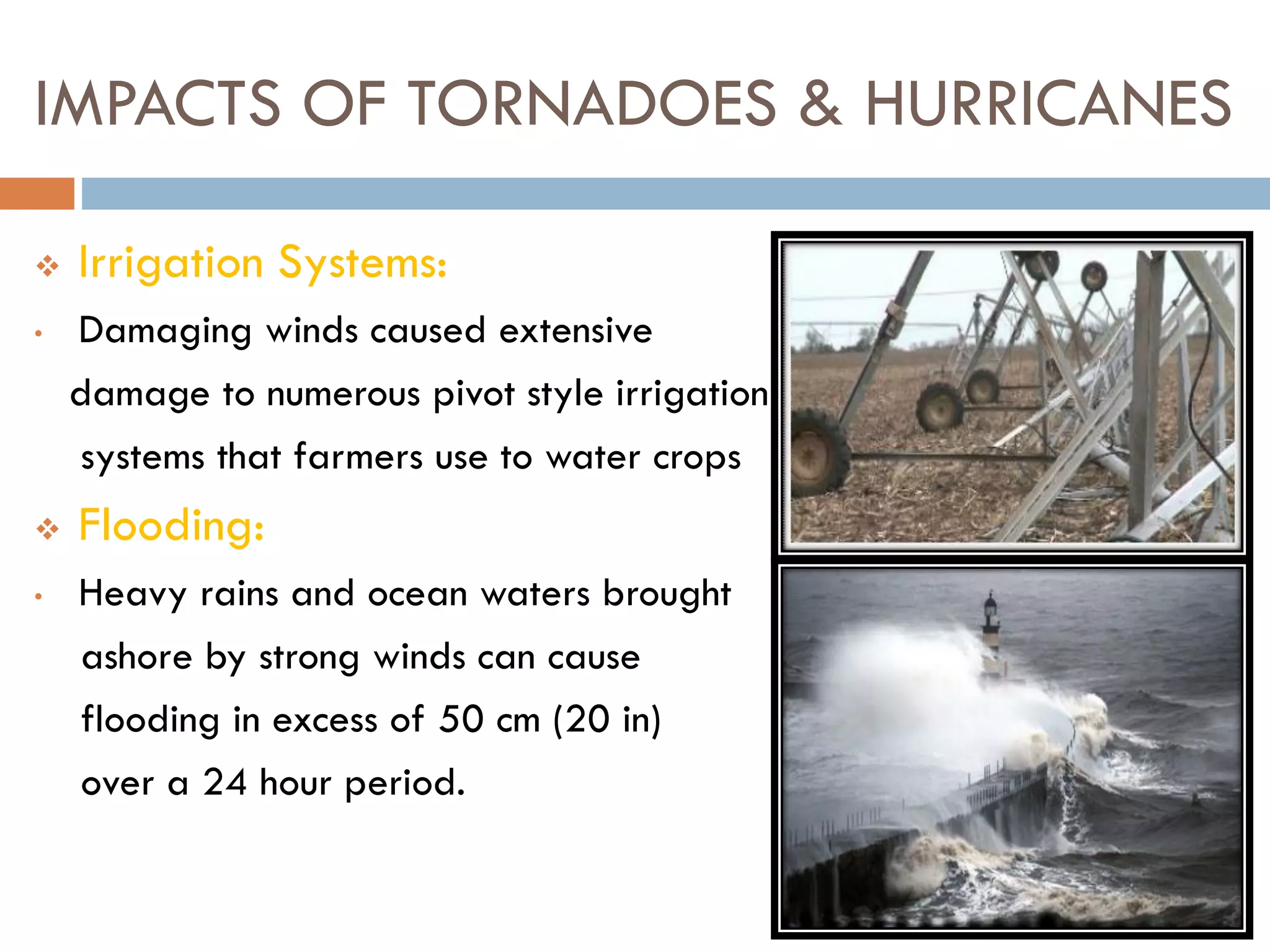
 Irrigation Systems:
• Damaging winds caused extensive
damage to numerous pivot style irrigation
systems that farmers use to water crops
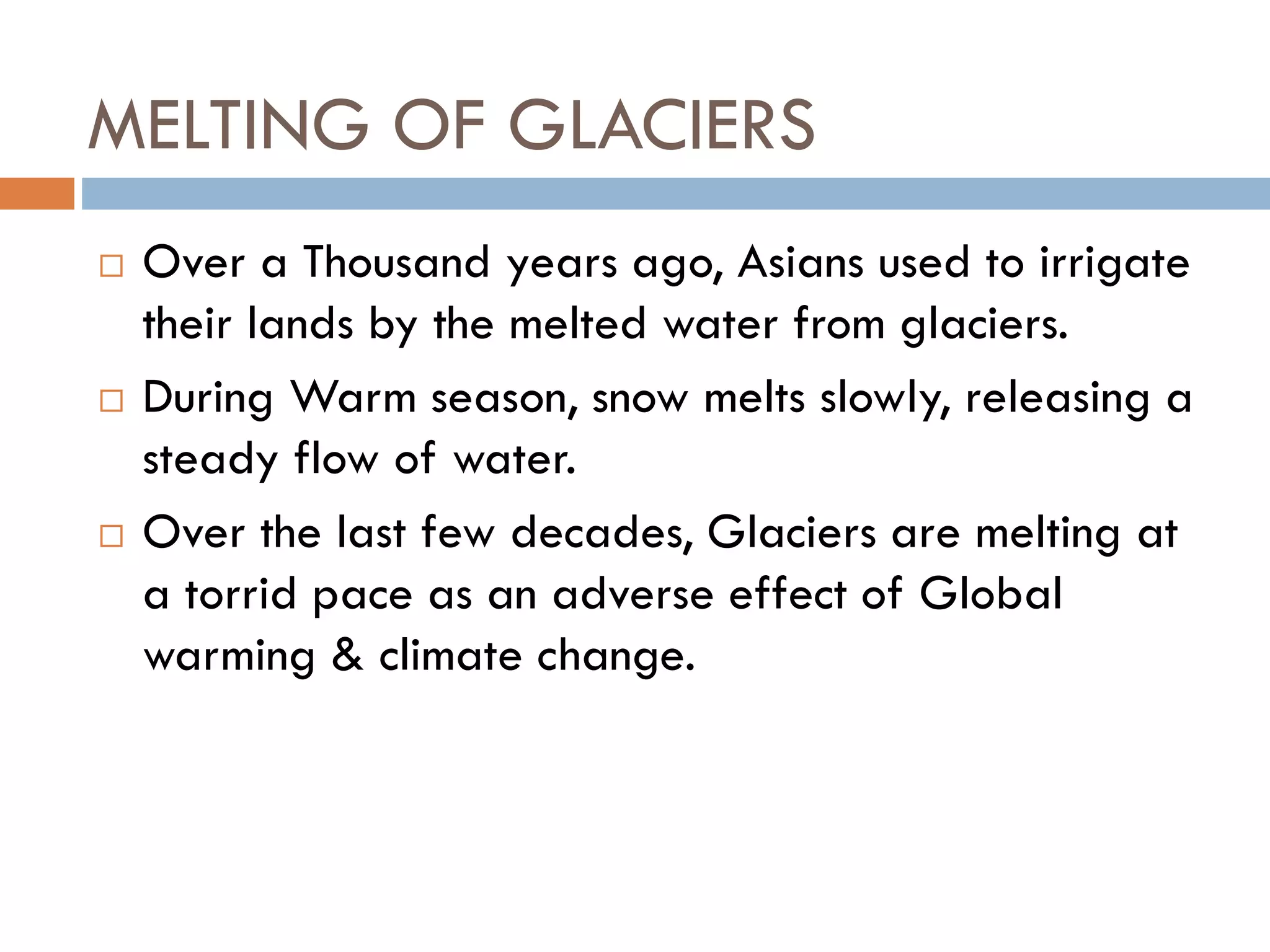
 Flooding:
• Heavy rains and ocean waters brought
ashore by strong winds can cause
flooding in excess of 50 cm (20 in)
over a 24 hour period.
IMPACTS OF TORNADOES & HURRICANES
 An abnormal increase in the ocean's
level, sometimes in excess of several
meters high.
 As hurricane winds, rainfall, and storm
surge cause direct and indirect effects
on the environment, this can also impact
agriculture.
Storm Surge: Impacts to Agriculture
MELTING OF GLACIERS
CAUSED BY GLOBAL
WARMING
MELTING OF GLACIERS
MELTING OF GLACIERS
 Over a Thousand years ago, Asians used to irrigate
their lands by the melted water from glaciers.
 During Warm season, snow melts slowly, releasing a
steady flow of water.
 Over the last few decades, Glaciers are melting at
a torrid pace as an adverse effect of Global
warming & climate change.
MELTING OF GLACIERS
 Effects of Glacier Melting:
 Reduced water for agricultural use
 Shrinkage of river based irrigated land
 Contamination of coastal groundwater supply
 More floods & droughts
 Mudslides, dam break etc.
MELTING OF GLACIERS
 Acc. to WWF, Himalayan Glaciers are retreating
10-15 m/year, causing rivers to be changed into
seasonal streams.
 This glacier melting would pose freshwater scarcity
needed for the crop production, thus leading to
food shortage.
 The world food security is threatened by the glacier
melting more in Himalayas and Tibet plateau.
MELTING OF GLACIERS
 Acc. to IPCC reports, Himalayan glaciers could melt
entirely by 2035.
 This melting of glaciers could soon deprive the
major rivers of India, China & Pakistan.
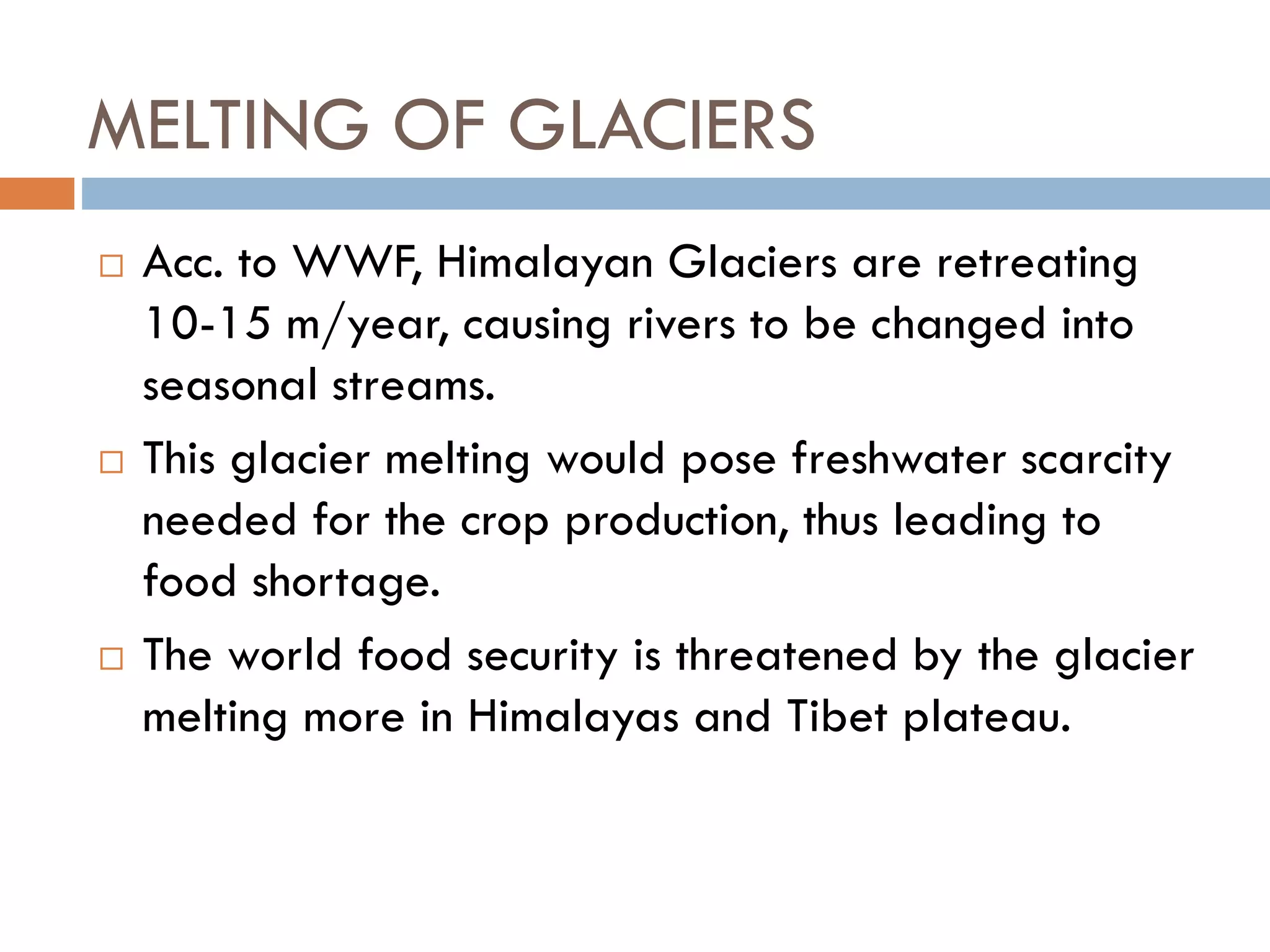
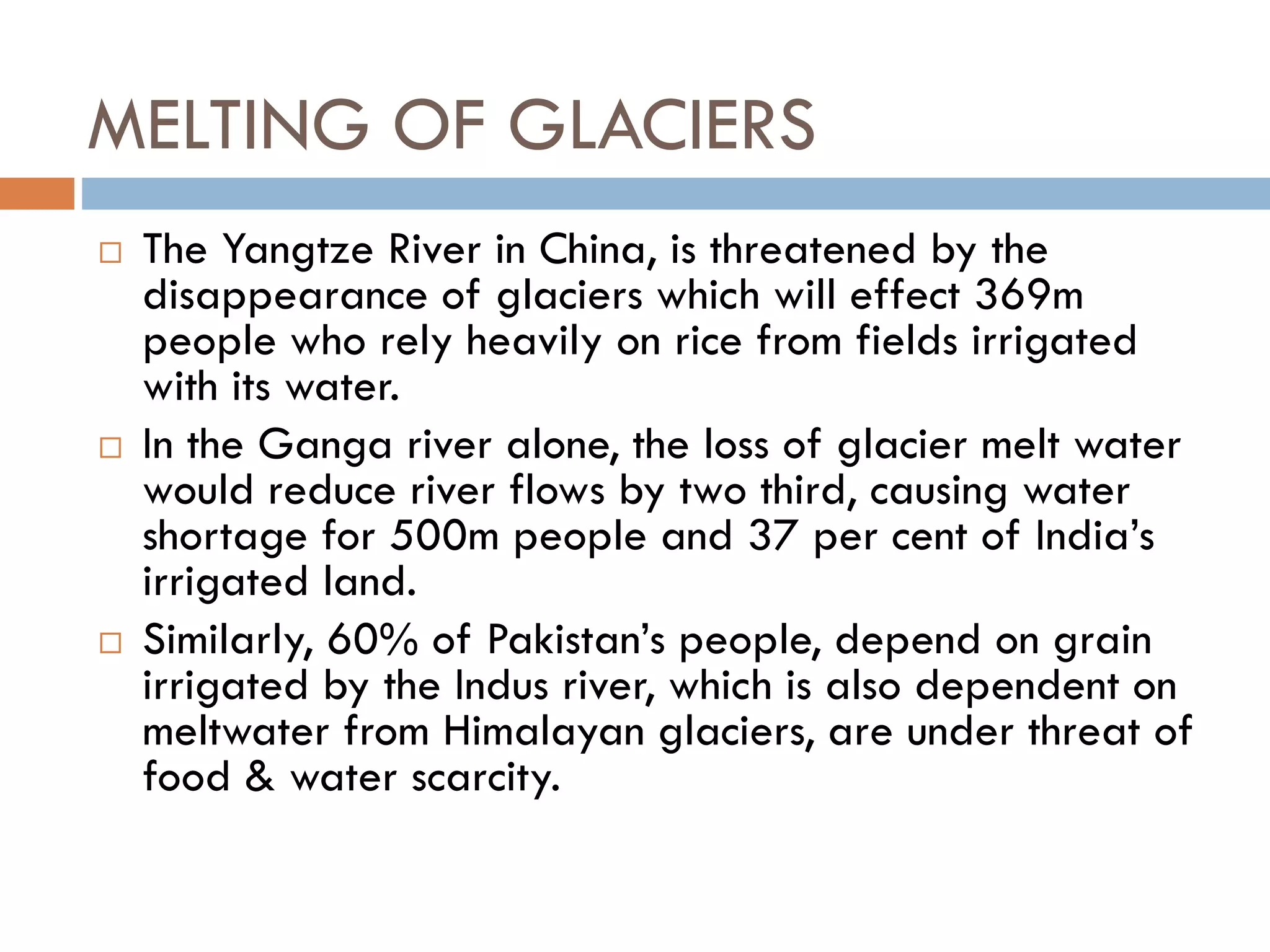
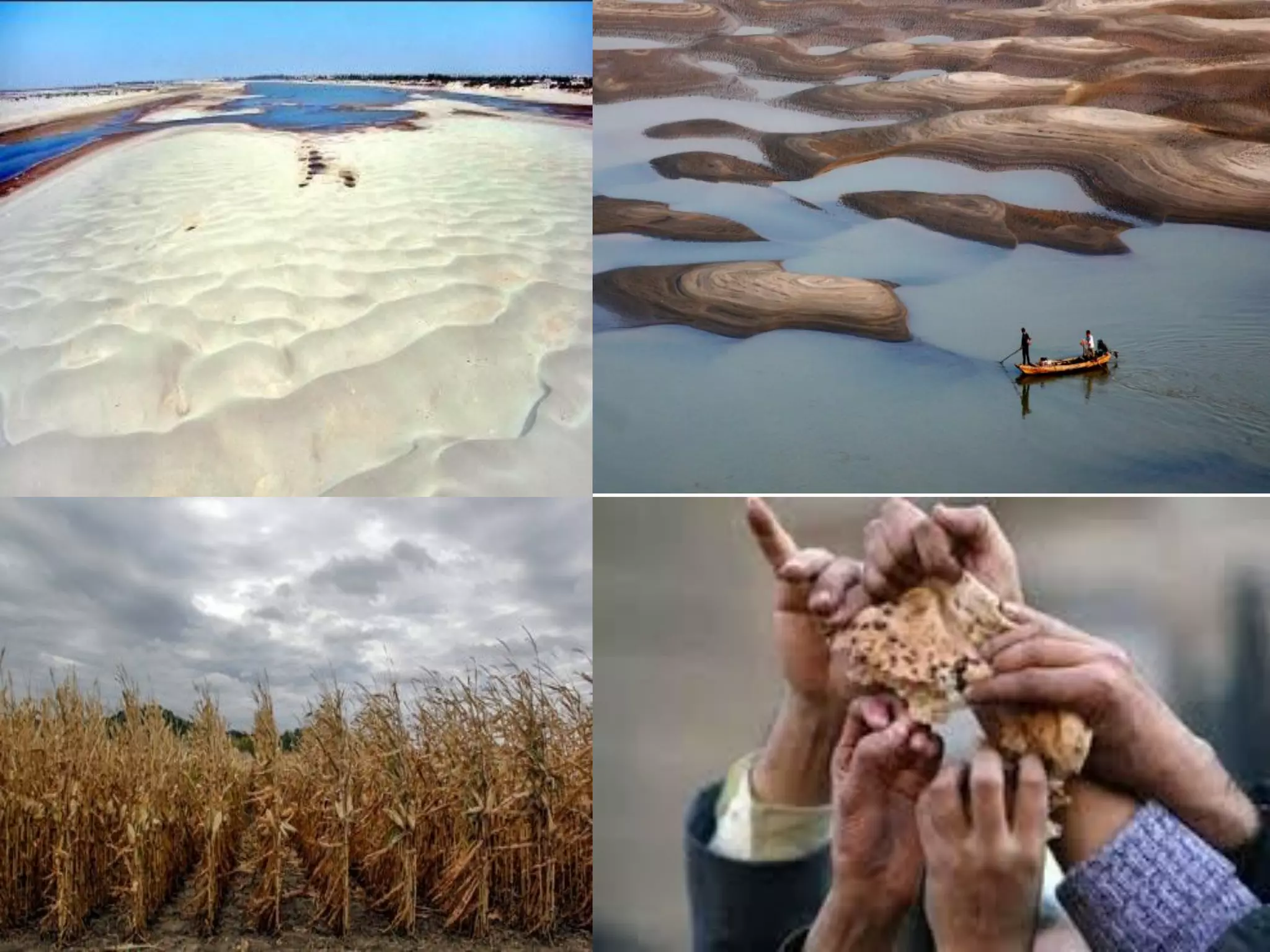
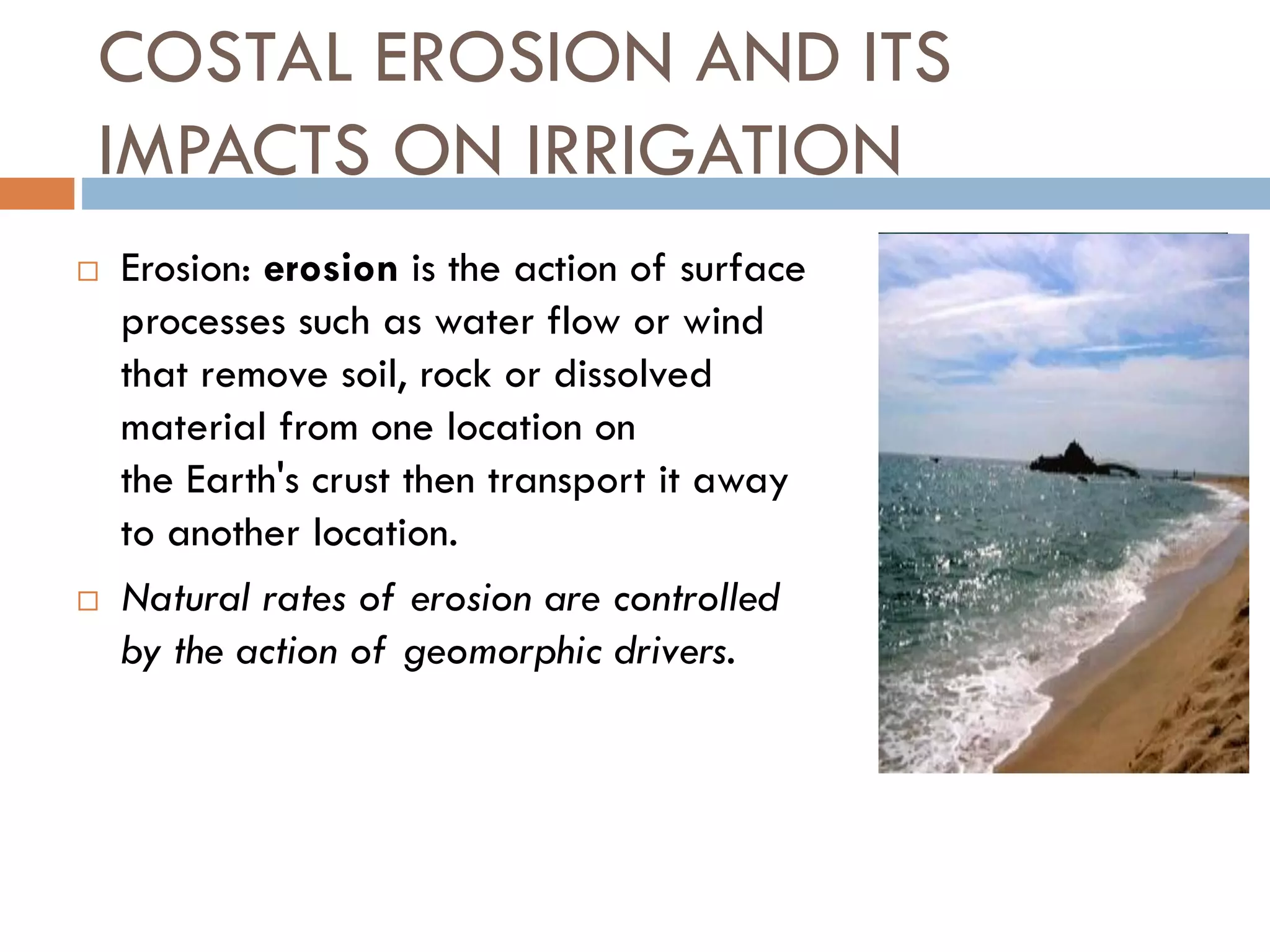
 In the Indus, Ganga, Yellow, and Yangtze River
basins, where irrigated agriculture depends heavily
on rivers, the glacier melt will shrink harvests and
could create unmanageable food shortages.
MELTING OF GLACIERS
 The Yangtze River in China, is threatened by the
disappearance of glaciers which will effect 369m
people who rely heavily on rice from fields irrigated
with its water.
 In the Ganga river alone, the loss of glacier melt water
would reduce river flows by two third, causing water
shortage for 500m people and 37 per cent of India’s
irrigated land.
 Similarly, 60% of Pakistan’s people, depend on grain
irrigated by the Indus river, which is also dependent on
meltwater from Himalayan glaciers, are under threat of
food & water scarcity.
COSTAL EROSION AND ITS IMPACTS
ON IRRIGATION
CAUSED BY GLOBAL WARMING
COSTAL EROSION AND ITS
IMPACTS ON IRRIGATION
 Erosion: erosion is the action of surface
processes such as water flow or wind
that remove soil, rock or dissolved
material from one location on
the Earth's crust then transport it away
to another location.
 Natural rates of erosion are controlled
by the action of geomorphic drivers.
COASTAL EROSION
 Coastal erosion, which
occurs on both exposed and
sheltered coasts, primarily
occurs through the action of
currents and waves but sea
level tidal change can also
play a role.
Cont:
 Hydraulic action takes place when air in a joint is suddenly
compressed by a wave closing the entrance of the joint. This
then cracks it.
 Wave pounding is when the shear energy of the wave hitting
the cliff or rock breaks pieces off.
Cont:
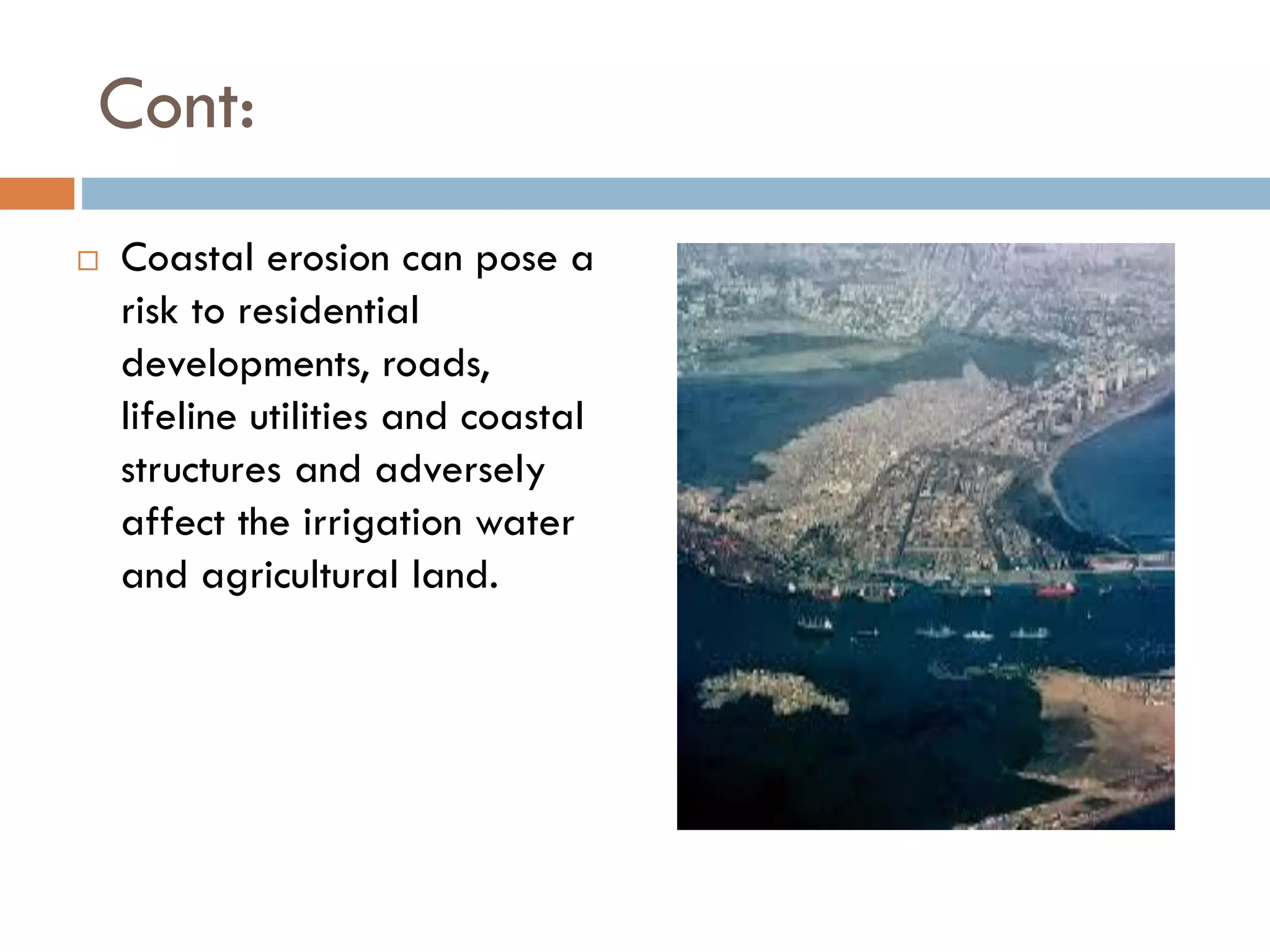
 Coastal erosion can pose a
risk to residential
developments, roads,
lifeline utilities and coastal
structures and adversely
affect the irrigation water
and agricultural land.
IMPACTS OF COASTAL EROSION
 Danger to life in the case of sudden onset landslide events
 Structural damage or destruction of buildings and
infrastructure
 Damage or destruction of lifeline infrastructure such as
water, sewage and gas pipes and roads
 Loss of land, resulting in coastal cliffs or shorelines
retreating closer to other buildings
 Land instability at neighboring slopes and properties
 Loss of beach amenity due to cliff collapse or sea wall
construction.
IMPACTS ON IRRIGATION
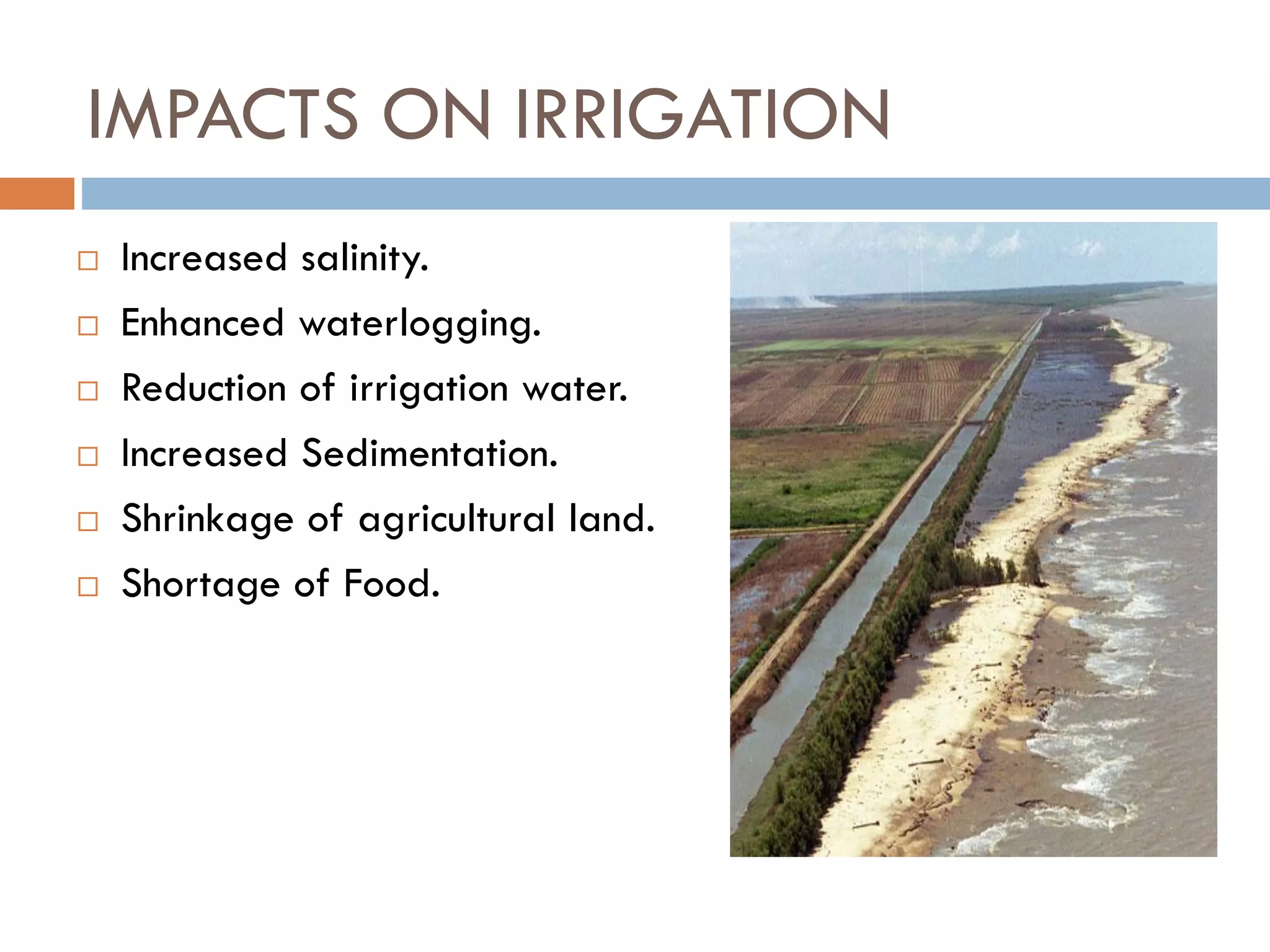
 Increased salinity.
 Enhanced waterlogging.
 Reduction of irrigation water.
 Increased Sedimentation.
 Shrinkage of agricultural land.
 Shortage of Food.
THANK YOU
EACH OF US MUST TAKE STEPS TO PROTECT OUR EARTH FROM GLOBAL WARMING

Global warming & Its Impacts

  • 1.
  • 2.
    CONTENT  Introduction ofGlobal Warming  Causes of Global Warming  Impacts of Global Warming  Droughts  Floods  Level Rising Temperatures of Oceans /sea  Tornadoes  Hurricanes  The Melting of Mountain Glaciers  The Reduction of Snow Cover  Coastal Erosion
  • 3.
    INTRODUCTION Global warming isthe term used to describe a gradual increase in the average temperature of the Earth's atmosphere and its oceans, due to which permanently change occurs in the Earth's climate.
  • 4.
    CAUSES OF GLOBALWARMING  Most of the climate scientists are agree that the main cause of the current global warming is due to the "green house effect“  There may be other causes like  Respiration  Mining activities  Rapid industrialization  Increased in auto mobile use
  • 5.
    GREEN HOUSE EFFECT present in the atmosphere absorbs infrared radiations reflected from the surface of the earth and heats up the atmosphere.
  • 6.
    SOURCES OF GREENHOUSE GASES
  • 7.
    Sunlight’s energy remainstrapped in the atmosphere
  • 8.
    FLOODS & DROUGHTS CAUSEDBY GLOBAL WARMING
  • 9.
    DROUGHTS CAUSED BYGLOBAL WARMING  A drought is an extended period of dry weather caused by a lack of rain  Increased temperatures cause more evaporation  some places will receive greater concentrations of rain and other places will receive less (droughts)
  • 10.
    EFFECTS OF DROUGHTSTO IRRIGATION  Amount of water in lakes, rivers, and streams  Crop Losses  Drying of Irrigation Canals  Affect the coastal Areas  Cause Heat Waves  Affect LiveStock
  • 11.
    HOW FLOOD ISCAUSED BY GLOBAL WARMING  A flood is an overflow of water that submerges land which is usually dry  The rate of evaporation from the ocean seems to be increasing
  • 12.
    EFFECTS OF FLOODTO IRRIGATION  Embankments of barrages and rivers  Damages underground piping system  Destroy agricultural crops  Affect the water table  Damage Head Canal  Affect whole Irrigation System
  • 13.
    CASE STUDY OF2010 FLOOD
  • 14.
    DAMAGES OF 2010FLOOD  Affects the 79 Districts of Country  20 Million people affected  1600 Casualties  1.89 Million homes Destroyed  Huge Damages of Water Courses, Tube wells  Damage the crops of Approximately 1.32 Million Hectares
  • 15.
    CROPS DAMAGES OF2010 FLOOD
  • 16.
  • 17.
    MAP OF FLOODAFFECTED AREAS
  • 18.
    LEVEL RISING TEMPERATURESOF OCEANS /SEA CAUSED BY GLOBAL WARMING
  • 19.
    RISING TEMPERATURE OFOCEANS AND SEA Rising temperature of ocean and sea may be more significant than the direct effect of higher temperature. Because…. • The world's agricultural output is heavily dependent on irrigation. • Out of a global cropped area of 1500 million ha, 16% is irrigated. • Global warming is likely to have a major impact on the hydrological cycle and consequently on irrigated agriculture.
  • 20.
    RISING TEMPERATURE OFOCEANS AND SEA As we have discussed that atmospheric temp raises due to green house effects so it raises the temp of sea/ocean on the following two mechanism Two major mechanisms are causing sea level to rise. First, shrinking land ice, such as mountain glaciers and polar ice sheets, is releasing water into the oceans. Second, as ocean temperatures rise, the warmer water expands. Trapped within a basin bounded by the continents, the water has nowhere to go but up. :
  • 21.
    RISING TEMPERATURE OFOCEANS AND SEA The consequences of sea level rises due to temp include  Threats to coastal communities  Some 40% of the world’s population lives within 62 miles of the ocean.
  • 22.
    RISING TEMPERATURE OFOCEANS AND SEA  Saltwater intrusion  Sea-level rise can mean that saltwater intrudes into groundwater drinking supplies, contaminates irrigation supplies, or overruns agriculture fields.
  • 23.
    RISING TEMPERATURE OFOCEANS AND SEA
  • 24.
  • 25.
     Tornadoes: • Atornado is rapidly spinning air that develops from a thunderstorms and is on the ground. • The ingredients for a tornado are a thunderstorm, winds changing speeds with height and rapidly rising air.  Hurricanes: • A hurricane is a huge organized thunderstorm complex that develops over the ocean • The ingredients are warm ocean water, weak upper level winds, and low pressure TORNADOES AND HURRICANES
  • 26.
     Comparison betweenTornadoes and Hurricanes: TORNADOES AND HURRICANES
  • 27.
    HOW DO TORNADOESFORM?  The formation of tornadoes can be described into 3 steps: 1. Air Rotates Because of Wind Shear 2. Faster Spin Makes a Funnel Cloud 3. The Funnel Rotates and Touches Down
  • 28.
  • 29.
    IMPACTS OF TORNADOES& HURRICANES  Irrigation Systems: • Damaging winds caused extensive damage to numerous pivot style irrigation systems that farmers use to water crops  Flooding: • Heavy rains and ocean waters brought ashore by strong winds can cause flooding in excess of 50 cm (20 in) over a 24 hour period.
  • 30.
    IMPACTS OF TORNADOES& HURRICANES  An abnormal increase in the ocean's level, sometimes in excess of several meters high.  As hurricane winds, rainfall, and storm surge cause direct and indirect effects on the environment, this can also impact agriculture. Storm Surge: Impacts to Agriculture
  • 31.
    MELTING OF GLACIERS CAUSEDBY GLOBAL WARMING
  • 32.
  • 33.
    MELTING OF GLACIERS Over a Thousand years ago, Asians used to irrigate their lands by the melted water from glaciers.  During Warm season, snow melts slowly, releasing a steady flow of water.  Over the last few decades, Glaciers are melting at a torrid pace as an adverse effect of Global warming & climate change.
  • 34.
    MELTING OF GLACIERS Effects of Glacier Melting:  Reduced water for agricultural use  Shrinkage of river based irrigated land  Contamination of coastal groundwater supply  More floods & droughts  Mudslides, dam break etc.
  • 35.
    MELTING OF GLACIERS Acc. to WWF, Himalayan Glaciers are retreating 10-15 m/year, causing rivers to be changed into seasonal streams.  This glacier melting would pose freshwater scarcity needed for the crop production, thus leading to food shortage.  The world food security is threatened by the glacier melting more in Himalayas and Tibet plateau.
  • 36.
    MELTING OF GLACIERS Acc. to IPCC reports, Himalayan glaciers could melt entirely by 2035.  This melting of glaciers could soon deprive the major rivers of India, China & Pakistan.  In the Indus, Ganga, Yellow, and Yangtze River basins, where irrigated agriculture depends heavily on rivers, the glacier melt will shrink harvests and could create unmanageable food shortages.
  • 37.
    MELTING OF GLACIERS The Yangtze River in China, is threatened by the disappearance of glaciers which will effect 369m people who rely heavily on rice from fields irrigated with its water.  In the Ganga river alone, the loss of glacier melt water would reduce river flows by two third, causing water shortage for 500m people and 37 per cent of India’s irrigated land.  Similarly, 60% of Pakistan’s people, depend on grain irrigated by the Indus river, which is also dependent on meltwater from Himalayan glaciers, are under threat of food & water scarcity.
  • 39.
    COSTAL EROSION ANDITS IMPACTS ON IRRIGATION CAUSED BY GLOBAL WARMING
  • 40.
    COSTAL EROSION ANDITS IMPACTS ON IRRIGATION  Erosion: erosion is the action of surface processes such as water flow or wind that remove soil, rock or dissolved material from one location on the Earth's crust then transport it away to another location.  Natural rates of erosion are controlled by the action of geomorphic drivers.
  • 41.
    COASTAL EROSION  Coastalerosion, which occurs on both exposed and sheltered coasts, primarily occurs through the action of currents and waves but sea level tidal change can also play a role.
  • 42.
    Cont:  Hydraulic actiontakes place when air in a joint is suddenly compressed by a wave closing the entrance of the joint. This then cracks it.  Wave pounding is when the shear energy of the wave hitting the cliff or rock breaks pieces off.
  • 43.
    Cont:  Coastal erosioncan pose a risk to residential developments, roads, lifeline utilities and coastal structures and adversely affect the irrigation water and agricultural land.
  • 44.
    IMPACTS OF COASTALEROSION  Danger to life in the case of sudden onset landslide events  Structural damage or destruction of buildings and infrastructure  Damage or destruction of lifeline infrastructure such as water, sewage and gas pipes and roads  Loss of land, resulting in coastal cliffs or shorelines retreating closer to other buildings  Land instability at neighboring slopes and properties  Loss of beach amenity due to cliff collapse or sea wall construction.
  • 45.
    IMPACTS ON IRRIGATION Increased salinity.  Enhanced waterlogging.  Reduction of irrigation water.  Increased Sedimentation.  Shrinkage of agricultural land.  Shortage of Food.
  • 46.
    THANK YOU EACH OFUS MUST TAKE STEPS TO PROTECT OUR EARTH FROM GLOBAL WARMING