MICROWAVE ASSISTED
SYNTHESIS
A Green Chemistry Approach
Seminar Presentation
Presented by –
Garima Singh
Enroll no. –
CSJMA24000003450
Masters Of Pharmacy
(First Year)
Presented to –
School of Pharmaceutical sciences
(pharmaceutical chemistry)
Session – 2024-25
CONTENTS
 Introduction
 Merits and Demerits
 Microwave assisted Organic Reactions
 Applications
 Conclusion
 Refrence
INTRODUCTION

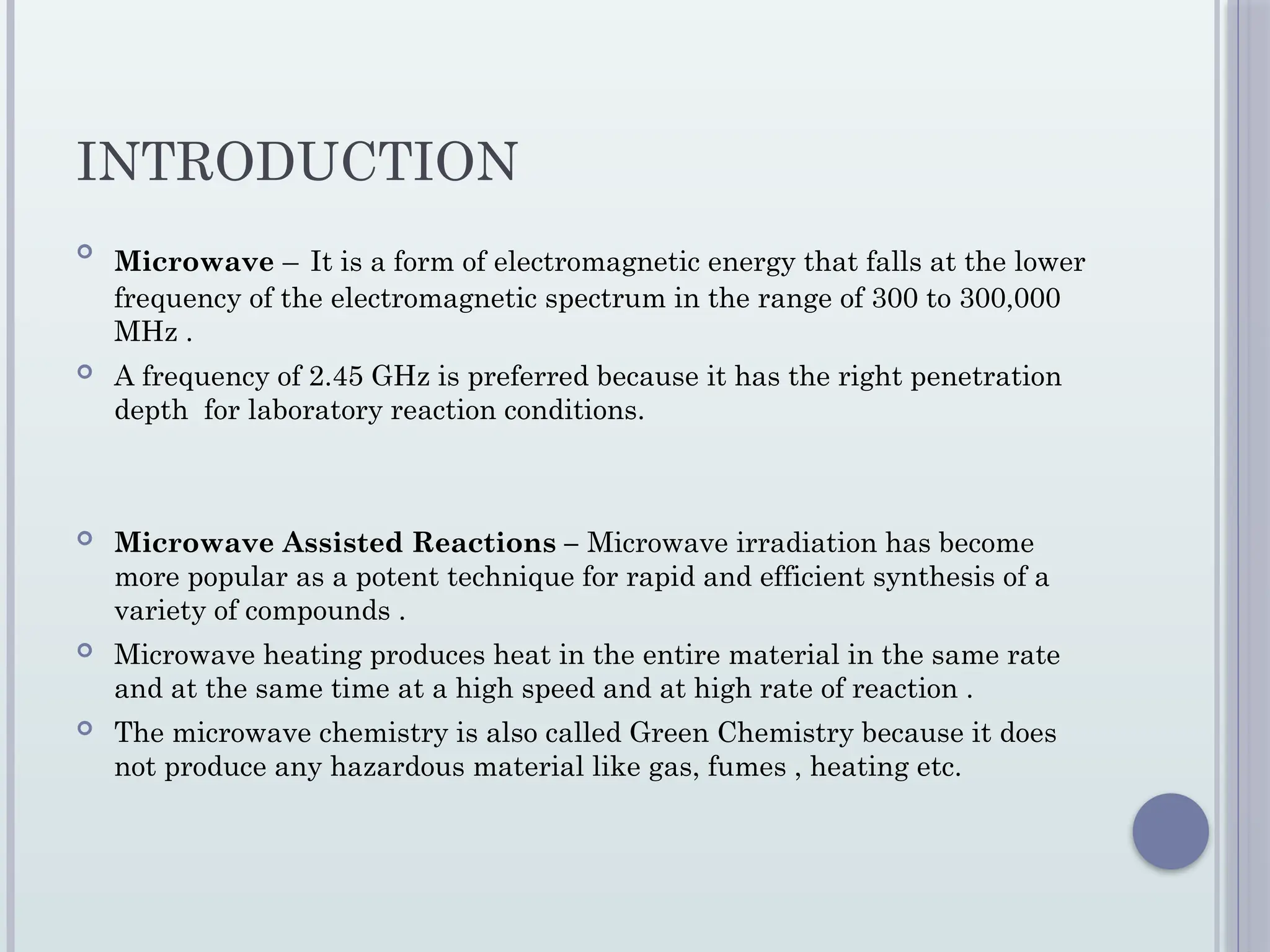
Microwave – It is a form of electromagnetic energy that falls at the lower
frequency of the electromagnetic spectrum in the range of 300 to 300,000
MHz .
 A frequency of 2.45 GHz is preferred because it has the right penetration
depth for laboratory reaction conditions.
 Microwave Assisted Reactions – Microwave irradiation has become
more popular as a potent technique for rapid and efficient synthesis of a
variety of compounds .
 Microwave heating produces heat in the entire material in the same rate
and at the same time at a high speed and at high rate of reaction .
 The microwave chemistry is also called Green Chemistry because it does
not produce any hazardous material like gas, fumes , heating etc.
MERITS DEMERITS
 Faster Reaction
 Energy saving
 Green synthesis
 Possibility of stirring
 Uniform and selective heating
 Better yield and high purity
 Continuous power output
 Sudden increase in temperature
may lead to distortion of
molecules
 Very vigorous and that can be
hazardous
 Microwave reactors are expensive
and delectated
 Heat force control is difficult
 Closed container is dangerous
because it could be burst
MICROWAVE ASSISTED ORGANIC
REACTIONS
 Microwave assisted reactions using solvents
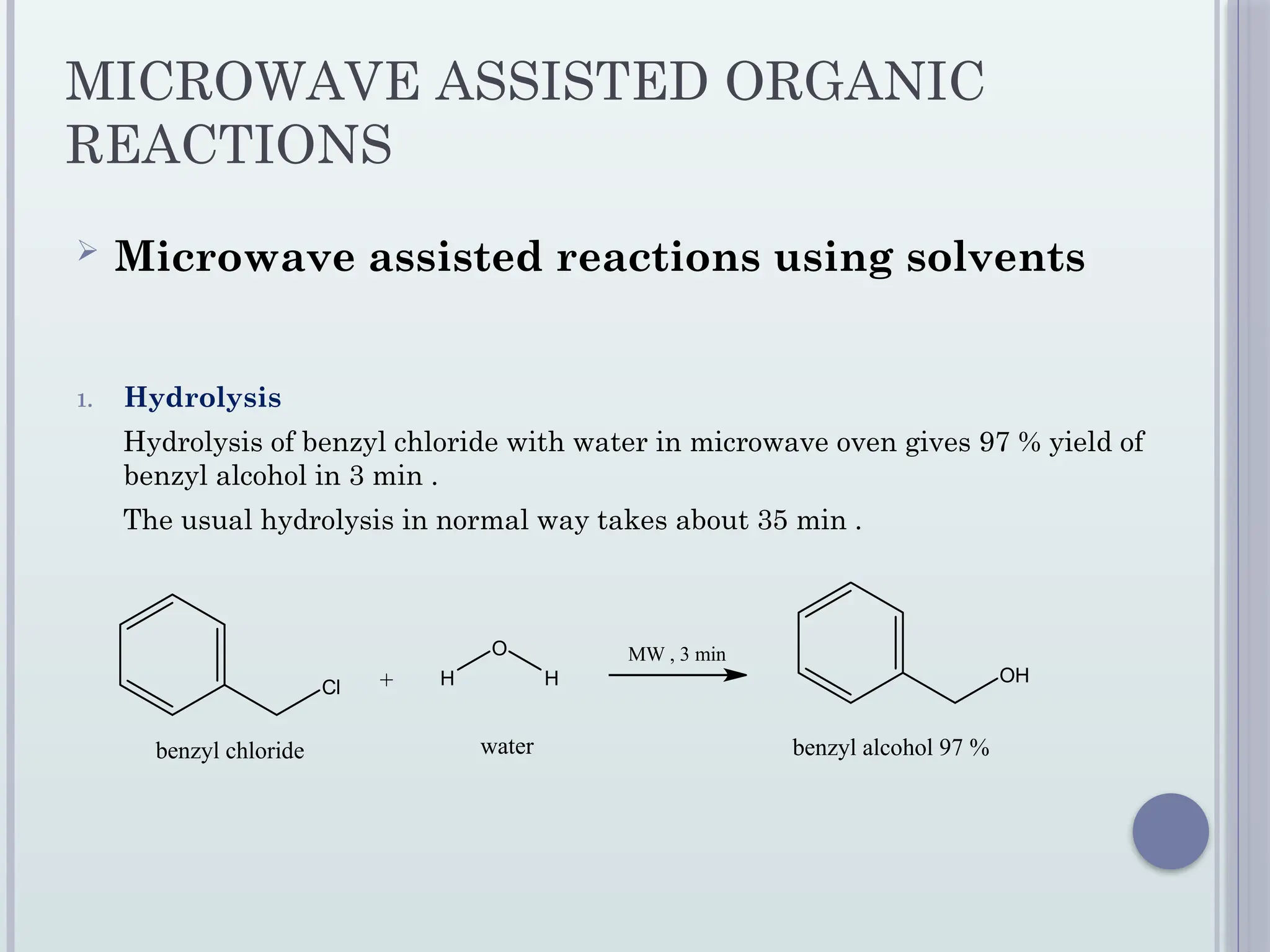
1. Hydrolysis
Hydrolysis of benzyl chloride with water in microwave oven gives 97 % yield of
benzyl alcohol in 3 min .
The usual hydrolysis in normal way takes about 35 min .
Cl
benzyl chloride
+ H
O
H
water
MW , 3 min
OH
benzyl alcohol 97 %
2. Esterification
A mixture of benzoic acid and n – propanol on heating in a microwave oven
for 6 minutes in conc. Sulfuric acids gives propylbenzoate .
3. Decarboxylation
Coventional decarboxylation of carboxylic acids involve refluxing in
quinoline in presence of copper chromate and the yields are low . However ,
in the presence of microwaves decarboxylation takes place in much shorter
time .
O
OH
benzoic acid
+ HO
n propanol
Conc. H2SO4
MW 6 min
O
O-
propylbenzoate
H
N
COOH
6 methoxy indole 2 carboxylic acid
H3CO
MW 12 min
quinoline
N
H
H3CO
6 methoxyindole 99%
 Microwave assisted reactions under solvent
free conditions
1. Aromatic Nucleophilic Substitutions
Formation of substituted Triazines are carried out using sodium phenoxide
and 1,3,5-trichlorotriazine under microwave irradiation (6min) . The
products , 1,3,5 –triaryloxytriazines are obtained in 85-90 % yields .
2. Deacetylation
Conventional process takes long time and the yields are low . Use of
microwave irradiation reduces the time of deacetylation and the yields are
good .
Na+
O-
sodium phenoxide
+
1,3,5 trichlorotriazine
MWI , 6 min
85 to 90 %
N
N
N
OAr
ArO OAr
N
N
N
Cl Cl
Cl
1,3,5 triaryloxytriazines
CH(OAC)2
benzaldehyde diacetate
Neutral alumina
MW 40 seconds
benzaldehyde
CHO
 Microwave assisted reactions using solid liquid
phase
1. O-Alkylation
Preparations of ethers were carried out from β-napthol using benzyl bromide and
1-butyl-3-methyl-imidazolium tetrafluoroborate under micrpwave irradiation
(6-12 min) the products were isolated in 75-90 % yields .
2. Oxidation
Oxidation of secondary alcohols to acetone derivatives was carried out using
tetrabutylammonium bromide and dichloromethane under microwave irradiation
(6-8 min) , products were isolated in 70-99 5 yields .
R1
OH
R2
PCC, TBAB , MWI
DCM , 6-8 min , 70-99 %
R1
O
R2
OH
BzBr , [BMm] BF
6-12 min , 75-90 %
O
APPLICATIONS OF MICROWAVE
ASSISTED REACTIONS
o Heck reaction
It is most important C-C bond forming reaction .
o Suzuki reactions
It is defined as palladium catalysed cross coupling of aryl halide with
boronic acids .
HC Br
x
+ COOH
Pd (OAC)2 , Pd-catalyst
Et2 N , Me CN
MW . 15 min
COOH
HC
X
R
X
+
R'
(OH)2B
Pd (OAc)2 , TBAB , Na2CO3
H2O
MW , 5 min
R R'
o Negishi and Kumada reaction
It is the coupling of Grignand reagents with alkyl , vinyl , or aryl halides
under Ni/Pd catalysis .
o Ullman condensation reaction
Cl
+
OMe
BrMg
PdCl2 (PPb2)
MW , 10 min
OMe
I
Iodobenzene
Hydrogen Catalyst
Conventional
OR
Microwave heating Biphenyl
+ 2 + 2I2
Benzene
CONCLUSION
 Microwave assisted synthesis is a convenient way toward the goal of green
chemistry . Microwaves irradiation can be used to in chemical synthesis as
a heat source ; it is very efficient and can be used to significantly reduce
reaction times of numerous synthetically useful chemical
transformations .
 Microwave-assisted synthesis has advantages over conventional
technology : it is more energy efficient and it can lead to improved isolated
yields of products with green synthesis .
 The advantages of this enabling technology have more recently , been
exploited in the context of multistep total synthesis and medicinal
chemistry / drug discovery , and have additionally penetrated related
fields such as polymer synthesis , material sciences , nanotechnology and
biochemical procsses .
REFRENCES
 Surati , M.A. Jauhari , S. & Desai , K.R. 2012 , A brief review :
Microwave assisted organic reation , Scholars Research Library ,
vol 4, no. 1, pp. 645-661
 Ahluwalia , V.K. & Kidwai , M. 2004 , New trends in Green
chemistry : Microwave Induced Green Synthesis , Anamaya
Publishers , New Delhi , 263 pp.
 Shrldon RA, Arends I, Hanefeld U. Green Chemistry and
Catalysis , Wiley , Wienheim, 2007 ; 1-2
THANK YOU !
FOR LISTENING………….

Microwave assisted Synthesis . Garima singh.pptx

  • 1.
    MICROWAVE ASSISTED SYNTHESIS A GreenChemistry Approach Seminar Presentation Presented by – Garima Singh Enroll no. – CSJMA24000003450 Masters Of Pharmacy (First Year) Presented to – School of Pharmaceutical sciences (pharmaceutical chemistry) Session – 2024-25
  • 3.
    CONTENTS  Introduction  Meritsand Demerits  Microwave assisted Organic Reactions  Applications  Conclusion  Refrence
  • 4.
    INTRODUCTION  Microwave – Itis a form of electromagnetic energy that falls at the lower frequency of the electromagnetic spectrum in the range of 300 to 300,000 MHz .  A frequency of 2.45 GHz is preferred because it has the right penetration depth for laboratory reaction conditions.  Microwave Assisted Reactions – Microwave irradiation has become more popular as a potent technique for rapid and efficient synthesis of a variety of compounds .  Microwave heating produces heat in the entire material in the same rate and at the same time at a high speed and at high rate of reaction .  The microwave chemistry is also called Green Chemistry because it does not produce any hazardous material like gas, fumes , heating etc.
  • 5.
    MERITS DEMERITS  FasterReaction  Energy saving  Green synthesis  Possibility of stirring  Uniform and selective heating  Better yield and high purity  Continuous power output  Sudden increase in temperature may lead to distortion of molecules  Very vigorous and that can be hazardous  Microwave reactors are expensive and delectated  Heat force control is difficult  Closed container is dangerous because it could be burst
  • 6.
    MICROWAVE ASSISTED ORGANIC REACTIONS Microwave assisted reactions using solvents 1. Hydrolysis Hydrolysis of benzyl chloride with water in microwave oven gives 97 % yield of benzyl alcohol in 3 min . The usual hydrolysis in normal way takes about 35 min . Cl benzyl chloride + H O H water MW , 3 min OH benzyl alcohol 97 %
  • 7.
    2. Esterification A mixtureof benzoic acid and n – propanol on heating in a microwave oven for 6 minutes in conc. Sulfuric acids gives propylbenzoate . 3. Decarboxylation Coventional decarboxylation of carboxylic acids involve refluxing in quinoline in presence of copper chromate and the yields are low . However , in the presence of microwaves decarboxylation takes place in much shorter time . O OH benzoic acid + HO n propanol Conc. H2SO4 MW 6 min O O- propylbenzoate H N COOH 6 methoxy indole 2 carboxylic acid H3CO MW 12 min quinoline N H H3CO 6 methoxyindole 99%
  • 8.
     Microwave assistedreactions under solvent free conditions 1. Aromatic Nucleophilic Substitutions Formation of substituted Triazines are carried out using sodium phenoxide and 1,3,5-trichlorotriazine under microwave irradiation (6min) . The products , 1,3,5 –triaryloxytriazines are obtained in 85-90 % yields . 2. Deacetylation Conventional process takes long time and the yields are low . Use of microwave irradiation reduces the time of deacetylation and the yields are good . Na+ O- sodium phenoxide + 1,3,5 trichlorotriazine MWI , 6 min 85 to 90 % N N N OAr ArO OAr N N N Cl Cl Cl 1,3,5 triaryloxytriazines CH(OAC)2 benzaldehyde diacetate Neutral alumina MW 40 seconds benzaldehyde CHO
  • 9.
     Microwave assistedreactions using solid liquid phase 1. O-Alkylation Preparations of ethers were carried out from β-napthol using benzyl bromide and 1-butyl-3-methyl-imidazolium tetrafluoroborate under micrpwave irradiation (6-12 min) the products were isolated in 75-90 % yields . 2. Oxidation Oxidation of secondary alcohols to acetone derivatives was carried out using tetrabutylammonium bromide and dichloromethane under microwave irradiation (6-8 min) , products were isolated in 70-99 5 yields . R1 OH R2 PCC, TBAB , MWI DCM , 6-8 min , 70-99 % R1 O R2 OH BzBr , [BMm] BF 6-12 min , 75-90 % O
  • 10.
    APPLICATIONS OF MICROWAVE ASSISTEDREACTIONS o Heck reaction It is most important C-C bond forming reaction . o Suzuki reactions It is defined as palladium catalysed cross coupling of aryl halide with boronic acids . HC Br x + COOH Pd (OAC)2 , Pd-catalyst Et2 N , Me CN MW . 15 min COOH HC X R X + R' (OH)2B Pd (OAc)2 , TBAB , Na2CO3 H2O MW , 5 min R R'
  • 11.
    o Negishi andKumada reaction It is the coupling of Grignand reagents with alkyl , vinyl , or aryl halides under Ni/Pd catalysis . o Ullman condensation reaction Cl + OMe BrMg PdCl2 (PPb2) MW , 10 min OMe I Iodobenzene Hydrogen Catalyst Conventional OR Microwave heating Biphenyl + 2 + 2I2 Benzene
  • 12.
    CONCLUSION  Microwave assistedsynthesis is a convenient way toward the goal of green chemistry . Microwaves irradiation can be used to in chemical synthesis as a heat source ; it is very efficient and can be used to significantly reduce reaction times of numerous synthetically useful chemical transformations .  Microwave-assisted synthesis has advantages over conventional technology : it is more energy efficient and it can lead to improved isolated yields of products with green synthesis .  The advantages of this enabling technology have more recently , been exploited in the context of multistep total synthesis and medicinal chemistry / drug discovery , and have additionally penetrated related fields such as polymer synthesis , material sciences , nanotechnology and biochemical procsses .
  • 13.
    REFRENCES  Surati ,M.A. Jauhari , S. & Desai , K.R. 2012 , A brief review : Microwave assisted organic reation , Scholars Research Library , vol 4, no. 1, pp. 645-661  Ahluwalia , V.K. & Kidwai , M. 2004 , New trends in Green chemistry : Microwave Induced Green Synthesis , Anamaya Publishers , New Delhi , 263 pp.  Shrldon RA, Arends I, Hanefeld U. Green Chemistry and Catalysis , Wiley , Wienheim, 2007 ; 1-2
  • 14.
    THANK YOU ! FORLISTENING………….