Green Chemistry is important because chemical developments can create new environmental problems and side effects. It provides a fundamental approach to preventing
Dr. Vivek Kumar
Assistant Professor
St. Vincent Pallotti College of Engineering and Technology,
Nagpur
Email: vicky0705@gmail.com
2.
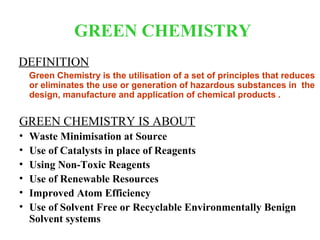
GREEN CHEMISTRY
DEFINITION
Green Chemistry is the utilisation of a set of principles that reduces
or eliminates the use or generation of hazardous substances in the
design, manufacture and application of chemical products .
GREEN CHEMISTRY IS ABOUT
• Waste Minimisation at Source
• Use of Catalysts in place of Reagents
• Using Non-Toxic Reagents
• Use of Renewable Resources
• Improved Atom Efficiency
• Use of Solvent Free or Recyclable Environmentally Benign
Solvent systems
Why do weneed Green Chemistry ?
• Chemistry is undeniably a very prominent
part of our daily lives.
• Chemical developments also bring new
environmental problems and harmful
unexpected side effects, which result in the
need for ‘greener’ chemical products.
• A famous example is the pesticide DDT.
5.
The 12 Principlesof Green Chemistry (1-6)
1. Prevention
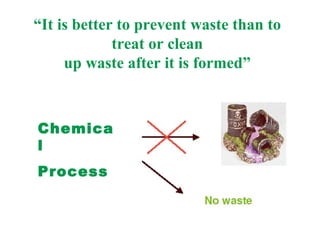
It is better to prevent waste than to treat or clean up waste after it has been created.
2. Atom Economy
Synthetic methods should be designed to maximise the incorporation of all materials
used in the process into the final product.
3. Less Hazardous Chemical Synthesis
Wherever practicable, synthetic methods should be designed to use and generate
substances that possess little or no toxicity to people or the environment.
4. Designing Safer Chemicals
Chemical products should be designed to effect their desired function while minimising
their toxicity.
5. Safer Solvents and Auxiliaries
The use of auxiliary substances (e.g., solvents or separation agents) should be made
unnecessary whenever possible and innocuous when used.
6. Design for Energy Efficiency
Energy requirements of chemical processes should be recognised for their environmental
and economic impacts and should be minimised. If possible, synthetic methods should be
conducted at ambient temperature and pressure.
6.
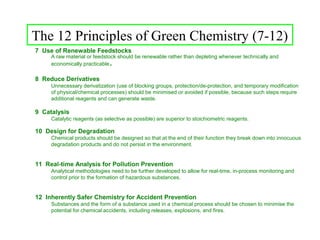
The 12 Principlesof Green Chemistry (7-12)
7 Use of Renewable Feedstocks
A raw material or feedstock should be renewable rather than depleting whenever technically and
economically practicable .
8 Reduce Derivatives
Unnecessary derivatization (use of blocking groups, protection/de-protection, and temporary modification
of physical/chemical processes) should be minimised or avoided if possible, because such steps require
additional reagents and can generate waste.
9 Catalysis
Catalytic reagents (as selective as possible) are superior to stoichiometric reagents.
10 Design for Degradation
Chemical products should be designed so that at the end of their function they break down into innocuous
degradation products and do not persist in the environment.
11 Real-time Analysis for Pollution Prevention
Analytical methodologies need to be further developed to allow for real-time, in-process monitoring and
control prior to the formation of hazardous substances.
12 Inherently Safer Chemistry for Accident Prevention
Substances and the form of a substance used in a chemical process should be chosen to minimise the
potential for chemical accidents, including releases, explosions, and fires.
7.
“It is betterto prevent waste than to
treat or clean
up waste after it is formed”
Chemica
l
Process
8.
The major usesof GREEN CHEMISTRY
• Energy
• Global Change
• Resource Depletion
• Food Supply
• Toxics in the Environment
9.
Conclusion
Green chemistry Not a solution
to all environmental problems But
the most fundamental approach to
preventing pollution.






![GREEN CHEMISTRY [IS A SOLUTION TO ENVIRONMENT PROBLEM?]](https://cdn.slidesharecdn.com/ss_thumbnails/60-191219142616-thumbnail.jpg?width=640&height=640&fit=bounds)


