Green Chemistry-
Preventing Pollution.
Sustaining the earth.
Dr. Roshini K Thumpakara
PG Department of Chemistry
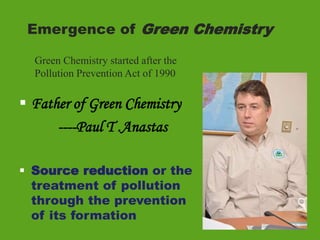
Emergence of Green Chemistry
 Father of Green Chemistry
----Paul T .Anastas
 Source reduction or the
treatment of pollution
through the prevention
of its formation
Green Chemistry started after the
Pollution Prevention Act of 1990
GREEN CHEMISTRY
Green Chemistry is the utilization of a set of principles that
reduces or eliminates the use or generation of hazardous
substances in the design, manufacture and application of chemical
products *.
Green chemistry seeks to reduce pollution at source.
Environmental chemistry focuses on the study of pollutant
chemicals and their effect on nature.
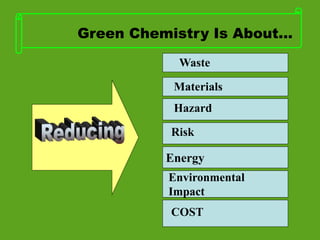
Green Chemistry Is About...
Waste
Materials
Hazard
Environmental
Impact
COST
Risk
Energy
5
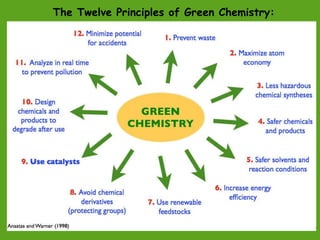
The Twelve Principles of Green Chemistry:
6
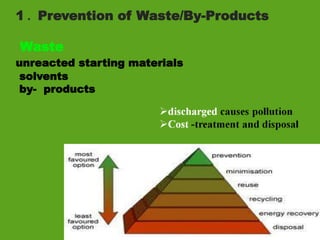
1 . Prevention of Waste/By-Products
Waste
unreacted starting materials
solvents
by- products
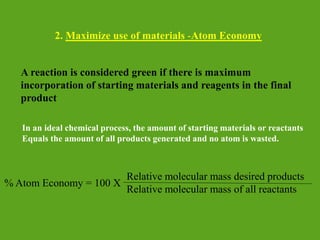
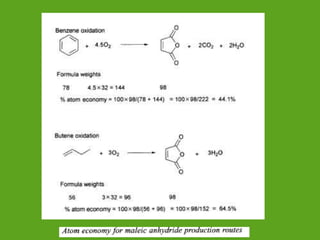
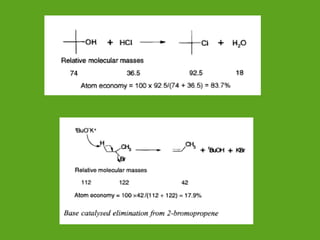
2. Maximize use of materials -Atom Economy
A reaction is considered green if there is maximum
incorporation of starting materials and reagents in the final
product
In an ideal chemical process, the amount of starting materials or reactants
Equals the amount of all products generated and no atom is wasted.
% Atom Economy = 100 X
Relative molecular mass desired products
Relative molecular mass of all reactants
Claisen Rearrangement reaction
Atom Economy = 100 %
Addition Reactions
Atom Economy = 100 %
Green Synthesis
Wherever practicable, synthetic methods should be designed to use and generate
substances that possess little or no toxicity to people or the environment
3. Minimisation of the use and production of hazardous and
toxic chemicals.
Adipic Acid
Benzene
Glucose
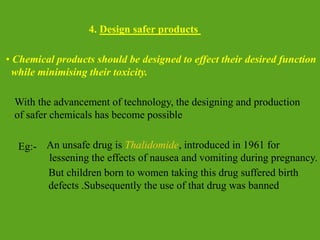
4. Design safer products
With the advancement of technology, the designing and production
of safer chemicals has become possible
Eg:- An unsafe drug is Thalidomide, introduced in 1961 for
lessening the effects of nausea and vomiting during pregnancy.
But children born to women taking this drug suffered birth
defects .Subsequently the use of that drug was banned
• Chemical products should be designed to effect their desired function
while minimising their toxicity.
5. Safer solvents and auxiliary substances
•The use of auxiliary substances (e.g., solvents or separation agents) should be
made unnecessary whenever possible and innocuous when used.
Many solvents used in traditional organic syntheses are highly toxic
Green chemistry approach:
 Use supercritical carbon dioxide as a solvent
 Reactions carried out using ordinary water as solvent
Ionic liquids are excellent solvents for many materials,
and they can be recycled.
Without the presence of any solvent
.
Design for Energy efficiency.
•Energy requirements of chemical processes should be
recognised for their environmental and economic
impacts and should be minimised.
Ways to conserve energy: green method
1.Using catalysts
2. Using microwave heating
3. Using ultrasound
4. Photochemical reaction using solar energy
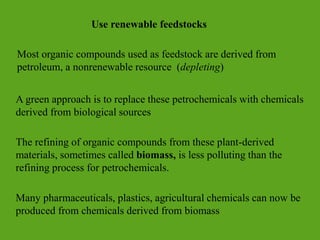
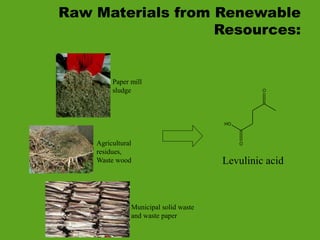
Use renewable feedstocks
Most organic compounds used as feedstock are derived from
petroleum, a nonrenewable resource (depleting)
A green approach is to replace these petrochemicals with chemicals
derived from biological sources
The refining of organic compounds from these plant-derived
materials, sometimes called biomass, is less polluting than the
refining process for petrochemicals.
Many pharmaceuticals, plastics, agricultural chemicals can now be
produced from chemicals derived from biomass
Raw Materials from Renewable
Resources:
O
HO
O
Paper mill
sludge
Levulinic acid
Municipal solid waste
and waste paper
Agricultural
residues,
Waste wood
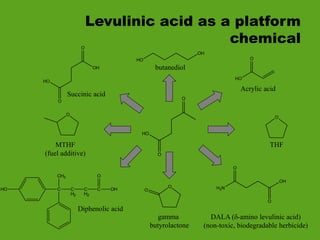
Levulinic acid as a platform
chemical
O
HO
O
O
H2N
OH
O
O
HO
DALA (-amino levulinic acid)
(non-toxic, biodegradable herbicide)
O
HO
O
OH
C
CH3
C
H2
C
H2
C
O
OH
HO
Diphenolic acid
Acrylic acid
Succinic acid
O
THF
O
MTHF
(fuel additive)
HO
OH
butanediol
O
O
gamma
butyrolactone
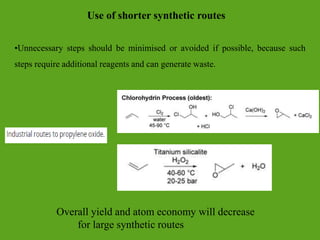
Use of shorter synthetic routes
•Unnecessary steps should be minimised or avoided if possible, because such
steps require additional reagents and can generate waste.
Overall yield and atom economy will decrease
for large synthetic routes
Use catalysis
 By the use of catalyst the need for large quantity of reagents can
be avoided that leads to waste stream
 Waste is generally reduced compared to the non-catalytic alternative
and better utilization of starting material.
 Better Yield and Atom economy
 Reaction become feasible in cases where no reaction is normally
possible
Green Nanocatalyst like gold nano particles,Silver nano particles etc
are very efficient in organic synthesis
Biocatalysis using enzymes are also very effective in green synthesis
 By increasing the rate of attainment of equilibrium through
lowering the activation energy, catalysts reduce the energy
requirement of a process
Design for degradation
Chemical products should be designed so that at the end of their function
they break down into innocuous degradation products and do not persist in
the environment.
The problem is encountered mainly in insecticides and polymers.
Real-time monitoring/control for Pollution Prevention
• Analytical methodologies need to be further developed to allow
for real-time, in-process monitoring and control prior to the formation of
hazardous substances.
Inherently Safer Chemistry for Accident Prevention
• The manufacturing plants should be designed to eliminate the possibility of
accidents during operation.
• Substances and the form of a substance used in a chemical process should
be chosen to minimise the potential for chemical accidents, including releases,
explosions, and fires.
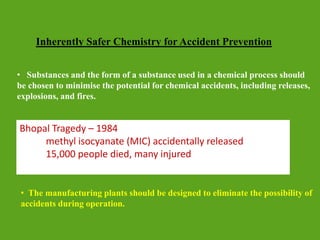
Bhopal Tragedy – 1984
methyl isocyanate (MIC) accidentally released
15,000 people died, many injured
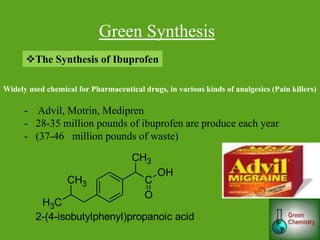
Green Synthesis
The Synthesis of Ibuprofen
Widely used chemical for Pharmaceutical drugs, in various kinds of analgesics (Pain killers)
- Advil, Motrin, Medipren
- 28-35 million pounds of ibuprofen are produce each year
- (37-46 million pounds of waste)
C
H3
CH3 C
CH3
O
OH
2-(4-isobutylphenyl)propanoic acid
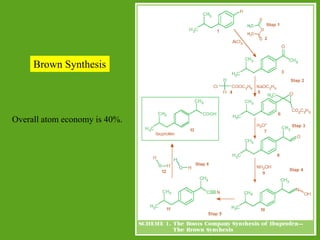
Brown Synthesis
Overall atom economy is 40%.
New "Greener" Ibuprofen Process
Overall atom economy is 77%
Advantages of BHC Synthesis of
Ibuprofen
Greater throughput and overall yield
(three steps versus five steps)
Greater atom economy (uses less feedstocks)
Fewer auxiliary substances (solvents separation agents)
Less waste (lower disposal costs)
Microwave assisted reactions
Microwaves lie in the electromagnetic spectrum between infrared waves and
radiowaves.
They have wavelengths between 0.01 and 1 metre, and operate in a
frequency range between 0.3 and 30 GHz.
However, for their use in laboratory reactions, a frequency of 2.45 GHz is preferred,
since this frequency has the right penetration depth for laboratory reaction conditions.
•Microwaves are used for heating purposes
•Homogeneous heating
•Teflon or potystyrene containers are used as reaction vessels
•Solvent used must be polar so as to absorb microwaves
Microwave assisted reactions in water
Efficient source of heating as energy directly imparted to the reaction medium
Rapid heating leads to saving of reaction time.
Smaller volume of solvent required
Diminishes the waste disposal problem
Advantages
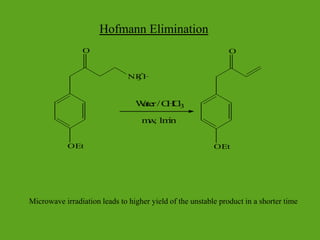
Hofmann Elimination
NR
3
+
I_
OEt
O
W
a
te
r/C
H
C
l3
m
w
,1
m
in
OEt
O
Microwave irradiation leads to higher yield of the unstable product in a shorter time
Microwave assisted reactions in organic solvent
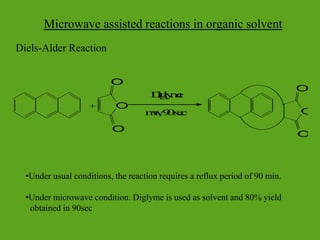
Diels-Alder Reaction
•Under usual conditions, the reaction requires a reflux period of 90 min.
•Under microwave condition. Diglyme is used as solvent and 80% yield
obtained in 90sec
O
O
O
D
i
g
l
y
m
e
m
w
,9
0
s
e
c O
O
O
+
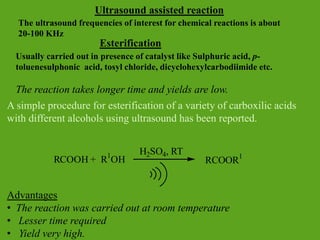
Esterification
Usually carried out in presence of catalyst like Sulphuric acid, p-
toluenesulphonic acid, tosyl chloride, dicyclohexylcarbodiimide etc.
The reaction takes longer time and yields are low.
A simple procedure for esterification of a variety of carboxilic acids
with different alcohols using ultrasound has been reported.
Advantages
• The reaction was carried out at room temperature
• Lesser time required
• Yield very high.
RCOOH + R1
OH RCOOR1
H2SO4, RT
Ultrasound assisted reaction
The ultrasound frequencies of interest for chemical reactions is about
20-100 KHz
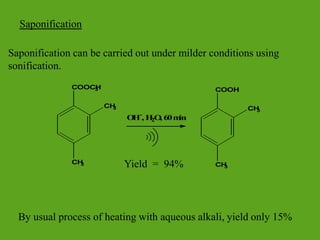
Saponification
Saponification can be carried out under milder conditions using
sonification.
Yield = 94%
COOCH
3
CH
3
CH
3
O
H-
, H
2O
, 60m
in
COOH
CH
3
CH
3
By usual process of heating with aqueous alkali, yield only 15%
In the end we can say that Green
chemistry is Not a solution to all
environmental problems But the most
fundamental approach to preventing
pollution
33

GreenChemistry.ppt

  • 1.
    Green Chemistry- Preventing Pollution. Sustainingthe earth. Dr. Roshini K Thumpakara PG Department of Chemistry
  • 2.
    Emergence of GreenChemistry  Father of Green Chemistry ----Paul T .Anastas  Source reduction or the treatment of pollution through the prevention of its formation Green Chemistry started after the Pollution Prevention Act of 1990
  • 3.
    GREEN CHEMISTRY Green Chemistryis the utilization of a set of principles that reduces or eliminates the use or generation of hazardous substances in the design, manufacture and application of chemical products *. Green chemistry seeks to reduce pollution at source. Environmental chemistry focuses on the study of pollutant chemicals and their effect on nature.
  • 4.
    Green Chemistry IsAbout... Waste Materials Hazard Environmental Impact COST Risk Energy
  • 5.
    5 The Twelve Principlesof Green Chemistry:
  • 6.
    6 1 . Preventionof Waste/By-Products Waste unreacted starting materials solvents by- products
  • 7.
    2. Maximize useof materials -Atom Economy A reaction is considered green if there is maximum incorporation of starting materials and reagents in the final product In an ideal chemical process, the amount of starting materials or reactants Equals the amount of all products generated and no atom is wasted. % Atom Economy = 100 X Relative molecular mass desired products Relative molecular mass of all reactants
  • 10.
    Claisen Rearrangement reaction AtomEconomy = 100 % Addition Reactions Atom Economy = 100 % Green Synthesis
  • 11.
    Wherever practicable, syntheticmethods should be designed to use and generate substances that possess little or no toxicity to people or the environment 3. Minimisation of the use and production of hazardous and toxic chemicals. Adipic Acid Benzene Glucose
  • 12.
    4. Design saferproducts With the advancement of technology, the designing and production of safer chemicals has become possible Eg:- An unsafe drug is Thalidomide, introduced in 1961 for lessening the effects of nausea and vomiting during pregnancy. But children born to women taking this drug suffered birth defects .Subsequently the use of that drug was banned • Chemical products should be designed to effect their desired function while minimising their toxicity.
  • 13.
    5. Safer solventsand auxiliary substances •The use of auxiliary substances (e.g., solvents or separation agents) should be made unnecessary whenever possible and innocuous when used. Many solvents used in traditional organic syntheses are highly toxic Green chemistry approach:  Use supercritical carbon dioxide as a solvent  Reactions carried out using ordinary water as solvent Ionic liquids are excellent solvents for many materials, and they can be recycled. Without the presence of any solvent .
  • 14.
    Design for Energyefficiency. •Energy requirements of chemical processes should be recognised for their environmental and economic impacts and should be minimised. Ways to conserve energy: green method 1.Using catalysts 2. Using microwave heating 3. Using ultrasound 4. Photochemical reaction using solar energy
  • 15.
    Use renewable feedstocks Mostorganic compounds used as feedstock are derived from petroleum, a nonrenewable resource (depleting) A green approach is to replace these petrochemicals with chemicals derived from biological sources The refining of organic compounds from these plant-derived materials, sometimes called biomass, is less polluting than the refining process for petrochemicals. Many pharmaceuticals, plastics, agricultural chemicals can now be produced from chemicals derived from biomass
  • 16.
    Raw Materials fromRenewable Resources: O HO O Paper mill sludge Levulinic acid Municipal solid waste and waste paper Agricultural residues, Waste wood
  • 17.
    Levulinic acid asa platform chemical O HO O O H2N OH O O HO DALA (-amino levulinic acid) (non-toxic, biodegradable herbicide) O HO O OH C CH3 C H2 C H2 C O OH HO Diphenolic acid Acrylic acid Succinic acid O THF O MTHF (fuel additive) HO OH butanediol O O gamma butyrolactone
  • 18.
    Use of shortersynthetic routes •Unnecessary steps should be minimised or avoided if possible, because such steps require additional reagents and can generate waste. Overall yield and atom economy will decrease for large synthetic routes
  • 19.
    Use catalysis  Bythe use of catalyst the need for large quantity of reagents can be avoided that leads to waste stream  Waste is generally reduced compared to the non-catalytic alternative and better utilization of starting material.  Better Yield and Atom economy  Reaction become feasible in cases where no reaction is normally possible Green Nanocatalyst like gold nano particles,Silver nano particles etc are very efficient in organic synthesis Biocatalysis using enzymes are also very effective in green synthesis  By increasing the rate of attainment of equilibrium through lowering the activation energy, catalysts reduce the energy requirement of a process
  • 20.
    Design for degradation Chemicalproducts should be designed so that at the end of their function they break down into innocuous degradation products and do not persist in the environment. The problem is encountered mainly in insecticides and polymers.
  • 21.
    Real-time monitoring/control forPollution Prevention • Analytical methodologies need to be further developed to allow for real-time, in-process monitoring and control prior to the formation of hazardous substances.
  • 22.
    Inherently Safer Chemistryfor Accident Prevention • The manufacturing plants should be designed to eliminate the possibility of accidents during operation. • Substances and the form of a substance used in a chemical process should be chosen to minimise the potential for chemical accidents, including releases, explosions, and fires. Bhopal Tragedy – 1984 methyl isocyanate (MIC) accidentally released 15,000 people died, many injured
  • 23.
    Green Synthesis The Synthesisof Ibuprofen Widely used chemical for Pharmaceutical drugs, in various kinds of analgesics (Pain killers) - Advil, Motrin, Medipren - 28-35 million pounds of ibuprofen are produce each year - (37-46 million pounds of waste) C H3 CH3 C CH3 O OH 2-(4-isobutylphenyl)propanoic acid
  • 24.
  • 25.
    New "Greener" IbuprofenProcess Overall atom economy is 77%
  • 26.
    Advantages of BHCSynthesis of Ibuprofen Greater throughput and overall yield (three steps versus five steps) Greater atom economy (uses less feedstocks) Fewer auxiliary substances (solvents separation agents) Less waste (lower disposal costs)
  • 27.
    Microwave assisted reactions Microwaveslie in the electromagnetic spectrum between infrared waves and radiowaves. They have wavelengths between 0.01 and 1 metre, and operate in a frequency range between 0.3 and 30 GHz. However, for their use in laboratory reactions, a frequency of 2.45 GHz is preferred, since this frequency has the right penetration depth for laboratory reaction conditions. •Microwaves are used for heating purposes •Homogeneous heating •Teflon or potystyrene containers are used as reaction vessels •Solvent used must be polar so as to absorb microwaves
  • 28.
    Microwave assisted reactionsin water Efficient source of heating as energy directly imparted to the reaction medium Rapid heating leads to saving of reaction time. Smaller volume of solvent required Diminishes the waste disposal problem Advantages
  • 29.
    Hofmann Elimination NR 3 + I_ OEt O W a te r/C H C l3 m w ,1 m in OEt O Microwave irradiationleads to higher yield of the unstable product in a shorter time
  • 30.
    Microwave assisted reactionsin organic solvent Diels-Alder Reaction •Under usual conditions, the reaction requires a reflux period of 90 min. •Under microwave condition. Diglyme is used as solvent and 80% yield obtained in 90sec O O O D i g l y m e m w ,9 0 s e c O O O +
  • 31.
    Esterification Usually carried outin presence of catalyst like Sulphuric acid, p- toluenesulphonic acid, tosyl chloride, dicyclohexylcarbodiimide etc. The reaction takes longer time and yields are low. A simple procedure for esterification of a variety of carboxilic acids with different alcohols using ultrasound has been reported. Advantages • The reaction was carried out at room temperature • Lesser time required • Yield very high. RCOOH + R1 OH RCOOR1 H2SO4, RT Ultrasound assisted reaction The ultrasound frequencies of interest for chemical reactions is about 20-100 KHz
  • 32.
    Saponification Saponification can becarried out under milder conditions using sonification. Yield = 94% COOCH 3 CH 3 CH 3 O H- , H 2O , 60m in COOH CH 3 CH 3 By usual process of heating with aqueous alkali, yield only 15%
  • 33.
    In the endwe can say that Green chemistry is Not a solution to all environmental problems But the most fundamental approach to preventing pollution 33