Presented by:
Santosh Kumar Sahoo
Research Scholar
NIPER Hyderabad
CONTENTS:
Introduction to Green chemistry.
Principles of Green chemistry.
Metrics
Perspective of pharmaceutical industries.
Green Discoveries
11/13/2016 2
• Highly chlorinated insecticide dichloro diphenyl trichloro ethane
(DDT) bio-accumulate in birds. This caused eggshell thinning and
nesting failures, resulting in dramatic population decline. In
mainstream scientific book, Silent Spring in 1962, Rachel Carson
was one of the first to call attention to this problem.
• DDT, polychlorinated biphenyls (PCBs), surfactants such as those
made from alkyl phenols and ethylene oxide can act as estrogen
mimics. The effects are now showing up in populations of native
animals, raising questions about possible effects in humans.
• Thalidomide was used to treat nausea in pregnant women till late
1962s. It was withdrawn from the market after several reported
newborn with birth defects.
• Chlorofluorocarbons were developed as safer alternatives to sulfur
dioxide and ammonia as refrigerants. Their role in the destruction
of the ozone layer was not anticipated.
• Tetraethyllead was used as an antiknock agent in gasoline until it
was learned that it was causing lead poisoning and lowering the IQ
in children.
• It still have not been decided what to do with the waste from
nuclear power plants that will remain radioactive for longer.
11/13/2016 3
• The natural insecticide Sabadilla, which is popular with organic farmers,
contains 30 alkaloids present at a level of 3–6% in the seeds of
Schoenocaulon officinale. It can affect cardiovascular system, respiration,
nerve fibers, and skeletal muscles of humans. Gastrointestinal symptoms
and hypotension may also result from its ingestion.
• Artificial sweetener saccharine contained in every tube of toothpaste is an
“anticipated” human carcinogen.
• Heterocyclic amines formed in the overcooking of meat; nitrosoamines,
aflatoxins, and other mycotoxins were associated with cancer risk.
• The use of radioactive material to preserve food is concerning.
• The discovery of Ziegler–Natta catalysis of stereospecific polymerization
alone resulted in major new polymers: polyethylene, Plastics that made
human life convenient which has become a measure cause of waste now.
• Manufacture of phloroglucinol, a reprographic chemical and pharmaceutical
intermediate was produced mainly from 2,4,6 - trinitrotoluene ( TNT ) that
forms solid waste containing Cr2(SO4)3, NH4Cl, FeCl3 , and KHSO4.
 “Better things for better living through chemistry”
 The challenge is to reduce the incidence and severity of accidents, waste,
the toxicity of chemicals, and the amount of energy used, while still
providing the goods that society needs.
 The choice is between “natural” and “chemical”
11/13/2016 4
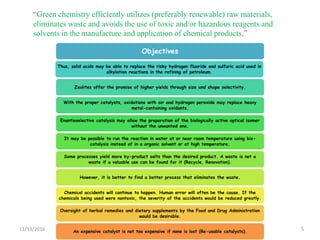
Objectives
Thus, solid acids may be able to replace the risky hydrogen fluoride and sulfuric acid used in
alkylation reactions in the refining of petroleum.
Zeolites offer the promise of higher yields through size and shape selectivity.
With the proper catalysts, oxidations with air and hydrogen peroxide may replace heavy
metal-containing oxidants.
Enantioselective catalysis may allow the preparation of the biologically active optical isomer
without the unwanted one.
It may be possible to run the reaction in water at or near room temperature using bio-
catalysis instead of in a organic solvent or at high temperature.
Some processes yield more by-product salts than the desired product. A waste is not a
waste if a valuable use can be found for it (Recycle, Renovation).
However, it is better to find a better process that eliminates the waste.
Chemical accidents will continue to happen. Human error will often be the cause. If the
chemicals being used were nontoxic, the severity of the accidents would be reduced greatly.
Oversight of herbal remedies and dietary supplements by the Food and Drug Administration
would be desirable.
An expensive catalyst is not too expensive if none is lost (Re-usable catalysts).11/13/2016 5
“Green chemistry efficiently utilizes (preferably renewable) raw materials,
eliminates waste and avoids the use of toxic and/or hazardous reagents and
solvents in the manufacture and application of chemical products.”
11/13/2016 611/13/2016 6
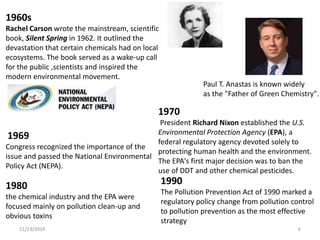
1960s
Rachel Carson wrote the mainstream, scientific
book, Silent Spring in 1962. It outlined the
devastation that certain chemicals had on local
ecosystems. The book served as a wake-up call
for the public ,scientists and inspired the
modern environmental movement.
1970
President Richard Nixon established the U.S.
Environmental Protection Agency (EPA), a
federal regulatory agency devoted solely to
protecting human health and the environment.
The EPA's first major decision was to ban the
use of DDT and other chemical pesticides.
1990
The Pollution Prevention Act of 1990 marked a
regulatory policy change from pollution control
to pollution prevention as the most effective
strategy
1980
the chemical industry and the EPA were
focused mainly on pollution clean-up and
obvious toxins
1969
Congress recognized the importance of the
issue and passed the National Environmental
Policy Act (NEPA).
Paul T. Anastas is known widely
as the "Father of Green Chemistry".
11/13/2016 7
Paul Anastas and John Warner formulated these guidelines in the 1990s
To provide a roadmap for chemists trying to implement green chemistry.
THE TWELVE PRINCIPLES OF GREEN CHEMISTRY
Nature, 2011, 469, 18
11/13/2016 8
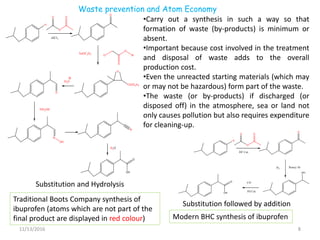
Traditional Boots Company synthesis of
ibuprofen (atoms which are not part of the
final product are displayed in red colour) Modern BHC synthesis of ibuprofen
Substitution followed by addition
Substitution and Hydrolysis
Waste prevention and Atom Economy
•Carry out a synthesis in such a way so that
formation of waste (by-products) is minimum or
absent.
•Important because cost involved in the treatment
and disposal of waste adds to the overall
production cost.
•Even the unreacted starting materials (which may
or may not be hazardous) form part of the waste.
•The waste (or by-products) if discharged (or
disposed off) in the atmosphere, sea or land not
only causes pollution but also requires expenditure
for cleaning-up.
11/13/2016 9
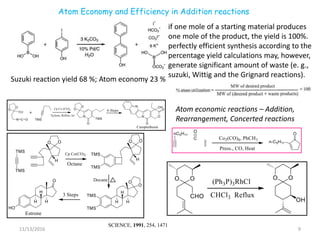
Atom Economy and Efficiency in Addition reactions
SCIENCE, 1991, 254, 1471
Suzuki reaction yield 68 %; Atom economy 23 %
if one mole of a starting material produces
one mole of the product, the yield is 100%.
perfectly efficient synthesis according to the
percentage yield calculations may, however,
generate significant amount of waste (e. g.,
suzuki, Wittig and the Grignard reactions).
Atom economic reactions – Addition,
Rearrangement, Concerted reactions
Safer Synthesis
 Formation of Chlorinated product and CO in reactions (of thionyl chloride, oxallyl
chloride with acids) and in Plastic industry; the use of mercuric acetate; Cr, Mn based
oxidizing agents should be minimized.
11/13/2016 10
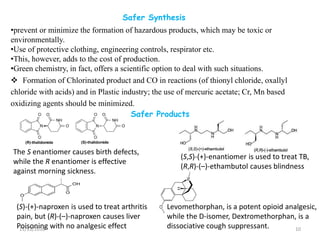
Safer Products
The S enantiomer causes birth defects,
while the R enantiomer is effective
against morning sickness.
(S,S)-(+)-enantiomer is used to treat TB,
(R,R)-(–)-ethambutol causes blindness
(S)-(+)-naproxen is used to treat arthritis
pain, but (R)-(–)-naproxen causes liver
Poisoning with no analgesic effect
Levomethorphan, is a potent opioid analgesic,
while the D-isomer, Dextromethorphan, is a
dissociative cough suppressant.
•prevent or minimize the formation of hazardous products, which may be toxic or
environmentally.
•Use of protective clothing, engineering controls, respirator etc.
•This, however, adds to the cost of production.
•Green chemistry, in fact, offers a scientific option to deal with such situations.
11
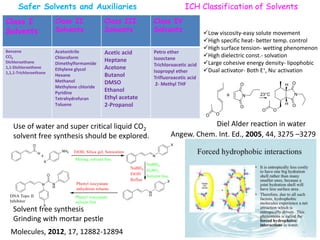
Class I
Solvents
Class II
Solvents
Class III
Solvents
Class IV
Solvents
Benzene
CCl4
Dichloroethane
1,1-Dichloroethene
1,1,1-Trichloroethane
Acetonitrile
Chloroform
Dimethylformamide
Ethylene glycol
Hexane
Methanol
Methylene chloride
Pyridine
Tetrahydrofuran
Toluene
Acetic acid
Heptane
Acetone
Butanol
DMSO
Ethanol
Ethyl acetate
2-Propanol
Petro ether
Isooctane
Trichloroacetic acid
Isopropyl ether
Trifluoroacetic acid
2- Methyl THF
Safer Solvents and Auxiliaries ICH Classification of Solvents
Use of water and super critical liquid CO2
solvent free synthesis should be explored.
Solvent free synthesis
Grinding with mortar pestle
Molecules, 2012, 17, 12882-12894
Angew. Chem. Int. Ed., 2005, 44, 3275 –3279
Diel Alder reaction in water
Low viscosity-easy solute movement
High specific heat- better temp. control
High surface tension- wetting phenomenon
High dielectric const.- solvation
Large cohesive energy density- lipophobic
Dual activator- Both E+, Nu- activation
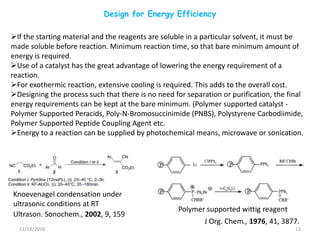
Design for Energy Efficiency
11/13/2016 12
Knoevenagel condensation under
ultrasonic conditions at RT
Ultrason. Sonochem., 2002, 9, 159
If the starting material and the reagents are soluble in a particular solvent, it must be
made soluble before reaction. Minimum reaction time, so that bare minimum amount of
energy is required.
Use of a catalyst has the great advantage of lowering the energy requirement of a
reaction.
For exothermic reaction, extensive cooling is required. This adds to the overall cost.
Designing the process such that there is no need for separation or purification, the final
energy requirements can be kept at the bare minimum. (Polymer supported catalyst -
Polymer Supported Peracids, Poly-N-Bromosuccinimide (PNBS), Polystyrene Carbodiimide,
Polymer Supported Peptide Coupling Agent etc.
Energy to a reaction can be supplied by photochemical means, microwave or sonication.
J Org. Chem., 1976, 41, 3877.
Polymer supported wittig reagent
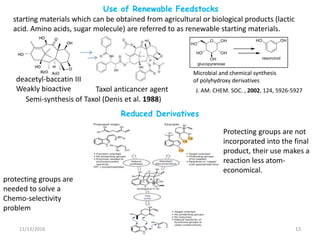
Reduced Derivatives
11/13/2016 13
Use of Renewable Feedstocks
deacetyl-baccatin III
Weakly bioactive Taxol anticancer agent
starting materials which can be obtained from agricultural or biological products (lactic
acid. Amino acids, sugar molecule) are referred to as renewable starting materials.
Semi-synthesis of Taxol (Denis et al. 1988)
Microbial and chemical synthesis
of polyhydroxy derivatives
J. AM. CHEM. SOC. , 2002, 124, 5926-5927
Protecting groups are not
incorporated into the final
product, their use makes a
reaction less atom-
economical.
protecting groups are
needed to solve a
Chemo-selectivity
problem
11/13/2016 14
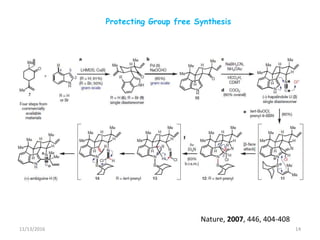
Nature, 2007, 446, 404-408
Protecting Group free Synthesis
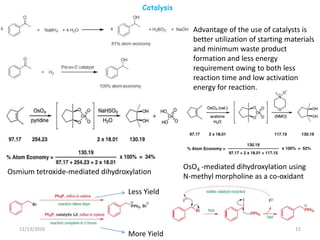
Catalysis
11/13/2016 15
Less Yield
More Yield
Osmium tetroxide-mediated dihydroxylation
OsO4 -mediated dihydroxylation using
N-methyl morpholine as a co-oxidant
Advantage of the use of catalysts is
better utilization of starting materials
and minimum waste product
formation and less energy
requirement owing to both less
reaction time and low activation
energy for reaction.
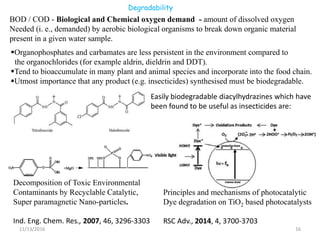
Degradability
11/13/2016 16
BOD / COD - Biological and Chemical oxygen demand - amount of dissolved oxygen
Needed (i. e., demanded) by aerobic biological organisms to break down organic material
present in a given water sample.
Decomposition of Toxic Environmental
Contaminants by Recyclable Catalytic,
Super paramagnetic Nano-particles.
Ind. Eng. Chem. Res., 2007, 46, 3296-3303
Principles and mechanisms of photocatalytic
Dye degradation on TiO2 based photocatalysts
RSC Adv., 2014, 4, 3700-3703
Organophosphates and carbamates are less persistent in the environment compared to
the organochlorides (for example aldrin, dieldrin and DDT).
Tend to bioaccumulate in many plant and animal species and incorporate into the food chain.
Utmost importance that any product (e.g. insecticides) synthesised must be biodegradable.
Easily biodegradable diacylhydrazines which have
been found to be useful as insecticides are:
Pollution Prevention
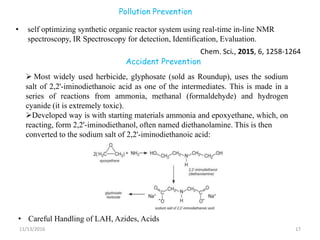
• self optimizing synthetic organic reactor system using real-time in-line NMR
spectroscopy, IR Spectroscopy for detection, Identification, Evaluation.
11/13/2016 17
Chem. Sci., 2015, 6, 1258-1264
Accident Prevention
 Most widely used herbicide, glyphosate (sold as Roundup), uses the sodium
salt of 2,2'-iminodiethanoic acid as one of the intermediates. This is made in a
series of reactions from ammonia, methanal (formaldehyde) and hydrogen
cyanide (it is extremely toxic).
Developed way is with starting materials ammonia and epoxyethane, which, on
reacting, form 2,2'-iminodiethanol, often named diethanolamine. This is then
converted to the sodium salt of 2,2'-iminodiethanoic acid:
• Careful Handling of LAH, Azides, Acids
Examples of Common Metrics
1. E-Factor.
2. Atom Economy.
3. Atom Efficiency.
4. Effective Mass Yield.
5. Carbon Efficiency.
6. Reaction Mass Efficiency.
11/13/2016 18
Green Chemistry Metrics
How do we measure the “greenness” of a reaction?
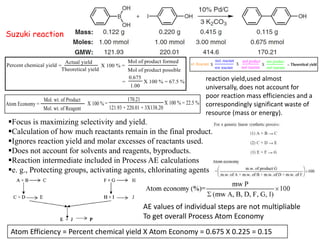
Atom Efficiency = Percent chemical yield X Atom Economy = 0.675 X 0.225 = 0.15
Focus is maximizing selectivity and yield.
Calculation of how much reactants remain in the final product.
Ignores reaction yield and molar excesses of reactants used.
Does not account for solvents and reagents, byproducts.
Reaction intermediate included in Process AE calculations
e. g., Protecting groups, activating agents, chlorinating agents
AE values of individual steps are not multipliable
To get overall Process Atom Economy
reaction yield,used almost
universally, does not account for
poor reaction mass efficiencies and a
correspondingly significant waste of
resource (mass or energy).
Suzuki reaction
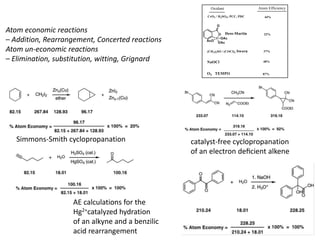
Atom economic reactions
– Addition, Rearrangement, Concerted reactions
Atom un-economic reactions
– Elimination, substitution, witting, Grignard
Simmons-Smith cyclopropanation catalyst-free cyclopropanation
of an electron deficient alkene
AE calculations for the
Hg2+catalyzed hydration
of an alkyne and a benzilic
acid rearrangement
2121
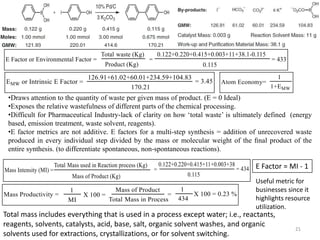
E Factor = MI - 1
•Draws attention to the quantity of waste per given mass of product. (E = 0 Ideal)
•Exposes the relative wastefulness of different parts of the chemical processing.
•Difficult for Pharmaceutical Industry-lack of clarity on how ‘total waste’ is ultimately defined (energy
based, emission treatment, waste solvent, reagents).
•E factor metrics are not additive. E factors for a multi-step synthesis = addition of unrecovered waste
produced in every individual step divided by the mass or molecular weight of the final product of the
entire synthesis. (to differentiate spontaneous, non-spontaneous reactions).
Total mass includes everything that is used in a process except water; i.e., reactants,
reagents, solvents, catalysts, acid, base, salt, organic solvent washes, and organic
solvents used for extractions, crystallizations, or for solvent switching.
Useful metric for
businesses since it
highlights resource
utilization.
11/13/2016 22
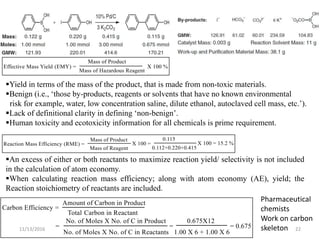
An excess of either or both reactants to maximize reaction yield/ selectivity is not included
in the calculation of atom economy.
When calculating reaction mass efficiency; along with atom economy (AE), yield; the
Reaction stoichiometry of reactants are included.
Yield in terms of the mass of the product, that is made from non-toxic materials.
Benign (i.e., ‘those by-products, reagents or solvents that have no known environmental
risk for example, water, low concentration saline, dilute ethanol, autoclaved cell mass, etc.’).
Lack of definitional clarity in defining ‘non-benign’.
Human toxicity and ecotoxicity information for all chemicals is prime requirement.
Pharmaceutical
chemists
Work on carbon
skeleton
11/13/2016 23
For different
equivalent
reagents
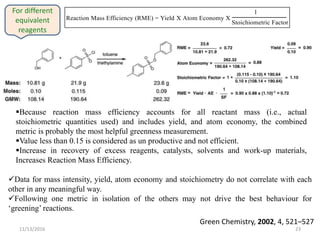
Data for mass intensity, yield, atom economy and stoichiometry do not correlate with each
other in any meaningful way.
Following one metric in isolation of the others may not drive the best behaviour for
‘greening’ reactions.
Because reaction mass efficiency accounts for all reactant mass (i.e., actual
stoichiometric quantities used) and includes yield, and atom economy, the combined
metric is probably the most helpful greenness measurement.
Value less than 0.15 is considered as un productive and not efficient.
Increase in recovery of excess reagents, catalysts, solvents and work-up materials,
Increases Reaction Mass Efficiency.
Green Chemistry, 2002, 4, 521–527
Perspective of pharmaceutical industries.
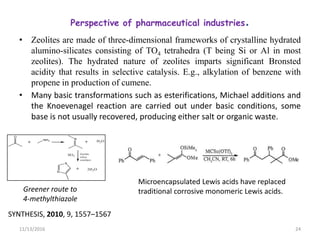
• Zeolites are made of three-dimensional frameworks of crystalline hydrated
alumino-silicates consisting of TO4 tetrahedra (T being Si or Al in most
zeolites). The hydrated nature of zeolites imparts significant Bronsted
acidity that results in selective catalysis. E.g., alkylation of benzene with
propene in production of cumene.
• Many basic transformations such as esterifications, Michael additions and
the Knoevenagel reaction are carried out under basic conditions, some
base is not usually recovered, producing either salt or organic waste.
11/13/2016 24
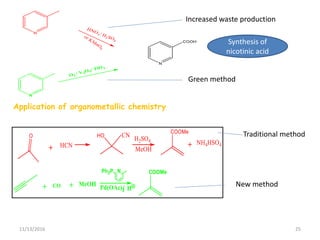
Greener route to
4-methylthiazole
SYNTHESIS, 2010, 9, 1557–1567
Microencapsulated Lewis acids have replaced
traditional corrosive monomeric Lewis acids.
11/13/2016 25
Increased waste production
Green method
Synthesis of
nicotinic acid
Application of organometallic chemistry
Traditional method
New method
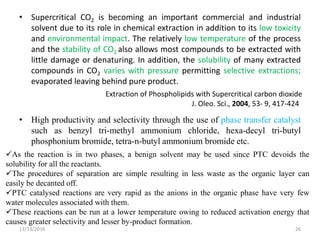
• Supercritical CO2 is becoming an important commercial and industrial
solvent due to its role in chemical extraction in addition to its low toxicity
and environmental impact. The relatively low temperature of the process
and the stability of CO2 also allows most compounds to be extracted with
little damage or denaturing. In addition, the solubility of many extracted
compounds in CO2 varies with pressure permitting selective extractions;
evaporated leaving behind pure product.
• High productivity and selectivity through the use of phase transfer catalyst
such as benzyl tri-methyl ammonium chloride, hexa-decyl tri-butyl
phosphonium bromide, tetra-n-butyl ammonium bromide etc.
11/13/2016 26
Extraction of Phospholipids with Supercritical carbon dioxide
J. Oleo. Sci., 2004, 53- 9, 417-424
As the reaction is in two phases, a benign solvent may be used since PTC devoids the
solubility for all the reactants.
The procedures of separation are simple resulting in less waste as the organic layer can
easily be decanted off.
PTC catalysed reactions are very rapid as the anions in the organic phase have very few
water molecules associated with them.
These reactions can be run at a lower temperature owing to reduced activation energy that
causes greater selectivity and lesser by-product formation.
11/13/2016 27
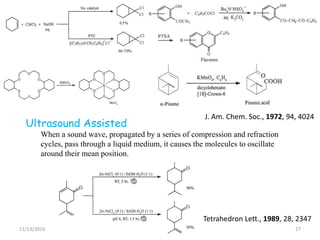
J. Am. Chem. Soc., 1972, 94, 4024
When a sound wave, propagated by a series of compression and refraction
cycles, pass through a liquid medium, it causes the molecules to oscillate
around their mean position.
Ultrasound Assisted
Tetrahedron Lett., 1989, 28, 2347
11/13/2016 28
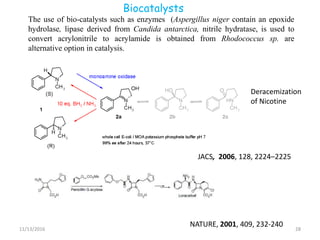
The use of bio-catalysts such as enzymes (Aspergillus niger contain an epoxide
hydrolase, lipase derived from Candida antarctica, nitrile hydratase, is used to
convert acrylonitrile to acrylamide is obtained from Rhodococcus sp. are
alternative option in catalysis.
JACS, 2006, 128, 2224–2225
Deracemization
of Nicotine
NATURE, 2001, 409, 232-240
Biocatalysts
11/13/2016 29
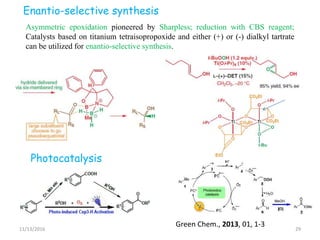
Asymmetric epoxidation pioneered by Sharpless; reduction with CBS reagent;
Catalysts based on titanium tetraisopropoxide and either (+) or (-) dialkyl tartrate
can be utilized for enantio-selective synthesis.
Photocatalysis
Green Chem., 2013, 01, 1-3
Enantio-selective synthesis
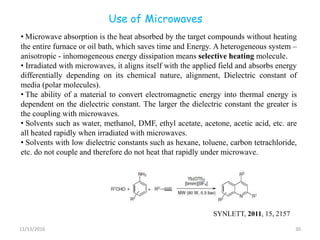
Use of Microwaves
11/13/2016 30
SYNLETT, 2011, 15, 2157
• Microwave absorption is the heat absorbed by the target compounds without heating
the entire furnace or oil bath, which saves time and Energy. A heterogeneous system –
anisotropic - inhomogeneous energy dissipation means selective heating molecule.
• Irradiated with microwaves, it aligns itself with the applied field and absorbs energy
differentially depending on its chemical nature, alignment, Dielectric constant of
media (polar molecules).
• The ability of a material to convert electromagnetic energy into thermal energy is
dependent on the dielectric constant. The larger the dielectric constant the greater is
the coupling with microwaves.
• Solvents such as water, methanol, DMF, ethyl acetate, acetone, acetic acid, etc. are
all heated rapidly when irradiated with microwaves.
• Solvents with low dielectric constants such as hexane, toluene, carbon tetrachloride,
etc. do not couple and therefore do not heat that rapidly under microwave.
Ionic Liquids
11/13/2016 31
Quaternization of an Amine or Phosphane followed by Lewis Acid
Multiphasic system, different selectivities, easy separation.
Heck Reaction- Synlett., 1996, 11, 1091
Beckmann Rearrangement-
Tetrahedron Letters, 2004, 45, 2681
Baeyer villiger rearrangement
Tetra Letters, 2003, 44, 8991
e. g., [emin]CI-AICI3 , their m.p.
and properties depend upon the
mole fractions of AICl3
and 1 ,3-dialkyl imidazolium
chloride present.
Green Discoveries
• 2006, Codexis, Inc. The key chiral building block for Atorvastatin
calcium synthesized by three biocatalysts greatly improved by directed
evolution.
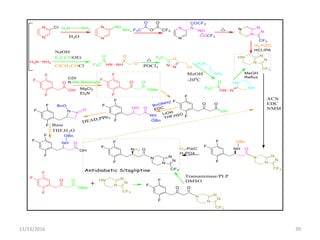
• 2006, Merck company synthesized Sitagliptin, the active ingredient in
JanuviaTM, used to treat type II diabetes, made by a novel green synthesis
from ß-amino acids.
• 2005, Merck company, Aprepitant, the active ingredient in Emend®,
used to treat chemotherapy-induced nausea and vomiting, made by a
convergent, highly atom-economical safer synthesis that also saves water
• 2004, Bristol-Myers Squibb Company, Paclitaxel, the active ingredient
in Taxol®, used to treat ovarian and breast cancer, synthesized by plant cell
fermentation.
• 2000, Roche Corporation, Ganciclovir, the active ingredient in
Cytovene® , a potent antiviral agent, synthesized by the guanine triester
process, eliminating 2 hazardous solid waste streams and 11 chemicals.
• Dowpharma and Pfizer Developed a Green, Energy Efficient,
Chemoenzymatic Manufacturing Process for Pregabalin (Lyrica).
11/13/2016 32
11/13/2016 33
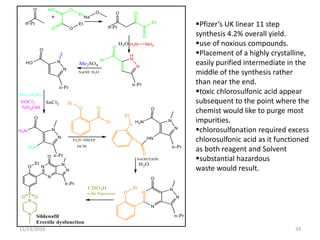
Pfizer’s UK linear 11 step
synthesis 4.2% overall yield.
use of noxious compounds.
Placement of a highly crystalline,
easily purified intermediate in the
middle of the synthesis rather
than near the end.
toxic chlorosulfonic acid appear
subsequent to the point where the
chemist would like to purge most
impurities.
chlorosulfonation required excess
chlorosulfonic acid as it functioned
as both reagent and Solvent
substantial hazardous
waste would result.
11/13/2016 34
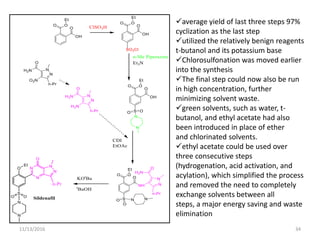
average yield of last three steps 97%
cyclization as the last step
utilized the relatively benign reagents
t-butanol and its potassium base
Chlorosulfonation was moved earlier
into the synthesis
The final step could now also be run
in high concentration, further
minimizing solvent waste.
green solvents, such as water, t-
butanol, and ethyl acetate had also
been introduced in place of ether
and chlorinated solvents.
ethyl acetate could be used over
three consecutive steps
(hydrogenation, acid activation, and
acylation), which simplified the process
and removed the need to completely
exchange solvents between all
steps, a major energy saving and waste
elimination
11/13/2016 35
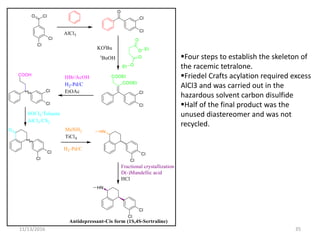
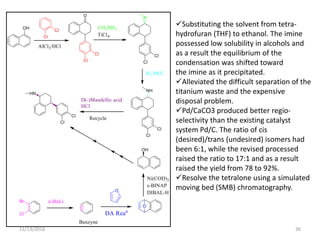
Four steps to establish the skeleton of
the racemic tetralone.
Friedel Crafts acylation required excess
AlCl3 and was carried out in the
hazardous solvent carbon disulfide
Half of the final product was the
unused diastereomer and was not
recycled.
11/13/2016 36
Substituting the solvent from tetra-
hydrofuran (THF) to ethanol. The imine
possessed low solubility in alcohols and
as a result the equilibrium of the
condensation was shifted toward
the imine as it precipitated.
Alleviated the difficult separation of the
titanium waste and the expensive
disposal problem.
Pd/CaCO3 produced better regio-
selectivity than the existing catalyst
system Pd/C. The ratio of cis
(desired)/trans (undesired) isomers had
been 6:1, while the revised processed
raised the ratio to 17:1 and as a result
raised the yield from 78 to 92%.
Resolve the tetralone using a simulated
moving bed (SMB) chromatography.
11/13/2016 37
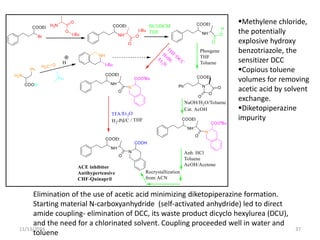
Methylene chloride,
the potentially
explosive hydroxy
benzotriazole, the
sensitizer DCC
Copious toluene
volumes for removing
acetic acid by solvent
exchange.
Diketopiperazine
impurity
Elimination of the use of acetic acid minimizing diketopiperazine formation.
Starting material N-carboxyanhydride (self-activated anhydride) led to direct
amide coupling- elimination of DCC, its waste product dicyclo hexylurea (DCU),
and the need for a chlorinated solvent. Coupling proceeded well in water and
toluene
11/13/2016 38
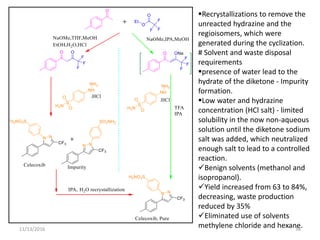
Recrystallizations to remove the
unreacted hydrazine and the
regioisomers, which were
generated during the cyclization.
# Solvent and waste disposal
requirements
presence of water lead to the
hydrate of the diketone - Impurity
formation.
Low water and hydrazine
concentration (HCl salt) - limited
solubility in the now non-aqueous
solution until the diketone sodium
salt was added, which neutralized
enough salt to lead to a controlled
reaction.
Benign solvents (methanol and
isopropanol).
Yield increased from 63 to 84%,
decreasing, waste production
reduced by 35%
Eliminated use of solvents
methylene chloride and hexane.
11/13/2016 39
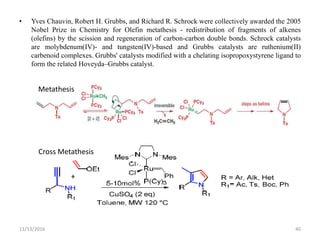
• Yves Chauvin, Robert H. Grubbs, and Richard R. Schrock were collectively awarded the 2005
Nobel Prize in Chemistry for Olefin metathesis - redistribution of fragments of alkenes
(olefins) by the scission and regeneration of carbon-carbon double bonds. Schrock catalysts
are molybdenum(IV)- and tungsten(IV)-based and Grubbs catalysts are ruthenium(II)
carbenoid complexes. Grubbs' catalysts modified with a chelating isopropoxystyrene ligand to
form the related Hoveyda–Grubbs catalyst.
11/13/2016 40
Metathesis
Cross Metathesis
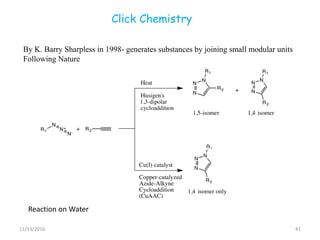
Click Chemistry
11/13/2016 41
By K. Barry Sharpless in 1998- generates substances by joining small modular units
Following Nature
Reaction on Water
11/13/2016 42

Green chemistry

  • 1.
    Presented by: Santosh KumarSahoo Research Scholar NIPER Hyderabad
  • 2.
    CONTENTS: Introduction to Greenchemistry. Principles of Green chemistry. Metrics Perspective of pharmaceutical industries. Green Discoveries 11/13/2016 2
  • 3.
    • Highly chlorinatedinsecticide dichloro diphenyl trichloro ethane (DDT) bio-accumulate in birds. This caused eggshell thinning and nesting failures, resulting in dramatic population decline. In mainstream scientific book, Silent Spring in 1962, Rachel Carson was one of the first to call attention to this problem. • DDT, polychlorinated biphenyls (PCBs), surfactants such as those made from alkyl phenols and ethylene oxide can act as estrogen mimics. The effects are now showing up in populations of native animals, raising questions about possible effects in humans. • Thalidomide was used to treat nausea in pregnant women till late 1962s. It was withdrawn from the market after several reported newborn with birth defects. • Chlorofluorocarbons were developed as safer alternatives to sulfur dioxide and ammonia as refrigerants. Their role in the destruction of the ozone layer was not anticipated. • Tetraethyllead was used as an antiknock agent in gasoline until it was learned that it was causing lead poisoning and lowering the IQ in children. • It still have not been decided what to do with the waste from nuclear power plants that will remain radioactive for longer. 11/13/2016 3
  • 4.
    • The naturalinsecticide Sabadilla, which is popular with organic farmers, contains 30 alkaloids present at a level of 3–6% in the seeds of Schoenocaulon officinale. It can affect cardiovascular system, respiration, nerve fibers, and skeletal muscles of humans. Gastrointestinal symptoms and hypotension may also result from its ingestion. • Artificial sweetener saccharine contained in every tube of toothpaste is an “anticipated” human carcinogen. • Heterocyclic amines formed in the overcooking of meat; nitrosoamines, aflatoxins, and other mycotoxins were associated with cancer risk. • The use of radioactive material to preserve food is concerning. • The discovery of Ziegler–Natta catalysis of stereospecific polymerization alone resulted in major new polymers: polyethylene, Plastics that made human life convenient which has become a measure cause of waste now. • Manufacture of phloroglucinol, a reprographic chemical and pharmaceutical intermediate was produced mainly from 2,4,6 - trinitrotoluene ( TNT ) that forms solid waste containing Cr2(SO4)3, NH4Cl, FeCl3 , and KHSO4.  “Better things for better living through chemistry”  The challenge is to reduce the incidence and severity of accidents, waste, the toxicity of chemicals, and the amount of energy used, while still providing the goods that society needs.  The choice is between “natural” and “chemical” 11/13/2016 4
  • 5.
    Objectives Thus, solid acidsmay be able to replace the risky hydrogen fluoride and sulfuric acid used in alkylation reactions in the refining of petroleum. Zeolites offer the promise of higher yields through size and shape selectivity. With the proper catalysts, oxidations with air and hydrogen peroxide may replace heavy metal-containing oxidants. Enantioselective catalysis may allow the preparation of the biologically active optical isomer without the unwanted one. It may be possible to run the reaction in water at or near room temperature using bio- catalysis instead of in a organic solvent or at high temperature. Some processes yield more by-product salts than the desired product. A waste is not a waste if a valuable use can be found for it (Recycle, Renovation). However, it is better to find a better process that eliminates the waste. Chemical accidents will continue to happen. Human error will often be the cause. If the chemicals being used were nontoxic, the severity of the accidents would be reduced greatly. Oversight of herbal remedies and dietary supplements by the Food and Drug Administration would be desirable. An expensive catalyst is not too expensive if none is lost (Re-usable catalysts).11/13/2016 5 “Green chemistry efficiently utilizes (preferably renewable) raw materials, eliminates waste and avoids the use of toxic and/or hazardous reagents and solvents in the manufacture and application of chemical products.”
  • 6.
    11/13/2016 611/13/2016 6 1960s RachelCarson wrote the mainstream, scientific book, Silent Spring in 1962. It outlined the devastation that certain chemicals had on local ecosystems. The book served as a wake-up call for the public ,scientists and inspired the modern environmental movement. 1970 President Richard Nixon established the U.S. Environmental Protection Agency (EPA), a federal regulatory agency devoted solely to protecting human health and the environment. The EPA's first major decision was to ban the use of DDT and other chemical pesticides. 1990 The Pollution Prevention Act of 1990 marked a regulatory policy change from pollution control to pollution prevention as the most effective strategy 1980 the chemical industry and the EPA were focused mainly on pollution clean-up and obvious toxins 1969 Congress recognized the importance of the issue and passed the National Environmental Policy Act (NEPA). Paul T. Anastas is known widely as the "Father of Green Chemistry".
  • 7.
    11/13/2016 7 Paul Anastasand John Warner formulated these guidelines in the 1990s To provide a roadmap for chemists trying to implement green chemistry. THE TWELVE PRINCIPLES OF GREEN CHEMISTRY Nature, 2011, 469, 18
  • 8.
    11/13/2016 8 Traditional BootsCompany synthesis of ibuprofen (atoms which are not part of the final product are displayed in red colour) Modern BHC synthesis of ibuprofen Substitution followed by addition Substitution and Hydrolysis Waste prevention and Atom Economy •Carry out a synthesis in such a way so that formation of waste (by-products) is minimum or absent. •Important because cost involved in the treatment and disposal of waste adds to the overall production cost. •Even the unreacted starting materials (which may or may not be hazardous) form part of the waste. •The waste (or by-products) if discharged (or disposed off) in the atmosphere, sea or land not only causes pollution but also requires expenditure for cleaning-up.
  • 9.
    11/13/2016 9 Atom Economyand Efficiency in Addition reactions SCIENCE, 1991, 254, 1471 Suzuki reaction yield 68 %; Atom economy 23 % if one mole of a starting material produces one mole of the product, the yield is 100%. perfectly efficient synthesis according to the percentage yield calculations may, however, generate significant amount of waste (e. g., suzuki, Wittig and the Grignard reactions). Atom economic reactions – Addition, Rearrangement, Concerted reactions
  • 10.
    Safer Synthesis  Formationof Chlorinated product and CO in reactions (of thionyl chloride, oxallyl chloride with acids) and in Plastic industry; the use of mercuric acetate; Cr, Mn based oxidizing agents should be minimized. 11/13/2016 10 Safer Products The S enantiomer causes birth defects, while the R enantiomer is effective against morning sickness. (S,S)-(+)-enantiomer is used to treat TB, (R,R)-(–)-ethambutol causes blindness (S)-(+)-naproxen is used to treat arthritis pain, but (R)-(–)-naproxen causes liver Poisoning with no analgesic effect Levomethorphan, is a potent opioid analgesic, while the D-isomer, Dextromethorphan, is a dissociative cough suppressant. •prevent or minimize the formation of hazardous products, which may be toxic or environmentally. •Use of protective clothing, engineering controls, respirator etc. •This, however, adds to the cost of production. •Green chemistry, in fact, offers a scientific option to deal with such situations.
  • 11.
    11 Class I Solvents Class II Solvents ClassIII Solvents Class IV Solvents Benzene CCl4 Dichloroethane 1,1-Dichloroethene 1,1,1-Trichloroethane Acetonitrile Chloroform Dimethylformamide Ethylene glycol Hexane Methanol Methylene chloride Pyridine Tetrahydrofuran Toluene Acetic acid Heptane Acetone Butanol DMSO Ethanol Ethyl acetate 2-Propanol Petro ether Isooctane Trichloroacetic acid Isopropyl ether Trifluoroacetic acid 2- Methyl THF Safer Solvents and Auxiliaries ICH Classification of Solvents Use of water and super critical liquid CO2 solvent free synthesis should be explored. Solvent free synthesis Grinding with mortar pestle Molecules, 2012, 17, 12882-12894 Angew. Chem. Int. Ed., 2005, 44, 3275 –3279 Diel Alder reaction in water Low viscosity-easy solute movement High specific heat- better temp. control High surface tension- wetting phenomenon High dielectric const.- solvation Large cohesive energy density- lipophobic Dual activator- Both E+, Nu- activation
  • 12.
    Design for EnergyEfficiency 11/13/2016 12 Knoevenagel condensation under ultrasonic conditions at RT Ultrason. Sonochem., 2002, 9, 159 If the starting material and the reagents are soluble in a particular solvent, it must be made soluble before reaction. Minimum reaction time, so that bare minimum amount of energy is required. Use of a catalyst has the great advantage of lowering the energy requirement of a reaction. For exothermic reaction, extensive cooling is required. This adds to the overall cost. Designing the process such that there is no need for separation or purification, the final energy requirements can be kept at the bare minimum. (Polymer supported catalyst - Polymer Supported Peracids, Poly-N-Bromosuccinimide (PNBS), Polystyrene Carbodiimide, Polymer Supported Peptide Coupling Agent etc. Energy to a reaction can be supplied by photochemical means, microwave or sonication. J Org. Chem., 1976, 41, 3877. Polymer supported wittig reagent
  • 13.
    Reduced Derivatives 11/13/2016 13 Useof Renewable Feedstocks deacetyl-baccatin III Weakly bioactive Taxol anticancer agent starting materials which can be obtained from agricultural or biological products (lactic acid. Amino acids, sugar molecule) are referred to as renewable starting materials. Semi-synthesis of Taxol (Denis et al. 1988) Microbial and chemical synthesis of polyhydroxy derivatives J. AM. CHEM. SOC. , 2002, 124, 5926-5927 Protecting groups are not incorporated into the final product, their use makes a reaction less atom- economical. protecting groups are needed to solve a Chemo-selectivity problem
  • 14.
    11/13/2016 14 Nature, 2007,446, 404-408 Protecting Group free Synthesis
  • 15.
    Catalysis 11/13/2016 15 Less Yield MoreYield Osmium tetroxide-mediated dihydroxylation OsO4 -mediated dihydroxylation using N-methyl morpholine as a co-oxidant Advantage of the use of catalysts is better utilization of starting materials and minimum waste product formation and less energy requirement owing to both less reaction time and low activation energy for reaction.
  • 16.
    Degradability 11/13/2016 16 BOD /COD - Biological and Chemical oxygen demand - amount of dissolved oxygen Needed (i. e., demanded) by aerobic biological organisms to break down organic material present in a given water sample. Decomposition of Toxic Environmental Contaminants by Recyclable Catalytic, Super paramagnetic Nano-particles. Ind. Eng. Chem. Res., 2007, 46, 3296-3303 Principles and mechanisms of photocatalytic Dye degradation on TiO2 based photocatalysts RSC Adv., 2014, 4, 3700-3703 Organophosphates and carbamates are less persistent in the environment compared to the organochlorides (for example aldrin, dieldrin and DDT). Tend to bioaccumulate in many plant and animal species and incorporate into the food chain. Utmost importance that any product (e.g. insecticides) synthesised must be biodegradable. Easily biodegradable diacylhydrazines which have been found to be useful as insecticides are:
  • 17.
    Pollution Prevention • selfoptimizing synthetic organic reactor system using real-time in-line NMR spectroscopy, IR Spectroscopy for detection, Identification, Evaluation. 11/13/2016 17 Chem. Sci., 2015, 6, 1258-1264 Accident Prevention  Most widely used herbicide, glyphosate (sold as Roundup), uses the sodium salt of 2,2'-iminodiethanoic acid as one of the intermediates. This is made in a series of reactions from ammonia, methanal (formaldehyde) and hydrogen cyanide (it is extremely toxic). Developed way is with starting materials ammonia and epoxyethane, which, on reacting, form 2,2'-iminodiethanol, often named diethanolamine. This is then converted to the sodium salt of 2,2'-iminodiethanoic acid: • Careful Handling of LAH, Azides, Acids
  • 18.
    Examples of CommonMetrics 1. E-Factor. 2. Atom Economy. 3. Atom Efficiency. 4. Effective Mass Yield. 5. Carbon Efficiency. 6. Reaction Mass Efficiency. 11/13/2016 18 Green Chemistry Metrics How do we measure the “greenness” of a reaction?
  • 19.
    Atom Efficiency =Percent chemical yield X Atom Economy = 0.675 X 0.225 = 0.15 Focus is maximizing selectivity and yield. Calculation of how much reactants remain in the final product. Ignores reaction yield and molar excesses of reactants used. Does not account for solvents and reagents, byproducts. Reaction intermediate included in Process AE calculations e. g., Protecting groups, activating agents, chlorinating agents AE values of individual steps are not multipliable To get overall Process Atom Economy reaction yield,used almost universally, does not account for poor reaction mass efficiencies and a correspondingly significant waste of resource (mass or energy). Suzuki reaction
  • 20.
    Atom economic reactions –Addition, Rearrangement, Concerted reactions Atom un-economic reactions – Elimination, substitution, witting, Grignard Simmons-Smith cyclopropanation catalyst-free cyclopropanation of an electron deficient alkene AE calculations for the Hg2+catalyzed hydration of an alkyne and a benzilic acid rearrangement
  • 21.
    2121 E Factor =MI - 1 •Draws attention to the quantity of waste per given mass of product. (E = 0 Ideal) •Exposes the relative wastefulness of different parts of the chemical processing. •Difficult for Pharmaceutical Industry-lack of clarity on how ‘total waste’ is ultimately defined (energy based, emission treatment, waste solvent, reagents). •E factor metrics are not additive. E factors for a multi-step synthesis = addition of unrecovered waste produced in every individual step divided by the mass or molecular weight of the final product of the entire synthesis. (to differentiate spontaneous, non-spontaneous reactions). Total mass includes everything that is used in a process except water; i.e., reactants, reagents, solvents, catalysts, acid, base, salt, organic solvent washes, and organic solvents used for extractions, crystallizations, or for solvent switching. Useful metric for businesses since it highlights resource utilization.
  • 22.
    11/13/2016 22 An excessof either or both reactants to maximize reaction yield/ selectivity is not included in the calculation of atom economy. When calculating reaction mass efficiency; along with atom economy (AE), yield; the Reaction stoichiometry of reactants are included. Yield in terms of the mass of the product, that is made from non-toxic materials. Benign (i.e., ‘those by-products, reagents or solvents that have no known environmental risk for example, water, low concentration saline, dilute ethanol, autoclaved cell mass, etc.’). Lack of definitional clarity in defining ‘non-benign’. Human toxicity and ecotoxicity information for all chemicals is prime requirement. Pharmaceutical chemists Work on carbon skeleton
  • 23.
    11/13/2016 23 For different equivalent reagents Datafor mass intensity, yield, atom economy and stoichiometry do not correlate with each other in any meaningful way. Following one metric in isolation of the others may not drive the best behaviour for ‘greening’ reactions. Because reaction mass efficiency accounts for all reactant mass (i.e., actual stoichiometric quantities used) and includes yield, and atom economy, the combined metric is probably the most helpful greenness measurement. Value less than 0.15 is considered as un productive and not efficient. Increase in recovery of excess reagents, catalysts, solvents and work-up materials, Increases Reaction Mass Efficiency. Green Chemistry, 2002, 4, 521–527
  • 24.
    Perspective of pharmaceuticalindustries. • Zeolites are made of three-dimensional frameworks of crystalline hydrated alumino-silicates consisting of TO4 tetrahedra (T being Si or Al in most zeolites). The hydrated nature of zeolites imparts significant Bronsted acidity that results in selective catalysis. E.g., alkylation of benzene with propene in production of cumene. • Many basic transformations such as esterifications, Michael additions and the Knoevenagel reaction are carried out under basic conditions, some base is not usually recovered, producing either salt or organic waste. 11/13/2016 24 Greener route to 4-methylthiazole SYNTHESIS, 2010, 9, 1557–1567 Microencapsulated Lewis acids have replaced traditional corrosive monomeric Lewis acids.
  • 25.
    11/13/2016 25 Increased wasteproduction Green method Synthesis of nicotinic acid Application of organometallic chemistry Traditional method New method
  • 26.
    • Supercritical CO2is becoming an important commercial and industrial solvent due to its role in chemical extraction in addition to its low toxicity and environmental impact. The relatively low temperature of the process and the stability of CO2 also allows most compounds to be extracted with little damage or denaturing. In addition, the solubility of many extracted compounds in CO2 varies with pressure permitting selective extractions; evaporated leaving behind pure product. • High productivity and selectivity through the use of phase transfer catalyst such as benzyl tri-methyl ammonium chloride, hexa-decyl tri-butyl phosphonium bromide, tetra-n-butyl ammonium bromide etc. 11/13/2016 26 Extraction of Phospholipids with Supercritical carbon dioxide J. Oleo. Sci., 2004, 53- 9, 417-424 As the reaction is in two phases, a benign solvent may be used since PTC devoids the solubility for all the reactants. The procedures of separation are simple resulting in less waste as the organic layer can easily be decanted off. PTC catalysed reactions are very rapid as the anions in the organic phase have very few water molecules associated with them. These reactions can be run at a lower temperature owing to reduced activation energy that causes greater selectivity and lesser by-product formation.
  • 27.
    11/13/2016 27 J. Am.Chem. Soc., 1972, 94, 4024 When a sound wave, propagated by a series of compression and refraction cycles, pass through a liquid medium, it causes the molecules to oscillate around their mean position. Ultrasound Assisted Tetrahedron Lett., 1989, 28, 2347
  • 28.
    11/13/2016 28 The useof bio-catalysts such as enzymes (Aspergillus niger contain an epoxide hydrolase, lipase derived from Candida antarctica, nitrile hydratase, is used to convert acrylonitrile to acrylamide is obtained from Rhodococcus sp. are alternative option in catalysis. JACS, 2006, 128, 2224–2225 Deracemization of Nicotine NATURE, 2001, 409, 232-240 Biocatalysts
  • 29.
    11/13/2016 29 Asymmetric epoxidationpioneered by Sharpless; reduction with CBS reagent; Catalysts based on titanium tetraisopropoxide and either (+) or (-) dialkyl tartrate can be utilized for enantio-selective synthesis. Photocatalysis Green Chem., 2013, 01, 1-3 Enantio-selective synthesis
  • 30.
    Use of Microwaves 11/13/201630 SYNLETT, 2011, 15, 2157 • Microwave absorption is the heat absorbed by the target compounds without heating the entire furnace or oil bath, which saves time and Energy. A heterogeneous system – anisotropic - inhomogeneous energy dissipation means selective heating molecule. • Irradiated with microwaves, it aligns itself with the applied field and absorbs energy differentially depending on its chemical nature, alignment, Dielectric constant of media (polar molecules). • The ability of a material to convert electromagnetic energy into thermal energy is dependent on the dielectric constant. The larger the dielectric constant the greater is the coupling with microwaves. • Solvents such as water, methanol, DMF, ethyl acetate, acetone, acetic acid, etc. are all heated rapidly when irradiated with microwaves. • Solvents with low dielectric constants such as hexane, toluene, carbon tetrachloride, etc. do not couple and therefore do not heat that rapidly under microwave.
  • 31.
    Ionic Liquids 11/13/2016 31 Quaternizationof an Amine or Phosphane followed by Lewis Acid Multiphasic system, different selectivities, easy separation. Heck Reaction- Synlett., 1996, 11, 1091 Beckmann Rearrangement- Tetrahedron Letters, 2004, 45, 2681 Baeyer villiger rearrangement Tetra Letters, 2003, 44, 8991 e. g., [emin]CI-AICI3 , their m.p. and properties depend upon the mole fractions of AICl3 and 1 ,3-dialkyl imidazolium chloride present.
  • 32.
    Green Discoveries • 2006,Codexis, Inc. The key chiral building block for Atorvastatin calcium synthesized by three biocatalysts greatly improved by directed evolution. • 2006, Merck company synthesized Sitagliptin, the active ingredient in JanuviaTM, used to treat type II diabetes, made by a novel green synthesis from ß-amino acids. • 2005, Merck company, Aprepitant, the active ingredient in Emend®, used to treat chemotherapy-induced nausea and vomiting, made by a convergent, highly atom-economical safer synthesis that also saves water • 2004, Bristol-Myers Squibb Company, Paclitaxel, the active ingredient in Taxol®, used to treat ovarian and breast cancer, synthesized by plant cell fermentation. • 2000, Roche Corporation, Ganciclovir, the active ingredient in Cytovene® , a potent antiviral agent, synthesized by the guanine triester process, eliminating 2 hazardous solid waste streams and 11 chemicals. • Dowpharma and Pfizer Developed a Green, Energy Efficient, Chemoenzymatic Manufacturing Process for Pregabalin (Lyrica). 11/13/2016 32
  • 33.
    11/13/2016 33 Pfizer’s UKlinear 11 step synthesis 4.2% overall yield. use of noxious compounds. Placement of a highly crystalline, easily purified intermediate in the middle of the synthesis rather than near the end. toxic chlorosulfonic acid appear subsequent to the point where the chemist would like to purge most impurities. chlorosulfonation required excess chlorosulfonic acid as it functioned as both reagent and Solvent substantial hazardous waste would result.
  • 34.
    11/13/2016 34 average yieldof last three steps 97% cyclization as the last step utilized the relatively benign reagents t-butanol and its potassium base Chlorosulfonation was moved earlier into the synthesis The final step could now also be run in high concentration, further minimizing solvent waste. green solvents, such as water, t- butanol, and ethyl acetate had also been introduced in place of ether and chlorinated solvents. ethyl acetate could be used over three consecutive steps (hydrogenation, acid activation, and acylation), which simplified the process and removed the need to completely exchange solvents between all steps, a major energy saving and waste elimination
  • 35.
    11/13/2016 35 Four stepsto establish the skeleton of the racemic tetralone. Friedel Crafts acylation required excess AlCl3 and was carried out in the hazardous solvent carbon disulfide Half of the final product was the unused diastereomer and was not recycled.
  • 36.
    11/13/2016 36 Substituting thesolvent from tetra- hydrofuran (THF) to ethanol. The imine possessed low solubility in alcohols and as a result the equilibrium of the condensation was shifted toward the imine as it precipitated. Alleviated the difficult separation of the titanium waste and the expensive disposal problem. Pd/CaCO3 produced better regio- selectivity than the existing catalyst system Pd/C. The ratio of cis (desired)/trans (undesired) isomers had been 6:1, while the revised processed raised the ratio to 17:1 and as a result raised the yield from 78 to 92%. Resolve the tetralone using a simulated moving bed (SMB) chromatography.
  • 37.
    11/13/2016 37 Methylene chloride, thepotentially explosive hydroxy benzotriazole, the sensitizer DCC Copious toluene volumes for removing acetic acid by solvent exchange. Diketopiperazine impurity Elimination of the use of acetic acid minimizing diketopiperazine formation. Starting material N-carboxyanhydride (self-activated anhydride) led to direct amide coupling- elimination of DCC, its waste product dicyclo hexylurea (DCU), and the need for a chlorinated solvent. Coupling proceeded well in water and toluene
  • 38.
    11/13/2016 38 Recrystallizations toremove the unreacted hydrazine and the regioisomers, which were generated during the cyclization. # Solvent and waste disposal requirements presence of water lead to the hydrate of the diketone - Impurity formation. Low water and hydrazine concentration (HCl salt) - limited solubility in the now non-aqueous solution until the diketone sodium salt was added, which neutralized enough salt to lead to a controlled reaction. Benign solvents (methanol and isopropanol). Yield increased from 63 to 84%, decreasing, waste production reduced by 35% Eliminated use of solvents methylene chloride and hexane.
  • 39.
  • 40.
    • Yves Chauvin,Robert H. Grubbs, and Richard R. Schrock were collectively awarded the 2005 Nobel Prize in Chemistry for Olefin metathesis - redistribution of fragments of alkenes (olefins) by the scission and regeneration of carbon-carbon double bonds. Schrock catalysts are molybdenum(IV)- and tungsten(IV)-based and Grubbs catalysts are ruthenium(II) carbenoid complexes. Grubbs' catalysts modified with a chelating isopropoxystyrene ligand to form the related Hoveyda–Grubbs catalyst. 11/13/2016 40 Metathesis Cross Metathesis
  • 41.
    Click Chemistry 11/13/2016 41 ByK. Barry Sharpless in 1998- generates substances by joining small modular units Following Nature Reaction on Water
  • 42.