Green Chemistry
Paul Anastas: Father of Green Chemistry 2
Green Chemistry is about reducing
• Waste
• Materials
• Hazards
• Risks
• Energy
• Cost
3
Goals of Green Chemistry
1. To reduce adverse environmental impact, try appropriate and
innovative choice of material & their chemical
transformation.
2. To develop processes based on renewable rather than non-
renewable raw materials.
3. To develop processes that are less prone to obnoxious
chemical release, fires & explosion.
4. To minimize by-products in chemical transformation by
redesign of reactions & reaction sequences.
4
Goals of Green Chemistry
6. To develop products that degrade more rapidly in the
environment than the current products.
7. To reduce the requirements for hazardous persistent solvents
& extractants in chemical processes.
8. To improve energy efficiency by developing low temperature
& low pressure processes using new catalysts.
9. To develop efficient & reliable methods to monitor the
processes for better & improved controls.
5
Principles of
Green Chemistry
The 12 Principles of Green Chemistry
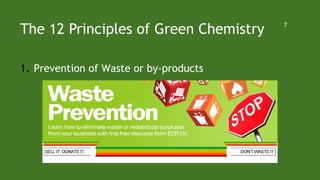
1. Prevention of Waste or by-products
7
The 12 Principles of Green Chemistry
1. Prevention of Waste or by-products
“It is better to prevent waste
than to treat or clean up waste
after it is formed”
8
The 12 Principles of Green Chemistry
•  
9
The 12 Principles of Green Chemistry
3. Minimization of hazardous products
Wherever practicable, synthetic methods should be
designed to use and generate substances that possess
little or no toxicity to people or the environment.
10
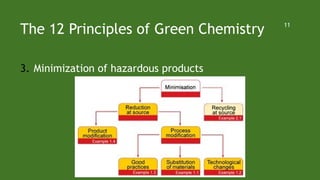
The 12 Principles of Green Chemistry
3. Minimization of hazardous products
11
The 12 Principles of Green Chemistry
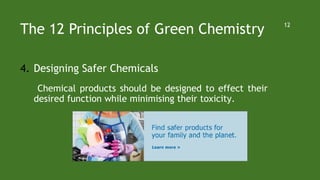
4. Designing Safer Chemicals
Chemical products should be designed to effect their
desired function while minimising their toxicity.
12
The 12 Principles of Green Chemistry
5. Safer Solvents & Auxiliaries
“The use of auxiliary substances (e.g. solvents,
separation agents, etc.) should be made unnecessary
wherever possible, and innocuous when used”
13
The 12 Principles of Green Chemistry 14
5. Safer Solvents & Auxiliaries
The 12 Principles of Green Chemistry
6. Design for Energy Efficiency
Energy requirements of chemical processes should be
recognised for their environmental and economic
impacts and should be minimised. If possible, synthetic
methods should be conducted at ambient temperature
and pressure.
15
The 12 Principles of Green Chemistry
6. Design for Energy Efficiency
Developing the alternatives for energy generation
(photovoltaic, hydrogen, fuel cells, bio based fuels,
etc.) as well as
Continue the path toward energy efficiency with
catalysis and product design at the forefront.
16
The 12 Principles of Green Chemistry
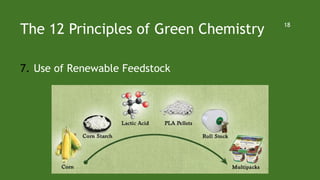
7. Use of Renewable Feedstock
“A raw material or feedstock should be renewable rather
than depleting whenever technically and economically
practicable.”
17
The 12 Principles of Green Chemistry 18
7. Use of Renewable Feedstock
The 12 Principles of Green Chemistry
8. Reduce Derivatives
Unnecessary derivatization (use of blocking groups,
protection/de-protection, and temporary modification
of physical/chemical processes) should be minimised or
avoided if possible, because such steps require
additional reagents and can generate waste.
19
The 12 Principles of Green Chemistry
8. Reduce Derivatives
More derivatives involve
 Additional Reagents
 Generate more waste products
 More Time
 Higher Cost of Products
20
The 12 Principles of Green Chemistry
9. Catalysis
Catalytic reagents (as selective as possible) are
superior to stoichiometric reagents.
e.g. Toluene can be exclusively converted into p-xylene
(avoiding o-xylene & m-xylene) by shape selective
zeolite catalyst.
21
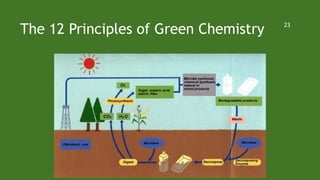
The 12 Principles of Green Chemistry
10. Designing of degradable products
Chemical products should be designed so that at the
end of their function they break down into innocuous
degradation products and do not persist in the
environment.
22
The 12 Principles of Green Chemistry 23
The 12 Principles of Green Chemistry
11. New Analytical Methods
“Analytical methodologies need to be further
developed to allow for real-time, in-process monitoring
and control prior to the formation of hazardous
substances.”
24
The 12 Principles of Green Chemistry
12. Safer Chemicals For Accident Prevention
“Analytical Substances and the form of a substance used in
a chemical process should be chosen to minimise the
potential for chemical accidents, including releases,
explosions, and fires.”
25
Efficiency Parameters
1. Reaction Yield
The reaction should have high percentage of yield.
•  
27
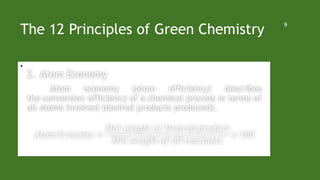
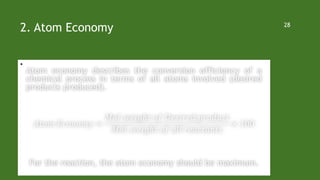
2. Atom Economy
•  
28
2. Atom Economy
e.g.
1. Rearrangement Reactions:
These reactions involves rearrangement of atoms that
forms molecule. Hence, the atom economy of these
reactions are 100%.
2. Addition Reactions:
These reactions involves addition of two or more
molecules without elimination that forms molecule.
Hence, the atom economy of these reactions are 100%
29
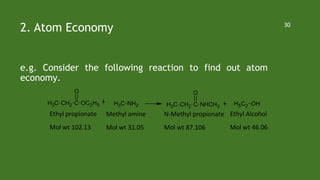
2. Atom Economy
e.g. Consider the following reaction to find out atom
economy.
30
CH3 CH2 C OC2H5
O
+ CH3 NH2
Ethyl propionate
Mol wt 102.13
Methyl amine
Mol wt 31.05
CH3 CH2 C NHCH3
O
N-Methyl propionate
Mol wt 87.106
+ H5C2 OH
Ethyl Alcohol
Mol wt 46.06
3. Conversion Factor
•  
31
4. Reaction Selectivity
•  
32
5. Environmental Load Factor 33
• It is represented by E and it should be minimum for reaction.
6. Mass Intensity 34
E = MI - 1
Pathways to Synthesis
Traditional & Green
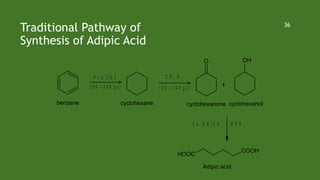
Traditional Pathway of
Synthesis of Adipic Acid
36
benzene
N i - A l 2 O 3
3 0 0 - 8 0 0 p s i
cyclohexane
C O , O 2
1 2 0 - 1 4 0 p s i
O
cyclohexanone
+
OH
cyclohexanol
C u , N H 4 V O 3
H N O 3
COOH
HOOC
Adipic acid
Drawbacks of Traditional Pathway
• Use of non-renewable, carcinogenic feedstock
• The reaction is energy consuming which works on
higher temperature & pressure
• More steps are required for synthesis
37
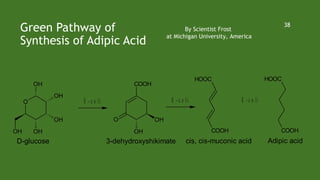
Green Pathway of
Synthesis of Adipic Acid
38
By Scientist Frost
at Michigan University, America
O
OH
OH
OH
OH
OH
D-glucose
E - c o li
COOH
O
OH
OH
3-dehydroxyshikimate
E - c o li
HOOC
COOH
cis, cis-muconic acid
E - c o li
HOOC
COOH
Adipic acid
Advantages of Green Pathway
• The reaction is cheap by using renewable
feedstock
• It requires safer pressure and temperature
• Fewer steps are required for synthesis
39
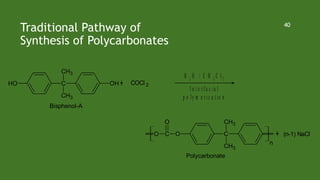
Traditional Pathway of
Synthesis of Polycarbonates
40
OH C
CH3
CH3
OH
Bisphenol-A
O C O
O
C
CH3
CH3
n
Polycarbonate
+ COCl 2
+ (n-1) NaCl
H 2 O / C H 2 C l2
I n t e r f a c ia l
p o ly m e r iz a t io n
Drawbacks of Traditional Pathway
• Uses of non-renewable (CH2Cl2), poisonous
solvent which is difficult to separate from
product
• Uses poisonous starting material phosgene
41
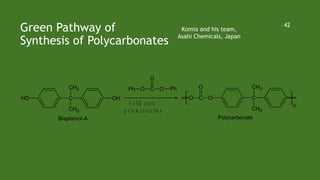
Green Pathway of
Synthesis of Polycarbonates
42
Komia and his team,
Asahi Chemicals, Japan
OH C
CH3
CH3
OH
Bisphenol-A
S o lid s t a t e
p o ly m e r iz a t io n
O C O
O
Ph Ph
O C O
O
C
CH3
CH3
n
Polycarbonate
Advantages of Green Pathway
• The reaction does not require solvent, it carries
in molten state
• It avoids use of poisonous starting materials.
43
NH2
Cl-CH2COOH
NH
COOH
NaNH2
N
H
C
OH
Oxidation
N
H
C
O
N
H
C
O
TryptophanAniline
Indigo Dye
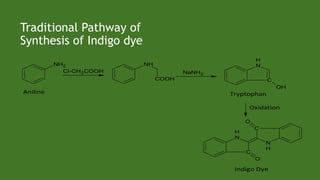
Traditional Pathway of
Synthesis of Indigo dye
Drawbacks of Traditional Pathway
• Uses of toxic aniline and harmful chloro-acetic
acid as a starting material
45
N
H
C
OH
Oxidation by air
N
H
C
O
N
H
C
O
L-Tryptophan
Indigo Dye
Tryptophanse
Enzyme N
H
CH
Naphthalene
Deoxygenase Enzyme
N
H
CH
OH
OH
Indole
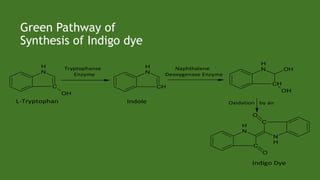
Green Pathway of
Synthesis of Indigo dye
Advantages of Green Pathway
• Renewable plant origin starting material
• Eco-friendly process
• Less steps in synthesis without waste matter
47
• Energy
• Global Change
• Resource Depletion
• Food Supply
• Toxics in the Environment
Major uses of Green Chemistry
Green chemistry Not a solution to all
environmental problems But the most
fundamental approach to prevent
pollution.
Conclusion
References
1. Green Chemistry: Environmentally Benign Reaction
By V. K. Ahluwalia, Ane Books India
1. Engineering Chemistry
By Jain & Jain
1. Engineering Chemistry
By O. G. Palanna

Green chemistry smd 123

  • 1.
  • 2.
    Paul Anastas: Fatherof Green Chemistry 2
  • 3.
    Green Chemistry isabout reducing • Waste • Materials • Hazards • Risks • Energy • Cost 3
  • 4.
    Goals of GreenChemistry 1. To reduce adverse environmental impact, try appropriate and innovative choice of material & their chemical transformation. 2. To develop processes based on renewable rather than non- renewable raw materials. 3. To develop processes that are less prone to obnoxious chemical release, fires & explosion. 4. To minimize by-products in chemical transformation by redesign of reactions & reaction sequences. 4
  • 5.
    Goals of GreenChemistry 6. To develop products that degrade more rapidly in the environment than the current products. 7. To reduce the requirements for hazardous persistent solvents & extractants in chemical processes. 8. To improve energy efficiency by developing low temperature & low pressure processes using new catalysts. 9. To develop efficient & reliable methods to monitor the processes for better & improved controls. 5
  • 6.
  • 7.
    The 12 Principlesof Green Chemistry 1. Prevention of Waste or by-products 7
  • 8.
    The 12 Principlesof Green Chemistry 1. Prevention of Waste or by-products “It is better to prevent waste than to treat or clean up waste after it is formed” 8
  • 9.
    The 12 Principlesof Green Chemistry •   9
  • 10.
    The 12 Principlesof Green Chemistry 3. Minimization of hazardous products Wherever practicable, synthetic methods should be designed to use and generate substances that possess little or no toxicity to people or the environment. 10
  • 11.
    The 12 Principlesof Green Chemistry 3. Minimization of hazardous products 11
  • 12.
    The 12 Principlesof Green Chemistry 4. Designing Safer Chemicals Chemical products should be designed to effect their desired function while minimising their toxicity. 12
  • 13.
    The 12 Principlesof Green Chemistry 5. Safer Solvents & Auxiliaries “The use of auxiliary substances (e.g. solvents, separation agents, etc.) should be made unnecessary wherever possible, and innocuous when used” 13
  • 14.
    The 12 Principlesof Green Chemistry 14 5. Safer Solvents & Auxiliaries
  • 15.
    The 12 Principlesof Green Chemistry 6. Design for Energy Efficiency Energy requirements of chemical processes should be recognised for their environmental and economic impacts and should be minimised. If possible, synthetic methods should be conducted at ambient temperature and pressure. 15
  • 16.
    The 12 Principlesof Green Chemistry 6. Design for Energy Efficiency Developing the alternatives for energy generation (photovoltaic, hydrogen, fuel cells, bio based fuels, etc.) as well as Continue the path toward energy efficiency with catalysis and product design at the forefront. 16
  • 17.
    The 12 Principlesof Green Chemistry 7. Use of Renewable Feedstock “A raw material or feedstock should be renewable rather than depleting whenever technically and economically practicable.” 17
  • 18.
    The 12 Principlesof Green Chemistry 18 7. Use of Renewable Feedstock
  • 19.
    The 12 Principlesof Green Chemistry 8. Reduce Derivatives Unnecessary derivatization (use of blocking groups, protection/de-protection, and temporary modification of physical/chemical processes) should be minimised or avoided if possible, because such steps require additional reagents and can generate waste. 19
  • 20.
    The 12 Principlesof Green Chemistry 8. Reduce Derivatives More derivatives involve  Additional Reagents  Generate more waste products  More Time  Higher Cost of Products 20
  • 21.
    The 12 Principlesof Green Chemistry 9. Catalysis Catalytic reagents (as selective as possible) are superior to stoichiometric reagents. e.g. Toluene can be exclusively converted into p-xylene (avoiding o-xylene & m-xylene) by shape selective zeolite catalyst. 21
  • 22.
    The 12 Principlesof Green Chemistry 10. Designing of degradable products Chemical products should be designed so that at the end of their function they break down into innocuous degradation products and do not persist in the environment. 22
  • 23.
    The 12 Principlesof Green Chemistry 23
  • 24.
    The 12 Principlesof Green Chemistry 11. New Analytical Methods “Analytical methodologies need to be further developed to allow for real-time, in-process monitoring and control prior to the formation of hazardous substances.” 24
  • 25.
    The 12 Principlesof Green Chemistry 12. Safer Chemicals For Accident Prevention “Analytical Substances and the form of a substance used in a chemical process should be chosen to minimise the potential for chemical accidents, including releases, explosions, and fires.” 25
  • 26.
  • 27.
    1. Reaction Yield Thereaction should have high percentage of yield. •   27
  • 28.
  • 29.
    2. Atom Economy e.g. 1.Rearrangement Reactions: These reactions involves rearrangement of atoms that forms molecule. Hence, the atom economy of these reactions are 100%. 2. Addition Reactions: These reactions involves addition of two or more molecules without elimination that forms molecule. Hence, the atom economy of these reactions are 100% 29
  • 30.
    2. Atom Economy e.g.Consider the following reaction to find out atom economy. 30 CH3 CH2 C OC2H5 O + CH3 NH2 Ethyl propionate Mol wt 102.13 Methyl amine Mol wt 31.05 CH3 CH2 C NHCH3 O N-Methyl propionate Mol wt 87.106 + H5C2 OH Ethyl Alcohol Mol wt 46.06
  • 31.
  • 32.
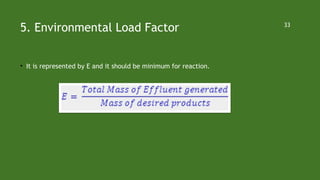
  • 33.
    5. Environmental LoadFactor 33 • It is represented by E and it should be minimum for reaction.
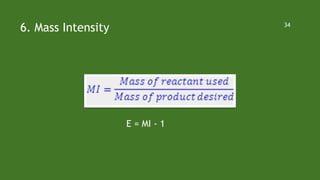
  • 34.
    6. Mass Intensity34 E = MI - 1
  • 35.
  • 36.
    Traditional Pathway of Synthesisof Adipic Acid 36 benzene N i - A l 2 O 3 3 0 0 - 8 0 0 p s i cyclohexane C O , O 2 1 2 0 - 1 4 0 p s i O cyclohexanone + OH cyclohexanol C u , N H 4 V O 3 H N O 3 COOH HOOC Adipic acid
  • 37.
    Drawbacks of TraditionalPathway • Use of non-renewable, carcinogenic feedstock • The reaction is energy consuming which works on higher temperature & pressure • More steps are required for synthesis 37
  • 38.
    Green Pathway of Synthesisof Adipic Acid 38 By Scientist Frost at Michigan University, America O OH OH OH OH OH D-glucose E - c o li COOH O OH OH 3-dehydroxyshikimate E - c o li HOOC COOH cis, cis-muconic acid E - c o li HOOC COOH Adipic acid
  • 39.
    Advantages of GreenPathway • The reaction is cheap by using renewable feedstock • It requires safer pressure and temperature • Fewer steps are required for synthesis 39
  • 40.
    Traditional Pathway of Synthesisof Polycarbonates 40 OH C CH3 CH3 OH Bisphenol-A O C O O C CH3 CH3 n Polycarbonate + COCl 2 + (n-1) NaCl H 2 O / C H 2 C l2 I n t e r f a c ia l p o ly m e r iz a t io n
  • 41.
    Drawbacks of TraditionalPathway • Uses of non-renewable (CH2Cl2), poisonous solvent which is difficult to separate from product • Uses poisonous starting material phosgene 41
  • 42.
    Green Pathway of Synthesisof Polycarbonates 42 Komia and his team, Asahi Chemicals, Japan OH C CH3 CH3 OH Bisphenol-A S o lid s t a t e p o ly m e r iz a t io n O C O O Ph Ph O C O O C CH3 CH3 n Polycarbonate
  • 43.
    Advantages of GreenPathway • The reaction does not require solvent, it carries in molten state • It avoids use of poisonous starting materials. 43
  • 44.
  • 45.
    Drawbacks of TraditionalPathway • Uses of toxic aniline and harmful chloro-acetic acid as a starting material 45
  • 46.
    N H C OH Oxidation by air N H C O N H C O L-Tryptophan IndigoDye Tryptophanse Enzyme N H CH Naphthalene Deoxygenase Enzyme N H CH OH OH Indole Green Pathway of Synthesis of Indigo dye
  • 47.
    Advantages of GreenPathway • Renewable plant origin starting material • Eco-friendly process • Less steps in synthesis without waste matter 47
  • 48.
    • Energy • GlobalChange • Resource Depletion • Food Supply • Toxics in the Environment Major uses of Green Chemistry
  • 49.
    Green chemistry Nota solution to all environmental problems But the most fundamental approach to prevent pollution. Conclusion
  • 50.
    References 1. Green Chemistry:Environmentally Benign Reaction By V. K. Ahluwalia, Ane Books India 1. Engineering Chemistry By Jain & Jain 1. Engineering Chemistry By O. G. Palanna

Editor's Notes

  • #3 Green chemistry, also called sustainable chemistry or clean chemistry. Environmental chemistry focuses on the effects of polluting chemicals on nature, green chemistry focuses on technological approaches for preventing pollution and reducing consumption of non-renewable resources. Green chemistry overlaps with all subdisciplines of chemistry but with a particular focus on chemical synthesis, process chemistry, and chemical engineering, in industrial applications. To a lesser extent, the principles of green chemistry also affect laboratory practices.
  • #4 In the United States, the Environmental Protection Agency played a significant early role in fostering green chemistry through its pollution prevention programs, funding, and professional coordination. At the same time in the United Kingdom, researchers at the University of York contributed to the establishment of the Green Chemistry Network within the Royal Society of Chemistry, and Launched the journal Green Chemistry.
  • #7 We designed this template so that each member of the project team has a set of slides with its own theme. Members, here’s how you add a new slide to just your set: Mark where you want to add the slide: Select an existing one in the Thumbnails pane, click the New Slide button, then choose a layout. The new slide gets the same theme as the other slides in your set. Careful! Don’t annoy your fellow presenters by accidentally changing their themes. That can happen if you choose a different theme from the Design tab, which changes all of the slides in the presentation to that look.