DLOC-4
GREEN BUILDING
CONSTRUCTIONS
Module No. 5
Green Building Rating Systems
- Dr. Rohan Dasgupta
Introduction
● Green building rating systems are frameworks that assess and certify the environmental
performance of buildings.
● These systems are designed to:
○ promote sustainable construction practices,
○ reduce environmental impact, and
○ improve the overall efficiency and performance of buildings.
● Different countries and regions have their own green building rating systems, but many share
common principles.
2
Evolution of Green Building Rating Systems
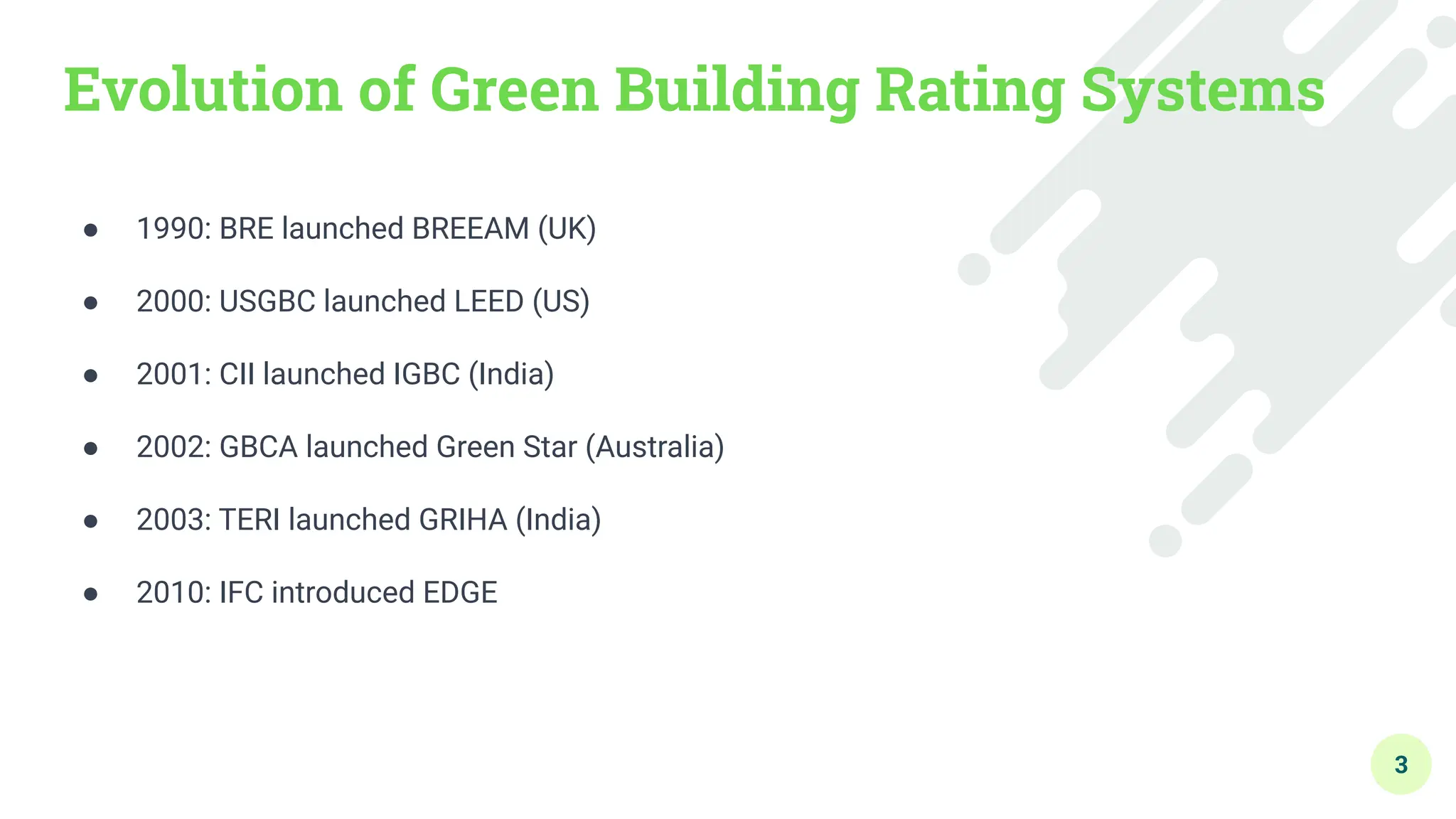
● 1990: BRE launched BREEAM (UK)
● 2000: USGBC launched LEED (US)
● 2001: CII launched IGBC (India)
● 2002: GBCA launched Green Star (Australia)
● 2003: TERI launched GRIHA (India)
● 2010: IFC introduced EDGE
3
Evolution of Green Building Rating Systems
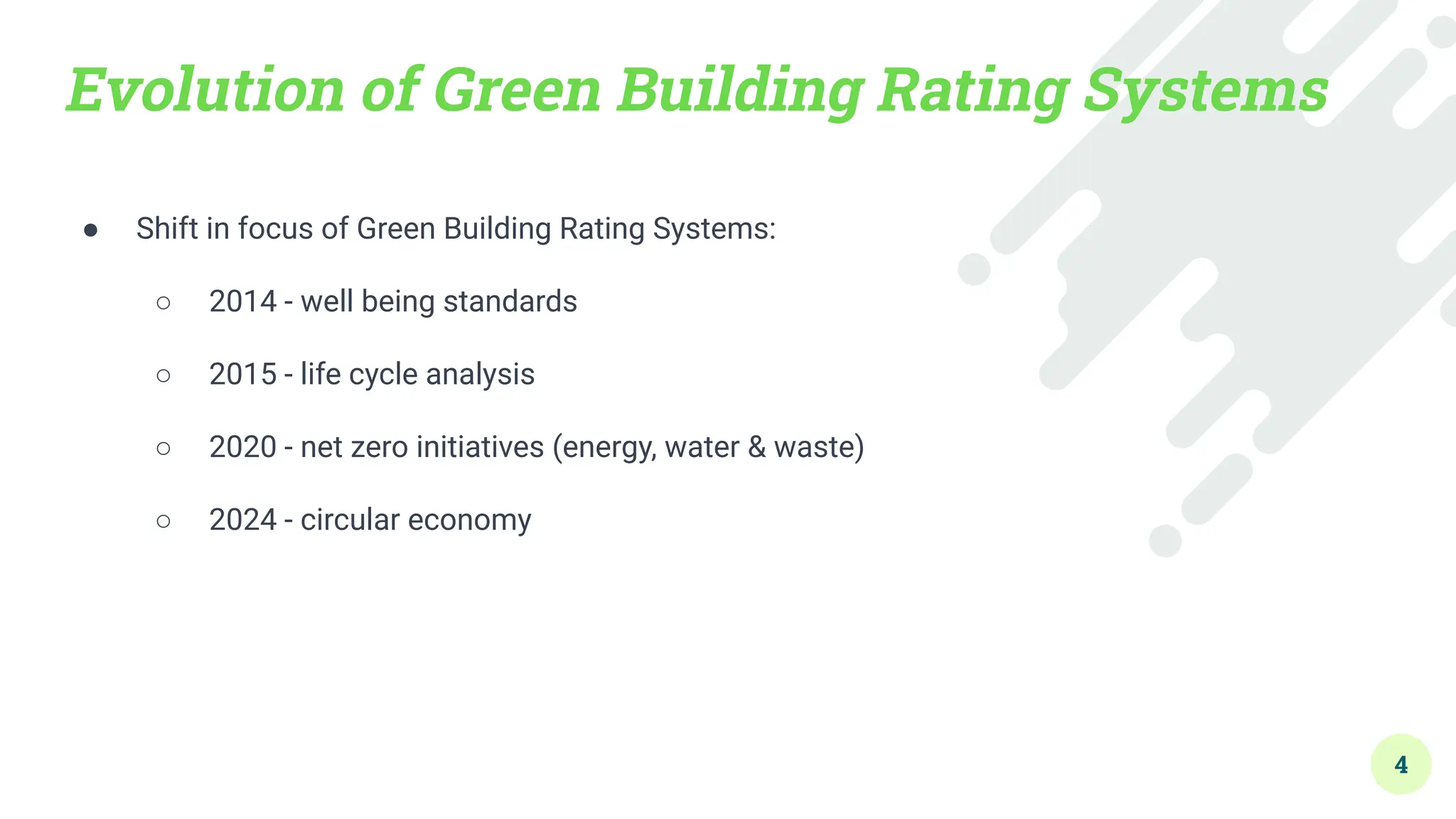
● Shift in focus of Green Building Rating Systems:
○ 2014 - well being standards
○ 2015 - life cycle analysis
○ 2020 - net zero initiatives (energy, water & waste)
○ 2024 - circular economy
4
5
Overview of
Green Building
Rating Systems
BREEAM
● BREEAM - Building Research Establishment Environmental Assessment Method
● World's first green building rating systems
● Launched in: 1990
● Launched by: UK’s Building Research Establishment (BRE).
● Purpose: To assess, certify, and encourage the sustainability of buildings, infrastructure, and
communities.
● Global Reach: Used in over 70 countries worldwide, with region-specific adaptations.
● Website: https://breeam.com/
6
BREEAM
● BREEAM evaluates projects across a wide range of categories, assigning
credits based on performance:
● Categories:
○ Energy: Reducing consumption and increasing efficiency.
○ Water: Efficient use and water-saving strategies.
○ Health & Well-being: Air quality, lighting, and thermal comfort.
○ Transport: Access to public transport and sustainable travel options.
○ Materials: Use of sustainable, low-impact materials.
7
BREEAM
○ Waste: Minimization and recycling during construction and operation.
○ Pollution: Limiting pollutants and environmental impact.
○ Innovation: Points for adopting novel sustainable practices.
● Rating Levels:
○ Pass,
○ Good,
○ Very Good,
○ Excellent, and
8
LEED
● LEED - Leadership in Energy and Environmental Design
● globally recognized green building certification system
● Launched in: 2000
● Launched by: USGBC
● Purpose: To promote sustainable building practices and measure a building’s overall
environmental performance.
● Global Reach: Used in over 165 countries worldwide
● Website: https://www.usgbc.org/leed
9
LEED
● LEED assesses buildings based on a point system across various sustainability
categories.
● Categories Assessed:
○ Energy and Atmosphere: Energy efficiency, renewable energy, and
greenhouse gas emissions reduction.
○ Water Efficiency: Efficient water usage and water-saving technologies.
○ Materials and Resources: Sustainable material sourcing and waste
reduction.
10
LEED
○ Sustainable Sites: Environmentally responsible site selection and design.
○ Innovation: Bonus points for innovative sustainability practices and strategies.
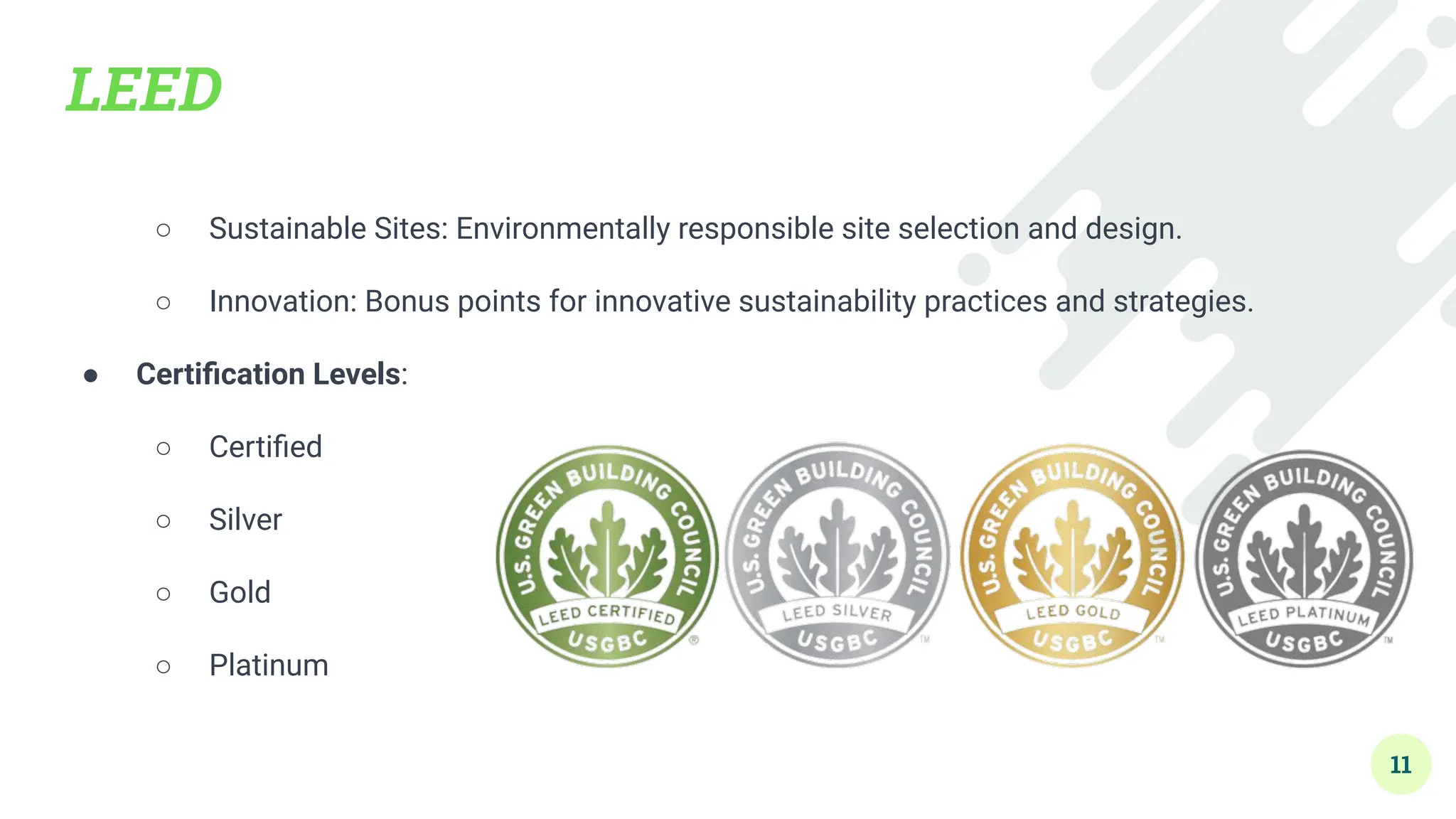
● Certification Levels:
○ Certified
○ Silver
○ Gold
○ Platinum
11
WGBC
● WGBC - World Green Building Council
● global network of national Green Building Councils (GBCs)
● Launched in: 2002
● Purpose: To accelerate the adoption of green building practices globally and create a more
sustainable built environment
● Global Reach: Over 70 member GBCs representing more than 36,000 companies and
organizations worldwide.
● Website: https://worldgbc.org/
12
WGBC
● Key Initiatives
○ Advancing Net Zero
○ Better Places for People
○ Sustainable Reconstruction
○ Circular Built Environment
○ World Green Building Week
13
WGBC
● Major Impacts
○ Environmental Impact:
■ Climate action, biodiversity conservation and resource conservation
○ Economic Impact
■ Energy savings and job creation
○ Social Impact
■ Health and well-being of occupants and global collaboration
14
Activity
- Visit worldgbc.org
- Go to Global Directory of Green Building Councils
- Enlist the green building councils in Asia affiliated to WGBC
GRIHA
● GRIHA - Green Rating for Integrated Habitat Assessment
● India’s national green building rating system
● Launched in: 2007
● Launched by: The Energy and Resources Institute (TERI)
● Purpose: To evaluate the environmental performance of buildings over their entire life cycle, focusing on
reducing resource consumption, minimizing waste, and lowering overall ecological impact.
● Reach: limited to India
● Website: grihaindia.org
16
GRIHA
● GRIHA evaluates buildings based on specific criteria across multiple sustainability categories.
Points are awarded for meeting or exceeding standards, and certification levels are achieved
based on total points scored.
● Categories Assessed:
○ Site Planning: Minimizing environmental disruption and managing site development sustainably.
○ Building Envelope Design: Optimizing building design for energy efficiency and thermal comfort.
○ Water and Waste Management: Efficient use of water resources, rainwater harvesting, and
effective waste management strategies.
17
GRIHA
○ Energy Efficiency: Reducing energy consumption through passive design,
renewable energy integration, and energy-efficient systems.
○ Materials Selection: Use of locally sourced, low-energy, and
environmentally friendly materials.
● Certification Levels:
○ 1-star, 2-star , 3-star, 4-star and 5-star
18
Activity
- Visit grihaindia.org
- Enlist all the green building rating systems under GRIHA
IGBC
● IGBC - Indian Green Building Council
● India’s national green building rating system
● Launched in: 2001
● Launched by: Confederation of Indian Industry (CII)
● Purpose: To enable sustainable building design and practices in India, reducing environmental
impact and improving quality of life through green infrastructure.
● Reach: limited to India
● Website: igbc.in
20
IGBC
● Categories Assessed:
○ Site Selection & Planning: Environmental impact, site management, and development.
○ Water Efficiency: Conservation techniques and reducing water consumption.
○ Energy Efficiency: Reducing energy consumption and incorporating renewable energy.
○ Materials & Resources: Use of sustainable materials, recycling, and waste management.
○ Indoor Environmental Quality: Ensuring better air quality, ventilation, and occupant comfort.
● Certification Levels:
○ Certified, Silver, Gold, and Platinum
21
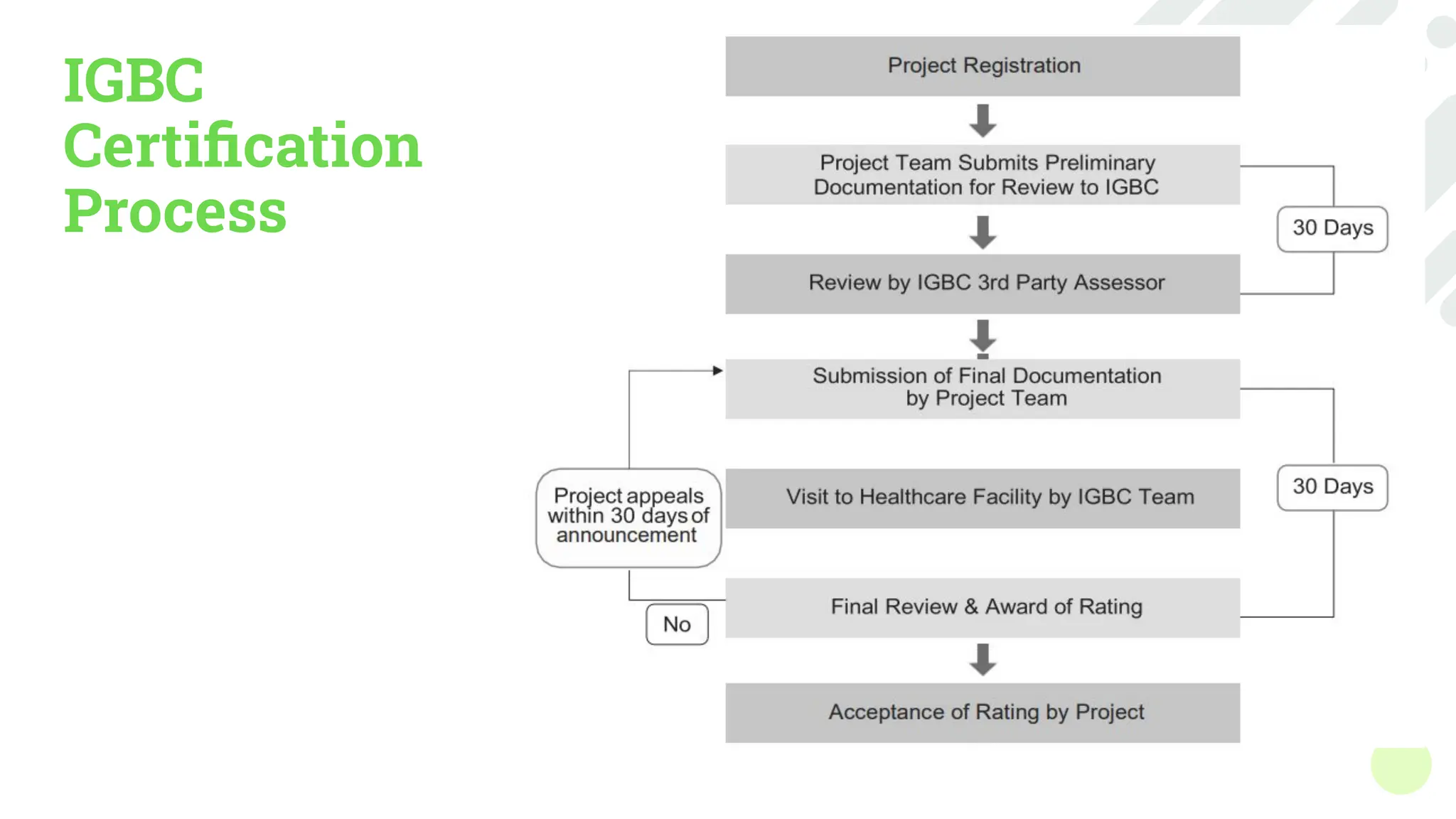
IGBC
Certification
Process
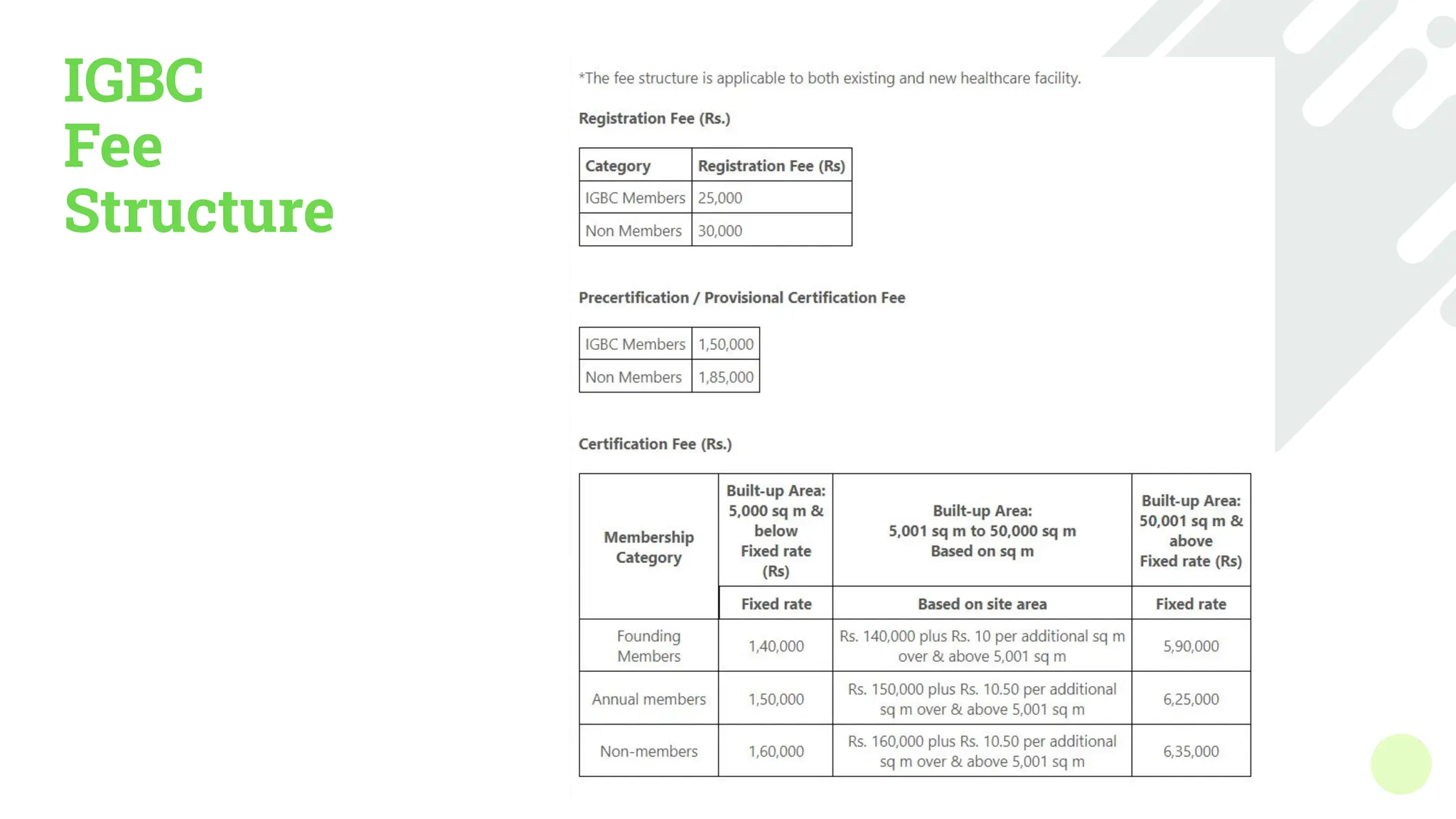
IGBC
Fee
Structure
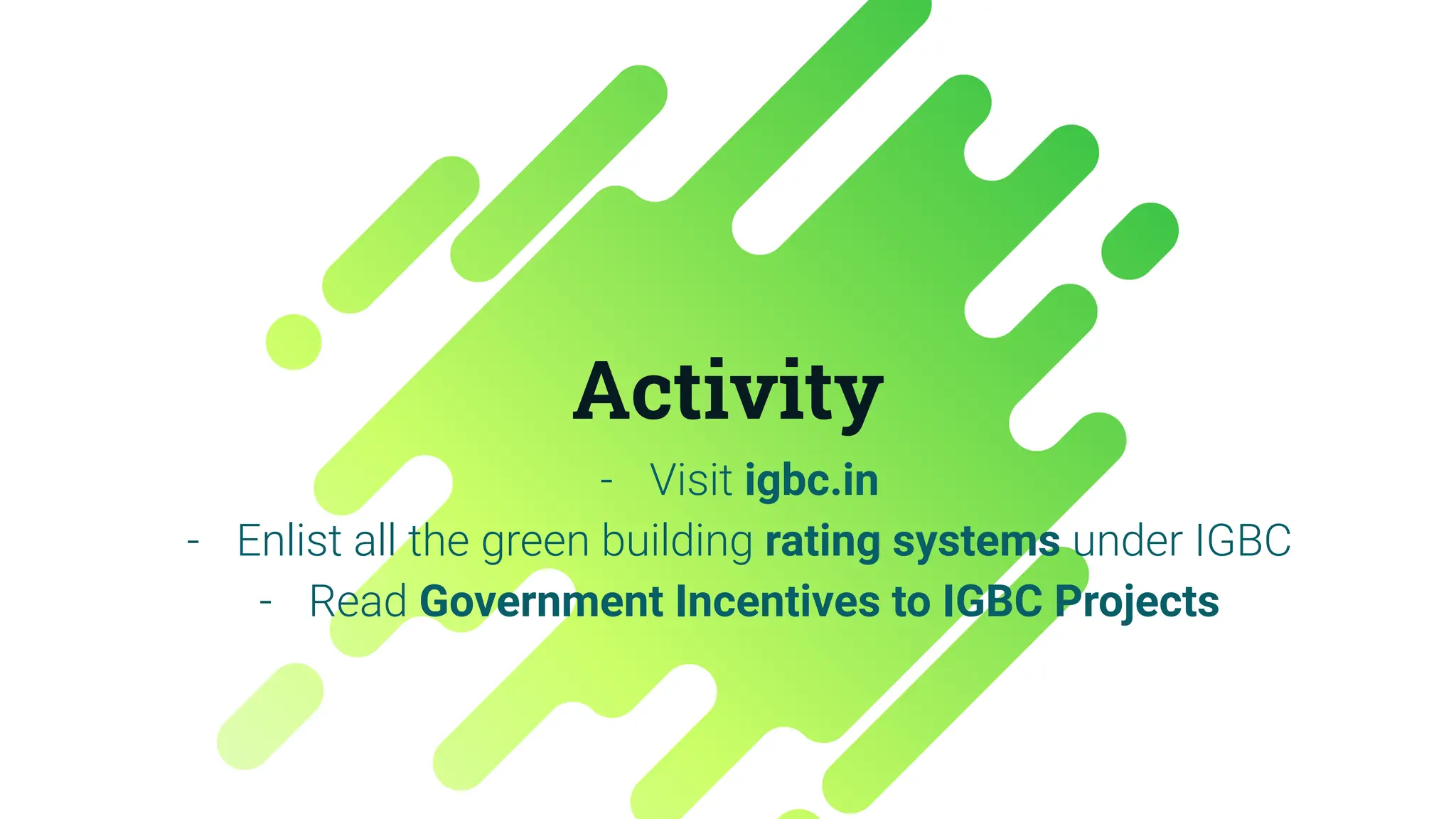
Activity
- Visit igbc.in
- Enlist all the green building rating systems under IGBC
- Read Government Incentives to IGBC Projects
Thank
you!
@DrRohanDasgupta
25

Green Building Construction - Module 5 - Green Building Rating Systems

  • 1.
    DLOC-4 GREEN BUILDING CONSTRUCTIONS Module No.5 Green Building Rating Systems - Dr. Rohan Dasgupta
  • 2.
    Introduction ● Green buildingrating systems are frameworks that assess and certify the environmental performance of buildings. ● These systems are designed to: ○ promote sustainable construction practices, ○ reduce environmental impact, and ○ improve the overall efficiency and performance of buildings. ● Different countries and regions have their own green building rating systems, but many share common principles. 2
  • 3.
    Evolution of GreenBuilding Rating Systems ● 1990: BRE launched BREEAM (UK) ● 2000: USGBC launched LEED (US) ● 2001: CII launched IGBC (India) ● 2002: GBCA launched Green Star (Australia) ● 2003: TERI launched GRIHA (India) ● 2010: IFC introduced EDGE 3
  • 4.
    Evolution of GreenBuilding Rating Systems ● Shift in focus of Green Building Rating Systems: ○ 2014 - well being standards ○ 2015 - life cycle analysis ○ 2020 - net zero initiatives (energy, water & waste) ○ 2024 - circular economy 4
  • 5.
  • 6.
    BREEAM ● BREEAM -Building Research Establishment Environmental Assessment Method ● World's first green building rating systems ● Launched in: 1990 ● Launched by: UK’s Building Research Establishment (BRE). ● Purpose: To assess, certify, and encourage the sustainability of buildings, infrastructure, and communities. ● Global Reach: Used in over 70 countries worldwide, with region-specific adaptations. ● Website: https://breeam.com/ 6
  • 7.
    BREEAM ● BREEAM evaluatesprojects across a wide range of categories, assigning credits based on performance: ● Categories: ○ Energy: Reducing consumption and increasing efficiency. ○ Water: Efficient use and water-saving strategies. ○ Health & Well-being: Air quality, lighting, and thermal comfort. ○ Transport: Access to public transport and sustainable travel options. ○ Materials: Use of sustainable, low-impact materials. 7
  • 8.
    BREEAM ○ Waste: Minimizationand recycling during construction and operation. ○ Pollution: Limiting pollutants and environmental impact. ○ Innovation: Points for adopting novel sustainable practices. ● Rating Levels: ○ Pass, ○ Good, ○ Very Good, ○ Excellent, and 8
  • 9.
    LEED ● LEED -Leadership in Energy and Environmental Design ● globally recognized green building certification system ● Launched in: 2000 ● Launched by: USGBC ● Purpose: To promote sustainable building practices and measure a building’s overall environmental performance. ● Global Reach: Used in over 165 countries worldwide ● Website: https://www.usgbc.org/leed 9
  • 10.
    LEED ● LEED assessesbuildings based on a point system across various sustainability categories. ● Categories Assessed: ○ Energy and Atmosphere: Energy efficiency, renewable energy, and greenhouse gas emissions reduction. ○ Water Efficiency: Efficient water usage and water-saving technologies. ○ Materials and Resources: Sustainable material sourcing and waste reduction. 10
  • 11.
    LEED ○ Sustainable Sites:Environmentally responsible site selection and design. ○ Innovation: Bonus points for innovative sustainability practices and strategies. ● Certification Levels: ○ Certified ○ Silver ○ Gold ○ Platinum 11
  • 12.
    WGBC ● WGBC -World Green Building Council ● global network of national Green Building Councils (GBCs) ● Launched in: 2002 ● Purpose: To accelerate the adoption of green building practices globally and create a more sustainable built environment ● Global Reach: Over 70 member GBCs representing more than 36,000 companies and organizations worldwide. ● Website: https://worldgbc.org/ 12
  • 13.
    WGBC ● Key Initiatives ○Advancing Net Zero ○ Better Places for People ○ Sustainable Reconstruction ○ Circular Built Environment ○ World Green Building Week 13
  • 14.
    WGBC ● Major Impacts ○Environmental Impact: ■ Climate action, biodiversity conservation and resource conservation ○ Economic Impact ■ Energy savings and job creation ○ Social Impact ■ Health and well-being of occupants and global collaboration 14
  • 15.
    Activity - Visit worldgbc.org -Go to Global Directory of Green Building Councils - Enlist the green building councils in Asia affiliated to WGBC
  • 16.
    GRIHA ● GRIHA -Green Rating for Integrated Habitat Assessment ● India’s national green building rating system ● Launched in: 2007 ● Launched by: The Energy and Resources Institute (TERI) ● Purpose: To evaluate the environmental performance of buildings over their entire life cycle, focusing on reducing resource consumption, minimizing waste, and lowering overall ecological impact. ● Reach: limited to India ● Website: grihaindia.org 16
  • 17.
    GRIHA ● GRIHA evaluatesbuildings based on specific criteria across multiple sustainability categories. Points are awarded for meeting or exceeding standards, and certification levels are achieved based on total points scored. ● Categories Assessed: ○ Site Planning: Minimizing environmental disruption and managing site development sustainably. ○ Building Envelope Design: Optimizing building design for energy efficiency and thermal comfort. ○ Water and Waste Management: Efficient use of water resources, rainwater harvesting, and effective waste management strategies. 17
  • 18.
    GRIHA ○ Energy Efficiency:Reducing energy consumption through passive design, renewable energy integration, and energy-efficient systems. ○ Materials Selection: Use of locally sourced, low-energy, and environmentally friendly materials. ● Certification Levels: ○ 1-star, 2-star , 3-star, 4-star and 5-star 18
  • 19.
    Activity - Visit grihaindia.org -Enlist all the green building rating systems under GRIHA
  • 20.
    IGBC ● IGBC -Indian Green Building Council ● India’s national green building rating system ● Launched in: 2001 ● Launched by: Confederation of Indian Industry (CII) ● Purpose: To enable sustainable building design and practices in India, reducing environmental impact and improving quality of life through green infrastructure. ● Reach: limited to India ● Website: igbc.in 20
  • 21.
    IGBC ● Categories Assessed: ○Site Selection & Planning: Environmental impact, site management, and development. ○ Water Efficiency: Conservation techniques and reducing water consumption. ○ Energy Efficiency: Reducing energy consumption and incorporating renewable energy. ○ Materials & Resources: Use of sustainable materials, recycling, and waste management. ○ Indoor Environmental Quality: Ensuring better air quality, ventilation, and occupant comfort. ● Certification Levels: ○ Certified, Silver, Gold, and Platinum 21
  • 22.
  • 23.
  • 24.
    Activity - Visit igbc.in -Enlist all the green building rating systems under IGBC - Read Government Incentives to IGBC Projects
  • 25.