
Indian Green Building Council
(IGBC) Certified Buildings In
Indian Smart Cities
PRESENTED BY:
Khushal Tadas
What is IGBC ?
Indian Green Building Council (IGBC) Green Homes is the first rating program developed
in India, exclusively for the residential sector. It is based on accepted energy and
environmental principles and strikes a balance between known established practices and
emerging concepts. The system is designed to be comprehensive in scope, yet simple in
operation
IGBC Green Homes Rating System is a voluntary and consensus based program. The rating
system has been developed based on materials and technologies that are presently available.
The objective of IGBC Green Homes is to facilitate the effective use of site resources,
water conservation, energy efficiency, handling of house-hold waste, optimum material
utilization and design for healthy, comfortable & environmentally friendly home
6.33 billion ft2
registered green
building footprint
4800 Green Building
Registered Projects
Benefits
A Green Home can have tremendous benefits, both
tangible and intangible. The immediate and most
tangible benefit is in the reduction in water and
operating energy costs right from day one, during
the entire life cycle of the building.
Tangible Benefits:
Energy savings : 20 - 30%
Water savings : 30 - 50%
Intangible Benefits:
Enhanced air quality
Excellent day lighting
Health & wellbeing of the occupants
Conservation of scarce national resources
Enhance marketability for the project
IGBC Green Homes Rating System
It is a measurement system designed for rating new
and major renovation of residential buildings which
are broadly classified into two construction types:
- Individual residential unit
- Multi-dwelling residential units
o Gated communities.
o High-rise residential apartments.
o Hostels, Service apartments,
Resorts, Motels and Guest houses.
IGBC Green Homes is designed primarily for new
residential buildings. However, it is also applicable
for existing buildings designed in accordance with
the IGBC Green Homes criteria.
Scope
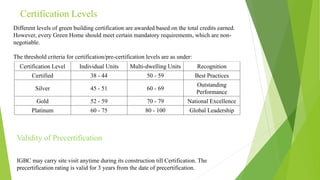
Certification Levels
Certification Level Individual Units Multi-dwelling Units Recognition
Certified 38 - 44 50 - 59 Best Practices
Silver 45 - 51 60 - 69
Outstanding
Performance
Gold 52 - 59 70 - 79 National Excellence
Platinum 60 - 75 80 - 100 Global Leadership
Different levels of green building certification are awarded based on the total credits earned.
However, every Green Home should meet certain mandatory requirements, which are non-
negotiable.
The threshold criteria for certification/pre-certification levels are as under:
Validity of Precertification
IGBC may carry site visit anytime during its construction till Certification. The
precertification rating is valid for 3 years from the date of precertification.
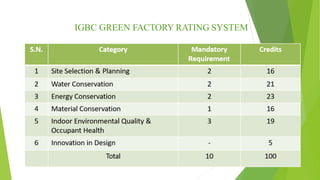
IGBC GREEN FACTORY RATING SYSTEM
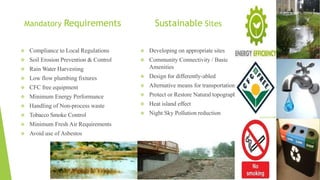
Mandatory Requirements
 Compliance to Local Regulations
 Soil Erosion Prevention & Control
 Rain Water Harvesting
 Low flow plumbing fixtures
 CFC free equipment
 Minimum Energy Performance
 Handling of Non-process waste
 Tobacco Smoke Control
 Minimum Fresh Air Requirements
 Avoid use of Asbestos
 Developing on appropriate sites
 Community Connectivity / Basic
Amenities
 Design for differently-abled
 Alternative means for transportation
 Protect or Restore Natural topography
 Heat island effect
 Night Sky Pollution reduction
Sustainable Sites
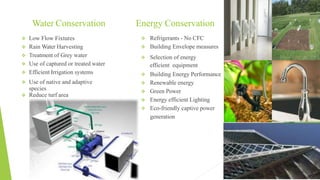
Water Conservation
 Low Flow Fixtures
 Rain Water Harvesting
 Treatment of Grey water
 Use of captured or treated water
 Efficient Irrigation systems
 Use of native and adaptive
species
 Reduce turf area
 Refrigerants - No CFC
 Building Envelope measures
 Selection of energy
efficient equipment
 Building Energy Performance
 Renewable energy
 Green Power
 Energy efficient Lighting
 Eco-friendly captive power
generation
Energy Conservation
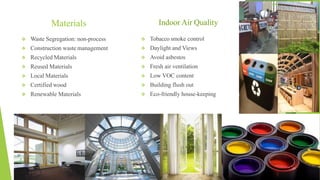
Materials
 Waste Segregation: non-process
 Construction waste management
 Recycled Materials
 Reused Materials
 Local Materials
 Certified wood
 Renewable Materials
 Tobacco smoke control
 Daylight and Views
 Avoid asbestos
 Fresh air ventilation
 Low VOC content
 Building flush out
 Eco-friendly house-keeping
Indoor Air Quality
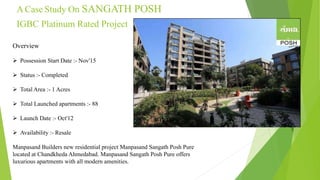
A Case Study On SANGATH POSH
IGBC Platinum Rated Project
Overview
 Possession Start Date :- Nov'15
 Status :- Completed
 Total Area :- 1 Acres
 Total Launched apartments :- 88
 Launch Date :- Oct'12
 Availability :- Resale
Manpasand Builders new residential project Manpasand Sangath Posh Pure
located at Chandkheda Ahmedabad. Manpasand Sangath Posh Pure offers
luxurious apartments with all modern amenities.
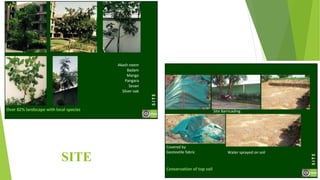
SITE
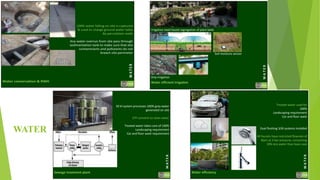
WATER
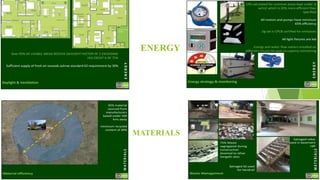
ENERGY
MATERIALS
Case Study
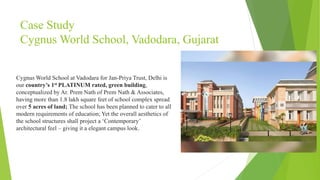
Cygnus World School, Vadodara, Gujarat
Cygnus World School at Vadodara for Jan-Priya Trust, Delhi is
our country’s 1st PLATINUM rated, green building,
conceptualized by Ar. Prem Nath of Prem Nath & Associates,
having more than 1.8 lakh square feet of school complex spread
over 5 acres of land; The school has been planned to cater to all
modern requirements of education; Yet the overall aesthetics of
the school structures shall project a ‘Contemporary’
architectural feel – giving it a elegant campus look.
DESIGN
 Planning concept for the project has been
kept simple and practical; the campus has been
mainly planned with Two Zones- Education Zone
& Sports Zone.
 The site surroundings shall be laid with a lot
of Green-Scapes;
 Campus common areas along with driveways &
walk ways shall be laid with paver tiles/blocks;
 Each room is designed in module of 8M x 8M –
providing a standard size requirement of a class
room for 30-35 children and a flexibility to
multiply or divide the module for larger halls for
laboratory or a toilet block, etc. respectively;
 Staircases, toilet facilities, etc. have been provided
as per the required norms & mandates;
 Facilities such as; Medical department including
Distilled and RO water system have been provided
keeping in mind the health of the students as well
as the faculties
 The systems are planned with Green building
concepts in mind – highlighting eco-friendly nature
of running systems
 Each school blocks are North-South oriented
and multiple internal courtyards have been planned
to enable building to breath from within
 Every class room is planned with Ventilators above
Windows and Doors– keeping the internal area well
ventilated and cooler than outside ambient
temperatures
 Class room is placed in a way to Advantage with
Maximum North Light; while provided with large
windows facing North and two entrance doors on
Southside passage
 vermiculite plasterfrom inside and tile cladding
from outside add to the heat insulation of Fly Ash
Brick Walls
 Terrace Tops have been laid with heat insulating
layer & then are fixed with White Glazed Tiles –
reflecting back all the heat;
GREEN PLANNING
FEATURES
GREEN MATERIALS
 Fly Ash Bricks for Masonry and Vermiculite
Plaster for Internal Plaster – adding value to heat
insulation
 Ceramic reflective Tiles cladding to external
surface & Glazed tiles on terrace tops – adding
value to heat insulation
 Low VOC Paints & Sealants keeping the
environment healthy
 Natural Stones pebbles, marble, granite, etc. for
various landscape features;
 Large Landscaped spaces, incl. wide courtyards
and central green zone between blocks – adding
further value a large patch of Green/Lawns which is
itself approx. 20% of total land area – adding to a
lot of healthy inhibition of internal spaces
 Rain Water Harvesting & Sewage Treatment
Plants enabling use of more than 75% water for
flushing and landscaping
 Solar Panels of approx. 7.5% (60KW) of the total
electricity consumption – enabling substantial
power saving and backup
 Water by virtue of STP & Rain Water Harvesting, topped
with water saving features enables a daily saving of 75% to
80%
 Electricity is one of the most important factors – saving by
vitue of planning a Non-Air-conditioned building itself add
to 35%+further other energy efficient features add to 15% to
20% of saving
 Installation of Energy Friendly Lamps, viz. T5 Tubes, CFLs
and LED Lamps – has enabled power saving upto 20% than
the routine usage
 Solar Panels (60 KW) add to the power saving by about 7%
to 8%
 Installation of Energy Friendly Lamps, viz. T5 Tubes, CFLs
and LED Lamps – has enabled power saving upto 20%than
the routine usage
 Water Saving Faucets and sensor controlled urinals too have
enables a lot of water saving
 Use of FRLS Cables and compact / dry type
Transformers too enable a lot of energy efficiency
ENERGY SAVING
TECHNIQUES
PLATINUM RATING FOR GREEN SCHOOLS
This is an IGBC’s Pilot project having awarded LEED Platinum Rating for Green Schools
– First ever rating awarded to a school project in India; – and has scored 86% which is
quite high – there are no immediate plans to add any further feature – however the school
management keeps working towards Green Education and plans various awareness
programs;
No Stone Was Left Unturned
The final & lasting impression of this School shall be of a Contemporary Indian School,
Technologically Well Equipped, and drawing from the Best Architectural Practices from
Around The World.
THANKYOU

IGBC

  • 1.
    Indian Green BuildingCouncil (IGBC) Certified Buildings In Indian Smart Cities PRESENTED BY: Khushal Tadas
  • 2.
    What is IGBC? Indian Green Building Council (IGBC) Green Homes is the first rating program developed in India, exclusively for the residential sector. It is based on accepted energy and environmental principles and strikes a balance between known established practices and emerging concepts. The system is designed to be comprehensive in scope, yet simple in operation IGBC Green Homes Rating System is a voluntary and consensus based program. The rating system has been developed based on materials and technologies that are presently available. The objective of IGBC Green Homes is to facilitate the effective use of site resources, water conservation, energy efficiency, handling of house-hold waste, optimum material utilization and design for healthy, comfortable & environmentally friendly home 6.33 billion ft2 registered green building footprint 4800 Green Building Registered Projects
  • 3.
    Benefits A Green Homecan have tremendous benefits, both tangible and intangible. The immediate and most tangible benefit is in the reduction in water and operating energy costs right from day one, during the entire life cycle of the building. Tangible Benefits: Energy savings : 20 - 30% Water savings : 30 - 50% Intangible Benefits: Enhanced air quality Excellent day lighting Health & wellbeing of the occupants Conservation of scarce national resources Enhance marketability for the project IGBC Green Homes Rating System It is a measurement system designed for rating new and major renovation of residential buildings which are broadly classified into two construction types: - Individual residential unit - Multi-dwelling residential units o Gated communities. o High-rise residential apartments. o Hostels, Service apartments, Resorts, Motels and Guest houses. IGBC Green Homes is designed primarily for new residential buildings. However, it is also applicable for existing buildings designed in accordance with the IGBC Green Homes criteria. Scope
  • 4.
    Certification Levels Certification LevelIndividual Units Multi-dwelling Units Recognition Certified 38 - 44 50 - 59 Best Practices Silver 45 - 51 60 - 69 Outstanding Performance Gold 52 - 59 70 - 79 National Excellence Platinum 60 - 75 80 - 100 Global Leadership Different levels of green building certification are awarded based on the total credits earned. However, every Green Home should meet certain mandatory requirements, which are non- negotiable. The threshold criteria for certification/pre-certification levels are as under: Validity of Precertification IGBC may carry site visit anytime during its construction till Certification. The precertification rating is valid for 3 years from the date of precertification.
  • 5.
    IGBC GREEN FACTORYRATING SYSTEM
  • 6.
    Mandatory Requirements  Complianceto Local Regulations  Soil Erosion Prevention & Control  Rain Water Harvesting  Low flow plumbing fixtures  CFC free equipment  Minimum Energy Performance  Handling of Non-process waste  Tobacco Smoke Control  Minimum Fresh Air Requirements  Avoid use of Asbestos  Developing on appropriate sites  Community Connectivity / Basic Amenities  Design for differently-abled  Alternative means for transportation  Protect or Restore Natural topography  Heat island effect  Night Sky Pollution reduction Sustainable Sites
  • 7.
    Water Conservation  LowFlow Fixtures  Rain Water Harvesting  Treatment of Grey water  Use of captured or treated water  Efficient Irrigation systems  Use of native and adaptive species  Reduce turf area  Refrigerants - No CFC  Building Envelope measures  Selection of energy efficient equipment  Building Energy Performance  Renewable energy  Green Power  Energy efficient Lighting  Eco-friendly captive power generation Energy Conservation
  • 8.
    Materials  Waste Segregation:non-process  Construction waste management  Recycled Materials  Reused Materials  Local Materials  Certified wood  Renewable Materials  Tobacco smoke control  Daylight and Views  Avoid asbestos  Fresh air ventilation  Low VOC content  Building flush out  Eco-friendly house-keeping Indoor Air Quality
  • 9.
    A Case StudyOn SANGATH POSH IGBC Platinum Rated Project Overview  Possession Start Date :- Nov'15  Status :- Completed  Total Area :- 1 Acres  Total Launched apartments :- 88  Launch Date :- Oct'12  Availability :- Resale Manpasand Builders new residential project Manpasand Sangath Posh Pure located at Chandkheda Ahmedabad. Manpasand Sangath Posh Pure offers luxurious apartments with all modern amenities.
  • 10.
  • 11.
  • 12.
  • 13.
    Case Study Cygnus WorldSchool, Vadodara, Gujarat Cygnus World School at Vadodara for Jan-Priya Trust, Delhi is our country’s 1st PLATINUM rated, green building, conceptualized by Ar. Prem Nath of Prem Nath & Associates, having more than 1.8 lakh square feet of school complex spread over 5 acres of land; The school has been planned to cater to all modern requirements of education; Yet the overall aesthetics of the school structures shall project a ‘Contemporary’ architectural feel – giving it a elegant campus look.
  • 14.
    DESIGN  Planning conceptfor the project has been kept simple and practical; the campus has been mainly planned with Two Zones- Education Zone & Sports Zone.  The site surroundings shall be laid with a lot of Green-Scapes;  Campus common areas along with driveways & walk ways shall be laid with paver tiles/blocks;  Each room is designed in module of 8M x 8M – providing a standard size requirement of a class room for 30-35 children and a flexibility to multiply or divide the module for larger halls for laboratory or a toilet block, etc. respectively;  Staircases, toilet facilities, etc. have been provided as per the required norms & mandates;  Facilities such as; Medical department including Distilled and RO water system have been provided keeping in mind the health of the students as well as the faculties  The systems are planned with Green building concepts in mind – highlighting eco-friendly nature of running systems  Each school blocks are North-South oriented and multiple internal courtyards have been planned to enable building to breath from within  Every class room is planned with Ventilators above Windows and Doors– keeping the internal area well ventilated and cooler than outside ambient temperatures  Class room is placed in a way to Advantage with Maximum North Light; while provided with large windows facing North and two entrance doors on Southside passage  vermiculite plasterfrom inside and tile cladding from outside add to the heat insulation of Fly Ash Brick Walls  Terrace Tops have been laid with heat insulating layer & then are fixed with White Glazed Tiles – reflecting back all the heat; GREEN PLANNING FEATURES
  • 15.
    GREEN MATERIALS  FlyAsh Bricks for Masonry and Vermiculite Plaster for Internal Plaster – adding value to heat insulation  Ceramic reflective Tiles cladding to external surface & Glazed tiles on terrace tops – adding value to heat insulation  Low VOC Paints & Sealants keeping the environment healthy  Natural Stones pebbles, marble, granite, etc. for various landscape features;  Large Landscaped spaces, incl. wide courtyards and central green zone between blocks – adding further value a large patch of Green/Lawns which is itself approx. 20% of total land area – adding to a lot of healthy inhibition of internal spaces  Rain Water Harvesting & Sewage Treatment Plants enabling use of more than 75% water for flushing and landscaping  Solar Panels of approx. 7.5% (60KW) of the total electricity consumption – enabling substantial power saving and backup  Water by virtue of STP & Rain Water Harvesting, topped with water saving features enables a daily saving of 75% to 80%  Electricity is one of the most important factors – saving by vitue of planning a Non-Air-conditioned building itself add to 35%+further other energy efficient features add to 15% to 20% of saving  Installation of Energy Friendly Lamps, viz. T5 Tubes, CFLs and LED Lamps – has enabled power saving upto 20% than the routine usage  Solar Panels (60 KW) add to the power saving by about 7% to 8%  Installation of Energy Friendly Lamps, viz. T5 Tubes, CFLs and LED Lamps – has enabled power saving upto 20%than the routine usage  Water Saving Faucets and sensor controlled urinals too have enables a lot of water saving  Use of FRLS Cables and compact / dry type Transformers too enable a lot of energy efficiency ENERGY SAVING TECHNIQUES
  • 16.
    PLATINUM RATING FORGREEN SCHOOLS This is an IGBC’s Pilot project having awarded LEED Platinum Rating for Green Schools – First ever rating awarded to a school project in India; – and has scored 86% which is quite high – there are no immediate plans to add any further feature – however the school management keeps working towards Green Education and plans various awareness programs; No Stone Was Left Unturned The final & lasting impression of this School shall be of a Contemporary Indian School, Technologically Well Equipped, and drawing from the Best Architectural Practices from Around The World.
  • 17.