Ideation and
Creative
Thinking
Module No. 3
Dr. Rohan Dasgupta
3.1. Psychology of Creativity
in Design Thinking
Psychology of Creativity in Design Thinking
● Creativity is the ability to generate original and valuable ideas
● Involves both divergent thinking (many ideas) and convergent thinking (choosing best
idea)
● Creativity is linked to cognitive flexibility and openness to experience
● Problem framing shapes the quality of creative solutions
● Emotions (curiosity, playfulness, intrinsic motivation) enhance creative thinking
● Environment and mindset strongly influence creative performance
Psychology of Creativity in Design Thinking
● Breaks mental blocks by challenging assumptions and biases
● Encourages associative thinking – connecting unrelated ideas
● Involves incubation: subconscious processing leads to sudden “aha!” moments
● Collaboration and diverse perspectives boost idea generation
● Risk-taking and tolerance for ambiguity are crucial traits
● Reflection and iteration help refine raw ideas into practical solutions
3.2. Ideation Methods
Ideation Methods
● Brainstorming
● Mind Mapping
● SCAMPER
● Lateral Thinking
Ideation Methods : Brainstorming
● A group creativity technique used to generate many ideas quickly
● Based on free-flow of thoughts without immediate judgment
● Encourages divergent thinking and breaking mental barriers
● Works best in a collaborative, open, and supportive environment
● Quantity over quality at first – evaluation happens later
● Aims to spark innovative, unexpected solutions
Ideation Methods : Brainstorming
● Delay judgment – no criticism during idea generation
● Encourage crazy ideas – unconventional thoughts may spark innovation
● Build on others’ ideas – combine and improve suggestions
● Go for quantity – more ideas increase chances of good ones
● Stay focused on the problem – keep the session goal clear
● One Conversation at a Time – Ensure active listening and avoid side discussions.
● Ensure equal participation – everyone contributes actively
● Visualize Ideas – Use sketches, sticky notes, or diagrams to make ideas more
concrete and memorable.
Activity : Brainstorming
● Topic: Improving campus life of students
● Make groups of 4 students
● Each group should appoint a facilitator to note down all ideas.
● Set a timer for 5 minutes → generate as many ideas as possible (no judgment).
● After time is up, each group should select top 3 ideas collaboratively.
● Groups should share their top ideas with the class.
● Short reflection: Discussion on how principles of brainstorming shaped their outcomes.
Ideation Methods : Mind Mapping
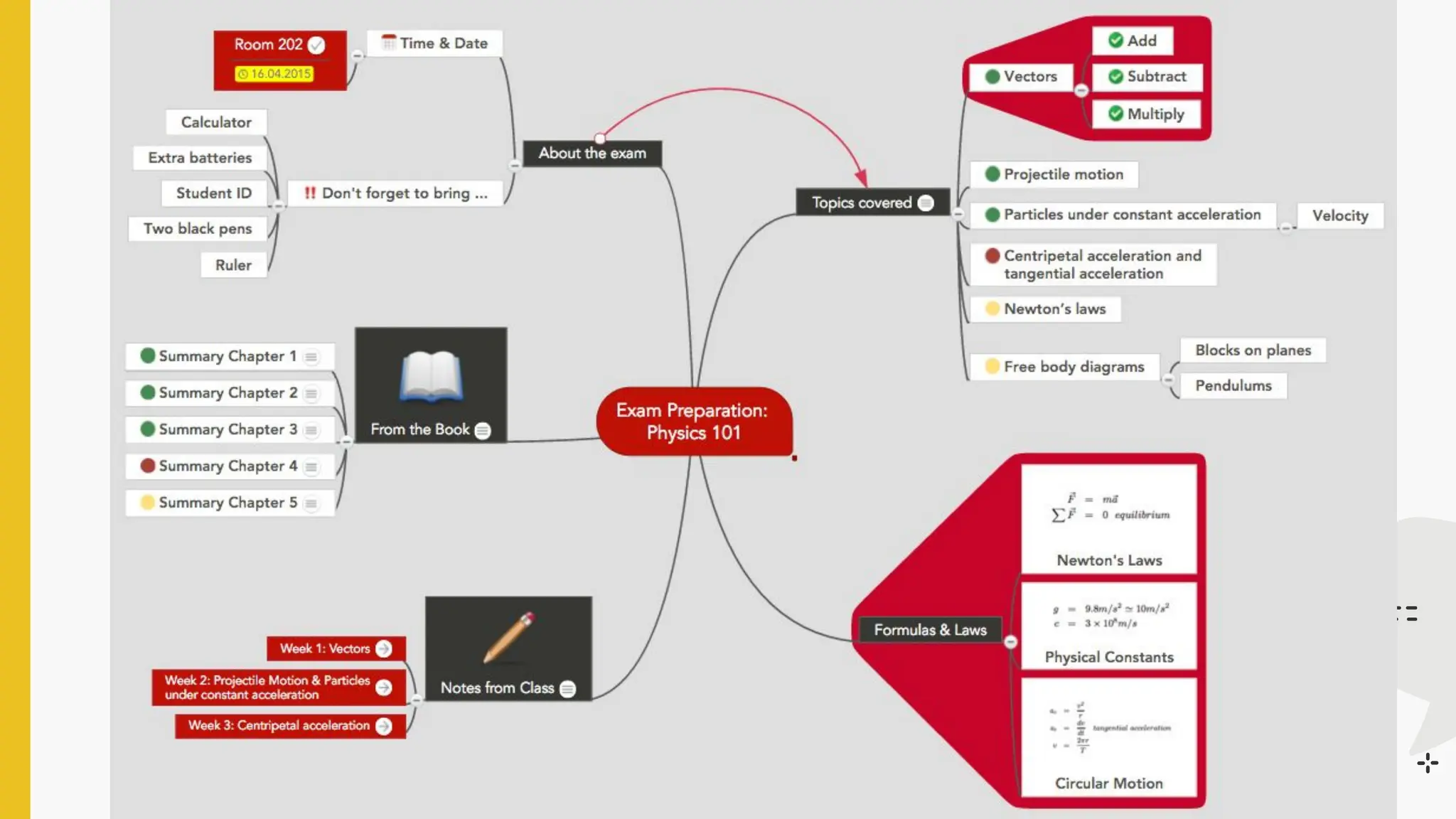
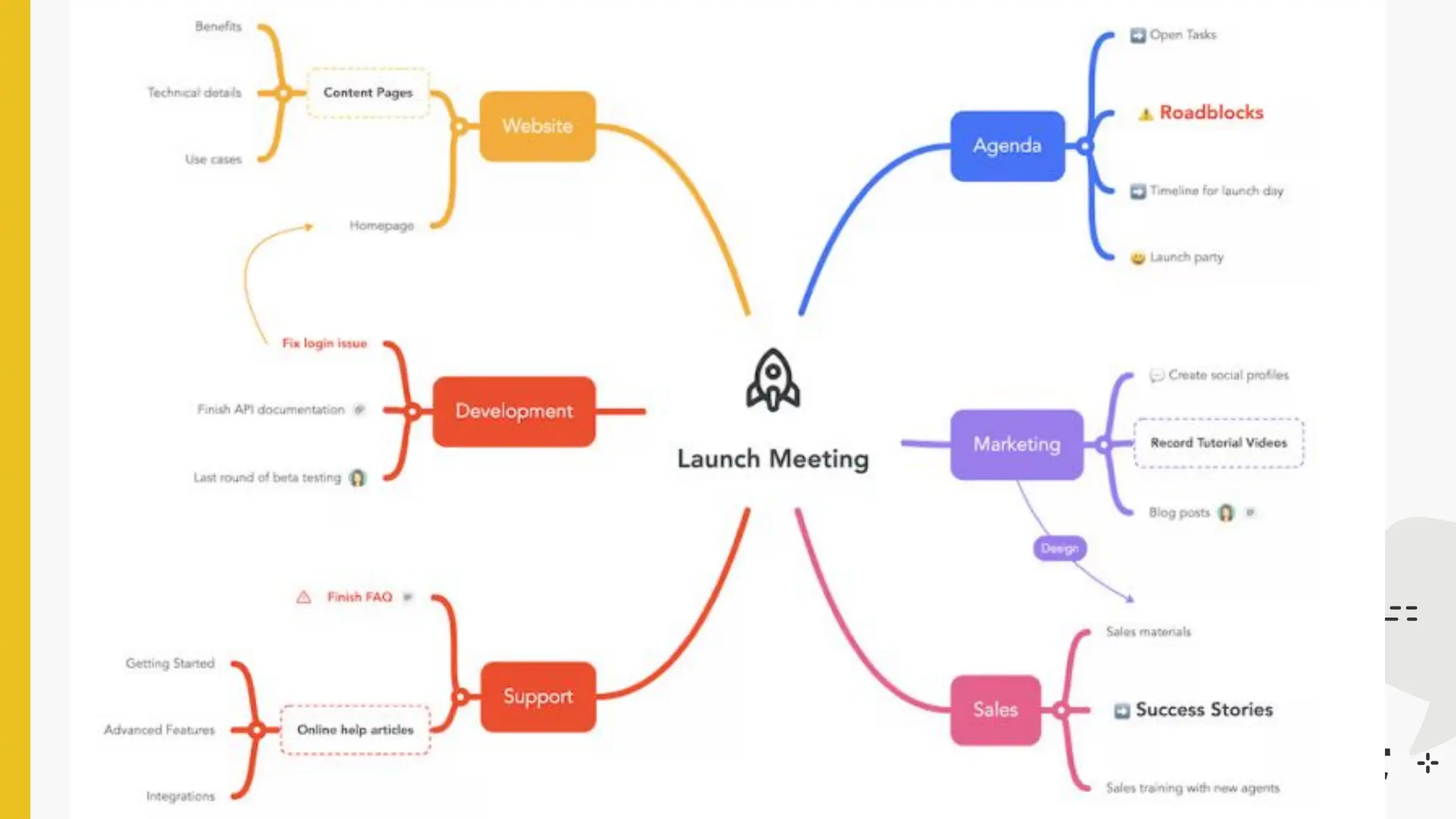
● Visual tool for organizing and exploring ideas
● Starts with a central theme or problem at the center
● Branches represent main ideas, with sub-branches for details
● Encourages free association and non-linear thinking
● Helps uncover hidden connections between concepts
● Useful for both individual and group ideation sessions
Ideation Methods : Mind Mapping
● Stimulates both left (logical) and right (creative) brain activity
● Breaks complex problems into simpler, structured parts
● Encourages flexibility in idea generation
● Enhances memory and recall through visual structure
● Supports collaboration and collective creativity in groups
● Makes ideas easier to review, refine, and present
Ideation Methods : Mind Mapping
HOW TO MAKE A MIND MAP
1. Define the central idea or main topic of the mind map: This should be a concise and clear
statement that encapsulates the purpose or objective of the design project.
2. Identify key themes and subtopics related to the central idea: These can be broad
categories or specific areas of focus within the design project.
3. Create nodes for each key theme or subtopic: These nodes will serve as the main branches
that stem out from the central idea.
4. Add branches that connect each node to the central idea: These branches represent the
relationships between the main topic and the subtopics.
Ideation Methods : Mind Mapping
HOW TO MAKE A MIND MAP (contd…)
5. Expand subtopics to make them more detailed: For each subtopic, designers further
expand the map when they put in additional nodes and branches. These represent more
specific ideas, concepts or features related to each subtopic.
6. Use color coding and icons to improve how visually clear the mind map is. Designers assign
different colors to different themes or subtopics, and they use icons to represent specific
ideas or concepts.
7. Review and refine the mind map to make sure that it accurately represents the information
and relationships the designers want to show. They should refine the structure, wording and
visual elements—as needed—to improve clarity and readability.
Ideation Methods : Mind Mapping
Tools for creating Mind Maps
● MindMeister
● Coggle
● Ayoa
● XMind
● Miro
● MindView
Activity : Mind Mapping
● The groups and theme shall be the same as the previous activity of Brainstorming
● Login/register to the tool: Coogle
● The 3 / 4 best ideas from the Brainstorming activity shall be sub-topics of the mind map.
● Add 3 / 4 branches to each sub-topic
● Add 3 / 4 sub-branches to at least 1 branch
● Share with rohan.dasgupta@aiktc.ac.in
Ideation Methods : SCAMPER
● SCAMPER is a structured brainstorming tool for generating innovative ideas.
● It encourages looking at problems/products from different perspectives.
● The name is an acronym: Substitute, Combine, Adapt, Modify, Put to another use,
Eliminate, Reverse.
● Helps to overcome creative blocks by prompting systematic questioning.
● Applicable across engineering, business, product design, and services.
● Goal: stimulate creativity and generate multiple solution possibilities.
Ideation Methods : SCAMPER
● Substitute – Replace a component, process, or material with another.
● Combine – Merge two ideas, products, or steps for added value.
● Adapt – Adjust existing ideas for a new situation or context.
● Modify/Magnify/Minify – Change size, shape, appearance, or features.
● Put to another use – Re-purpose existing solutions for new functions.
● Eliminate – Simplify by removing unnecessary parts or steps.
● Reverse/Rearrange – Change the order, orientation, or direction.
Ideation Methods : SCAMPER
● Substitute – Replace plastic with biodegradable material.
● Combine – Add a built-in water filter.
● Adapt – Design bottle that fits into a bike frame or car holder.
● Modify/Magnify/Minify – Make it collapsible for easy storage.
● Put to another use – Bottle doubles as a phone stand.
● Eliminate – Remove the cap by using a self-sealing spout.
● Reverse/Rearrange – Invert design: bottle refills from the bottom for easier cleaning.
★ Example: Water Bottle
Ideation Methods : Lateral Thinking
● Term introduced by Edward de Bono, meaning “thinking in non-linear ways.”
● Helps break rigid, habitual thought patterns.
● Encourages fresh, unconventional perspectives.
● Complements logical (vertical) thinking with creativity.
● Focuses on generating alternatives, not just refining one idea.
● Widely used in innovation, design, and engineering.
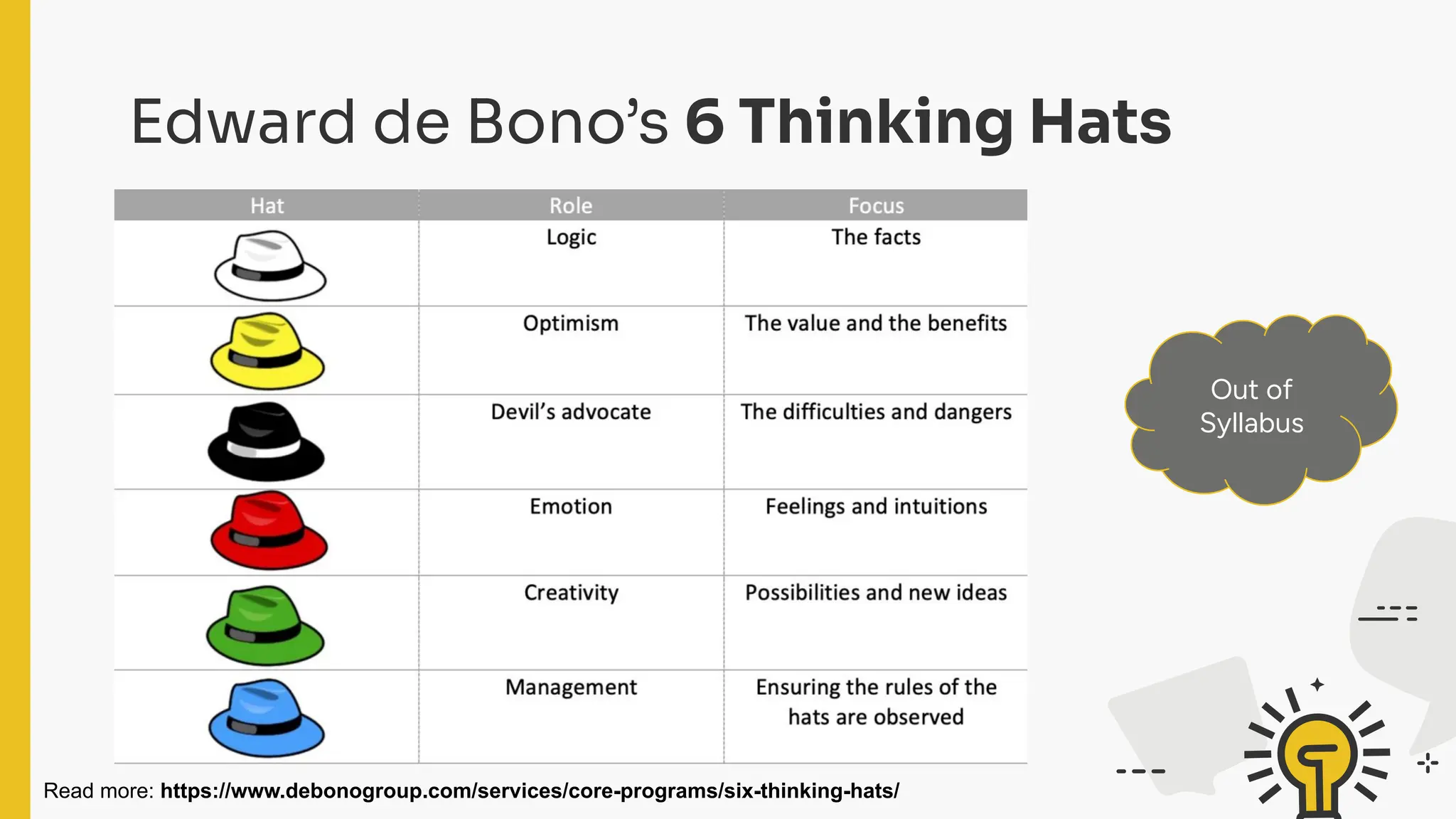
Edward de Bono’s 6 Thinking Hats
Read more: https://www.debonogroup.com/services/core-programs/six-thinking-hats/
Out of
Syllabus
Ideation Methods : Lateral Thinking
Techniques of Lateral Thinking
● Random Entry: Use a random stimulus to trigger new ideas.
● Provocation (Po): Make outrageous or illogical statements to explore possibilities.
● Challenge: Question why things are done the usual way.
● Concept Extraction: Simplify complex problems into core ideas.
● Analogies & Metaphors: Borrow insights from unrelated fields.
● Reversal: Flip assumptions or processes to see new opportunities.
Ideation Methods : Lateral Thinking
Example of Lateral Thinking
● Problem: Passengers often complained about long waiting times at baggage claim.
● Conventional solution: Speed up the conveyor system or add more staff.
● Lateral thinking solution:
○ The airport increased the walking distance from the plane to the baggage carousel.
○ By the time passengers reached, their luggage was already waiting.
● Result: Complaints dropped dramatically, even though the overall time was the same.
● Lesson: Sometimes the solution is not to eliminate the problem, but to change how
people experience it.
Ideation Methods : Lateral Thinking
Example of Lateral Thinking
● Problem: Passengers often complained about long waiting times at baggage claim.
● Conventional solution: Speed up the conveyor system or add more staff.
● Lateral thinking solution:
○ The airport increased the walking distance from the plane to the baggage carousel.
○ By the time passengers reached, their luggage was already waiting.
● Result: Complaints dropped dramatically, even though the overall time was the same.
● Lesson: Sometimes the solution is not to eliminate the problem, but to change how
people experience it.
3.3. Innovation Heuristics
and Analogies
Innovation heuristics and analogies
INNOVATION HEURISTICS
● Heuristics are rules of thumb or strategies that guide idea generation.
● Simplify complex problems into manageable steps for innovation.
● Encourage exploring multiple directions instead of one fixed path.
● Examples: “Eliminate,” “Combine,” “Substitute,” “Rearrange.”
● Provide structured creativity without rigid formulas.
● Help engineers and designers break habitual thinking patterns.
Innovation heuristics and analogies
ANALOGICAL THINKING INNOVATION
● Analogy = solving problems by drawing parallels from other domains.
● Uses “this reminds me of…” approach to spark new ideas.
● Famous example: Wright brothers studied bird flight for airplanes.
● Encourages cross-disciplinary insights (biology → engineering, nature → design).
● Helps in reframing problems with fresh perspectives.
● Builds innovative bridges between unrelated fields.
Innovation heuristics and analogies
APPLICATIONS AND BENEFITS
● Speeds up idea generation during design thinking workshops.
● Useful in product design (e.g., Velcro inspired by burrs).
● Improves problem-solving efficiency with tried heuristics.
● Encourages biomimicry and nature-inspired innovations.
● Enhances team creativity by combining diverse perspectives.
● Leads to practical, novel solutions with real-world impact.
3.4. Overcoming Fixed
Mindsets and Cognitive Blocks
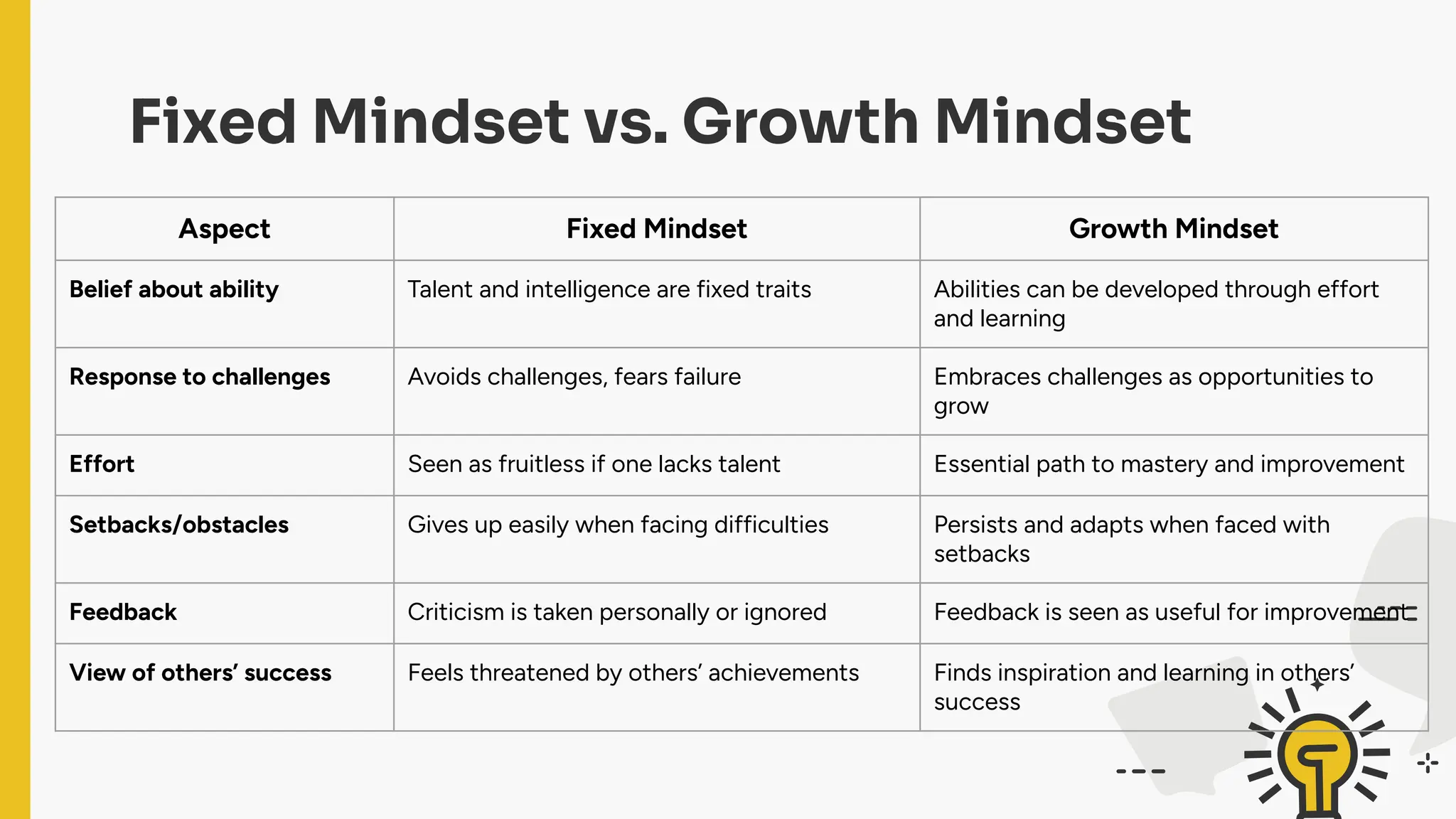
Fixed Mindset vs. Growth Mindset
Aspect Fixed Mindset Growth Mindset
Belief about ability Talent and intelligence are fixed traits Abilities can be developed through effort
and learning
Response to challenges Avoids challenges, fears failure Embraces challenges as opportunities to
grow
Effort Seen as fruitless if one lacks talent Essential path to mastery and improvement
Setbacks/obstacles Gives up easily when facing difficulties Persists and adapts when faced with
setbacks
Feedback Criticism is taken personally or ignored Feedback is seen as useful for improvement
View of others’ success Feels threatened by others’ achievements Finds inspiration and learning in others’
success
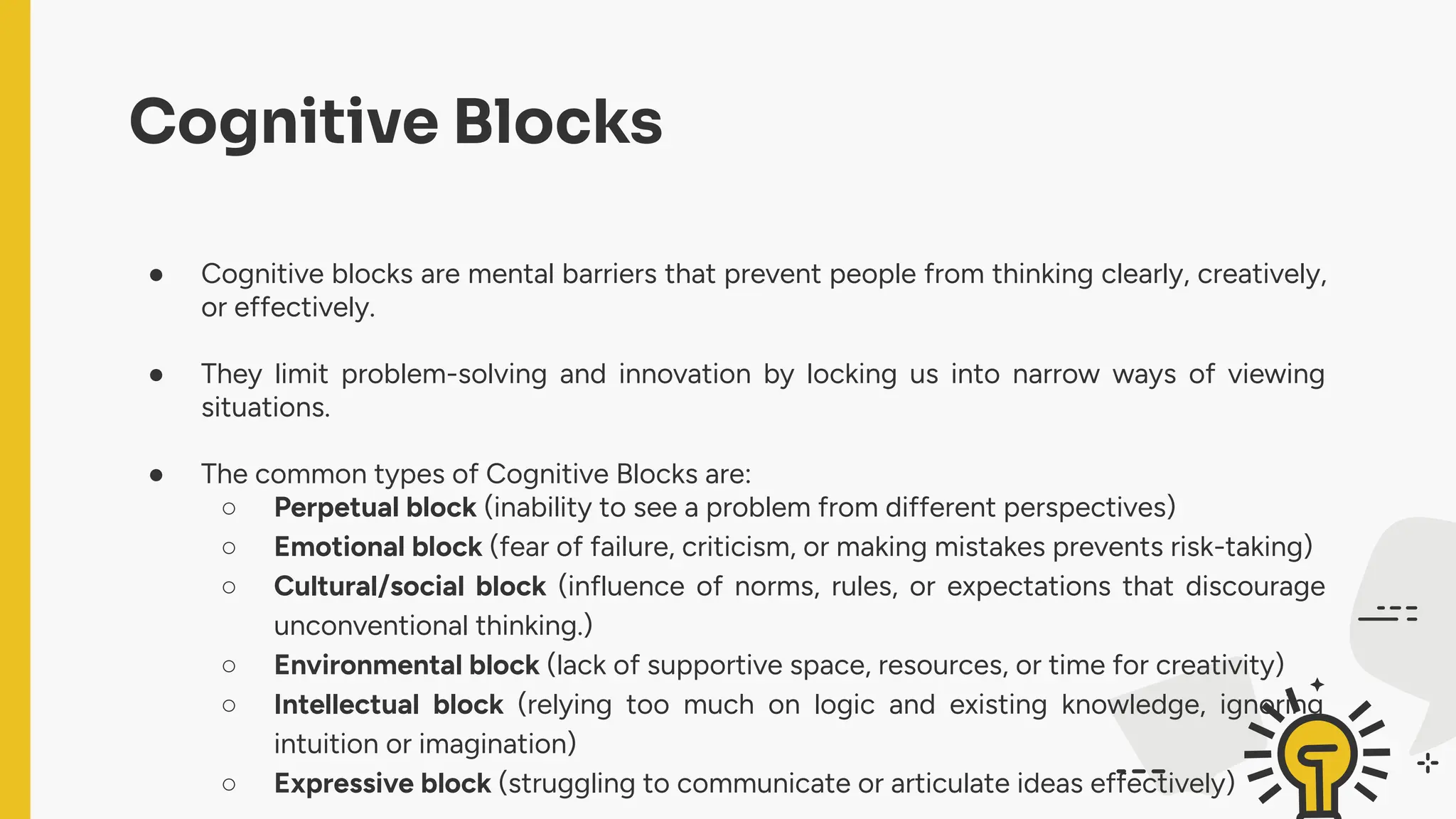
Cognitive Blocks
● Cognitive blocks are mental barriers that prevent people from thinking clearly, creatively,
or effectively.
● They limit problem-solving and innovation by locking us into narrow ways of viewing
situations.
● The common types of Cognitive Blocks are:
○ Perpetual block (inability to see a problem from different perspectives)
○ Emotional block (fear of failure, criticism, or making mistakes prevents risk-taking)
○ Cultural/social block (influence of norms, rules, or expectations that discourage
unconventional thinking.)
○ Environmental block (lack of supportive space, resources, or time for creativity)
○ Intellectual block (relying too much on logic and existing knowledge, ignoring
intuition or imagination)
○ Expressive block (struggling to communicate or articulate ideas effectively)
How to Overcome Cognitive Blocks
● Strategies to Overcome Perceptual Block
○ Use brainstorming and “SCAMPER” techniques to see multiple angles.
○ Reframe the problem: ask “What if?” or “Why not?”.
○ Seek inspiration from other fields (e.g., nature, art, history).
● Strategies to Overcome Emotional Block
○ Find a safe, non-judgmental environment for ideas.
○ Self-emphasize learning from mistakes.
○ Learn risk-taking and reward effort, not just outcomes.
● Strategies to Overcome Cultural/Social Block
○ Challenge assumptions like “This is how it’s always done.”
○ Experience diversity of thought and perspectives.
○ Be part of open discussions without hierarchy in idea-sharing.
How to Overcome Cognitive Blocks
● Strategies to Overcome Environmental Block
○ Be part of flexible spaces for collaboration and creativity.
○ Take your own time for exploration beyond deadlines.
○ Use simple tools (post-its, whiteboards, prototypes) to encourage idea flow.
● Strategies to Overcome Intellectual Block
○ Balance logic with imagination (use analogies, metaphors, storytelling).
○ Expose yourself to interdisciplinary knowledge.
○ Be curious and question beyond the “standard solution.”
● Strategies to Overcome Expressive Block
○ Learn visual thinking (sketches, diagrams, storyboards).
○ Learn role-playing or prototyping to express ideas beyond words.
○ Practice pitching ideas simply and clearly.
3.5. Convergent vs Divergent
Thinking
Divergent Thinking
● Expands possibilities by generating many ideas.
● Encourages creativity, imagination, and free flow of thoughts.
● Quantity matters more than quality at first.
● Breaks away from assumptions and norms.
● Tools: Brainstorming, mind-mapping, SCAMPER, role-play.
● Example: “List 20 different ways to improve public transport.”
Convergent Thinking
● Narrows down options to reach the best possible solution.
● Focuses on logic, analysis, and evaluation.
● Quality and feasibility matter more than quantity.
● Uses criteria, constraints, and evidence to filter ideas.
● Tools: Decision matrix, pros–cons list, SWOT analysis.
● Example: “Choose the 2 most practical ideas for improving public transport.”
Divergent → Convergent Thinking
● First explore widely, then focus sharply.
● Divergent thinking = Idea generation stage (Ideate).
● Convergent thinking = Idea selection and refinement.
● Both are essential for innovation.
● Cycle can repeat multiple times.
● Outcome: Creative and practical solutions.
3.6. Idea Selection:
Feasibility vs Impact
Feasibility
● Refers to how practical and realistic an idea is.
● Considers available time, budget, and skills.
● Checks technological readiness.
● Evaluates ease of implementation.
● Accounts for institutional or policy constraints.
● Ensures idea is “doable” in current context.
Impact
● Refers to the potential value or benefit of an idea.
● Considers user satisfaction and experience.
● Addresses the size of the problem solved.
● Looks at long-term positive effects.
● Can influence society, environment, or community.
● Focuses on “how much difference will it make?”
Feasibility vs Impact Matrix
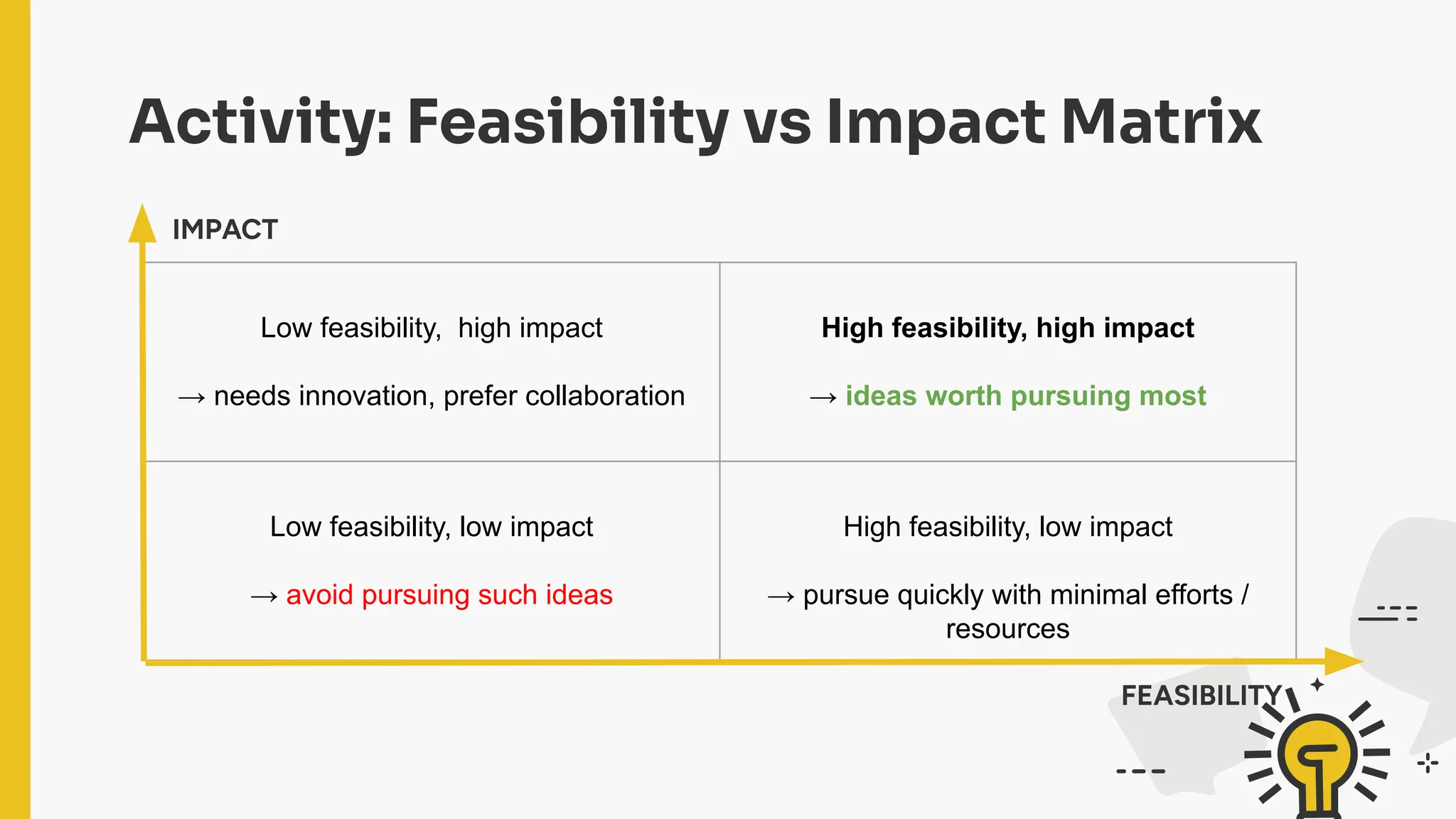
● Visual: 2x2 matrix – Feasibility on X-axis, Impact on Y-axis
○ High Feasibility + High Impact → Best ideas to pursue.
○ Low Feasibility + High Impact → Ambitious, may need innovation.
○ High Feasibility + Low Impact → Easy wins, but limited value.
○ Low Feasibility + Low Impact → Avoid pursuing.
Apply the Feasibility vs Impact Matrix
● Map all brainstormed ideas on the grid.
● Discuss trade-offs with team.
● Prioritize ideas in “High Impact, High Feasibility.”
● Consider partnerships/resources for “High Impact, Low Feasibility.”
● Avoid “Low Impact” ideas unless quick wins are strategic.
● Select 2–3 ideas for prototyping.
Activity: Feasibility vs Impact Matrix
● Sit in the same group as you did while performing the Brainstorming & Mind-Map
activities
● Remember: the topic was “improving campus lives of students”
● Keep the 10 ideas that you brainstormed in front of you, and
○ put each idea in one quadrant of the feasibility vs impact matrix
○ identify the following: ideas that you want to take forward for prototyping
Activity: Feasibility vs Impact Matrix
Low feasibility, high impact
→ needs innovation, prefer collaboration
High feasibility, high impact
→ ideas worth pursuing most
Low feasibility, low impact
→ avoid pursuing such ideas
High feasibility, low impact
→ pursue quickly with minimal efforts /
resources
IMPACT
FEASIBILITY
Case Analysis: Creative
Ideation at Google & IDEO
Case Analysis: Creative Ideation at Google
● Google is widely regarded as one of the most innovative companies in the world.
● Its success in products like Gmail, Google Maps, and Google Docs can be attributed to
structured yet flexible creative ideation practices.
● Google applies a design thinking mindset, encouraging experimentation, risk-taking, and
cross-functional collaboration.
● Psychological Safety: Google fosters an environment where employees feel safe sharing
unconventional ideas without fear of criticism.
● “20% Time” Policy: Employees are encouraged to spend 20% of their work time on
passion projects (leading to products like Gmail and AdSense).
● Cross-Functional Teams: Engineers, designers, and product managers collaborate to
ensure ideas are both technically feasible and user-centric.
Case Analysis: Creative Ideation at Google
● Ideation Practices at Google
○ Brainstorming & “Yes, and…” Principle: Teams build on each other’s ideas instead
of shutting them down.
○ Design Sprints: A 5-day structured process (developed at Google Ventures) to
rapidly ideate, prototype, and test solutions.
○ Prototyping Early: Quick, low-cost prototypes help test assumptions before
scaling.
○ User Empathy: Extensive use of user testing and data to refine ideas.
Case Analysis: Creative Ideation at Google
● Case Examples
○ Google Maps: Originated from a startup acquisition but grew through ideation at
Google—employees proposed features like Street View and real-time traffic.
○ Gmail: Started as a 20% time project by Paul Buchheit; initially rejected for being
unconventional (1 GB storage!) but became revolutionary.
○ Google X (Moonshot Factory): Focuses on radical ideas like self-driving cars and
internet balloons, balancing feasibility vs. impact.
Case Analysis: Creative Ideation at IDEO
● IDEO is a global design and innovation consultancy, famous for pioneering the design
thinking approach.
● Known for creating the first Apple mouse, Palm V PDA, and human-centered solutions in
healthcare, education, and business.
● Core belief: “Design is not just about products, it’s about solving problems creatively.
● Radical Collaboration: Teams are intentionally multidisciplinary (engineers, designers,
psychologists, anthropologists, business experts).
● Creative Confidence: Employees are encouraged to believe everyone is capable of
being creative.
● Fail Early, Fail Often: Quick iterations reduce the cost of failure and accelerate learning.
Case Analysis: Creative Ideation at IDEO
Ideation Practices as IDEO
● Brainstorming Rules: Defer judgment. Encourage wild ideas. Build on others’ ideas (“Yes,
and…”).Go for quantity over quality at first.
● Prototyping as Thinking: Prototypes are built early to visualize and test ideas.
● Storytelling: Ideas are communicated through narratives, sketches, and role-play.
● Observation & Immersion: Team members directly observe users in their environment
before ideating.
Case Analysis: Creative Ideation at IDEO
Case Examples
● Redesigning the Shopping Cart (ABC Nightline, 1999):
○ A famous 5-day project where IDEO redesigned the shopping cart.
○ Process involved observing shoppers, brainstorming unconventional ideas,
prototyping rapidly, and testing in real-world settings.
○ Result: A radically different cart design prioritizing safety, convenience, and theft
prevention.
● Healthcare Innovations: IDEO worked with hospitals to improve patient experiences
through redesigned waiting areas and service workflows.
CREDITS: This presentation template was created by Slidesgo, and
includes icons by Flaticon, and infographics & images by Freepik
Thanks!
Do you have any questions?
rohan.dasgupta@aiktc.ac.in
9967569336
https://www.linkedin.com/in/drrohandasgupta/

Design Thinking - Module 3 - Ideation and Creative Thinking - Dr. Rohan Dasgupta

  • 1.
  • 2.
    3.1. Psychology ofCreativity in Design Thinking
  • 3.
    Psychology of Creativityin Design Thinking ● Creativity is the ability to generate original and valuable ideas ● Involves both divergent thinking (many ideas) and convergent thinking (choosing best idea) ● Creativity is linked to cognitive flexibility and openness to experience ● Problem framing shapes the quality of creative solutions ● Emotions (curiosity, playfulness, intrinsic motivation) enhance creative thinking ● Environment and mindset strongly influence creative performance
  • 4.
    Psychology of Creativityin Design Thinking ● Breaks mental blocks by challenging assumptions and biases ● Encourages associative thinking – connecting unrelated ideas ● Involves incubation: subconscious processing leads to sudden “aha!” moments ● Collaboration and diverse perspectives boost idea generation ● Risk-taking and tolerance for ambiguity are crucial traits ● Reflection and iteration help refine raw ideas into practical solutions
  • 5.
  • 6.
    Ideation Methods ● Brainstorming ●Mind Mapping ● SCAMPER ● Lateral Thinking
  • 7.
    Ideation Methods :Brainstorming ● A group creativity technique used to generate many ideas quickly ● Based on free-flow of thoughts without immediate judgment ● Encourages divergent thinking and breaking mental barriers ● Works best in a collaborative, open, and supportive environment ● Quantity over quality at first – evaluation happens later ● Aims to spark innovative, unexpected solutions
  • 8.
    Ideation Methods :Brainstorming ● Delay judgment – no criticism during idea generation ● Encourage crazy ideas – unconventional thoughts may spark innovation ● Build on others’ ideas – combine and improve suggestions ● Go for quantity – more ideas increase chances of good ones ● Stay focused on the problem – keep the session goal clear ● One Conversation at a Time – Ensure active listening and avoid side discussions. ● Ensure equal participation – everyone contributes actively ● Visualize Ideas – Use sketches, sticky notes, or diagrams to make ideas more concrete and memorable.
  • 9.
    Activity : Brainstorming ●Topic: Improving campus life of students ● Make groups of 4 students ● Each group should appoint a facilitator to note down all ideas. ● Set a timer for 5 minutes → generate as many ideas as possible (no judgment). ● After time is up, each group should select top 3 ideas collaboratively. ● Groups should share their top ideas with the class. ● Short reflection: Discussion on how principles of brainstorming shaped their outcomes.
  • 10.
    Ideation Methods :Mind Mapping ● Visual tool for organizing and exploring ideas ● Starts with a central theme or problem at the center ● Branches represent main ideas, with sub-branches for details ● Encourages free association and non-linear thinking ● Helps uncover hidden connections between concepts ● Useful for both individual and group ideation sessions
  • 11.
    Ideation Methods :Mind Mapping ● Stimulates both left (logical) and right (creative) brain activity ● Breaks complex problems into simpler, structured parts ● Encourages flexibility in idea generation ● Enhances memory and recall through visual structure ● Supports collaboration and collective creativity in groups ● Makes ideas easier to review, refine, and present
  • 12.
    Ideation Methods :Mind Mapping HOW TO MAKE A MIND MAP 1. Define the central idea or main topic of the mind map: This should be a concise and clear statement that encapsulates the purpose or objective of the design project. 2. Identify key themes and subtopics related to the central idea: These can be broad categories or specific areas of focus within the design project. 3. Create nodes for each key theme or subtopic: These nodes will serve as the main branches that stem out from the central idea. 4. Add branches that connect each node to the central idea: These branches represent the relationships between the main topic and the subtopics.
  • 13.
    Ideation Methods :Mind Mapping HOW TO MAKE A MIND MAP (contd…) 5. Expand subtopics to make them more detailed: For each subtopic, designers further expand the map when they put in additional nodes and branches. These represent more specific ideas, concepts or features related to each subtopic. 6. Use color coding and icons to improve how visually clear the mind map is. Designers assign different colors to different themes or subtopics, and they use icons to represent specific ideas or concepts. 7. Review and refine the mind map to make sure that it accurately represents the information and relationships the designers want to show. They should refine the structure, wording and visual elements—as needed—to improve clarity and readability.
  • 16.
    Ideation Methods :Mind Mapping Tools for creating Mind Maps ● MindMeister ● Coggle ● Ayoa ● XMind ● Miro ● MindView
  • 17.
    Activity : MindMapping ● The groups and theme shall be the same as the previous activity of Brainstorming ● Login/register to the tool: Coogle ● The 3 / 4 best ideas from the Brainstorming activity shall be sub-topics of the mind map. ● Add 3 / 4 branches to each sub-topic ● Add 3 / 4 sub-branches to at least 1 branch ● Share with rohan.dasgupta@aiktc.ac.in
  • 18.
    Ideation Methods :SCAMPER ● SCAMPER is a structured brainstorming tool for generating innovative ideas. ● It encourages looking at problems/products from different perspectives. ● The name is an acronym: Substitute, Combine, Adapt, Modify, Put to another use, Eliminate, Reverse. ● Helps to overcome creative blocks by prompting systematic questioning. ● Applicable across engineering, business, product design, and services. ● Goal: stimulate creativity and generate multiple solution possibilities.
  • 19.
    Ideation Methods :SCAMPER ● Substitute – Replace a component, process, or material with another. ● Combine – Merge two ideas, products, or steps for added value. ● Adapt – Adjust existing ideas for a new situation or context. ● Modify/Magnify/Minify – Change size, shape, appearance, or features. ● Put to another use – Re-purpose existing solutions for new functions. ● Eliminate – Simplify by removing unnecessary parts or steps. ● Reverse/Rearrange – Change the order, orientation, or direction.
  • 20.
    Ideation Methods :SCAMPER ● Substitute – Replace plastic with biodegradable material. ● Combine – Add a built-in water filter. ● Adapt – Design bottle that fits into a bike frame or car holder. ● Modify/Magnify/Minify – Make it collapsible for easy storage. ● Put to another use – Bottle doubles as a phone stand. ● Eliminate – Remove the cap by using a self-sealing spout. ● Reverse/Rearrange – Invert design: bottle refills from the bottom for easier cleaning. ★ Example: Water Bottle
  • 21.
    Ideation Methods :Lateral Thinking ● Term introduced by Edward de Bono, meaning “thinking in non-linear ways.” ● Helps break rigid, habitual thought patterns. ● Encourages fresh, unconventional perspectives. ● Complements logical (vertical) thinking with creativity. ● Focuses on generating alternatives, not just refining one idea. ● Widely used in innovation, design, and engineering.
  • 22.
    Edward de Bono’s6 Thinking Hats Read more: https://www.debonogroup.com/services/core-programs/six-thinking-hats/ Out of Syllabus
  • 23.
    Ideation Methods :Lateral Thinking Techniques of Lateral Thinking ● Random Entry: Use a random stimulus to trigger new ideas. ● Provocation (Po): Make outrageous or illogical statements to explore possibilities. ● Challenge: Question why things are done the usual way. ● Concept Extraction: Simplify complex problems into core ideas. ● Analogies & Metaphors: Borrow insights from unrelated fields. ● Reversal: Flip assumptions or processes to see new opportunities.
  • 24.
    Ideation Methods :Lateral Thinking Example of Lateral Thinking ● Problem: Passengers often complained about long waiting times at baggage claim. ● Conventional solution: Speed up the conveyor system or add more staff. ● Lateral thinking solution: ○ The airport increased the walking distance from the plane to the baggage carousel. ○ By the time passengers reached, their luggage was already waiting. ● Result: Complaints dropped dramatically, even though the overall time was the same. ● Lesson: Sometimes the solution is not to eliminate the problem, but to change how people experience it.
  • 25.
    Ideation Methods :Lateral Thinking Example of Lateral Thinking ● Problem: Passengers often complained about long waiting times at baggage claim. ● Conventional solution: Speed up the conveyor system or add more staff. ● Lateral thinking solution: ○ The airport increased the walking distance from the plane to the baggage carousel. ○ By the time passengers reached, their luggage was already waiting. ● Result: Complaints dropped dramatically, even though the overall time was the same. ● Lesson: Sometimes the solution is not to eliminate the problem, but to change how people experience it.
  • 26.
  • 27.
    Innovation heuristics andanalogies INNOVATION HEURISTICS ● Heuristics are rules of thumb or strategies that guide idea generation. ● Simplify complex problems into manageable steps for innovation. ● Encourage exploring multiple directions instead of one fixed path. ● Examples: “Eliminate,” “Combine,” “Substitute,” “Rearrange.” ● Provide structured creativity without rigid formulas. ● Help engineers and designers break habitual thinking patterns.
  • 28.
    Innovation heuristics andanalogies ANALOGICAL THINKING INNOVATION ● Analogy = solving problems by drawing parallels from other domains. ● Uses “this reminds me of…” approach to spark new ideas. ● Famous example: Wright brothers studied bird flight for airplanes. ● Encourages cross-disciplinary insights (biology → engineering, nature → design). ● Helps in reframing problems with fresh perspectives. ● Builds innovative bridges between unrelated fields.
  • 29.
    Innovation heuristics andanalogies APPLICATIONS AND BENEFITS ● Speeds up idea generation during design thinking workshops. ● Useful in product design (e.g., Velcro inspired by burrs). ● Improves problem-solving efficiency with tried heuristics. ● Encourages biomimicry and nature-inspired innovations. ● Enhances team creativity by combining diverse perspectives. ● Leads to practical, novel solutions with real-world impact.
  • 30.
    3.4. Overcoming Fixed Mindsetsand Cognitive Blocks
  • 31.
    Fixed Mindset vs.Growth Mindset Aspect Fixed Mindset Growth Mindset Belief about ability Talent and intelligence are fixed traits Abilities can be developed through effort and learning Response to challenges Avoids challenges, fears failure Embraces challenges as opportunities to grow Effort Seen as fruitless if one lacks talent Essential path to mastery and improvement Setbacks/obstacles Gives up easily when facing difficulties Persists and adapts when faced with setbacks Feedback Criticism is taken personally or ignored Feedback is seen as useful for improvement View of others’ success Feels threatened by others’ achievements Finds inspiration and learning in others’ success
  • 32.
    Cognitive Blocks ● Cognitiveblocks are mental barriers that prevent people from thinking clearly, creatively, or effectively. ● They limit problem-solving and innovation by locking us into narrow ways of viewing situations. ● The common types of Cognitive Blocks are: ○ Perpetual block (inability to see a problem from different perspectives) ○ Emotional block (fear of failure, criticism, or making mistakes prevents risk-taking) ○ Cultural/social block (influence of norms, rules, or expectations that discourage unconventional thinking.) ○ Environmental block (lack of supportive space, resources, or time for creativity) ○ Intellectual block (relying too much on logic and existing knowledge, ignoring intuition or imagination) ○ Expressive block (struggling to communicate or articulate ideas effectively)
  • 33.
    How to OvercomeCognitive Blocks ● Strategies to Overcome Perceptual Block ○ Use brainstorming and “SCAMPER” techniques to see multiple angles. ○ Reframe the problem: ask “What if?” or “Why not?”. ○ Seek inspiration from other fields (e.g., nature, art, history). ● Strategies to Overcome Emotional Block ○ Find a safe, non-judgmental environment for ideas. ○ Self-emphasize learning from mistakes. ○ Learn risk-taking and reward effort, not just outcomes. ● Strategies to Overcome Cultural/Social Block ○ Challenge assumptions like “This is how it’s always done.” ○ Experience diversity of thought and perspectives. ○ Be part of open discussions without hierarchy in idea-sharing.
  • 34.
    How to OvercomeCognitive Blocks ● Strategies to Overcome Environmental Block ○ Be part of flexible spaces for collaboration and creativity. ○ Take your own time for exploration beyond deadlines. ○ Use simple tools (post-its, whiteboards, prototypes) to encourage idea flow. ● Strategies to Overcome Intellectual Block ○ Balance logic with imagination (use analogies, metaphors, storytelling). ○ Expose yourself to interdisciplinary knowledge. ○ Be curious and question beyond the “standard solution.” ● Strategies to Overcome Expressive Block ○ Learn visual thinking (sketches, diagrams, storyboards). ○ Learn role-playing or prototyping to express ideas beyond words. ○ Practice pitching ideas simply and clearly.
  • 35.
    3.5. Convergent vsDivergent Thinking
  • 36.
    Divergent Thinking ● Expandspossibilities by generating many ideas. ● Encourages creativity, imagination, and free flow of thoughts. ● Quantity matters more than quality at first. ● Breaks away from assumptions and norms. ● Tools: Brainstorming, mind-mapping, SCAMPER, role-play. ● Example: “List 20 different ways to improve public transport.”
  • 37.
    Convergent Thinking ● Narrowsdown options to reach the best possible solution. ● Focuses on logic, analysis, and evaluation. ● Quality and feasibility matter more than quantity. ● Uses criteria, constraints, and evidence to filter ideas. ● Tools: Decision matrix, pros–cons list, SWOT analysis. ● Example: “Choose the 2 most practical ideas for improving public transport.”
  • 38.
    Divergent → ConvergentThinking ● First explore widely, then focus sharply. ● Divergent thinking = Idea generation stage (Ideate). ● Convergent thinking = Idea selection and refinement. ● Both are essential for innovation. ● Cycle can repeat multiple times. ● Outcome: Creative and practical solutions.
  • 39.
  • 40.
    Feasibility ● Refers tohow practical and realistic an idea is. ● Considers available time, budget, and skills. ● Checks technological readiness. ● Evaluates ease of implementation. ● Accounts for institutional or policy constraints. ● Ensures idea is “doable” in current context.
  • 41.
    Impact ● Refers tothe potential value or benefit of an idea. ● Considers user satisfaction and experience. ● Addresses the size of the problem solved. ● Looks at long-term positive effects. ● Can influence society, environment, or community. ● Focuses on “how much difference will it make?”
  • 42.
    Feasibility vs ImpactMatrix ● Visual: 2x2 matrix – Feasibility on X-axis, Impact on Y-axis ○ High Feasibility + High Impact → Best ideas to pursue. ○ Low Feasibility + High Impact → Ambitious, may need innovation. ○ High Feasibility + Low Impact → Easy wins, but limited value. ○ Low Feasibility + Low Impact → Avoid pursuing.
  • 43.
    Apply the Feasibilityvs Impact Matrix ● Map all brainstormed ideas on the grid. ● Discuss trade-offs with team. ● Prioritize ideas in “High Impact, High Feasibility.” ● Consider partnerships/resources for “High Impact, Low Feasibility.” ● Avoid “Low Impact” ideas unless quick wins are strategic. ● Select 2–3 ideas for prototyping.
  • 44.
    Activity: Feasibility vsImpact Matrix ● Sit in the same group as you did while performing the Brainstorming & Mind-Map activities ● Remember: the topic was “improving campus lives of students” ● Keep the 10 ideas that you brainstormed in front of you, and ○ put each idea in one quadrant of the feasibility vs impact matrix ○ identify the following: ideas that you want to take forward for prototyping
  • 45.
    Activity: Feasibility vsImpact Matrix Low feasibility, high impact → needs innovation, prefer collaboration High feasibility, high impact → ideas worth pursuing most Low feasibility, low impact → avoid pursuing such ideas High feasibility, low impact → pursue quickly with minimal efforts / resources IMPACT FEASIBILITY
  • 46.
  • 47.
    Case Analysis: CreativeIdeation at Google ● Google is widely regarded as one of the most innovative companies in the world. ● Its success in products like Gmail, Google Maps, and Google Docs can be attributed to structured yet flexible creative ideation practices. ● Google applies a design thinking mindset, encouraging experimentation, risk-taking, and cross-functional collaboration. ● Psychological Safety: Google fosters an environment where employees feel safe sharing unconventional ideas without fear of criticism. ● “20% Time” Policy: Employees are encouraged to spend 20% of their work time on passion projects (leading to products like Gmail and AdSense). ● Cross-Functional Teams: Engineers, designers, and product managers collaborate to ensure ideas are both technically feasible and user-centric.
  • 48.
    Case Analysis: CreativeIdeation at Google ● Ideation Practices at Google ○ Brainstorming & “Yes, and…” Principle: Teams build on each other’s ideas instead of shutting them down. ○ Design Sprints: A 5-day structured process (developed at Google Ventures) to rapidly ideate, prototype, and test solutions. ○ Prototyping Early: Quick, low-cost prototypes help test assumptions before scaling. ○ User Empathy: Extensive use of user testing and data to refine ideas.
  • 49.
    Case Analysis: CreativeIdeation at Google ● Case Examples ○ Google Maps: Originated from a startup acquisition but grew through ideation at Google—employees proposed features like Street View and real-time traffic. ○ Gmail: Started as a 20% time project by Paul Buchheit; initially rejected for being unconventional (1 GB storage!) but became revolutionary. ○ Google X (Moonshot Factory): Focuses on radical ideas like self-driving cars and internet balloons, balancing feasibility vs. impact.
  • 50.
    Case Analysis: CreativeIdeation at IDEO ● IDEO is a global design and innovation consultancy, famous for pioneering the design thinking approach. ● Known for creating the first Apple mouse, Palm V PDA, and human-centered solutions in healthcare, education, and business. ● Core belief: “Design is not just about products, it’s about solving problems creatively. ● Radical Collaboration: Teams are intentionally multidisciplinary (engineers, designers, psychologists, anthropologists, business experts). ● Creative Confidence: Employees are encouraged to believe everyone is capable of being creative. ● Fail Early, Fail Often: Quick iterations reduce the cost of failure and accelerate learning.
  • 51.
    Case Analysis: CreativeIdeation at IDEO Ideation Practices as IDEO ● Brainstorming Rules: Defer judgment. Encourage wild ideas. Build on others’ ideas (“Yes, and…”).Go for quantity over quality at first. ● Prototyping as Thinking: Prototypes are built early to visualize and test ideas. ● Storytelling: Ideas are communicated through narratives, sketches, and role-play. ● Observation & Immersion: Team members directly observe users in their environment before ideating.
  • 52.
    Case Analysis: CreativeIdeation at IDEO Case Examples ● Redesigning the Shopping Cart (ABC Nightline, 1999): ○ A famous 5-day project where IDEO redesigned the shopping cart. ○ Process involved observing shoppers, brainstorming unconventional ideas, prototyping rapidly, and testing in real-world settings. ○ Result: A radically different cart design prioritizing safety, convenience, and theft prevention. ● Healthcare Innovations: IDEO worked with hospitals to improve patient experiences through redesigned waiting areas and service workflows.
  • 53.
    CREDITS: This presentationtemplate was created by Slidesgo, and includes icons by Flaticon, and infographics & images by Freepik Thanks! Do you have any questions? rohan.dasgupta@aiktc.ac.in 9967569336 https://www.linkedin.com/in/drrohandasgupta/