Demystifying Global Green
Building Rating System
and Aligning your Product
Testing Strategies
Morna Hallsaxton, MFA
LEED AP BD+C, ID+C
Morna.hallsaxton@intertek.com
Agenda
•  Sustainable Overview
•  Comparison of Global Green Building Rating Systems
•  Comparisons with product Energy Efficiency,
Chemicals, and Product Life (LCA/EPD)
•  LEED-Homes vs. LEED Commercial
•  Mexico Case Study
•  What’s Next?
•  Questions
MOHURD
2
Challenge Statement
“…sustainable-
to ensure that it meets the needs of the present without compromising
the ability of future generations to meet their own needs.”
From the 1987, the United Nations,
Brundtland Commission
3
Definition: Triple Bottom Line
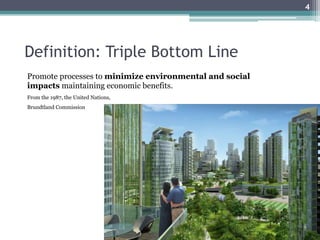
Promote processes to minimize environmental and social
impacts maintaining economic benefits.
From the 1987, the United Nations,
Brundtland Commission
4
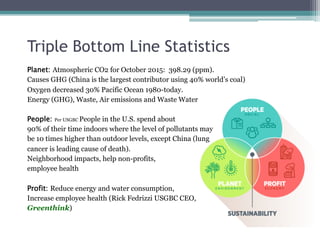
Triple Bottom Line Statistics
Planet: Atmospheric CO2 for October 2015: 398.29 (ppm).
Causes GHG (China is the largest contributor using 40% world’s coal)
Oxygen decreased 30% Pacific Ocean 1980-today.
Energy (GHG), Waste, Air emissions and Waste Water
People: Per USGBC People in the U.S. spend about
90% of their time indoors where the level of pollutants may
be 10 times higher than outdoor levels, except China (lung
cancer is leading cause of death).
Neighborhood impacts, help non-profits,
employee health
Profit: Reduce energy and water consumption,
Increase employee health (Rick Fedrizzi USGBC CEO,
Greenthink)
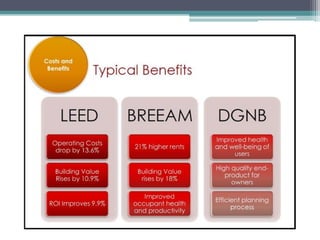
Profit and Cost
Global Sustainable Rating Systems
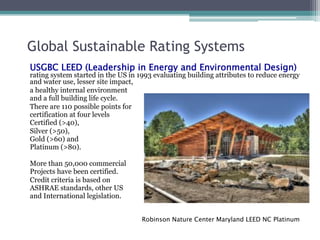
USGBC LEED (Leadership in Energy and Environmental Design)
rating system started in the US in 1993 evaluating building attributes to reduce energy
and water use, lesser site impact,
a healthy internal environment
and a full building life cycle.
There are 110 possible points for
certification at four levels
Certified (>40),
Silver (>50),
Gold (>60) and
Platinum (>80).
More than 50,000 commercial
Projects have been certified.
Credit criteria is based on
ASHRAE standards, other US
and International legislation.
Robinson Nature Center Maryland LEED NC Platinum
Global Sustainable Rating Systems
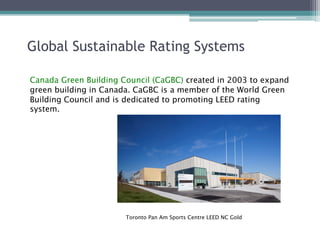
Canada Green Building Council (CaGBC) created in 2003 to expand
green building in Canada. CaGBC is a member of the World Green
Building Council and is dedicated to promoting LEED rating
system.
Toronto Pan Am Sports Centre LEED NC Gold
Global Sustainable Rating Systems
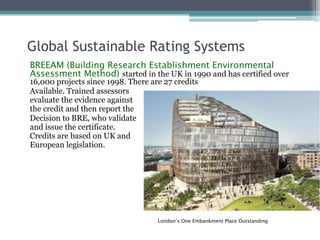
BREEAM (Building Research Establishment Environmental
Assessment Method) started in the UK in 1990 and has certified over
16,000 projects since 1998. There are 27 credits
Available. Trained assessors
evaluate the evidence against
the credit and then report the
Decision to BRE, who validate
and issue the certificate.
Credits are based on UK and
European legislation.
London’s One Embankment Place Outstanding
Global Sustainable Rating Systems
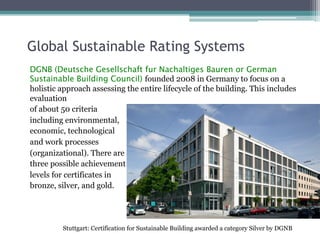
DGNB (Deutsche Gesellschaft fur Nachaltiges Bauren or German
Sustainable Building Council) founded 2008 in Germany to focus on a
holistic approach assessing the entire lifecycle of the building. This includes
evaluation
of about 50 criteria
including environmental,
economic, technological
and work processes
(organizational). There are
three possible achievement
levels for certificates in
bronze, silver, and gold.
Stuttgart: Certification for Sustainable Building awarded a category Silver by DGNB
Global Sustainable Rating Systems
China
Three Star System (GBEL-Green Building Evaluation Labeling)
•  credits based for NEW residential and public buildings.
•  Developed in 2006 for three different certification levels
•  Different from LEED in that it includes “Operations and
Management” as one of the seven category groups (Land, Energy,
Water, Materials, IEQ, O&M, Preference).
MOHURD: (Ministry of Housing and Urban-Rural Development)
•  developed in 2008 as a building labeling program
•  Mandatory in regulating energy efficiency of new government-
owned and large publically owned buildings.
•  (MOHURD Building Energy Label) certifies the Star rating.
Global Sustainable Rating Systems
China
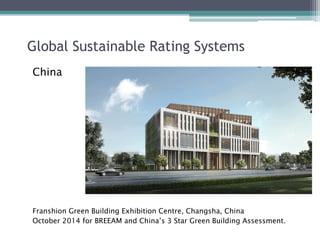
Franshion Green Building Exhibition Centre, Changsha, China
October 2014 for BREEAM and China’s 3 Star Green Building Assessment.
Canadian	
  Green	
  Building	
  
Council
Online	
  questionnaire-­‐based	
  approach,	
  
improvements,	
  then	
  verified	
  by	
  third	
  party	
  
BREEAM	
  assessor	
  (Building	
  Research	
  
Establishment)
Client	
  works	
  with	
  DGNB	
  auditor	
  
(third	
  party)	
  for	
  project	
  registration	
  
and	
  document	
  submission.
Formal	
  Examination,	
  Expert	
  committee	
  
evaluation,	
  and	
  public	
  scrutiny.	
  Wait	
  one	
  
year	
  for	
  energy	
  .
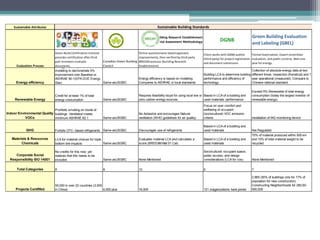
Same asUSGBC
Energy efficiency is based on modeling.
Compares to ASHRAE or local standards
Building LCA to determine building
performance and efficiency of
technology
Collection of absolute energy data at two
different times: inspection (thoretical) and 1
year operational (measured). Compare to
Chinese national standard.
Same asUSGBC
Requires feasibility stuyd for using local low or
zero carbon enregy sources.
Based in LCA of a building and
used materials: performance
Exceed 5% Renewable of total energy
consumption (today the largest investor of
renewable energy)
Same asUSGBC
No Asbestos and encourages Natural
ventilation (WHO guidelines for air quality)
Focus on user comfort and
wellbeing of occupant
(sociocultural) VOC emission
criteria Installation of IAQ monitoring device
Same asUSGBC Discourages use of refrigerants
Based in LCA of a building and
used materials Not Regulated
Same asUSGBC
Evaluates material LCA and calculates a
score (BREEAM Mat 01 Cal)
Based in LCA of a building and
used materials
70% of material produced within 500 km
and 10% of total material weight to be
recycled
Same asUSGBC None Mentioned
Sociocultural: occupant space,
public access, and design
considerations (LCA for cos) None Mentioned
8 10 6 7
4,000 plus 16,000 121 oraganizations have joined
2,965 (50% of buildings only for 17% of
population for new construction)
Constructing Neighborhoods for 250,00-
500,000
Sustainable	
  Building	
  Standards
Building	
  Research	
  Establishment	
  
Environmental	
  Assessment	
  Methodology DGNB
Green	
  Building	
  Evaluation	
  
and	
  Labeling	
  (GBEL)
Energy efficiency
LCA for material choices for triple
bottom line impacts
Forbids CFC- based refrigerants
Sustainable	
  Attributes
Energy efficiency based on
modeling to demonstrate 5%
improvement over Baseline or
ASHRAE 90.1(EPA DOE Energy
Star)
Green	
  Build	
  Certification	
  Institute	
  
provides	
  certification	
  after	
  third	
  
part	
  reviewers	
  evaluate	
  
documents.Evaluation	
  Process
8
Projects Certififed
50,000 in over 22 countries (2,000
in China)
Renewable Energy
Credit for at least 1% of total
energy consumption
Total Categories
Corporate Social
Responsibility ISO 14001
No credits for this now, yet
realizes that this needs to be
included.
Indoor Environmental Quality
VOCs
Materials & Resources
Chemicals
GHG
Prohibits smoking on inside of
buildings. Ventilation meets
minimum ASHRAE 62.1
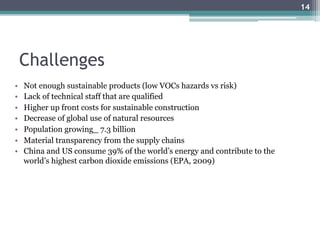
Challenges
•  Not enough sustainable products (low VOCs hazards vs risk)
•  Lack of technical staff that are qualified
•  Higher up front costs for sustainable construction
•  Decrease of global use of natural resources
•  Population growing_ 7.3 billion
•  Material transparency from the supply chains
•  China and US consume 39% of the world’s energy and contribute to the
world’s highest carbon dioxide emissions (EPA, 2009)
14
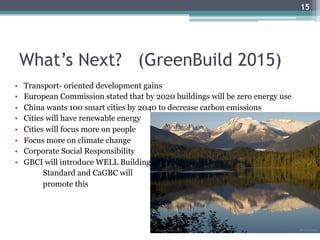
What’s Next? (GreenBuild 2015)
•  Transport- oriented development gains
•  European Commission stated that by 2020 buildings will be zero energy use
•  China wants 100 smart cities by 2040 to decrease carbon emissions
•  Cities will have renewable energy
•  Cities will focus more on people
•  Focus more on climate change
•  Corporate Social Responsibility
•  GBCI will introduce WELL Building
Standard and CaGBC will
promote this
15
In Conclusion
•  Reduce climate Warming
•  Chemical Transparency
•  Reduce energy use and GHG
•  Collaborate with industry
•  Resources are everywhere
16
Questions
17
(No question is too small!)

Construct Canada_M

  • 1.
    Demystifying Global Green BuildingRating System and Aligning your Product Testing Strategies Morna Hallsaxton, MFA LEED AP BD+C, ID+C Morna.hallsaxton@intertek.com
  • 2.
    Agenda •  Sustainable Overview • Comparison of Global Green Building Rating Systems •  Comparisons with product Energy Efficiency, Chemicals, and Product Life (LCA/EPD) •  LEED-Homes vs. LEED Commercial •  Mexico Case Study •  What’s Next? •  Questions MOHURD 2
  • 3.
    Challenge Statement “…sustainable- to ensurethat it meets the needs of the present without compromising the ability of future generations to meet their own needs.” From the 1987, the United Nations, Brundtland Commission 3
  • 4.
    Definition: Triple BottomLine Promote processes to minimize environmental and social impacts maintaining economic benefits. From the 1987, the United Nations, Brundtland Commission 4
  • 5.
    Triple Bottom LineStatistics Planet: Atmospheric CO2 for October 2015: 398.29 (ppm). Causes GHG (China is the largest contributor using 40% world’s coal) Oxygen decreased 30% Pacific Ocean 1980-today. Energy (GHG), Waste, Air emissions and Waste Water People: Per USGBC People in the U.S. spend about 90% of their time indoors where the level of pollutants may be 10 times higher than outdoor levels, except China (lung cancer is leading cause of death). Neighborhood impacts, help non-profits, employee health Profit: Reduce energy and water consumption, Increase employee health (Rick Fedrizzi USGBC CEO, Greenthink)
  • 6.
  • 7.
    Global Sustainable RatingSystems USGBC LEED (Leadership in Energy and Environmental Design) rating system started in the US in 1993 evaluating building attributes to reduce energy and water use, lesser site impact, a healthy internal environment and a full building life cycle. There are 110 possible points for certification at four levels Certified (>40), Silver (>50), Gold (>60) and Platinum (>80). More than 50,000 commercial Projects have been certified. Credit criteria is based on ASHRAE standards, other US and International legislation. Robinson Nature Center Maryland LEED NC Platinum
  • 8.
    Global Sustainable RatingSystems Canada Green Building Council (CaGBC) created in 2003 to expand green building in Canada. CaGBC is a member of the World Green Building Council and is dedicated to promoting LEED rating system. Toronto Pan Am Sports Centre LEED NC Gold
  • 9.
    Global Sustainable RatingSystems BREEAM (Building Research Establishment Environmental Assessment Method) started in the UK in 1990 and has certified over 16,000 projects since 1998. There are 27 credits Available. Trained assessors evaluate the evidence against the credit and then report the Decision to BRE, who validate and issue the certificate. Credits are based on UK and European legislation. London’s One Embankment Place Outstanding
  • 10.
    Global Sustainable RatingSystems DGNB (Deutsche Gesellschaft fur Nachaltiges Bauren or German Sustainable Building Council) founded 2008 in Germany to focus on a holistic approach assessing the entire lifecycle of the building. This includes evaluation of about 50 criteria including environmental, economic, technological and work processes (organizational). There are three possible achievement levels for certificates in bronze, silver, and gold. Stuttgart: Certification for Sustainable Building awarded a category Silver by DGNB
  • 11.
    Global Sustainable RatingSystems China Three Star System (GBEL-Green Building Evaluation Labeling) •  credits based for NEW residential and public buildings. •  Developed in 2006 for three different certification levels •  Different from LEED in that it includes “Operations and Management” as one of the seven category groups (Land, Energy, Water, Materials, IEQ, O&M, Preference). MOHURD: (Ministry of Housing and Urban-Rural Development) •  developed in 2008 as a building labeling program •  Mandatory in regulating energy efficiency of new government- owned and large publically owned buildings. •  (MOHURD Building Energy Label) certifies the Star rating.
  • 12.
    Global Sustainable RatingSystems China Franshion Green Building Exhibition Centre, Changsha, China October 2014 for BREEAM and China’s 3 Star Green Building Assessment.
  • 13.
    Canadian  Green  Building   Council Online  questionnaire-­‐based  approach,   improvements,  then  verified  by  third  party   BREEAM  assessor  (Building  Research   Establishment) Client  works  with  DGNB  auditor   (third  party)  for  project  registration   and  document  submission. Formal  Examination,  Expert  committee   evaluation,  and  public  scrutiny.  Wait  one   year  for  energy  . Same asUSGBC Energy efficiency is based on modeling. Compares to ASHRAE or local standards Building LCA to determine building performance and efficiency of technology Collection of absolute energy data at two different times: inspection (thoretical) and 1 year operational (measured). Compare to Chinese national standard. Same asUSGBC Requires feasibility stuyd for using local low or zero carbon enregy sources. Based in LCA of a building and used materials: performance Exceed 5% Renewable of total energy consumption (today the largest investor of renewable energy) Same asUSGBC No Asbestos and encourages Natural ventilation (WHO guidelines for air quality) Focus on user comfort and wellbeing of occupant (sociocultural) VOC emission criteria Installation of IAQ monitoring device Same asUSGBC Discourages use of refrigerants Based in LCA of a building and used materials Not Regulated Same asUSGBC Evaluates material LCA and calculates a score (BREEAM Mat 01 Cal) Based in LCA of a building and used materials 70% of material produced within 500 km and 10% of total material weight to be recycled Same asUSGBC None Mentioned Sociocultural: occupant space, public access, and design considerations (LCA for cos) None Mentioned 8 10 6 7 4,000 plus 16,000 121 oraganizations have joined 2,965 (50% of buildings only for 17% of population for new construction) Constructing Neighborhoods for 250,00- 500,000 Sustainable  Building  Standards Building  Research  Establishment   Environmental  Assessment  Methodology DGNB Green  Building  Evaluation   and  Labeling  (GBEL) Energy efficiency LCA for material choices for triple bottom line impacts Forbids CFC- based refrigerants Sustainable  Attributes Energy efficiency based on modeling to demonstrate 5% improvement over Baseline or ASHRAE 90.1(EPA DOE Energy Star) Green  Build  Certification  Institute   provides  certification  after  third   part  reviewers  evaluate   documents.Evaluation  Process 8 Projects Certififed 50,000 in over 22 countries (2,000 in China) Renewable Energy Credit for at least 1% of total energy consumption Total Categories Corporate Social Responsibility ISO 14001 No credits for this now, yet realizes that this needs to be included. Indoor Environmental Quality VOCs Materials & Resources Chemicals GHG Prohibits smoking on inside of buildings. Ventilation meets minimum ASHRAE 62.1
  • 14.
    Challenges •  Not enoughsustainable products (low VOCs hazards vs risk) •  Lack of technical staff that are qualified •  Higher up front costs for sustainable construction •  Decrease of global use of natural resources •  Population growing_ 7.3 billion •  Material transparency from the supply chains •  China and US consume 39% of the world’s energy and contribute to the world’s highest carbon dioxide emissions (EPA, 2009) 14
  • 15.
    What’s Next? (GreenBuild2015) •  Transport- oriented development gains •  European Commission stated that by 2020 buildings will be zero energy use •  China wants 100 smart cities by 2040 to decrease carbon emissions •  Cities will have renewable energy •  Cities will focus more on people •  Focus more on climate change •  Corporate Social Responsibility •  GBCI will introduce WELL Building Standard and CaGBC will promote this 15
  • 16.
    In Conclusion •  Reduceclimate Warming •  Chemical Transparency •  Reduce energy use and GHG •  Collaborate with industry •  Resources are everywhere 16
  • 17.