Building Rating Systems
In
India & World
Environment Responsive Design
Submitted to : Ar. Tapaswini
Submitted by :
Pavani
Kavya Sri
Neeharika
Content :
Green Building
• Green Building Rating System
• Agencies and Institutions
 Indian Green Building Council (IGBC)
 TERI
 GRIHA
• CASE STUDY – 1
CII Building ( First green building in INDIA)
• CASE STUDY - 2
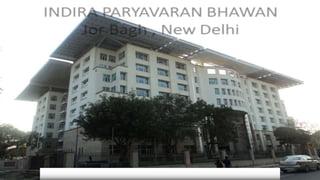
- INDIRA PARYAVARAN BHAWAN
( FIRST NET ZERO BUILDING)
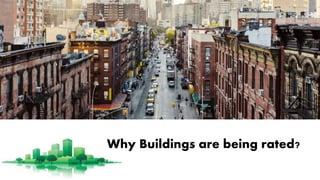
Why Buildings are being rated?
Buildings have extensive direct
and indirect impacts on the
environment.
During their construction,
occupancy, renovation, repurposing,
and demolition, buildings use
energy, water, and raw materials,
generate waste, and emit potentially
harmful atmospheric emissions.
These facts have prompted the
creation of green building standards,
certifications, and rating systems
aimed at mitigating the impact of
buildings on the natural environment
through sustainable design.
How did it
start?
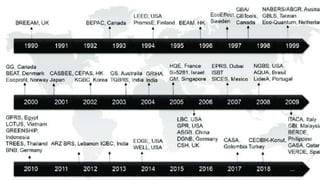
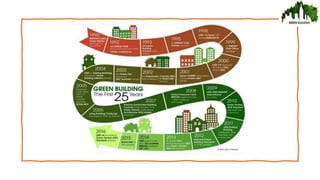
• The push toward sustainable design increased with the launch in 1990 of Building Research
Establishment's Environmental Assessment Method (BREEAM), the first green building
rating system in the world.
• In 2000, the U.S. Green Building Council (USGBC) followed suit and developed and
released criteria also aimed at improving the environmental performance of buildings through
its Leadership in Energy and Environmental Design (LEED) rating system for new
construction.
• Since that first release, LEED has continued to grow in prominence and to include rating
systems for existing buildings and entire neighborhoods.
• Others also responded to the growing interest and demand for sustainable design including
the Green Building Initiative (GBI), which was created to assist the National Association of
Homebuilders (NAHB) in promoting its Green Building Guidelines for Residential Structures.
• Although originally developed for Canada, GBI helped to make Green Globes available for
use in the U.S. in 2005.
• Additional rating systems have been developed that were influenced by these early
programs but are tailored to their own national priorities and requirements or seek to go
beyond the limits of current policy and building practices to address broader issues of
sustainability or evolving concepts such as net zero energy, and living and restorative
building concepts that improve the natural environment, or those that model nature's
processes.
GREEN BUILDING AGENCIES AND INSTITUTIONS
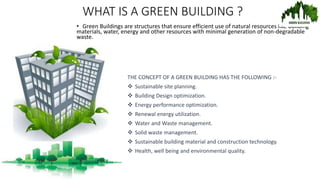
WHAT IS A GREEN BUILDING ?
• Green Buildings are structures that ensure efficient use of natural resources like building
materials, water, energy and other resources with minimal generation of non-degradable
waste.
THE CONCEPT OF A GREEN BUILDING HAS THE FOLLOWING :-
 Sustainable site planning.
 Building Design optimization.
 Energy performance optimization.
 Renewal energy utilization.
 Water and Waste management.
 Solid waste management.
 Sustainable building material and construction technology.
 Health, well being and environmental quality.
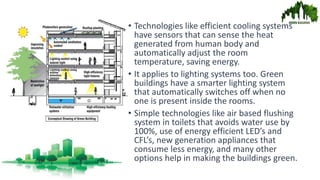
• Technologies like efficient cooling systems
have sensors that can sense the heat
generated from human body and
automatically adjust the room
temperature, saving energy.
• It applies to lighting systems too. Green
buildings have a smarter lighting system
that automatically switches off when no
one is present inside the rooms.
• Simple technologies like air based flushing
system in toilets that avoids water use by
100%, use of energy efficient LED’s and
CFL’s, new generation appliances that
consume less energy, and many other
options help in making the buildings green.
GREEN BUILDING RATING SYSTEMS
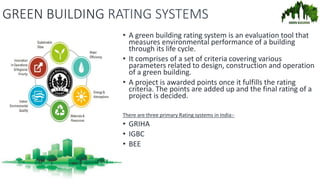
• A green building rating system is an evaluation tool that
measures environmental performance of a building
through its life cycle.
• It comprises of a set of criteria covering various
parameters related to design, construction and operation
of a green building.
• A project is awarded points once it fulfills the rating
criteria. The points are added up and the final rating of a
project is decided.
There are three primary Rating systems in India:-
• GRIHA
• IGBC
• BEE
International Building Rating Agencies
The Building Research Establishment Environmental Assessment Method (BREEAM) –
United Kingdom
Leadership in Energy and Environmental Design (LEED) - USA
Indian Building Rating Agencies
Green Rating for Integrated Habitat Assessment (GRIHA)
Leadership in Energy and Environment Design (LEED)
INDIAN GREEN BUILDING COUNCIL (IGBC)
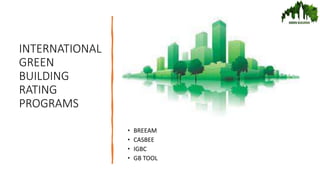
INTERNATIONAL
GREEN
BUILDING
RATING
PROGRAMS
• BREEAM
• CASBEE
• IGBC
• GB TOOL
BREEAM: BUILDING RESEARCH ESTABLISHMENT’S
ENVIRONMENTAL ASSESSMENT METHOD
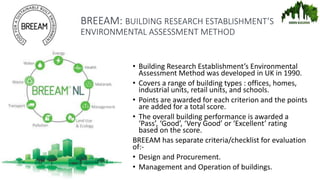
• Building Research Establishment’s Environmental
Assessment Method was developed in UK in 1990.
• Covers a range of building types : offices, homes,
industrial units, retail units, and schools.
• Points are awarded for each criterion and the points
are added for a total score.
• The overall building performance is awarded a
‘Pass’, ‘Good’, ‘Very Good’ or ‘Excellent’ rating
based on the score.
BREEAM has separate criteria/checklist for evaluation
of:-
• Design and Procurement.
• Management and Operation of buildings.
CASBEE:
COMPREHENSIVE ASSESSMENT SYSTEM FOR
BUILDING ENVIRONMENTAL EFFICIENCY
• Comprehensive Assessment System for Building
Environmental Efficiency (CASBEE) was developed
in Japan, in 2001.
• The family of assessment tools is based on the
building’s life cycle: pre-design, new construction,
existing buildings, and renovation.
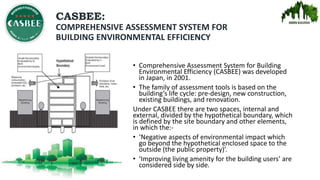
Under CASBEE there are two spaces, internal and
external, divided by the hypothetical boundary, which
is defined by the site boundary and other elements,
in which the:-
• ‘Negative aspects of environmental impact which
go beyond the hypothetical enclosed space to the
outside (the public property)’.
• ‘Improving living amenity for the building users’ are
considered side by side.
LEED: LEADERSHIP IN ENERGY
AND ENVIRONMENTAL DESIGN
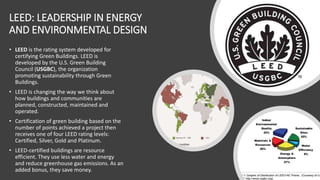
• LEED is the rating system developed for
certifying Green Buildings. LEED is
developed by the U.S. Green Building
Council (USGBC), the organization
promoting sustainability through Green
Buildings.
• LEED is changing the way we think about
how buildings and communities are
planned, constructed, maintained and
operated.
• Certification of green building based on the
number of points achieved a project then
receives one of four LEED rating levels:
Certified, Silver, Gold and Platinum.
• LEED-certified buildings are resource
efficient. They use less water and energy
and reduce greenhouse gas emissions. As an
added bonus, they save money.
GB TOOL:
• GB Tool Green Building Challenge Assessment Framework was developed by the International Framework Committee for
the Green Building Challenge, an international project that has involved more than 25 countries since 1998.
• GB Tool is designed to be adapted by sponsors to reflect regional conditions and context.
It includes criteria in categories :
• Site Selection.
• Project Planning and Development.
• Environmental Loadings.
• Energy and Resource Consumption.
• Indoor Environmental Quality.
• Functionality.
• Long-Term Performance.
• Social and Economic Aspects.
• Criteria are assessed using scales that are based on local benchmarks of ‘typical’ practice.
GRIHA
GREEN
RATING FOR
INTEGRATED
HABITAT
ASSESSMENT
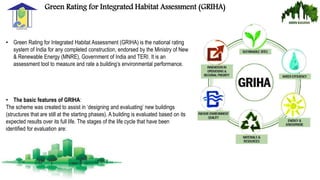
Green Rating for Integrated Habitat Assessment (GRIHA)
• Green Rating for Integrated Habitat Assessment (GRIHA) is the national rating
system of India for any completed construction, endorsed by the Ministry of New
& Renewable Energy (MNRE), Government of India and TERI. It is an
assessment tool to measure and rate a building’s environmental performance.
• The basic features of GRIHA:
The scheme was created to assist in ‘designing and evaluating’ new buildings
(structures that are still at the starting phases). A building is evaluated based on its
expected results over its full life. The stages of the life cycle that have been
identified for evaluation are:
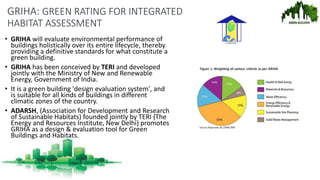
GRIHA: GREEN RATING FOR INTEGRATED
HABITAT ASSESSMENT
• GRIHA will evaluate environmental performance of
buildings holistically over its entire lifecycle, thereby
providing a definitive standards for what constitute a
green building.
• GRIHA has been conceived by TERI and developed
jointly with the Ministry of New and Renewable
Energy, Government of India.
• It is a green building 'design evaluation system', and
is suitable for all kinds of buildings in different
climatic zones of the country.
• ADARSH, (Association for Development and Research
of Sustainable Habitats) founded jointly by TERI (The
Energy and Resources Institute, New Delhi) promotes
GRIHA as a design & evaluation tool for Green
Buildings and Habitats.
OBJECTIVES OF GRIHA :
Minimize a building’s resource consumption, waste generation, and overall
ecological impact.
Evaluates the environmental performance of a building holistically over its
entire life cycle, thereby providing a definitive standard for what constitutes a
‘green building’.
Based on accepted energy and environmental principles, seeks to strike a
balance between the established practices and emerging concepts.
Reduced energy consumption without sacrificing the comfort levels.
Reduced destruction of natural areas, habitats, and biodiversity, and reduced
soil loss from erosion etc.
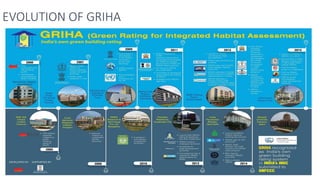
EVOLUTION OF GRIHA
GRIHA RATING CRITERIA
 Except for industrial complexes, all buildings – offices, retail malls, institutions, hotels, hospitals, health-care
facilities, residences, and multi-family high-rise buildings – in the pre-design/design stage are eligible for
certification under GRIHA.
 The percentage of total outdoor lighting fixtures with solar lighting system, as per GRIHA tenets which is a
minimum of 25% of total number or 15% of total connected load, whichever is higher, can fetch 1 point.
 Demonstrated use of minimization and consolidation of transportation or service corridors and shading of
pedestrian roads, as per GRIHA can garner 1 point.
 The Use of aggregate utility corridors, as per GRIHA is another point to the kitty.
 Furthermore, firming up of utility corridors along the formerly disturbed areas or along new roads in order to
reduce needless cutting and trenching and ensure easy maintenance is also a GRIHA point.
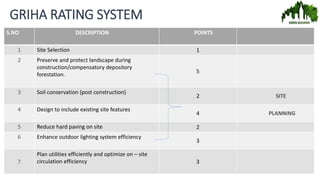
GRIHA RATING SYSTEM
S.NO DESCRIPTION POINTS
1 Site Selection 1
2 Preserve and protect landscape during
construction/compensatory depository
forestation.
5
3 Soil conservation (post construction)
2 SITE
4 Design to include existing site features
4 PLANNING
5 Reduce hard paving on site 2
6 Enhance outdoor lighting system efficiency
3
7
Plan utilities efficiently and optimize on – site
circulation efficiency 3
S.NO DESCRIPTION POINTS
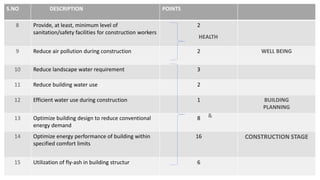
8 Provide, at least, minimum level of
sanitation/safety facilities for construction workers
2
9 Reduce air pollution during construction 2 WELL BEING
10 Reduce landscape water requirement 3
11 Reduce building water use 2
12 Efficient water use during construction 1 BUILDING
PLANNING
13 Optimize building design to reduce conventional
energy demand
8
14 Optimize energy performance of building within
specified comfort limits
16 CONSTRUCTION STAGE
15 Utilization of fly-ash in building structur 6
HEALTH
&
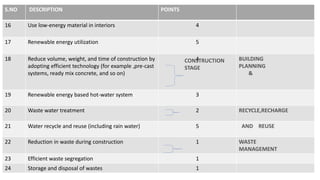
S.NO DESCRIPTION POINTS
16 Use low-energy material in interiors 4
17 Renewable energy utilization 5
18 Reduce volume, weight, and time of construction by
adopting efficient technology (for example ,pre-cast
systems, ready mix concrete, and so on)
4 BUILDING
PLANNING
&
19 Renewable energy based hot-water system 3
20 Waste water treatment 2 RECYCLE,RECHARGE
21 Water recycle and reuse (including rain water) 5 AND REUSE
22 Reduction in waste during construction 1 WASTE
MANAGEMENT
23 Efficient waste segregation 1
24 Storage and disposal of wastes 1
CONSTRUCTION
STAGE
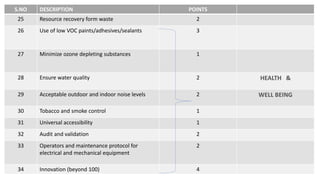
S.NO DESCRIPTION POINTS
25 Resource recovery form waste 2
26 Use of low VOC paints/adhesives/sealants 3
27 Minimize ozone depleting substances 1
28 Ensure water quality 2 HEALTH &
29 Acceptable outdoor and indoor noise levels 2 WELL BEING
30 Tobacco and smoke control 1
31 Universal accessibility 1
32 Audit and validation 2
33 Operators and maintenance protocol for
electrical and mechanical equipment
2
34 Innovation (beyond 100) 4
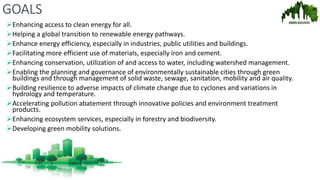
GOALS
Enhancing access to clean energy for all.
Helping a global transition to renewable energy pathways.
Enhance energy efficiency, especially in industries, public utilities and buildings.
Facilitating more efficient use of materials, especially iron and cement.
Enhancing conservation, utilization of and access to water, including watershed management.
Enabling the planning and governance of environmentally sustainable cities through green
buildings and through management of solid waste, sewage, sanitation, mobility and air quality.
Building resilience to adverse impacts of climate change due to cyclones and variations in
hydrology and temperature.
Accelerating pollution abatement through innovative policies and environment treatment
products.
Enhancing ecosystem services, especially in forestry and biodiversity.
Developing green mobility solutions.
INDIAN
GREEN
BUILDING
COUNCIL
(IGBC)
➢IGBC was formed in the year of 2001 by Confederation of Indian
industry(CII)
➢Vision of IGBC-India to become one of the world leaders in green buildings
by 2015
➢IGBC Green building rating system : one single rating cannot be applied to
suit all building types
• IGBC Green Homes Rating
• IGBC Green Factory Rating
• IGBC Green SEZs
• IGBC Green Township Rating
• IGBC India NC (New Construction)
• IGBC India CS (Core and Shell)
IGBC SERVICES
• IGBC Membership
• IGBC Local Chapters
• Green Building Certification
• Green Building Training Programme
• IGBC AP exam
• Green Building Directory(major venders and manufacturers)
• Green Building Congress(India’s annual flagship event)
• Government and IGBC : Additional FAR(Floor Area Ratio) of 5% for IGBC Rated
Green Building by Greater Noida Development Authority
• Plot size of 5,000 sq.m and above
• To achieve a minimum of Gold
• Rediscovery of Indian Ethos:
• 5 elements of nature(Panchabhutas)
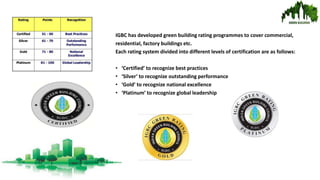
IGBC has developed green building rating programmes to cover commercial,
residential, factory buildings etc.
Each rating system divided into different levels of certification are as follows:
• ‘Certified’ to recognize best practices
• ‘Silver’ to recognize outstanding performance
• ‘Gold’ to recognize national excellence
• ‘Platinum’ to recognize global leadership
IGBC: INDIAN GREEN BUILDING COUNCIL
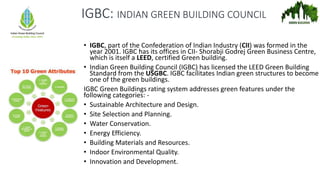
• IGBC, part of the Confederation of Indian Industry (CII) was formed in the
year 2001. IGBC has its offices in CII- Shorabji Godrej Green Business Centre,
which is itself a LEED, certified Green building.
• Indian Green Building Council (IGBC) has licensed the LEED Green Building
Standard from the USGBC. IGBC facilitates Indian green structures to become
one of the green buildings.
IGBC Green Buildings rating system addresses green features under the
following categories: -
• Sustainable Architecture and Design.
• Site Selection and Planning.
• Water Conservation.
• Energy Efficiency.
• Building Materials and Resources.
• Indoor Environmental Quality.
• Innovation and Development.
THE ENERGY AND RESOURCES INSTITUTE
• The TERI School of Advanced Studies (TERI SAS) is a higher education
institute in New Delhi, India which specialises in the field of sustainable
development.
• It was established in 1998 by TERI (The Energy and Resources Institute). In
1999, the TERI School of Advanced Studies was granted the 'Deemed to be
University'[1] status by the University Grants Commission (UGC).
The School started functioning from its green campus, located in Vasant-Kunj, New
Delhi in 2008 and offers Masters and PhD programs. It has started work on
developing a new campus at Hyderabad, Telangana in southern India.
Former name TERI University
Type Education and Research Institution
Established 1998
Chancellor Dr Shailesh Nayak
Vice-Chancellor Prof. Manipadma Datta (Acting)
Location New Delhi
, Delhi
, India
Campus 2 acres (0.81 ha)
Website www.terisas.ac.in
 TERI SAS imparts a world-class education with the help of six different departments and two
centres:
1. Department of Natural Resources
2. Department of Energy and Environment
3. Department of Biotechnology
4. Coca-Cola Department of Regional Water Studies
5. Department of Policy Studies
6. Department of Business and Sustainability
7. Centre for Post Graduate Legal Studies 8. Centre for Distance Education
 TERI SAS has been awarded for its interdisciplinary approach in providing a world-class education with the help
of a multidisciplinary curriculum. Some of the awards and recognition are:
 1. TERI SAS won the 3rd prize under the theme ‘Walkway of Discovery’, at the Bangalore India BIO 2010 Meet for
its unique biotechnology research work.
 2. Awarded for having the ‘Most Innovative Curriculum’ at the India Today Aspire Education Summit Awards,
2012.
 3. Awarded the "Greenest University and Research Institution" as part of the RTCC 2013 Climate Change.
 4. Accenture Innovation Jockeys (Season II) in 2013: Hunt for India's Most Innovative Minds
 5. Top Entries of Earthian 2013 & 2014 by TERI SAS Students 6. TERI SAS was awarded UN GCNI (Global
Compact Network India) Award at the 3rd Innovative Practices Awards 2019 on SDGs.
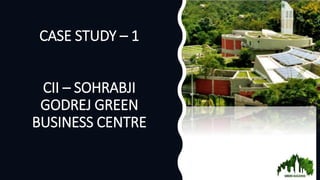
CASE STUDY – 1
CII – SOHRABJI
GODREJ GREEN
BUSINESS CENTRE
General Details
• Project name : CII - Sohrabji Godrej Green Business Centre
• (CII - Godrej GBC)
• Architect : Karan Grover & Associates
• Investor / Owner: Confederation of Indian Industry (CII)
• Project built date: 2004
• Area of project : 5 acres
• Built up Area : Built Up Area : 20000 sq ft
• Large area for landscape to enhance micro climate and for visual delight
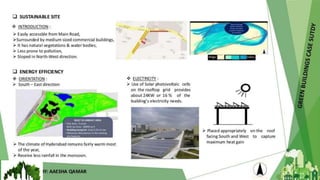
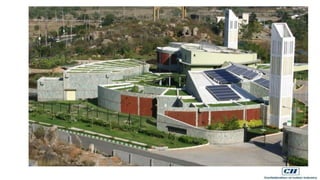
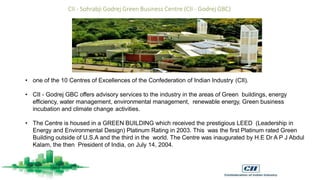
• one of the 10 Centres of Excellences of the Confederation of Indian Industry (CII).
• CII - Godrej GBC offers advisory services to the industry in the areas of Green buildings, energy
efficiency, water management, environmental management, renewable energy, Green business
incubation and climate change activities.
• The Centre is housed in a GREEN BUILDING which received the prestigious LEED (Leadership in
Energy and Environmental Design) Platinum Rating in 2003. This was the first Platinum rated Green
Building outside of U.S.A and the third in the world. The Centre was inaugurated by H.E Dr A P J Abdul
Kalam, the then President of India, on July 14, 2004.
CII - Sohrabji Godrej Green Business Centre (CII - Godrej GBC)
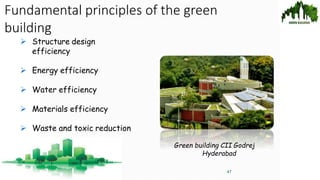
Fundamental principles of the green
building
47
 Structure design
efficiency
 Energy efficiency
 Water efficiency
 Materials efficiency
 Waste and toxic reduction
Green building CII Godrej
Hyderabad
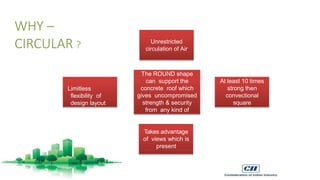
Limitless
flexibility of
design layout
Unrestricted
circulation of Air
Takes advantage
of views which is
present
The ROUND shape
can support the
concrete roof which
gives uncompromised
strength & security
from any kind of
disaster
At least 10 times
strong then
convectional
square
construction
WHY –
CIRCULAR ?
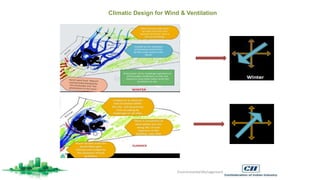
Climatic Design for Wind & Ventilation
EnvironmentalManagement
Materials used & Green
Facts
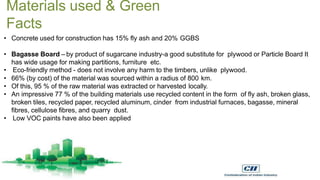
• Concrete used for construction has 15% fly ash and 20% GGBS
• Bagasse Board – by product of sugarcane industry-a good substitute for plywood or Particle Board It
has wide usage for making partitions, furniture etc.
• Eco-friendly method - does not involve any harm to the timbers, unlike plywood.
• 66% (by cost) of the material was sourced within a radius of 800 km.
• Of this, 95 % of the raw material was extracted or harvested locally.
• An impressive 77 % of the building materials use recycled content in the form of fly ash, broken glass,
broken tiles, recycled paper, recycled aluminum, cinder from industrial furnaces, bagasse, mineral
fibres, cellulose fibres, and quarry dust.
• Low VOC paints have also been applied
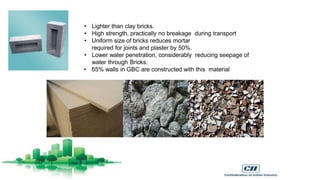
• Lighter than clay bricks.
• High strength, practically no breakage during transport
• Uniform size of bricks reduces mortar
required for joints and plaster by 50%.
• Lower water penetration, considerably reducing seepage of
water through Bricks.
• 65% walls in GBC are constructed with this material
V
S
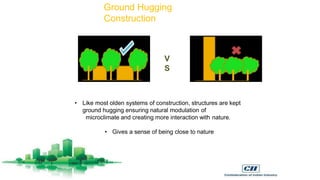
Ground Hugging
Construction
• Like most olden systems of construction, structures are kept
ground hugging ensuring natural modulation of
microclimate and creating more interaction with nature.
• Gives a sense of being close to nature
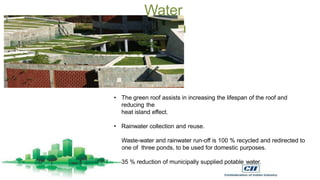
Water
conservation
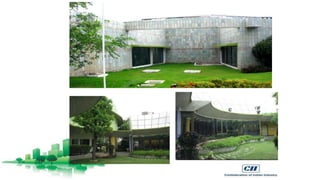
• The green roof assists in increasing the lifespan of the roof and
reducing the
heat island effect.
• Rainwater collection and reuse.
• Waste-water and rainwater run-off is 100 % recycled and redirected to
one of three ponds, to be used for domestic purposes.
• 35 % reduction of municipally supplied potable water.
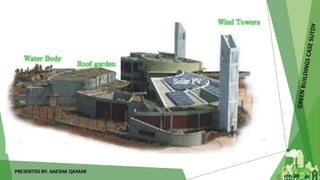
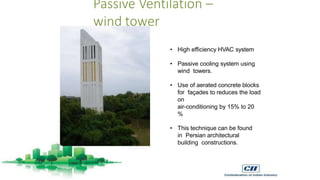
Passive Ventilation –
wind tower
• High efficiency HVAC system
• Passive cooling system using
wind towers.
• Use of aerated concrete blocks
for façades to reduces the load
on
air-conditioning by 15% to 20
%
• This technique can be found
in Persian architectural
building constructions.
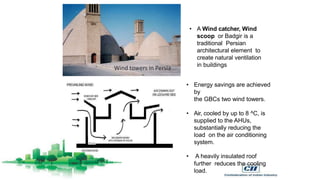
• A Wind catcher, Wind
scoop or Badgir is a
traditional Persian
architectural element to
create natural ventilation
in buildings
• Energy savings are achieved
by
the GBCs two wind towers.
• Air, cooled by up to 8 ^C, is
supplied to the AHUs,
substantially reducing the
load on the air conditioning
system.
• A heavily insulated roof
further reduces the cooling
load.
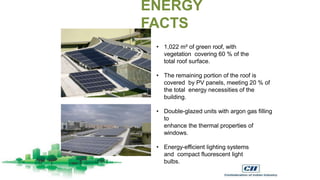
• 1,022 m² of green roof, with
vegetation covering 60 % of the
total roof surface.
• The remaining portion of the roof is
covered by PV panels, meeting 20 % of
the total energy necessities of the
building.
• Double-glazed units with argon gas filling
to
enhance the thermal properties of
windows.
• Energy-efficient lighting systems
and compact fluorescent light
bulbs.
ENERGY
FACTS
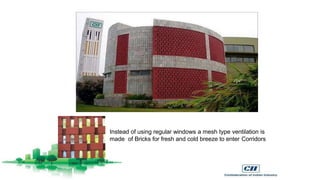
Instead of using regular windows a mesh type ventilation is
made of Bricks for fresh and cold breeze to enter Corridors
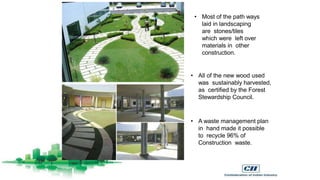
• Most of the path ways
laid in landscaping
are stones/tiles
which were left over
materials in other
construction.
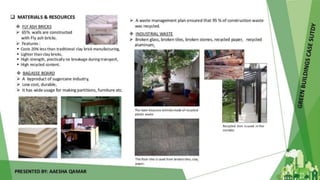
• All of the new wood used
was sustainably harvested,
as certified by the Forest
Stewardship Council.
• A waste management plan
in hand made it possible
to recycle 96% of
Construction waste.
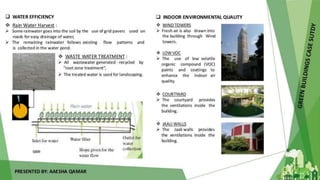
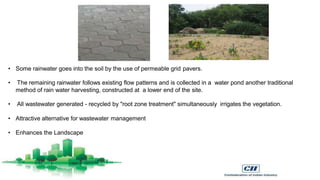
• Some rainwater goes into the soil by the use of permeable grid pavers.
• The remaining rainwater follows existing flow patterns and is collected in a water pond another traditional
method of rain water harvesting, constructed at a lower end of the site.
• All wastewater generated - recycled by "root zone treatment" simultaneously irrigates the vegetation.
• Attractive alternative for wastewater management
• Enhances the Landscape
Light & Ventilation
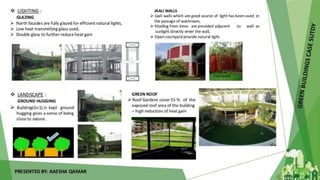
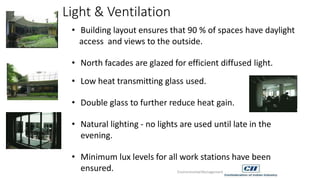
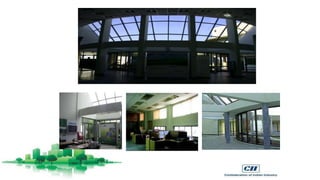
• Building layout ensures that 90 % of spaces have daylight
access and views to the outside.
• North facades are glazed for efficient diffused light.
• Low heat transmitting glass used.
• Double glass to further reduce heat gain.
• Natural lighting - no lights are used until late in the
evening.
• Minimum lux levels for all work stations have been
ensured. EnvironmentalManagement
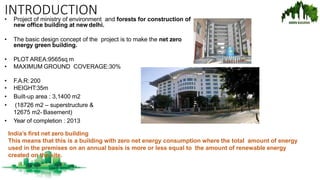
INTRODUCTION
• Project of ministry of environment and forests for construction of
new office building at new delhi.
• The basic design concept of the project is to make the net zero
energy green building.
• PLOT AREA:9565sq m
• MAXIMUM GROUND COVERAGE:30%
• F.A.R: 200
• HEIGHT:35m
• Built-up area : 3,1400 m2
• (18726 m2 – superstructure &
12675 m2- Basement)
• Year of completion : 2013
India’s first net zero building
This means that this is a building with zero net energy consumption where the total amount of energy
used in the premises on an annual basis is more or less equal to the amount of renewable energy
created on the site.
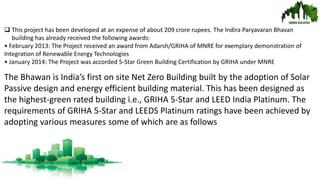
 This project has been developed at an expense of about 209 crore rupees. The Indira Paryavaran Bhavan
building has already received the following awards:
• February 2013: The Project received an award from Adarsh/GRIHA of MNRE for exemplary demonstration of
Integration of Renewable Energy Technologies
• January 2014: The Project was accorded 5-Star Green Building Certification by GRIHA under MNRE
The Bhawan is India’s first on site Net Zero Building built by the adoption of Solar
Passive design and energy efficient building material. This has been designed as
the highest-green rated building i.e., GRIHA 5-Star and LEED India Platinum. The
requirements of GRIHA 5-Star and LEEDS Platinum ratings have been achieved by
adopting various measures some of which are as follows
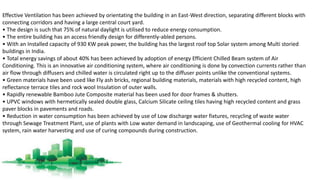
Effective Ventilation has been achieved by orientating the building in an East-West direction, separating different blocks with
connecting corridors and having a large central court yard.
• The design is such that 75% of natural daylight is utilised to reduce energy consumption.
• The entire building has an access friendly design for differently-abled persons.
• With an Installed capacity of 930 KW peak power, the building has the largest roof top Solar system among Multi storied
buildings in India.
• Total energy savings of about 40% has been achieved by adoption of energy Efficient Chilled Beam system of Air
Conditioning. This is an innovative air conditioning system, where air conditioning is done by convection currents rather than
air flow through diffusers and chilled water is circulated right up to the diffuser points unlike the conventional systems.
• Green materials have been used like Fly ash bricks, regional building materials, materials with high recycled content, high
reflectance terrace tiles and rock wool Insulation of outer walls.
• Rapidly renewable Bamboo Jute Composite material has been used for door frames & shutters.
• UPVC windows with hermetically sealed double glass, Calcium Silicate ceiling tiles having high recycled content and grass
paver blocks in pavements and roads.
• Reduction in water consumption has been achieved by use of Low discharge water fixtures, recycling of waste water
through Sewage Treatment Plant, use of plants with Low water demand in landscaping, use of Geothermal cooling for HVAC
system, rain water harvesting and use of curing compounds during construction.
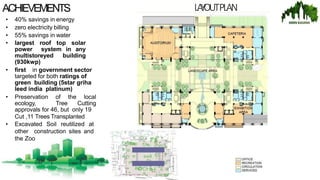
ACHIEVEMENTS
• 40% savings in energy
• zero electricity billing
• 55% savings in water
• largest roof top solar
power system in any
multistoreyed building
(930kwp)
• first in government sector
targeted for both ratings of
green building (5star griha
leed india platinum)
• Preservation of the local
ecology, Tree Cutting
approvals for 46, but only 19
Cut ,11 Trees Transplanted
• Excavated Soil reutilized at
other construction sites and
the Zoo
LA
YOUTPLAN
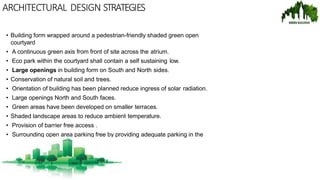
ARCHITECTURAL DESIGN STRATEGIES
• Building form wrapped around a pedestrian-friendly shaded green open
courtyard
• A continuous green axis from front of site across the atrium.
• Eco park within the courtyard shall contain a self sustaining low.
• Large openings in building form on South and North sides.
• Conservation of natural soil and trees.
• Orientation of building has been planned reduce ingress of solar radiation.
• Large openings North and South faces.
• Green areas have been developed on smaller terraces.
• Shaded landscape areas to reduce ambient temperature.
• Provision of barrier free access .
• Surrounding open area parking free by providing adequate parking in the
basement.
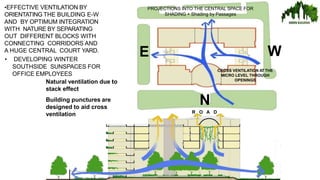
E
•EFFECTIVE VENTILATION BY
ORIENTATING THE BUILDING E-W
AND BY OPTIMUM INTEGRATION
WITH NATURE BY SEPARATING
OUT DIFFERENT BLOCKS WITH
CONNECTING CORRIDORS AND
A HUGE CENTRAL COURT YARD.
• DEVELOPING WINTER
SOUTHSIDE SUNSPACES FOR
OFFICE EMPLOYEES
W
CROSS VENTILATION AT THE
MICRO LEVEL THROUGH
OPENINGS
N
R O A D
PROJECTIONS INTO THE CENTRAL SPACE FOR
SHADING + Shading by Passages
Natural ventilation due to
stack effect
Building punctures are
designed to aid cross
ventilation
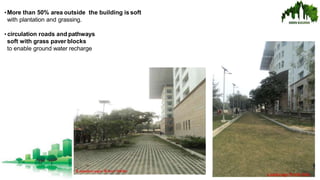
•More than 50% area outside the building is soft
with plantation and grassing.
• circulation roads and pathways
soft with grass paver blocks
to enable ground water recharge
BUILDINGPLANNINGANDCONSTRUCTIONMEASURES
Reduce landscape water requirement-
•Drip irrigation
•Use of native species of shrubs and trees having low water demand in landscaping
•Low lawn area so as to reduce water demand.
•Reuse of treated water for irrigation
Reduce water use in thebuilding-
55% reduction in overall use of water. This was achieved by using:
•Low discharge fixtures
•Dual Flushing cistern
•Waste water treatment
•Reuse of treated water for irrigation and cooling towers for HVAC
•Rain water harvesting
Efficient water use during construction-
•Use of curing compound
20
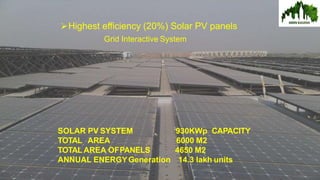
SOLAR PV SYSTEM
TOTAL AREA
TOTAL AREA OFPANELS
ANNUAL ENERGYGeneration
930KWp CAPACITY
6000 M2
4650 M2
14.3 lakh units
Highest efficiency (20%) Solar PV panels
Grid Interactive System
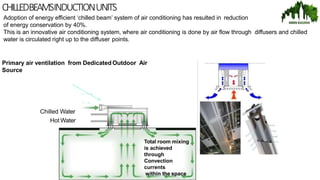
CHILLEDBEAMSINDUCTIONUNITS
Chilled Water
Hot Water
Total room mixing
is achieved
through
Convection
currents
within the space
Adoption of energy efficient ‘chilled beam’ system of air conditioning has resulted in reduction
of energy conservation by 40%.
This is an innovative air conditioning system, where air conditioning is done by air flow through diffusers and chilled
water is circulated right up to the diffuser points.
Primary air ventilation from Dedicated Outdoor Air
Source
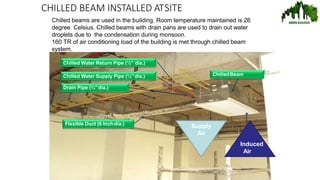
CHILLED BEAM INSTALLED ATSITE
2
3
Flexible Duct (6 Inch dia.)
ChilledBeam
Drain Pipe (¾”dia.)
Chilled Water Return Pipe (½” dia.)
Supply
Air
Induced
Air
Chilled Water Supply Pipe (½” dia.)
Chilled beams are used in the building. Room temperature maintained is 26
degree Celsius. Chilled beams with drain pans are used to drain out water
droplets due to the condensation during monsoon.
160 TR of air conditioning load of the building is met through chilled beam
system.
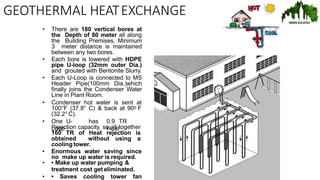
GEOTHERMAL HEATEXCHANGE
• There are 180 vertical bores at
the Depth of 80 meter all along
the Building Premises. Minimum
3 meter distance is maintained
between any two bores.
• Each bore is lowered with HDPE
pipe U-loop (32mm outer Dia.)
and grouted with Bentonite Slurry.
• Each U-Loop is connected to MS
Header Pipe(100mm Dia.)which
finally joins the Condenser Water
Line in Plant Room.
• Condenser hot water is sent at
100°F (37.8° C) & back at 900 F
(32.2° C).
• One U-
Loop
has 0.9 TR
Heat
Rejection capacity, so all together
160 TR of Heat rejection is
obtained without using a
cooling tower.
• Enormous water saving since
no make up water is required.
• • Make up water pumping &
treatment cost get eliminated.
• • Saves cooling tower fan
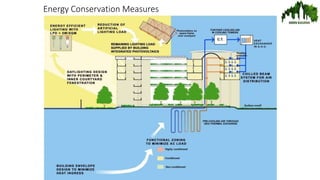
Energy Conservation Measures
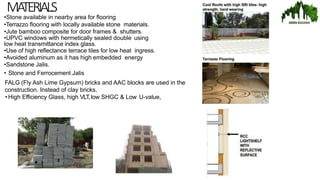
MA
TERIALS
•Stone available in nearby area for flooring
•Terrazzo flooring with locally available stone materials.
•Jute bamboo composite for door frames & shutters.
•UPVC windows with hermetically sealed double using
low heat transmittance index glass.
•Use of high reflectance terrace tiles for low heat ingress.
•Avoided aluminum as it has high embedded energy
•Sandstone Jalis.
• Stone and Ferrocement Jalis
FALG (Fly Ash Lime Gypsum) bricks and AAC blocks are used in the
construction. Instead of clay bricks.
• High Efficiency Glass, high VLT,low SHGC & Low U-value,
THANK YOU

Environmental responsive design - Building rating systems

  • 1.
    Building Rating Systems In India& World Environment Responsive Design Submitted to : Ar. Tapaswini Submitted by : Pavani Kavya Sri Neeharika
  • 2.
    Content : Green Building •Green Building Rating System • Agencies and Institutions  Indian Green Building Council (IGBC)  TERI  GRIHA • CASE STUDY – 1 CII Building ( First green building in INDIA) • CASE STUDY - 2 - INDIRA PARYAVARAN BHAWAN ( FIRST NET ZERO BUILDING)
  • 3.
    Why Buildings arebeing rated?
  • 4.
    Buildings have extensivedirect and indirect impacts on the environment. During their construction, occupancy, renovation, repurposing, and demolition, buildings use energy, water, and raw materials, generate waste, and emit potentially harmful atmospheric emissions. These facts have prompted the creation of green building standards, certifications, and rating systems aimed at mitigating the impact of buildings on the natural environment through sustainable design.
  • 5.
    How did it start? •The push toward sustainable design increased with the launch in 1990 of Building Research Establishment's Environmental Assessment Method (BREEAM), the first green building rating system in the world. • In 2000, the U.S. Green Building Council (USGBC) followed suit and developed and released criteria also aimed at improving the environmental performance of buildings through its Leadership in Energy and Environmental Design (LEED) rating system for new construction. • Since that first release, LEED has continued to grow in prominence and to include rating systems for existing buildings and entire neighborhoods. • Others also responded to the growing interest and demand for sustainable design including the Green Building Initiative (GBI), which was created to assist the National Association of Homebuilders (NAHB) in promoting its Green Building Guidelines for Residential Structures. • Although originally developed for Canada, GBI helped to make Green Globes available for use in the U.S. in 2005. • Additional rating systems have been developed that were influenced by these early programs but are tailored to their own national priorities and requirements or seek to go beyond the limits of current policy and building practices to address broader issues of sustainability or evolving concepts such as net zero energy, and living and restorative building concepts that improve the natural environment, or those that model nature's processes.
  • 8.
    GREEN BUILDING AGENCIESAND INSTITUTIONS
  • 11.
    WHAT IS AGREEN BUILDING ? • Green Buildings are structures that ensure efficient use of natural resources like building materials, water, energy and other resources with minimal generation of non-degradable waste. THE CONCEPT OF A GREEN BUILDING HAS THE FOLLOWING :-  Sustainable site planning.  Building Design optimization.  Energy performance optimization.  Renewal energy utilization.  Water and Waste management.  Solid waste management.  Sustainable building material and construction technology.  Health, well being and environmental quality.
  • 12.
    • Technologies likeefficient cooling systems have sensors that can sense the heat generated from human body and automatically adjust the room temperature, saving energy. • It applies to lighting systems too. Green buildings have a smarter lighting system that automatically switches off when no one is present inside the rooms. • Simple technologies like air based flushing system in toilets that avoids water use by 100%, use of energy efficient LED’s and CFL’s, new generation appliances that consume less energy, and many other options help in making the buildings green.
  • 13.
    GREEN BUILDING RATINGSYSTEMS • A green building rating system is an evaluation tool that measures environmental performance of a building through its life cycle. • It comprises of a set of criteria covering various parameters related to design, construction and operation of a green building. • A project is awarded points once it fulfills the rating criteria. The points are added up and the final rating of a project is decided. There are three primary Rating systems in India:- • GRIHA • IGBC • BEE
  • 14.
    International Building RatingAgencies The Building Research Establishment Environmental Assessment Method (BREEAM) – United Kingdom Leadership in Energy and Environmental Design (LEED) - USA
  • 15.
    Indian Building RatingAgencies Green Rating for Integrated Habitat Assessment (GRIHA) Leadership in Energy and Environment Design (LEED) INDIAN GREEN BUILDING COUNCIL (IGBC)
  • 16.
  • 17.
    BREEAM: BUILDING RESEARCHESTABLISHMENT’S ENVIRONMENTAL ASSESSMENT METHOD • Building Research Establishment’s Environmental Assessment Method was developed in UK in 1990. • Covers a range of building types : offices, homes, industrial units, retail units, and schools. • Points are awarded for each criterion and the points are added for a total score. • The overall building performance is awarded a ‘Pass’, ‘Good’, ‘Very Good’ or ‘Excellent’ rating based on the score. BREEAM has separate criteria/checklist for evaluation of:- • Design and Procurement. • Management and Operation of buildings.
  • 18.
    CASBEE: COMPREHENSIVE ASSESSMENT SYSTEMFOR BUILDING ENVIRONMENTAL EFFICIENCY • Comprehensive Assessment System for Building Environmental Efficiency (CASBEE) was developed in Japan, in 2001. • The family of assessment tools is based on the building’s life cycle: pre-design, new construction, existing buildings, and renovation. Under CASBEE there are two spaces, internal and external, divided by the hypothetical boundary, which is defined by the site boundary and other elements, in which the:- • ‘Negative aspects of environmental impact which go beyond the hypothetical enclosed space to the outside (the public property)’. • ‘Improving living amenity for the building users’ are considered side by side.
  • 19.
    LEED: LEADERSHIP INENERGY AND ENVIRONMENTAL DESIGN • LEED is the rating system developed for certifying Green Buildings. LEED is developed by the U.S. Green Building Council (USGBC), the organization promoting sustainability through Green Buildings. • LEED is changing the way we think about how buildings and communities are planned, constructed, maintained and operated. • Certification of green building based on the number of points achieved a project then receives one of four LEED rating levels: Certified, Silver, Gold and Platinum. • LEED-certified buildings are resource efficient. They use less water and energy and reduce greenhouse gas emissions. As an added bonus, they save money.
  • 20.
    GB TOOL: • GBTool Green Building Challenge Assessment Framework was developed by the International Framework Committee for the Green Building Challenge, an international project that has involved more than 25 countries since 1998. • GB Tool is designed to be adapted by sponsors to reflect regional conditions and context. It includes criteria in categories : • Site Selection. • Project Planning and Development. • Environmental Loadings. • Energy and Resource Consumption. • Indoor Environmental Quality. • Functionality. • Long-Term Performance. • Social and Economic Aspects. • Criteria are assessed using scales that are based on local benchmarks of ‘typical’ practice.
  • 21.
  • 22.
    Green Rating forIntegrated Habitat Assessment (GRIHA) • Green Rating for Integrated Habitat Assessment (GRIHA) is the national rating system of India for any completed construction, endorsed by the Ministry of New & Renewable Energy (MNRE), Government of India and TERI. It is an assessment tool to measure and rate a building’s environmental performance. • The basic features of GRIHA: The scheme was created to assist in ‘designing and evaluating’ new buildings (structures that are still at the starting phases). A building is evaluated based on its expected results over its full life. The stages of the life cycle that have been identified for evaluation are:
  • 23.
    GRIHA: GREEN RATINGFOR INTEGRATED HABITAT ASSESSMENT • GRIHA will evaluate environmental performance of buildings holistically over its entire lifecycle, thereby providing a definitive standards for what constitute a green building. • GRIHA has been conceived by TERI and developed jointly with the Ministry of New and Renewable Energy, Government of India. • It is a green building 'design evaluation system', and is suitable for all kinds of buildings in different climatic zones of the country. • ADARSH, (Association for Development and Research of Sustainable Habitats) founded jointly by TERI (The Energy and Resources Institute, New Delhi) promotes GRIHA as a design & evaluation tool for Green Buildings and Habitats.
  • 24.
    OBJECTIVES OF GRIHA: Minimize a building’s resource consumption, waste generation, and overall ecological impact. Evaluates the environmental performance of a building holistically over its entire life cycle, thereby providing a definitive standard for what constitutes a ‘green building’. Based on accepted energy and environmental principles, seeks to strike a balance between the established practices and emerging concepts. Reduced energy consumption without sacrificing the comfort levels. Reduced destruction of natural areas, habitats, and biodiversity, and reduced soil loss from erosion etc.
  • 25.
  • 26.
    GRIHA RATING CRITERIA Except for industrial complexes, all buildings – offices, retail malls, institutions, hotels, hospitals, health-care facilities, residences, and multi-family high-rise buildings – in the pre-design/design stage are eligible for certification under GRIHA.  The percentage of total outdoor lighting fixtures with solar lighting system, as per GRIHA tenets which is a minimum of 25% of total number or 15% of total connected load, whichever is higher, can fetch 1 point.  Demonstrated use of minimization and consolidation of transportation or service corridors and shading of pedestrian roads, as per GRIHA can garner 1 point.  The Use of aggregate utility corridors, as per GRIHA is another point to the kitty.  Furthermore, firming up of utility corridors along the formerly disturbed areas or along new roads in order to reduce needless cutting and trenching and ensure easy maintenance is also a GRIHA point.
  • 27.
    GRIHA RATING SYSTEM S.NODESCRIPTION POINTS 1 Site Selection 1 2 Preserve and protect landscape during construction/compensatory depository forestation. 5 3 Soil conservation (post construction) 2 SITE 4 Design to include existing site features 4 PLANNING 5 Reduce hard paving on site 2 6 Enhance outdoor lighting system efficiency 3 7 Plan utilities efficiently and optimize on – site circulation efficiency 3
  • 28.
    S.NO DESCRIPTION POINTS 8Provide, at least, minimum level of sanitation/safety facilities for construction workers 2 9 Reduce air pollution during construction 2 WELL BEING 10 Reduce landscape water requirement 3 11 Reduce building water use 2 12 Efficient water use during construction 1 BUILDING PLANNING 13 Optimize building design to reduce conventional energy demand 8 14 Optimize energy performance of building within specified comfort limits 16 CONSTRUCTION STAGE 15 Utilization of fly-ash in building structur 6 HEALTH &
  • 29.
    S.NO DESCRIPTION POINTS 16Use low-energy material in interiors 4 17 Renewable energy utilization 5 18 Reduce volume, weight, and time of construction by adopting efficient technology (for example ,pre-cast systems, ready mix concrete, and so on) 4 BUILDING PLANNING & 19 Renewable energy based hot-water system 3 20 Waste water treatment 2 RECYCLE,RECHARGE 21 Water recycle and reuse (including rain water) 5 AND REUSE 22 Reduction in waste during construction 1 WASTE MANAGEMENT 23 Efficient waste segregation 1 24 Storage and disposal of wastes 1 CONSTRUCTION STAGE
  • 30.
    S.NO DESCRIPTION POINTS 25Resource recovery form waste 2 26 Use of low VOC paints/adhesives/sealants 3 27 Minimize ozone depleting substances 1 28 Ensure water quality 2 HEALTH & 29 Acceptable outdoor and indoor noise levels 2 WELL BEING 30 Tobacco and smoke control 1 31 Universal accessibility 1 32 Audit and validation 2 33 Operators and maintenance protocol for electrical and mechanical equipment 2 34 Innovation (beyond 100) 4
  • 31.
    GOALS Enhancing access toclean energy for all. Helping a global transition to renewable energy pathways. Enhance energy efficiency, especially in industries, public utilities and buildings. Facilitating more efficient use of materials, especially iron and cement. Enhancing conservation, utilization of and access to water, including watershed management. Enabling the planning and governance of environmentally sustainable cities through green buildings and through management of solid waste, sewage, sanitation, mobility and air quality. Building resilience to adverse impacts of climate change due to cyclones and variations in hydrology and temperature. Accelerating pollution abatement through innovative policies and environment treatment products. Enhancing ecosystem services, especially in forestry and biodiversity. Developing green mobility solutions.
  • 32.
  • 33.
    ➢IGBC was formedin the year of 2001 by Confederation of Indian industry(CII) ➢Vision of IGBC-India to become one of the world leaders in green buildings by 2015 ➢IGBC Green building rating system : one single rating cannot be applied to suit all building types • IGBC Green Homes Rating • IGBC Green Factory Rating • IGBC Green SEZs • IGBC Green Township Rating • IGBC India NC (New Construction) • IGBC India CS (Core and Shell)
  • 35.
    IGBC SERVICES • IGBCMembership • IGBC Local Chapters • Green Building Certification • Green Building Training Programme • IGBC AP exam • Green Building Directory(major venders and manufacturers) • Green Building Congress(India’s annual flagship event) • Government and IGBC : Additional FAR(Floor Area Ratio) of 5% for IGBC Rated Green Building by Greater Noida Development Authority • Plot size of 5,000 sq.m and above • To achieve a minimum of Gold • Rediscovery of Indian Ethos: • 5 elements of nature(Panchabhutas)
  • 37.
    IGBC has developedgreen building rating programmes to cover commercial, residential, factory buildings etc. Each rating system divided into different levels of certification are as follows: • ‘Certified’ to recognize best practices • ‘Silver’ to recognize outstanding performance • ‘Gold’ to recognize national excellence • ‘Platinum’ to recognize global leadership
  • 38.
    IGBC: INDIAN GREENBUILDING COUNCIL • IGBC, part of the Confederation of Indian Industry (CII) was formed in the year 2001. IGBC has its offices in CII- Shorabji Godrej Green Business Centre, which is itself a LEED, certified Green building. • Indian Green Building Council (IGBC) has licensed the LEED Green Building Standard from the USGBC. IGBC facilitates Indian green structures to become one of the green buildings. IGBC Green Buildings rating system addresses green features under the following categories: - • Sustainable Architecture and Design. • Site Selection and Planning. • Water Conservation. • Energy Efficiency. • Building Materials and Resources. • Indoor Environmental Quality. • Innovation and Development.
  • 39.
    THE ENERGY ANDRESOURCES INSTITUTE
  • 40.
    • The TERISchool of Advanced Studies (TERI SAS) is a higher education institute in New Delhi, India which specialises in the field of sustainable development. • It was established in 1998 by TERI (The Energy and Resources Institute). In 1999, the TERI School of Advanced Studies was granted the 'Deemed to be University'[1] status by the University Grants Commission (UGC). The School started functioning from its green campus, located in Vasant-Kunj, New Delhi in 2008 and offers Masters and PhD programs. It has started work on developing a new campus at Hyderabad, Telangana in southern India. Former name TERI University Type Education and Research Institution Established 1998 Chancellor Dr Shailesh Nayak Vice-Chancellor Prof. Manipadma Datta (Acting) Location New Delhi , Delhi , India Campus 2 acres (0.81 ha) Website www.terisas.ac.in
  • 41.
     TERI SASimparts a world-class education with the help of six different departments and two centres: 1. Department of Natural Resources 2. Department of Energy and Environment 3. Department of Biotechnology 4. Coca-Cola Department of Regional Water Studies 5. Department of Policy Studies 6. Department of Business and Sustainability 7. Centre for Post Graduate Legal Studies 8. Centre for Distance Education  TERI SAS has been awarded for its interdisciplinary approach in providing a world-class education with the help of a multidisciplinary curriculum. Some of the awards and recognition are:  1. TERI SAS won the 3rd prize under the theme ‘Walkway of Discovery’, at the Bangalore India BIO 2010 Meet for its unique biotechnology research work.  2. Awarded for having the ‘Most Innovative Curriculum’ at the India Today Aspire Education Summit Awards, 2012.  3. Awarded the "Greenest University and Research Institution" as part of the RTCC 2013 Climate Change.  4. Accenture Innovation Jockeys (Season II) in 2013: Hunt for India's Most Innovative Minds  5. Top Entries of Earthian 2013 & 2014 by TERI SAS Students 6. TERI SAS was awarded UN GCNI (Global Compact Network India) Award at the 3rd Innovative Practices Awards 2019 on SDGs.
  • 42.
    CASE STUDY –1 CII – SOHRABJI GODREJ GREEN BUSINESS CENTRE
  • 43.
    General Details • Projectname : CII - Sohrabji Godrej Green Business Centre • (CII - Godrej GBC) • Architect : Karan Grover & Associates • Investor / Owner: Confederation of Indian Industry (CII) • Project built date: 2004 • Area of project : 5 acres • Built up Area : Built Up Area : 20000 sq ft • Large area for landscape to enhance micro climate and for visual delight
  • 46.
    • one ofthe 10 Centres of Excellences of the Confederation of Indian Industry (CII). • CII - Godrej GBC offers advisory services to the industry in the areas of Green buildings, energy efficiency, water management, environmental management, renewable energy, Green business incubation and climate change activities. • The Centre is housed in a GREEN BUILDING which received the prestigious LEED (Leadership in Energy and Environmental Design) Platinum Rating in 2003. This was the first Platinum rated Green Building outside of U.S.A and the third in the world. The Centre was inaugurated by H.E Dr A P J Abdul Kalam, the then President of India, on July 14, 2004. CII - Sohrabji Godrej Green Business Centre (CII - Godrej GBC)
  • 47.
    Fundamental principles ofthe green building 47  Structure design efficiency  Energy efficiency  Water efficiency  Materials efficiency  Waste and toxic reduction Green building CII Godrej Hyderabad
  • 48.
    Limitless flexibility of design layout Unrestricted circulationof Air Takes advantage of views which is present The ROUND shape can support the concrete roof which gives uncompromised strength & security from any kind of disaster At least 10 times strong then convectional square construction WHY – CIRCULAR ?
  • 49.
    Climatic Design forWind & Ventilation EnvironmentalManagement
  • 54.
    Materials used &Green Facts • Concrete used for construction has 15% fly ash and 20% GGBS • Bagasse Board – by product of sugarcane industry-a good substitute for plywood or Particle Board It has wide usage for making partitions, furniture etc. • Eco-friendly method - does not involve any harm to the timbers, unlike plywood. • 66% (by cost) of the material was sourced within a radius of 800 km. • Of this, 95 % of the raw material was extracted or harvested locally. • An impressive 77 % of the building materials use recycled content in the form of fly ash, broken glass, broken tiles, recycled paper, recycled aluminum, cinder from industrial furnaces, bagasse, mineral fibres, cellulose fibres, and quarry dust. • Low VOC paints have also been applied
  • 55.
    • Lighter thanclay bricks. • High strength, practically no breakage during transport • Uniform size of bricks reduces mortar required for joints and plaster by 50%. • Lower water penetration, considerably reducing seepage of water through Bricks. • 65% walls in GBC are constructed with this material
  • 56.
    V S Ground Hugging Construction • Likemost olden systems of construction, structures are kept ground hugging ensuring natural modulation of microclimate and creating more interaction with nature. • Gives a sense of being close to nature
  • 57.
    Water conservation • The greenroof assists in increasing the lifespan of the roof and reducing the heat island effect. • Rainwater collection and reuse. • Waste-water and rainwater run-off is 100 % recycled and redirected to one of three ponds, to be used for domestic purposes. • 35 % reduction of municipally supplied potable water.
  • 59.
    Passive Ventilation – windtower • High efficiency HVAC system • Passive cooling system using wind towers. • Use of aerated concrete blocks for façades to reduces the load on air-conditioning by 15% to 20 % • This technique can be found in Persian architectural building constructions.
  • 60.
    • A Windcatcher, Wind scoop or Badgir is a traditional Persian architectural element to create natural ventilation in buildings • Energy savings are achieved by the GBCs two wind towers. • Air, cooled by up to 8 ^C, is supplied to the AHUs, substantially reducing the load on the air conditioning system. • A heavily insulated roof further reduces the cooling load.
  • 61.
    • 1,022 m²of green roof, with vegetation covering 60 % of the total roof surface. • The remaining portion of the roof is covered by PV panels, meeting 20 % of the total energy necessities of the building. • Double-glazed units with argon gas filling to enhance the thermal properties of windows. • Energy-efficient lighting systems and compact fluorescent light bulbs. ENERGY FACTS
  • 62.
    Instead of usingregular windows a mesh type ventilation is made of Bricks for fresh and cold breeze to enter Corridors
  • 63.
    • Most ofthe path ways laid in landscaping are stones/tiles which were left over materials in other construction. • All of the new wood used was sustainably harvested, as certified by the Forest Stewardship Council. • A waste management plan in hand made it possible to recycle 96% of Construction waste.
  • 64.
    • Some rainwatergoes into the soil by the use of permeable grid pavers. • The remaining rainwater follows existing flow patterns and is collected in a water pond another traditional method of rain water harvesting, constructed at a lower end of the site. • All wastewater generated - recycled by "root zone treatment" simultaneously irrigates the vegetation. • Attractive alternative for wastewater management • Enhances the Landscape
  • 65.
    Light & Ventilation •Building layout ensures that 90 % of spaces have daylight access and views to the outside. • North facades are glazed for efficient diffused light. • Low heat transmitting glass used. • Double glass to further reduce heat gain. • Natural lighting - no lights are used until late in the evening. • Minimum lux levels for all work stations have been ensured. EnvironmentalManagement
  • 68.
    INTRODUCTION • Project ofministry of environment and forests for construction of new office building at new delhi. • The basic design concept of the project is to make the net zero energy green building. • PLOT AREA:9565sq m • MAXIMUM GROUND COVERAGE:30% • F.A.R: 200 • HEIGHT:35m • Built-up area : 3,1400 m2 • (18726 m2 – superstructure & 12675 m2- Basement) • Year of completion : 2013 India’s first net zero building This means that this is a building with zero net energy consumption where the total amount of energy used in the premises on an annual basis is more or less equal to the amount of renewable energy created on the site.
  • 69.
     This projecthas been developed at an expense of about 209 crore rupees. The Indira Paryavaran Bhavan building has already received the following awards: • February 2013: The Project received an award from Adarsh/GRIHA of MNRE for exemplary demonstration of Integration of Renewable Energy Technologies • January 2014: The Project was accorded 5-Star Green Building Certification by GRIHA under MNRE The Bhawan is India’s first on site Net Zero Building built by the adoption of Solar Passive design and energy efficient building material. This has been designed as the highest-green rated building i.e., GRIHA 5-Star and LEED India Platinum. The requirements of GRIHA 5-Star and LEEDS Platinum ratings have been achieved by adopting various measures some of which are as follows
  • 70.
    Effective Ventilation hasbeen achieved by orientating the building in an East-West direction, separating different blocks with connecting corridors and having a large central court yard. • The design is such that 75% of natural daylight is utilised to reduce energy consumption. • The entire building has an access friendly design for differently-abled persons. • With an Installed capacity of 930 KW peak power, the building has the largest roof top Solar system among Multi storied buildings in India. • Total energy savings of about 40% has been achieved by adoption of energy Efficient Chilled Beam system of Air Conditioning. This is an innovative air conditioning system, where air conditioning is done by convection currents rather than air flow through diffusers and chilled water is circulated right up to the diffuser points unlike the conventional systems. • Green materials have been used like Fly ash bricks, regional building materials, materials with high recycled content, high reflectance terrace tiles and rock wool Insulation of outer walls. • Rapidly renewable Bamboo Jute Composite material has been used for door frames & shutters. • UPVC windows with hermetically sealed double glass, Calcium Silicate ceiling tiles having high recycled content and grass paver blocks in pavements and roads. • Reduction in water consumption has been achieved by use of Low discharge water fixtures, recycling of waste water through Sewage Treatment Plant, use of plants with Low water demand in landscaping, use of Geothermal cooling for HVAC system, rain water harvesting and use of curing compounds during construction.
  • 71.
    ACHIEVEMENTS • 40% savingsin energy • zero electricity billing • 55% savings in water • largest roof top solar power system in any multistoreyed building (930kwp) • first in government sector targeted for both ratings of green building (5star griha leed india platinum) • Preservation of the local ecology, Tree Cutting approvals for 46, but only 19 Cut ,11 Trees Transplanted • Excavated Soil reutilized at other construction sites and the Zoo LA YOUTPLAN
  • 72.
    ARCHITECTURAL DESIGN STRATEGIES •Building form wrapped around a pedestrian-friendly shaded green open courtyard • A continuous green axis from front of site across the atrium. • Eco park within the courtyard shall contain a self sustaining low. • Large openings in building form on South and North sides. • Conservation of natural soil and trees. • Orientation of building has been planned reduce ingress of solar radiation. • Large openings North and South faces. • Green areas have been developed on smaller terraces. • Shaded landscape areas to reduce ambient temperature. • Provision of barrier free access . • Surrounding open area parking free by providing adequate parking in the basement.
  • 73.
    E •EFFECTIVE VENTILATION BY ORIENTATINGTHE BUILDING E-W AND BY OPTIMUM INTEGRATION WITH NATURE BY SEPARATING OUT DIFFERENT BLOCKS WITH CONNECTING CORRIDORS AND A HUGE CENTRAL COURT YARD. • DEVELOPING WINTER SOUTHSIDE SUNSPACES FOR OFFICE EMPLOYEES W CROSS VENTILATION AT THE MICRO LEVEL THROUGH OPENINGS N R O A D PROJECTIONS INTO THE CENTRAL SPACE FOR SHADING + Shading by Passages Natural ventilation due to stack effect Building punctures are designed to aid cross ventilation
  • 74.
    •More than 50%area outside the building is soft with plantation and grassing. • circulation roads and pathways soft with grass paver blocks to enable ground water recharge
  • 75.
    BUILDINGPLANNINGANDCONSTRUCTIONMEASURES Reduce landscape waterrequirement- •Drip irrigation •Use of native species of shrubs and trees having low water demand in landscaping •Low lawn area so as to reduce water demand. •Reuse of treated water for irrigation Reduce water use in thebuilding- 55% reduction in overall use of water. This was achieved by using: •Low discharge fixtures •Dual Flushing cistern •Waste water treatment •Reuse of treated water for irrigation and cooling towers for HVAC •Rain water harvesting Efficient water use during construction- •Use of curing compound
  • 76.
    20 SOLAR PV SYSTEM TOTALAREA TOTAL AREA OFPANELS ANNUAL ENERGYGeneration 930KWp CAPACITY 6000 M2 4650 M2 14.3 lakh units Highest efficiency (20%) Solar PV panels Grid Interactive System
  • 77.
    CHILLEDBEAMSINDUCTIONUNITS Chilled Water Hot Water Totalroom mixing is achieved through Convection currents within the space Adoption of energy efficient ‘chilled beam’ system of air conditioning has resulted in reduction of energy conservation by 40%. This is an innovative air conditioning system, where air conditioning is done by air flow through diffusers and chilled water is circulated right up to the diffuser points. Primary air ventilation from Dedicated Outdoor Air Source
  • 78.
    CHILLED BEAM INSTALLEDATSITE 2 3 Flexible Duct (6 Inch dia.) ChilledBeam Drain Pipe (¾”dia.) Chilled Water Return Pipe (½” dia.) Supply Air Induced Air Chilled Water Supply Pipe (½” dia.) Chilled beams are used in the building. Room temperature maintained is 26 degree Celsius. Chilled beams with drain pans are used to drain out water droplets due to the condensation during monsoon. 160 TR of air conditioning load of the building is met through chilled beam system.
  • 79.
    GEOTHERMAL HEATEXCHANGE • Thereare 180 vertical bores at the Depth of 80 meter all along the Building Premises. Minimum 3 meter distance is maintained between any two bores. • Each bore is lowered with HDPE pipe U-loop (32mm outer Dia.) and grouted with Bentonite Slurry. • Each U-Loop is connected to MS Header Pipe(100mm Dia.)which finally joins the Condenser Water Line in Plant Room. • Condenser hot water is sent at 100°F (37.8° C) & back at 900 F (32.2° C). • One U- Loop has 0.9 TR Heat Rejection capacity, so all together 160 TR of Heat rejection is obtained without using a cooling tower. • Enormous water saving since no make up water is required. • • Make up water pumping & treatment cost get eliminated. • • Saves cooling tower fan
  • 80.
  • 81.
    MA TERIALS •Stone available innearby area for flooring •Terrazzo flooring with locally available stone materials. •Jute bamboo composite for door frames & shutters. •UPVC windows with hermetically sealed double using low heat transmittance index glass. •Use of high reflectance terrace tiles for low heat ingress. •Avoided aluminum as it has high embedded energy •Sandstone Jalis. • Stone and Ferrocement Jalis FALG (Fly Ash Lime Gypsum) bricks and AAC blocks are used in the construction. Instead of clay bricks. • High Efficiency Glass, high VLT,low SHGC & Low U-value,
  • 82.