Green Buildings:
A Case Based Study
Siddharth Yadav : AP15338
Anshita Aggarwal : AP15355
Tanuj Singhal : AP15361
Sampada Kadam : AP15386
Submitted to:
Prof. A.Abhyankar
INTRODUCTION
• Green building (also known as green construction or sustainable building) expands
and complements the building design concerns of economy, utility, durability, and
comfort.
• A Green Building is one which uses less water, optimizes energy efficiency,
conserves natural resources, generates less waste and provides healthier space for
occupants as compared to conventional buildings.
• Efficiently using energy, water and other resources.
• Protecting occupant health and improving employee productivity.
• Reducing waste, pollution and environment degradation.
OBJECTIVE
Environment Sensitive development
Minimum Site Disturbance / Heat island effect / Minimum light pollution / Use of native plants /
CFC & HCFC free material use / Promote Public transport
Water Sensitive Approach
• Rain Water Harvesting /Use of low flow fixtures / Use of sensor based fixtures / Water
efficient Irrigation / 100 % use of sewage water / Water efficient HVAC system
Energy Conscious Approach
• Energy efficient HVAC / Energy efficient lighting / Usage of renewable energy /Sensor based
lighting and ventilation / Energy efficient electrical equipment
Eco-Friendly Material & Resources
• Minimum Construction waste / Use of regional materials / Use of rapidly renewable material
/ Recycle & reuse of material / Use of high recycle content material
Healthy & Productive Indoor environment
• Use of low emitting materials / Indoor pollutants control / Natural use of day light and view
of outdoor spaces / Increase ventilation / Minimum pollution during construction
FUNDAMENTAL PRINCIPLES
GREEN BUILDINGS PROJECT IN INDIA
• Suzlon Energy Limited-Pune
• Biodiversity Conservation India-Bangalore
• Olympia Technology Park-Chennai
• ITC Green Centre-Gurgaon
• The Druk White Lotus School-Ladakh
• Doon School-Dehradun
• Raintree Hotels-Chennai
• Nokia-Gurgaon
• Rajiv Gandhi International Airport-Hyderabad
• Hiranandini-BG House, Powai
• ABN Amro Bank, Chennai
• Palais Royale at Worli, Mumbai
• Punjab Forest Complex,Mohali
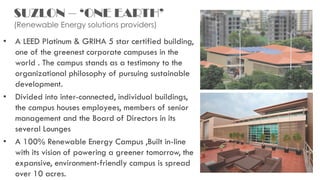
SUZLON – ‘ONE EARTH’
(Renewable Energy solutions providers)
• A LEED Platinum & GRIHA 5 star certified building,
one of the greenest corporate campuses in the
world . The campus stands as a testimony to the
organizational philosophy of pursuing sustainable
development.
• Divided into inter-connected, individual buildings,
the campus houses employees, members of senior
management and the Board of Directors in its
several Lounges
• A 100% Renewable Energy Campus ,Built in-line
with its vision of powering a greener tomorrow, the
expansive, environment-friendly campus is spread
over 10 acres.
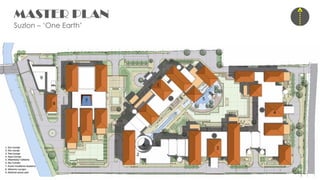
MASTER PLAN
Suzlon – ‘One Earth’
ONE EARTH :
Features That Make It Green
. 100% powered by on-site and off-site renewable energy
including hybrid wind turbines, solar panels and photovoltaic cells
Rainwater harvesting facilities with on-site water treatment and
recycling facilities
On-site organic waste converter
‘Office in garden’ design concept which harvests maximum
daylight in work spaces and common areas
Reduction of approximately 35% in operating cost due to energy
and water cost savings, a benefit that is transferred to customers
through increased investment in technology
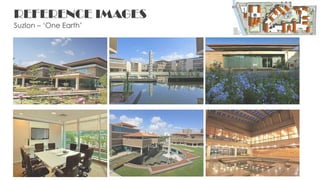
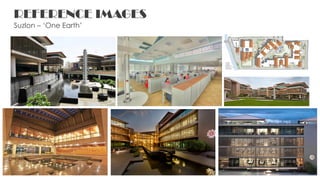
REFERENCE IMAGES
Suzlon – ‘One Earth’
ONE EARTH :
Highlights
. 7% of the total energy consumption comes from 18 on-site hybrid wind turbines, solar panels
and photovoltaic cells and 93% of the remaining is from off-site wind turbines. This building
has 154.83kW renewable energy incorporated
The HVAC scheme is designed innovatively combining various energy efficient
components like pre-cooling of fresh air, heat recovery/exchange mechanisms to
minimise overall energy consumption.
Solar photovoltaic panels form the roof of the atrium of the learning centre, generating
green power.
The orientation of the blocks is such that the majority of building facades face north, south,
north-west & south-east. This enables adequate day lighting and glare control.
All workstations are equipped with task lighting which is governed by motion sensors turning.
Reflective pools not only connect the campus but also create a micro environment in the
campus, cooling the air ground.
REFERENCE IMAGES
Suzlon – ‘One Earth’
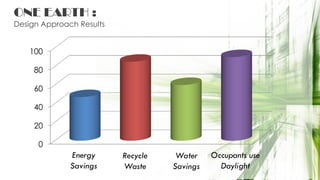
ONE EARTH :
Design Approach Results
0
20
40
60
80
100
Energy
Savings
Recycle
Waste
Water
Savings
Occupants use
Daylight
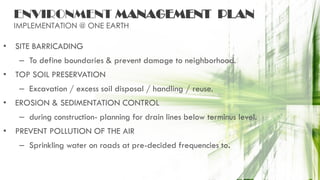
ENVIRONMENT MANAGEMENT PLAN
IMPLEMENTATION @ ONE EARTH
• SITE BARRICADING
– To define boundaries & prevent damage to neighborhood.
• TOP SOIL PRESERVATION
– Excavation / excess soil disposal / handling / reuse.
• EROSION & SEDIMENTATION CONTROL
– during construction- planning for drain lines below terminus level.
• PREVENT POLLUTION OF THE AIR
– Sprinkling water on roads at pre-decided frequencies to.
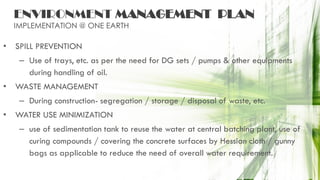
ENVIRONMENT MANAGEMENT PLAN
IMPLEMENTATION @ ONE EARTH
• SPILL PREVENTION
– Use of trays, etc. as per the need for DG sets / pumps & other equipments
during handling of oil.
• WASTE MANAGEMENT
– During construction- segregation / storage / disposal of waste, etc.
• WATER USE MINIMIZATION
– use of sedimentation tank to reuse the water at central batching plant, use of
curing compounds / covering the concrete surfaces by Hessian cloth / gunny
bags as applicable to reduce the need of overall water requirement.
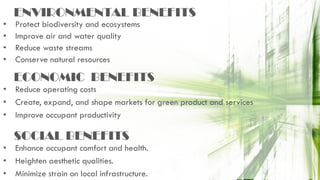
ENVIRONMENTAL BENEFITS
• Protect biodiversity and ecosystems
• Improve air and water quality
• Reduce waste streams
• Conserve natural resources
• Reduce operating costs
• Create, expand, and shape markets for green product and services
• Improve occupant productivity
ECONOMIC BENEFITS
• Enhance occupant comfort and health.
• Heighten aesthetic qualities.
• Minimize strain on local infrastructure.
SOCIAL BENEFITS
THANK YOU

Green Buildings

  • 1.
    Green Buildings: A CaseBased Study Siddharth Yadav : AP15338 Anshita Aggarwal : AP15355 Tanuj Singhal : AP15361 Sampada Kadam : AP15386 Submitted to: Prof. A.Abhyankar
  • 2.
    INTRODUCTION • Green building(also known as green construction or sustainable building) expands and complements the building design concerns of economy, utility, durability, and comfort. • A Green Building is one which uses less water, optimizes energy efficiency, conserves natural resources, generates less waste and provides healthier space for occupants as compared to conventional buildings. • Efficiently using energy, water and other resources. • Protecting occupant health and improving employee productivity. • Reducing waste, pollution and environment degradation. OBJECTIVE
  • 3.
    Environment Sensitive development MinimumSite Disturbance / Heat island effect / Minimum light pollution / Use of native plants / CFC & HCFC free material use / Promote Public transport Water Sensitive Approach • Rain Water Harvesting /Use of low flow fixtures / Use of sensor based fixtures / Water efficient Irrigation / 100 % use of sewage water / Water efficient HVAC system Energy Conscious Approach • Energy efficient HVAC / Energy efficient lighting / Usage of renewable energy /Sensor based lighting and ventilation / Energy efficient electrical equipment Eco-Friendly Material & Resources • Minimum Construction waste / Use of regional materials / Use of rapidly renewable material / Recycle & reuse of material / Use of high recycle content material Healthy & Productive Indoor environment • Use of low emitting materials / Indoor pollutants control / Natural use of day light and view of outdoor spaces / Increase ventilation / Minimum pollution during construction FUNDAMENTAL PRINCIPLES
  • 4.
    GREEN BUILDINGS PROJECTIN INDIA • Suzlon Energy Limited-Pune • Biodiversity Conservation India-Bangalore • Olympia Technology Park-Chennai • ITC Green Centre-Gurgaon • The Druk White Lotus School-Ladakh • Doon School-Dehradun • Raintree Hotels-Chennai • Nokia-Gurgaon • Rajiv Gandhi International Airport-Hyderabad • Hiranandini-BG House, Powai • ABN Amro Bank, Chennai • Palais Royale at Worli, Mumbai • Punjab Forest Complex,Mohali
  • 5.
    SUZLON – ‘ONEEARTH’ (Renewable Energy solutions providers) • A LEED Platinum & GRIHA 5 star certified building, one of the greenest corporate campuses in the world . The campus stands as a testimony to the organizational philosophy of pursuing sustainable development. • Divided into inter-connected, individual buildings, the campus houses employees, members of senior management and the Board of Directors in its several Lounges • A 100% Renewable Energy Campus ,Built in-line with its vision of powering a greener tomorrow, the expansive, environment-friendly campus is spread over 10 acres.
  • 6.
    MASTER PLAN Suzlon –‘One Earth’
  • 7.
    ONE EARTH : FeaturesThat Make It Green . 100% powered by on-site and off-site renewable energy including hybrid wind turbines, solar panels and photovoltaic cells Rainwater harvesting facilities with on-site water treatment and recycling facilities On-site organic waste converter ‘Office in garden’ design concept which harvests maximum daylight in work spaces and common areas Reduction of approximately 35% in operating cost due to energy and water cost savings, a benefit that is transferred to customers through increased investment in technology
  • 8.
  • 9.
    ONE EARTH : Highlights .7% of the total energy consumption comes from 18 on-site hybrid wind turbines, solar panels and photovoltaic cells and 93% of the remaining is from off-site wind turbines. This building has 154.83kW renewable energy incorporated The HVAC scheme is designed innovatively combining various energy efficient components like pre-cooling of fresh air, heat recovery/exchange mechanisms to minimise overall energy consumption. Solar photovoltaic panels form the roof of the atrium of the learning centre, generating green power. The orientation of the blocks is such that the majority of building facades face north, south, north-west & south-east. This enables adequate day lighting and glare control. All workstations are equipped with task lighting which is governed by motion sensors turning. Reflective pools not only connect the campus but also create a micro environment in the campus, cooling the air ground.
  • 10.
  • 11.
    ONE EARTH : DesignApproach Results 0 20 40 60 80 100 Energy Savings Recycle Waste Water Savings Occupants use Daylight
  • 12.
    ENVIRONMENT MANAGEMENT PLAN IMPLEMENTATION@ ONE EARTH • SITE BARRICADING – To define boundaries & prevent damage to neighborhood. • TOP SOIL PRESERVATION – Excavation / excess soil disposal / handling / reuse. • EROSION & SEDIMENTATION CONTROL – during construction- planning for drain lines below terminus level. • PREVENT POLLUTION OF THE AIR – Sprinkling water on roads at pre-decided frequencies to.
  • 13.
    ENVIRONMENT MANAGEMENT PLAN IMPLEMENTATION@ ONE EARTH • SPILL PREVENTION – Use of trays, etc. as per the need for DG sets / pumps & other equipments during handling of oil. • WASTE MANAGEMENT – During construction- segregation / storage / disposal of waste, etc. • WATER USE MINIMIZATION – use of sedimentation tank to reuse the water at central batching plant, use of curing compounds / covering the concrete surfaces by Hessian cloth / gunny bags as applicable to reduce the need of overall water requirement.
  • 14.
    ENVIRONMENTAL BENEFITS • Protectbiodiversity and ecosystems • Improve air and water quality • Reduce waste streams • Conserve natural resources • Reduce operating costs • Create, expand, and shape markets for green product and services • Improve occupant productivity ECONOMIC BENEFITS • Enhance occupant comfort and health. • Heighten aesthetic qualities. • Minimize strain on local infrastructure. SOCIAL BENEFITS
  • 15.