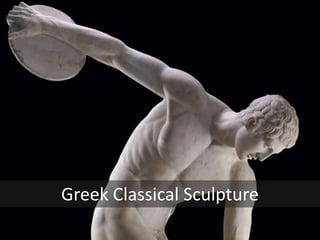






Greek Classical Sculpture
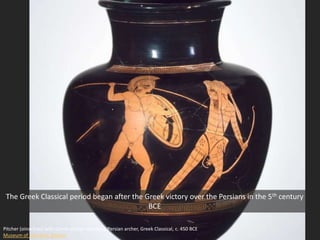
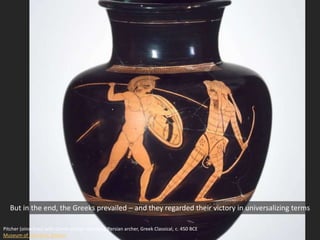
Pitcher (oinochoe) with Greek warrior attacking Persian archer, Greek Classical, c. 450 BCE
Museum of Fine Arts, Boston
The Greek Classical period began after the Greek victory over the Persians in the 5th century
BCE
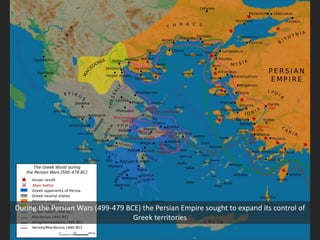
During the Persian Wars (499-479 BCE) the Persian Empire sought to expand its control of
Greek territories
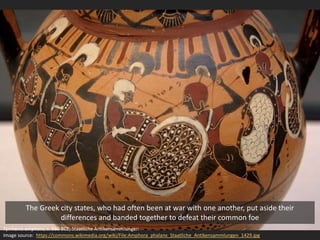
Tyrrhenic amphora, c. 560 BCE, Staatliche Antikensammlungen
Image source: https://commons.wikimedia.org/wiki/File:Amphora_phalanx_Staatliche_Antikensammlungen_1429.jpg
The Greek city states, who had often been at war with one another, put aside their
differences and banded together to defeat their common foe
The movie 300 is about the famous battle at Thermopylae, when King Leonidas of Sparta and
300 of his men held a pass for three days
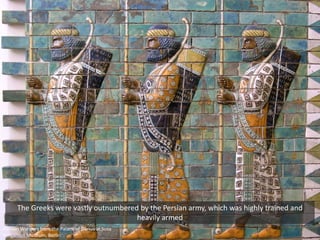
Persian Warriors from the Palace of Darius at Susa
Pergamon Museum, Berlin
The Greeks were vastly outnumbered by the Persian army, which was highly trained and
heavily armed
Pitcher (oinochoe) with Greek warrior attacking Persian archer, Greek Classical, c. 450 BCE
Museum of Fine Arts, Boston
But in the end, the Greeks prevailed – and they regarded their victory in universalizing terms
Pitcher (oinochoe) with Greek warrior attacking Persian archer, Greek Classical, c. 450 BCE
Museum of Fine Arts, Boston
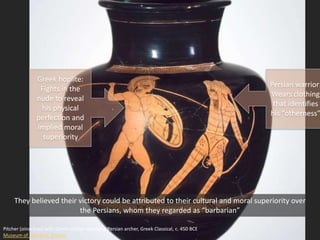
They believed their victory could be attributed to their cultural and moral superiority over
the Persians, whom they regarded as “barbarian”
Greek hoplite:
Fights in the
nude to reveal
his physical
perfection and
implied moral
superiority
Persian warrior:
Wears clothing
that identifies
his “otherness”
Pitcher (oinochoe) with Greek warrior attacking Persian archer, Greek Classical, c. 450 BCE
Museum of Fine Arts, Boston
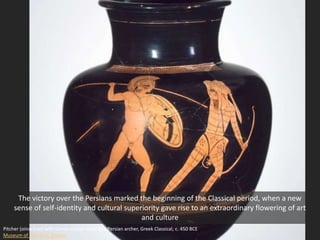
The victory over the Persians marked the beginning of the Classical period, when a new
sense of self-identity and cultural superiority gave rise to an extraordinary flowering of art
and culture
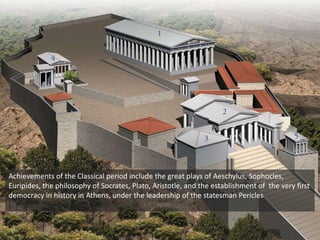
Achievements of the Classical period include the great plays of Aeschylus, Sophocles,
Euripides, the philosophy of Socrates, Plato, Aristotle, and the establishment of the very first
democracy in history in Athens, under the leadership of the statesman Pericles
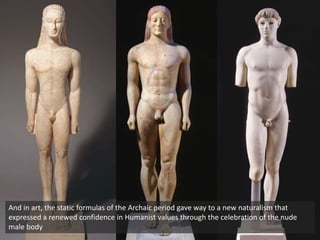
And in art, the static formulas of the Archaic period gave way to a new naturalism that
expressed a renewed confidence in Humanist values through the celebration of the nude
male body
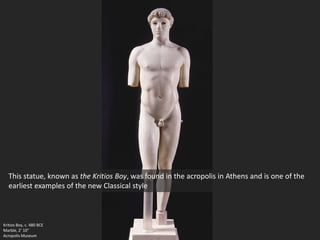
Kritios Boy, c. 480 BCE
Marble, 2’ 10”
Acropolis Museum
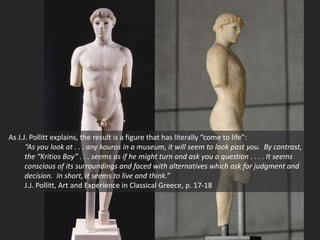
This statue, known as the Kritios Boy, was found in the acropolis in Athens and is one of the
earliest examples of the new Classical style
Kritios Boy, c. 480 BCE
Marble, 2’ 10”
Acropolis Museum
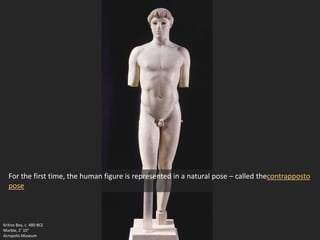
For the first time, the human figure is represented in a natural pose – called thecontrapposto
pose
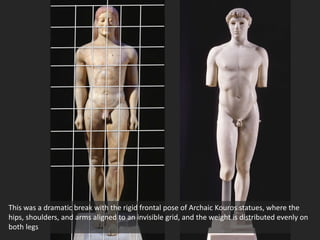
This was a dramatic break with the rigid frontal pose of Archaic Kouros statues, where the
hips, shoulders, and arms aligned to an invisible grid, and the weight is distributed evenly on
both legs
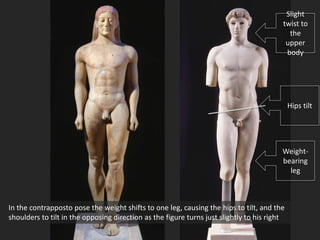
In the contrapposto pose the weight shifts to one leg, causing the hips to tilt, and the
shoulders to tilt in the opposing direction as the figure turns just slightly to his right
Weight-
bearing
leg
Hips tilt
Slight
twist to
the
upper
body
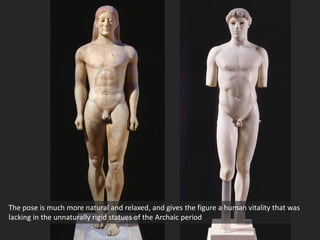
The pose is much more natural and relaxed, and gives the figure a human vitality that was
lacking in the unnaturally rigid statues of the Archaic period
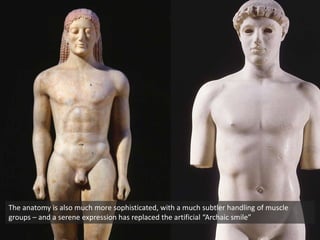
The anatomy is also much more sophisticated, with a much subtler handling of muscle
groups – and a serene expression has replaced the artificial “Archaic smile”
As J.J. Pollitt explains, the result is a figure that has literally “come to life”:
“As you look at . . . any kouros in a museum, it will seem to look past you. By contrast,
the “Kritios Boy” . . . seems as if he might turn and ask you a question . . . . It seems
conscious of its surroundings and faced with alternatives which ask for judgment and
decision. In short, it seems to live and think.”
J.J. Pollitt, Art and Experience in Classical Greece, p. 17-18
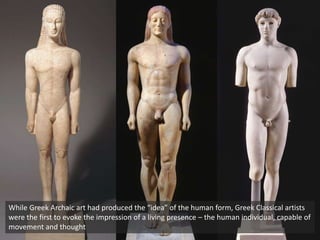
While Greek Archaic art had produced the “idea” of the human form, Greek Classical artists
were the first to evoke the impression of a living presence – the human individual, capable of
movement and thought
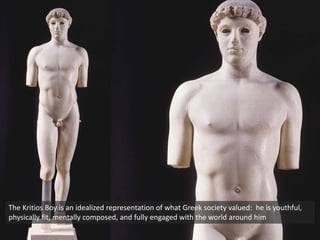
The Kritios Boy is an idealized representation of what Greek society valued: he is youthful,
physically fit, mentally composed, and fully engaged with the world around him
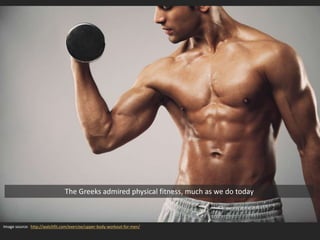
Image source: http://watchfit.com/exercise/upper-body-workout-for-men/
The Greeks admired physical fitness, much as we do today
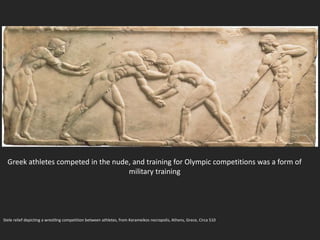
Stele relief depicting a wrestling competition between athletes, from Kerameikos necropolis, Athens, Grece, Circa 510
Greek athletes competed in the nude, and training for Olympic competitions was a form of
military training
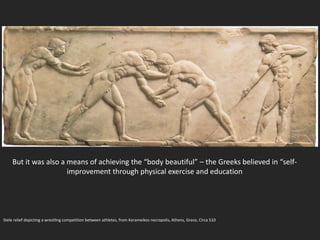
Stele relief depicting a wrestling competition between athletes, from Kerameikos necropolis, Athens, Grece, Circa 510
But it was also a means of achieving the “body beautiful” – the Greeks believed in “self-
improvement through physical exercise and education
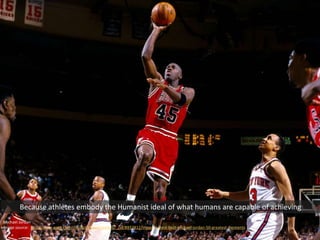
Athletes were celebrities in Greek culture, as they are in our own society
Derek Jeeter
Image source: http://muzul.com/celebrity/derek-jeter/
Michael Jordan
Image source: http://www.espn.com/chicago/photos/gallery/_/id/8932812/image/1/best-best-michael-jordan-50-greatest-moments
Because athletes embody the Humanist ideal of what humans are capable of achieving
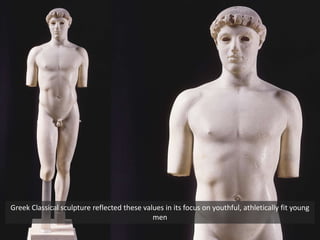
Greek Classical sculpture reflected these values in its focus on youthful, athletically fit young
men
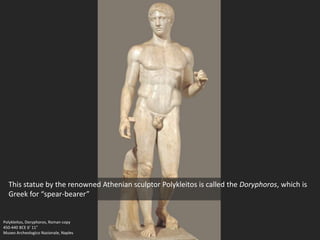
Polykleitos, Doryphoros, Roman copy
450-440 BCE 6’ 11”
Museo Archeologico Nazionale, Naples
This statue by the renowned Athenian sculptor Polykleitos is called the Doryphoros, which is
Greek for “spear-bearer”
Polykleitos, Doryphoros, Roman copy
450-440 BCE 6’ 11”
Museo Archeologico Nazionale, Naples
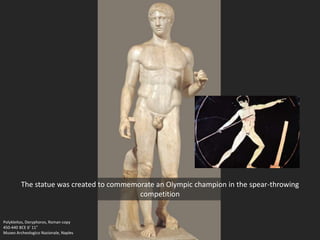
The statue was created to commemorate an Olympic champion in the spear-throwing
competition
Polykleitos, Doryphoros, Roman copy
450-440 BCE 6’ 11”
Museo Archeologico Nazionale, Naples
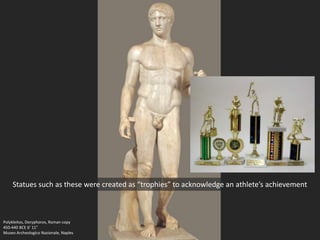
Statues such as these were created as “trophies” to acknowledge an athlete’s achievement
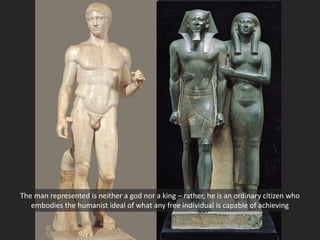
The man represented is neither a god nor a king – rather, he is an ordinary citizen who
embodies the humanist ideal of what any free individual is capable of achieving
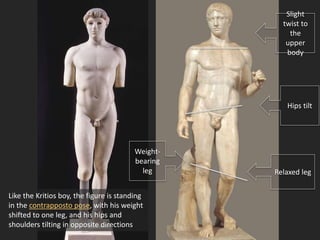
Like the Kritios boy, the figure is standing
in the contrapposto pose, with his weight
shifted to one leg, and his hips and
shoulders tilting in opposite directions
Weight-
bearing
leg
Hips tilt
Slight
twist to
the
upper
body
Relaxed leg
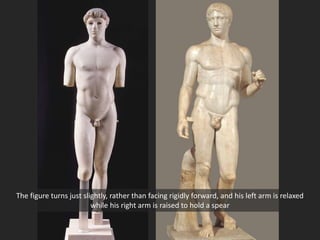
The figure turns just slightly, rather than facing rigidly forward, and his left arm is relaxed
while his right arm is raised to hold a spear
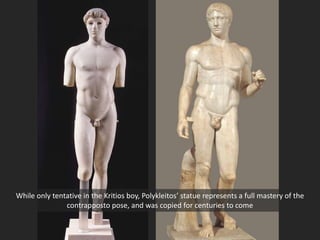
While only tentative in the Kritios boy, Polykleitos’ statue represents a full mastery of the
contrapposto pose, and was copied for centuries to come
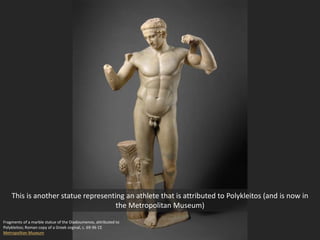
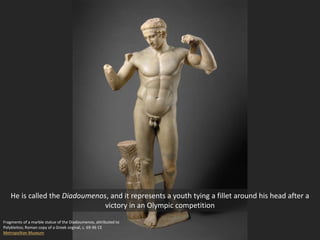
Fragments of a marble statue of the Diadoumenos, attributed to
Polykleitos; Roman copy of a Greek orginal, c. 69-96 CE
Metropolitan Museum
This is another statue representing an athlete that is attributed to Polykleitos (and is now in
the Metropolitan Museum)
Fragments of a marble statue of the Diadoumenos, attributed to
Polykleitos; Roman copy of a Greek orginal, c. 69-96 CE
Metropolitan Museum
He is called the Diadoumenos, and it represents a youth tying a fillet around his head after a
victory in an Olympic competition
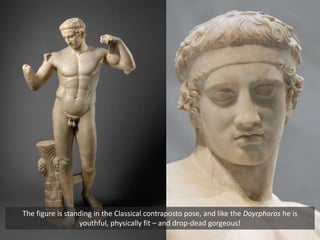
The figure is standing in the Classical contraposto pose, and like the Doyrphoros he is
youthful, physically fit – and drop-dead gorgeous!
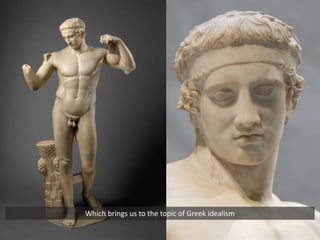
Which brings us to the topic of Greek idealism
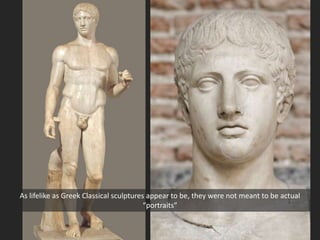
As lifelike as Greek Classical sculptures appear to be, they were not meant to be actual
“portraits”
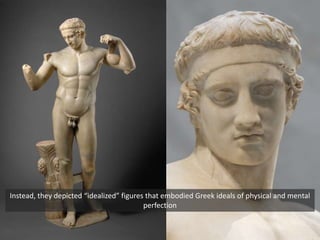
Instead, they depicted “idealized” figures that embodied Greek ideals of physical and mental
perfection
Most humans are not “perfect” in reality
Image source: http://creativity-online.com/work/dressmann-underwear-for-perfect-men/43310
Some achieve it, but even celebrities rely on help from personal trainers, make-up artists, plastic
surgeons, and photographers
Channing Tatum
Image source: https://www.thecut.com/2016/08/what-will-channing-tatum-look-like-as-a-merman.html
Idealism in art is kind of like a photo-shopped version of reality
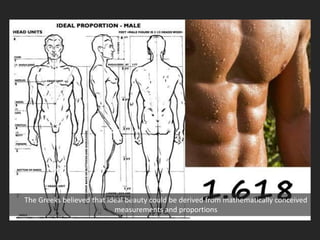
The Greeks believed that ideal beauty could be derived from mathematically conceived
measurements and proportions
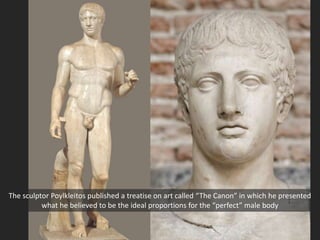
The sculptor Poylkleitos published a treatise on art called “The Canon” in which he presented
what he believed to be the ideal proportions for the “perfect” male body
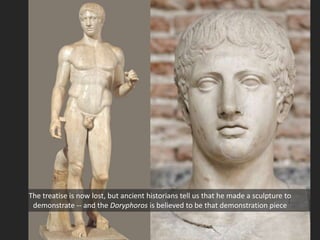
The treatise is now lost, but ancient historians tell us that he made a sculpture to
demonstrate -- and the Doryphoros is believed to be that demonstration piece
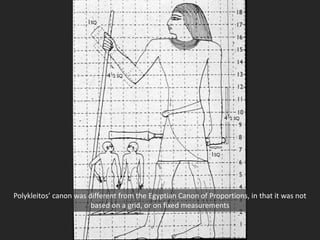
Polykleitos’ canon was different from the Egyptian Canon of Proportions, in that it was not
based on a grid, or on fixed measurements
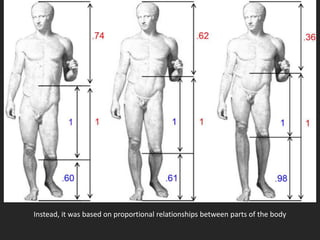
Instead, it was based on proportional relationships between parts of the body
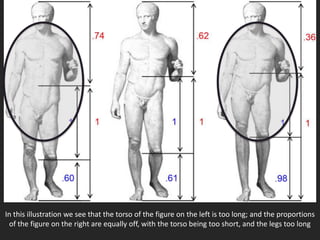
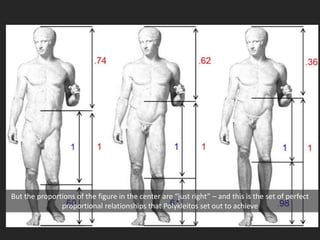
In this illustration we see that the torso of the figure on the left is too long; and the proportions
of the figure on the right are equally off, with the torso being too short, and the legs too long
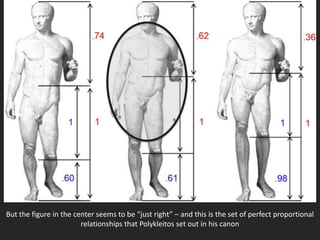
But the figure in the center seems to be “just right” – and this is the set of perfect proportional
relationships that Polykleitos set out in his canon
But the proportions of the figure in the center are “just right” – and this is the set of perfect
proportional relationships that Polykleitos set out to achieve
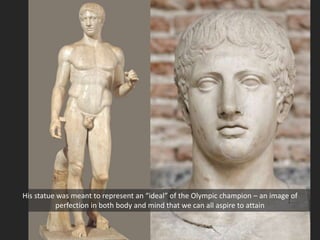
His statue was meant to represent an “ideal” of the Olympic champion – an image of
perfection in both body and mind that we can all aspire to attain
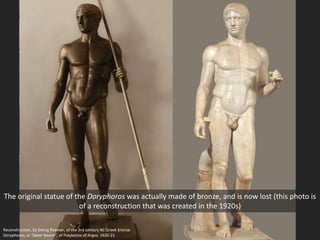
Reconstruction, by Georg Roemer, of the 3rd century BC Greek bronze
Doryphoros, or 'Spear bearer', of Polykeitos of Argos. 1920-21
The original statue of the Doryphoros was actually made of bronze, and is now lost (this photo is
of a reconstruction that was created in the 1920s)
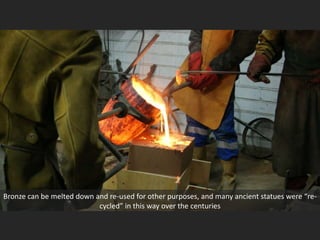
Bronze can be melted down and re-used for other purposes, and many ancient statues were “re-
cycled” in this way over the centuries
Polykleitos, Doryphoros, Roman copy
440 BCE 6’ 11”, Minneapolis Institute of Art
Polykleitos, Doryphoros, Roman copy
450-440 BCE 6’ 11”
Museo Archeologico Nazionale, Naples
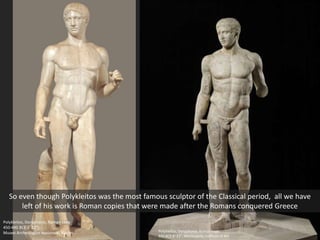
So even though Polykleitos was the most famous sculptor of the Classical period, all we have
left of his work is Roman copies that were made after the Romans conquered Greece
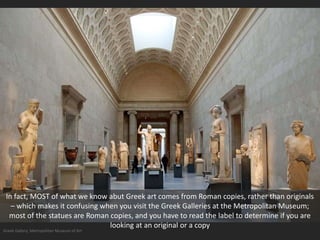
Greek Gallery, Metropolitan Museum of Art
In fact, MOST of what we know abut Greek art comes from Roman copies, rather than originals
– which makes it confusing when you visit the Greek Galleries at the Metropolitan Museum;
most of the statues are Roman copies, and you have to read the label to determine if you are
looking at an original or a copy
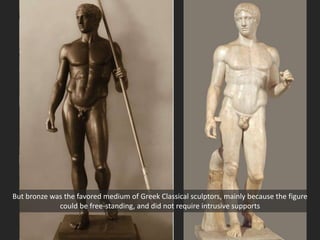
But bronze was the favored medium of Greek Classical sculptors, mainly because the figure
could be free-standing, and did not require intrusive supports
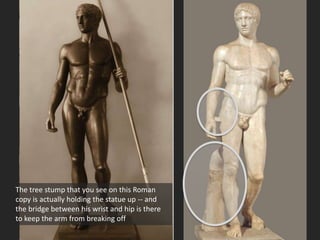
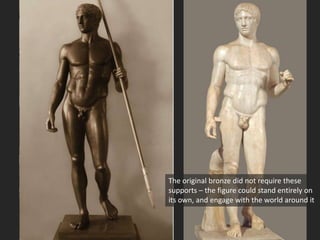
The tree stump that you see on this Roman
copy is actually holding the statue up -- and
the bridge between his wrist and hip is there
to keep the arm from breaking off
The original bronze did not require these
supports – the figure could stand entirely on
its own, and engage with the world around it
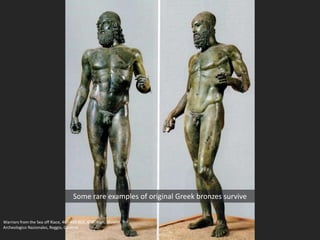
Some rare examples of original Greek bronzes survive
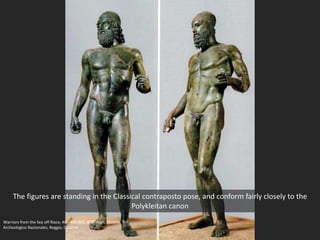
Warriors from the Sea off Riace, 460-450 BCE, 6’ 6” high; Museio
Archeologico Nazionales, Reggio, Calabria
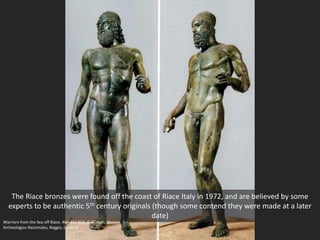
The Riace bronzes were found off the coast of Riace Italy in 1972, and are believed by some
experts to be authentic 5th century originals (though some contend they were made at a later
date)
Warriors from the Sea off Riace, 460-450 BCE, 6’ 6” high; Museio
Archeologico Nazionales, Reggio, Calabria
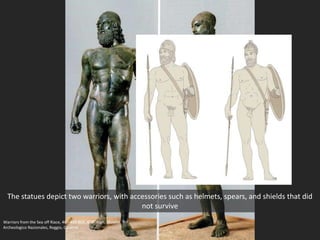
The statues depict two warriors, with accessories such as helmets, spears, and shields that did
not survive
Warriors from the Sea off Riace, 460-450 BCE, 6’ 6” high; Museio
Archeologico Nazionales, Reggio, Calabria
The figures are standing in the Classical contraposto pose, and conform fairly closely to the
Polykleitan canon
Warriors from the Sea off Riace, 460-450 BCE, 6’ 6” high; Museio
Archeologico Nazionales, Reggio, Calabria
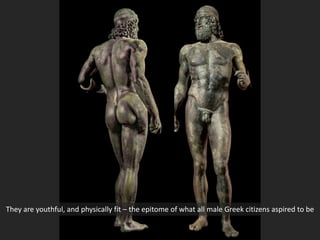
They are youthful, and physically fit – the epitome of what all male Greek citizens aspired to be
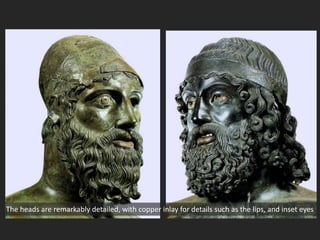
The heads are remarkably detailed, with copper inlay for details such as the lips, and inset eyes
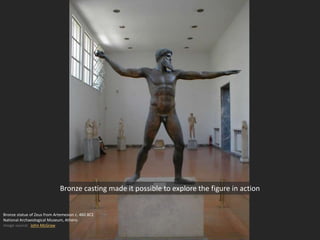
Bronze casting made it possible to explore the figure in action
Bronze statue of Zeus from Artemesion c. 460 BCE
National Archaeological Museum, Athens
Image source: John McGraw
Bronze statue of Zeus from Artemesion c. 460 BCE
National Archaeological Museum, Athens
Wikimedia
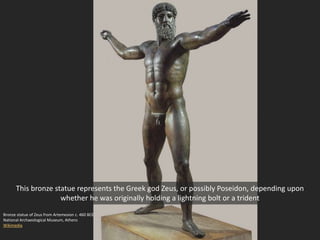
This bronze statue represents the Greek god Zeus, or possibly Poseidon, depending upon
whether he was originally holding a lightning bolt or a trident
Bronze statue of Zeus from Artemesion c. 460 BCE
National Archaeological Museum, Athens
Wikimedia
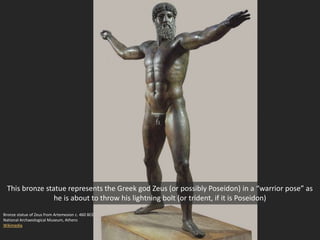
This bronze statue represents the Greek god Zeus (or possibly Poseidon) in a “warrior pose” as
he is about to throw his lightning bolt (or trident, if it is Poseidon)
Bronze statue of Zeus from Artemesion c. 460 BCE
National Archaeological Museum, Athens
Wikimedia
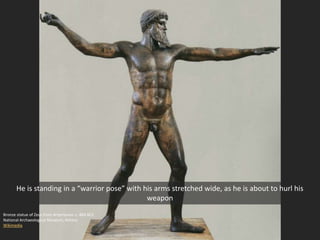
He is standing in a “warrior pose” with his arms stretched wide, as he is about to hurl his
weapon
Bronze statue of Zeus from Artemesion c. 460 BCE
National Archaeological Museum, Athens
Wikimedia
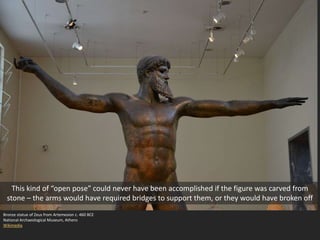
This kind of “open pose” could never have been accomplished if the figure was carved from
stone – the arms would have required bridges to support them, or they would have broken off
Bronze statue of Zeus from Artemesion c. 460 BCE
National Archaeological Museum, Athens
Wikimedia
Warrior from the Sea off Riace, 460-450 BCE, 6’ 6” high; Museio
Archeologico Nazionales, Reggio, Calabria
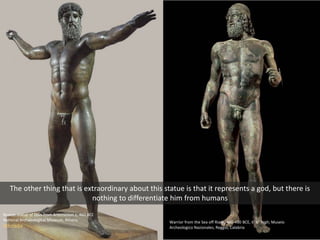
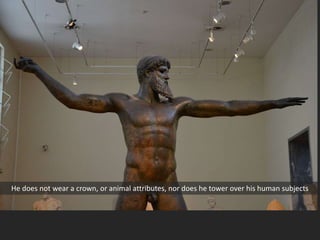
The other thing that is extraordinary about this statue is that it represents a god, but there is
nothing to differentiate him from humans
He does not wear a crown, or animal attributes, nor does he tower over his human subjects
Bronze statue of Zeus from Artemesion c. 460 BCE
National Archaeological Museum, Athens
Wikimedia
Warrior from the Sea off Riace, 460-450 BCE, 6’ 6” high; Museio
Archeologico Nazionales, Reggio, Calabria
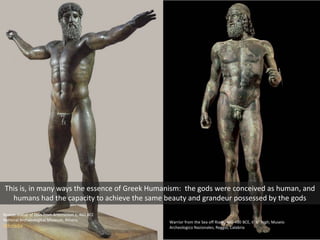
This is, in many ways the essence of Greek Humanism: the gods were conceived as human, and
humans had the capacity to achieve the same beauty and grandeur possessed by the gods
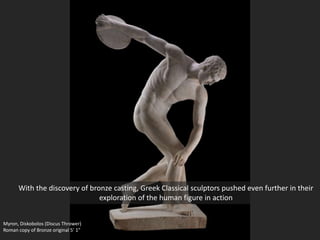
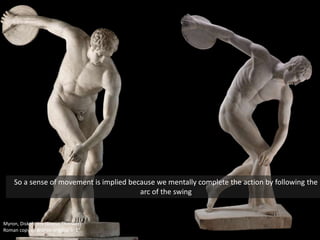
Myron, Diskobolos (Discus Thrower)
Roman copy of Bronze original 5’ 1”
With the discovery of bronze casting, Greek Classical sculptors pushed even further in their
exploration of the human figure in action
Myron, Diskobolos (Discus Thrower)
Roman copy of Bronze original 5’ 1”
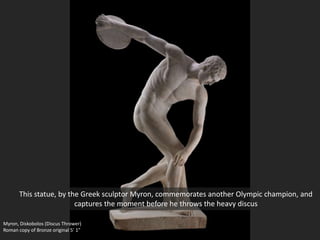
This statue, by the Greek sculptor Myron, commemorates another Olympic champion, and
captures the moment before he throws the heavy discus
Myron, Diskobolos (Discus Thrower)
Roman copy of Bronze original 5’ 1”
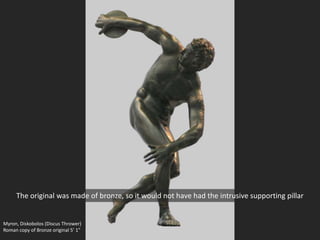
The original was made of bronze, so it would not have had the intrusive supporting pillar
Myron, Diskobolos (Discus Thrower)
Roman copy of Bronze original 5’ 1”
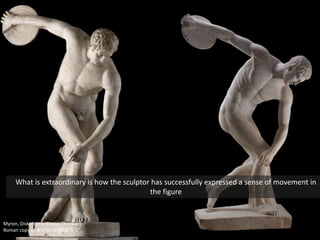
What is extraordinary is how the sculptor has successfully expressed a sense of movement in
the figure
Myron, Diskobolos (Discus Thrower)
Roman copy of Bronze original 5’ 1”
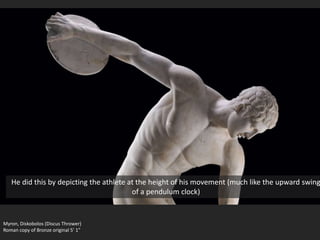
He did this by depicting the athlete at the height of his movement (much like the upward swing
of a pendulum clock)
Myron, Diskobolos (Discus Thrower)
Roman copy of Bronze original 5’ 1”
So a sense of movement is implied because we mentally complete the action by following the
arc of the swing
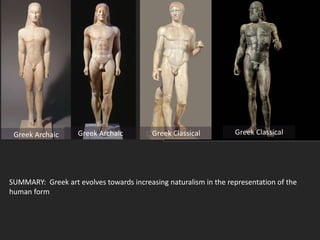
SUMMARY: Greek art evolves towards increasing naturalism in the representation of the
human form
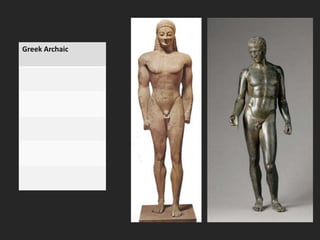
Greek Archaic Greek Archaic Greek Classical Greek Classical
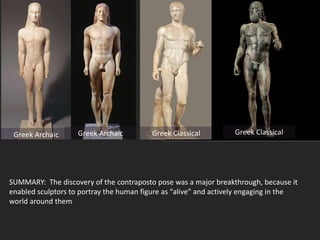
SUMMARY: The discovery of the contraposto pose was a major breakthrough, because it
enabled sculptors to portray the human figure as “alive” and actively engaging in the
world around them
Greek Archaic Greek Archaic Greek Classical Greek Classical
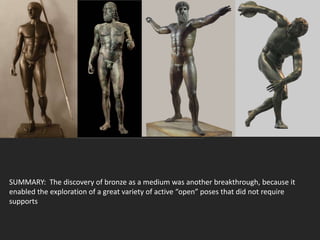
SUMMARY: The discovery of bronze as a medium was another breakthrough, because it
enabled the exploration of a great variety of active “open” poses that did not require
supports
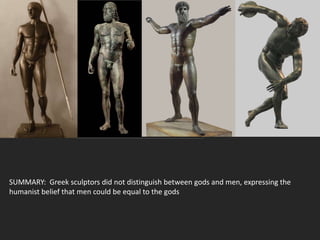
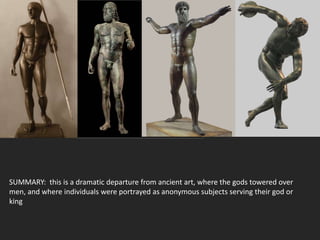
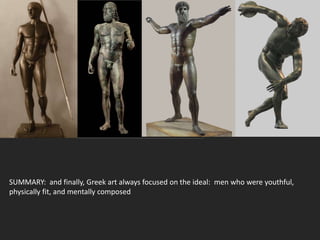
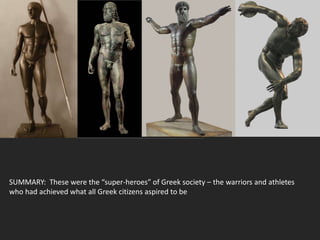
SUMMARY: Greek sculptors did not distinguish between gods and men, expressing the
humanist belief that men could be equal to the gods
SUMMARY: this is a dramatic departure from ancient art, where the gods towered over
men, and where individuals were portrayed as anonymous subjects serving their god or
king
SUMMARY: and finally, Greek art always focused on the ideal: men who were youthful,
physically fit, and mentally composed
SUMMARY: These were the “super-heroes” of Greek society – the warriors and athletes
who had achieved what all Greek citizens aspired to be
Thanks for listening!
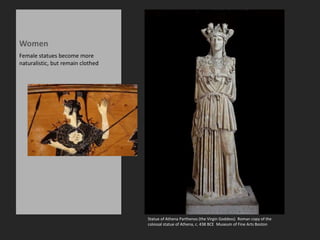
Women
Female statues become more
naturalistic, but remain clothed
Statue of Athena Parthenos (the Virgin Goddess) Roman copy of the
colossal statue of Athena, c. 438 BCE Museum of Fine Arts Boston
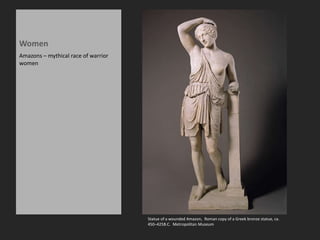
Women
Amazons – mythical race of warrior
women
Statue of a wounded Amazon, Roman copy of a Greek bronze statue, ca.
450–425B.C. Metropolitan Museum
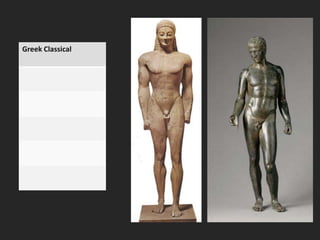
Greek Archaic
Greek Archaic
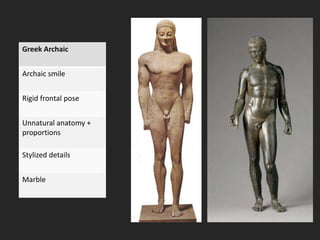
Archaic smile
Rigid frontal pose
Unnatural anatomy +
proportions
Stylized details
Marble
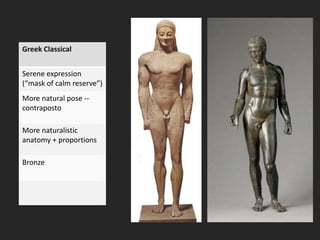
Greek Classical
Greek Classical
Serene expression
(“mask of calm reserve”)
More natural pose --
contraposto
More naturalistic
anatomy + proportions
Bronze
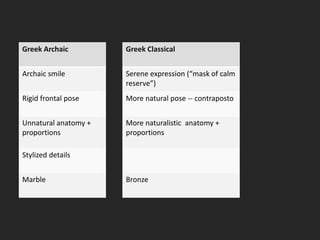
Greek Archaic
Archaic smile
Rigid frontal pose
Unnatural anatomy +
proportions
Stylized details
Marble
Greek Classical
Serene expression (“mask of calm
reserve”)
More natural pose -- contraposto
More naturalistic anatomy +
proportions
Bronze

Greek Classical Sculpture

  • 1.
  • 2.
    Pitcher (oinochoe) withGreek warrior attacking Persian archer, Greek Classical, c. 450 BCE Museum of Fine Arts, Boston The Greek Classical period began after the Greek victory over the Persians in the 5th century BCE
  • 3.
    During the PersianWars (499-479 BCE) the Persian Empire sought to expand its control of Greek territories
  • 4.
    Tyrrhenic amphora, c.560 BCE, Staatliche Antikensammlungen Image source: https://commons.wikimedia.org/wiki/File:Amphora_phalanx_Staatliche_Antikensammlungen_1429.jpg The Greek city states, who had often been at war with one another, put aside their differences and banded together to defeat their common foe
  • 5.
    The movie 300is about the famous battle at Thermopylae, when King Leonidas of Sparta and 300 of his men held a pass for three days
  • 6.
    Persian Warriors fromthe Palace of Darius at Susa Pergamon Museum, Berlin The Greeks were vastly outnumbered by the Persian army, which was highly trained and heavily armed
  • 7.
    Pitcher (oinochoe) withGreek warrior attacking Persian archer, Greek Classical, c. 450 BCE Museum of Fine Arts, Boston But in the end, the Greeks prevailed – and they regarded their victory in universalizing terms
  • 8.
    Pitcher (oinochoe) withGreek warrior attacking Persian archer, Greek Classical, c. 450 BCE Museum of Fine Arts, Boston They believed their victory could be attributed to their cultural and moral superiority over the Persians, whom they regarded as “barbarian” Greek hoplite: Fights in the nude to reveal his physical perfection and implied moral superiority Persian warrior: Wears clothing that identifies his “otherness”
  • 9.
    Pitcher (oinochoe) withGreek warrior attacking Persian archer, Greek Classical, c. 450 BCE Museum of Fine Arts, Boston The victory over the Persians marked the beginning of the Classical period, when a new sense of self-identity and cultural superiority gave rise to an extraordinary flowering of art and culture
  • 10.
    Achievements of theClassical period include the great plays of Aeschylus, Sophocles, Euripides, the philosophy of Socrates, Plato, Aristotle, and the establishment of the very first democracy in history in Athens, under the leadership of the statesman Pericles
  • 11.
    And in art,the static formulas of the Archaic period gave way to a new naturalism that expressed a renewed confidence in Humanist values through the celebration of the nude male body
  • 12.
    Kritios Boy, c.480 BCE Marble, 2’ 10” Acropolis Museum This statue, known as the Kritios Boy, was found in the acropolis in Athens and is one of the earliest examples of the new Classical style
  • 13.
    Kritios Boy, c.480 BCE Marble, 2’ 10” Acropolis Museum For the first time, the human figure is represented in a natural pose – called thecontrapposto pose
  • 14.
    This was adramatic break with the rigid frontal pose of Archaic Kouros statues, where the hips, shoulders, and arms aligned to an invisible grid, and the weight is distributed evenly on both legs
  • 15.
    In the contrappostopose the weight shifts to one leg, causing the hips to tilt, and the shoulders to tilt in the opposing direction as the figure turns just slightly to his right Weight- bearing leg Hips tilt Slight twist to the upper body
  • 16.
    The pose ismuch more natural and relaxed, and gives the figure a human vitality that was lacking in the unnaturally rigid statues of the Archaic period
  • 17.
    The anatomy isalso much more sophisticated, with a much subtler handling of muscle groups – and a serene expression has replaced the artificial “Archaic smile”
  • 18.
    As J.J. Pollittexplains, the result is a figure that has literally “come to life”: “As you look at . . . any kouros in a museum, it will seem to look past you. By contrast, the “Kritios Boy” . . . seems as if he might turn and ask you a question . . . . It seems conscious of its surroundings and faced with alternatives which ask for judgment and decision. In short, it seems to live and think.” J.J. Pollitt, Art and Experience in Classical Greece, p. 17-18
  • 19.
    While Greek Archaicart had produced the “idea” of the human form, Greek Classical artists were the first to evoke the impression of a living presence – the human individual, capable of movement and thought
  • 20.
    The Kritios Boyis an idealized representation of what Greek society valued: he is youthful, physically fit, mentally composed, and fully engaged with the world around him
  • 21.
    Image source: http://watchfit.com/exercise/upper-body-workout-for-men/ TheGreeks admired physical fitness, much as we do today
  • 22.
    Stele relief depictinga wrestling competition between athletes, from Kerameikos necropolis, Athens, Grece, Circa 510 Greek athletes competed in the nude, and training for Olympic competitions was a form of military training
  • 23.
    Stele relief depictinga wrestling competition between athletes, from Kerameikos necropolis, Athens, Grece, Circa 510 But it was also a means of achieving the “body beautiful” – the Greeks believed in “self- improvement through physical exercise and education
  • 24.
    Athletes were celebritiesin Greek culture, as they are in our own society Derek Jeeter Image source: http://muzul.com/celebrity/derek-jeter/
  • 25.
    Michael Jordan Image source:http://www.espn.com/chicago/photos/gallery/_/id/8932812/image/1/best-best-michael-jordan-50-greatest-moments Because athletes embody the Humanist ideal of what humans are capable of achieving
  • 26.
    Greek Classical sculpturereflected these values in its focus on youthful, athletically fit young men
  • 27.
    Polykleitos, Doryphoros, Romancopy 450-440 BCE 6’ 11” Museo Archeologico Nazionale, Naples This statue by the renowned Athenian sculptor Polykleitos is called the Doryphoros, which is Greek for “spear-bearer”
  • 28.
    Polykleitos, Doryphoros, Romancopy 450-440 BCE 6’ 11” Museo Archeologico Nazionale, Naples The statue was created to commemorate an Olympic champion in the spear-throwing competition
  • 29.
    Polykleitos, Doryphoros, Romancopy 450-440 BCE 6’ 11” Museo Archeologico Nazionale, Naples Statues such as these were created as “trophies” to acknowledge an athlete’s achievement
  • 30.
    The man representedis neither a god nor a king – rather, he is an ordinary citizen who embodies the humanist ideal of what any free individual is capable of achieving
  • 31.
    Like the Kritiosboy, the figure is standing in the contrapposto pose, with his weight shifted to one leg, and his hips and shoulders tilting in opposite directions Weight- bearing leg Hips tilt Slight twist to the upper body Relaxed leg
  • 32.
    The figure turnsjust slightly, rather than facing rigidly forward, and his left arm is relaxed while his right arm is raised to hold a spear
  • 33.
    While only tentativein the Kritios boy, Polykleitos’ statue represents a full mastery of the contrapposto pose, and was copied for centuries to come
  • 34.
    Fragments of amarble statue of the Diadoumenos, attributed to Polykleitos; Roman copy of a Greek orginal, c. 69-96 CE Metropolitan Museum This is another statue representing an athlete that is attributed to Polykleitos (and is now in the Metropolitan Museum)
  • 35.
    Fragments of amarble statue of the Diadoumenos, attributed to Polykleitos; Roman copy of a Greek orginal, c. 69-96 CE Metropolitan Museum He is called the Diadoumenos, and it represents a youth tying a fillet around his head after a victory in an Olympic competition
  • 36.
    The figure isstanding in the Classical contraposto pose, and like the Doyrphoros he is youthful, physically fit – and drop-dead gorgeous!
  • 37.
    Which brings usto the topic of Greek idealism
  • 38.
    As lifelike asGreek Classical sculptures appear to be, they were not meant to be actual “portraits”
  • 39.
    Instead, they depicted“idealized” figures that embodied Greek ideals of physical and mental perfection
  • 40.
    Most humans arenot “perfect” in reality Image source: http://creativity-online.com/work/dressmann-underwear-for-perfect-men/43310
  • 41.
    Some achieve it,but even celebrities rely on help from personal trainers, make-up artists, plastic surgeons, and photographers Channing Tatum Image source: https://www.thecut.com/2016/08/what-will-channing-tatum-look-like-as-a-merman.html
  • 42.
    Idealism in artis kind of like a photo-shopped version of reality
  • 43.
    The Greeks believedthat ideal beauty could be derived from mathematically conceived measurements and proportions
  • 44.
    The sculptor Poylkleitospublished a treatise on art called “The Canon” in which he presented what he believed to be the ideal proportions for the “perfect” male body
  • 45.
    The treatise isnow lost, but ancient historians tell us that he made a sculpture to demonstrate -- and the Doryphoros is believed to be that demonstration piece
  • 46.
    Polykleitos’ canon wasdifferent from the Egyptian Canon of Proportions, in that it was not based on a grid, or on fixed measurements
  • 47.
    Instead, it wasbased on proportional relationships between parts of the body
  • 48.
    In this illustrationwe see that the torso of the figure on the left is too long; and the proportions of the figure on the right are equally off, with the torso being too short, and the legs too long
  • 49.
    But the figurein the center seems to be “just right” – and this is the set of perfect proportional relationships that Polykleitos set out in his canon
  • 50.
    But the proportionsof the figure in the center are “just right” – and this is the set of perfect proportional relationships that Polykleitos set out to achieve
  • 51.
    His statue wasmeant to represent an “ideal” of the Olympic champion – an image of perfection in both body and mind that we can all aspire to attain
  • 52.
    Reconstruction, by GeorgRoemer, of the 3rd century BC Greek bronze Doryphoros, or 'Spear bearer', of Polykeitos of Argos. 1920-21 The original statue of the Doryphoros was actually made of bronze, and is now lost (this photo is of a reconstruction that was created in the 1920s)
  • 53.
    Bronze can bemelted down and re-used for other purposes, and many ancient statues were “re- cycled” in this way over the centuries
  • 54.
    Polykleitos, Doryphoros, Romancopy 440 BCE 6’ 11”, Minneapolis Institute of Art Polykleitos, Doryphoros, Roman copy 450-440 BCE 6’ 11” Museo Archeologico Nazionale, Naples So even though Polykleitos was the most famous sculptor of the Classical period, all we have left of his work is Roman copies that were made after the Romans conquered Greece
  • 55.
    Greek Gallery, MetropolitanMuseum of Art In fact, MOST of what we know abut Greek art comes from Roman copies, rather than originals – which makes it confusing when you visit the Greek Galleries at the Metropolitan Museum; most of the statues are Roman copies, and you have to read the label to determine if you are looking at an original or a copy
  • 56.
    But bronze wasthe favored medium of Greek Classical sculptors, mainly because the figure could be free-standing, and did not require intrusive supports
  • 57.
    The tree stumpthat you see on this Roman copy is actually holding the statue up -- and the bridge between his wrist and hip is there to keep the arm from breaking off
  • 58.
    The original bronzedid not require these supports – the figure could stand entirely on its own, and engage with the world around it
  • 59.
    Some rare examplesof original Greek bronzes survive Warriors from the Sea off Riace, 460-450 BCE, 6’ 6” high; Museio Archeologico Nazionales, Reggio, Calabria
  • 60.
    The Riace bronzeswere found off the coast of Riace Italy in 1972, and are believed by some experts to be authentic 5th century originals (though some contend they were made at a later date) Warriors from the Sea off Riace, 460-450 BCE, 6’ 6” high; Museio Archeologico Nazionales, Reggio, Calabria
  • 61.
    The statues depicttwo warriors, with accessories such as helmets, spears, and shields that did not survive Warriors from the Sea off Riace, 460-450 BCE, 6’ 6” high; Museio Archeologico Nazionales, Reggio, Calabria
  • 62.
    The figures arestanding in the Classical contraposto pose, and conform fairly closely to the Polykleitan canon Warriors from the Sea off Riace, 460-450 BCE, 6’ 6” high; Museio Archeologico Nazionales, Reggio, Calabria
  • 63.
    They are youthful,and physically fit – the epitome of what all male Greek citizens aspired to be
  • 64.
    The heads areremarkably detailed, with copper inlay for details such as the lips, and inset eyes
  • 65.
    Bronze casting madeit possible to explore the figure in action Bronze statue of Zeus from Artemesion c. 460 BCE National Archaeological Museum, Athens Image source: John McGraw
  • 66.
    Bronze statue ofZeus from Artemesion c. 460 BCE National Archaeological Museum, Athens Wikimedia This bronze statue represents the Greek god Zeus, or possibly Poseidon, depending upon whether he was originally holding a lightning bolt or a trident
  • 67.
    Bronze statue ofZeus from Artemesion c. 460 BCE National Archaeological Museum, Athens Wikimedia This bronze statue represents the Greek god Zeus (or possibly Poseidon) in a “warrior pose” as he is about to throw his lightning bolt (or trident, if it is Poseidon)
  • 68.
    Bronze statue ofZeus from Artemesion c. 460 BCE National Archaeological Museum, Athens Wikimedia He is standing in a “warrior pose” with his arms stretched wide, as he is about to hurl his weapon
  • 69.
    Bronze statue ofZeus from Artemesion c. 460 BCE National Archaeological Museum, Athens Wikimedia This kind of “open pose” could never have been accomplished if the figure was carved from stone – the arms would have required bridges to support them, or they would have broken off
  • 70.
    Bronze statue ofZeus from Artemesion c. 460 BCE National Archaeological Museum, Athens Wikimedia Warrior from the Sea off Riace, 460-450 BCE, 6’ 6” high; Museio Archeologico Nazionales, Reggio, Calabria The other thing that is extraordinary about this statue is that it represents a god, but there is nothing to differentiate him from humans
  • 71.
    He does notwear a crown, or animal attributes, nor does he tower over his human subjects
  • 72.
    Bronze statue ofZeus from Artemesion c. 460 BCE National Archaeological Museum, Athens Wikimedia Warrior from the Sea off Riace, 460-450 BCE, 6’ 6” high; Museio Archeologico Nazionales, Reggio, Calabria This is, in many ways the essence of Greek Humanism: the gods were conceived as human, and humans had the capacity to achieve the same beauty and grandeur possessed by the gods
  • 73.
    Myron, Diskobolos (DiscusThrower) Roman copy of Bronze original 5’ 1” With the discovery of bronze casting, Greek Classical sculptors pushed even further in their exploration of the human figure in action
  • 74.
    Myron, Diskobolos (DiscusThrower) Roman copy of Bronze original 5’ 1” This statue, by the Greek sculptor Myron, commemorates another Olympic champion, and captures the moment before he throws the heavy discus
  • 75.
    Myron, Diskobolos (DiscusThrower) Roman copy of Bronze original 5’ 1” The original was made of bronze, so it would not have had the intrusive supporting pillar
  • 76.
    Myron, Diskobolos (DiscusThrower) Roman copy of Bronze original 5’ 1” What is extraordinary is how the sculptor has successfully expressed a sense of movement in the figure
  • 77.
    Myron, Diskobolos (DiscusThrower) Roman copy of Bronze original 5’ 1” He did this by depicting the athlete at the height of his movement (much like the upward swing of a pendulum clock)
  • 78.
    Myron, Diskobolos (DiscusThrower) Roman copy of Bronze original 5’ 1” So a sense of movement is implied because we mentally complete the action by following the arc of the swing
  • 79.
    SUMMARY: Greek artevolves towards increasing naturalism in the representation of the human form Greek Archaic Greek Archaic Greek Classical Greek Classical
  • 80.
    SUMMARY: The discoveryof the contraposto pose was a major breakthrough, because it enabled sculptors to portray the human figure as “alive” and actively engaging in the world around them Greek Archaic Greek Archaic Greek Classical Greek Classical
  • 81.
    SUMMARY: The discoveryof bronze as a medium was another breakthrough, because it enabled the exploration of a great variety of active “open” poses that did not require supports
  • 82.
    SUMMARY: Greek sculptorsdid not distinguish between gods and men, expressing the humanist belief that men could be equal to the gods
  • 83.
    SUMMARY: this isa dramatic departure from ancient art, where the gods towered over men, and where individuals were portrayed as anonymous subjects serving their god or king
  • 84.
    SUMMARY: and finally,Greek art always focused on the ideal: men who were youthful, physically fit, and mentally composed
  • 85.
    SUMMARY: These werethe “super-heroes” of Greek society – the warriors and athletes who had achieved what all Greek citizens aspired to be
  • 86.
  • 87.
    Women Female statues becomemore naturalistic, but remain clothed Statue of Athena Parthenos (the Virgin Goddess) Roman copy of the colossal statue of Athena, c. 438 BCE Museum of Fine Arts Boston
  • 88.
    Women Amazons – mythicalrace of warrior women Statue of a wounded Amazon, Roman copy of a Greek bronze statue, ca. 450–425B.C. Metropolitan Museum
  • 89.
  • 90.
    Greek Archaic Archaic smile Rigidfrontal pose Unnatural anatomy + proportions Stylized details Marble
  • 91.
  • 92.
    Greek Classical Serene expression (“maskof calm reserve”) More natural pose -- contraposto More naturalistic anatomy + proportions Bronze
  • 93.
    Greek Archaic Archaic smile Rigidfrontal pose Unnatural anatomy + proportions Stylized details Marble Greek Classical Serene expression (“mask of calm reserve”) More natural pose -- contraposto More naturalistic anatomy + proportions Bronze