
Romanticism in France
Ingres and Delacroix
The leading figures in 19th century French art were Jean Auguste Dominique Ingres
and Eugene Delacroix
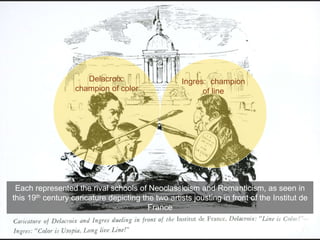
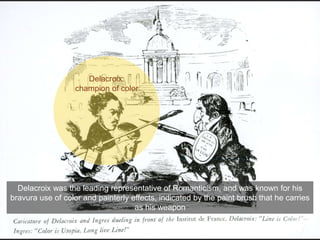
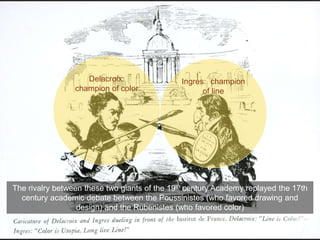
Each represented the rival schools of Neoclassicism and Romanticism, as seen in
this 19th century caricature depicting the two artists jousting in front of the Institut de
France
Ingres: champion
of line
Delacroix:
champion of color
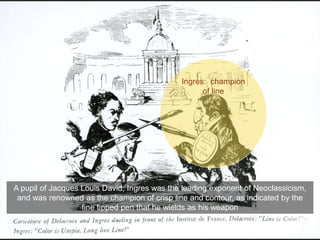
A pupil of Jacques Louis David, Ingres was the leading exponent of Neoclassicism,
and was renowned as the champion of crisp line and contour, as indicated by the
fine tipped pen that he wields as his weapon
Ingres: champion
of line
Delacroix was the leading representative of Romanticism, and was known for his
bravura use of color and painterly effects, indicated by the paint brush that he carries
as his weapon
Delacroix:
champion of color
The rivalry between these two giants of the 19th century Academy replayed the 17th
century academic debate between the Poussinistes (who favored drawing and
design) and the Rubenistes (who favored color)
Delacroix:
champion of color
Ingres: champion
of line
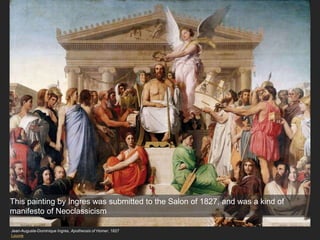
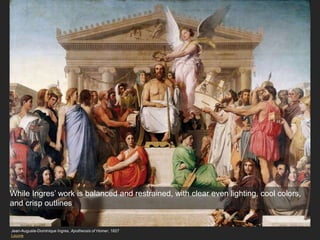
Jean-Auguste-Dominique Ingres, Apotheosis of Homer, 1827
Louvre
This painting by Ingres was submitted to the Salon of 1827, and was a kind of
manifesto of Neoclassicism
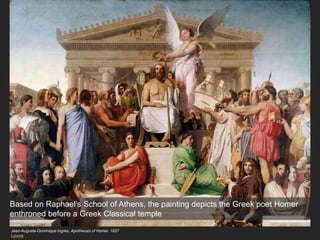
Jean-Auguste-Dominique Ingres, Apotheosis of Homer, 1827
Louvre
Based on Raphael’s School of Athens, the painting depicts the Greek poet Homer
enthroned before a Greek Classical temple
Jean-Auguste-Dominique Ingres, Apotheosis of Homer, 1827
Louvre
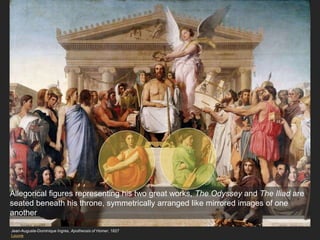
Allegorical figures representing his two great works, The Odyssey and The Iliad are
seated beneath his throne, symmetrically arranged like mirrored images of one
another
Jean-Auguste-Dominique Ingres, Apotheosis of Homer, 1827
Louvre
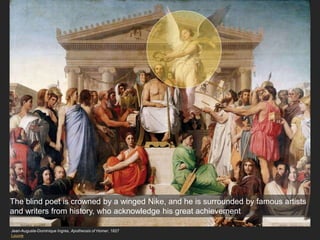
The blind poet is crowned by a winged Nike, and he is surrounded by famous artists
and writers from history, who acknowledge his great achievement
Jean-Auguste-Dominique Ingres, Apotheosis of Homer, 1827
Louvre
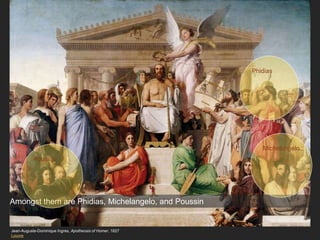
Amongst them are Phidias, Michelangelo, and Poussin
Phidias
Michelangelo
Poussin
Jean-Auguste-Dominique Ingres, Apotheosis of Homer, 1827
Louvre
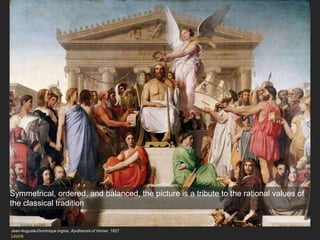
Symmetrical, ordered, and balanced, the picture is a tribute to the rational values of
the classical tradition
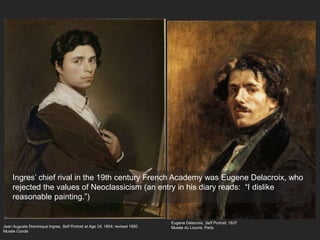
Jean Auguste Dominique Ingres, Self Portrait at Age 24, 1804; revised 1850
Musée Condé
Ingres’ chief rival in the 19th century French Academy was Eugene Delacroix, who
rejected the values of Neoclassicism (an entry in his diary reads: “I dislike
reasonable painting.”)
Eugene Delacroix, Self Portrait, 1837
Musée du Louvre, Paris
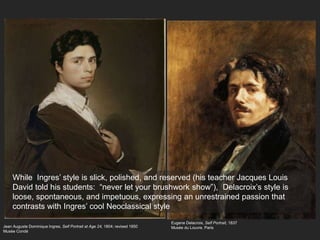
Jean Auguste Dominique Ingres, Self Portrait at Age 24, 1804; revised 1850
Musée Condé
While Ingres’ style is slick, polished, and reserved (his teacher Jacques Louis
David told his students: “never let your brushwork show”), Delacroix’s style is
loose, spontaneous, and impetuous, expressing an unrestrained passion that
contrasts with Ingres’ cool Neoclassical style
Eugene Delacroix, Self Portrait, 1837
Musée du Louvre, Paris
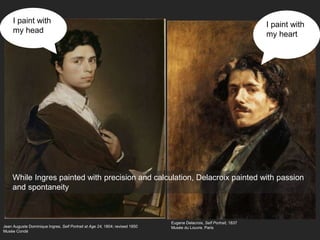
Jean Auguste Dominique Ingres, Self Portrait at Age 24, 1804; revised 1850
Musée Condé
While Ingres painted with precision and calculation, Delacroix painted with passion
and spontaneity
Eugene Delacroix, Self Portrait, 1837
Musée du Louvre, Paris
I paint with
my heart
I paint with
my head
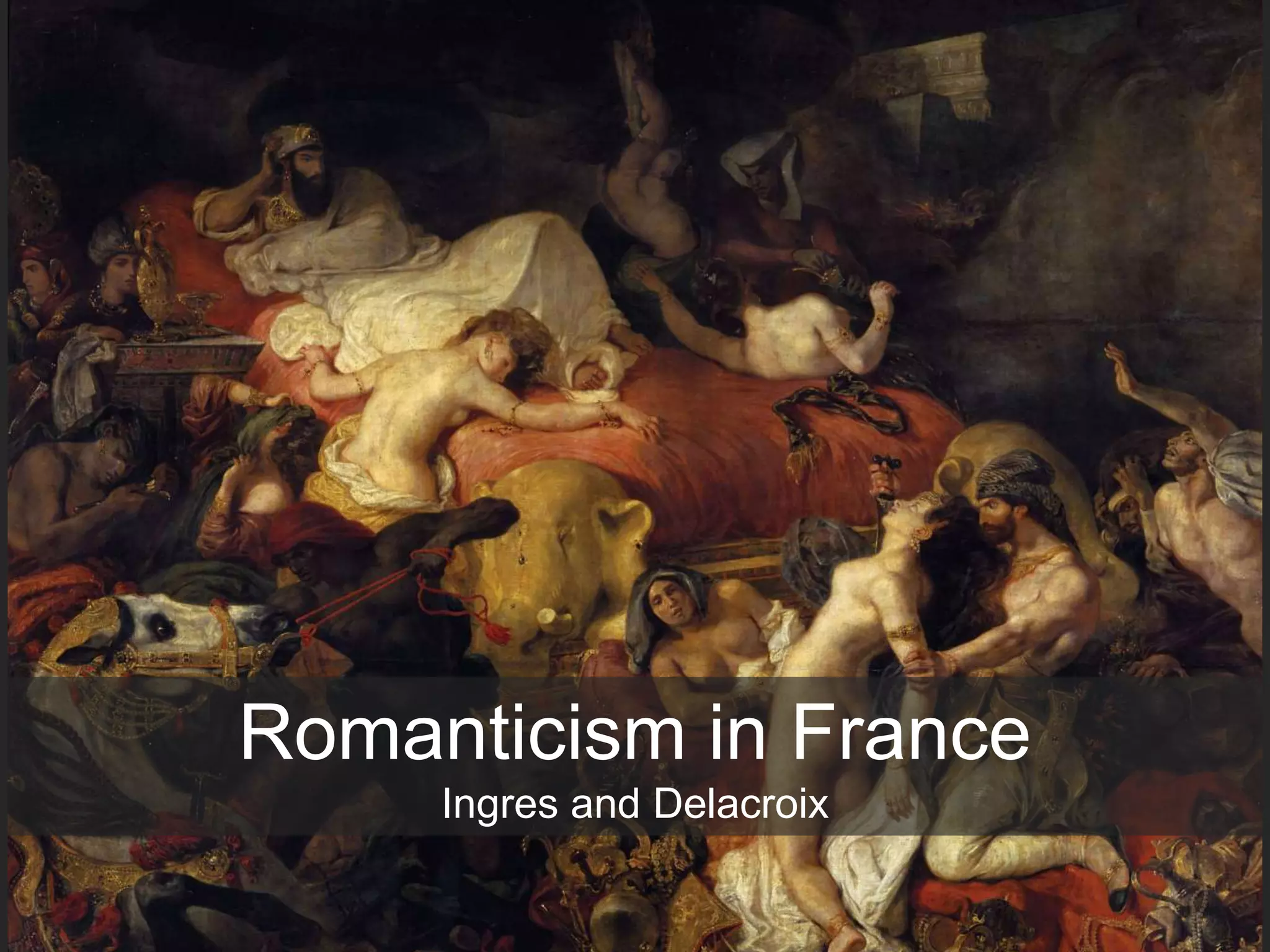
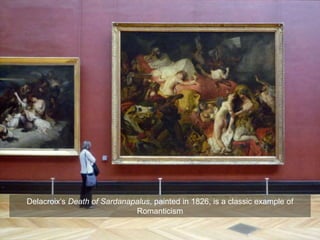
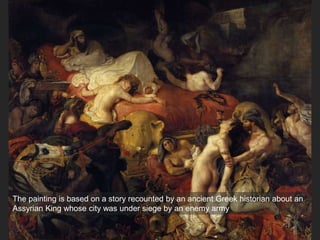
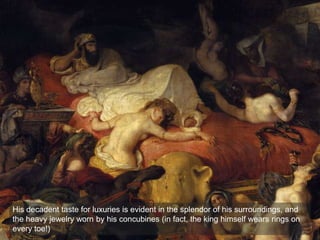
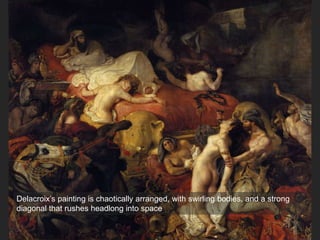
Delacroix’s Death of Sardanapalus, painted in 1826, is a classic example of
Romanticism
The painting is based on a story recounted by an ancient Greek historian about an
Assyrian King whose city was under siege by an enemy army
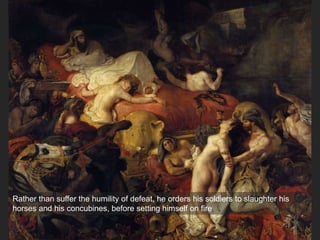
Rather than suffer the humility of defeat, he orders his soldiers to slaughter his
horses and his concubines, before setting himself on fire
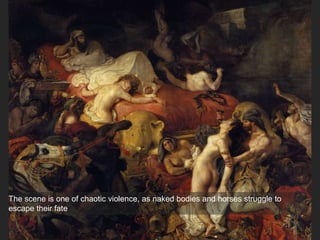
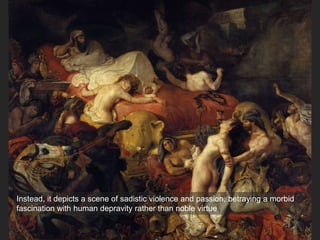
The scene is one of chaotic violence, as naked bodies and horses struggle to
escape their fate
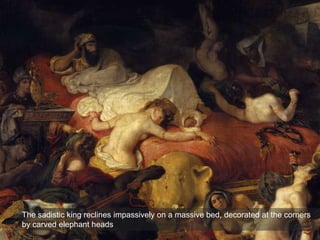
The sadistic king reclines impassively on a massive bed, decorated at the corners
by carved elephant heads
His decadent taste for luxuries is evident in the splendor of his surroundings, and
the heavy jewelry worn by his concubines (in fact, the king himself wears rings on
every toe!)
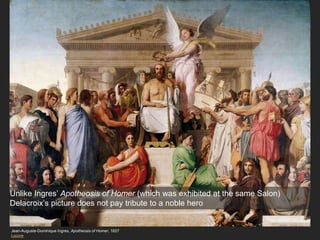
Jean-Auguste-Dominique Ingres, Apotheosis of Homer, 1827
Louvre
Unlike Ingres’ Apotheosis of Homer (which was exhibited at the same Salon)
Delacroix’s picture does not pay tribute to a noble hero
Instead, it depicts a scene of sadistic violence and passion, betraying a morbid
fascination with human depravity rather than noble virtue
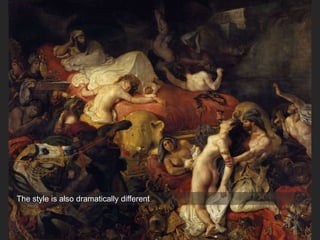
The style is also dramatically different
Jean-Auguste-Dominique Ingres, Apotheosis of Homer, 1827
Louvre
While Ingres’ work is balanced and restrained, with clear even lighting, cool colors,
and crisp outlines
Delacroix’s painting is chaotically arranged, with swirling bodies, and a strong
diagonal that rushes headlong into space
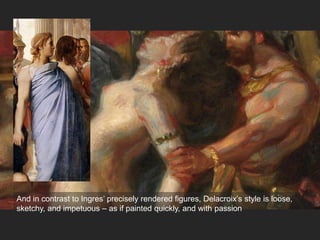
And in contrast to Ingres’ precisely rendered figures, Delacroix’s style is loose,
sketchy, and impetuous – as if painted quickly, and with passion
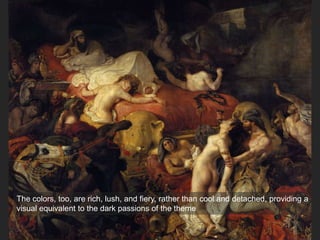
The colors, too, are rich, lush, and fiery, rather than cool and detached, providing a
visual equivalent to the dark passions of the theme
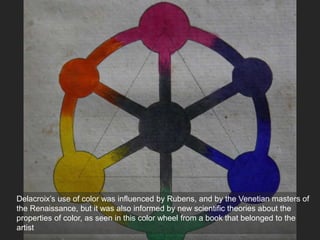
Delacroix’s use of color was influenced by Rubens, and by the Venetian masters of
the Renaissance, but it was also informed by new scientific theories about the
properties of color, as seen in this color wheel from a book that belonged to the
artist
The diagram shows primary and secondary colors, with their complimentary colors
at the other end of the axis
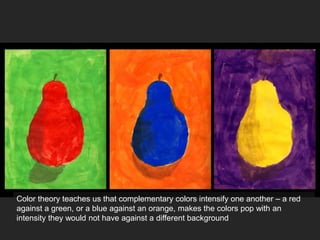
Color theory teaches us that complementary colors intensify one another – a red
against a green, or a blue against an orange, makes the colors pop with an
intensity they would not have against a different background
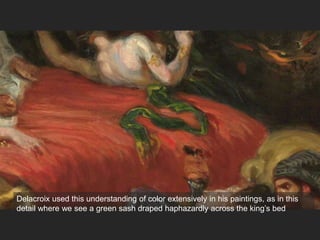
Delacroix used this understanding of color extensively in his paintings, as in this
detail where we see a green sash draped haphazardly across the king’s bed
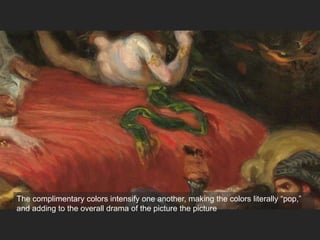
The complimentary colors intensify one another, making the colors literally “pop,”
and adding to the overall drama of the picture the picture
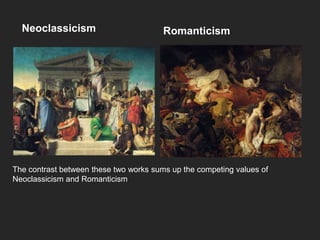
Neoclassicism Romanticism
The contrast between these two works sums up the competing values of
Neoclassicism and Romanticism
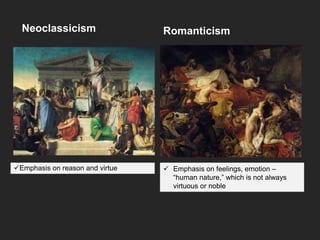
Neoclassicism Romanticism
Emphasis on reason and virtue  Emphasis on feelings, emotion –
“human nature,” which is not always
virtuous or noble
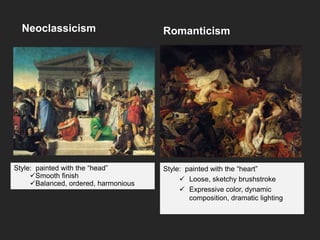
Neoclassicism Romanticism
Style: painted with the “head”
Smooth finish
Balanced, ordered, harmonious
Style: painted with the “heart”
 Loose, sketchy brushstroke
 Expressive color, dynamic
composition, dramatic lighting
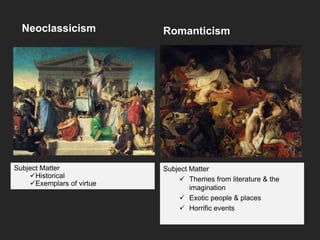
Neoclassicism Romanticism
Subject Matter
Historical
Exemplars of virtue
Subject Matter
 Themes from literature & the
imagination
 Exotic people & places
 Horrific events
I recommend that you watch this video on Delacroix’s use of color, from the
National Gallery of Art, London

Romanticism: Ingres and Delacroix

  • 1.
  • 2.
    The leading figuresin 19th century French art were Jean Auguste Dominique Ingres and Eugene Delacroix
  • 3.
    Each represented therival schools of Neoclassicism and Romanticism, as seen in this 19th century caricature depicting the two artists jousting in front of the Institut de France Ingres: champion of line Delacroix: champion of color
  • 4.
    A pupil ofJacques Louis David, Ingres was the leading exponent of Neoclassicism, and was renowned as the champion of crisp line and contour, as indicated by the fine tipped pen that he wields as his weapon Ingres: champion of line
  • 5.
    Delacroix was theleading representative of Romanticism, and was known for his bravura use of color and painterly effects, indicated by the paint brush that he carries as his weapon Delacroix: champion of color
  • 6.
    The rivalry betweenthese two giants of the 19th century Academy replayed the 17th century academic debate between the Poussinistes (who favored drawing and design) and the Rubenistes (who favored color) Delacroix: champion of color Ingres: champion of line
  • 7.
    Jean-Auguste-Dominique Ingres, Apotheosisof Homer, 1827 Louvre This painting by Ingres was submitted to the Salon of 1827, and was a kind of manifesto of Neoclassicism
  • 8.
    Jean-Auguste-Dominique Ingres, Apotheosisof Homer, 1827 Louvre Based on Raphael’s School of Athens, the painting depicts the Greek poet Homer enthroned before a Greek Classical temple
  • 9.
    Jean-Auguste-Dominique Ingres, Apotheosisof Homer, 1827 Louvre Allegorical figures representing his two great works, The Odyssey and The Iliad are seated beneath his throne, symmetrically arranged like mirrored images of one another
  • 10.
    Jean-Auguste-Dominique Ingres, Apotheosisof Homer, 1827 Louvre The blind poet is crowned by a winged Nike, and he is surrounded by famous artists and writers from history, who acknowledge his great achievement
  • 11.
    Jean-Auguste-Dominique Ingres, Apotheosisof Homer, 1827 Louvre Amongst them are Phidias, Michelangelo, and Poussin Phidias Michelangelo Poussin
  • 12.
    Jean-Auguste-Dominique Ingres, Apotheosisof Homer, 1827 Louvre Symmetrical, ordered, and balanced, the picture is a tribute to the rational values of the classical tradition
  • 13.
    Jean Auguste DominiqueIngres, Self Portrait at Age 24, 1804; revised 1850 Musée Condé Ingres’ chief rival in the 19th century French Academy was Eugene Delacroix, who rejected the values of Neoclassicism (an entry in his diary reads: “I dislike reasonable painting.”) Eugene Delacroix, Self Portrait, 1837 Musée du Louvre, Paris
  • 14.
    Jean Auguste DominiqueIngres, Self Portrait at Age 24, 1804; revised 1850 Musée Condé While Ingres’ style is slick, polished, and reserved (his teacher Jacques Louis David told his students: “never let your brushwork show”), Delacroix’s style is loose, spontaneous, and impetuous, expressing an unrestrained passion that contrasts with Ingres’ cool Neoclassical style Eugene Delacroix, Self Portrait, 1837 Musée du Louvre, Paris
  • 15.
    Jean Auguste DominiqueIngres, Self Portrait at Age 24, 1804; revised 1850 Musée Condé While Ingres painted with precision and calculation, Delacroix painted with passion and spontaneity Eugene Delacroix, Self Portrait, 1837 Musée du Louvre, Paris I paint with my heart I paint with my head
  • 16.
    Delacroix’s Death ofSardanapalus, painted in 1826, is a classic example of Romanticism
  • 17.
    The painting isbased on a story recounted by an ancient Greek historian about an Assyrian King whose city was under siege by an enemy army
  • 18.
    Rather than sufferthe humility of defeat, he orders his soldiers to slaughter his horses and his concubines, before setting himself on fire
  • 19.
    The scene isone of chaotic violence, as naked bodies and horses struggle to escape their fate
  • 20.
    The sadistic kingreclines impassively on a massive bed, decorated at the corners by carved elephant heads
  • 21.
    His decadent tastefor luxuries is evident in the splendor of his surroundings, and the heavy jewelry worn by his concubines (in fact, the king himself wears rings on every toe!)
  • 22.
    Jean-Auguste-Dominique Ingres, Apotheosisof Homer, 1827 Louvre Unlike Ingres’ Apotheosis of Homer (which was exhibited at the same Salon) Delacroix’s picture does not pay tribute to a noble hero
  • 23.
    Instead, it depictsa scene of sadistic violence and passion, betraying a morbid fascination with human depravity rather than noble virtue
  • 24.
    The style isalso dramatically different
  • 25.
    Jean-Auguste-Dominique Ingres, Apotheosisof Homer, 1827 Louvre While Ingres’ work is balanced and restrained, with clear even lighting, cool colors, and crisp outlines
  • 26.
    Delacroix’s painting ischaotically arranged, with swirling bodies, and a strong diagonal that rushes headlong into space
  • 27.
    And in contrastto Ingres’ precisely rendered figures, Delacroix’s style is loose, sketchy, and impetuous – as if painted quickly, and with passion
  • 28.
    The colors, too,are rich, lush, and fiery, rather than cool and detached, providing a visual equivalent to the dark passions of the theme
  • 29.
    Delacroix’s use ofcolor was influenced by Rubens, and by the Venetian masters of the Renaissance, but it was also informed by new scientific theories about the properties of color, as seen in this color wheel from a book that belonged to the artist
  • 30.
    The diagram showsprimary and secondary colors, with their complimentary colors at the other end of the axis
  • 31.
    Color theory teachesus that complementary colors intensify one another – a red against a green, or a blue against an orange, makes the colors pop with an intensity they would not have against a different background
  • 32.
    Delacroix used thisunderstanding of color extensively in his paintings, as in this detail where we see a green sash draped haphazardly across the king’s bed
  • 33.
    The complimentary colorsintensify one another, making the colors literally “pop,” and adding to the overall drama of the picture the picture
  • 34.
    Neoclassicism Romanticism The contrastbetween these two works sums up the competing values of Neoclassicism and Romanticism
  • 35.
    Neoclassicism Romanticism Emphasis onreason and virtue  Emphasis on feelings, emotion – “human nature,” which is not always virtuous or noble
  • 36.
    Neoclassicism Romanticism Style: paintedwith the “head” Smooth finish Balanced, ordered, harmonious Style: painted with the “heart”  Loose, sketchy brushstroke  Expressive color, dynamic composition, dramatic lighting
  • 37.
    Neoclassicism Romanticism Subject Matter Historical Exemplarsof virtue Subject Matter  Themes from literature & the imagination  Exotic people & places  Horrific events
  • 38.
    I recommend thatyou watch this video on Delacroix’s use of color, from the National Gallery of Art, London