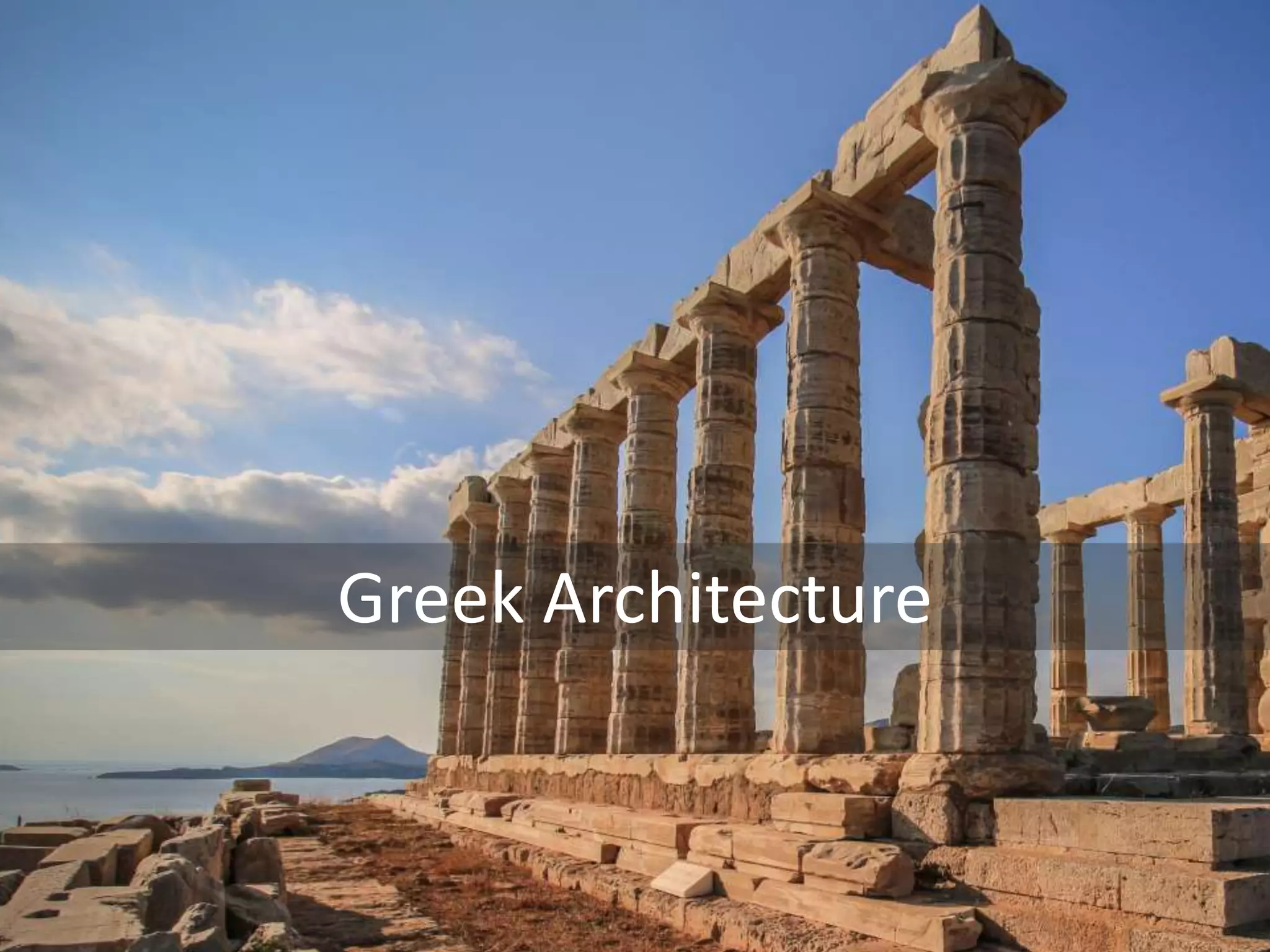
Greek Architecture
Reconstruction of the Agora of Athens
Image source: http://coursesite.uhcl.edu/HSH/Whitec/terms/A/agora.htm
The focal point of the Greek city-state was the Agora – a large open space surrounded by
buildings
Reconstruction of the Agora of Athens
Image source: http://plurdledgabbleblotchits.tumblr.com/post/120075838869/cindywest-reconstrucci%C3%B3n-del-%C3%A1gora-de-atenas
The is where Greek citizens would come to shop, worship, and participate in government
The agora was like your local “downtown,” where people go to to do whatever it is we do
when we go “downtown”
Reconstruction of the Agora of Athens
Image source: http://plurdledgabbleblotchits.tumblr.com/post/120075838869/cindywest-reconstrucci%C3%B3n-del-%C3%A1gora-de-atenas
The Stoa was a common architectural feature of the Agora
Stoa
The stoa consisted of a double row of columns topped by a roof, and offered shade from the sun
Vendors would sell their wares here, and philosophers would meet their students here as well
Reconstruction of the Agora of Athens
Image source: http://plurdledgabbleblotchits.tumblr.com/post/120075838869/cindywest-reconstrucci%C3%B3n-del-%C3%A1gora-de-atenas
The agora also included temples, but each city had an Acropolis – which means “High City” –
and this is where the most important temples dedicated to the city’s gods were located
Acropolis = “High
City”
Temple of Poseidon, c. 440 BCE
Image source: http://www.ancient.eu/image/250/
Greek temples were built with stone and used the post and lintel system of architecture, where
columns hold up the roof
P
O
S
T
P
O
S
T
LINTEL
P
O
S
T
P
O
S
T
LINTEL
P
O
S
T
P
O
S
T
LINTEL
There are a variety of types of Greek temples, most of them rectangular in shape (with the
exception of the round tholos-type temple), with columns on the outside
This plan shows a typical peripteral (or peristyle) temple
The black circles refer to columns, and the thick black lines refer to walls
Columns
Walls
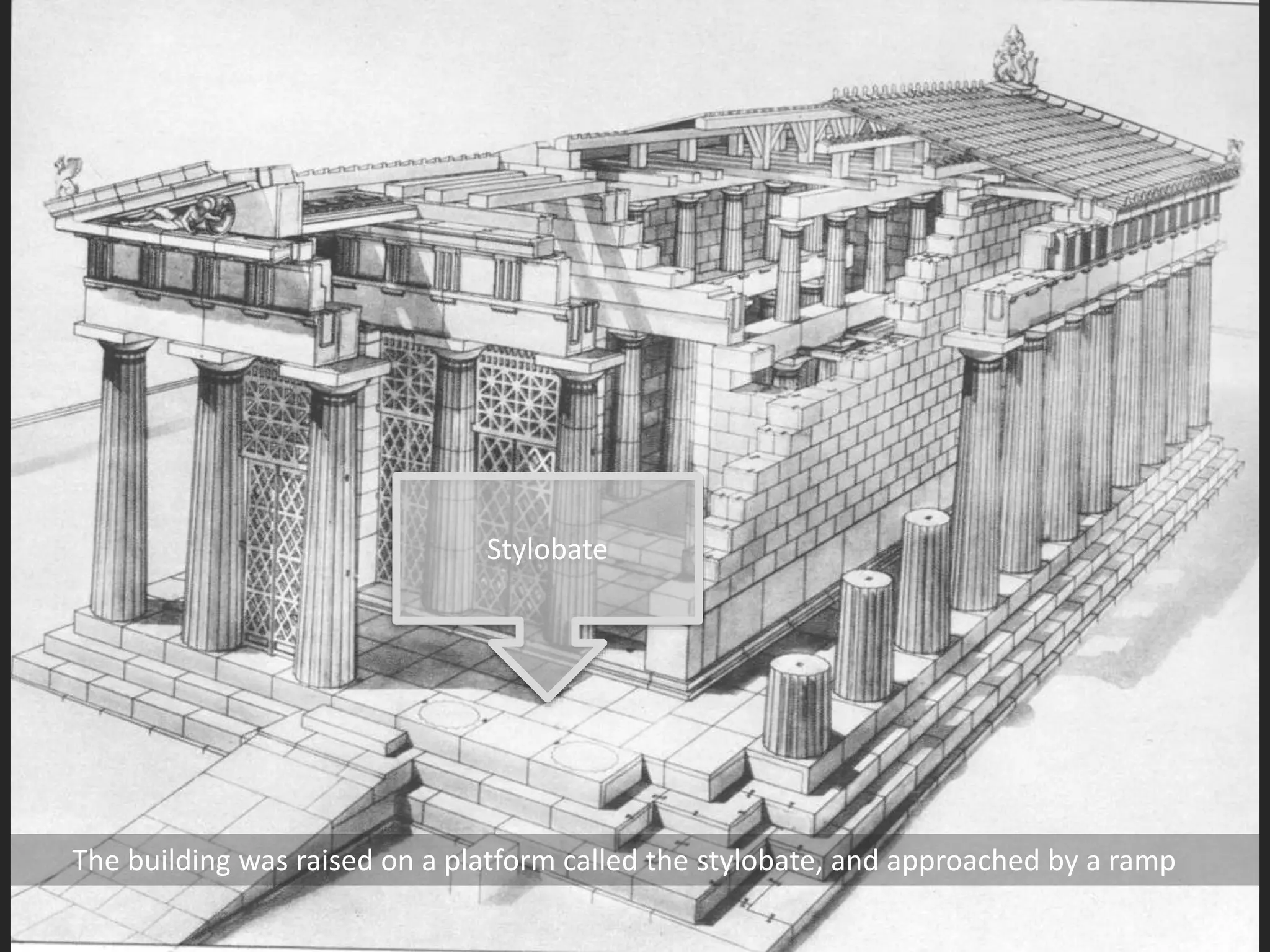
The building was raised on a platform called the stylobate, and approached by a ramp
Stylobate
The sloping roof was made of timber, and covered with tile
Columns were actually carved in separate pieces (or drums), and stacked vertically on a wooden
core
The temple was entered through a porch, called the Pronaos
And the main part of the temple is called the Naos (or cella)
This is where a cult statue of the god was held – but people didn’t go inside the building to
worship
Sacrifice scene. Attic red-figure krater, ca. 430 BC–420 BCE, Louvre
Image source: https://commons.wikimedia.org/wiki/File:Sacrifice_Pothos_Painter_Louvre_G496.jpg
Greek religious rituals took place at an altar outside the temple, rather than inside –and as a
result, Greek architects were much more concerned with how the building looked on the
outside, rather than the inside
Greek architects developed a “grammar” of column elements called the “orders”
Each order had its own specific characteristics, and architects rarely mixed elements from one
order with another
There are hundreds of elements proper to each of the orders — you need to know only those
that are easiest to recognize
The Doric order has a massive column
shaft, a cushion-shaped capital, and
alternating triglyphs and metopes along
the frieze
Massive
column
shaft
Cushion capital
Triglyph Metope Triglyph
This is an example of a Doric temple
The triangular area on top is called the pediment
And here is another example of a Doric temple
The Ionic order has a slender column
shaft, a volute capital, and instead of
triglyphs and metopes, it has a smooth
continuous frieze
Slender
column
shaft
Volute capital
Frieze
This is an example of an Ionic temple
And here is another example
Temple of Hera, Paestum, c. 550 BCE
Just like sculpture and vase painting, Greek architecture evolved over time
Temple of Hera, Paestum, c. 550 BCE
This temple was erected in the Greek colony of Paestum (in Italy) in the 6th century (during the
Archaic period)
Temple of Hera, Paestum, c. 550 BCE
It is a Doric order temple, and was dedicated to Hera, wife of Zeus -- one of the 12 Olympian
deities
Temple of Hera, Paestum, c. 550 BCE
The building has suffered considerable damage over the years – the roof and interior walls are
no longer standing
Temple of Hera, Paestum, c. 550 BCE
So we have to use our imagination to reconstruct what it would have originally looked like
Temple of Hera, Paestum, c. 550 BCE
The columns are massive, and seem to swell in their mid-section
This swelling is called “entasis”
Temple of Hera, Paestum, c. 550 BCE
It gives the columns a more elastic appearance, and reveals their weight-bearing function
About a century after the temple of Hera was completed, a second temple dedicated to
Poseidon was built right next to it
Temple of Hera
c. 550 BCE
Temple of
Poseidon
c. 460 BCE
It is also a Doric Temple, with massive column shafts, cushion capitals, and alternating triglyphs
and metopes
Massive
column
shaft
Cushion
capital
Triglyph
Metope
It also still has its triangular shaped pediment
The main difference between the two buildings is in their proportions
Temple of Hera
c. 550 BCE
Temple of
Poseidon
c. 460 BCE
The columns of the newer temple, for example, are taller
Temple of Hera
c. 550 BCE
Temple of
Poseidon
c. 460 BCE
They still have “entasis,” but they are less chunky, and more refined
And there are 6 columns across the front, rather than 9 -- resulting in different proportions
While the Temple of Hera is “squat,” the Temple of Poseidon is taller, more lofty, and more
graceful in its proportions
Temple of Hera
c. 550 BCE
Temple of
Poseidon
c. 460 BCE
Basically, this is what Greek architects did: they tweaked the proportions of their buildings in
order to achieve the most visually “perfect” building possible
The Temple of Athena Parthenos (the Parthenon), located on the acropolis above Athens, is
widely regarded as the most “perfect” Greek temple
The original temple had been destroyed by the Persians during the Persian wars
But during the 5th century the buildings of the sanctuary were rebuilt, under the leadership
of the democratically elected leader Pericles
The most important building was the Temple of Athena Parthenos – known today as the
Parthenon
The Parthenon
It was dedicated to Athena, patron goddess of the city
The Parthenon is a Doric temple (though we will see later that it also has some Ionic
elements)
The building has suffered considerable damage over the centuries
The roof and inner walls are no longer standing
Some of the worse damage was done in 1687, when it was being used to store ammunition,
and was bombed by Venetian shells
There is a full-scale replica of the building in Nashville Tennessee, which give us some idea of
the grandeur of the original building
The architects of the Parthenon were Iktinos and Callikrates, and they perfected the formula
for constructing the most visually “perfect” temple ever to have been built in the Greek
world
The secret is in the math: the controlling ratio for the building is X = 2y + 1, which governs
every aspect of the building
For example, there are 8 columns along the front, and 17 along the side:
2 x 8 + 1 = 17, thus conforming to the formula X = 2y + 1
X = 2y + 1
This ratio is also related to the Golden Section, a mathematical proportion based on pi, and is
believed to be the basis of all natural beauty
Yet, despite the sophisticated mathematics that went into the design of the Parthenon, there
is not a straight line in the building!
The stylobate and entablature, for example, are curved rather than straight
This was to make the building appear perfect: without this subtle curve, the building would
appear to sag in the middle
And the columns are not exactly straight either: they tilt just a tiny bit inward
Its difficult to see with the naked eye, but if we frame the building with a perfect square you
can see that the outer columns tilt just a little bit inwards
If the columns were perfectly straight, they would appear to tilt outwards – so the
adjustment was, again, to make the building appear perfectly geometrical
So Greek architects strove to make their buildings appear perfect to the human eye, as if to
illustrate Protagoras’ famous claim that “Man is the measure of all things”
The human eye alone can determine what is perfect and right
I highly recommend this short video from NOVA that goes into more detail about the optical
refinements of the Parthenon
Thanks for listening!

Greek Architecture

  • 1.
  • 2.
    Reconstruction of theAgora of Athens Image source: http://coursesite.uhcl.edu/HSH/Whitec/terms/A/agora.htm The focal point of the Greek city-state was the Agora – a large open space surrounded by buildings
  • 3.
    Reconstruction of theAgora of Athens Image source: http://plurdledgabbleblotchits.tumblr.com/post/120075838869/cindywest-reconstrucci%C3%B3n-del-%C3%A1gora-de-atenas The is where Greek citizens would come to shop, worship, and participate in government
  • 4.
    The agora waslike your local “downtown,” where people go to to do whatever it is we do when we go “downtown”
  • 5.
    Reconstruction of theAgora of Athens Image source: http://plurdledgabbleblotchits.tumblr.com/post/120075838869/cindywest-reconstrucci%C3%B3n-del-%C3%A1gora-de-atenas The Stoa was a common architectural feature of the Agora Stoa
  • 6.
    The stoa consistedof a double row of columns topped by a roof, and offered shade from the sun
  • 7.
    Vendors would selltheir wares here, and philosophers would meet their students here as well
  • 8.
    Reconstruction of theAgora of Athens Image source: http://plurdledgabbleblotchits.tumblr.com/post/120075838869/cindywest-reconstrucci%C3%B3n-del-%C3%A1gora-de-atenas The agora also included temples, but each city had an Acropolis – which means “High City” – and this is where the most important temples dedicated to the city’s gods were located Acropolis = “High City”
  • 9.
    Temple of Poseidon,c. 440 BCE Image source: http://www.ancient.eu/image/250/ Greek temples were built with stone and used the post and lintel system of architecture, where columns hold up the roof P O S T P O S T LINTEL P O S T P O S T LINTEL P O S T P O S T LINTEL
  • 10.
    There are avariety of types of Greek temples, most of them rectangular in shape (with the exception of the round tholos-type temple), with columns on the outside
  • 11.
    This plan showsa typical peripteral (or peristyle) temple
  • 12.
    The black circlesrefer to columns, and the thick black lines refer to walls Columns Walls
  • 13.
    The building wasraised on a platform called the stylobate, and approached by a ramp Stylobate
  • 14.
    The sloping roofwas made of timber, and covered with tile
  • 15.
    Columns were actuallycarved in separate pieces (or drums), and stacked vertically on a wooden core
  • 16.
    The temple wasentered through a porch, called the Pronaos
  • 17.
    And the mainpart of the temple is called the Naos (or cella)
  • 18.
    This is wherea cult statue of the god was held – but people didn’t go inside the building to worship
  • 19.
    Sacrifice scene. Atticred-figure krater, ca. 430 BC–420 BCE, Louvre Image source: https://commons.wikimedia.org/wiki/File:Sacrifice_Pothos_Painter_Louvre_G496.jpg Greek religious rituals took place at an altar outside the temple, rather than inside –and as a result, Greek architects were much more concerned with how the building looked on the outside, rather than the inside
  • 20.
    Greek architects developeda “grammar” of column elements called the “orders”
  • 21.
    Each order hadits own specific characteristics, and architects rarely mixed elements from one order with another
  • 22.
    There are hundredsof elements proper to each of the orders — you need to know only those that are easiest to recognize
  • 23.
    The Doric orderhas a massive column shaft, a cushion-shaped capital, and alternating triglyphs and metopes along the frieze Massive column shaft Cushion capital Triglyph Metope Triglyph
  • 24.
    This is anexample of a Doric temple
  • 25.
    The triangular areaon top is called the pediment
  • 26.
    And here isanother example of a Doric temple
  • 27.
    The Ionic orderhas a slender column shaft, a volute capital, and instead of triglyphs and metopes, it has a smooth continuous frieze Slender column shaft Volute capital Frieze
  • 28.
    This is anexample of an Ionic temple
  • 29.
    And here isanother example
  • 30.
    Temple of Hera,Paestum, c. 550 BCE Just like sculpture and vase painting, Greek architecture evolved over time
  • 31.
    Temple of Hera,Paestum, c. 550 BCE This temple was erected in the Greek colony of Paestum (in Italy) in the 6th century (during the Archaic period)
  • 32.
    Temple of Hera,Paestum, c. 550 BCE It is a Doric order temple, and was dedicated to Hera, wife of Zeus -- one of the 12 Olympian deities
  • 33.
    Temple of Hera,Paestum, c. 550 BCE The building has suffered considerable damage over the years – the roof and interior walls are no longer standing
  • 34.
    Temple of Hera,Paestum, c. 550 BCE So we have to use our imagination to reconstruct what it would have originally looked like
  • 35.
    Temple of Hera,Paestum, c. 550 BCE The columns are massive, and seem to swell in their mid-section
  • 36.
    This swelling iscalled “entasis”
  • 37.
    Temple of Hera,Paestum, c. 550 BCE It gives the columns a more elastic appearance, and reveals their weight-bearing function
  • 38.
    About a centuryafter the temple of Hera was completed, a second temple dedicated to Poseidon was built right next to it Temple of Hera c. 550 BCE Temple of Poseidon c. 460 BCE
  • 39.
    It is alsoa Doric Temple, with massive column shafts, cushion capitals, and alternating triglyphs and metopes Massive column shaft Cushion capital Triglyph Metope
  • 40.
    It also stillhas its triangular shaped pediment
  • 41.
    The main differencebetween the two buildings is in their proportions Temple of Hera c. 550 BCE Temple of Poseidon c. 460 BCE
  • 42.
    The columns ofthe newer temple, for example, are taller Temple of Hera c. 550 BCE Temple of Poseidon c. 460 BCE
  • 43.
    They still have“entasis,” but they are less chunky, and more refined
  • 44.
    And there are6 columns across the front, rather than 9 -- resulting in different proportions
  • 45.
    While the Templeof Hera is “squat,” the Temple of Poseidon is taller, more lofty, and more graceful in its proportions Temple of Hera c. 550 BCE Temple of Poseidon c. 460 BCE
  • 46.
    Basically, this iswhat Greek architects did: they tweaked the proportions of their buildings in order to achieve the most visually “perfect” building possible
  • 47.
    The Temple ofAthena Parthenos (the Parthenon), located on the acropolis above Athens, is widely regarded as the most “perfect” Greek temple
  • 48.
    The original templehad been destroyed by the Persians during the Persian wars
  • 49.
    But during the5th century the buildings of the sanctuary were rebuilt, under the leadership of the democratically elected leader Pericles
  • 50.
    The most importantbuilding was the Temple of Athena Parthenos – known today as the Parthenon The Parthenon
  • 51.
    It was dedicatedto Athena, patron goddess of the city
  • 52.
    The Parthenon isa Doric temple (though we will see later that it also has some Ionic elements)
  • 53.
    The building hassuffered considerable damage over the centuries
  • 54.
    The roof andinner walls are no longer standing
  • 55.
    Some of theworse damage was done in 1687, when it was being used to store ammunition, and was bombed by Venetian shells
  • 56.
    There is afull-scale replica of the building in Nashville Tennessee, which give us some idea of the grandeur of the original building
  • 57.
    The architects ofthe Parthenon were Iktinos and Callikrates, and they perfected the formula for constructing the most visually “perfect” temple ever to have been built in the Greek world
  • 58.
    The secret isin the math: the controlling ratio for the building is X = 2y + 1, which governs every aspect of the building
  • 59.
    For example, thereare 8 columns along the front, and 17 along the side: 2 x 8 + 1 = 17, thus conforming to the formula X = 2y + 1 X = 2y + 1
  • 60.
    This ratio isalso related to the Golden Section, a mathematical proportion based on pi, and is believed to be the basis of all natural beauty
  • 61.
    Yet, despite thesophisticated mathematics that went into the design of the Parthenon, there is not a straight line in the building!
  • 62.
    The stylobate andentablature, for example, are curved rather than straight
  • 63.
    This was tomake the building appear perfect: without this subtle curve, the building would appear to sag in the middle
  • 64.
    And the columnsare not exactly straight either: they tilt just a tiny bit inward
  • 65.
    Its difficult tosee with the naked eye, but if we frame the building with a perfect square you can see that the outer columns tilt just a little bit inwards
  • 66.
    If the columnswere perfectly straight, they would appear to tilt outwards – so the adjustment was, again, to make the building appear perfectly geometrical
  • 67.
    So Greek architectsstrove to make their buildings appear perfect to the human eye, as if to illustrate Protagoras’ famous claim that “Man is the measure of all things”
  • 68.
    The human eyealone can determine what is perfect and right
  • 69.
    I highly recommendthis short video from NOVA that goes into more detail about the optical refinements of the Parthenon
  • 70.