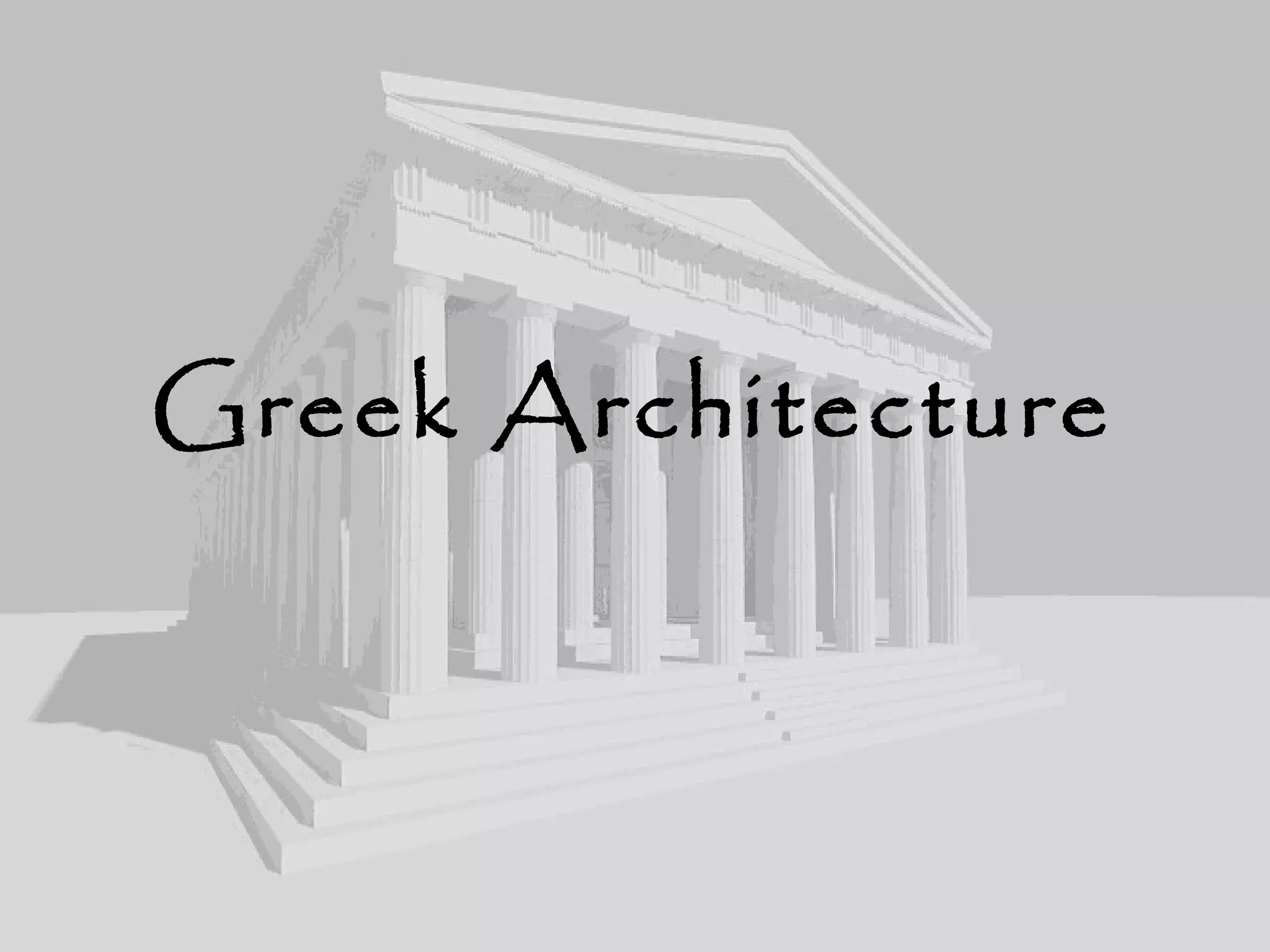
Greek Architecture
Introduction
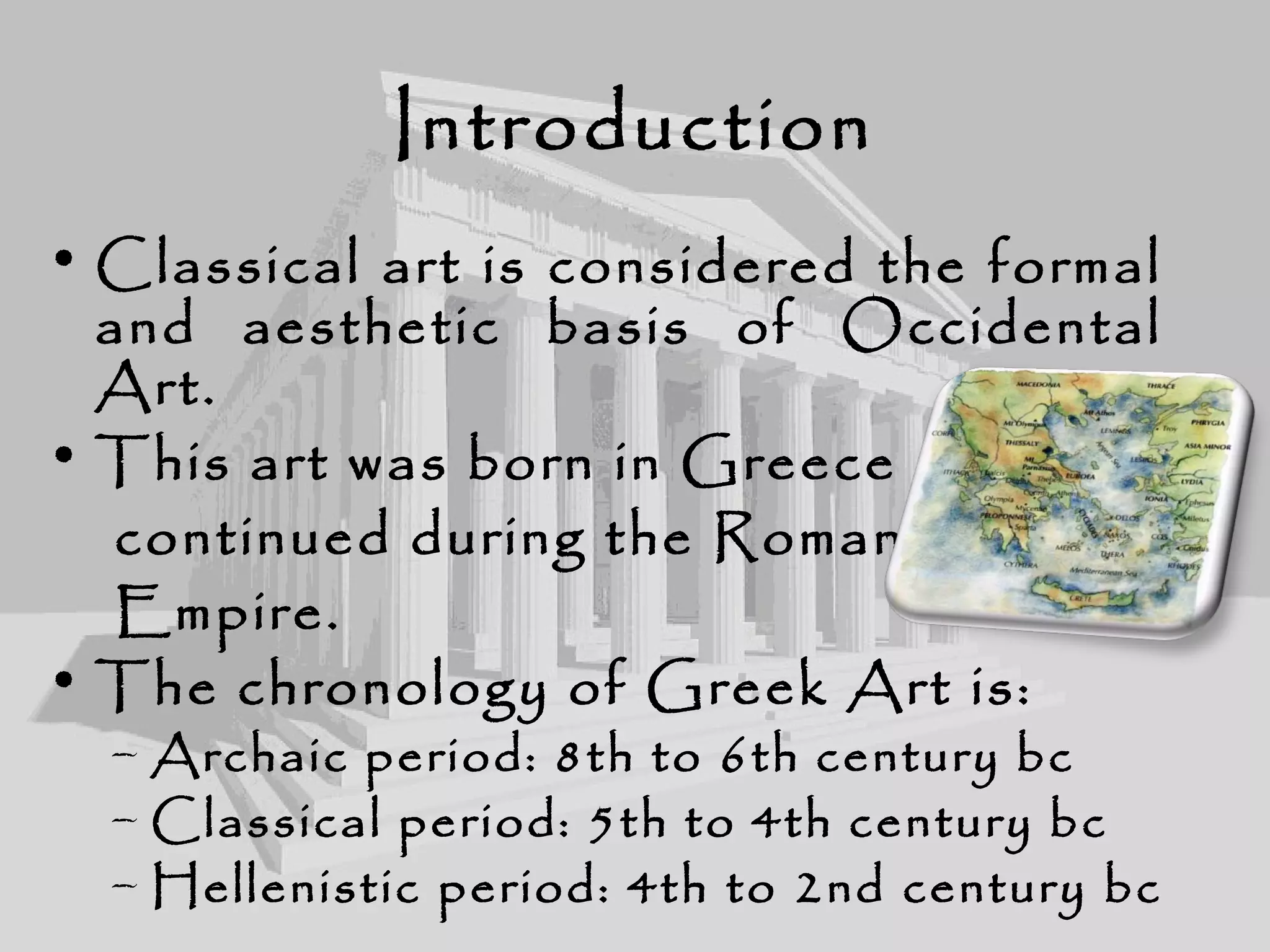
• Classical art is considered the formal
and aesthetic basis of Occidental
Art.
• This art was born in Greece and
continued during the Roman
Empire.
• The chronology of Greek Art is:
– Archaic period: 8th to 6th century bc
– Classical period: 5th to 4th century bc
– Hellenistic period: 4th to 2nd century bc
Introduction
• Archaic period:
– It is the time of formation
– To the local basis are added other
influences:
• Crete civilization
• Mycenaean civilization
• Oriental influences, above all, Egyptian
– Art evolved from abstraction to
expressive naturalism.
Introduction
• Classical period:
– It is the peak of this art
– Every art manifestation reached its
zenith
– It is the period of political, economic and
cultural expansion of the polis, mainly
Athens.
– It is the period of the Democracy
– This situation lasted until the political
decay of the polis with the Peloponnesus
Wars.
Introduction
• Hellenistic period:
– Greek culture suffered a deep
transformation
– Alexander the Great expanded Greek
culture
– With culture, Art expanded too:
• The artistic forms
• Technical solutions
– Greece became the artistic reference in
the whole Mediterranean area.
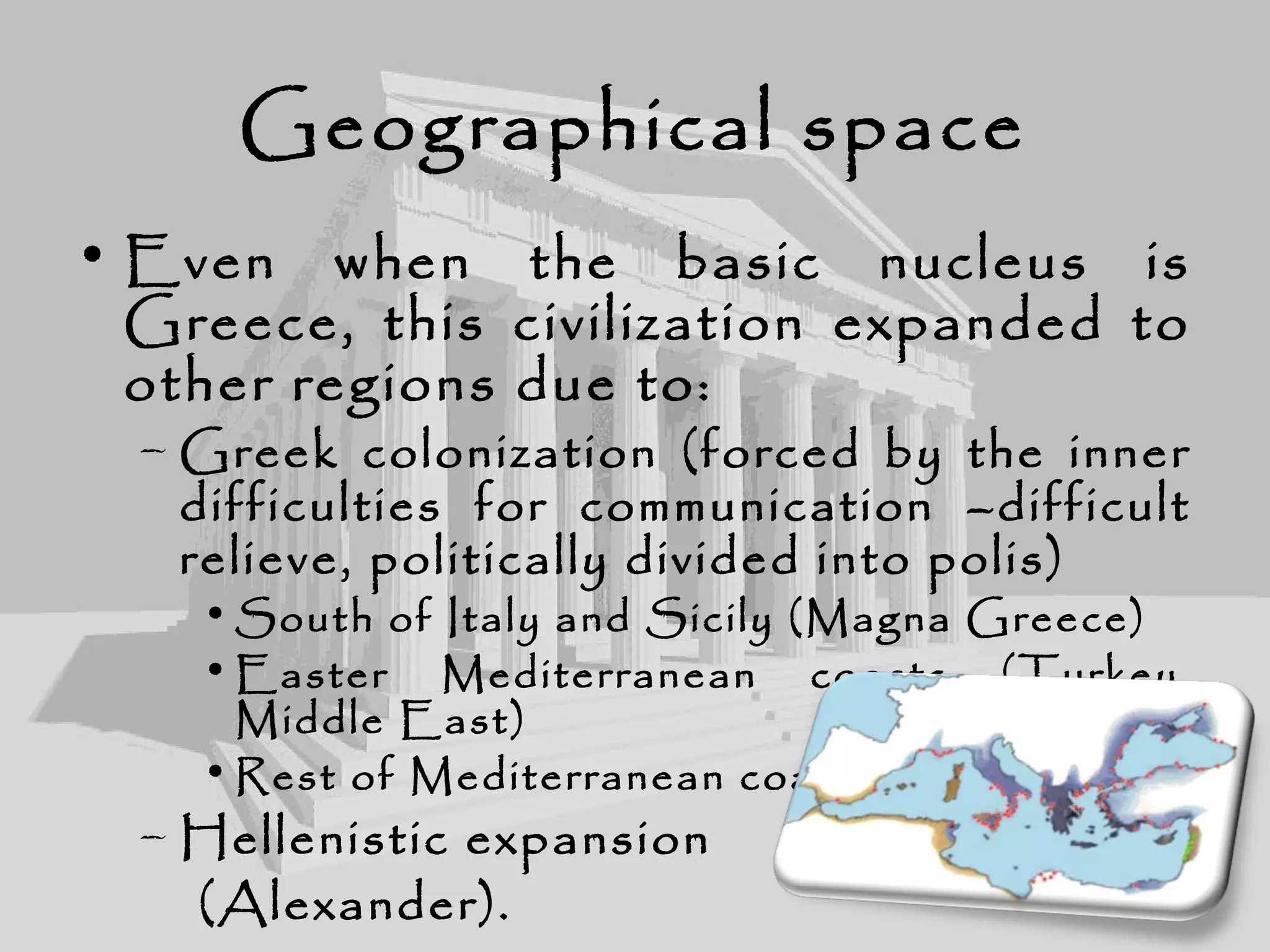
Geographical space
• Even when the basic nucleus is
Greece, this civilization expanded to
other regions due to:
– Greek colonization (forced by the inner
difficulties for communication –difficult
relieve, politically divided into polis)
• South of Italy and Sicily (Magna Greece)
• Easter Mediterranean coasts (Turkey,
Middle East)
• Rest of Mediterranean coasts.
– Hellenistic expansion
(Alexander).
Greek civilization
• Ideologically:
– Freedom and individual independence
– Isodomia: equal right among free men
• Human being is the centre of their culture:
everything is done at man’s measure
• Rich mythology and religion: gods were
used to express beauty ideal.
• Reason, observation and experience are
the basis for the reality: Philosophy and
Sciences developed
Architecture: Basis
• Greek created equilibrate and
proportional works
• It is an architecture to be seen
(temple)
– Sculptural values, volumes
– Building is conceived as an sculpture
• Beauty= proportion and measure:
– it is conceived from the human point of
view
– it is anti-colossal
Architecture: Basis
• The organization of the polis did not help
the development of the palace.
• Temple is the essential building, residence
of the god, not a place for people
• Other constructions combined beauty with
practical solutions:
– Theatres
– Sanctuaries
– Gymnasiums
• Importance of urbanism: Hipodamus from
Mileto created the orthogonal planning
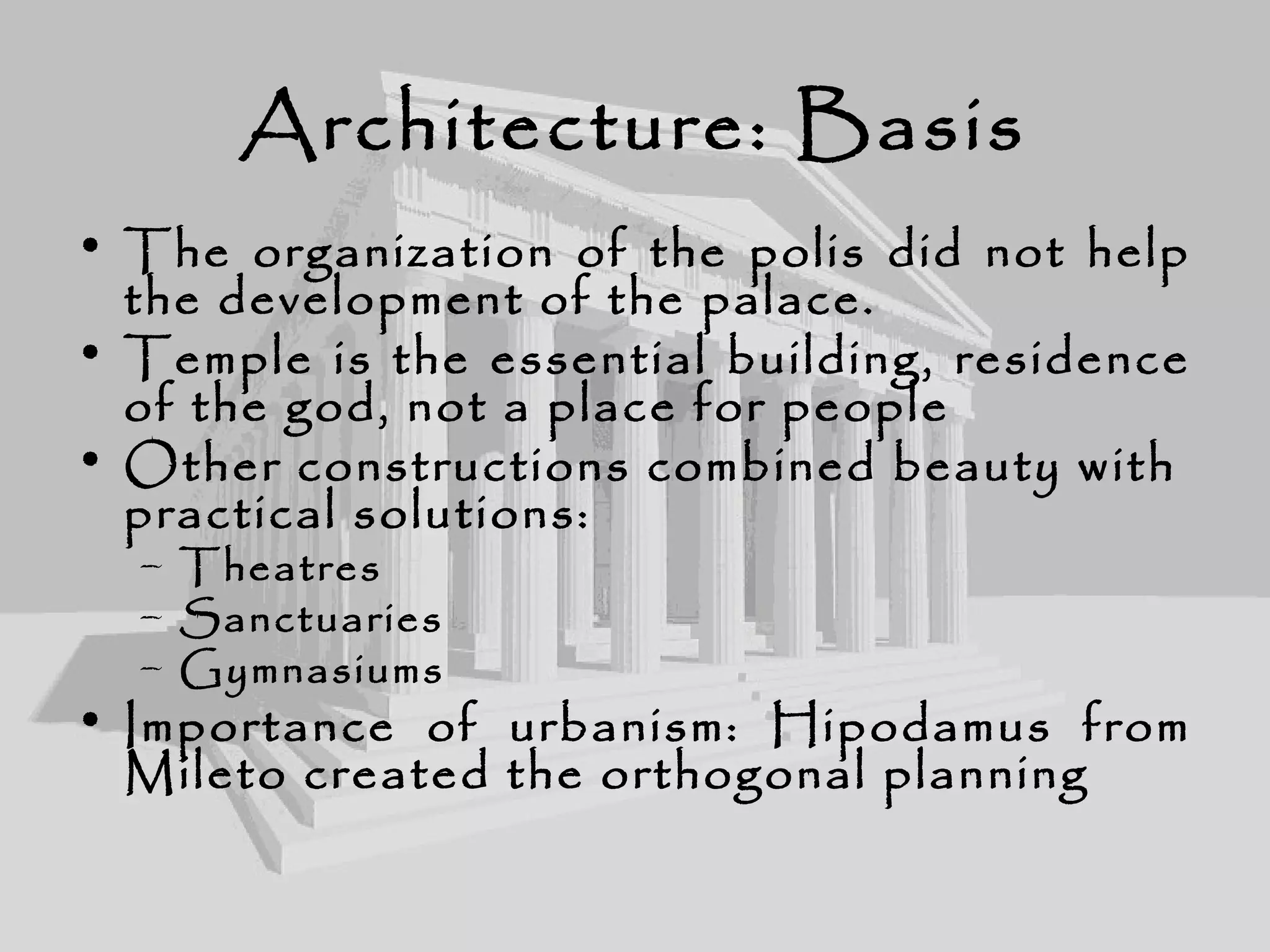
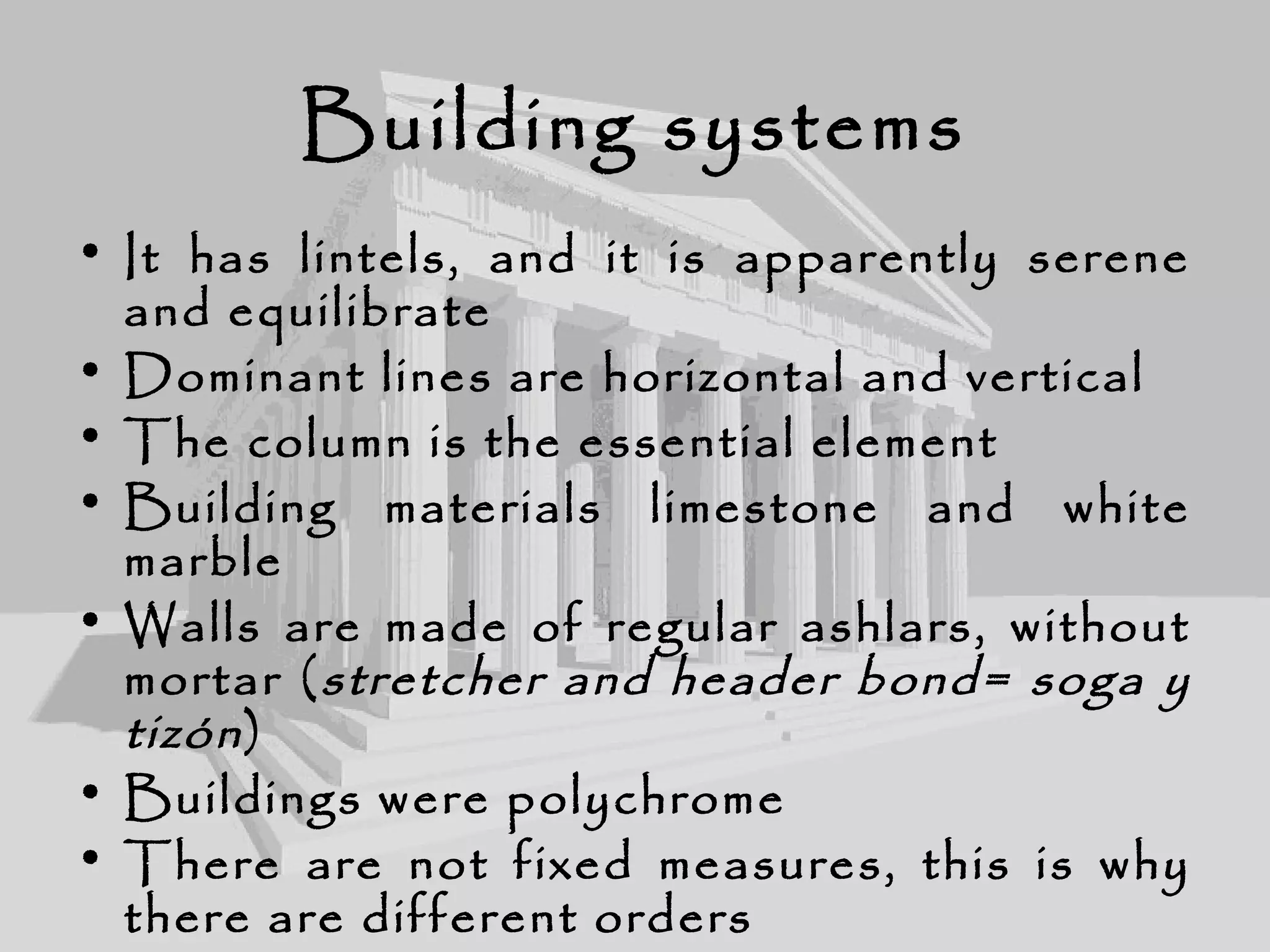
Building systems
• It has lintels, and it is apparently serene
and equilibrate
• Dominant lines are horizontal and vertical
• The column is the essential element
• Building materials limestone and white
marble
• Walls are made of regular ashlars, without
mortar (stretcher and header bond= soga y
tizón)
• Buildings were polychrome
• There are not fixed measures, this is why
there are different orders
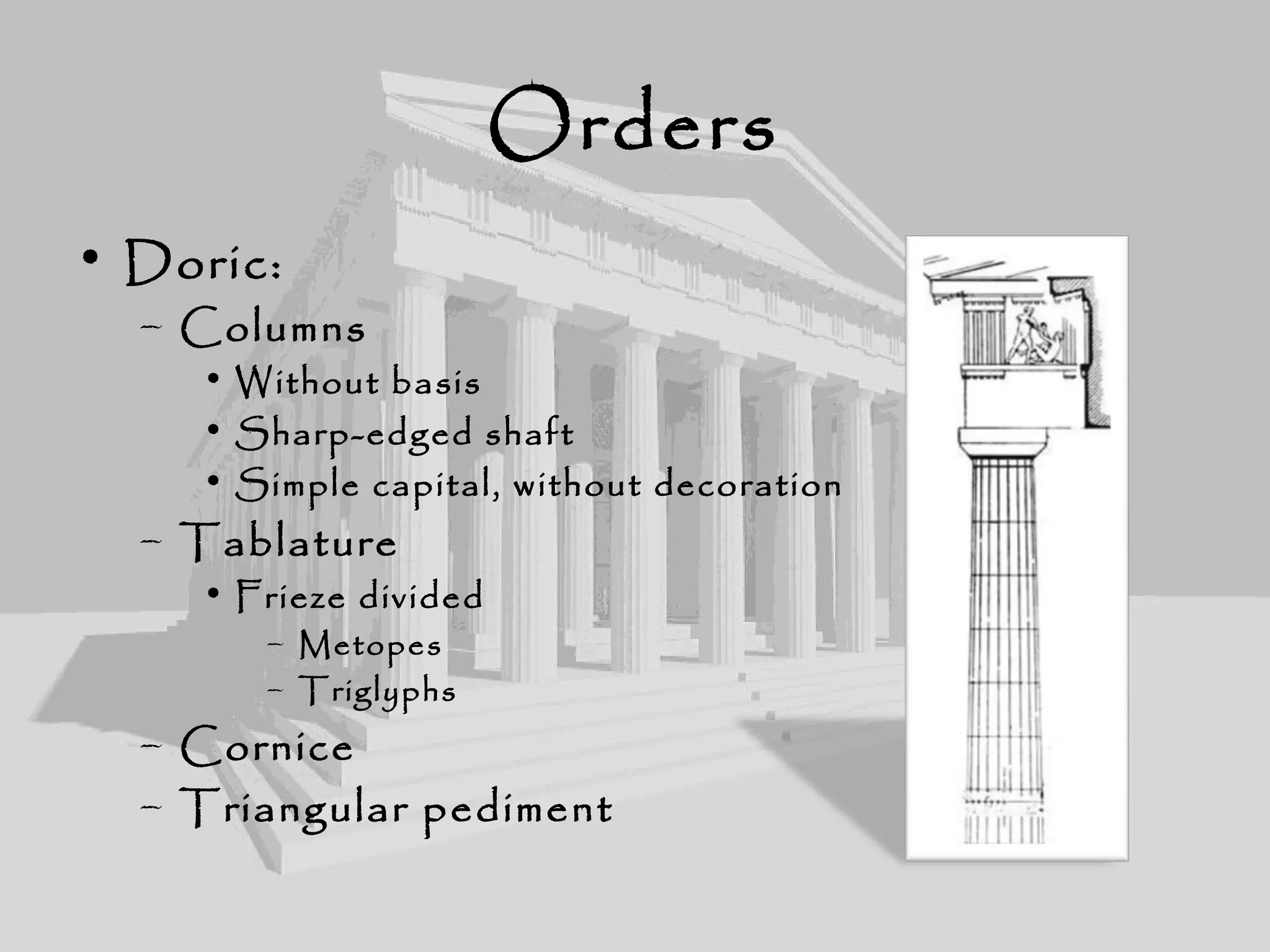
Orders
• Doric:
– Columns
• Without basis
• Sharp-edged shaft
• Simple capital, without decoration
– Tablature
• Frieze divided
– Metopes
– Triglyphs
– Cornice
– Triangular pediment
• Of the three columns found in Greece, Doric columns are the
simplest. They have a capital (the top, or crown) made of a
circle topped by a square. The shaft (the tall part of the
column) is plain and has 20 sides. There is no base in the
Doric order. The Doric order is very plain, but powerful-
looking in its design. Doric, like most Greek styles, works well
horizontally on buildings, that's why it was so good with the
long rectangular buildings made by the Greeks. The area
above the column, called the frieze [pronounced "freeze"], had
simple patterns. Above the columns are the metopes and
triglyphs. The metope [pronounced "met-o-pee"] is a plain,
smooth stone section between triglyphs. Sometimes the
metopes had statues of heroes or gods on them. The triglyphs
are a pattern of 3 vertical lines between the metopes.
• There are many examples of ancient Doric buildings. Perhaps
the most famous one is the Parthenon in Athens, which is
Orders
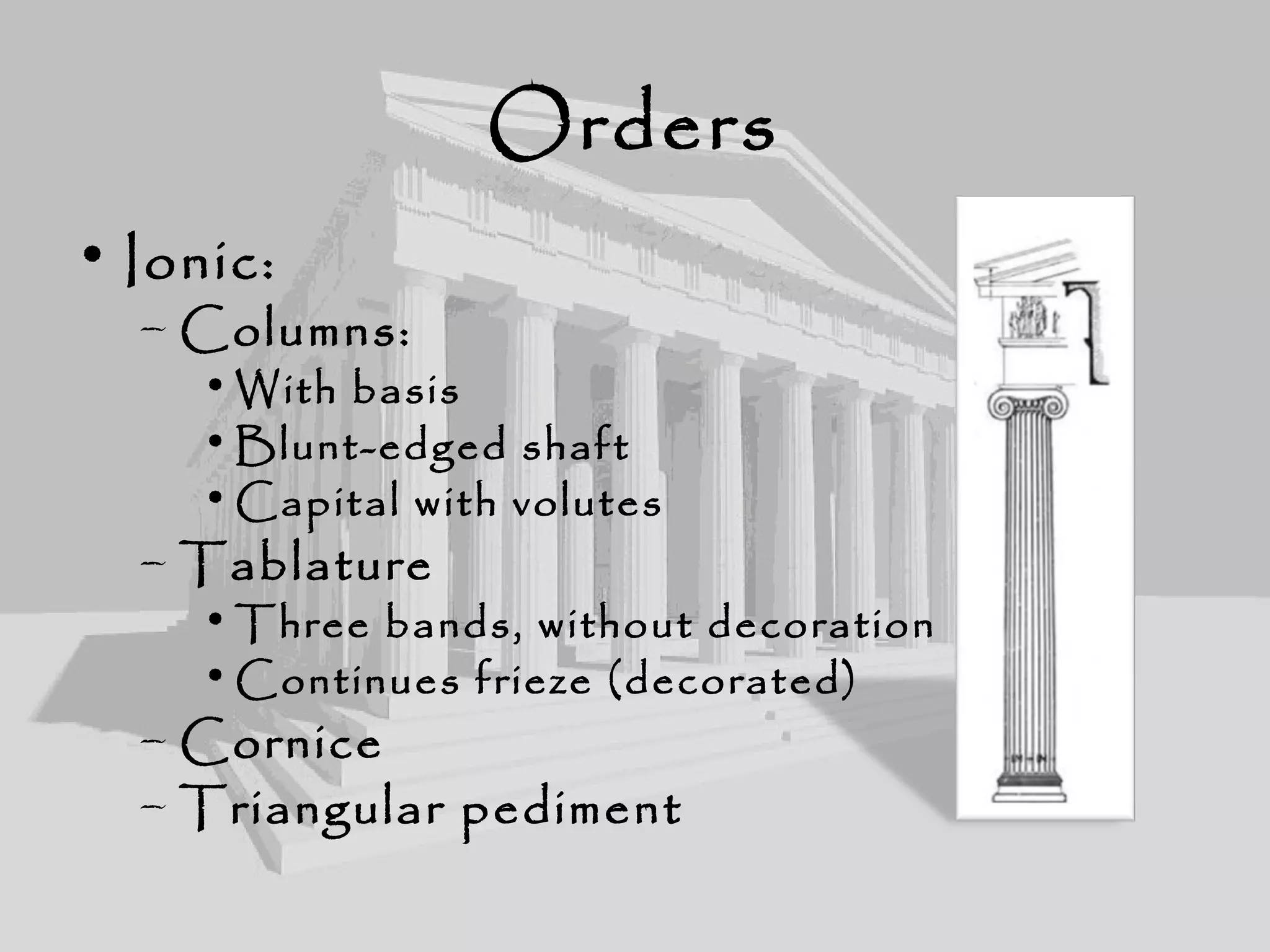
• Ionic:
– Columns:
• With basis
• Blunt-edged shaft
• Capital with volutes
– Tablature
• Three bands, without decoration
• Continues frieze (decorated)
– Cornice
– Triangular pediment
• Ionic shafts were taller than Doric ones. This makes the
columns look slender. They also had flutes, which are lines
carved into them from top to bottom. The shafts also had a
special characteristic: entasis, which is a little bulge in the
columns make the columns look straight, even at a distance
[because since you would see the building from eye level, the
shafts would appear to get narrower as they rise, so this
bulge makes up for that - so it looks straight to your eye but
it really isn't !] . The frieze is plain. The bases were large
and looked like a set of stacked rings. Ionic capitals consist
of a scrolls above the shaft. The Ionic style is a little more
Orders
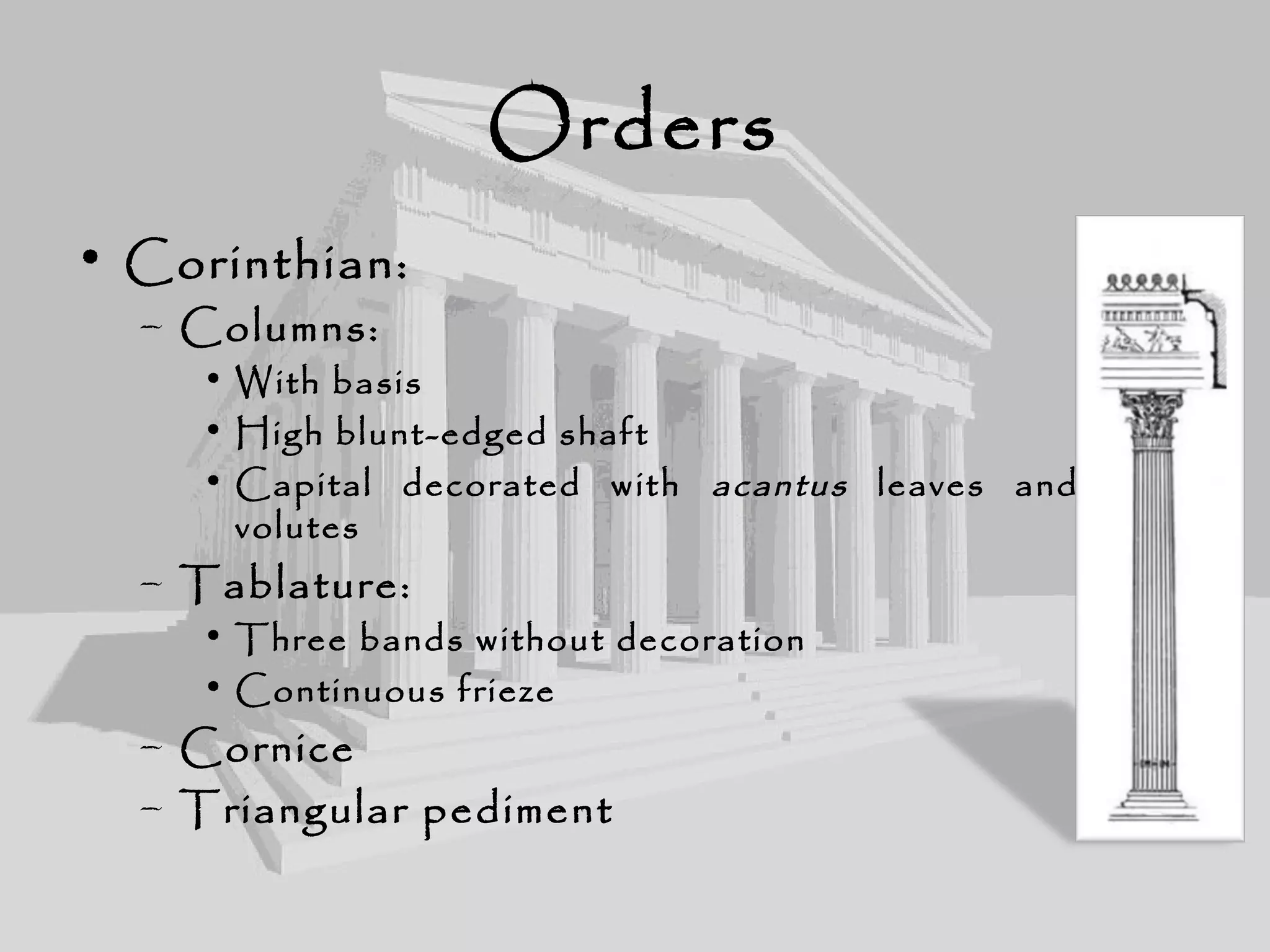
• Corinthian:
– Columns:
• With basis
• High blunt-edged shaft
• Capital decorated with acantus leaves and small
volutes
– Tablature:
• Three bands without decoration
• Continuous frieze
– Cornice
– Triangular pediment
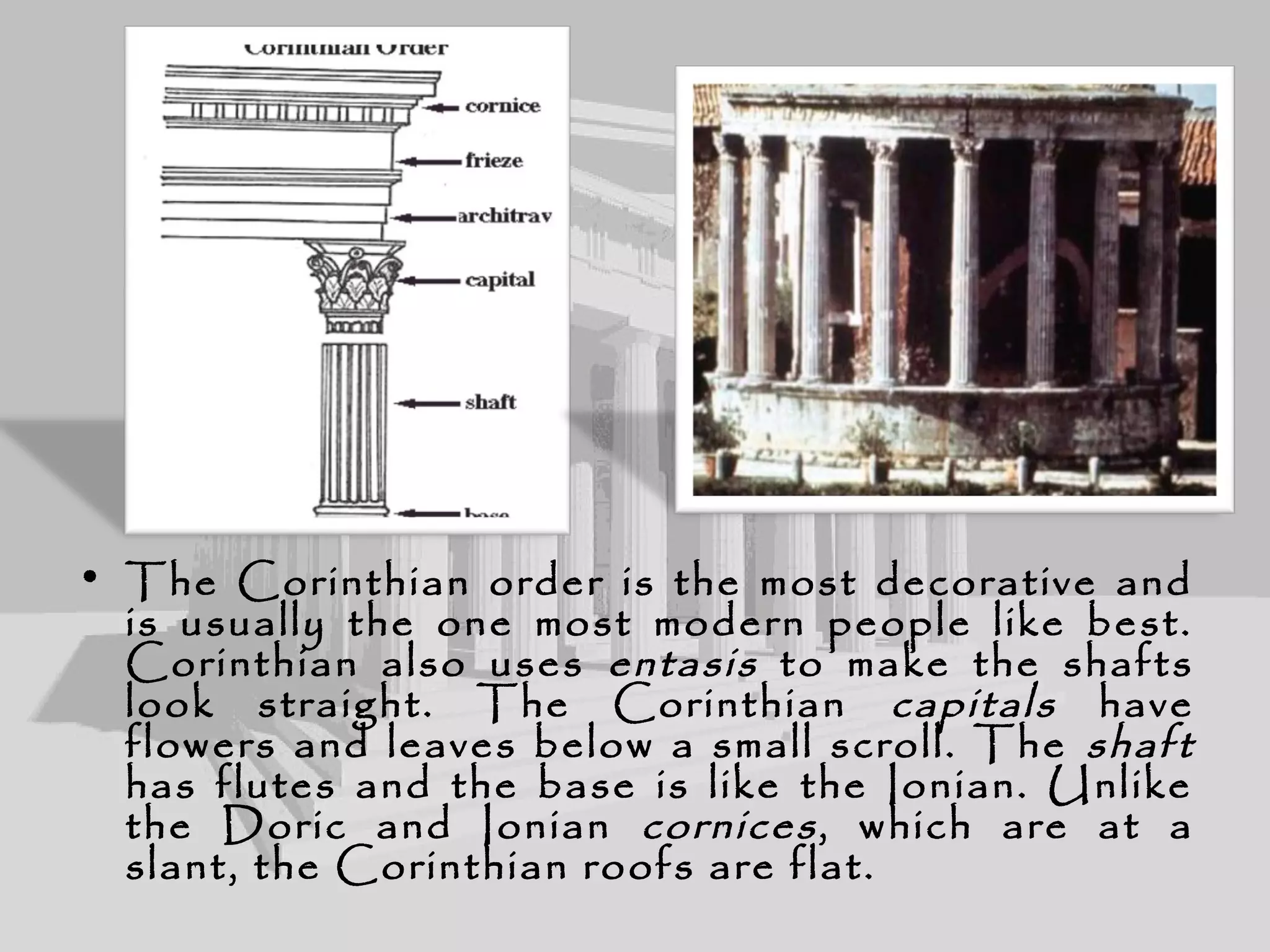
• The Corinthian order is the most decorative and
is usually the one most modern people like best.
Corinthian also uses entasis to make the shafts
look straight. The Corinthian capitals have
flowers and leaves below a small scroll. The shaft
has flutes and the base is like the Ionian. Unlike
the Doric and Ionian cornices, which are at a
slant, the Corinthian roofs are flat.
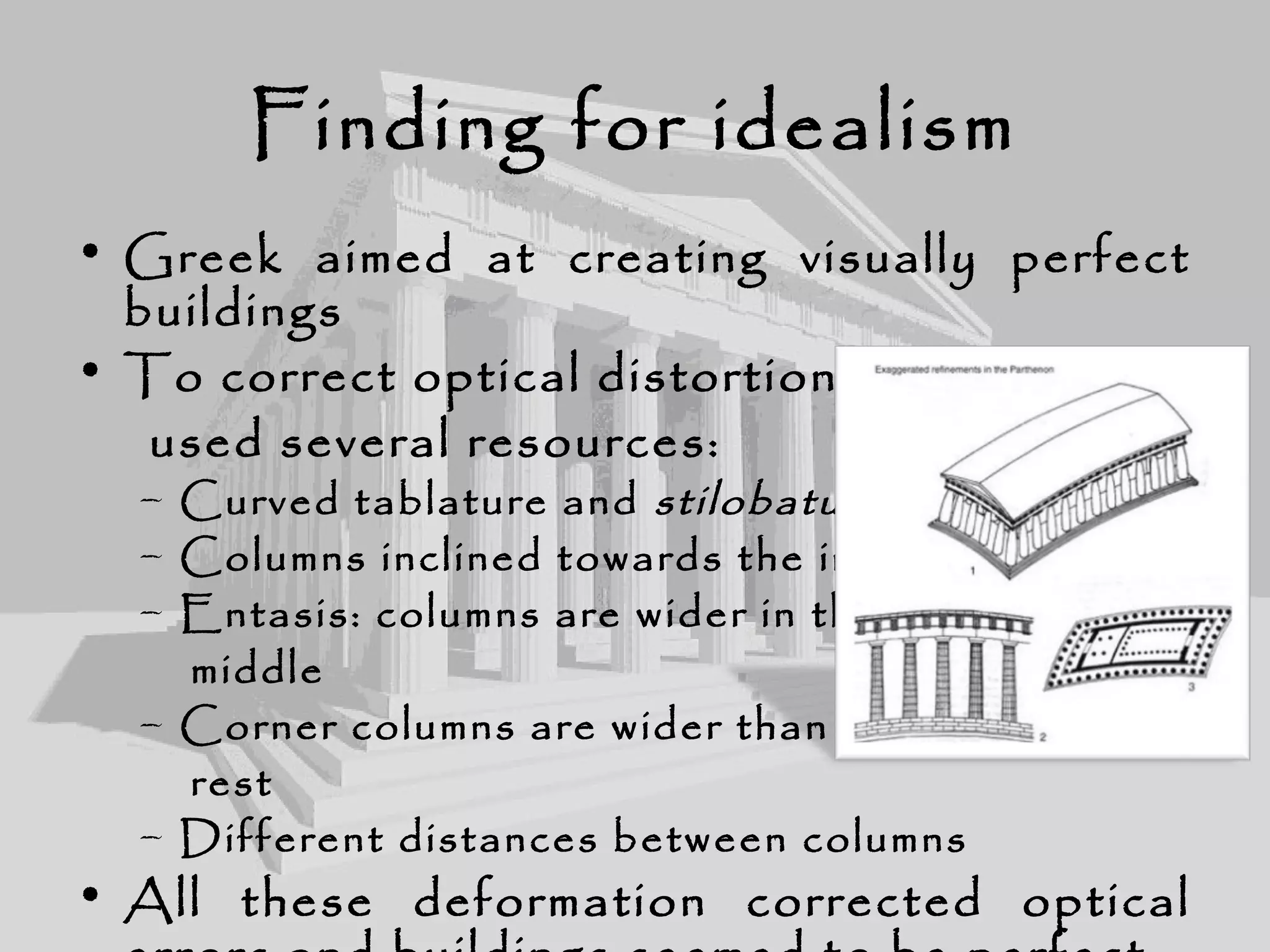
Finding for idealism
• Greek aimed at creating visually perfect
buildings
• To correct optical distortions they
used several resources:
– Curved tablature and stilobatus
– Columns inclined towards the inside
– Entasis: columns are wider in the
middle
– Corner columns are wider than the
rest
– Different distances between columns
• All these deformation corrected optical
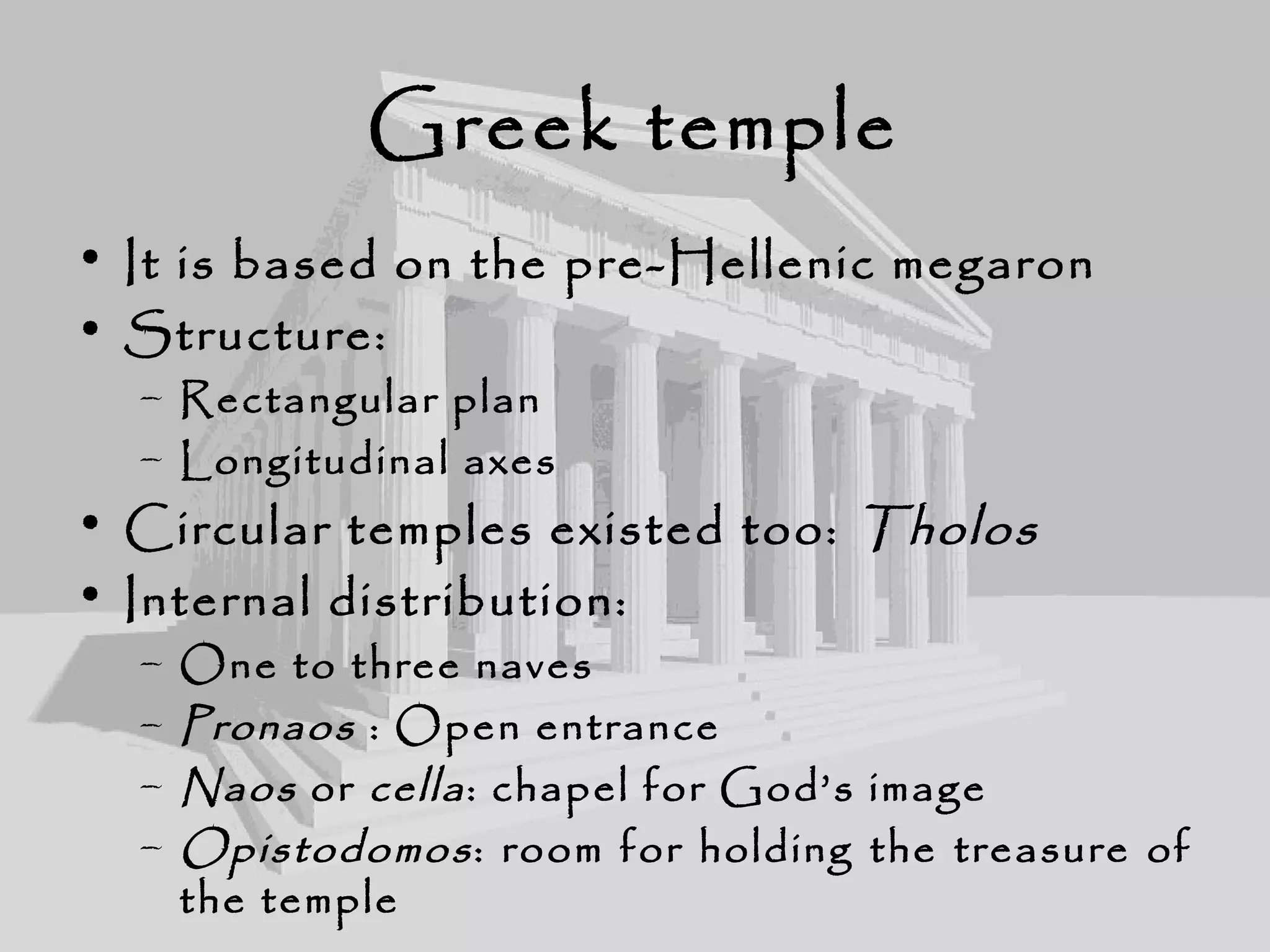
Greek temple
• It is based on the pre-Hellenic megaron
• Structure:
– Rectangular plan
– Longitudinal axes
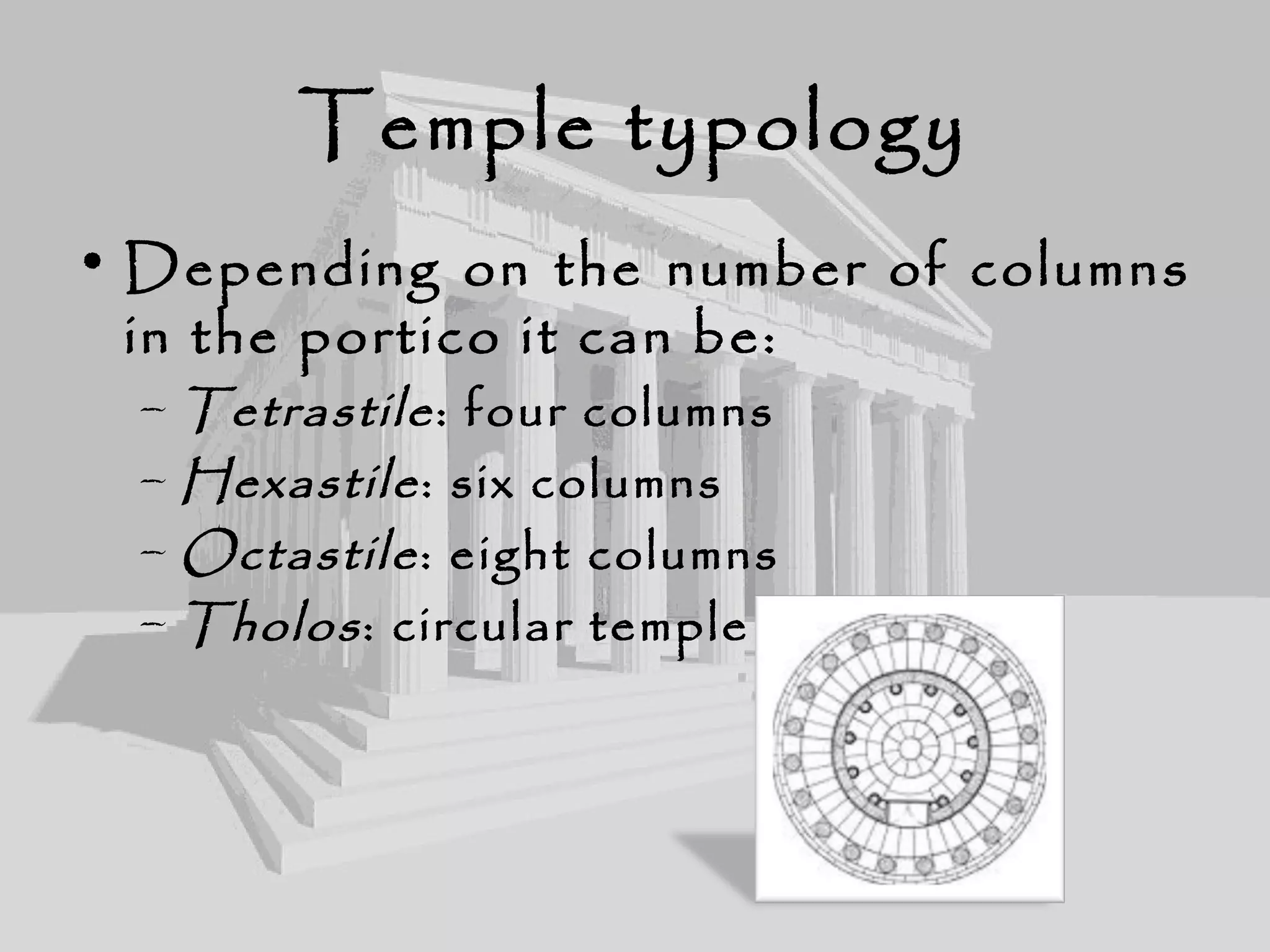
• Circular temples existed too: Tholos
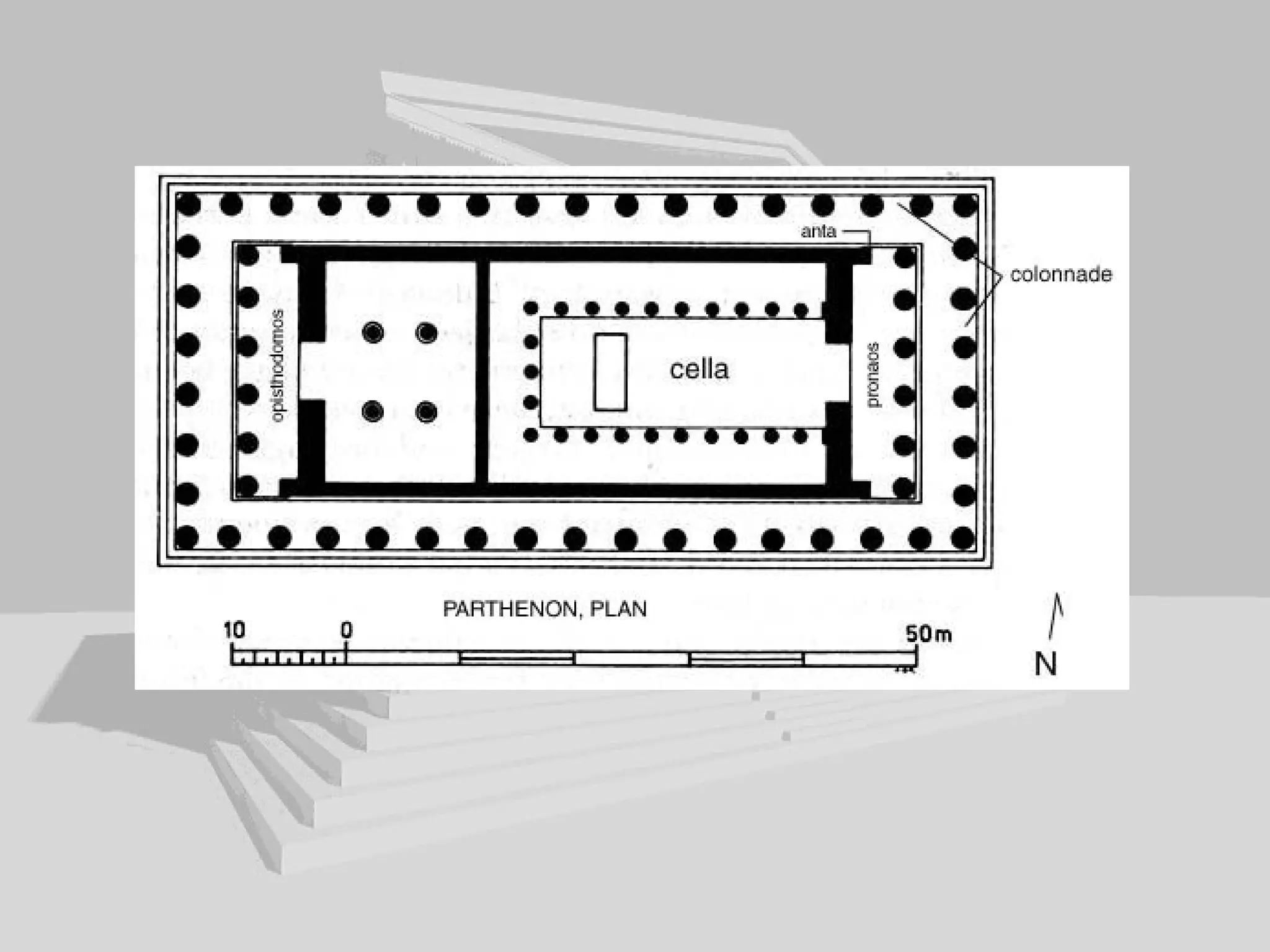
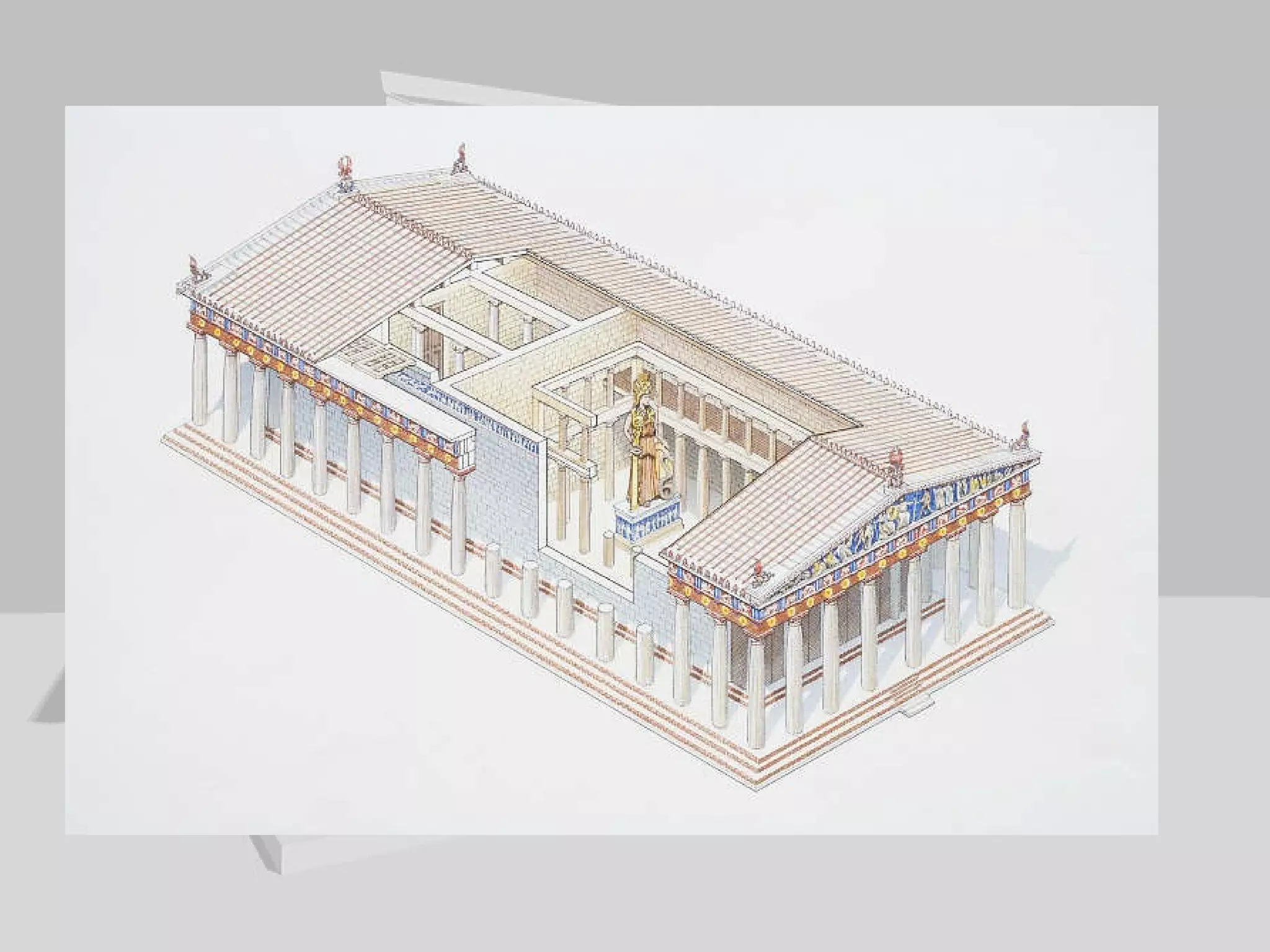
• Internal distribution:
– One to three naves
– Pronaos : Open entrance
– Naos or cella: chapel for God’s image
– Opistodomos: room for holding the treasure of
the temple
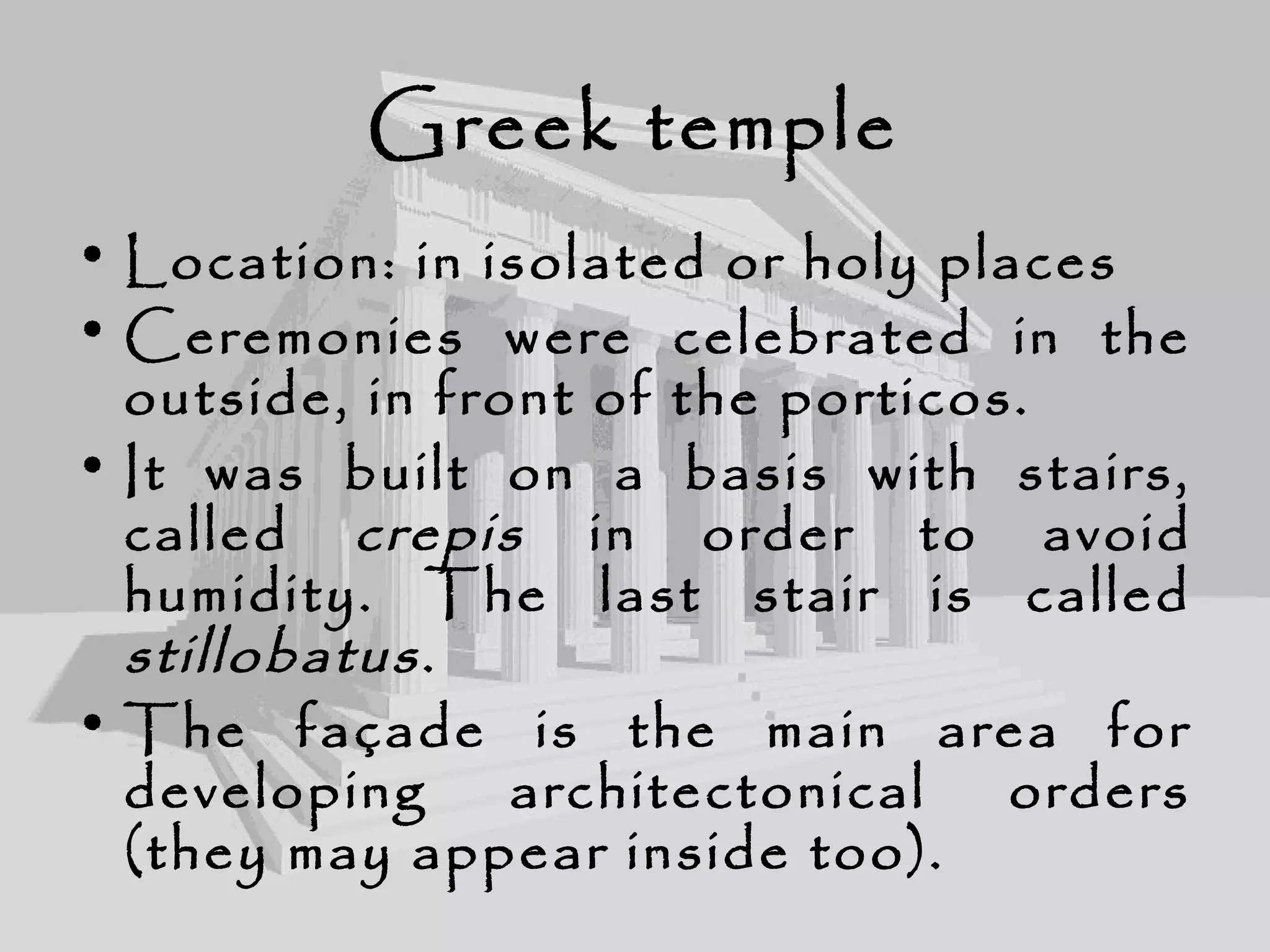
Greek temple
• Location: in isolated or holy places
• Ceremonies were celebrated in the
outside, in front of the porticos.
• It was built on a basis with stairs,
called crepis in order to avoid
humidity. The last stair is called
stillobatus.
• The façade is the main area for
developing architectonical orders
(they may appear inside too).
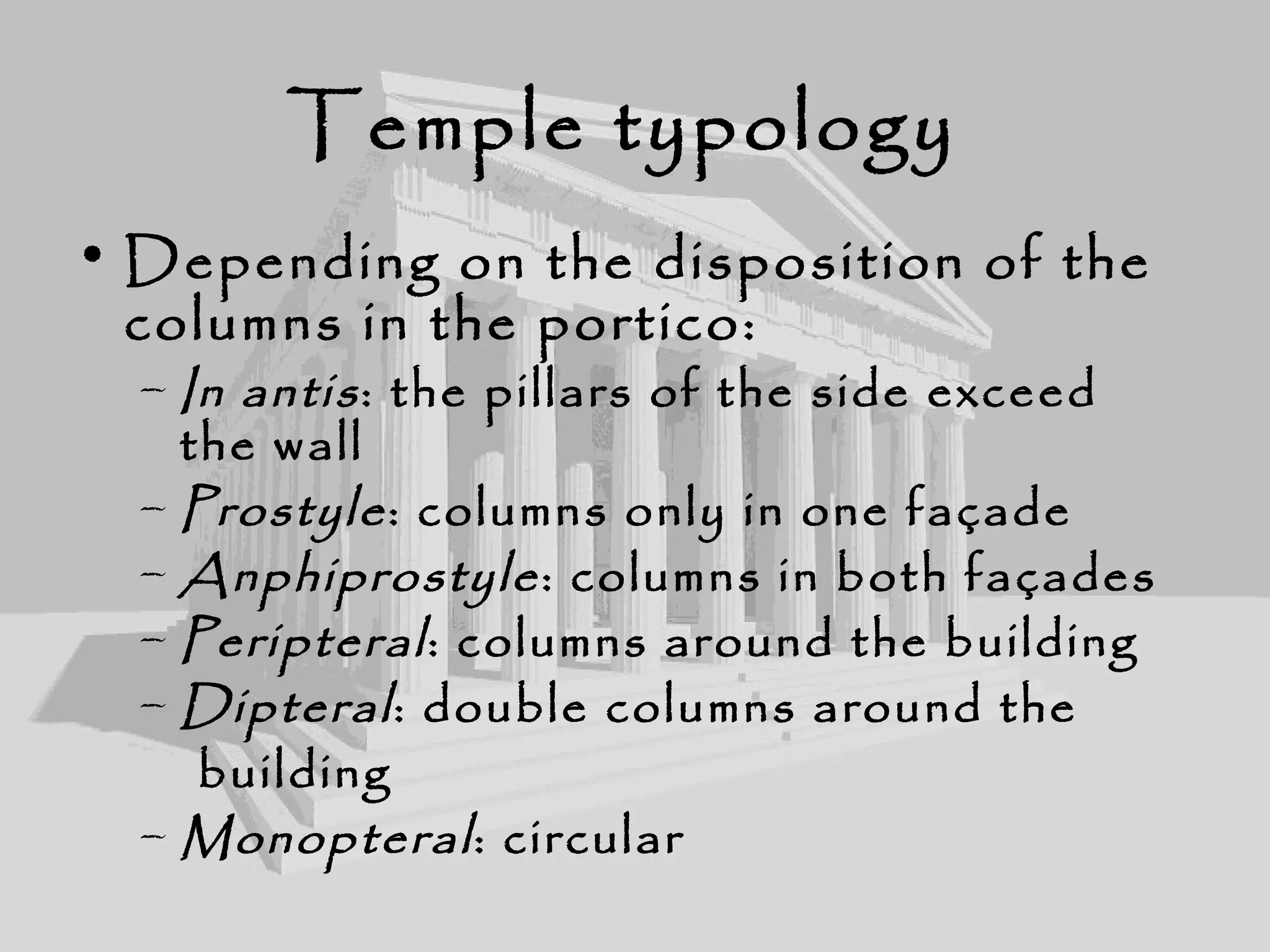
Temple typology
• Depending on the disposition of the
columns in the portico:
– In antis: the pillars of the side exceed
the wall
– Prostyle: columns only in one façade
– Anphiprostyle: columns in both façades
– Peripteral: columns around the building
– Dipteral: double columns around the
building
– Monopteral: circular
Temple typology
• Depending on the number of columns
in the portico it can be:
– Tetrastile: four columns
– Hexastile: six columns
– Octastile: eight columns
– Tholos: circular temple
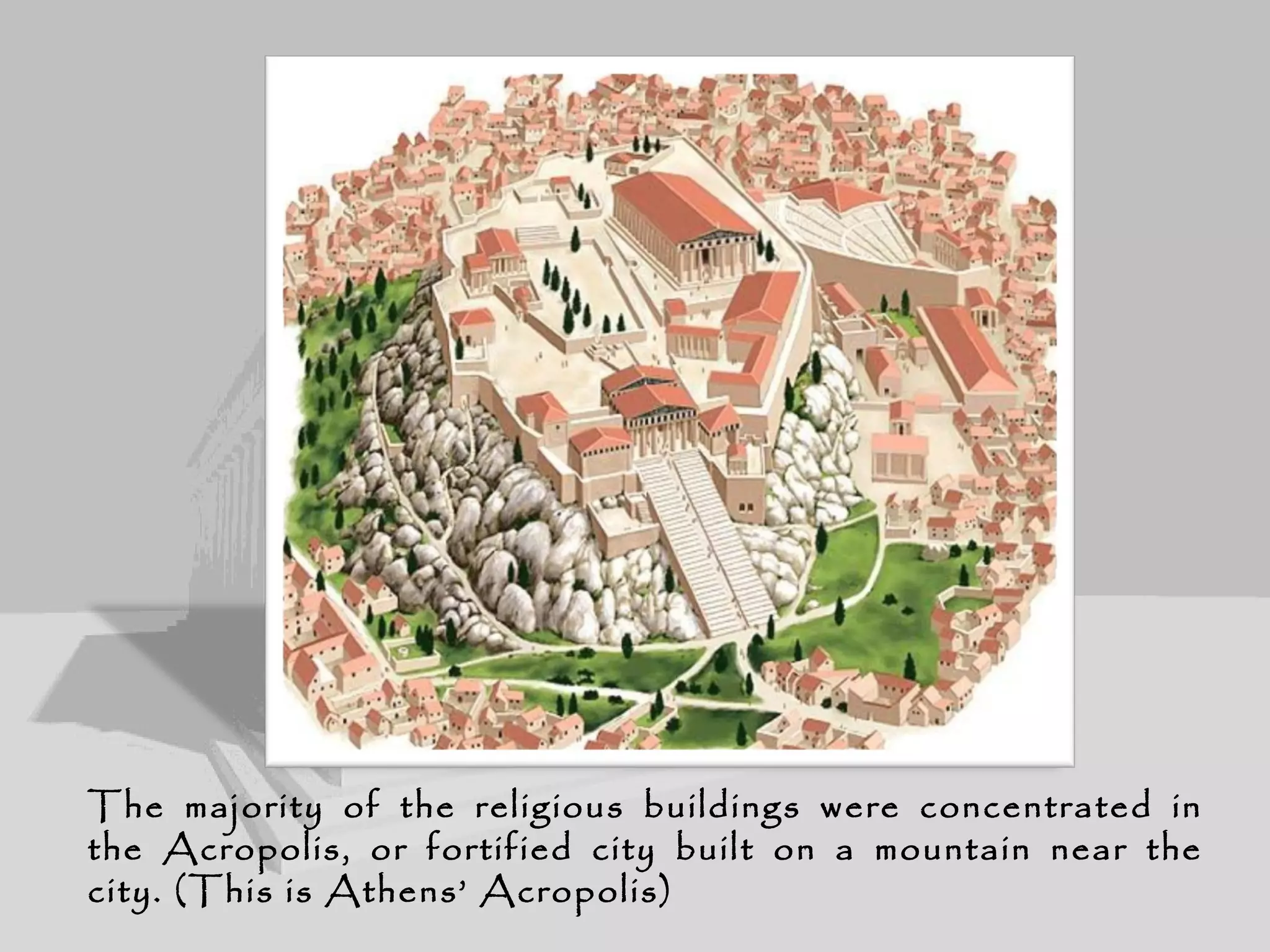
The majority of the religious buildings were concentrated in
the Acropolis, or fortified city built on a mountain near the
city. (This is Athens’ Acropolis)
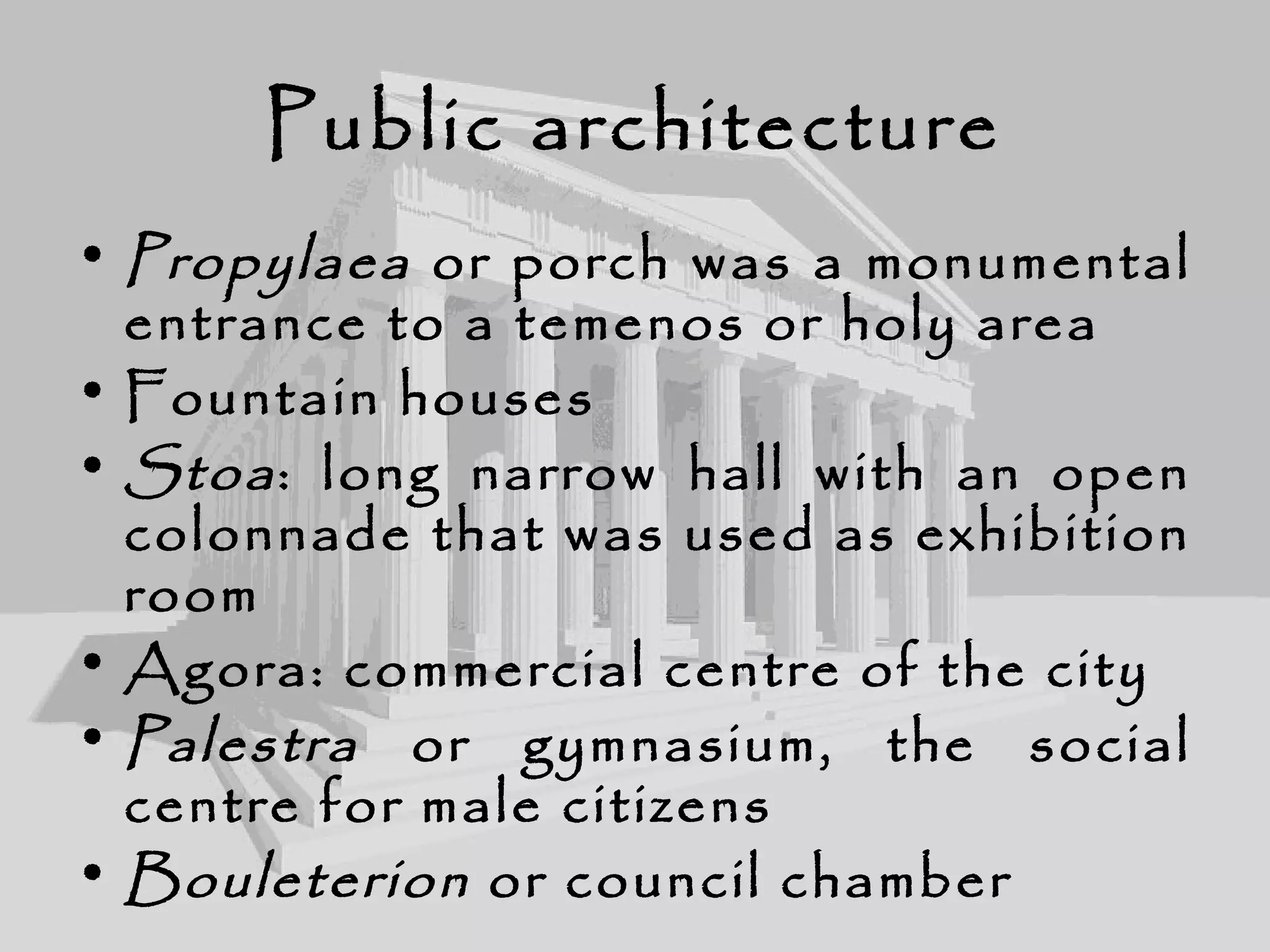
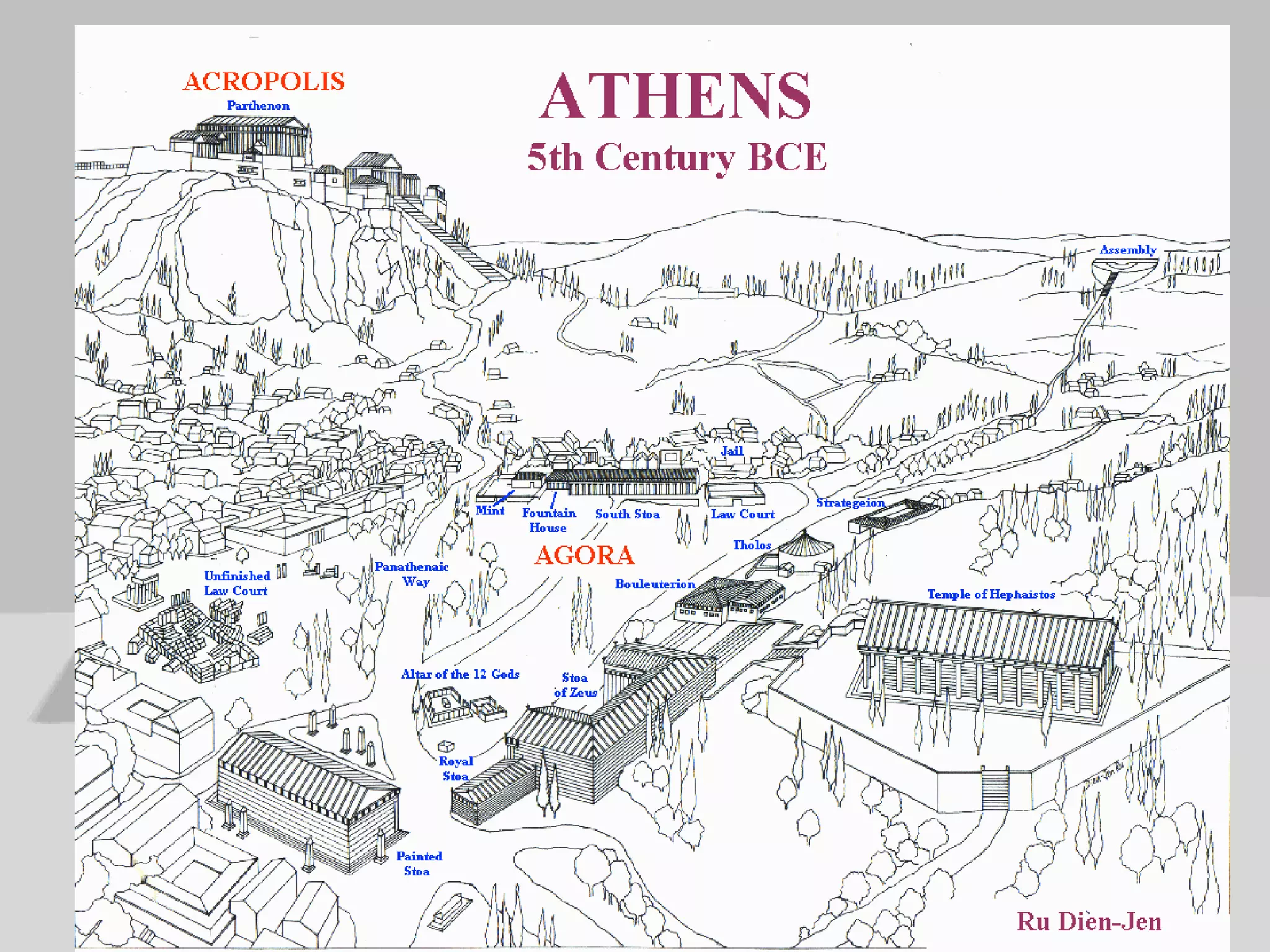
Public architecture
• Propylaea or porch was a monumental
entrance to a temenos or holy area
• Fountain houses
• Stoa: long narrow hall with an open
colonnade that was used as exhibition
room
• Agora: commercial centre of the city
• Palestra or gymnasium, the social
centre for male citizens
• Bouleterion or council chamber
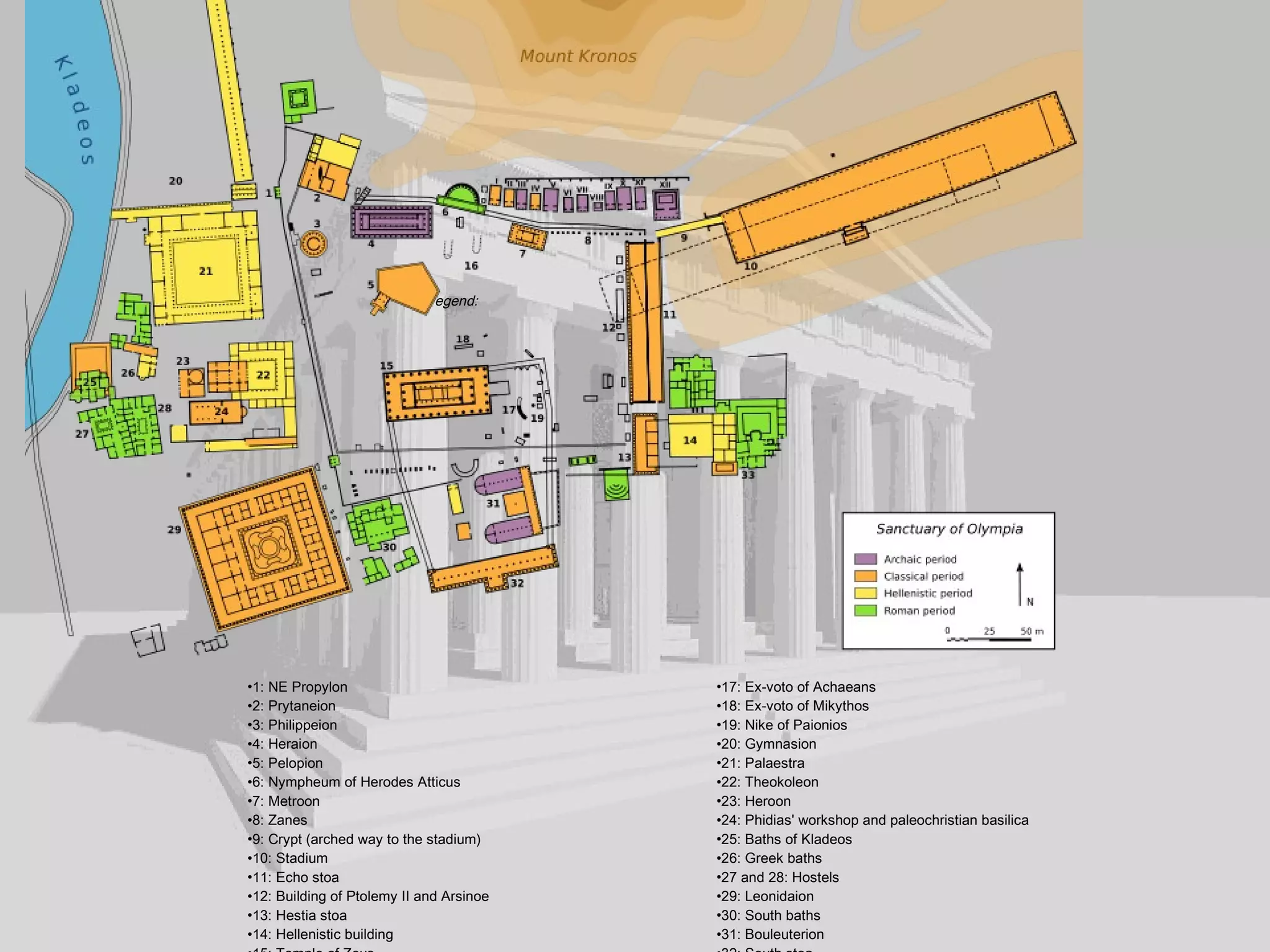
egend:
•1: NE Propylon
•2: Prytaneion
•3: Philippeion
•4: Heraion
•5: Pelopion
•6: Nympheum of Herodes Atticus
•7: Metroon
•8: Zanes
•9: Crypt (arched way to the stadium)
•10: Stadium
•11: Echo stoa
•12: Building of Ptolemy II and Arsinoe
•13: Hestia stoa
•14: Hellenistic building
•17: Ex-voto of Achaeans
•18: Ex-voto of Mikythos
•19: Nike of Paionios
•20: Gymnasion
•21: Palaestra
•22: Theokoleon
•23: Heroon
•24: Phidias' workshop and paleochristian basilica
•25: Baths of Kladeos
•26: Greek baths
•27 and 28: Hostels
•29: Leonidaion
•30: South baths
•31: Bouleuterion
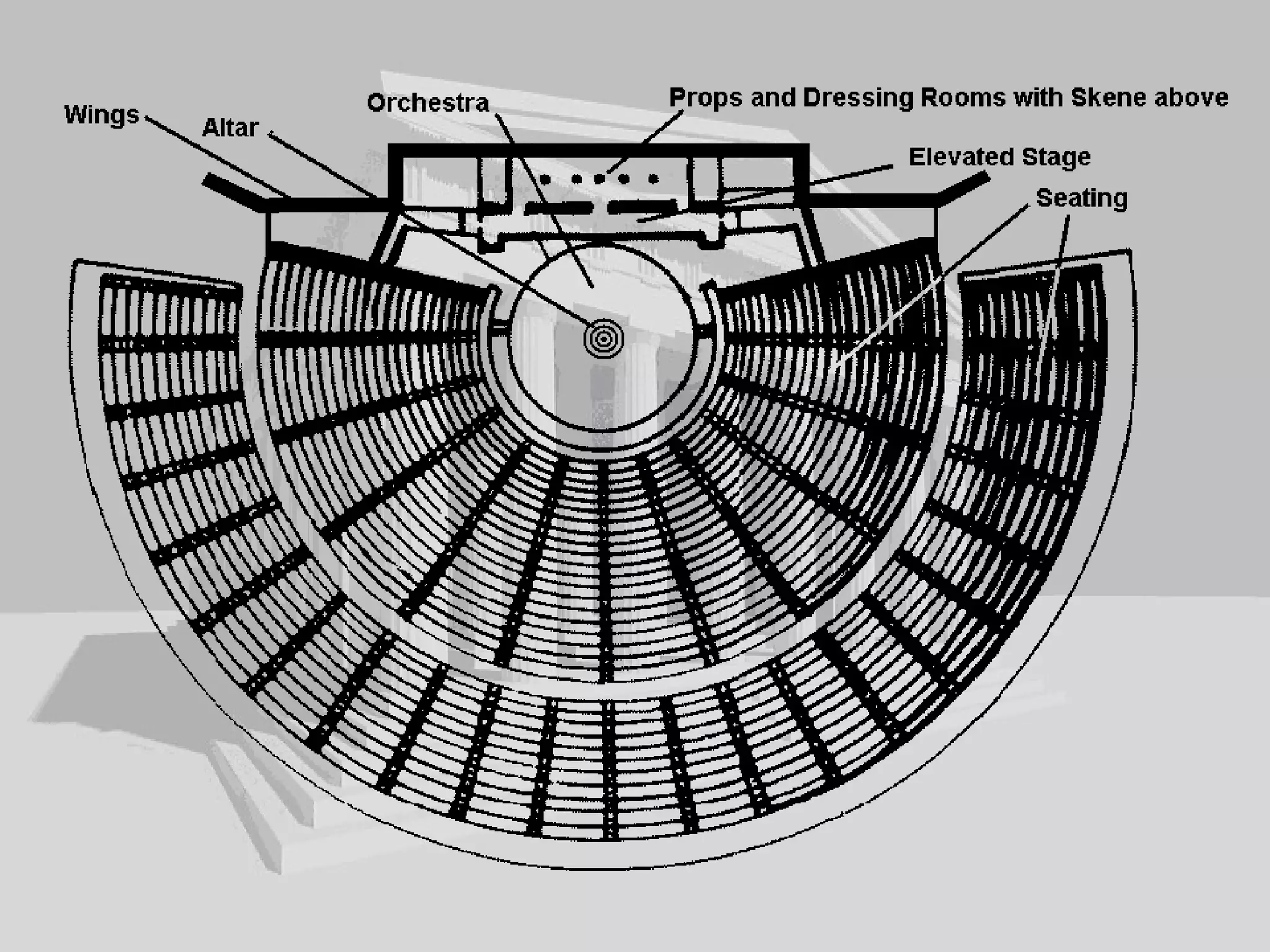
Public buildings
• Theatre:
– It was used for meeting and dramatic
performances
– It consisted of several parts:
• Skene: place for the performance, it was circular
• Orchestra: first line of seats, for the chorus
• Seats: divided in areas to made it possible the
movement
• Storage rooms (behind the skene)
– There were built on a hill
– They have perfect acoustic due to their
location
– There were small theatres for reading poetry,
they were called odeon.
Greek architecture

Greek architecture

  • 1.
  • 2.
    Introduction • Classical artis considered the formal and aesthetic basis of Occidental Art. • This art was born in Greece and continued during the Roman Empire. • The chronology of Greek Art is: – Archaic period: 8th to 6th century bc – Classical period: 5th to 4th century bc – Hellenistic period: 4th to 2nd century bc
  • 3.
    Introduction • Archaic period: –It is the time of formation – To the local basis are added other influences: • Crete civilization • Mycenaean civilization • Oriental influences, above all, Egyptian – Art evolved from abstraction to expressive naturalism.
  • 4.
    Introduction • Classical period: –It is the peak of this art – Every art manifestation reached its zenith – It is the period of political, economic and cultural expansion of the polis, mainly Athens. – It is the period of the Democracy – This situation lasted until the political decay of the polis with the Peloponnesus Wars.
  • 5.
    Introduction • Hellenistic period: –Greek culture suffered a deep transformation – Alexander the Great expanded Greek culture – With culture, Art expanded too: • The artistic forms • Technical solutions – Greece became the artistic reference in the whole Mediterranean area.
  • 6.
    Geographical space • Evenwhen the basic nucleus is Greece, this civilization expanded to other regions due to: – Greek colonization (forced by the inner difficulties for communication –difficult relieve, politically divided into polis) • South of Italy and Sicily (Magna Greece) • Easter Mediterranean coasts (Turkey, Middle East) • Rest of Mediterranean coasts. – Hellenistic expansion (Alexander).
  • 7.
    Greek civilization • Ideologically: –Freedom and individual independence – Isodomia: equal right among free men • Human being is the centre of their culture: everything is done at man’s measure • Rich mythology and religion: gods were used to express beauty ideal. • Reason, observation and experience are the basis for the reality: Philosophy and Sciences developed
  • 8.
    Architecture: Basis • Greekcreated equilibrate and proportional works • It is an architecture to be seen (temple) – Sculptural values, volumes – Building is conceived as an sculpture • Beauty= proportion and measure: – it is conceived from the human point of view – it is anti-colossal
  • 9.
    Architecture: Basis • Theorganization of the polis did not help the development of the palace. • Temple is the essential building, residence of the god, not a place for people • Other constructions combined beauty with practical solutions: – Theatres – Sanctuaries – Gymnasiums • Importance of urbanism: Hipodamus from Mileto created the orthogonal planning
  • 10.
    Building systems • Ithas lintels, and it is apparently serene and equilibrate • Dominant lines are horizontal and vertical • The column is the essential element • Building materials limestone and white marble • Walls are made of regular ashlars, without mortar (stretcher and header bond= soga y tizón) • Buildings were polychrome • There are not fixed measures, this is why there are different orders
  • 11.
    Orders • Doric: – Columns •Without basis • Sharp-edged shaft • Simple capital, without decoration – Tablature • Frieze divided – Metopes – Triglyphs – Cornice – Triangular pediment
  • 12.
    • Of thethree columns found in Greece, Doric columns are the simplest. They have a capital (the top, or crown) made of a circle topped by a square. The shaft (the tall part of the column) is plain and has 20 sides. There is no base in the Doric order. The Doric order is very plain, but powerful- looking in its design. Doric, like most Greek styles, works well horizontally on buildings, that's why it was so good with the long rectangular buildings made by the Greeks. The area above the column, called the frieze [pronounced "freeze"], had simple patterns. Above the columns are the metopes and triglyphs. The metope [pronounced "met-o-pee"] is a plain, smooth stone section between triglyphs. Sometimes the metopes had statues of heroes or gods on them. The triglyphs are a pattern of 3 vertical lines between the metopes. • There are many examples of ancient Doric buildings. Perhaps the most famous one is the Parthenon in Athens, which is
  • 13.
    Orders • Ionic: – Columns: •With basis • Blunt-edged shaft • Capital with volutes – Tablature • Three bands, without decoration • Continues frieze (decorated) – Cornice – Triangular pediment
  • 14.
    • Ionic shaftswere taller than Doric ones. This makes the columns look slender. They also had flutes, which are lines carved into them from top to bottom. The shafts also had a special characteristic: entasis, which is a little bulge in the columns make the columns look straight, even at a distance [because since you would see the building from eye level, the shafts would appear to get narrower as they rise, so this bulge makes up for that - so it looks straight to your eye but it really isn't !] . The frieze is plain. The bases were large and looked like a set of stacked rings. Ionic capitals consist of a scrolls above the shaft. The Ionic style is a little more
  • 15.
    Orders • Corinthian: – Columns: •With basis • High blunt-edged shaft • Capital decorated with acantus leaves and small volutes – Tablature: • Three bands without decoration • Continuous frieze – Cornice – Triangular pediment
  • 16.
    • The Corinthianorder is the most decorative and is usually the one most modern people like best. Corinthian also uses entasis to make the shafts look straight. The Corinthian capitals have flowers and leaves below a small scroll. The shaft has flutes and the base is like the Ionian. Unlike the Doric and Ionian cornices, which are at a slant, the Corinthian roofs are flat.
  • 17.
    Finding for idealism •Greek aimed at creating visually perfect buildings • To correct optical distortions they used several resources: – Curved tablature and stilobatus – Columns inclined towards the inside – Entasis: columns are wider in the middle – Corner columns are wider than the rest – Different distances between columns • All these deformation corrected optical
  • 18.
    Greek temple • Itis based on the pre-Hellenic megaron • Structure: – Rectangular plan – Longitudinal axes • Circular temples existed too: Tholos • Internal distribution: – One to three naves – Pronaos : Open entrance – Naos or cella: chapel for God’s image – Opistodomos: room for holding the treasure of the temple
  • 21.
    Greek temple • Location:in isolated or holy places • Ceremonies were celebrated in the outside, in front of the porticos. • It was built on a basis with stairs, called crepis in order to avoid humidity. The last stair is called stillobatus. • The façade is the main area for developing architectonical orders (they may appear inside too).
  • 22.
    Temple typology • Dependingon the disposition of the columns in the portico: – In antis: the pillars of the side exceed the wall – Prostyle: columns only in one façade – Anphiprostyle: columns in both façades – Peripteral: columns around the building – Dipteral: double columns around the building – Monopteral: circular
  • 23.
    Temple typology • Dependingon the number of columns in the portico it can be: – Tetrastile: four columns – Hexastile: six columns – Octastile: eight columns – Tholos: circular temple
  • 24.
    The majority ofthe religious buildings were concentrated in the Acropolis, or fortified city built on a mountain near the city. (This is Athens’ Acropolis)
  • 25.
    Public architecture • Propylaeaor porch was a monumental entrance to a temenos or holy area • Fountain houses • Stoa: long narrow hall with an open colonnade that was used as exhibition room • Agora: commercial centre of the city • Palestra or gymnasium, the social centre for male citizens • Bouleterion or council chamber
  • 27.
    egend: •1: NE Propylon •2:Prytaneion •3: Philippeion •4: Heraion •5: Pelopion •6: Nympheum of Herodes Atticus •7: Metroon •8: Zanes •9: Crypt (arched way to the stadium) •10: Stadium •11: Echo stoa •12: Building of Ptolemy II and Arsinoe •13: Hestia stoa •14: Hellenistic building •17: Ex-voto of Achaeans •18: Ex-voto of Mikythos •19: Nike of Paionios •20: Gymnasion •21: Palaestra •22: Theokoleon •23: Heroon •24: Phidias' workshop and paleochristian basilica •25: Baths of Kladeos •26: Greek baths •27 and 28: Hostels •29: Leonidaion •30: South baths •31: Bouleuterion
  • 28.
    Public buildings • Theatre: –It was used for meeting and dramatic performances – It consisted of several parts: • Skene: place for the performance, it was circular • Orchestra: first line of seats, for the chorus • Seats: divided in areas to made it possible the movement • Storage rooms (behind the skene) – There were built on a hill – They have perfect acoustic due to their location – There were small theatres for reading poetry, they were called odeon.