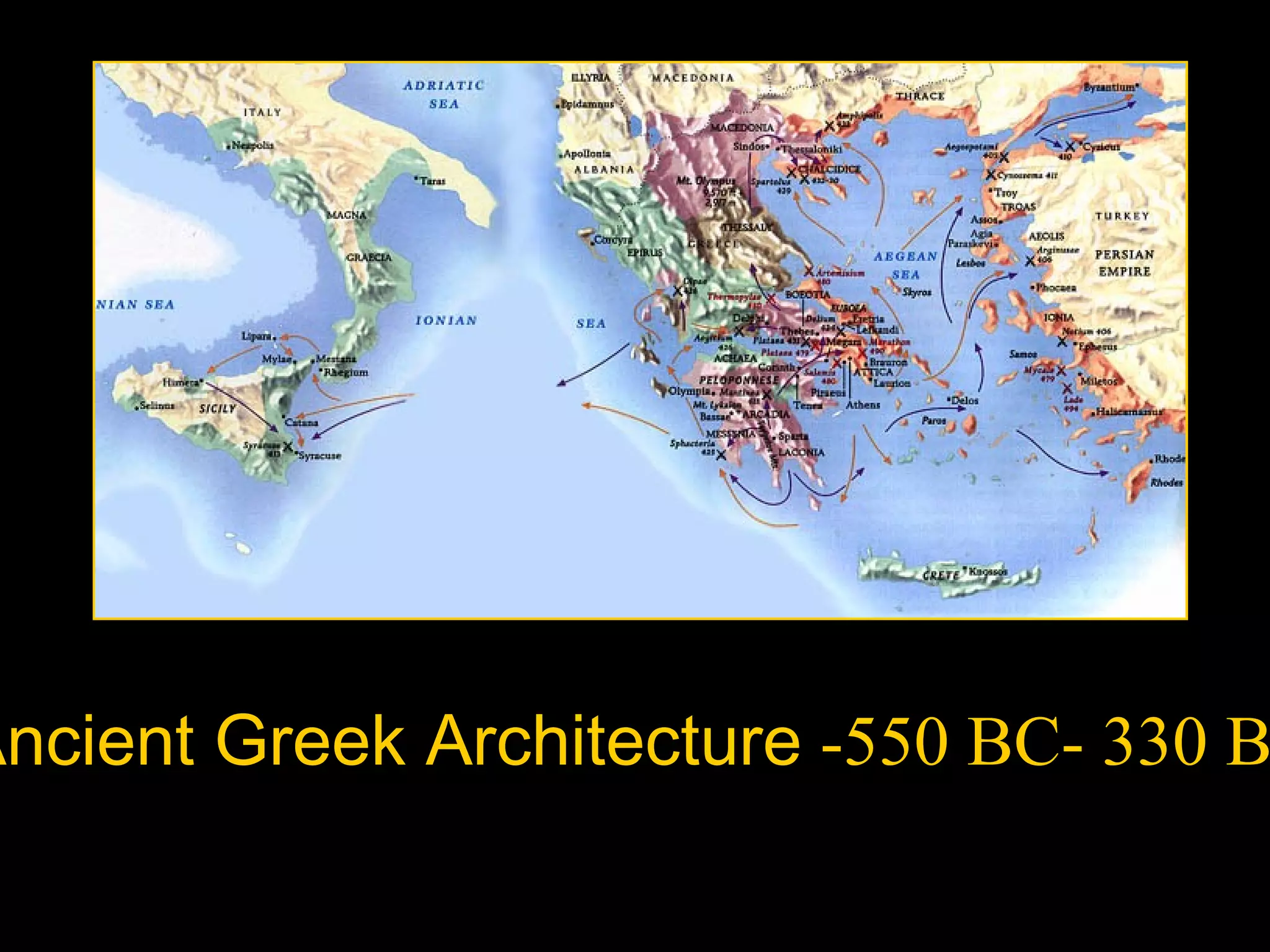
Ancient Greek Architecture -550 BC- 330 B
•Like Egyptians, Greeks designed their temples to
be earthly homes of the gods
•Like Egyptians, Greeks preferred limited access
to the gods- grand temples had doors that were
removed from public view
•Front and back of temple looks almost identical –
only sculptural ornamentation is different
•When Greeks came to worship, they gathered
near the temple – only “big shots” could enter the
temples
•Huge statues in the temples
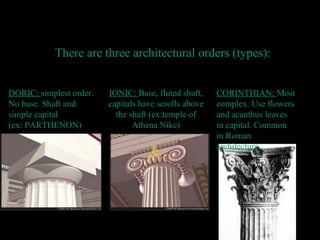
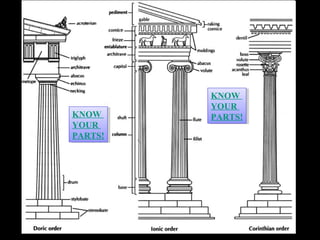
IONIC: Base, fluted shaft,
capitals have scrolls above
the shaft (ex:temple of
Athena Nike)
Architectur
e
There are three architectural orders (types):
DORIC: simplest order.
No base. Shaft and
simple capital
(ex: PARTHENON)
CORINTHIAN: Most
complex. Use flowers
and acanthus leaves
in capital. Common
in Roman
architecture
KNOW
YOUR
PARTS!
KNOW
YOUR
PARTS!KNOW
YOUR
PARTS!
KNOW
YOUR
PARTS!
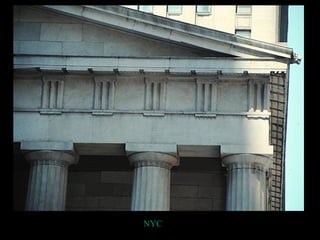
NYC
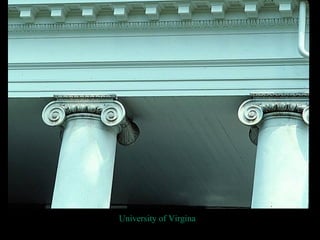
University of Virgina
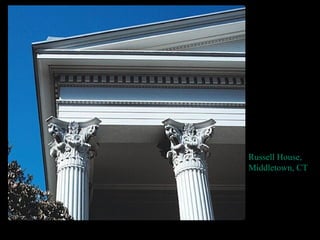
Russell House,
Middletown, CT
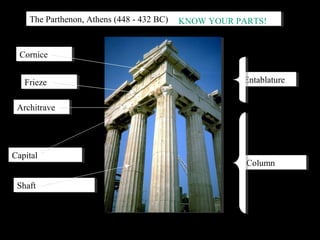
The Parthenon, Athens (448 - 432 BC)The Parthenon, Athens (448 - 432 BC)
EntablatureEntablature
ColumnColumn
ShaftShaft
ArchitraveArchitrave
CapitalCapital
FriezeFrieze
CorniceCornice
KNOW YOUR PARTS!
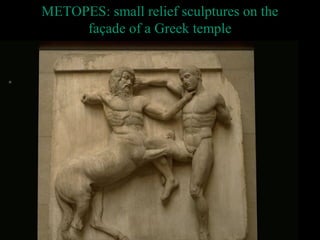
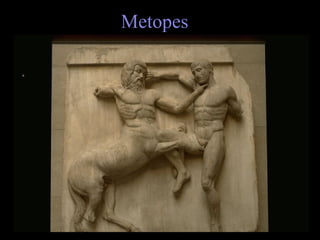
METOPES: small relief sculptures on the
façade of a Greek temple
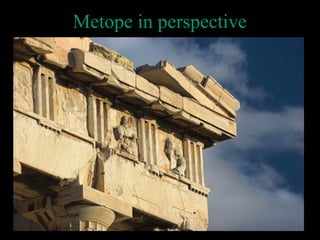
Metope in perspective
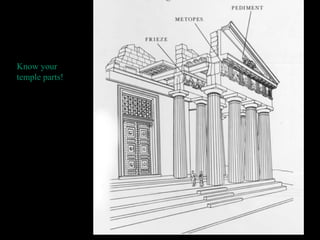
Know your
temple parts!
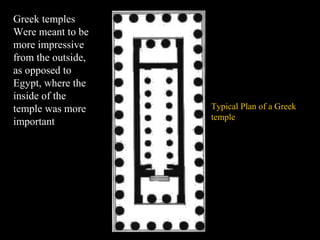
Typical Plan of a Greek
temple
Greek temples
Were meant to be
more impressive
from the outside,
as opposed to
Egypt, where the
inside of the
temple was more
important
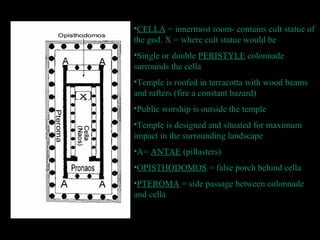
•CELLA = innermost room- contains cult statue of
the god. X = where cult statue would be
•Single or double PERISTYLE colonnade
surrounds the cella
•Temple is roofed in terracotta with wood beams
and rafters (fire a constant hazard)
•Public worship is outside the temple
•Temple is designed and situated for maximum
impact in the surrounding landscape
•A= ANTAE (pillasters)
•OPISTHODOMOS = false porch behind cella
•PTEROMA = side passage between colonnade
and cella
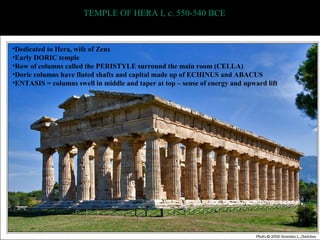
TEMPLE OF HERA I, c. 550-540 BCE
•Dedicated to Hera, wife of Zeus
•Early DORIC temple
•Row of columns called the PERISTYLE surround the main room (CELLA)
•Doric columns have fluted shafts and capital made up of ECHINUS and ABACUS
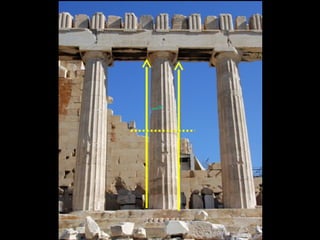
•ENTASIS = columns swell in middle and taper at top – sense of energy and upward lift
entosis
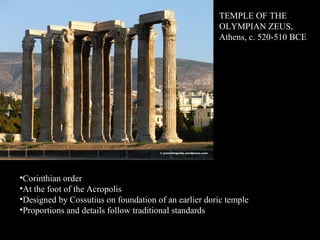
TEMPLE OF THE
OLYMPIAN ZEUS,
Athens, c. 520-510 BCE
•Corinthian order
•At the foot of the Acropolis
•Designed by Cossutius on foundation of an earlier doric temple
•Proportions and details follow traditional standards
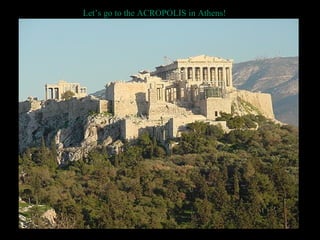
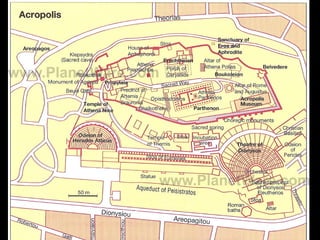
Let’s go to the ACROPOLIS in Athens!
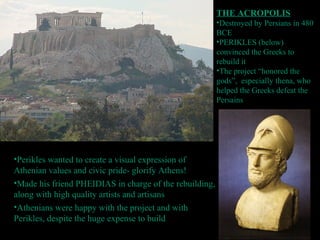
THE ACROPOLIS
•Destroyed by Persians in 480
BCE
•PERIKLES (below)
convinced the Greeks to
rebuild it
•The project “honored the
gods”, especially thena, who
helped the Greeks defeat the
Persains
•Perikles wanted to create a visual expression of
Athenian values and civic pride- glorify Athens!
•Made his friend PHEIDIAS in charge of the rebuilding,
along with high quality artists and artisans
•Athenians were happy with the project and with
Perikles, despite the huge expense to build
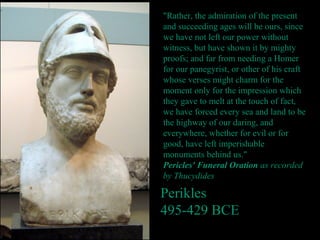
Perikles
495-429 BCE
"Rather, the admiration of the present
and succeeding ages will be ours, since
we have not left our power without
witness, but have shown it by mighty
proofs; and far from needing a Homer
for our panegyrist, or other of his craft
whose verses might charm for the
moment only for the impression which
they gave to melt at the touch of fact,
we have forced every sea and land to be
the highway of our daring, and
everywhere, whether for evil or for
good, have left imperishable
monuments behind us."
Pericles' Funeral Oration as recorded
by Thucydides
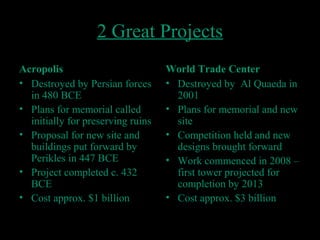
2 Great Projects
Acropolis
• Destroyed by Persian forces
in 480 BCE
• Plans for memorial called
initially for preserving ruins
• Proposal for new site and
buildings put forward by
Perikles in 447 BCE
• Project completed c. 432
BCE
• Cost approx. $1 billion
World Trade Center
• Destroyed by Al Quaeda in
2001
• Plans for memorial and new
site
• Competition held and new
designs brought forward
• Work commenced in 2008 –
first tower projected for
completion by 2013
• Cost approx. $3 billion
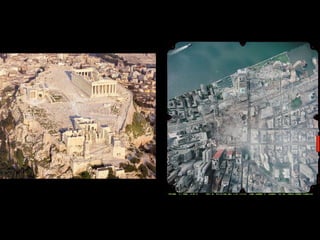
2 Sites of Destruction
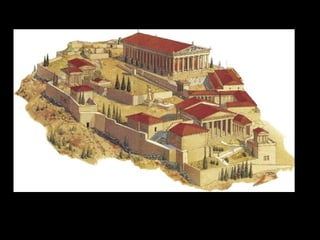
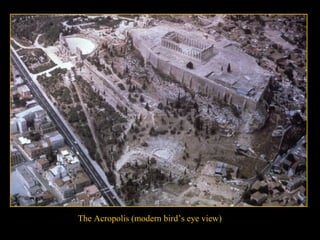
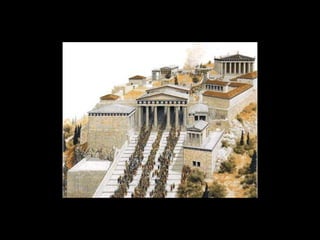
The Acropolis (modern bird’s eye view)
•Acropolis was
ompleted at the end
of 5th
century BCE
•Visitors climb steep
ramp on west side of
hill to sanctuary
entrance
•Religious buildings
and votive statues
filled the hilltop
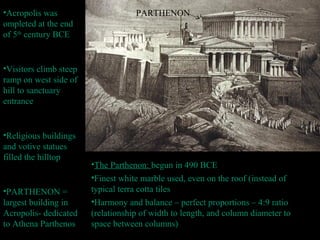
•PARTHENON =
largest building in
Acropolis- dedicated
to Athena Parthenos
•The Parthenon: begun in 490 BCE
•Finest white marble used, even on the roof (instead of
typical terra cotta tiles
•Harmony and balance – perfect proportions – 4:9 ratio
(relationship of width to length, and column diameter to
space between columns)
PARTHENON
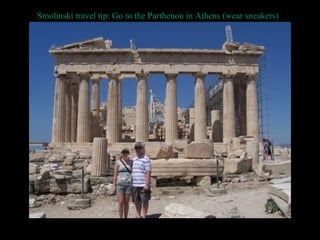
Smolinski travel tip: Go to the Parthenon in Athens (wear sneakers)
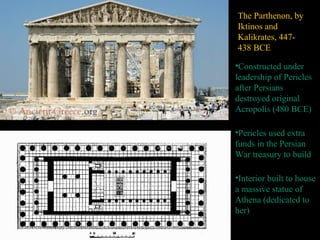
The Parthenon, by
Iktinos and
Kalikrates, 447-
438 BCE
•Constructed under
leadership of Pericles
after Persians
destroyed original
Acropolis (480 BCE)
•Pericles used extra
funds in the Persian
War treasury to build
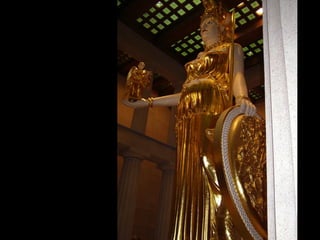
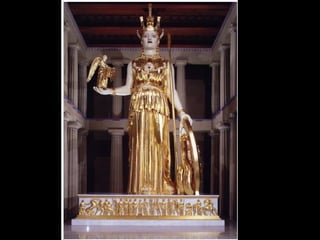
•Interior built to house
a massive statue of
Athena (dedicated to
her)
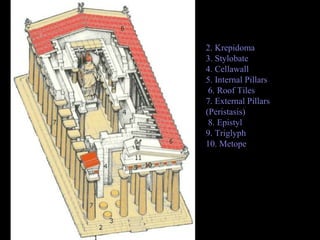
2. Krepidoma
3. Stylobate
4. Cellawall
5. Internal Pillars
6. Roof Tiles
7. External Pillars
(Peristasis)
8. Epistyl
9. Triglyph
10. Metope
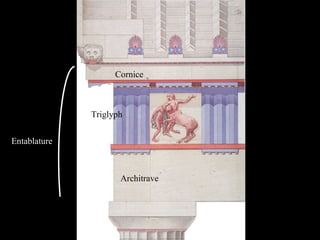
Architrave
Triglyph
Cornice
Entablature
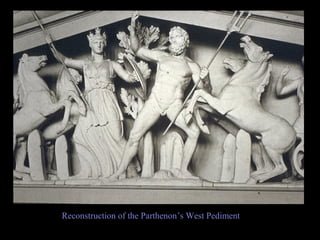
Reconstruction of the Parthenon’s West Pediment
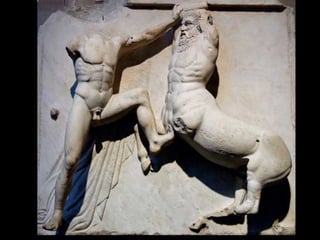
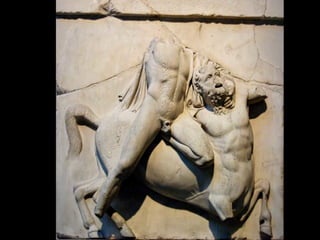
The Metopes
• Series of 92 sculptures surrounding the outside
of the Parthenon located on the entablature
• East – Olympian Gods and Giants
• West – Invasion of Athens by the Amazons
• North – Scenes of the Trojan War
• South – Battle of the Lapiths and the Centuars
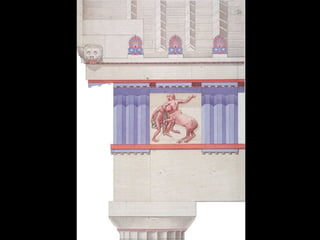
Metopes
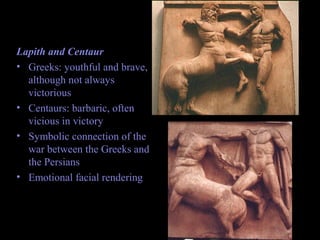
Lapith and Centaur
• Greeks: youthful and brave,
although not always
victorious
• Centaurs: barbaric, often
vicious in victory
• Symbolic connection of the
war between the Greeks and
the Persians
• Emotional facial rendering
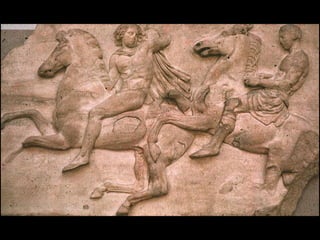
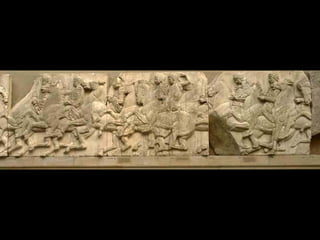
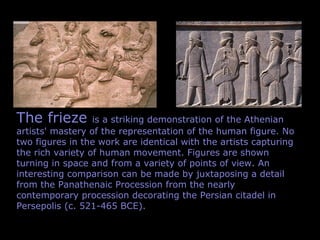
The frieze is a striking demonstration of the Athenian
artists' mastery of the representation of the human figure. No
two figures in the work are identical with the artists capturing
the rich variety of human movement. Figures are shown
turning in space and from a variety of points of view. An
interesting comparison can be made by juxtaposing a detail
from the Panathenaic Procession from the nearly
contemporary procession decorating the Persian citadel in
Persepolis (c. 521-465 BCE).
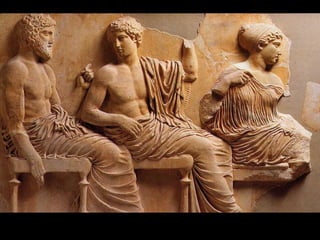
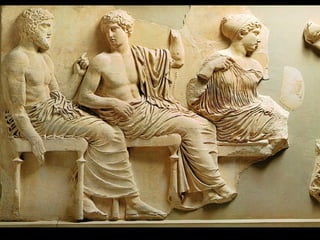
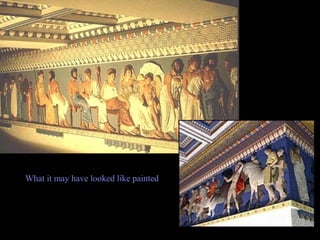
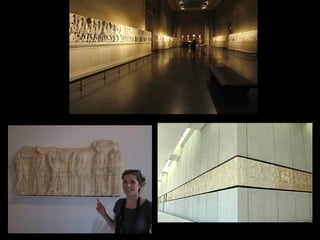
Section of the Parthenon frieze coming from the east part of the building.
The relief representation depicts the gods Poseidon, Apollo, Artemis,
Aphrodite, and Eros
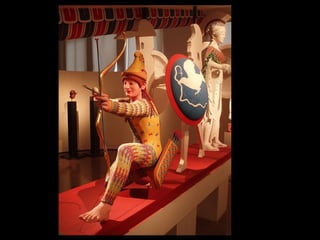
What it may have looked like painted
Parthenon Sculpture
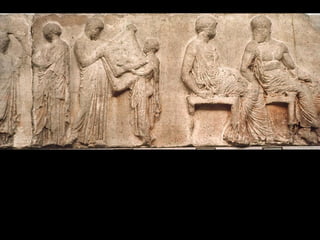
Panathenaic Frieze
• Frieze on the inside
entablature of the Parthenon
• Festival took place every
four years in Athens
• Figures are more stoic at the
center of the frieze, where
the gods watch the
procession
• At further areas the figures
are more animated, on
horseback, or walking
• Animals carried for
sacrifices
• Relief sculptures
• Contrapposto
• Complicated overlapping of
figures
Name, Location, Medium, and Chronology
•The Parthenon (447 – 438 BCE)
•Located in Athens Greece on the Acropolis
•Built of local marble
•Proposed by Perikles, commisioned by the City of Athens
•Architects : Iktinus and Kallicrates
•Lead Sculptor: Phidias
Purpose of the Work:
•Serves as Major Temple for Athena
•Serves as Treasury for Delian Laegue
Unique Features
• Classical proportions using precise mathematics in adjusting form toward visual
perception
•Combines Doric Order features with Ionic frieze
•Sculptural program of exceptional achievement in craftsmanship and aesthetic
unity including the Metopes, Frieze, Pediments and Colossal Athena
•Becomes the major influential basis for more building in Western civilization than
any other single building
Aspects of Greek Culture
•Represents the pagan religious rites and ceremonies for Classical Greece
•Demonstrates the power and wealth of a newly victorious Athens
•Illustrates beliefs in the role of the individual
•Demonstrates its democratic roots through the commissioning process
• Culminates the Greek search for mathematical proportion and balance in its
highest refinement
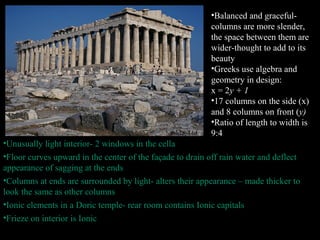
•Balanced and graceful-
columns are more slender,
the space between them are
wider-thought to add to its
beauty
•Greeks use algebra and
geometry in design:
x = 2y + 1
•17 columns on the side (x)
and 8 columns on front (y)
•Ratio of length to width is
9:4
•Unusually light interior- 2 windows in the cella
•Floor curves upward in the center of the façade to drain off rain water and deflect
appearance of sagging at the ends
•Columns at ends are surrounded by light- alters their appearance – made thicker to
look the same as other columns
•Ionic elements in a Doric temple- rear room contains Ionic capitals
•Frieze on interior is Ionic
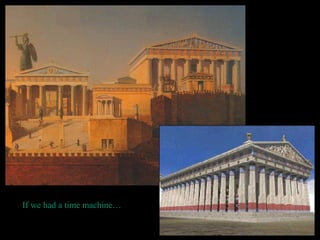
If we had a time machine…
OK OK, enough about the Parthenon….
Let’s look at some other Greek architecture….
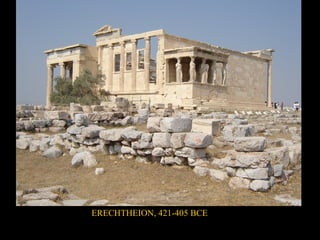
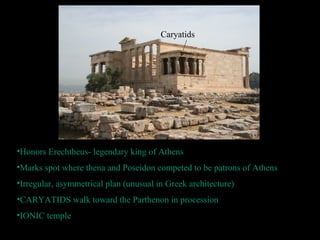
ERECHTHEION, 421-405 BCE
•Honors Erechtheus- legendary king of Athens
•Marks spot where thena and Poseidon competed to be patrons of Athens
•Irregular, asymmetrical plan (unusual in Greek architecture)
•CARYATIDS walk toward the Parthenon in procession
•IONIC temple
Caryatids
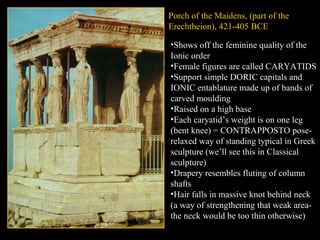
Porch of the Maidens, (part of the
Erechtheion), 421-405 BCE
•Shows off the feminine quality of the
Ionic order
•Female figures are called CARYATIDS
•Support simple DORIC capitals and
IONIC entablature made up of bands of
carved moulding
•Raised on a high base
•Each caryatid’s weight is on one leg
(bent knee) = CONTRAPPOSTO pose-
relaxed way of standing typical in Greek
sculpture (we’ll see this in Classical
sculpture)
•Drapery resembles fluting of column
shafts
•Hair falls in massive knot behind neck
(a way of strengthening that weak area-
the neck would be too thin otherwise)
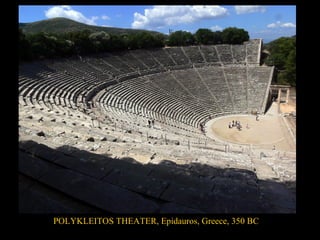
POLYKLEITOS THEATER, Epidauros, Greece, 350 BC
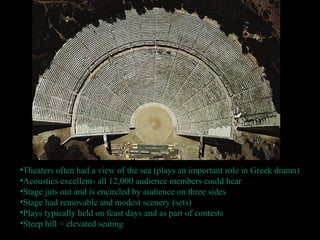
•Theaters often had a view of the sea (plays an important role in Greek drama)
•Acoustics excellent- all 12,000 audience members could hear
•Stage juts out and is encircled by audience on three sides
•Stage had removable and modest scenery (sets)
•Plays typically held on feast days and as part of contests
•Steep hill = elevated seating
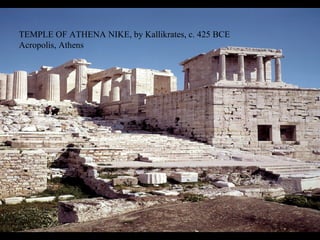
TEMPLE OF ATHENA NIKE, by Kallikrates, c. 425 BCE
Acropolis, Athens
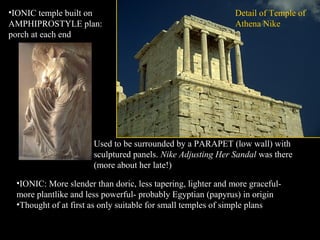
Detail of Temple of
Athena Nike
•IONIC: More slender than doric, less tapering, lighter and more graceful-
more plantlike and less powerful- probably Egyptian (papyrus) in origin
•Thought of at first as only suitable for small temples of simple plans
•IONIC temple built on
AMPHIPROSTYLE plan:
porch at each end
Used to be surrounded by a PARAPET (low wall) with
sculptured panels. Nike Adjusting Her Sandal was there
(more about her late!)
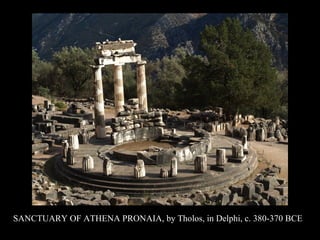
SANCTUARY OF ATHENA PRONAIA, by Tholos, in Delphi, c. 380-370 BCE
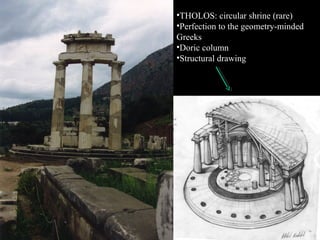
•THOLOS: circular shrine (rare)
•Perfection to the geometry-minded
Greeks
•Doric column
•Structural drawing
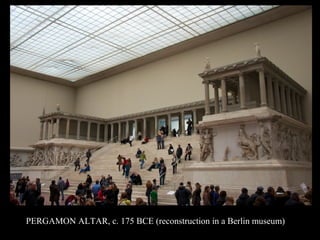
PERGAMON ALTAR, c. 175 BCE (reconstruction in a Berlin museum)
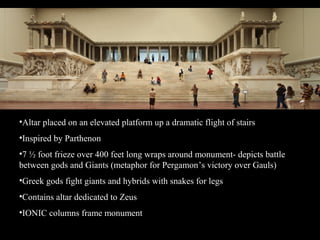
•Altar placed on an elevated platform up a dramatic flight of stairs
•Inspired by Parthenon
•7 ½ foot frieze over 400 feet long wraps around monument- depicts battle
between gods and Giants (metaphor for Pergamon’s victory over Gauls)
•Greek gods fight giants and hybrids with snakes for legs
•Contains altar dedicated to Zeus
•IONIC columns frame monument
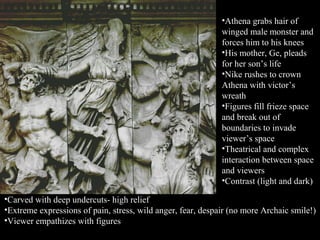
•Athena grabs hair of
winged male monster and
forces him to his knees
•His mother, Ge, pleads
for her son’s life
•Nike rushes to crown
Athena with victor’s
wreath
•Figures fill frieze space
and break out of
boundaries to invade
viewer’s space
•Theatrical and complex
interaction between space
and viewers
•Contrast (light and dark)
•Carved with deep undercuts- high relief
•Extreme expressions of pain, stress, wild anger, fear, despair (no more Archaic smile!)
•Viewer empathizes with figures
IN SUMMARY:
Greek temples are typically surrounded by an imposing
set of columns that embrace the cella where the god is
housed. The temple is often set apart from the rest of
the city, sometimes located on an adjoining hill called
an acropolis. Greek theaters, like the temples, are built
of cut stone carefully carved into an important site
The Greeks have had such a powerful influence on
history that we have dubbed their art “Classical”-
standard of authority

Greece Part 2

  • 1.
  • 2.
    •Like Egyptians, Greeksdesigned their temples to be earthly homes of the gods •Like Egyptians, Greeks preferred limited access to the gods- grand temples had doors that were removed from public view •Front and back of temple looks almost identical – only sculptural ornamentation is different •When Greeks came to worship, they gathered near the temple – only “big shots” could enter the temples •Huge statues in the temples
  • 3.
    IONIC: Base, flutedshaft, capitals have scrolls above the shaft (ex:temple of Athena Nike) Architectur e There are three architectural orders (types): DORIC: simplest order. No base. Shaft and simple capital (ex: PARTHENON) CORINTHIAN: Most complex. Use flowers and acanthus leaves in capital. Common in Roman architecture
  • 4.
  • 5.
  • 6.
  • 7.
  • 8.
    The Parthenon, Athens(448 - 432 BC)The Parthenon, Athens (448 - 432 BC) EntablatureEntablature ColumnColumn ShaftShaft ArchitraveArchitrave CapitalCapital FriezeFrieze CorniceCornice KNOW YOUR PARTS!
  • 9.
    METOPES: small reliefsculptures on the façade of a Greek temple
  • 10.
  • 11.
  • 12.
    Typical Plan ofa Greek temple Greek temples Were meant to be more impressive from the outside, as opposed to Egypt, where the inside of the temple was more important
  • 13.
    •CELLA = innermostroom- contains cult statue of the god. X = where cult statue would be •Single or double PERISTYLE colonnade surrounds the cella •Temple is roofed in terracotta with wood beams and rafters (fire a constant hazard) •Public worship is outside the temple •Temple is designed and situated for maximum impact in the surrounding landscape •A= ANTAE (pillasters) •OPISTHODOMOS = false porch behind cella •PTEROMA = side passage between colonnade and cella
  • 14.
    TEMPLE OF HERAI, c. 550-540 BCE •Dedicated to Hera, wife of Zeus •Early DORIC temple •Row of columns called the PERISTYLE surround the main room (CELLA) •Doric columns have fluted shafts and capital made up of ECHINUS and ABACUS •ENTASIS = columns swell in middle and taper at top – sense of energy and upward lift
  • 15.
  • 16.
    TEMPLE OF THE OLYMPIANZEUS, Athens, c. 520-510 BCE •Corinthian order •At the foot of the Acropolis •Designed by Cossutius on foundation of an earlier doric temple •Proportions and details follow traditional standards
  • 17.
    Let’s go tothe ACROPOLIS in Athens!
  • 20.
    THE ACROPOLIS •Destroyed byPersians in 480 BCE •PERIKLES (below) convinced the Greeks to rebuild it •The project “honored the gods”, especially thena, who helped the Greeks defeat the Persains •Perikles wanted to create a visual expression of Athenian values and civic pride- glorify Athens! •Made his friend PHEIDIAS in charge of the rebuilding, along with high quality artists and artisans •Athenians were happy with the project and with Perikles, despite the huge expense to build
  • 21.
    Perikles 495-429 BCE "Rather, theadmiration of the present and succeeding ages will be ours, since we have not left our power without witness, but have shown it by mighty proofs; and far from needing a Homer for our panegyrist, or other of his craft whose verses might charm for the moment only for the impression which they gave to melt at the touch of fact, we have forced every sea and land to be the highway of our daring, and everywhere, whether for evil or for good, have left imperishable monuments behind us." Pericles' Funeral Oration as recorded by Thucydides
  • 22.
    2 Great Projects Acropolis •Destroyed by Persian forces in 480 BCE • Plans for memorial called initially for preserving ruins • Proposal for new site and buildings put forward by Perikles in 447 BCE • Project completed c. 432 BCE • Cost approx. $1 billion World Trade Center • Destroyed by Al Quaeda in 2001 • Plans for memorial and new site • Competition held and new designs brought forward • Work commenced in 2008 – first tower projected for completion by 2013 • Cost approx. $3 billion
  • 23.
    2 Sites ofDestruction
  • 25.
    The Acropolis (modernbird’s eye view)
  • 26.
    •Acropolis was ompleted atthe end of 5th century BCE •Visitors climb steep ramp on west side of hill to sanctuary entrance •Religious buildings and votive statues filled the hilltop •PARTHENON = largest building in Acropolis- dedicated to Athena Parthenos •The Parthenon: begun in 490 BCE •Finest white marble used, even on the roof (instead of typical terra cotta tiles •Harmony and balance – perfect proportions – 4:9 ratio (relationship of width to length, and column diameter to space between columns) PARTHENON
  • 27.
    Smolinski travel tip:Go to the Parthenon in Athens (wear sneakers)
  • 28.
    The Parthenon, by Iktinosand Kalikrates, 447- 438 BCE •Constructed under leadership of Pericles after Persians destroyed original Acropolis (480 BCE) •Pericles used extra funds in the Persian War treasury to build •Interior built to house a massive statue of Athena (dedicated to her)
  • 29.
    2. Krepidoma 3. Stylobate 4.Cellawall 5. Internal Pillars 6. Roof Tiles 7. External Pillars (Peristasis) 8. Epistyl 9. Triglyph 10. Metope
  • 31.
  • 32.
    Reconstruction of theParthenon’s West Pediment
  • 33.
    The Metopes • Seriesof 92 sculptures surrounding the outside of the Parthenon located on the entablature • East – Olympian Gods and Giants • West – Invasion of Athens by the Amazons • North – Scenes of the Trojan War • South – Battle of the Lapiths and the Centuars
  • 34.
  • 35.
    Lapith and Centaur •Greeks: youthful and brave, although not always victorious • Centaurs: barbaric, often vicious in victory • Symbolic connection of the war between the Greeks and the Persians • Emotional facial rendering
  • 38.
    The frieze isa striking demonstration of the Athenian artists' mastery of the representation of the human figure. No two figures in the work are identical with the artists capturing the rich variety of human movement. Figures are shown turning in space and from a variety of points of view. An interesting comparison can be made by juxtaposing a detail from the Panathenaic Procession from the nearly contemporary procession decorating the Persian citadel in Persepolis (c. 521-465 BCE).
  • 43.
    Section of theParthenon frieze coming from the east part of the building. The relief representation depicts the gods Poseidon, Apollo, Artemis, Aphrodite, and Eros
  • 45.
    What it mayhave looked like painted
  • 48.
    Parthenon Sculpture Panathenaic Frieze •Frieze on the inside entablature of the Parthenon • Festival took place every four years in Athens • Figures are more stoic at the center of the frieze, where the gods watch the procession • At further areas the figures are more animated, on horseback, or walking • Animals carried for sacrifices • Relief sculptures • Contrapposto • Complicated overlapping of figures
  • 51.
    Name, Location, Medium,and Chronology •The Parthenon (447 – 438 BCE) •Located in Athens Greece on the Acropolis •Built of local marble •Proposed by Perikles, commisioned by the City of Athens •Architects : Iktinus and Kallicrates •Lead Sculptor: Phidias Purpose of the Work: •Serves as Major Temple for Athena •Serves as Treasury for Delian Laegue
  • 52.
    Unique Features • Classicalproportions using precise mathematics in adjusting form toward visual perception •Combines Doric Order features with Ionic frieze •Sculptural program of exceptional achievement in craftsmanship and aesthetic unity including the Metopes, Frieze, Pediments and Colossal Athena •Becomes the major influential basis for more building in Western civilization than any other single building Aspects of Greek Culture •Represents the pagan religious rites and ceremonies for Classical Greece •Demonstrates the power and wealth of a newly victorious Athens •Illustrates beliefs in the role of the individual •Demonstrates its democratic roots through the commissioning process • Culminates the Greek search for mathematical proportion and balance in its highest refinement
  • 53.
    •Balanced and graceful- columnsare more slender, the space between them are wider-thought to add to its beauty •Greeks use algebra and geometry in design: x = 2y + 1 •17 columns on the side (x) and 8 columns on front (y) •Ratio of length to width is 9:4 •Unusually light interior- 2 windows in the cella •Floor curves upward in the center of the façade to drain off rain water and deflect appearance of sagging at the ends •Columns at ends are surrounded by light- alters their appearance – made thicker to look the same as other columns •Ionic elements in a Doric temple- rear room contains Ionic capitals •Frieze on interior is Ionic
  • 54.
    If we hada time machine…
  • 55.
    OK OK, enoughabout the Parthenon…. Let’s look at some other Greek architecture….
  • 56.
  • 57.
    •Honors Erechtheus- legendaryking of Athens •Marks spot where thena and Poseidon competed to be patrons of Athens •Irregular, asymmetrical plan (unusual in Greek architecture) •CARYATIDS walk toward the Parthenon in procession •IONIC temple Caryatids
  • 58.
    Porch of theMaidens, (part of the Erechtheion), 421-405 BCE •Shows off the feminine quality of the Ionic order •Female figures are called CARYATIDS •Support simple DORIC capitals and IONIC entablature made up of bands of carved moulding •Raised on a high base •Each caryatid’s weight is on one leg (bent knee) = CONTRAPPOSTO pose- relaxed way of standing typical in Greek sculpture (we’ll see this in Classical sculpture) •Drapery resembles fluting of column shafts •Hair falls in massive knot behind neck (a way of strengthening that weak area- the neck would be too thin otherwise)
  • 59.
  • 60.
    •Theaters often hada view of the sea (plays an important role in Greek drama) •Acoustics excellent- all 12,000 audience members could hear •Stage juts out and is encircled by audience on three sides •Stage had removable and modest scenery (sets) •Plays typically held on feast days and as part of contests •Steep hill = elevated seating
  • 61.
    TEMPLE OF ATHENANIKE, by Kallikrates, c. 425 BCE Acropolis, Athens
  • 62.
    Detail of Templeof Athena Nike •IONIC: More slender than doric, less tapering, lighter and more graceful- more plantlike and less powerful- probably Egyptian (papyrus) in origin •Thought of at first as only suitable for small temples of simple plans •IONIC temple built on AMPHIPROSTYLE plan: porch at each end Used to be surrounded by a PARAPET (low wall) with sculptured panels. Nike Adjusting Her Sandal was there (more about her late!)
  • 63.
    SANCTUARY OF ATHENAPRONAIA, by Tholos, in Delphi, c. 380-370 BCE
  • 64.
    •THOLOS: circular shrine(rare) •Perfection to the geometry-minded Greeks •Doric column •Structural drawing
  • 65.
    PERGAMON ALTAR, c.175 BCE (reconstruction in a Berlin museum)
  • 66.
    •Altar placed onan elevated platform up a dramatic flight of stairs •Inspired by Parthenon •7 ½ foot frieze over 400 feet long wraps around monument- depicts battle between gods and Giants (metaphor for Pergamon’s victory over Gauls) •Greek gods fight giants and hybrids with snakes for legs •Contains altar dedicated to Zeus •IONIC columns frame monument
  • 67.
    •Athena grabs hairof winged male monster and forces him to his knees •His mother, Ge, pleads for her son’s life •Nike rushes to crown Athena with victor’s wreath •Figures fill frieze space and break out of boundaries to invade viewer’s space •Theatrical and complex interaction between space and viewers •Contrast (light and dark) •Carved with deep undercuts- high relief •Extreme expressions of pain, stress, wild anger, fear, despair (no more Archaic smile!) •Viewer empathizes with figures
  • 68.
    IN SUMMARY: Greek templesare typically surrounded by an imposing set of columns that embrace the cella where the god is housed. The temple is often set apart from the rest of the city, sometimes located on an adjoining hill called an acropolis. Greek theaters, like the temples, are built of cut stone carefully carved into an important site The Greeks have had such a powerful influence on history that we have dubbed their art “Classical”- standard of authority