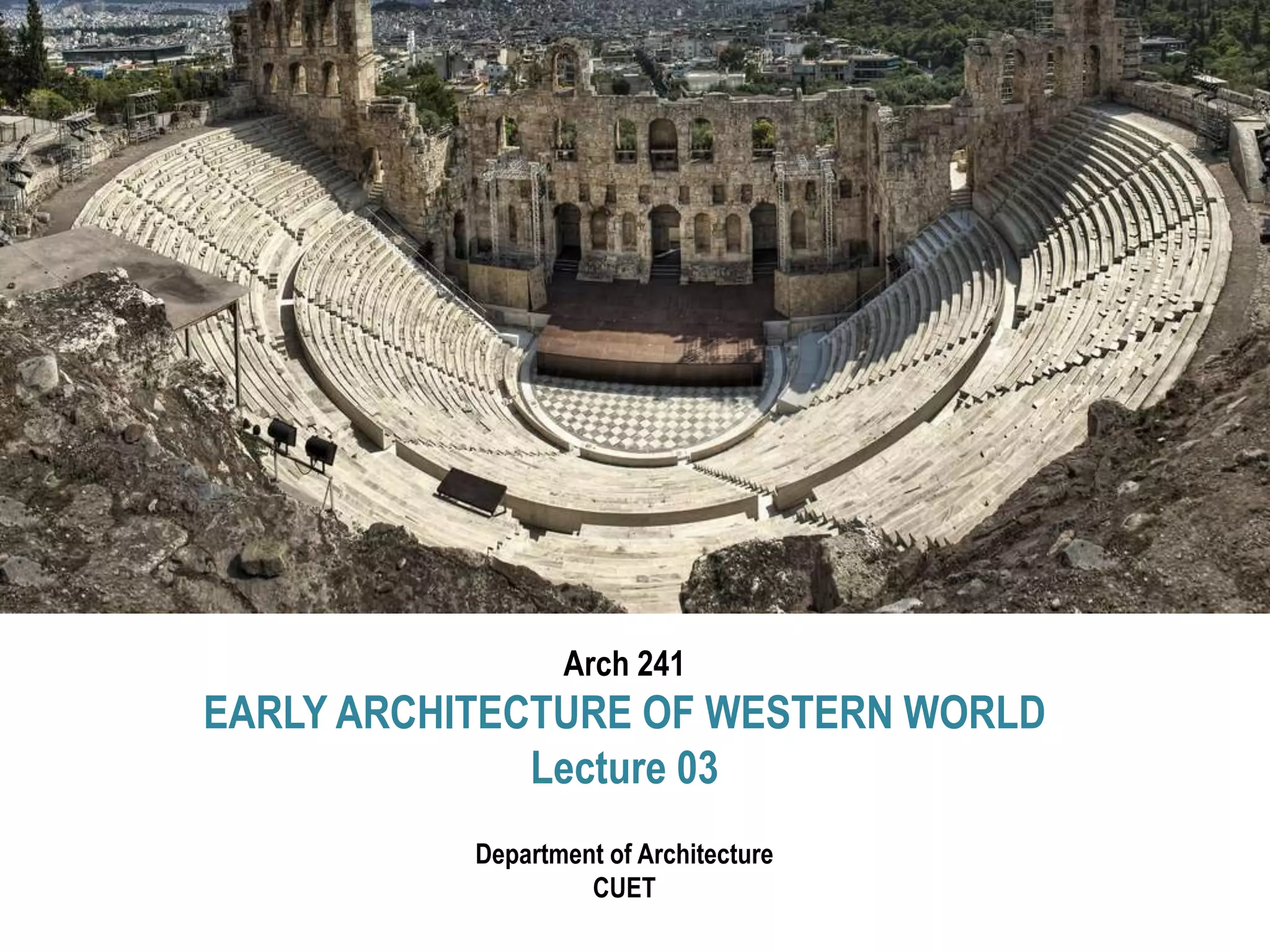
Arch 241
EARLY ARCHITECTURE OF WESTERN WORLD
Lecture 03
Department of Architecture
CUET
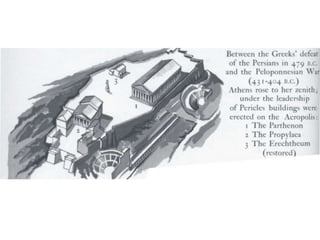
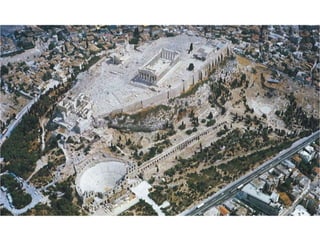
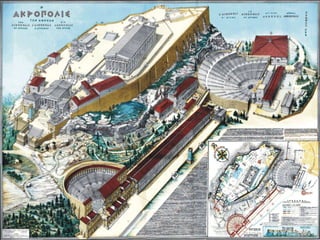
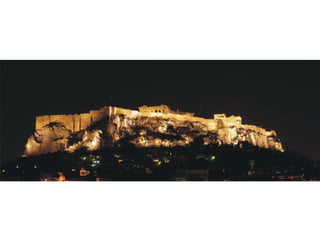
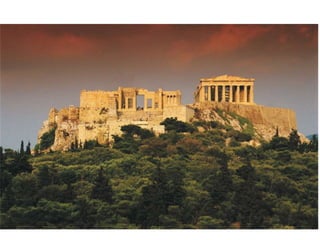
THE ACROPOLIS, ATHENS
Greek Architecture
Typical features of a Greek city
•A principal Temple
•One or two subsidiary temples
•Stoa or colonnaded shelters
•Alters
•Statues or votive columns in honour of heroes, benefactors or victors in games
•Semicircular seats or walled recesses for rest and contemplation.
•Sacred groves of trees.
•Agora, the city square or market place.
•Prytanaeon or civic hall
•Bouleteurion or council house
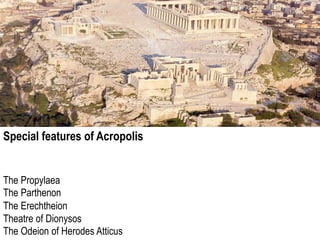
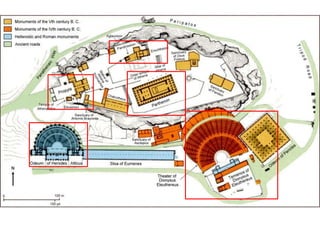
Special features of Acropolis
The Propylaea
The Parthenon
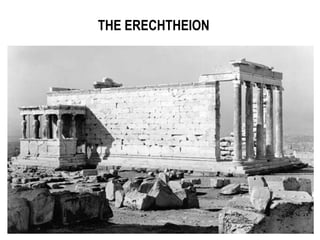
The Erechtheion
Theatre of Dionysos
The Odeion of Herodes Atticus
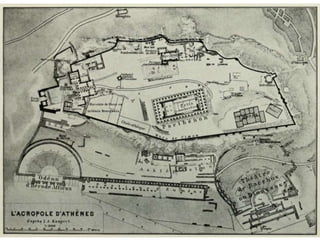
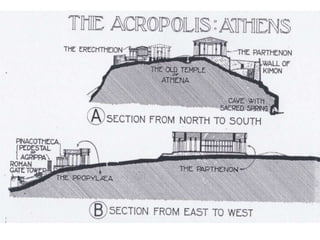
The Growth of the Acropolis
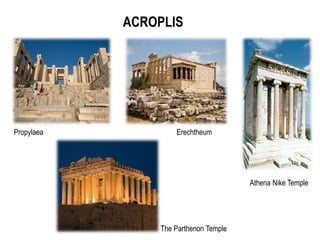
ACROPLIS
Athena Nike Temple
Propylaea Erechtheum
The Parthenon Temple
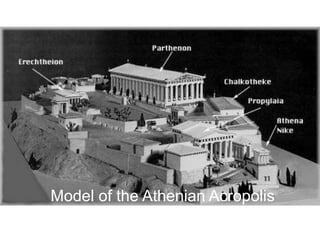
Model of the Athenian Acropolis
Where’d the money come from?
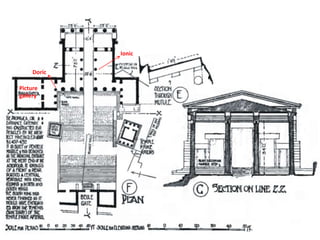
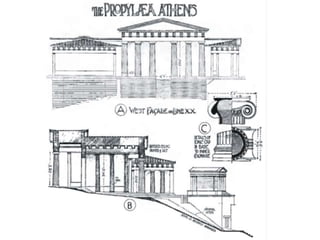
•Propylaea were erected as entrance gateways to many of the principal cities of Greece.
•The Propylaea, Athens, were erected under Pericles by the architect Mnesicles in b.c.437.
•It is at the west end of the Acropolis, being reached by a long flight of steps from the plain
beneath.
•It has front and rear Hexastyle Doric porticos at different levels, giving access to a great
covered hall, having a wide central passage bounded.
•By two rows of Ionic columns, and having at its eastern end a wall in which are five
doorways of different heights.
•On either side of the western entrance portico are projecting wings having three smaller
Doric columns, that to the north being used as a picture gallery, while that to the south was
never completed.
PROPYLAEA, The Acropolis, Athens
Picture
gallery
Ionic
Doric
THE ERECHTHEION
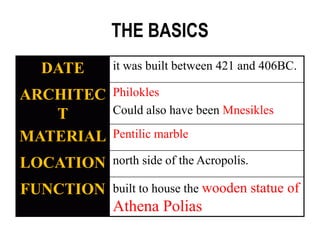
THE BASICS
DATE it was built between 421 and 406BC.
ARCHITEC
T
Philokles
Could also have been Mnesikles
MATERIAL Pentilic marble
LOCATION north side of the Acropolis.
FUNCTION built to house the wooden statue of
Athena Polias
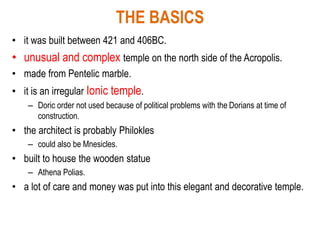
THE BASICS
• it was built between 421 and 406BC.
• unusual and complex temple on the north side of the Acropolis.
• made from Pentelic marble.
• it is an irregular Ionic temple.
– Doric order not used because of political problems with the Dorians at time of
construction.
• the architect is probably Philokles
– could also be Mnesicles.
• built to house the wooden statue
– Athena Polias.
• a lot of care and money was put into this elegant and decorative temple.
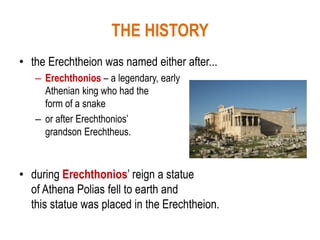
THE HISTORY
• the Erechtheion was named either after...
– Erechthonios – a legendary, early
Athenian king who had the
form of a snake
– or after Erechthonios’
grandson Erechtheus.
• during Erechthonios’ reign a statue
of Athena Polias fell to earth and
this statue was placed in the Erechtheion.
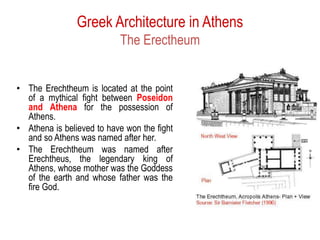
Greek Architecture in Athens
The Erectheum
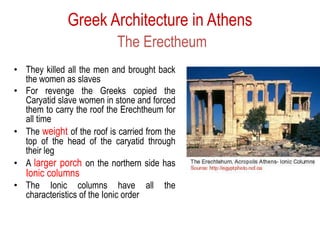
• The Erechtheum is located at the point
of a mythical fight between Poseidon
and Athena for the possession of
Athens.
• Athena is believed to have won the fight
and so Athens was named after her.
• The Erechtheum was named after
Erechtheus, the legendary king of
Athens, whose mother was the Goddess
of the earth and whose father was the
fire God.
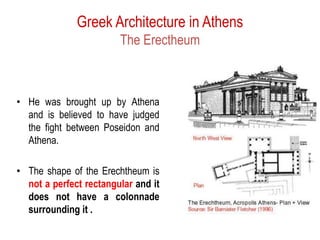
Greek Architecture in Athens
The Erectheum
• He was brought up by Athena
and is believed to have judged
the fight between Poseidon and
Athena.
• The shape of the Erechtheum is
not a perfect rectangular and it
does not have a colonnade
surrounding it .
Greek Architecture in Athens
The Erectheum
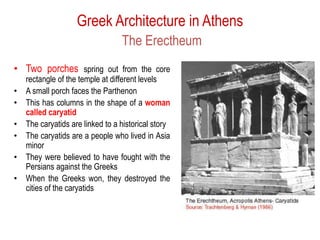
• Two porches spring out from the core
rectangle of the temple at different levels
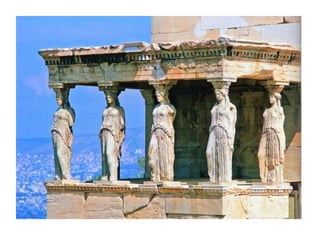
• A small porch faces the Parthenon
• This has columns in the shape of a woman
called caryatid
• The caryatids are linked to a historical story
• The caryatids are a people who lived in Asia
minor
• They were believed to have fought with the
Persians against the Greeks
• When the Greeks won, they destroyed the
cities of the caryatids
Greek Architecture in Athens
The Erectheum
• They killed all the men and brought back
the women as slaves
• For revenge the Greeks copied the
Caryatid slave women in stone and forced
them to carry the roof the Erechtheum for
all time
• The weight of the roof is carried from the
top of the head of the caryatid through
their leg
• A larger porch on the northern side has
Ionic columns
• The Ionic columns have all the
characteristics of the Ionic order
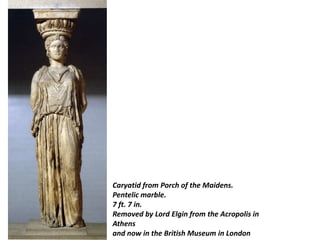
Caryatid from Porch of the Maidens.
Pentelic marble.
7 ft. 7 in.
Removed by Lord Elgin from the Acropolis in
Athens
and now in the British Museum in London
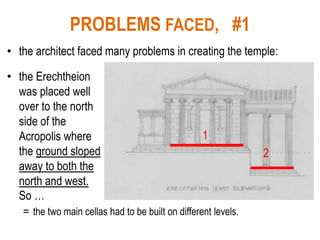
PROBLEMS FACED, #1
• the architect faced many problems in creating the temple:
• the Erechtheion
was placed well
over to the north
side of the
Acropolis where
the ground sloped
away to both the
north and west.
So …
= the two main cellas had to be built on different levels.
1
2
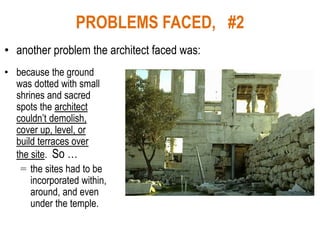
PROBLEMS FACED, #2
• another problem the architect faced was:
• because the ground
was dotted with small
shrines and sacred
spots the architect
couldn’t demolish,
cover up, level, or
build terraces over
the site. So …
= the sites had to be
incorporated within,
around, and even
under the temple.
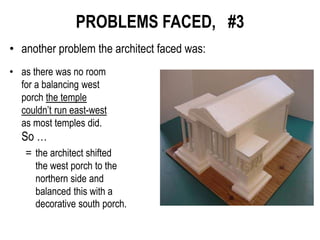
PROBLEMS FACED, #3
• another problem the architect faced was:
• as there was no room
for a balancing west
porch the temple
couldn’t run east-west
as most temples did.
So …
= the architect shifted
the west porch to the
northern side and
balanced this with a
decorative south porch.
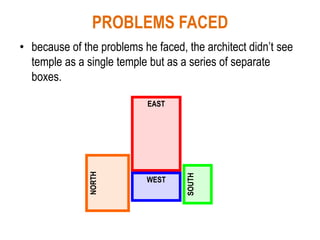
PROBLEMS FACED
• because of the problems he faced, the architect didn’t see
temple as a single temple but as a series of separate
boxes.
NORTH
EAST
WEST
SOUTH
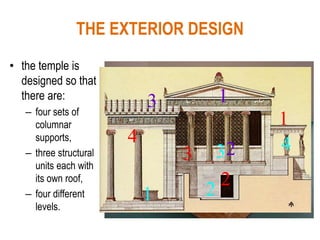
THE EXTERIOR DESIGN
• the temple is
designed so that
there are:
– four sets of
columnar
supports,
– three structural
units each with
its own roof,
– four different
levels.
1
2
3
4
1
2
3
1
3
2
4
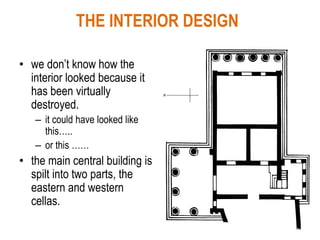
THE INTERIOR DESIGN
• we don’t know how the
interior looked because it
has been virtually
destroyed.
– it could have looked like
this…..
– or this ……
• the main central building is
spilt into two parts, the
eastern and western
cellas.
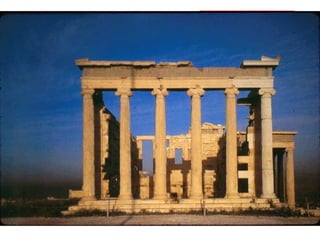
EAST
• entry to the cella was by a
wide doorway and two
windows gave access to the
cella.
• probably contained the cult
statue of Athene Polias.
• there are two altars in the
main room,
– one to Boutes,
– one to Hephaistos.
• the east porch is Ionic Hexastyle.
• another two rooms ran lengthwise down the cella.
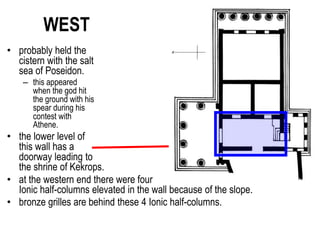
WEST
• probably held the
cistern with the salt
sea of Poseidon.
– this appeared
when the god hit
the ground with his
spear during his
contest with
Athene.
• the lower level of
this wall has a
doorway leading to
the shrine of Kekrops.
• at the western end there were four
Ionic half-columns elevated in the wall because of the slope.
• bronze grilles are behind these 4 Ionic half-columns.
1 2 3 4
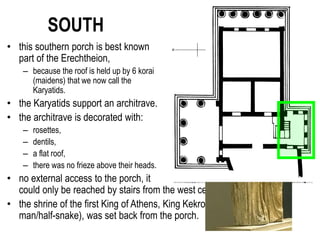
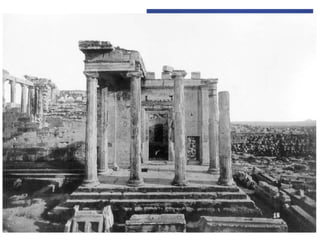
SOUTH
• this southern porch is best known
part of the Erechtheion,
– because the roof is held up by 6 korai
(maidens) that we now call the
Karyatids.
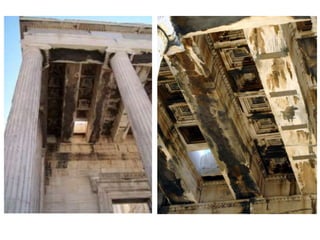
• the Karyatids support an architrave.
• the architrave is decorated with:
– rosettes,
– dentils,
– a flat roof,
– there was no frieze above their heads.
• no external access to the porch, it
could only be reached by stairs from the west cella.
• the shrine of the first King of Athens, King Kekrops (said to be half-
man/half-snake), was set back from the porch.
• essentially the north is a balancing
porch.
• OR a western porch rotated to the
north side.
• 4 Ionic columns stand along the
north façade with two more on the
side.
• the coffered roof had a hole in it to
allow light in because it was here
that a thunderbolt from Zeus was
said to have struck.
• this porch gave access to the western
cella through a large doorway.
• the porch juts out to the west:
– a door here which allows access to the shrine of Pandrosos where an olive tree stood,
the gift of Athena to Athens when she won the competition against Poseidon.
NORTH
DECORATION
• the Ionic columns were highly decorated with gilding
and glass beads and they had elaborate bases and
capitals.
• the porches had coffered marble ceilings while the cellae
had wooden ones.
• a frieze of Pentelic marble was pegged against dark
entablature of Eleusinian limestone.
• the subject of these friezes were probably to do with
foundation myths of Athens.
• cellas had coffered wooden ceilings with each porch having
a coffered marble ceiling.
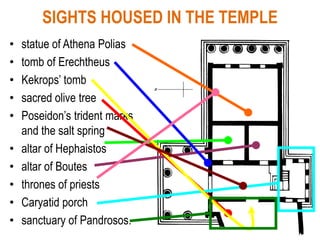
SIGHTS HOUSED IN THE TEMPLE
• statue of Athena Polias
• tomb of Erechtheus
• Kekrops’ tomb
• sacred olive tree
• Poseidon’s trident marks
and the salt spring
• altar of Hephaistos
• altar of Boutes
• thrones of priests
• Caryatid porch
• sanctuary of Pandrosos.
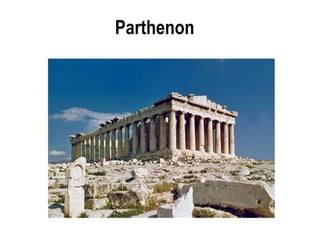
Parthenon
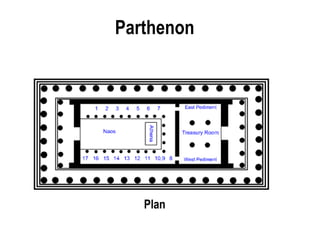
Parthenon
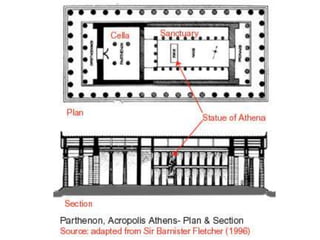
Plan
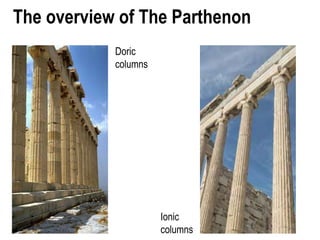
The overview of The Parthenon
Doric
columns
Ionic
columns
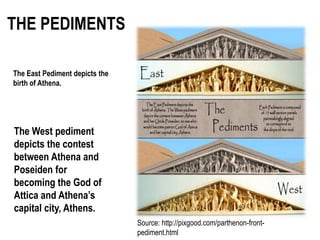
THE PEDIMENTS
Source: http://pixgood.com/parthenon-front-
pediment.html
The East Pediment depicts the
birth of Athena.
The West pediment
depicts the contest
between Athena and
Poseiden for
becoming the God of
Attica and Athena’s
capital city, Athens.
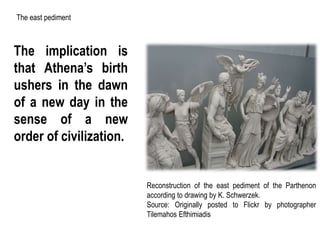
The implication is
that Athena’s birth
ushers in the dawn
of a new day in the
sense of a new
order of civilization.
Reconstruction of the east pediment of the Parthenon
according to drawing by K. Schwerzek.
Source: Originally posted to Flickr by photographer
Tilemahos Efthimiadis
The east pediment
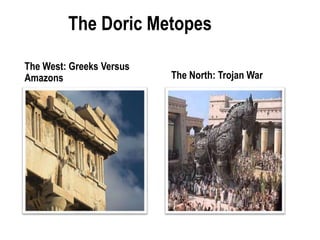
The Doric Metopes
The West: Greeks Versus
Amazons The North: Trojan War
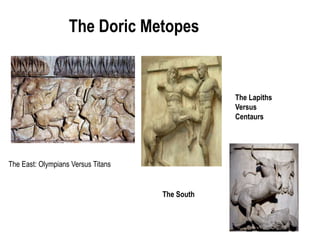
The Doric Metopes
The East: Olympians Versus Titans
The Lapiths
Versus
Centaurs
The South
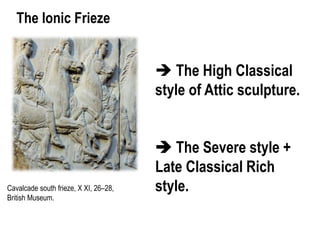
The Ionic Frieze
Cavalcade south frieze, X XI, 26–28,
British Museum.
 The High Classical
style of Attic sculpture.
 The Severe style +
Late Classical Rich
style.
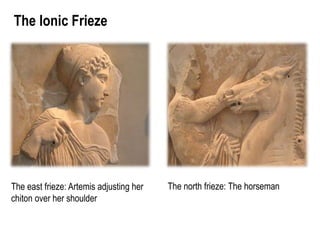
The Ionic Frieze
The east frieze: Artemis adjusting her
chiton over her shoulder
The north frieze: The horseman
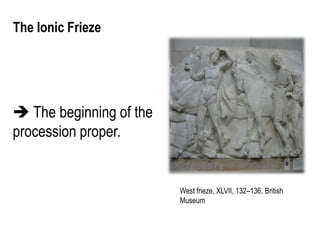
The Ionic Frieze
West frieze, XLVII, 132–136, British
Museum
 The beginning of the
procession proper.
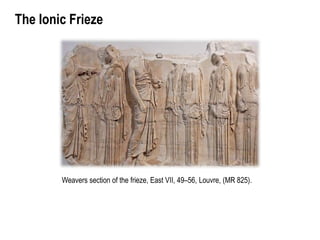
The Ionic Frieze
Weavers section of the frieze, East VII, 49–56, Louvre, (MR 825).
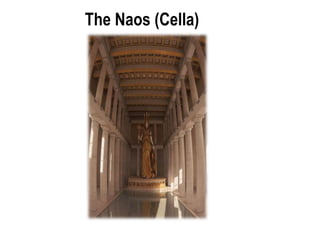
The Naos (Cella)
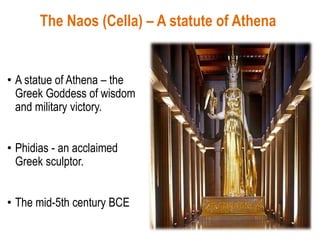
The Naos (Cella) – A statute of Athena
• A statue of Athena – the
Greek Goddess of wisdom
and military victory.
• Phidias - an acclaimed
Greek sculptor.
• The mid-5th century BCE
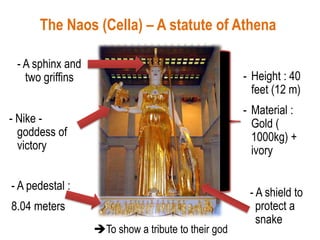
The Naos (Cella) – A statute of Athena
- Nike -
goddess of
victory
- A sphinx and
two griffins
- A shield to
protect a
snake
- Height : 40
feet (12 m)
- Material :
Gold (
1000kg) +
ivory
- A pedestal :
8.04 meters
To show a tribute to their god
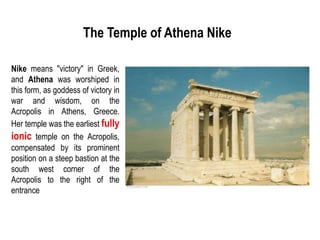
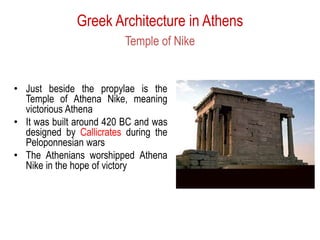
The Temple of Athena Nike
Nike means "victory" in Greek,
and Athena was worshiped in
this form, as goddess of victory in
war and wisdom, on the
Acropolis in Athens, Greece.
Her temple was the earliest fully
ionic temple on the Acropolis,
compensated by its prominent
position on a steep bastion at the
south west corner of the
Acropolis to the right of the
entrance
Greek Architecture in Athens
Temple of Nike
• Just beside the propylae is the
Temple of Athena Nike, meaning
victorious Athena
• It was built around 420 BC and was
designed by Callicrates during the
Peloponnesian wars
• The Athenians worshipped Athena
Nike in the hope of victory
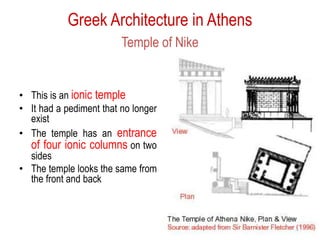
Greek Architecture in Athens
Temple of Nike
• This is an ionic temple
• It had a pediment that no longer
exist
• The temple has an entrance
of four ionic columns on two
sides
• The temple looks the same from
the front and back
Public architecture
• Propylaea or porch was a monumental entrance to a
temenos or holy area
• Fountain houses
• Stoa: long narrow hall with an open colonnade that was
used as exhibition room
• Agora: commercial centre of the city
• Palestra or gymnasium, the social centre for male
citizens
• Bouleterion or council chamber
egend:
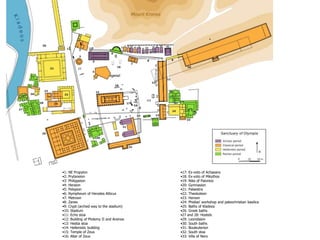
•1: NE Propylon
•2: Prytaneion
•3: Philippeion
•4: Heraion
•5: Pelopion
•6: Nympheum of Herodes Atticus
•7: Metroon
•8: Zanes
•9: Crypt (arched way to the stadium)
•10: Stadium
•11: Echo stoa
•12: Building of Ptolemy II and Arsinoe
•13: Hestia stoa
•14: Hellenistic building
•15: Temple of Zeus
•16: Altar of Zeus
•17: Ex-voto of Achaeans
•18: Ex-voto of Mikythos
•19: Nike of Paionios
•20: Gymnasion
•21: Palaestra
•22: Theokoleon
•23: Heroon
•24: Phidias' workshop and paleochristian basilica
•25: Baths of Kladeos
•26: Greek baths
•27 and 28: Hostels
•29: Leonidaion
•30: South baths
•31: Bouleuterion
•32: South stoa
•33: Villa of Nero
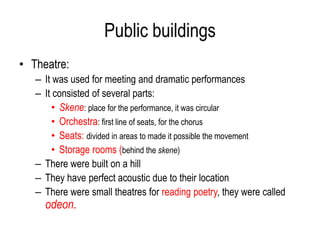
Public buildings
• Theatre:
– It was used for meeting and dramatic performances
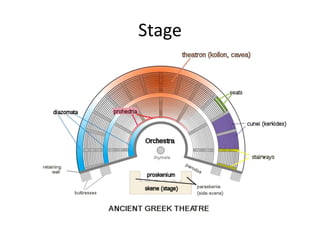
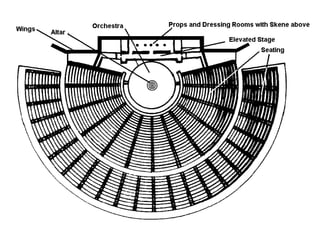
– It consisted of several parts:
• Skene: place for the performance, it was circular
• Orchestra: first line of seats, for the chorus
• Seats: divided in areas to made it possible the movement
• Storage rooms (behind the skene)
– There were built on a hill
– They have perfect acoustic due to their location
– There were small theatres for reading poetry, they were called
odeon.
Stage
Civic Architecture
Theaters – Theater Epidarus
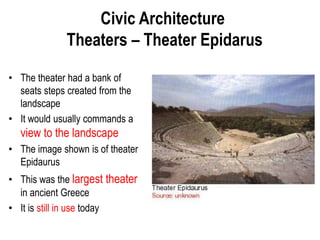
• The theater had a bank of
seats steps created from the
landscape
• It would usually commands a
view to the landscape
• The image shown is of theater
Epidaurus
• This was the largest theater
in ancient Greece
• It is still in use today
Greek City Planning and Design
The Acropolis
• The Acropolis was the city of temples
• It is the location where all the major temples of a city are located
• It was built to glorify the Gods
• Greeks considered high places to be important & sacred
• The Acropolis were usually located on the highest ground
• Other public buildings such as gymnasia, stadia, and theaters were
generally regarded as part of religious rituals
• They are normally found attached on lower ground to the hills of the
Acropolis
Greek City Planning and Design
The Town
• The town was where the people lived
• This was the domain of women, who did not have any public role
• Early Greek towns had an irregular street pattern, resulting from
its organic growth
• Later Hellenistic towns such as Prienne had a formal rectilinear
pattern
• The town was made up of only residential houses
Greek City Planning and Design
The Town
• Houses were usually constructed of mud bricks
• Houses were of the courtyard type, with rooms arranged around a
courtyard
• Houses vary according to standing in the society
• Houses of poor people were very simple compared to the house of the
rich, which had more rooms and better finishing
Greek Architecture in Athens
Architecture, Planning & Design
• Athens is a very good example of a typical ancient Greek city
• The city has the three components of acropolis, agora and town
found in a Greek city
• The Acropolis and Agora in Athens also have some of the best
examples of ancient Greek architecture
• We will examine the Acropolis and Agora in Athens to understand Greek
architecture, planning and city design.
Greek City Planning and Design
The Agora
• The Agora was the most important gathering place in a Greek
city
• It started as an open area where the council of the city met to take
decisions
• With time buildings were constructed to define and enclose the space
• It also transformed into a place for combined social, commercial and
political activities
• It emerged as the heart of Greek intellectual life and discourse.
• It was usually located on a flat ground for ease of communication
• It was placed to be easily accessible from all directions
• In many cities, it is also located close to the Acropolis
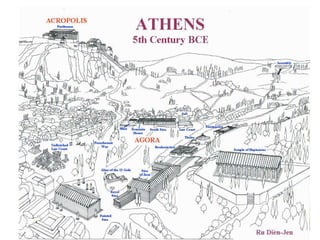
Greek Architecture in Athens
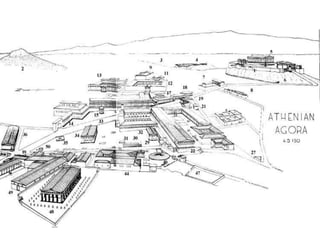
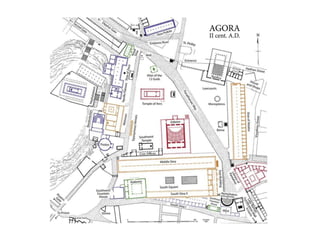
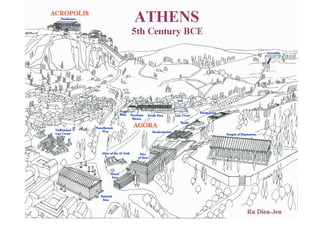
The Agora
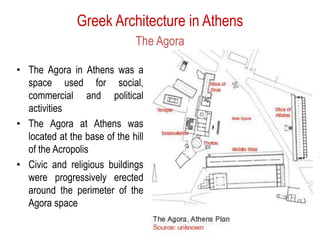
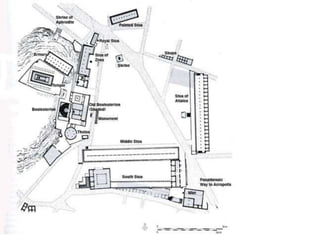
• The Agora in Athens was a
space used for social,
commercial and political
activities
• The Agora at Athens was
located at the base of the hill
of the Acropolis
• Civic and religious buildings
were progressively erected
around the perimeter of the
Agora space
Greek Architecture in Athens
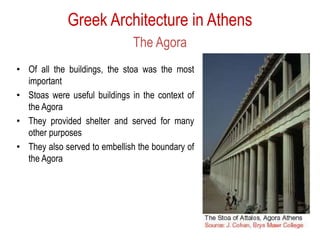
The Agora
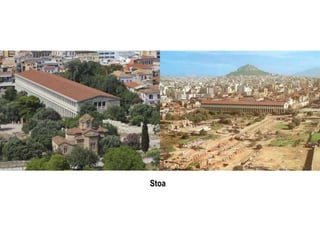
• Of all the buildings, the stoa was the most
important
• Stoas were useful buildings in the context of
the Agora
• They provided shelter and served for many
other purposes
• They also served to embellish the boundary of
the Agora
Stoa
Greek Architecture in Athens
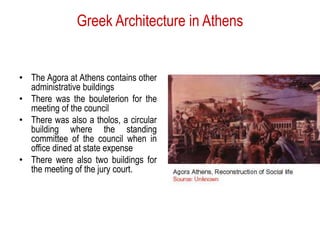
• The Agora at Athens contains other
administrative buildings
• There was the bouleterion for the
meeting of the council
• There was also a tholos, a circular
building where the standing
committee of the council when in
office dined at state expense
• There were also two buildings for
the meeting of the jury court.
Greek Architecture in Athens
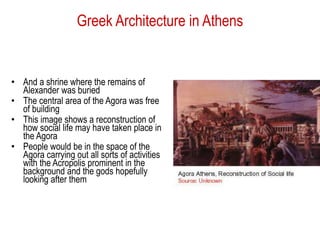
• And a shrine where the remains of
Alexander was buried
• The central area of the Agora was free
of building
• This image shows a reconstruction of
how social life may have taken place in
the Agora
• People would be in the space of the
Agora carrying out all sorts of activities
with the Acropolis prominent in the
background and the gods hopefully
looking after them
greek 03.pptx
greek 03.pptx

greek 03.pptx

  • 1.
    Arch 241 EARLY ARCHITECTUREOF WESTERN WORLD Lecture 03 Department of Architecture CUET
  • 2.
    THE ACROPOLIS, ATHENS GreekArchitecture Typical features of a Greek city •A principal Temple •One or two subsidiary temples •Stoa or colonnaded shelters •Alters •Statues or votive columns in honour of heroes, benefactors or victors in games •Semicircular seats or walled recesses for rest and contemplation. •Sacred groves of trees. •Agora, the city square or market place. •Prytanaeon or civic hall •Bouleteurion or council house
  • 3.
    Special features ofAcropolis The Propylaea The Parthenon The Erechtheion Theatre of Dionysos The Odeion of Herodes Atticus
  • 4.
    The Growth ofthe Acropolis
  • 5.
    ACROPLIS Athena Nike Temple PropylaeaErechtheum The Parthenon Temple
  • 6.
    Model of theAthenian Acropolis Where’d the money come from?
  • 13.
    •Propylaea were erectedas entrance gateways to many of the principal cities of Greece. •The Propylaea, Athens, were erected under Pericles by the architect Mnesicles in b.c.437. •It is at the west end of the Acropolis, being reached by a long flight of steps from the plain beneath. •It has front and rear Hexastyle Doric porticos at different levels, giving access to a great covered hall, having a wide central passage bounded. •By two rows of Ionic columns, and having at its eastern end a wall in which are five doorways of different heights. •On either side of the western entrance portico are projecting wings having three smaller Doric columns, that to the north being used as a picture gallery, while that to the south was never completed. PROPYLAEA, The Acropolis, Athens
  • 14.
  • 18.
  • 19.
    THE BASICS DATE itwas built between 421 and 406BC. ARCHITEC T Philokles Could also have been Mnesikles MATERIAL Pentilic marble LOCATION north side of the Acropolis. FUNCTION built to house the wooden statue of Athena Polias
  • 20.
    THE BASICS • itwas built between 421 and 406BC. • unusual and complex temple on the north side of the Acropolis. • made from Pentelic marble. • it is an irregular Ionic temple. – Doric order not used because of political problems with the Dorians at time of construction. • the architect is probably Philokles – could also be Mnesicles. • built to house the wooden statue – Athena Polias. • a lot of care and money was put into this elegant and decorative temple.
  • 21.
    THE HISTORY • theErechtheion was named either after... – Erechthonios – a legendary, early Athenian king who had the form of a snake – or after Erechthonios’ grandson Erechtheus. • during Erechthonios’ reign a statue of Athena Polias fell to earth and this statue was placed in the Erechtheion.
  • 22.
    Greek Architecture inAthens The Erectheum • The Erechtheum is located at the point of a mythical fight between Poseidon and Athena for the possession of Athens. • Athena is believed to have won the fight and so Athens was named after her. • The Erechtheum was named after Erechtheus, the legendary king of Athens, whose mother was the Goddess of the earth and whose father was the fire God.
  • 23.
    Greek Architecture inAthens The Erectheum • He was brought up by Athena and is believed to have judged the fight between Poseidon and Athena. • The shape of the Erechtheum is not a perfect rectangular and it does not have a colonnade surrounding it .
  • 24.
    Greek Architecture inAthens The Erectheum • Two porches spring out from the core rectangle of the temple at different levels • A small porch faces the Parthenon • This has columns in the shape of a woman called caryatid • The caryatids are linked to a historical story • The caryatids are a people who lived in Asia minor • They were believed to have fought with the Persians against the Greeks • When the Greeks won, they destroyed the cities of the caryatids
  • 25.
    Greek Architecture inAthens The Erectheum • They killed all the men and brought back the women as slaves • For revenge the Greeks copied the Caryatid slave women in stone and forced them to carry the roof the Erechtheum for all time • The weight of the roof is carried from the top of the head of the caryatid through their leg • A larger porch on the northern side has Ionic columns • The Ionic columns have all the characteristics of the Ionic order
  • 27.
    Caryatid from Porchof the Maidens. Pentelic marble. 7 ft. 7 in. Removed by Lord Elgin from the Acropolis in Athens and now in the British Museum in London
  • 28.
    PROBLEMS FACED, #1 •the architect faced many problems in creating the temple: • the Erechtheion was placed well over to the north side of the Acropolis where the ground sloped away to both the north and west. So … = the two main cellas had to be built on different levels. 1 2
  • 29.
    PROBLEMS FACED, #2 •another problem the architect faced was: • because the ground was dotted with small shrines and sacred spots the architect couldn’t demolish, cover up, level, or build terraces over the site. So … = the sites had to be incorporated within, around, and even under the temple.
  • 30.
    PROBLEMS FACED, #3 •another problem the architect faced was: • as there was no room for a balancing west porch the temple couldn’t run east-west as most temples did. So … = the architect shifted the west porch to the northern side and balanced this with a decorative south porch.
  • 31.
    PROBLEMS FACED • becauseof the problems he faced, the architect didn’t see temple as a single temple but as a series of separate boxes. NORTH EAST WEST SOUTH
  • 32.
    THE EXTERIOR DESIGN •the temple is designed so that there are: – four sets of columnar supports, – three structural units each with its own roof, – four different levels. 1 2 3 4 1 2 3 1 3 2 4
  • 33.
    THE INTERIOR DESIGN •we don’t know how the interior looked because it has been virtually destroyed. – it could have looked like this….. – or this …… • the main central building is spilt into two parts, the eastern and western cellas.
  • 34.
    EAST • entry tothe cella was by a wide doorway and two windows gave access to the cella. • probably contained the cult statue of Athene Polias. • there are two altars in the main room, – one to Boutes, – one to Hephaistos. • the east porch is Ionic Hexastyle. • another two rooms ran lengthwise down the cella.
  • 35.
    WEST • probably heldthe cistern with the salt sea of Poseidon. – this appeared when the god hit the ground with his spear during his contest with Athene. • the lower level of this wall has a doorway leading to the shrine of Kekrops. • at the western end there were four Ionic half-columns elevated in the wall because of the slope. • bronze grilles are behind these 4 Ionic half-columns. 1 2 3 4
  • 36.
    SOUTH • this southernporch is best known part of the Erechtheion, – because the roof is held up by 6 korai (maidens) that we now call the Karyatids. • the Karyatids support an architrave. • the architrave is decorated with: – rosettes, – dentils, – a flat roof, – there was no frieze above their heads. • no external access to the porch, it could only be reached by stairs from the west cella. • the shrine of the first King of Athens, King Kekrops (said to be half- man/half-snake), was set back from the porch.
  • 37.
    • essentially thenorth is a balancing porch. • OR a western porch rotated to the north side. • 4 Ionic columns stand along the north façade with two more on the side. • the coffered roof had a hole in it to allow light in because it was here that a thunderbolt from Zeus was said to have struck. • this porch gave access to the western cella through a large doorway. • the porch juts out to the west: – a door here which allows access to the shrine of Pandrosos where an olive tree stood, the gift of Athena to Athens when she won the competition against Poseidon. NORTH
  • 39.
    DECORATION • the Ioniccolumns were highly decorated with gilding and glass beads and they had elaborate bases and capitals. • the porches had coffered marble ceilings while the cellae had wooden ones. • a frieze of Pentelic marble was pegged against dark entablature of Eleusinian limestone. • the subject of these friezes were probably to do with foundation myths of Athens. • cellas had coffered wooden ceilings with each porch having a coffered marble ceiling.
  • 40.
    SIGHTS HOUSED INTHE TEMPLE • statue of Athena Polias • tomb of Erechtheus • Kekrops’ tomb • sacred olive tree • Poseidon’s trident marks and the salt spring • altar of Hephaistos • altar of Boutes • thrones of priests • Caryatid porch • sanctuary of Pandrosos.
  • 41.
  • 42.
  • 44.
    The overview ofThe Parthenon Doric columns Ionic columns
  • 45.
    THE PEDIMENTS Source: http://pixgood.com/parthenon-front- pediment.html TheEast Pediment depicts the birth of Athena. The West pediment depicts the contest between Athena and Poseiden for becoming the God of Attica and Athena’s capital city, Athens.
  • 46.
    The implication is thatAthena’s birth ushers in the dawn of a new day in the sense of a new order of civilization. Reconstruction of the east pediment of the Parthenon according to drawing by K. Schwerzek. Source: Originally posted to Flickr by photographer Tilemahos Efthimiadis The east pediment
  • 47.
    The Doric Metopes TheWest: Greeks Versus Amazons The North: Trojan War
  • 48.
    The Doric Metopes TheEast: Olympians Versus Titans The Lapiths Versus Centaurs The South
  • 49.
    The Ionic Frieze Cavalcadesouth frieze, X XI, 26–28, British Museum.  The High Classical style of Attic sculpture.  The Severe style + Late Classical Rich style.
  • 50.
    The Ionic Frieze Theeast frieze: Artemis adjusting her chiton over her shoulder The north frieze: The horseman
  • 51.
    The Ionic Frieze Westfrieze, XLVII, 132–136, British Museum  The beginning of the procession proper.
  • 52.
    The Ionic Frieze Weaverssection of the frieze, East VII, 49–56, Louvre, (MR 825).
  • 53.
  • 54.
    The Naos (Cella)– A statute of Athena • A statue of Athena – the Greek Goddess of wisdom and military victory. • Phidias - an acclaimed Greek sculptor. • The mid-5th century BCE
  • 55.
    The Naos (Cella)– A statute of Athena - Nike - goddess of victory - A sphinx and two griffins - A shield to protect a snake - Height : 40 feet (12 m) - Material : Gold ( 1000kg) + ivory - A pedestal : 8.04 meters To show a tribute to their god
  • 56.
    The Temple ofAthena Nike Nike means "victory" in Greek, and Athena was worshiped in this form, as goddess of victory in war and wisdom, on the Acropolis in Athens, Greece. Her temple was the earliest fully ionic temple on the Acropolis, compensated by its prominent position on a steep bastion at the south west corner of the Acropolis to the right of the entrance
  • 57.
    Greek Architecture inAthens Temple of Nike • Just beside the propylae is the Temple of Athena Nike, meaning victorious Athena • It was built around 420 BC and was designed by Callicrates during the Peloponnesian wars • The Athenians worshipped Athena Nike in the hope of victory
  • 58.
    Greek Architecture inAthens Temple of Nike • This is an ionic temple • It had a pediment that no longer exist • The temple has an entrance of four ionic columns on two sides • The temple looks the same from the front and back
  • 59.
    Public architecture • Propylaeaor porch was a monumental entrance to a temenos or holy area • Fountain houses • Stoa: long narrow hall with an open colonnade that was used as exhibition room • Agora: commercial centre of the city • Palestra or gymnasium, the social centre for male citizens • Bouleterion or council chamber
  • 61.
    egend: •1: NE Propylon •2:Prytaneion •3: Philippeion •4: Heraion •5: Pelopion •6: Nympheum of Herodes Atticus •7: Metroon •8: Zanes •9: Crypt (arched way to the stadium) •10: Stadium •11: Echo stoa •12: Building of Ptolemy II and Arsinoe •13: Hestia stoa •14: Hellenistic building •15: Temple of Zeus •16: Altar of Zeus •17: Ex-voto of Achaeans •18: Ex-voto of Mikythos •19: Nike of Paionios •20: Gymnasion •21: Palaestra •22: Theokoleon •23: Heroon •24: Phidias' workshop and paleochristian basilica •25: Baths of Kladeos •26: Greek baths •27 and 28: Hostels •29: Leonidaion •30: South baths •31: Bouleuterion •32: South stoa •33: Villa of Nero
  • 62.
    Public buildings • Theatre: –It was used for meeting and dramatic performances – It consisted of several parts: • Skene: place for the performance, it was circular • Orchestra: first line of seats, for the chorus • Seats: divided in areas to made it possible the movement • Storage rooms (behind the skene) – There were built on a hill – They have perfect acoustic due to their location – There were small theatres for reading poetry, they were called odeon.
  • 63.
  • 65.
    Civic Architecture Theaters –Theater Epidarus • The theater had a bank of seats steps created from the landscape • It would usually commands a view to the landscape • The image shown is of theater Epidaurus • This was the largest theater in ancient Greece • It is still in use today
  • 66.
    Greek City Planningand Design The Acropolis • The Acropolis was the city of temples • It is the location where all the major temples of a city are located • It was built to glorify the Gods • Greeks considered high places to be important & sacred • The Acropolis were usually located on the highest ground • Other public buildings such as gymnasia, stadia, and theaters were generally regarded as part of religious rituals • They are normally found attached on lower ground to the hills of the Acropolis
  • 67.
    Greek City Planningand Design The Town • The town was where the people lived • This was the domain of women, who did not have any public role • Early Greek towns had an irregular street pattern, resulting from its organic growth • Later Hellenistic towns such as Prienne had a formal rectilinear pattern • The town was made up of only residential houses
  • 68.
    Greek City Planningand Design The Town • Houses were usually constructed of mud bricks • Houses were of the courtyard type, with rooms arranged around a courtyard • Houses vary according to standing in the society • Houses of poor people were very simple compared to the house of the rich, which had more rooms and better finishing
  • 69.
    Greek Architecture inAthens Architecture, Planning & Design • Athens is a very good example of a typical ancient Greek city • The city has the three components of acropolis, agora and town found in a Greek city • The Acropolis and Agora in Athens also have some of the best examples of ancient Greek architecture • We will examine the Acropolis and Agora in Athens to understand Greek architecture, planning and city design.
  • 70.
    Greek City Planningand Design The Agora • The Agora was the most important gathering place in a Greek city • It started as an open area where the council of the city met to take decisions • With time buildings were constructed to define and enclose the space • It also transformed into a place for combined social, commercial and political activities • It emerged as the heart of Greek intellectual life and discourse. • It was usually located on a flat ground for ease of communication • It was placed to be easily accessible from all directions • In many cities, it is also located close to the Acropolis
  • 71.
    Greek Architecture inAthens The Agora • The Agora in Athens was a space used for social, commercial and political activities • The Agora at Athens was located at the base of the hill of the Acropolis • Civic and religious buildings were progressively erected around the perimeter of the Agora space
  • 74.
    Greek Architecture inAthens The Agora • Of all the buildings, the stoa was the most important • Stoas were useful buildings in the context of the Agora • They provided shelter and served for many other purposes • They also served to embellish the boundary of the Agora
  • 75.
  • 76.
    Greek Architecture inAthens • The Agora at Athens contains other administrative buildings • There was the bouleterion for the meeting of the council • There was also a tholos, a circular building where the standing committee of the council when in office dined at state expense • There were also two buildings for the meeting of the jury court.
  • 77.
    Greek Architecture inAthens • And a shrine where the remains of Alexander was buried • The central area of the Agora was free of building • This image shows a reconstruction of how social life may have taken place in the Agora • People would be in the space of the Agora carrying out all sorts of activities with the Acropolis prominent in the background and the gods hopefully looking after them