Classical Architecture:
A Timeless Embodiment of Balance, Harmony, and Elegance
PREPARED BY :
JAMUNA BAMANU(770113)
KRISHMA DUWAL(770117)
NIRUTA SHRESTHA (770122)
PUNISHA TITAJU(770127)
INTRODUCTION
01
VITRUVIUS
02
THE PARTHENON
03
Table of contents
Introduction
● A style of building originated in ancient
Greece (5th century) and Rome (3rd
century)
● Known for the ornamentation of their
columns and pediments
● Visual emphasis on the facade which were
often filled with reliefs and statues
● Reproduced throughout the architectural
history; The Renaissance, Neoclassicism
etc
● Primarily trabeated (post & beam) and
evolved from timber origin
● Colosseum, Pantheon, Parthenon,
Erechtheion;most common examples
Colosseum Pantheon
Parthenon Erechtheion
● Followed the concept of boldness, humility and
intellect
● Symmetry and proportion: evenly spaced out
columns and windows
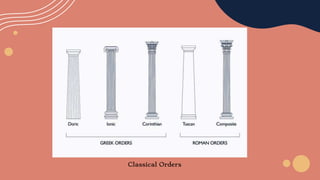
● Columns in specific style(orders): Doric, Ionic
and Corinthian for Greek & Tuscan and
Composite for Romans
● Front topped with a pediment: full height front
porch with pediment on top and centrally
positioned door
● Durable building material: marble, concrete and
brick
● Elegance and Simplicity: values simplicity and
elegance in design. Not too much ornamentation
is applied to enhance the building's aesthetic
without overwhelming it.
Characteristics
Elements
Classical Orders
● Roman classical architect, engineer, and writer who
lived during the first century BC.
● Born in northern Italy and received a comprehensive
education in mathematics, science, and engineering.
● Best known for his influential book, De Architectura,
● Originated the idea that all buildings should have three
attributes: Firmitas, Utilitas, and Venustas
● Served as a military engineer under Julius Caesar
initially
● Later worked on several architectural projects, including
the construction of public buildings, aqueducts, and
fortifications.
MARCUS VITRUVIUS POLLIO
● Treatise on architecture written by Marcus Vitruvius Pollio in the first
century BC. It was based on his own experience as well as on theoretical
works by famous Greek architects such as Hermogenes.
● De Architectura outlines three key design principles :proportion, symmetry,
and durability ,were essential to creating buildings that were both functional
and aesthetically pleasing.
● The book is divided into ten volumes, each focusing on a different aspect of
architecture, such as materials, proportions, and construction techniques.
● For example, Vitruvius discusses the importance of using durable materials,
such as stone and brick, and emphasizes the need for symmetry and
proportion in design.
DE ARCHITECTURA
Vitruvius designed and supervised the
construction of this Basilica in Fano
(reconstruction). However, many of the other
things he did would not now be considered the
realm of architecture.
HIS CONTRIBUTION
● De Architectura
● Principles of Architecture
● Proportions and Symmetry
● Construction Techniques
● Town Planning and Engineering
● Historical Insights
● Influence on Renaissance
Architecture
In conclusion, Marcus Vitruvius Pollio was a
remarkable figure in the history of architecture
and engineering. His work, De Architectura, is still
studied and admired today for its insights into
design principles such as proportion, symmetry,
and durability.
His's legacy has had a lasting impact on the field of
architecture, influencing countless designers and
engineers over the centuries. His contributions to
the field cannot be overstated, and we owe him a
debt of gratitude for his insights and innovations.
Vitruvian Man
● Temple that dominates the hill of the
Acropolis at Athens, Greece
● Built in the mid-5th century BCE and
dedicated to the Greek goddess Athena
Parthenos (“Athena the Virgin”) -under the
Architects Ictinus and Callicrates.
● Generally considered to be the Culmination
of the development of the Doric order, the
simplest of the three Classical Greek
architectural.
● Includes gold and ivory statue of Athena for
interior decoration and exterior decoration
of the building continued until 432 BCE.
THE PARTHENON
(TEMPLE OF VIRGIN GODDESS: ATHENA)
Fig: Acropolis
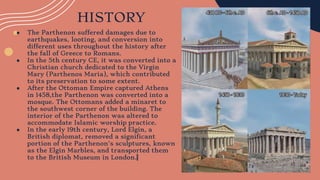
HISTORY
● The Parthenon suffered damages due to
earthquakes, looting, and conversion into
different uses throughout the history after
the fall of Greece to Romans.
● In the 5th century CE, it was converted into a
Christian church dedicated to the Virgin
Mary (Parthenos Maria), which contributed
to its preservation to some extent.
● After the Ottoman Empire captured Athens
in 1458,the Parthenon was converted into a
mosque. The Ottomans added a minaret to
the southwest corner of the building. The
interior of the Parthenon was altered to
accommodate Islamic worship practice.
● In the early 19th century, Lord Elgin, a
British diplomat, removed a significant
portion of the Parthenon's sculptures, known
as the Elgin Marbles, and transported them
to the British Museum in London.
● Religious Significance: It was an expression of the
city's devotion to its protector deity: Athena
Parthenos
● Civic Pride: Its construction was part of ‘vision to
showcase Athens’ cultural and political supremacy.
● Celebration of Democracy: It embodied democratic
ideals as its grandeur and accessibility emphasized
the city's commitment to involving citizens in
public life and celebrating their achievements.
● Cultural Identity: To provide sense of shared
cultural identity among the Athenians.
PURPOSE AND
SYMBOLISM
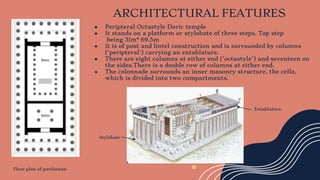
● Peripteral Octastyle Doric temple
● It stands on a platform or stylobate of three steps. Top step
being 31m* 69.5m
● It is of post and lintel construction and is surrounded by columns
('peripteral') carrying an entablature.
● There are eight columns at either end ('octastyle') and seventeen on
the sides.There is a double row of columns at either end.
● The colonnade surrounds an inner masonry structure, the cella,
which is divided into two compartments.
ARCHITECTURAL FEATURES
Floor plan of parthenon
Stylobate
Entablature
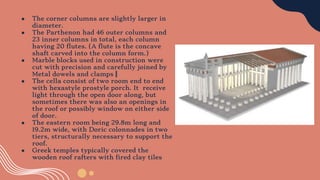
● The corner columns are slightly larger in
diameter.
● The Parthenon had 46 outer columns and
23 inner columns in total, each column
having 20 flutes. (A flute is the concave
shaft carved into the column form.)
● Marble blocks used in construction were
cut with precision and carefully joined by
Metal dowels and clamps
● The cella consist of two room end to end
with hexastyle prostyle porch. It receive
light through the open door along, but
sometimes there was also an openings in
the roof or possibly window on either side
of door.
● The eastern room being 29.8m long and
19.2m wide, with Doric colonnades in two
tiers, structurally necessary to support the
roof.
● Greek temples typically covered the
wooden roof rafters with fired clay tiles
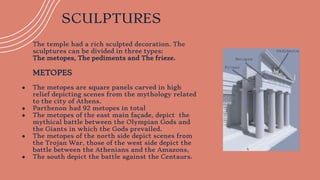
The temple had a rich sculpted decoration. The
sculptures can be divided in three types:
The metopes, The pediments and The frieze.
METOPES
● The metopes are square panels carved in high
relief depicting scenes from the mythology related
to the city of Athens.
● Parthenon had 92 metopes in total
● The metopes of the east main façade, depict the
mythical battle between the Olympian Gods and
the Giants in which the Gods prevailed.
● The metopes of the north side depict scenes from
the Trojan War, those of the west side depict the
battle between the Athenians and the Amazons,
● The south depict the battle against the Centaurs.
SCULPTURES
PEDIMENTS
● The two triangular pediments of the
Parthenon contain full sculptures of gods
and deities. The east pediment depicts the
birth of goddess Athena, while the west
depicts the quarrel between Athena and
Poseidon for the sovereignty over Athens.
FRIEZE
● The Parthenon frieze is a high-relief
sculpted zone all around the cella of the
temple. It is 160 metres long and it depicts
the Panathenaic Procession, the most
important religious festival of Athens. The
frieze contains 378 human and god figures
and more than 200 animals, mainly
horses.
PART OF EAST PEDIMENTS
FRIEZE OF PARTHENON
THE INTERIOR
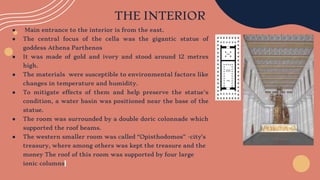
● Main entrance to the interior is from the east.
● The central focus of the cella was the gigantic statue of
goddess Athena Parthenos
● It was made of gold and ivory and stood around 12 metres
high.
● The materials were susceptible to environmental factors like
changes in temperature and humidity.
● To mitigate effects of them and help preserve the statue's
condition, a water basin was positioned near the base of the
statue.
● The room was surrounded by a double doric colonnade which
supported the roof beams.
● The western smaller room was called “Opisthodomos” -city’s
treasury, where among others was kept the treasure and the
money The roof of this room was supported by four large
ionic columns
AESTHETIC REFINEMENTS
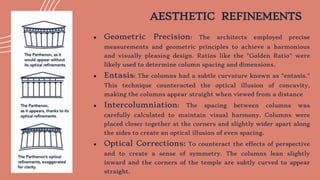
● Geometric Precision: The architects employed precise
measurements and geometric principles to achieve a harmonious
and visually pleasing design. Ratios like the "Golden Ratio" were
likely used to determine column spacing and dimensions.
● Entasis: The columns had a subtle curvature known as "entasis."
This technique counteracted the optical illusion of concavity,
making the columns appear straight when viewed from a distance
● Intercolumniation: The spacing between columns was
carefully calculated to maintain visual harmony. Columns were
placed closer together at the corners and slightly wider apart along
the sides to create an optical illusion of even spacing.
● Optical Corrections: To counteract the effects of perspective
and to create a sense of symmetry. The columns lean slightly
inward and the corners of the temple are subtly curved to appear
straight.
● https://www.britannica.com/art/Classical-architecture
● https://www.greece-is.com/the-optical-illusions-that-make-the-
parthenon-perfect/
● http://www.akropolis.gr/en/parthenon-interior.php
● https://www.ukessays.com/essays/architecture/the-differences-
between-the-greek-and-roman-architecture.php
● https://www.visionpubl.com/en/cities/athens/parthenon-facts-
history/
● https://en.wikipedia.org/wiki/Parthenon
● https://en.wikipedia.org/wiki/Vitruvius
● https://www.britannica.com/biography/Vitruvius
● http://www.visual-arts-cork.com/architecture/vitruvius.html
REFERENCES
THANK YOU !

CLASSICAL ARCH.pptx

  • 1.
    Classical Architecture: A TimelessEmbodiment of Balance, Harmony, and Elegance PREPARED BY : JAMUNA BAMANU(770113) KRISHMA DUWAL(770117) NIRUTA SHRESTHA (770122) PUNISHA TITAJU(770127)
  • 2.
  • 3.
    Introduction ● A styleof building originated in ancient Greece (5th century) and Rome (3rd century) ● Known for the ornamentation of their columns and pediments ● Visual emphasis on the facade which were often filled with reliefs and statues ● Reproduced throughout the architectural history; The Renaissance, Neoclassicism etc ● Primarily trabeated (post & beam) and evolved from timber origin ● Colosseum, Pantheon, Parthenon, Erechtheion;most common examples
  • 4.
  • 5.
    ● Followed theconcept of boldness, humility and intellect ● Symmetry and proportion: evenly spaced out columns and windows ● Columns in specific style(orders): Doric, Ionic and Corinthian for Greek & Tuscan and Composite for Romans ● Front topped with a pediment: full height front porch with pediment on top and centrally positioned door ● Durable building material: marble, concrete and brick ● Elegance and Simplicity: values simplicity and elegance in design. Not too much ornamentation is applied to enhance the building's aesthetic without overwhelming it. Characteristics
  • 6.
  • 7.
  • 8.
    ● Roman classicalarchitect, engineer, and writer who lived during the first century BC. ● Born in northern Italy and received a comprehensive education in mathematics, science, and engineering. ● Best known for his influential book, De Architectura, ● Originated the idea that all buildings should have three attributes: Firmitas, Utilitas, and Venustas ● Served as a military engineer under Julius Caesar initially ● Later worked on several architectural projects, including the construction of public buildings, aqueducts, and fortifications. MARCUS VITRUVIUS POLLIO
  • 9.
    ● Treatise onarchitecture written by Marcus Vitruvius Pollio in the first century BC. It was based on his own experience as well as on theoretical works by famous Greek architects such as Hermogenes. ● De Architectura outlines three key design principles :proportion, symmetry, and durability ,were essential to creating buildings that were both functional and aesthetically pleasing. ● The book is divided into ten volumes, each focusing on a different aspect of architecture, such as materials, proportions, and construction techniques. ● For example, Vitruvius discusses the importance of using durable materials, such as stone and brick, and emphasizes the need for symmetry and proportion in design. DE ARCHITECTURA
  • 10.
    Vitruvius designed andsupervised the construction of this Basilica in Fano (reconstruction). However, many of the other things he did would not now be considered the realm of architecture. HIS CONTRIBUTION ● De Architectura ● Principles of Architecture ● Proportions and Symmetry ● Construction Techniques ● Town Planning and Engineering ● Historical Insights ● Influence on Renaissance Architecture
  • 11.
    In conclusion, MarcusVitruvius Pollio was a remarkable figure in the history of architecture and engineering. His work, De Architectura, is still studied and admired today for its insights into design principles such as proportion, symmetry, and durability. His's legacy has had a lasting impact on the field of architecture, influencing countless designers and engineers over the centuries. His contributions to the field cannot be overstated, and we owe him a debt of gratitude for his insights and innovations. Vitruvian Man
  • 12.
    ● Temple thatdominates the hill of the Acropolis at Athens, Greece ● Built in the mid-5th century BCE and dedicated to the Greek goddess Athena Parthenos (“Athena the Virgin”) -under the Architects Ictinus and Callicrates. ● Generally considered to be the Culmination of the development of the Doric order, the simplest of the three Classical Greek architectural. ● Includes gold and ivory statue of Athena for interior decoration and exterior decoration of the building continued until 432 BCE. THE PARTHENON (TEMPLE OF VIRGIN GODDESS: ATHENA) Fig: Acropolis
  • 13.
    HISTORY ● The Parthenonsuffered damages due to earthquakes, looting, and conversion into different uses throughout the history after the fall of Greece to Romans. ● In the 5th century CE, it was converted into a Christian church dedicated to the Virgin Mary (Parthenos Maria), which contributed to its preservation to some extent. ● After the Ottoman Empire captured Athens in 1458,the Parthenon was converted into a mosque. The Ottomans added a minaret to the southwest corner of the building. The interior of the Parthenon was altered to accommodate Islamic worship practice. ● In the early 19th century, Lord Elgin, a British diplomat, removed a significant portion of the Parthenon's sculptures, known as the Elgin Marbles, and transported them to the British Museum in London.
  • 14.
    ● Religious Significance:It was an expression of the city's devotion to its protector deity: Athena Parthenos ● Civic Pride: Its construction was part of ‘vision to showcase Athens’ cultural and political supremacy. ● Celebration of Democracy: It embodied democratic ideals as its grandeur and accessibility emphasized the city's commitment to involving citizens in public life and celebrating their achievements. ● Cultural Identity: To provide sense of shared cultural identity among the Athenians. PURPOSE AND SYMBOLISM
  • 15.
    ● Peripteral OctastyleDoric temple ● It stands on a platform or stylobate of three steps. Top step being 31m* 69.5m ● It is of post and lintel construction and is surrounded by columns ('peripteral') carrying an entablature. ● There are eight columns at either end ('octastyle') and seventeen on the sides.There is a double row of columns at either end. ● The colonnade surrounds an inner masonry structure, the cella, which is divided into two compartments. ARCHITECTURAL FEATURES Floor plan of parthenon Stylobate Entablature
  • 16.
    ● The cornercolumns are slightly larger in diameter. ● The Parthenon had 46 outer columns and 23 inner columns in total, each column having 20 flutes. (A flute is the concave shaft carved into the column form.) ● Marble blocks used in construction were cut with precision and carefully joined by Metal dowels and clamps ● The cella consist of two room end to end with hexastyle prostyle porch. It receive light through the open door along, but sometimes there was also an openings in the roof or possibly window on either side of door. ● The eastern room being 29.8m long and 19.2m wide, with Doric colonnades in two tiers, structurally necessary to support the roof. ● Greek temples typically covered the wooden roof rafters with fired clay tiles
  • 17.
    The temple hada rich sculpted decoration. The sculptures can be divided in three types: The metopes, The pediments and The frieze. METOPES ● The metopes are square panels carved in high relief depicting scenes from the mythology related to the city of Athens. ● Parthenon had 92 metopes in total ● The metopes of the east main façade, depict the mythical battle between the Olympian Gods and the Giants in which the Gods prevailed. ● The metopes of the north side depict scenes from the Trojan War, those of the west side depict the battle between the Athenians and the Amazons, ● The south depict the battle against the Centaurs. SCULPTURES
  • 18.
    PEDIMENTS ● The twotriangular pediments of the Parthenon contain full sculptures of gods and deities. The east pediment depicts the birth of goddess Athena, while the west depicts the quarrel between Athena and Poseidon for the sovereignty over Athens. FRIEZE ● The Parthenon frieze is a high-relief sculpted zone all around the cella of the temple. It is 160 metres long and it depicts the Panathenaic Procession, the most important religious festival of Athens. The frieze contains 378 human and god figures and more than 200 animals, mainly horses. PART OF EAST PEDIMENTS FRIEZE OF PARTHENON
  • 19.
    THE INTERIOR ● Mainentrance to the interior is from the east. ● The central focus of the cella was the gigantic statue of goddess Athena Parthenos ● It was made of gold and ivory and stood around 12 metres high. ● The materials were susceptible to environmental factors like changes in temperature and humidity. ● To mitigate effects of them and help preserve the statue's condition, a water basin was positioned near the base of the statue. ● The room was surrounded by a double doric colonnade which supported the roof beams. ● The western smaller room was called “Opisthodomos” -city’s treasury, where among others was kept the treasure and the money The roof of this room was supported by four large ionic columns
  • 20.
    AESTHETIC REFINEMENTS ● GeometricPrecision: The architects employed precise measurements and geometric principles to achieve a harmonious and visually pleasing design. Ratios like the "Golden Ratio" were likely used to determine column spacing and dimensions. ● Entasis: The columns had a subtle curvature known as "entasis." This technique counteracted the optical illusion of concavity, making the columns appear straight when viewed from a distance ● Intercolumniation: The spacing between columns was carefully calculated to maintain visual harmony. Columns were placed closer together at the corners and slightly wider apart along the sides to create an optical illusion of even spacing. ● Optical Corrections: To counteract the effects of perspective and to create a sense of symmetry. The columns lean slightly inward and the corners of the temple are subtly curved to appear straight.
  • 21.
    ● https://www.britannica.com/art/Classical-architecture ● https://www.greece-is.com/the-optical-illusions-that-make-the- parthenon-perfect/ ●http://www.akropolis.gr/en/parthenon-interior.php ● https://www.ukessays.com/essays/architecture/the-differences- between-the-greek-and-roman-architecture.php ● https://www.visionpubl.com/en/cities/athens/parthenon-facts- history/ ● https://en.wikipedia.org/wiki/Parthenon ● https://en.wikipedia.org/wiki/Vitruvius ● https://www.britannica.com/biography/Vitruvius ● http://www.visual-arts-cork.com/architecture/vitruvius.html REFERENCES
  • 22.