Greek	architects	provided	some	of	the	finest	and	most	distinctive	buildings	in	
the	entire	Ancient	World	and	some	of	their	structures,	such	as	temples,	
theatres,	and	stadia,	would	become	staple	features	of	towns	and	cities	from	
antiquity	onwards.	In	addition,	the	Greek	concern	with	simplicity,	proportion,	
perspective,	and	harmony	in	their	buildings	would	go	on	to	greatly	influence	
architects	in	the	Roman	world	and	provide	the	foundation	for	the	classical	
architectural	orders	which	would	dominate	the	western	world	from	the	
Renaissance	to	the	present	day.	
Greek architecture refers to the architecture of the Greek-speaking peoples
who inhabited the Greek mainland. The Greek colonies in Ionia (coastal Asia
Minor), and Magna Graecia (Greek colonies in Italy and Sicily). Greek
architecture stretches from c. 900 B.C.E. to the first century C.E. (with the
earliest extant stone architecture dating to the seventh century B.C.E.). 		
	
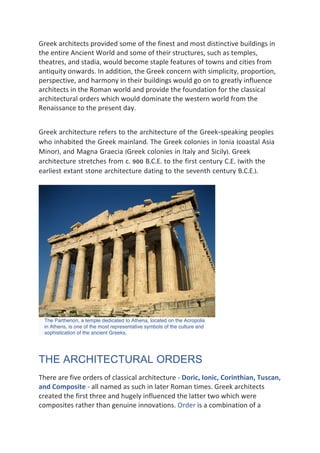
The Parthenon, a temple dedicated to Athena, located on the Acropolis
in Athens, is one of the most representative symbols of the culture and
sophistication of the ancient Greeks.
	
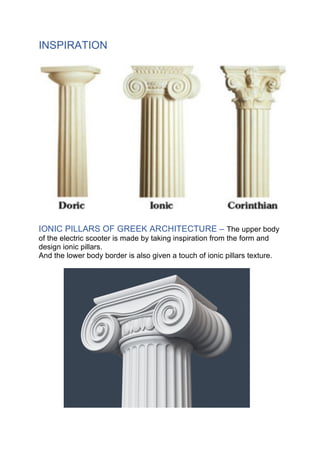
THE ARCHITECTURAL ORDERS
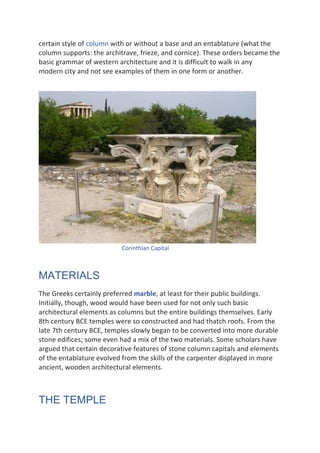
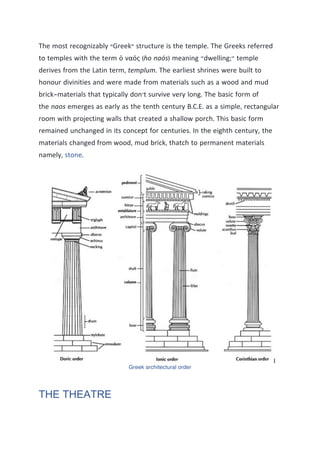
There	are	five	orders	of	classical	architecture	-	Doric,	Ionic,	Corinthian,	Tuscan,	
and	Composite	-	all	named	as	such	in	later	Roman	times.	Greek	architects	
created	the	first	three	and	hugely	influenced	the	latter	two	which	were	
composites	rather	than	genuine	innovations.	Order	is	a	combination	of	a
certain	style	of	column	with	or	without	a	base	and	an	entablature	(what	the	
column	supports:	the	architrave,	frieze,	and	cornice). These	orders	became	the	
basic	grammar	of	western	architecture	and	it	is	difficult	to	walk	in	any	
modern	city	and	not	see	examples	of	them	in	one	form	or	another.	
																																																									Corinthian	Capital	
	
MATERIALS
The	Greeks	certainly	preferred	marble,	at	least	for	their	public	buildings.	
Initially,	though,	wood	would	have	been	used	for	not	only	such	basic	
architectural	elements	as	columns	but	the	entire	buildings	themselves.	Early	
8th	century	BCE	temples	were	so	constructed	and	had	thatch	roofs.	From	the	
late	7th	century	BCE,	temples	slowly	began	to	be	converted	into	more	durable	
stone	edifices;	some	even	had	a	mix	of	the	two	materials.	Some	scholars	have	
argued	that	certain	decorative	features	of	stone	column	capitals	and	elements	
of	the	entablature	evolved	from	the	skills	of	the	carpenter	displayed	in	more	
ancient,	wooden	architectural	elements.	
THE TEMPLE
The most recognizably “Greek” structure is the temple. The Greeks referred
to temples with the term ὁ ναός (ho naós) meaning "dwelling;" temple
derives from the Latin term, templum. The earliest shrines were built to
honour divinities and were made from materials such as a wood and mud
brick—materials that typically don't survive very long. The basic form of
the naos emerges as early as the tenth century B.C.E. as a simple, rectangular
room with projecting walls that created a shallow porch. This basic form
remained unchanged in its concept for centuries. In the eighth century, the
materials changed	from	wood, mud brick, thatch to permanent materials
namely, stone.
	
Greek architectural order
THE THEATRE
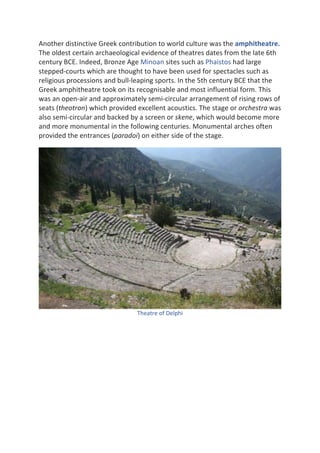
Another	distinctive	Greek	contribution	to	world	culture	was	the	amphitheatre.	
The	oldest	certain	archaeological	evidence	of	theatres	dates	from	the	late	6th	
century	BCE.	Indeed,	Bronze	Age	Minoan	sites	such	as	Phaistos	had	large	
stepped-courts	which	are	thought	to	have	been	used	for	spectacles	such	as	
religious	processions	and	bull-leaping	sports.	In	the	5th	century	BCE	that	the	
Greek	amphitheatre	took	on	its	recognisable	and	most	influential	form.	This	
was	an	open-air	and	approximately	semi-circular	arrangement	of	rising	rows	of	
seats	(theotron)	which	provided	excellent	acoustics.	The	stage	or	orchestra	was	
also	semi-circular	and	backed	by	a	screen	or	skene,	which	would	become	more	
and	more	monumental	in	the	following	centuries.	Monumental	arches	often	
provided	the	entrances	(paradoi)	on	either	side	of	the	stage.		
	
Theatre	of	Delphi
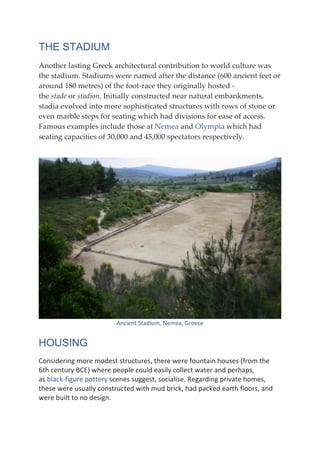
THE STADIUM
Another lasting Greek architectural contribution to world culture was
the stadium. Stadiums were named after the distance (600 ancient feet or
around 180 metres) of the foot-race they originally hosted -
the stade or stadion. Initially constructed near natural embankments,
stadia evolved into more sophisticated structures with rows of stone or
even marble steps for seating which had divisions for ease of access.
Famous examples include those at Nemea and Olympia which had
seating capacities of 30,000 and 45,000 spectators respectively.
Ancient	Stadium,	Nemea,	Greece	
HOUSING
Considering	more	modest	structures,	there	were	fountain	houses	(from	the	
6th	century	BCE)	where	people	could	easily	collect	water	and	perhaps,	
as	black-figure	pottery	scenes	suggest,	socialise.	Regarding	private	homes,	
these	were	usually	constructed	with	mud	brick,	had	packed	earth	floors,	and	
were	built	to	no	design.
INSPIRATION
IONIC PILLARS OF GREEK ARCHITECTURE – The upper body
of the electric scooter is made by taking inspiration from the form and
design ionic pillars.
And the lower body border is also given a touch of ionic pillars texture.
COLOURS INSPIRATION
Basic colours used in Greek architecture were shades of brown so the
scooter is given colours using this colour pallet.
Then the buildings were reconstructed and brighter colours were used in
the borders and detailing.
PARTHEON IN GREECE
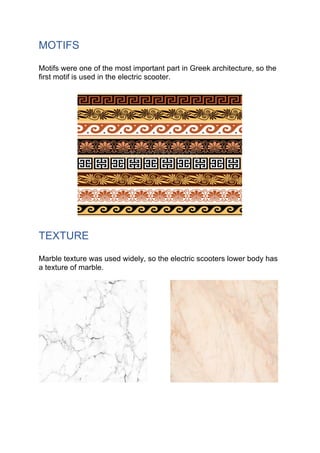
MOTIFS
Motifs were one of the most important part in Greek architecture, so the
first motif is used in the electric scooter.
TEXTURE
Marble texture was used widely, so the electric scooters lower body has
a texture of marble.

GREEK ARCHITECTURE - AN OVERVIEW