Greek
Architecture
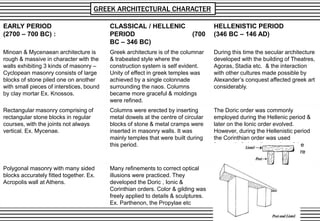
EARLY PERIOD
(2700 – 700 BC) :
CLASSICAL / HELLENIC
PERIOD (700
BC – 346 BC)
HELLENISTIC PERIOD
(346 BC – 146 AD)
Minoan & Mycenaean architecture is
rough & massive in character with the
walls exhibiting 3 kinds of masonry –
Cyclopean masonry consists of large
blocks of stone piled one on another
with small pieces of interstices, bound
by clay mortar Ex. Knossos.
Greek architecture is of the columnar
& trabeated style where the
construction system is self evident.
Unity of effect in greek temples was
achieved by a single colonnade
surrounding the naos. Columns
became more graceful & moldings
were refined.
During this time the secular architecture
developed with the building of Theatres,
Agoras, Stadia etc. & the interaction
with other cultures made possible by
Alexander’s conquest affected greek art
considerably.
Rectangular masonry comprising of
rectangular stone blocks in regular
courses, with the joints not always
vertical. Ex. Mycenae.
Columns were erected by inserting
metal dowels at the centre of circular
blocks of stone & metal cramps were
inserted in masonry walls. It was
mainly temples that were built during
this period.
The Doric order was commonly
employed during the Hellenic period &
later on the Ionic order evolved.
However, during the Hellenistic period
the Corinthian order was used
frequently & the taller version of the
Ionic order. Ex. Erechtheion, theatre
Epidauros & Tower of Winds.
Polygonal masonry with many sided
blocks accurately fitted together. Ex.
Acropolis wall at Athens.
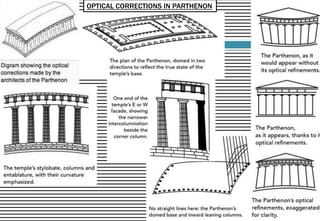
Many refinements to correct optical
illusions were practiced. They
developed the Doric , Ionic &
Corinthian orders. Color & gilding was
freely applied to details & sculptures.
Ex. Parthenon, the Propylae etc
GREEK ARCHITECTURAL CHARACTER
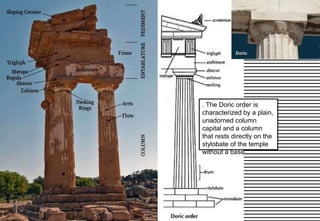
. The Doric order is
characterized by a plain,
unadorned column
capital and a column
that rests directly on the
stylobate of the temple
without a base.
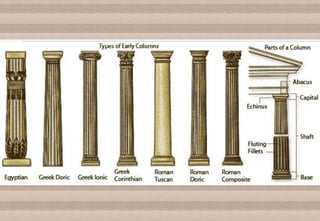
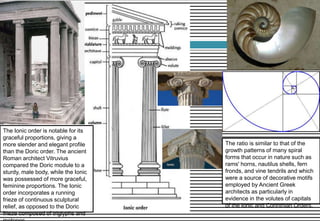
The Ionic order is notable for its
graceful proportions, giving a
more slender and elegant profile
than the Doric order. The ancient
Roman architect Vitruvius
compared the Doric module to a
sturdy, male body, while the Ionic
was possessed of more graceful,
feminine proportions. The Ionic
order incorporates a running
frieze of continuous sculptural
relief, as opposed to the Doric
frieze composed of triglyphs and
The ratio is similar to that of the
growth patterns of many spiral
forms that occur in nature such as
rams' horns, nautilus shells, fern
fronds, and vine tendrils and which
were a source of decorative motifs
employed by Ancient Greek
architects as particularly in
evidence in the volutes of capitals
of the Ionic and Corinthian Orders.
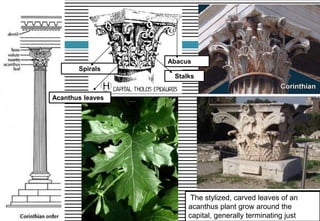
The stylized, carved leaves of an
acanthus plant grow around the
capital, generally terminating just
Abacus
Spirals
Acanthus leaves
Stalks
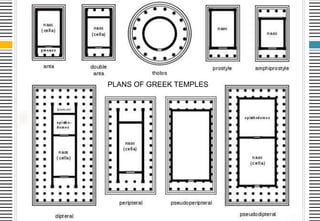
PLANS OF GREEK TEMPLES
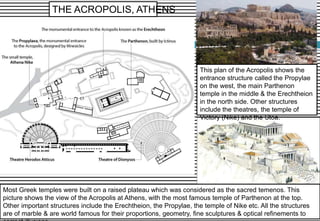
Most Greek temples were built on a raised plateau which was considered as the sacred temenos. This
picture shows the view of the Acropolis at Athens, with the most famous temple of Parthenon at the top.
Other important structures include the Erechtheion, the Propylae, the temple of Nike etc. All the structures
are of marble & are world famous for their proportions, geometry, fine sculptures & optical refinements to
This plan of the Acropolis shows the
entrance structure called the Propylae
on the west, the main Parthenon
temple in the middle & the Erechtheion
in the north side. Other structures
include the theatres, the temple of
Victory (Nike) and the Stoa.
THE ACROPOLIS, ATHENS
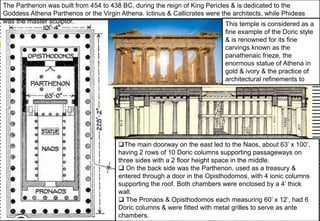
The Parthenon was built from 454 to 438 BC, during the reign of King Pericles & is dedicated to the
Goddess Athena Parthenos or the Virgin Athena. Ictinus & Callicrates were the architects, while Phideas
was the master sculptor. This temple is considered as a
fine example of the Doric style
& is renowned for its fine
carvings known as the
panathenaic frieze, the
enormous statue of Athena in
gold & ivory & the practice of
architectural refinements to
correct optical illusions.
The main doorway on the east led to the Naos, about 63’ x 100’,
having 2 rows of 10 Doric columns supporting passageways on
three sides with a 2 floor height space in the middle.
 On the back side was the Parthenon, used as a treasury &
entered through a door in the Opisthodomos, with 4 ionic columns
supporting the roof. Both chambers were enclosed by a 4’ thick
wall.
 The Pronaos & Opisthodomos each measuring 60’ x 12’, had 6
Doric columns & were fitted with metal grilles to serve as ante
chambers.
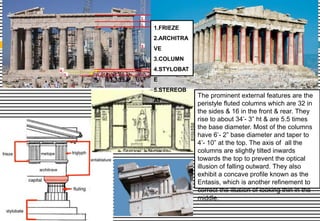
The prominent external features are the
peristyle fluted columns which are 32 in
the sides & 16 in the front & rear. They
rise to about 34’- 3” ht & are 5.5 times
the base diameter. Most of the columns
have 6’- 2” base diameter and taper to
4’- 10” at the top. The axis of all the
columns are slightly tilted inwards
towards the top to prevent the optical
illusion of falling outward. They also
exhibit a concave profile known as the
Entasis, which is another refinement to
correct the illusion of looking thin in the
middle.
1.FRIEZE
2.ARCHITRA
VE
3.COLUMN
4.STYLOBAT
E
5.STEREOB
AT
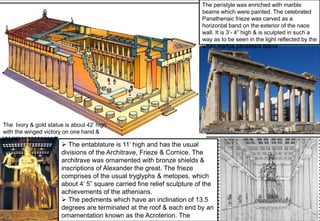
 The entablature is 11’ high and has the usual
divisions of the Architrave, Frieze & Cornice. The
architrave was ornamented with bronze shields &
inscriptions of Alexander the great. The frieze
comprises of the usual tryglyphs & metopes, which
about 4’ 5” square carried fine relief sculpture of the
achievements of the athenians.
 The pediments which have an inclination of 13.5
degrees are terminated at the roof & each end by an
ornamentation known as the Acroterion. The
The Ivory & gold statue is about 42’ high
with the winged victory on one hand &
shield
The peristyle was enriched with marble
beams which were painted. The celebrated
Panathenaic frieze was carved as a
horizontal band on the exterior of the naos
wall. It is 3’- 4” high & is sculpted in such a
way as to be seen in the light reflected by the
white marble pavement below
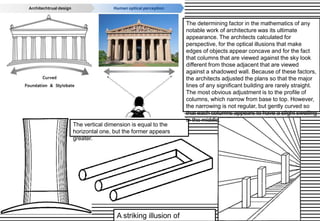
A striking illusion of
The vertical dimension is equal to the
horizontal one, but the former appears
greater.
The determining factor in the mathematics of any
notable work of architecture was its ultimate
appearance. The architects calculated for
perspective, for the optical illusions that make
edges of objects appear concave and for the fact
that columns that are viewed against the sky look
different from those adjacent that are viewed
against a shadowed wall. Because of these factors,
the architects adjusted the plans so that the major
lines of any significant building are rarely straight.
The most obvious adjustment is to the profile of
columns, which narrow from base to top. However,
the narrowing is not regular, but gently curved so
that each columns appears to have a slight swelling
in the middle.
OPTICAL CORRECTIONS IN PARTHENON
 The Erechtheion was constructed from 420 –
393 BC by Mnesicles, who was the architect
The Erechtheion is a fine example of
asymmetrical architectural composition having
various levels, which gives it different views from
all around.
 It has no side colonnades & hence is called
“Apteral” in style. The temple is considered to be
very sacred as it contains the olive wood statue
of Athena, the salt well of Poseidon & the tomb of
Erechtheus
THE ERECHTHEION
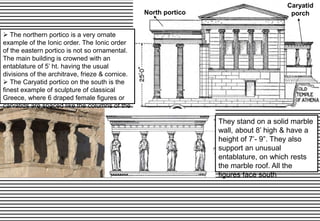
Caryatid
porch
The Erechtheion is irregular in plan owing to
the sloping site & contains the shrine of Athena
in the eastern portion with the main entrance
through the Ionic hexastyle portico, Behind this
is the shrine of Erechtheion & Poseidon, which
is accessed from the northern Ionic tetrastyle
portico. The western naos was added later &
entered through the passage connecting the
northern portico & the southern Caryatid porch.
The northern portico is 10’ lower than the
North portico
Caryatid
porch
 The northern portico is a very ornate
example of the Ionic order. The Ionic order
of the eastern portico is not so ornamental.
The main building is crowned with an
entablature of 5’ ht. having the usual
divisions of the architrave, frieze & cornice.
 The Caryatid portico on the south is the
finest example of sculpture of classical
Greece, where 6 draped female figures or
caryatids are spaced like the columns of the
north portico.
They stand on a solid marble
wall, about 8’ high & have a
height of 7’- 9”. They also
support an unusual
entablature, on which rests
the marble roof. All the
figures face south
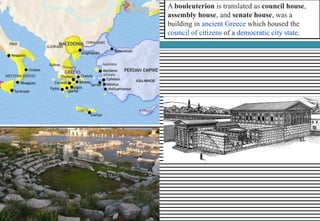
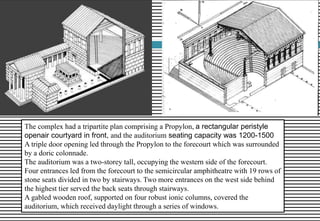
A bouleuterion is translated as council house,
assembly house, and senate house, was a
building in ancient Greece which housed the
council of citizens of a democratic city state.
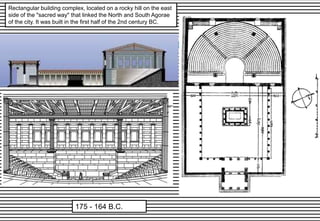
Rectangular building complex, located on a rocky hill on the east
side of the "sacred way" that linked the North and South Agorae
of the city. It was built in the first half of the 2nd century BC.
175 - 164 B.C.
12/9/2019 5:40 PM
The complex had a tripartite plan comprising a Propylon, a rectangular peristyle
openair courtyard in front, and the auditorium seating capacity was 1200-1500
A triple door opening led through the Propylon to the forecourt which was surrounded
by a doric colonnade.
The auditorium was a two-storey tall, occupying the western side of the forecourt.
Four entrances led from the forecourt to the semicircular amphitheatre with 19 rows of
stone seats divided in two by stairways. Two more entrances on the west side behind
the highest tier served the back seats through stairways.
A gabled wooden roof, supported on four robust ionic columns, covered the
auditorium, which received daylight through a series of windows.
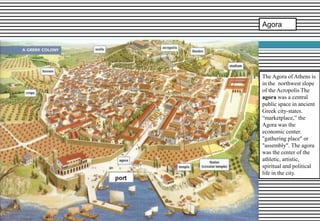
Agora
The Agora of Athens is
in the northwest slope
of the Acropolis The
agora was a central
public space in ancient
Greek city-states.
“marketplace,” the
Agora was the
economic center.
"gathering place" or
"assembly". The agora
was the center of the
athletic, artistic,
spiritual and political
life in the city.
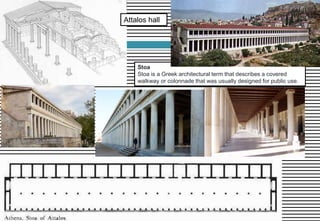
Stoa
Stoa is a Greek architectural term that describes a covered
walkway or colonnade that was usually designed for public use.
Attalos hall
12/9/2019 5:40 PM
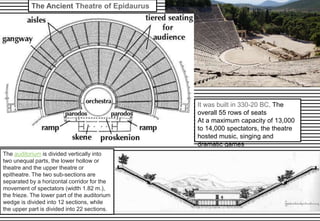
It was built in 330-20 BC, The
overall 55 rows of seats
At a maximum capacity of 13,000
to 14,000 spectators, the theatre
hosted music, singing and
dramatic games
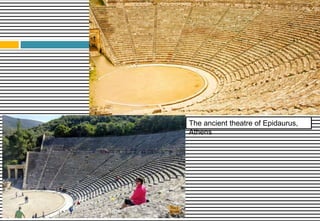
The Ancient Theatre of Epidaurus
The auditorium is divided vertically into
two unequal parts, the lower hollow or
theatre and the upper theatre or
epitheatre. The two sub-sections are
separated by a horizontal corridor for the
movement of spectators (width 1.82 m.),
the frieze. The lower part of the auditorium
wedge is divided into 12 sections, while
the upper part is divided into 22 sections.
The ancient theatre of Epidaurus,
Athens
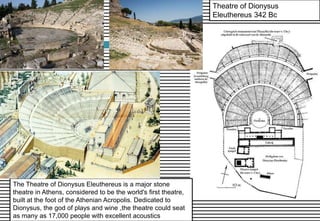
Theatre of Dionysus
Eleuthereus 342 Bc
The Theatre of Dionysus Eleuthereus is a major stone
theatre in Athens, considered to be the world's first theatre,
built at the foot of the Athenian Acropolis. Dedicated to
Dionysus, the god of plays and wine ,the theatre could seat
as many as 17,000 people with excellent acoustics

Greek architecture

  • 1.
  • 2.
    EARLY PERIOD (2700 –700 BC) : CLASSICAL / HELLENIC PERIOD (700 BC – 346 BC) HELLENISTIC PERIOD (346 BC – 146 AD) Minoan & Mycenaean architecture is rough & massive in character with the walls exhibiting 3 kinds of masonry – Cyclopean masonry consists of large blocks of stone piled one on another with small pieces of interstices, bound by clay mortar Ex. Knossos. Greek architecture is of the columnar & trabeated style where the construction system is self evident. Unity of effect in greek temples was achieved by a single colonnade surrounding the naos. Columns became more graceful & moldings were refined. During this time the secular architecture developed with the building of Theatres, Agoras, Stadia etc. & the interaction with other cultures made possible by Alexander’s conquest affected greek art considerably. Rectangular masonry comprising of rectangular stone blocks in regular courses, with the joints not always vertical. Ex. Mycenae. Columns were erected by inserting metal dowels at the centre of circular blocks of stone & metal cramps were inserted in masonry walls. It was mainly temples that were built during this period. The Doric order was commonly employed during the Hellenic period & later on the Ionic order evolved. However, during the Hellenistic period the Corinthian order was used frequently & the taller version of the Ionic order. Ex. Erechtheion, theatre Epidauros & Tower of Winds. Polygonal masonry with many sided blocks accurately fitted together. Ex. Acropolis wall at Athens. Many refinements to correct optical illusions were practiced. They developed the Doric , Ionic & Corinthian orders. Color & gilding was freely applied to details & sculptures. Ex. Parthenon, the Propylae etc GREEK ARCHITECTURAL CHARACTER
  • 4.
    . The Doricorder is characterized by a plain, unadorned column capital and a column that rests directly on the stylobate of the temple without a base.
  • 5.
    The Ionic orderis notable for its graceful proportions, giving a more slender and elegant profile than the Doric order. The ancient Roman architect Vitruvius compared the Doric module to a sturdy, male body, while the Ionic was possessed of more graceful, feminine proportions. The Ionic order incorporates a running frieze of continuous sculptural relief, as opposed to the Doric frieze composed of triglyphs and The ratio is similar to that of the growth patterns of many spiral forms that occur in nature such as rams' horns, nautilus shells, fern fronds, and vine tendrils and which were a source of decorative motifs employed by Ancient Greek architects as particularly in evidence in the volutes of capitals of the Ionic and Corinthian Orders.
  • 6.
    The stylized, carvedleaves of an acanthus plant grow around the capital, generally terminating just Abacus Spirals Acanthus leaves Stalks
  • 7.
  • 8.
    Most Greek templeswere built on a raised plateau which was considered as the sacred temenos. This picture shows the view of the Acropolis at Athens, with the most famous temple of Parthenon at the top. Other important structures include the Erechtheion, the Propylae, the temple of Nike etc. All the structures are of marble & are world famous for their proportions, geometry, fine sculptures & optical refinements to This plan of the Acropolis shows the entrance structure called the Propylae on the west, the main Parthenon temple in the middle & the Erechtheion in the north side. Other structures include the theatres, the temple of Victory (Nike) and the Stoa. THE ACROPOLIS, ATHENS
  • 9.
    The Parthenon wasbuilt from 454 to 438 BC, during the reign of King Pericles & is dedicated to the Goddess Athena Parthenos or the Virgin Athena. Ictinus & Callicrates were the architects, while Phideas was the master sculptor. This temple is considered as a fine example of the Doric style & is renowned for its fine carvings known as the panathenaic frieze, the enormous statue of Athena in gold & ivory & the practice of architectural refinements to correct optical illusions. The main doorway on the east led to the Naos, about 63’ x 100’, having 2 rows of 10 Doric columns supporting passageways on three sides with a 2 floor height space in the middle.  On the back side was the Parthenon, used as a treasury & entered through a door in the Opisthodomos, with 4 ionic columns supporting the roof. Both chambers were enclosed by a 4’ thick wall.  The Pronaos & Opisthodomos each measuring 60’ x 12’, had 6 Doric columns & were fitted with metal grilles to serve as ante chambers.
  • 10.
    The prominent externalfeatures are the peristyle fluted columns which are 32 in the sides & 16 in the front & rear. They rise to about 34’- 3” ht & are 5.5 times the base diameter. Most of the columns have 6’- 2” base diameter and taper to 4’- 10” at the top. The axis of all the columns are slightly tilted inwards towards the top to prevent the optical illusion of falling outward. They also exhibit a concave profile known as the Entasis, which is another refinement to correct the illusion of looking thin in the middle. 1.FRIEZE 2.ARCHITRA VE 3.COLUMN 4.STYLOBAT E 5.STEREOB AT
  • 11.
     The entablatureis 11’ high and has the usual divisions of the Architrave, Frieze & Cornice. The architrave was ornamented with bronze shields & inscriptions of Alexander the great. The frieze comprises of the usual tryglyphs & metopes, which about 4’ 5” square carried fine relief sculpture of the achievements of the athenians.  The pediments which have an inclination of 13.5 degrees are terminated at the roof & each end by an ornamentation known as the Acroterion. The The Ivory & gold statue is about 42’ high with the winged victory on one hand & shield The peristyle was enriched with marble beams which were painted. The celebrated Panathenaic frieze was carved as a horizontal band on the exterior of the naos wall. It is 3’- 4” high & is sculpted in such a way as to be seen in the light reflected by the white marble pavement below
  • 12.
    A striking illusionof The vertical dimension is equal to the horizontal one, but the former appears greater. The determining factor in the mathematics of any notable work of architecture was its ultimate appearance. The architects calculated for perspective, for the optical illusions that make edges of objects appear concave and for the fact that columns that are viewed against the sky look different from those adjacent that are viewed against a shadowed wall. Because of these factors, the architects adjusted the plans so that the major lines of any significant building are rarely straight. The most obvious adjustment is to the profile of columns, which narrow from base to top. However, the narrowing is not regular, but gently curved so that each columns appears to have a slight swelling in the middle.
  • 13.
  • 14.
     The Erechtheionwas constructed from 420 – 393 BC by Mnesicles, who was the architect The Erechtheion is a fine example of asymmetrical architectural composition having various levels, which gives it different views from all around.  It has no side colonnades & hence is called “Apteral” in style. The temple is considered to be very sacred as it contains the olive wood statue of Athena, the salt well of Poseidon & the tomb of Erechtheus THE ERECHTHEION Caryatid porch The Erechtheion is irregular in plan owing to the sloping site & contains the shrine of Athena in the eastern portion with the main entrance through the Ionic hexastyle portico, Behind this is the shrine of Erechtheion & Poseidon, which is accessed from the northern Ionic tetrastyle portico. The western naos was added later & entered through the passage connecting the northern portico & the southern Caryatid porch. The northern portico is 10’ lower than the
  • 15.
    North portico Caryatid porch  Thenorthern portico is a very ornate example of the Ionic order. The Ionic order of the eastern portico is not so ornamental. The main building is crowned with an entablature of 5’ ht. having the usual divisions of the architrave, frieze & cornice.  The Caryatid portico on the south is the finest example of sculpture of classical Greece, where 6 draped female figures or caryatids are spaced like the columns of the north portico. They stand on a solid marble wall, about 8’ high & have a height of 7’- 9”. They also support an unusual entablature, on which rests the marble roof. All the figures face south
  • 16.
    A bouleuterion istranslated as council house, assembly house, and senate house, was a building in ancient Greece which housed the council of citizens of a democratic city state.
  • 17.
    Rectangular building complex,located on a rocky hill on the east side of the "sacred way" that linked the North and South Agorae of the city. It was built in the first half of the 2nd century BC. 175 - 164 B.C.
  • 18.
    12/9/2019 5:40 PM Thecomplex had a tripartite plan comprising a Propylon, a rectangular peristyle openair courtyard in front, and the auditorium seating capacity was 1200-1500 A triple door opening led through the Propylon to the forecourt which was surrounded by a doric colonnade. The auditorium was a two-storey tall, occupying the western side of the forecourt. Four entrances led from the forecourt to the semicircular amphitheatre with 19 rows of stone seats divided in two by stairways. Two more entrances on the west side behind the highest tier served the back seats through stairways. A gabled wooden roof, supported on four robust ionic columns, covered the auditorium, which received daylight through a series of windows.
  • 19.
    Agora The Agora ofAthens is in the northwest slope of the Acropolis The agora was a central public space in ancient Greek city-states. “marketplace,” the Agora was the economic center. "gathering place" or "assembly". The agora was the center of the athletic, artistic, spiritual and political life in the city.
  • 20.
    Stoa Stoa is aGreek architectural term that describes a covered walkway or colonnade that was usually designed for public use. Attalos hall
  • 21.
    12/9/2019 5:40 PM Itwas built in 330-20 BC, The overall 55 rows of seats At a maximum capacity of 13,000 to 14,000 spectators, the theatre hosted music, singing and dramatic games The Ancient Theatre of Epidaurus The auditorium is divided vertically into two unequal parts, the lower hollow or theatre and the upper theatre or epitheatre. The two sub-sections are separated by a horizontal corridor for the movement of spectators (width 1.82 m.), the frieze. The lower part of the auditorium wedge is divided into 12 sections, while the upper part is divided into 22 sections.
  • 22.
    The ancient theatreof Epidaurus, Athens
  • 23.
    Theatre of Dionysus Eleuthereus342 Bc The Theatre of Dionysus Eleuthereus is a major stone theatre in Athens, considered to be the world's first theatre, built at the foot of the Athenian Acropolis. Dedicated to Dionysus, the god of plays and wine ,the theatre could seat as many as 17,000 people with excellent acoustics

Editor's Notes

  • #4 有关可选的时间/目标阶段的日程设计。