GREEK ARCHIECTURE
The Age of Pericles: Acropolis of Athens.
Joarder Hafiz Ullah
Assistant Professor
DUET, Gazipur.
The Acropolis of Athens
•is an ancient citadel located
on a high rocky outcrop above
the city of Athens .
•The Acropolis hill (acro - edge,
polis - city), so called the
"Sacred Rock" of Athens,
The Acropolis of Athens
N37 58 15.132 E23 43 34.248
The Acropolis of Athens and its monuments are universal symbols
of the classical spirit and civilization and form the greatest
architectural and artistic complex bequeathed by Greek Antiquity to
the world. In the second half of the fifth century bc, Athens,
following the victory against the Persians and the establishment
of democracy, took a leading position amongst the other city-states
of the ancient world
In the age that followed, as thought and art flourished, an exceptional
group of artists put into effect the ambitious plans of Athenian
statesman Pericles and, under the inspired guidance of the sculptor
Pheidias, transformed the rocky hill into a unique monument of
thought and the arts. The most important monuments were built during
that time: the Parthenon, built by Ictinus, the Erechtheon, the
Propylaea, the monumental entrance to the Acropolis, designed by
Mnesicles and the small temple Athena Nike.
Important Structures – The Acropolis
 The most famous Greek buildings topped the Athenian Acropolis.
 These include:
• The Propylaea,
• The Temple of Athena Nike,
• The Parthenon
• the Erectheum.
The Propylaea (437-432 BCE)
• The Propylaea, the monumental gateway of
the Acropolis was designed by the architect
Mnesicles and constructed in 437-432 B.C. It
comprises a central building and two lateral
wings. The colonnades along the west and
east sides had a row of Doric columns while
two rows of Ionic columns divided the central
corridor into three parts. The walls of the north
wing were decorated with painted panels or
wall paintings and that is why it was called the
"Pinakotheke". The ceiling of the Propylaea
had coffers with painted decoration and a
perforated sima around the roof.
Temple of Athena Nike
This is a small temple dedicated
to the victorious Athena.
The Temple of Athena Nike (Featherless
Victory) is situated southwest of the
Entrance, on a rampart protecting the main
entrace of the Acropolis. It was constructed
in ca. 420 B.C. by the architect
Kallikrates. It is built in the Ionic order,
and it is amphiprostyle with a row of four
columns in front of each of its narrow
sides. The relief frieze on the upper
section of the walls depicts the conference
of gods on the east side, and scenes from
battles on the other three. A marble
parapet decorated with the relief
representation of Nikae (Victories),
protected the edge of the Bastion on which
the temple was erected.
•The ratio of height to diameter of
the columns is 7:1
• not the 9:1 or 10:1 generally
found in Ionic temples.
Designed by the architect of
Parthenon Kallikrates, it was
probably build at 427 BC in pure
Ionic style from Pentelic marble.
Due to the of lack of money, the
Peloponnesian war and internal
political strife's the temple was
not build at once. The thorakion
with the victories was constructed
around 410 BC, after the war
victories of Alkibiades. It was
damaged in the explosion of 1645
AD, and the columns were
restored, as close as possible, to
the originals.
The Parthenon
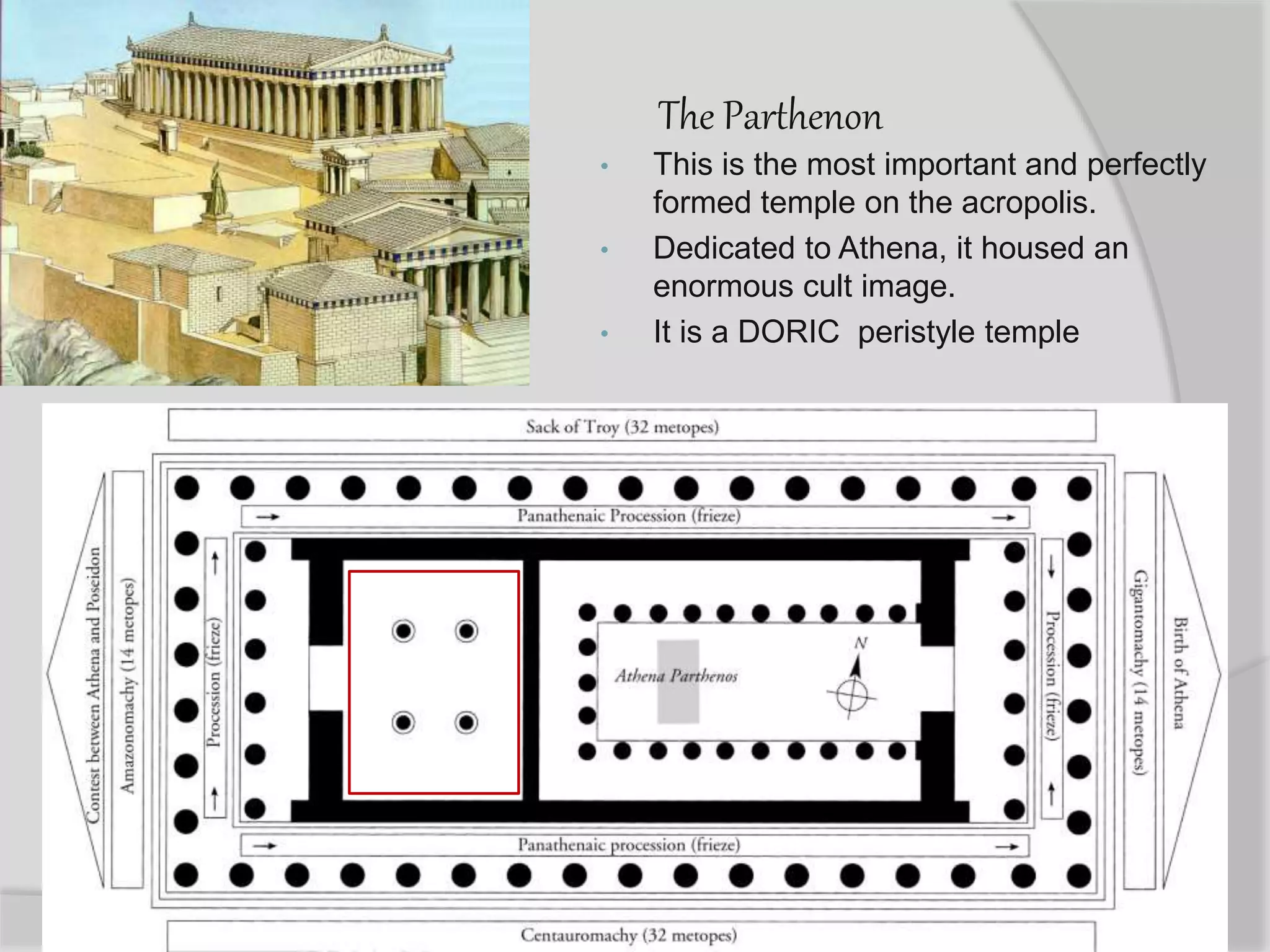
• This is the most important and perfectly
formed temple on the acropolis.
• Dedicated to Athena, it housed an
enormous cult image.
• It is a DORIC peristyle temple
The Parthenon
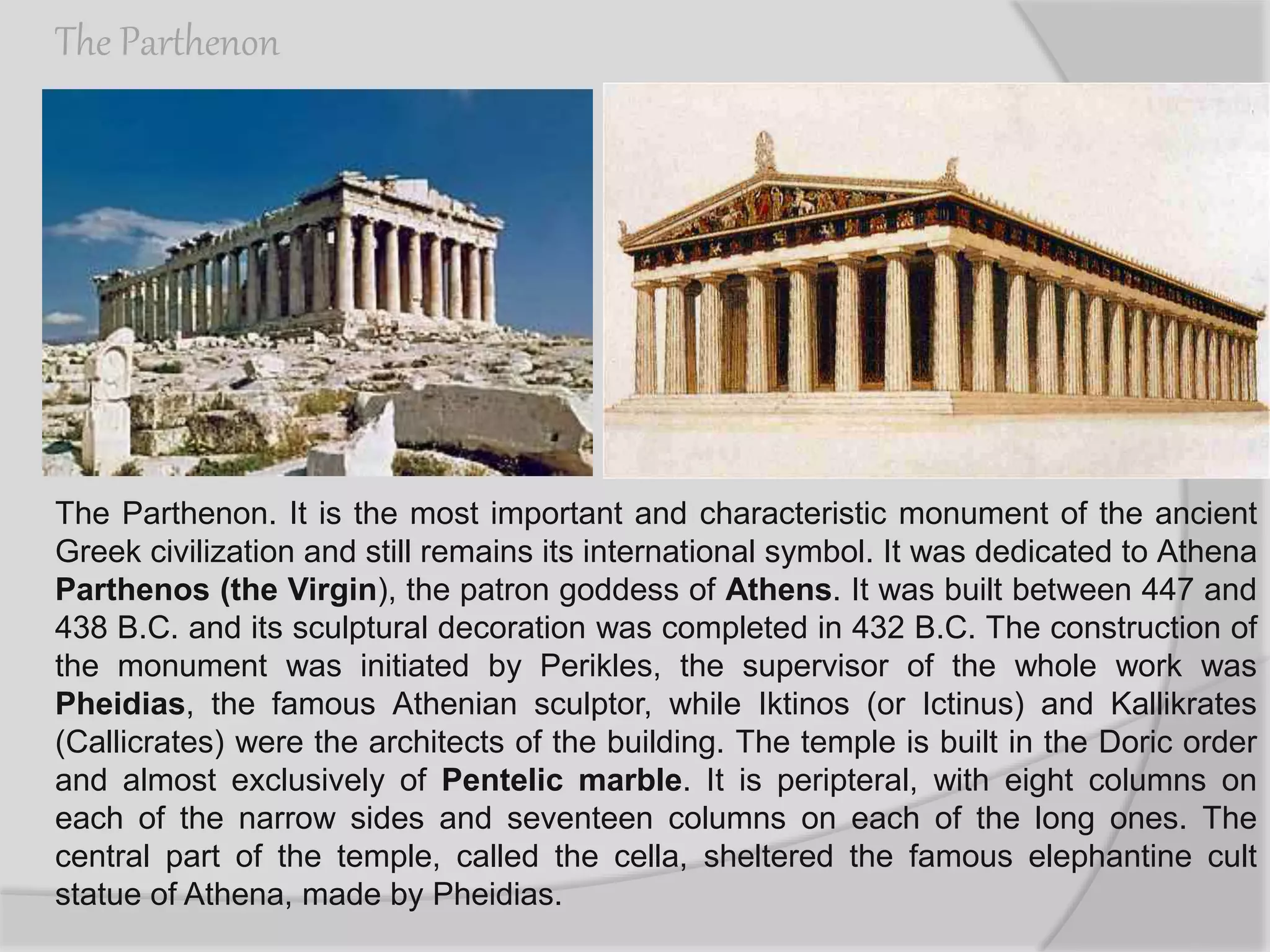
The Parthenon. It is the most important and characteristic monument of the ancient
Greek civilization and still remains its international symbol. It was dedicated to Athena
Parthenos (the Virgin), the patron goddess of Athens. It was built between 447 and
438 B.C. and its sculptural decoration was completed in 432 B.C. The construction of
the monument was initiated by Perikles, the supervisor of the whole work was
Pheidias, the famous Athenian sculptor, while Iktinos (or Ictinus) and Kallikrates
(Callicrates) were the architects of the building. The temple is built in the Doric order
and almost exclusively of Pentelic marble. It is peripteral, with eight columns on
each of the narrow sides and seventeen columns on each of the long ones. The
central part of the temple, called the cella, sheltered the famous elephantine cult
statue of Athena, made by Pheidias.
 One of the Parthenon’s most
impressive features was not seen by
most worshippers – the great frieze
showing the Panathenaic Procession.
 The colour of this reconstruction is
indicative of what much of the structure
would have looked like before being
bleached by centuries of
Mediterranean sun.
The Parthenon
Situated on the Acropolis and
completed in 438 B.C. Perfect
example of Greek architecture
and of early column and beam
construction. The temple is
228 ft Long, 101 ft Wide, and
66 ft High. Columns are 6 ft
1½ in. Diameter at the base,
and 34 ft High. The architrave
beams are 14 ft 5 in. Long.
PARTHENON
 This is a complex building of up
to four distinct spaces.
 It is also built on a slope, so its
walls are of differing heights.
 It is dedicated to Athena Polias
and Poseidon Erechtheus.
The Erechtheum (421-406 BCE)
The Erechtheum, an Ionic temple,
which an unusual design compared to
other temples, and with rich ornamental
decorations. Building started around
421 BC and completed around 406 BC
It was build approximately on the place
of an older Athena Temple destroyed
in 480/79 by the Persians. In the
medieval times its interior was modified
serving as a church.
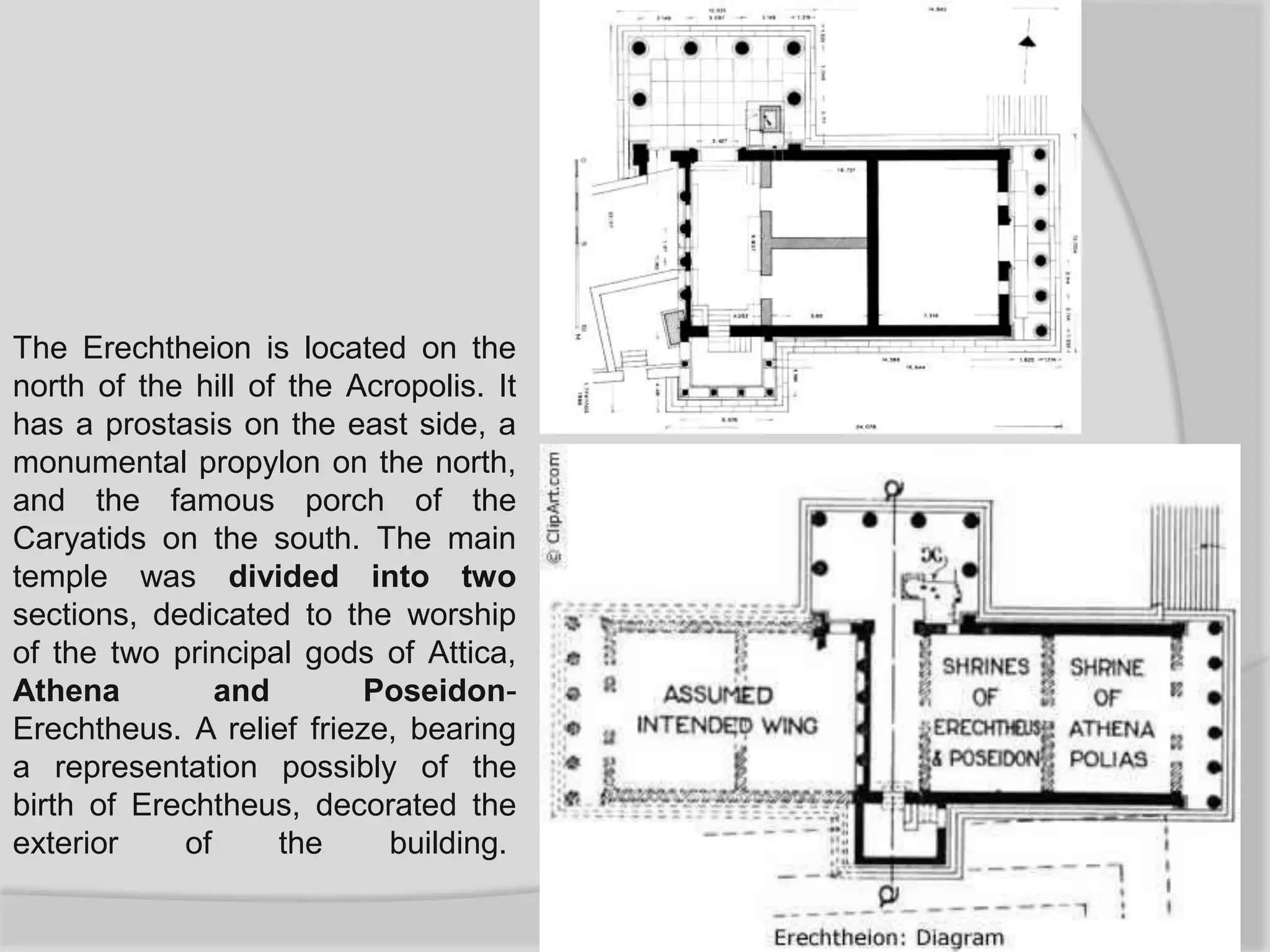
The Erechtheion is located on the
north of the hill of the Acropolis. It
has a prostasis on the east side, a
monumental propylon on the north,
and the famous porch of the
Caryatids on the south. The main
temple was divided into two
sections, dedicated to the worship
of the two principal gods of Attica,
Athena and Poseidon-
Erechtheus. A relief frieze, bearing
a representation possibly of the
birth of Erechtheus, decorated the
exterior of the building.
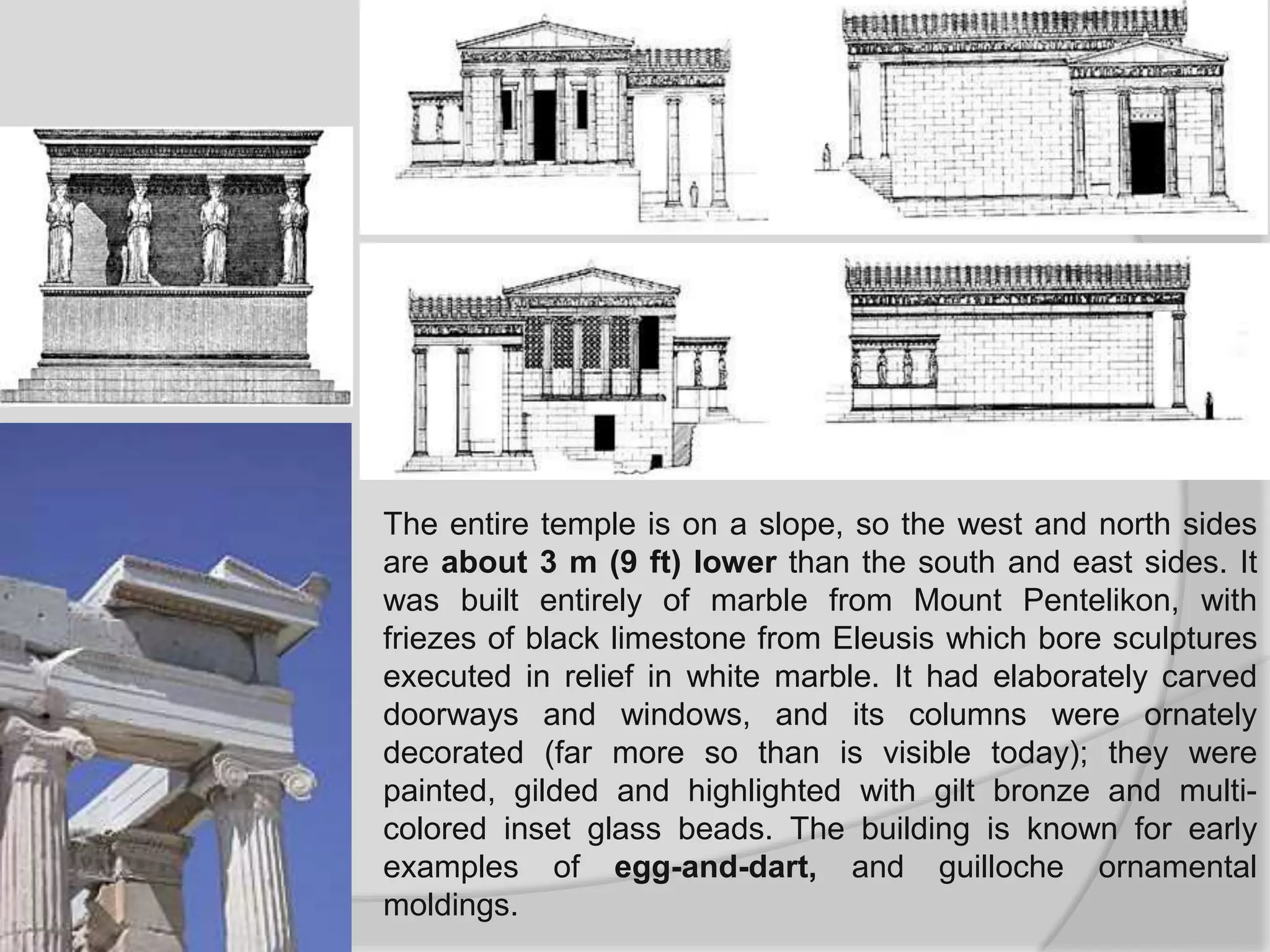
The entire temple is on a slope, so the west and north sides
are about 3 m (9 ft) lower than the south and east sides. It
was built entirely of marble from Mount Pentelikon, with
friezes of black limestone from Eleusis which bore sculptures
executed in relief in white marble. It had elaborately carved
doorways and windows, and its columns were ornately
decorated (far more so than is visible today); they were
painted, gilded and highlighted with gilt bronze and multi-
colored inset glass beads. The building is known for early
examples of egg-and-dart, and guilloche ornamental
moldings.
The Erechtheum
• The most distinctive element of this building is the
Porch of the Maidens. To the south-west is the
famous porch with the Caryatids, of which one is
exhibited in the British Museum; the remaining are
on display in the Acropolis Museum. On the
monument itself casts replace the originals.
The Caryatids
The Caryatids statues of young women clad in
peplos. They supported the roof of the south porch
of the Erechtheion, and probably were the work of
Alkamenes, a student of the great sculptor Pheidias.
Dated to ca. 420 B.C
References:
Sir Banister Fletcher- A History of Architecture. (Twentieth Edition) (p119-p143)
Emily Cole- The Grammar of Architecture ( p-108- p111)
Louis Hellman- Architecture for beginners
THANK YOU.
This is just a track line to the subject matter. students are requested to study the recommended books & also go after .

Ga acropolis

  • 1.
    GREEK ARCHIECTURE The Ageof Pericles: Acropolis of Athens. Joarder Hafiz Ullah Assistant Professor DUET, Gazipur.
  • 2.
    The Acropolis ofAthens •is an ancient citadel located on a high rocky outcrop above the city of Athens . •The Acropolis hill (acro - edge, polis - city), so called the "Sacred Rock" of Athens,
  • 3.
    The Acropolis ofAthens N37 58 15.132 E23 43 34.248 The Acropolis of Athens and its monuments are universal symbols of the classical spirit and civilization and form the greatest architectural and artistic complex bequeathed by Greek Antiquity to the world. In the second half of the fifth century bc, Athens, following the victory against the Persians and the establishment of democracy, took a leading position amongst the other city-states of the ancient world
  • 4.
    In the agethat followed, as thought and art flourished, an exceptional group of artists put into effect the ambitious plans of Athenian statesman Pericles and, under the inspired guidance of the sculptor Pheidias, transformed the rocky hill into a unique monument of thought and the arts. The most important monuments were built during that time: the Parthenon, built by Ictinus, the Erechtheon, the Propylaea, the monumental entrance to the Acropolis, designed by Mnesicles and the small temple Athena Nike.
  • 5.
    Important Structures –The Acropolis  The most famous Greek buildings topped the Athenian Acropolis.  These include: • The Propylaea, • The Temple of Athena Nike, • The Parthenon • the Erectheum.
  • 8.
    The Propylaea (437-432BCE) • The Propylaea, the monumental gateway of the Acropolis was designed by the architect Mnesicles and constructed in 437-432 B.C. It comprises a central building and two lateral wings. The colonnades along the west and east sides had a row of Doric columns while two rows of Ionic columns divided the central corridor into three parts. The walls of the north wing were decorated with painted panels or wall paintings and that is why it was called the "Pinakotheke". The ceiling of the Propylaea had coffers with painted decoration and a perforated sima around the roof.
  • 10.
    Temple of AthenaNike This is a small temple dedicated to the victorious Athena. The Temple of Athena Nike (Featherless Victory) is situated southwest of the Entrance, on a rampart protecting the main entrace of the Acropolis. It was constructed in ca. 420 B.C. by the architect Kallikrates. It is built in the Ionic order, and it is amphiprostyle with a row of four columns in front of each of its narrow sides. The relief frieze on the upper section of the walls depicts the conference of gods on the east side, and scenes from battles on the other three. A marble parapet decorated with the relief representation of Nikae (Victories), protected the edge of the Bastion on which the temple was erected.
  • 11.
    •The ratio ofheight to diameter of the columns is 7:1 • not the 9:1 or 10:1 generally found in Ionic temples.
  • 12.
    Designed by thearchitect of Parthenon Kallikrates, it was probably build at 427 BC in pure Ionic style from Pentelic marble. Due to the of lack of money, the Peloponnesian war and internal political strife's the temple was not build at once. The thorakion with the victories was constructed around 410 BC, after the war victories of Alkibiades. It was damaged in the explosion of 1645 AD, and the columns were restored, as close as possible, to the originals.
  • 13.
    The Parthenon • Thisis the most important and perfectly formed temple on the acropolis. • Dedicated to Athena, it housed an enormous cult image. • It is a DORIC peristyle temple
  • 14.
    The Parthenon The Parthenon.It is the most important and characteristic monument of the ancient Greek civilization and still remains its international symbol. It was dedicated to Athena Parthenos (the Virgin), the patron goddess of Athens. It was built between 447 and 438 B.C. and its sculptural decoration was completed in 432 B.C. The construction of the monument was initiated by Perikles, the supervisor of the whole work was Pheidias, the famous Athenian sculptor, while Iktinos (or Ictinus) and Kallikrates (Callicrates) were the architects of the building. The temple is built in the Doric order and almost exclusively of Pentelic marble. It is peripteral, with eight columns on each of the narrow sides and seventeen columns on each of the long ones. The central part of the temple, called the cella, sheltered the famous elephantine cult statue of Athena, made by Pheidias.
  • 15.
     One ofthe Parthenon’s most impressive features was not seen by most worshippers – the great frieze showing the Panathenaic Procession.  The colour of this reconstruction is indicative of what much of the structure would have looked like before being bleached by centuries of Mediterranean sun. The Parthenon Situated on the Acropolis and completed in 438 B.C. Perfect example of Greek architecture and of early column and beam construction. The temple is 228 ft Long, 101 ft Wide, and 66 ft High. Columns are 6 ft 1½ in. Diameter at the base, and 34 ft High. The architrave beams are 14 ft 5 in. Long.
  • 16.
  • 17.
     This isa complex building of up to four distinct spaces.  It is also built on a slope, so its walls are of differing heights.  It is dedicated to Athena Polias and Poseidon Erechtheus. The Erechtheum (421-406 BCE) The Erechtheum, an Ionic temple, which an unusual design compared to other temples, and with rich ornamental decorations. Building started around 421 BC and completed around 406 BC It was build approximately on the place of an older Athena Temple destroyed in 480/79 by the Persians. In the medieval times its interior was modified serving as a church.
  • 18.
    The Erechtheion islocated on the north of the hill of the Acropolis. It has a prostasis on the east side, a monumental propylon on the north, and the famous porch of the Caryatids on the south. The main temple was divided into two sections, dedicated to the worship of the two principal gods of Attica, Athena and Poseidon- Erechtheus. A relief frieze, bearing a representation possibly of the birth of Erechtheus, decorated the exterior of the building.
  • 19.
    The entire templeis on a slope, so the west and north sides are about 3 m (9 ft) lower than the south and east sides. It was built entirely of marble from Mount Pentelikon, with friezes of black limestone from Eleusis which bore sculptures executed in relief in white marble. It had elaborately carved doorways and windows, and its columns were ornately decorated (far more so than is visible today); they were painted, gilded and highlighted with gilt bronze and multi- colored inset glass beads. The building is known for early examples of egg-and-dart, and guilloche ornamental moldings.
  • 20.
    The Erechtheum • Themost distinctive element of this building is the Porch of the Maidens. To the south-west is the famous porch with the Caryatids, of which one is exhibited in the British Museum; the remaining are on display in the Acropolis Museum. On the monument itself casts replace the originals. The Caryatids The Caryatids statues of young women clad in peplos. They supported the roof of the south porch of the Erechtheion, and probably were the work of Alkamenes, a student of the great sculptor Pheidias. Dated to ca. 420 B.C
  • 21.
    References: Sir Banister Fletcher-A History of Architecture. (Twentieth Edition) (p119-p143) Emily Cole- The Grammar of Architecture ( p-108- p111) Louis Hellman- Architecture for beginners THANK YOU. This is just a track line to the subject matter. students are requested to study the recommended books & also go after .

Editor's Notes

  • #22 Joarder Hafiz Ullah, Lecturer, Dept. of Architecture, DUET.