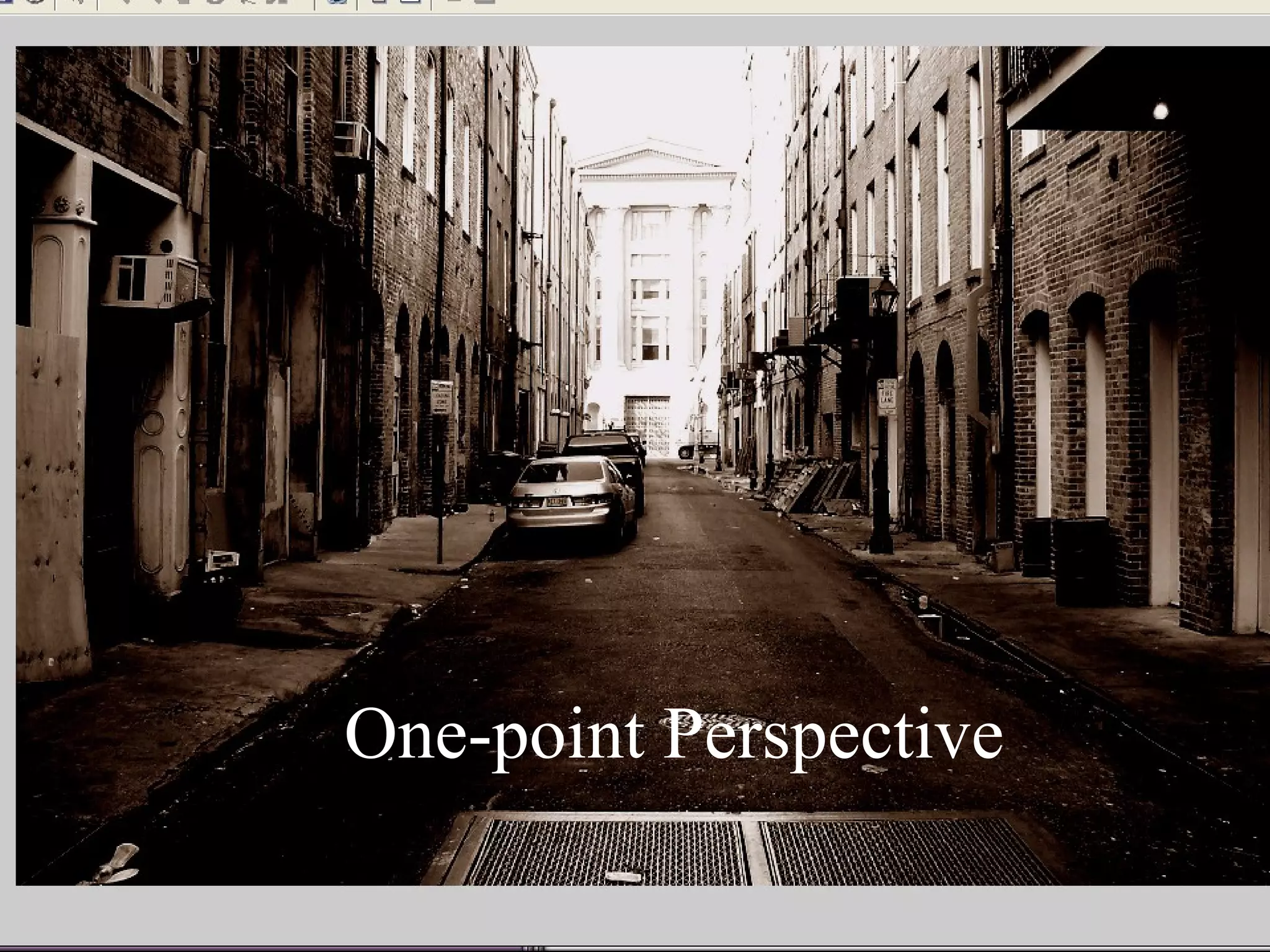
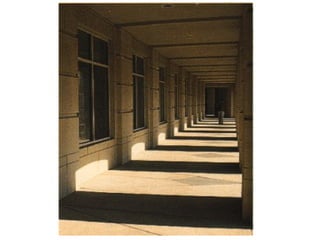
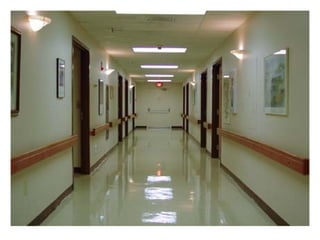
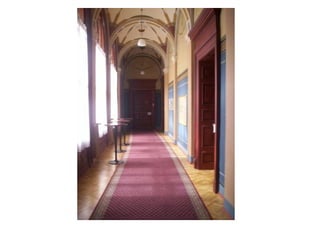
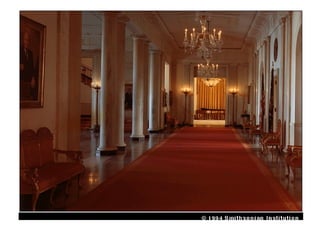
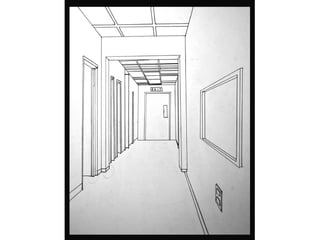
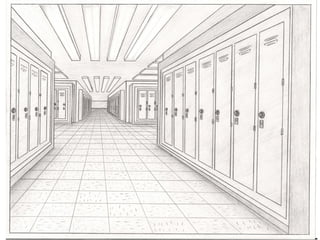
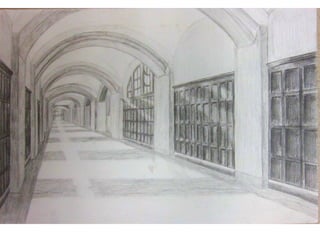
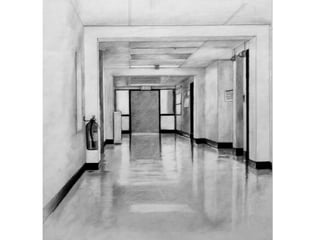
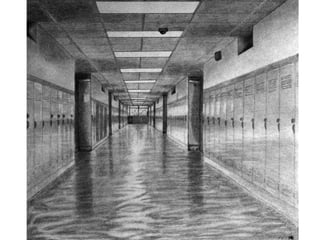
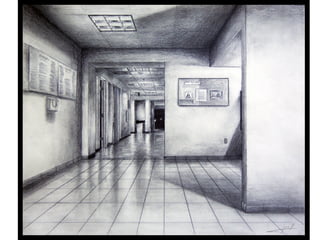
One-PointOne-Point
PerspectivePerspective
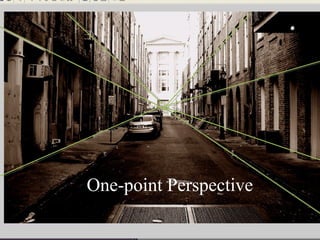
One-point Perspective
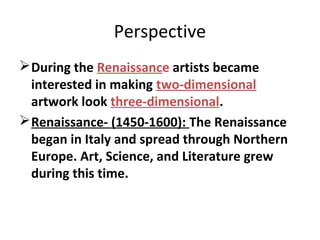
Perspective
During the Renaissance artists became
interested in making two-dimensional
artwork look three-dimensional.
Renaissance- (1450-1600): The Renaissance
began in Italy and spread through Northern
Europe. Art, Science, and Literature grew
during this time.
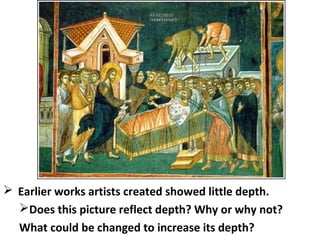
 Earlier works artists created showed little depth.
Does this picture reflect depth? Why or why not?
What could be changed to increase its depth?
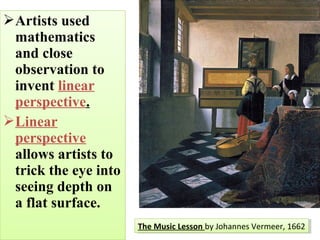
Artists used
mathematics
and close
observation to
invent linear
perspective.
Linear
perspective
allows artists to
trick the eye into
seeing depth on
a flat surface.
Artists used
mathematics
and close
observation to
invent linear
perspective.
Linear
perspective
allows artists to
trick the eye into
seeing depth on
a flat surface.
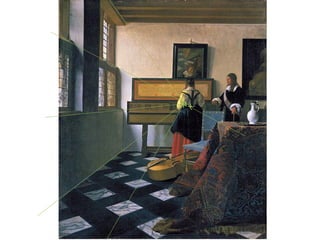
The Music Lesson by Johannes Vermeer, 1662The Music Lesson by Johannes Vermeer, 1662
Linear Perspective:
Based on the way the human eye sees the
world.
Objects that are closer appear larger, more
distant objects appear smaller.
To create the illusion of space the artists
creates a vanishing point on the horizon line.
Objects are drawn using orthogonal lines,
which lead to the vanishing points.
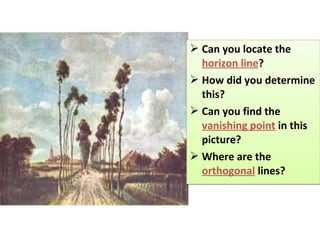
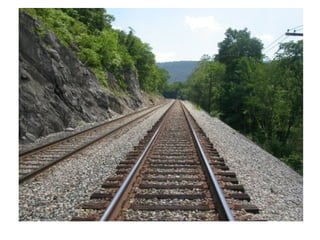
 Can you locate the
horizon line?
 How did you determine
this?
 Can you find the
vanishing point in this
picture?
 Where are the
orthogonal lines?
 Can you locate the
horizon line?
 How did you determine
this?
 Can you find the
vanishing point in this
picture?
 Where are the
orthogonal lines?
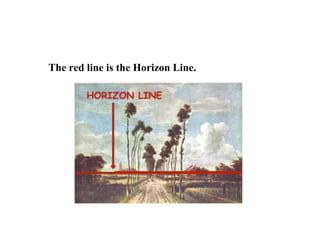
The red line is the Horizon Line.
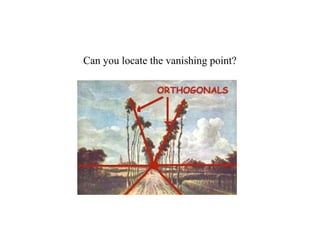
Can you locate the vanishing point?
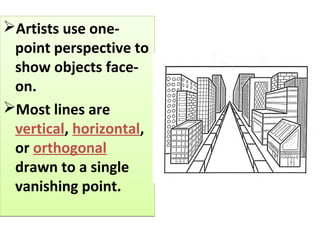
Artists use one-
point perspective to
show objects face-
on.
Most lines are
vertical, horizontal,
or orthogonal
drawn to a single
vanishing point.
Artists use one-
point perspective to
show objects face-
on.
Most lines are
vertical, horizontal,
or orthogonal
drawn to a single
vanishing point.
One-PointOne-Point
PerspectivePerspective
One-point Perspective
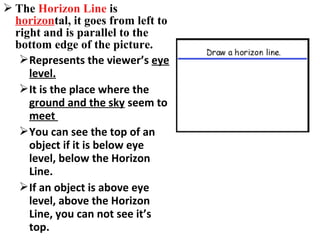
 The Horizon Line is
horizontal, it goes from left to
right and is parallel to the
bottom edge of the picture.
Represents the viewer’s eye
level.
It is the place where the
ground and the sky seem to
meet
You can see the top of an
object if it is below eye
level, below the Horizon
Line.
If an object is above eye
level, above the Horizon
Line, you can not see it’s
top.
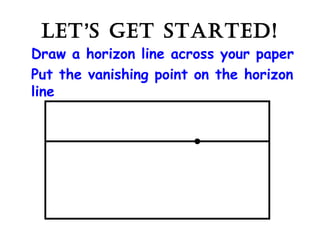
LET’S GET STARTED!
Draw a horizon line across your paper
Put the vanishing point on the horizon
line
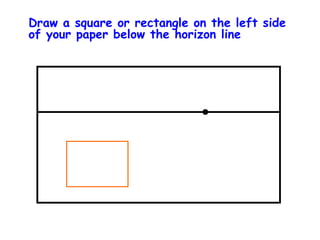
Draw a square or rectangle on the left side
of your paper below the horizon line
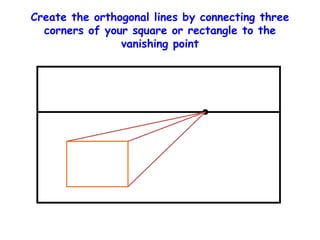
Create the orthogonal lines by connecting three
corners of your square or rectangle to the
vanishing point
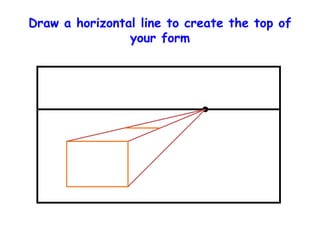
Draw a horizontal line to create the top of
your form
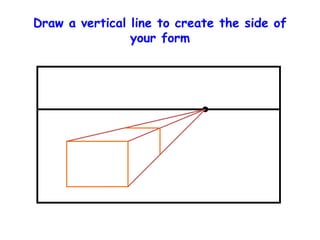
Draw a vertical line to create the side of
your form
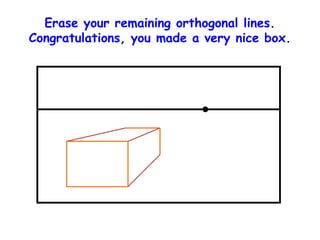
Erase your remaining orthogonal lines.
Congratulations, you made a very nice box.
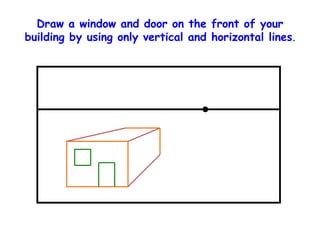
Draw a window and door on the front of your
building by using only vertical and horizontal lines.
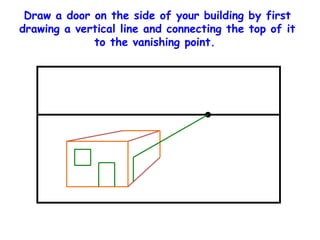
Draw a door on the side of your building by first
drawing a vertical line and connecting the top of it
to the vanishing point.
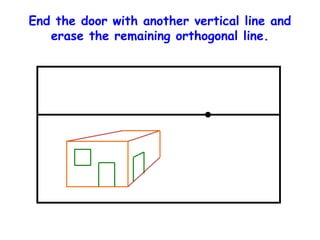
End the door with another vertical line and
erase the remaining orthogonal line.
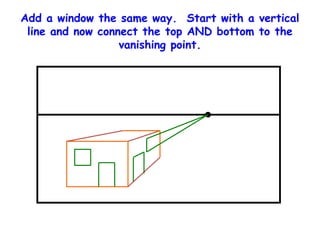
Add a window the same way. Start with a vertical
line and now connect the top AND bottom to the
vanishing point.
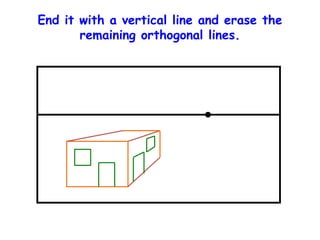
End it with a vertical line and erase the
remaining orthogonal lines.
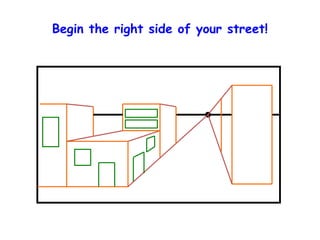
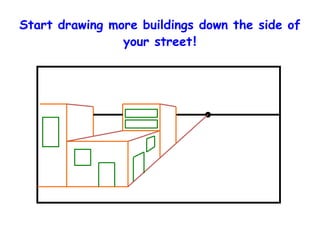
Start drawing more buildings down the side of
your street!
Begin the right side of your street!
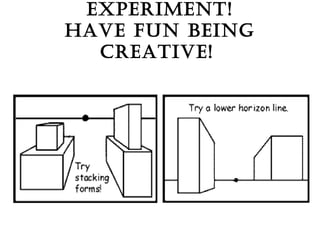
EXPERIMENT!
HAVE FUN BEING
CREATIVE!
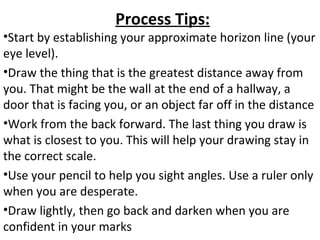
Process Tips:
•Start by establishing your approximate horizon line (your
eye level).
•Draw the thing that is the greatest distance away from
you. That might be the wall at the end of a hallway, a
door that is facing you, or an object far off in the distance
•Work from the back forward. The last thing you draw is
what is closest to you. This will help your drawing stay in
the correct scale.
•Use your pencil to help you sight angles. Use a ruler only
when you are desperate.
•Draw lightly, then go back and darken when you are
confident in your marks

One point perspective

  • 1.
  • 2.
    Perspective During the Renaissanceartists became interested in making two-dimensional artwork look three-dimensional. Renaissance- (1450-1600): The Renaissance began in Italy and spread through Northern Europe. Art, Science, and Literature grew during this time.
  • 3.
     Earlier worksartists created showed little depth. Does this picture reflect depth? Why or why not? What could be changed to increase its depth?
  • 4.
    Artists used mathematics and close observationto invent linear perspective. Linear perspective allows artists to trick the eye into seeing depth on a flat surface. Artists used mathematics and close observation to invent linear perspective. Linear perspective allows artists to trick the eye into seeing depth on a flat surface. The Music Lesson by Johannes Vermeer, 1662The Music Lesson by Johannes Vermeer, 1662
  • 6.
    Linear Perspective: Based onthe way the human eye sees the world. Objects that are closer appear larger, more distant objects appear smaller. To create the illusion of space the artists creates a vanishing point on the horizon line. Objects are drawn using orthogonal lines, which lead to the vanishing points.
  • 7.
     Can youlocate the horizon line?  How did you determine this?  Can you find the vanishing point in this picture?  Where are the orthogonal lines?  Can you locate the horizon line?  How did you determine this?  Can you find the vanishing point in this picture?  Where are the orthogonal lines?
  • 8.
    The red lineis the Horizon Line.
  • 9.
    Can you locatethe vanishing point?
  • 10.
    Artists use one- pointperspective to show objects face- on. Most lines are vertical, horizontal, or orthogonal drawn to a single vanishing point. Artists use one- point perspective to show objects face- on. Most lines are vertical, horizontal, or orthogonal drawn to a single vanishing point.
  • 11.
  • 17.
     The HorizonLine is horizontal, it goes from left to right and is parallel to the bottom edge of the picture. Represents the viewer’s eye level. It is the place where the ground and the sky seem to meet You can see the top of an object if it is below eye level, below the Horizon Line. If an object is above eye level, above the Horizon Line, you can not see it’s top.
  • 18.
    LET’S GET STARTED! Drawa horizon line across your paper Put the vanishing point on the horizon line
  • 19.
    Draw a squareor rectangle on the left side of your paper below the horizon line
  • 20.
    Create the orthogonallines by connecting three corners of your square or rectangle to the vanishing point
  • 21.
    Draw a horizontalline to create the top of your form
  • 22.
    Draw a verticalline to create the side of your form
  • 23.
    Erase your remainingorthogonal lines. Congratulations, you made a very nice box.
  • 24.
    Draw a windowand door on the front of your building by using only vertical and horizontal lines.
  • 25.
    Draw a dooron the side of your building by first drawing a vertical line and connecting the top of it to the vanishing point.
  • 26.
    End the doorwith another vertical line and erase the remaining orthogonal line.
  • 27.
    Add a windowthe same way. Start with a vertical line and now connect the top AND bottom to the vanishing point.
  • 28.
    End it witha vertical line and erase the remaining orthogonal lines.
  • 29.
    Start drawing morebuildings down the side of your street!
  • 30.
    Begin the rightside of your street!
  • 31.
  • 38.
    Process Tips: •Start byestablishing your approximate horizon line (your eye level). •Draw the thing that is the greatest distance away from you. That might be the wall at the end of a hallway, a door that is facing you, or an object far off in the distance •Work from the back forward. The last thing you draw is what is closest to you. This will help your drawing stay in the correct scale. •Use your pencil to help you sight angles. Use a ruler only when you are desperate. •Draw lightly, then go back and darken when you are confident in your marks