Greek Art
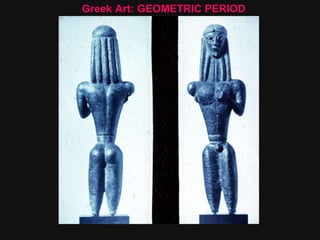
Greek Art: GEOMETRIC PERIOD
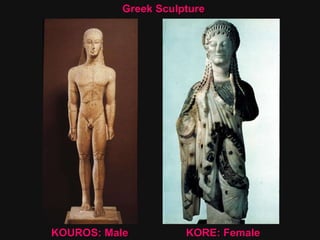
Greek Sculpture KOUROS: Male KORE: Female
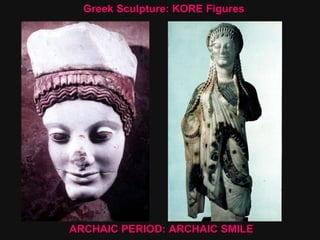
ARCHAIC PERIOD: ARCHAIC SMILE Greek Sculpture: KORE Figures
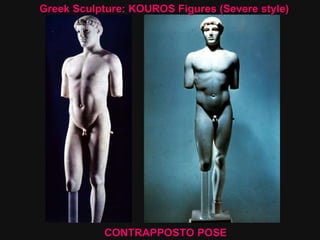
Greek Sculpture: KOUROS Figures (Severe style) CONTRAPPOSTO POSE
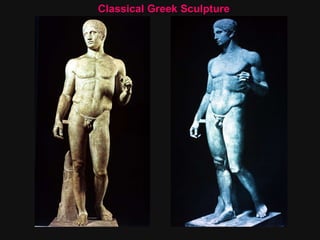
Classical Greek Sculpture
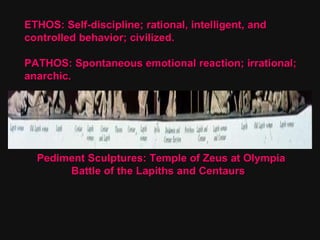
Pediment Sculptures: Temple of Zeus at Olympia Battle of the Lapiths and Centaurs ETHOS: Self-discipline; rational, intelligent, and  controlled behavior; civilized. PATHOS: Spontaneous emotional reaction; irrational; anarchic.
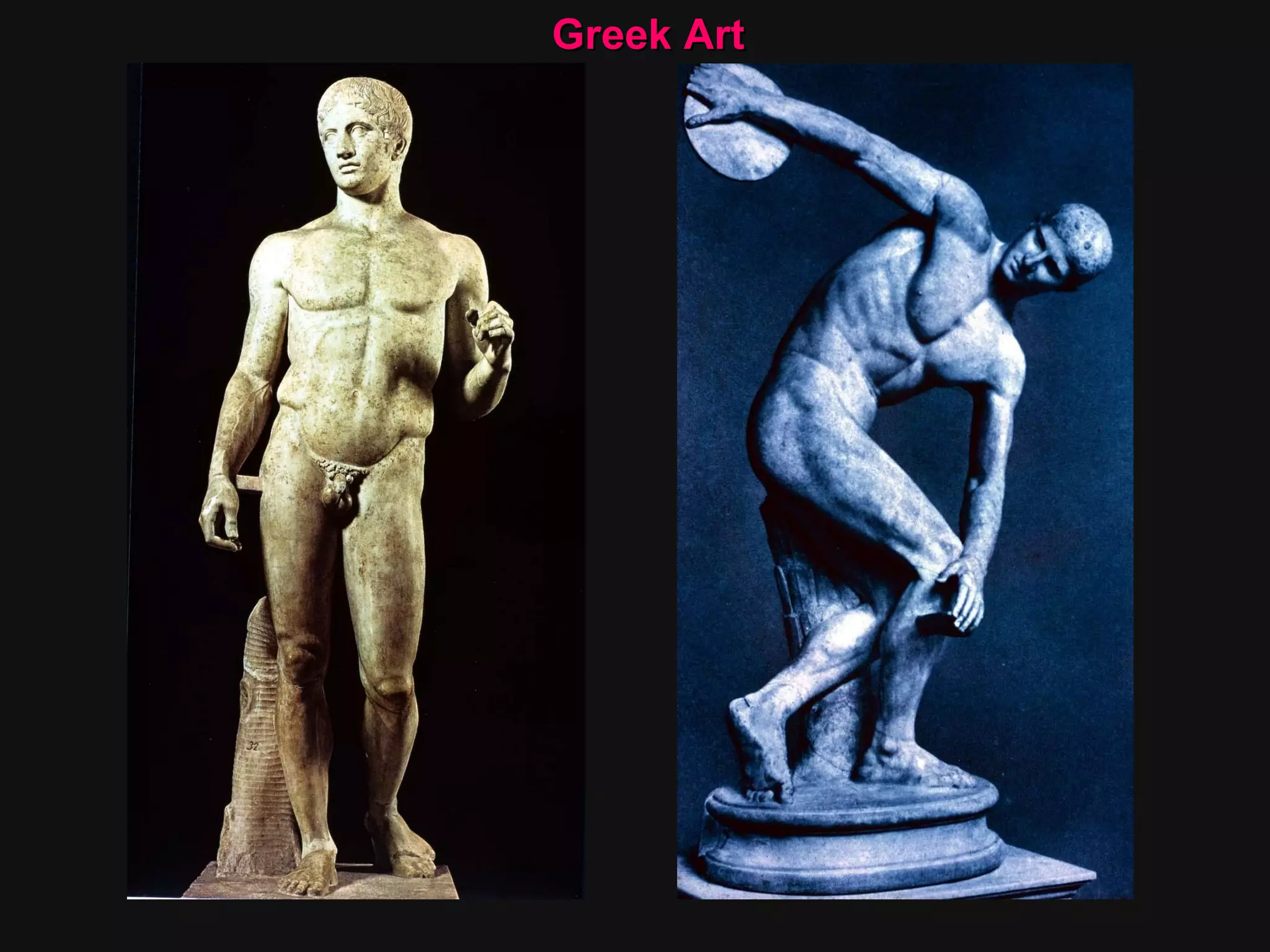
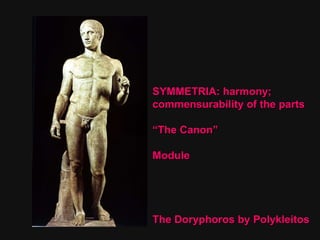
SYMMETRIA: harmony;  commensurability of the parts “ The Canon” Module The Doryphoros by Polykleitos
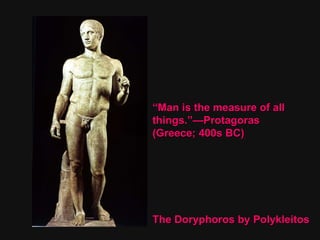
“ Man is the measure of all things.”—Protagoras (Greece; 400s BC) The Doryphoros by Polykleitos
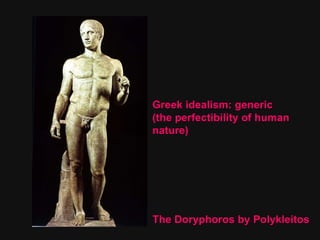
Greek idealism: generic  (the perfectibility of human  nature) The Doryphoros by Polykleitos
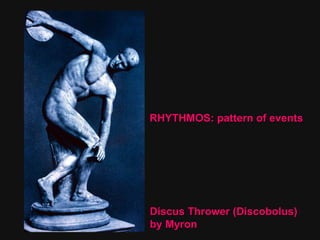
RHYTHMOS: pattern of events  Discus Thrower (Discobolus) by Myron
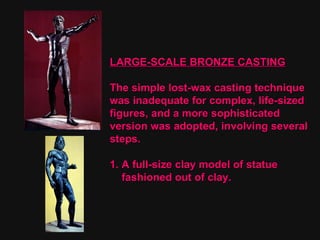
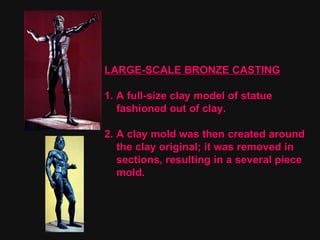
LARGE-SCALE BRONZE CASTING The simple lost-wax casting technique  was inadequate for complex, life-sized  figures, and a more sophisticated version was adopted, involving several steps. 1. A full-size clay model of statue  fashioned out of clay.
LARGE-SCALE BRONZE CASTING 1. A full-size clay model of statue  fashioned out of clay. 2. A clay mold was then created around  the clay original; it was removed in sections, resulting in a several piece  mold.
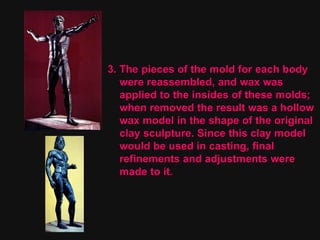
3. The pieces of the mold for each body  were reassembled, and wax was applied to the insides of these molds; when removed the result was a hollow wax model in the shape of the original clay sculpture. Since this clay model  would be used in casting, final  refinements and adjustments were  made to it.
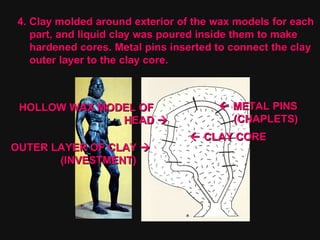
4. Clay molded around exterior of the wax models for each  part, and liquid clay was poured inside them to make  hardened cores. Metal pins inserted to connect the clay outer layer to the clay core. OUTER LAYER OF CLAY   (INVESTMENT)  HOLLOW WAX MODEL OF  HEAD      CLAY CORE     METAL PINS  (CHAPLETS)
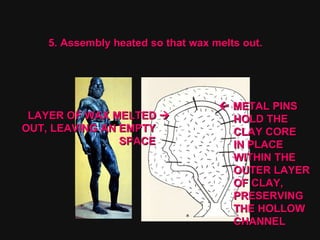
5. Assembly heated so that wax melts out.  LAYER OF WAX MELTED   OUT, LEAVING AN EMPTY  SPACE     METAL PINS  HOLD THE  CLAY CORE IN PLACE  WITHIN THE  OUTER LAYER  OF CLAY,  PRESERVING  THE HOLLOW CHANNEL
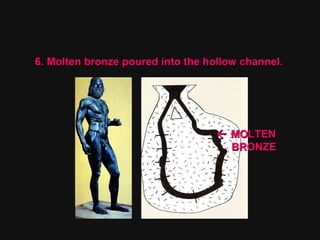
6. Molten bronze poured into the hollow channel.     MOLTEN  BRONZE
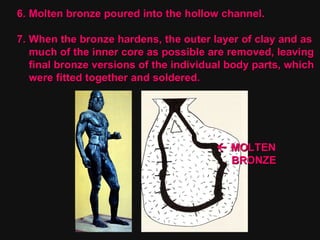
6. Molten bronze poured into the hollow channel. 7. When the bronze hardens, the outer layer of clay and as  much of the inner core as possible are removed, leaving  final bronze versions of the individual body parts, which were fitted together and soldered.    MOLTEN  BRONZE
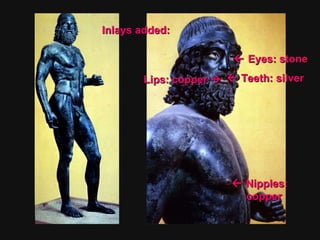
Inlays added:  Lips: copper      Nipples:  copper     Eyes: stone     Teeth: silver
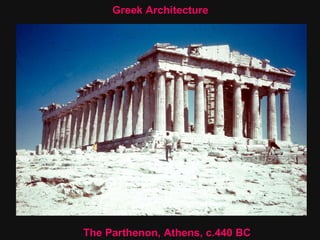
Greek Architecture The Parthenon, Athens, c.440 BC
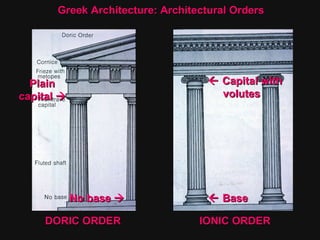
Greek Architecture: Architectural Orders DORIC ORDER IONIC ORDER No base      Base Plain  capital      Capital with volutes
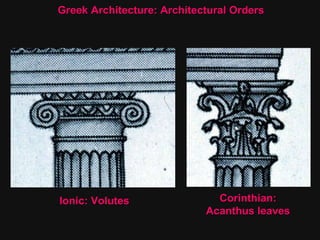
Ionic: Volutes Corinthian: Acanthus leaves Greek Architecture: Architectural Orders
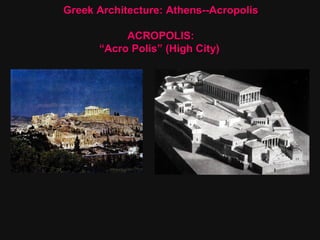
Greek Architecture: Athens--Acropolis ACROPOLIS: “ Acro Polis” (High City)
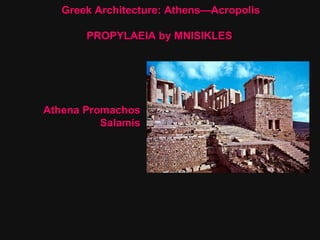
Athena Promachos Salamis Greek Architecture: Athens—Acropolis PROPYLAEIA by MNISIKLES
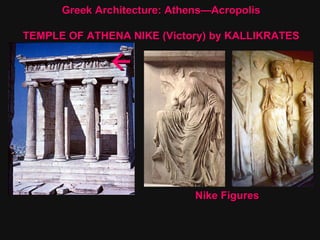
Greek Architecture: Athens—Acropolis TEMPLE OF ATHENA NIKE (Victory) by KALLIKRATES  Nike Figures
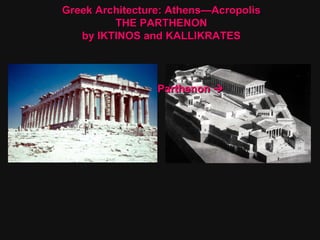
Parthenon   Greek Architecture: Athens—Acropolis THE PARTHENON by IKTINOS and KALLIKRATES
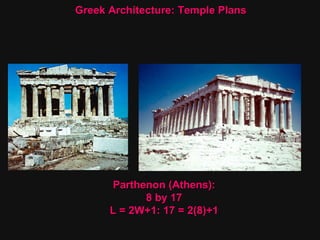
Parthenon (Athens): 8 by 17 L = 2W+1: 17 = 2(8)+1 Greek Architecture: Temple Plans
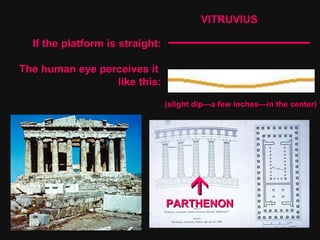
VITRUVIUS  If the platform is straight: The human eye perceives it  like this: _____________ (slight dip—a few inches—in the center) PARTHENON 
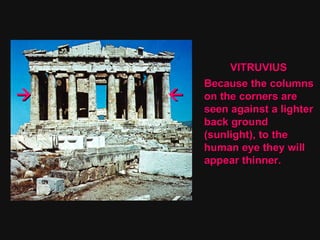
  Because the columns  on the corners are  seen against a lighter  back ground  (sunlight), to the  human eye they will  appear thinner. VITRUVIUS
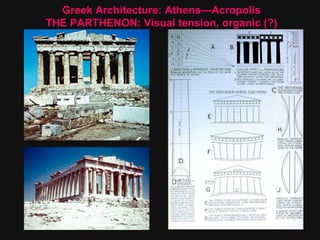
Greek Architecture: Athens—Acropolis THE PARTHENON: Visual tension, organic (?)
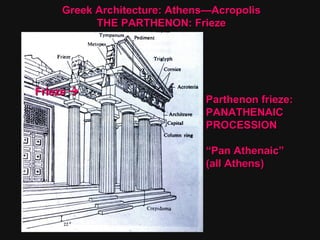
Greek Architecture: Athens—Acropolis THE PARTHENON: Frieze Frieze   Parthenon frieze: PANATHENAIC PROCESSION “ Pan Athenaic” (all Athens)
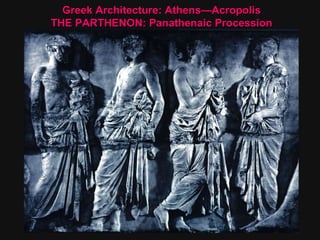
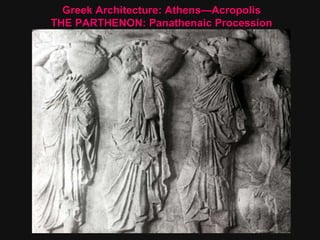
Greek Architecture: Athens—Acropolis THE PARTHENON: Panathenaic Procession
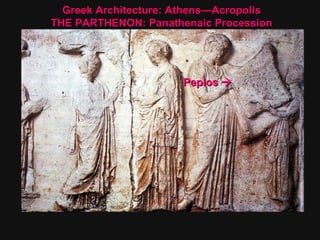
Greek Architecture: Athens—Acropolis THE PARTHENON: Panathenaic Procession Peplos  
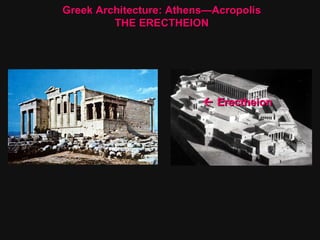
   Erectheion Greek Architecture: Athens—Acropolis THE ERECTHEION
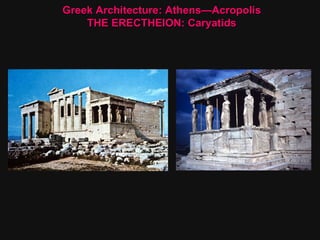
Greek Architecture: Athens—Acropolis THE ERECTHEION: Caryatids
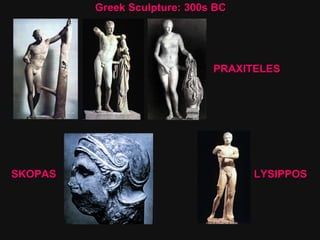
PRAXITELES SKOPAS LYSIPPOS Greek Sculpture: 300s BC
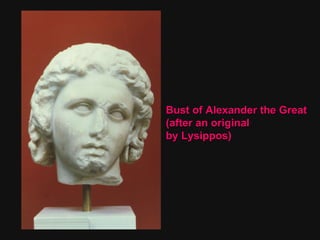
Bust of Alexander the Great  (after an original by Lysippos)
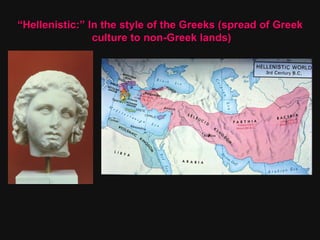
“ Hellenistic:” In the style of the Greeks (spread of Greek  culture to non-Greek lands)
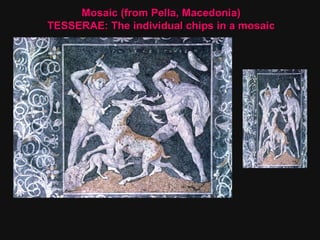
Mosaic (from Pella, Macedonia) TESSERAE: The individual chips in a mosaic
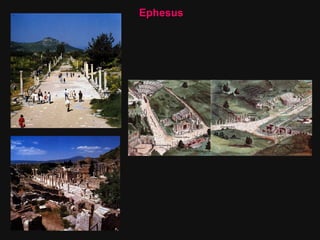
Ephesus
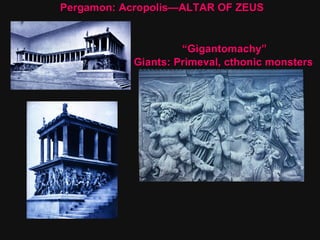
Pergamon: Acropolis—ALTAR OF ZEUS  Giants: Primeval, cthonic monsters “ Gigantomachy”
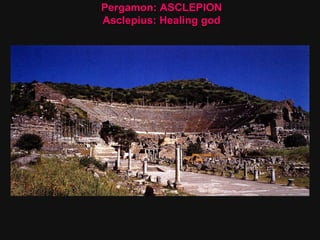
Pergamon: ASCLEPION  Asclepius: Healing god
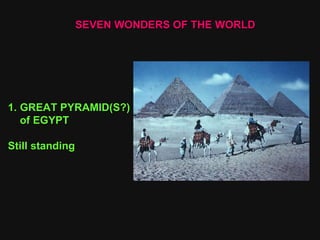
SEVEN WONDERS OF THE WORLD GREAT PYRAMID(S?) of EGYPT Still standing
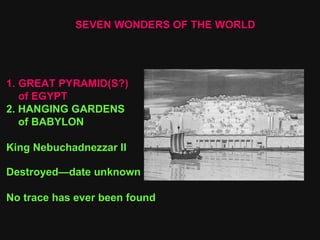
SEVEN WONDERS OF THE WORLD GREAT PYRAMID(S?) of EGYPT 2. HANGING GARDENS of BABYLON King Nebuchadnezzar II Destroyed—date unknown No trace has ever been found
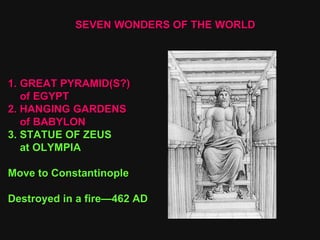
SEVEN WONDERS OF THE WORLD GREAT PYRAMID(S?) of EGYPT 2. HANGING GARDENS of BABYLON 3. STATUE OF ZEUS at OLYMPIA Move to Constantinople Destroyed in a fire—462 AD
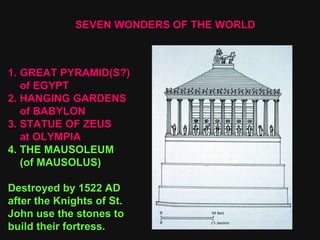
SEVEN WONDERS OF THE WORLD GREAT PYRAMID(S?) of EGYPT 2. HANGING GARDENS of BABYLON 3. STATUE OF ZEUS at OLYMPIA 4. THE MAUSOLEUM  (of MAUSOLUS) Destroyed by 1522 AD after the Knights of St. John use the stones to  build their fortress.
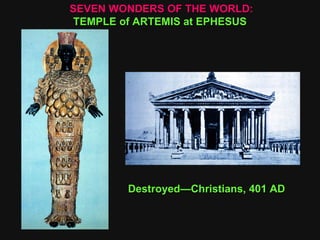
Destroyed—Christians, 401 AD SEVEN WONDERS OF THE WORLD:  TEMPLE of ARTEMIS at EPHESUS
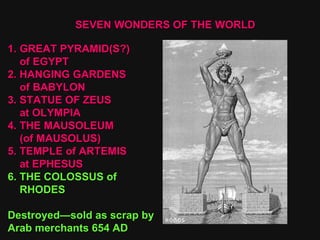
SEVEN WONDERS OF THE WORLD GREAT PYRAMID(S?) of EGYPT 2. HANGING GARDENS of BABYLON 3. STATUE OF ZEUS at OLYMPIA 4. THE MAUSOLEUM  (of MAUSOLUS) 5. TEMPLE of ARTEMIS at EPHESUS 6. THE COLOSSUS of RHODES Destroyed—sold as scrap by Arab merchants 654 AD
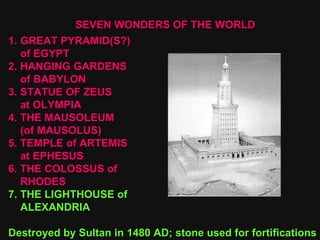
SEVEN WONDERS OF THE WORLD GREAT PYRAMID(S?) of EGYPT 2. HANGING GARDENS of BABYLON 3. STATUE OF ZEUS at OLYMPIA 4. THE MAUSOLEUM  (of MAUSOLUS) 5. TEMPLE of ARTEMIS at EPHESUS 6. THE COLOSSUS of RHODES 7. THE LIGHTHOUSE of ALEXANDRIA Destroyed by Sultan in 1480 AD; stone used for fortifications

Review 4 greek and hellenistic

  • 1.
  • 2.
  • 3.
    Greek Sculpture KOUROS:Male KORE: Female
  • 4.
    ARCHAIC PERIOD: ARCHAICSMILE Greek Sculpture: KORE Figures
  • 5.
    Greek Sculpture: KOUROSFigures (Severe style) CONTRAPPOSTO POSE
  • 6.
  • 7.
    Pediment Sculptures: Templeof Zeus at Olympia Battle of the Lapiths and Centaurs ETHOS: Self-discipline; rational, intelligent, and controlled behavior; civilized. PATHOS: Spontaneous emotional reaction; irrational; anarchic.
  • 8.
    SYMMETRIA: harmony; commensurability of the parts “ The Canon” Module The Doryphoros by Polykleitos
  • 9.
    “ Man isthe measure of all things.”—Protagoras (Greece; 400s BC) The Doryphoros by Polykleitos
  • 10.
    Greek idealism: generic (the perfectibility of human nature) The Doryphoros by Polykleitos
  • 11.
    RHYTHMOS: pattern ofevents Discus Thrower (Discobolus) by Myron
  • 12.
    LARGE-SCALE BRONZE CASTINGThe simple lost-wax casting technique was inadequate for complex, life-sized figures, and a more sophisticated version was adopted, involving several steps. 1. A full-size clay model of statue fashioned out of clay.
  • 13.
    LARGE-SCALE BRONZE CASTING1. A full-size clay model of statue fashioned out of clay. 2. A clay mold was then created around the clay original; it was removed in sections, resulting in a several piece mold.
  • 14.
    3. The piecesof the mold for each body were reassembled, and wax was applied to the insides of these molds; when removed the result was a hollow wax model in the shape of the original clay sculpture. Since this clay model would be used in casting, final refinements and adjustments were made to it.
  • 15.
    4. Clay moldedaround exterior of the wax models for each part, and liquid clay was poured inside them to make hardened cores. Metal pins inserted to connect the clay outer layer to the clay core. OUTER LAYER OF CLAY  (INVESTMENT) HOLLOW WAX MODEL OF HEAD   CLAY CORE  METAL PINS (CHAPLETS)
  • 16.
    5. Assembly heatedso that wax melts out. LAYER OF WAX MELTED  OUT, LEAVING AN EMPTY SPACE  METAL PINS HOLD THE CLAY CORE IN PLACE WITHIN THE OUTER LAYER OF CLAY, PRESERVING THE HOLLOW CHANNEL
  • 17.
    6. Molten bronzepoured into the hollow channel.  MOLTEN BRONZE
  • 18.
    6. Molten bronzepoured into the hollow channel. 7. When the bronze hardens, the outer layer of clay and as much of the inner core as possible are removed, leaving final bronze versions of the individual body parts, which were fitted together and soldered.  MOLTEN BRONZE
  • 19.
    Inlays added: Lips: copper   Nipples: copper  Eyes: stone  Teeth: silver
  • 20.
    Greek Architecture TheParthenon, Athens, c.440 BC
  • 21.
    Greek Architecture: ArchitecturalOrders DORIC ORDER IONIC ORDER No base   Base Plain capital   Capital with volutes
  • 22.
    Ionic: Volutes Corinthian:Acanthus leaves Greek Architecture: Architectural Orders
  • 23.
    Greek Architecture: Athens--AcropolisACROPOLIS: “ Acro Polis” (High City)
  • 24.
    Athena Promachos SalamisGreek Architecture: Athens—Acropolis PROPYLAEIA by MNISIKLES
  • 25.
    Greek Architecture: Athens—AcropolisTEMPLE OF ATHENA NIKE (Victory) by KALLIKRATES  Nike Figures
  • 26.
    Parthenon Greek Architecture: Athens—Acropolis THE PARTHENON by IKTINOS and KALLIKRATES
  • 27.
    Parthenon (Athens): 8by 17 L = 2W+1: 17 = 2(8)+1 Greek Architecture: Temple Plans
  • 28.
    VITRUVIUS Ifthe platform is straight: The human eye perceives it like this: _____________ (slight dip—a few inches—in the center) PARTHENON 
  • 29.
      Becausethe columns on the corners are seen against a lighter back ground (sunlight), to the human eye they will appear thinner. VITRUVIUS
  • 30.
    Greek Architecture: Athens—AcropolisTHE PARTHENON: Visual tension, organic (?)
  • 31.
    Greek Architecture: Athens—AcropolisTHE PARTHENON: Frieze Frieze  Parthenon frieze: PANATHENAIC PROCESSION “ Pan Athenaic” (all Athens)
  • 32.
    Greek Architecture: Athens—AcropolisTHE PARTHENON: Panathenaic Procession
  • 33.
    Greek Architecture: Athens—AcropolisTHE PARTHENON: Panathenaic Procession
  • 34.
    Greek Architecture: Athens—AcropolisTHE PARTHENON: Panathenaic Procession Peplos 
  • 35.
    Erectheion Greek Architecture: Athens—Acropolis THE ERECTHEION
  • 36.
    Greek Architecture: Athens—AcropolisTHE ERECTHEION: Caryatids
  • 37.
    PRAXITELES SKOPAS LYSIPPOSGreek Sculpture: 300s BC
  • 38.
    Bust of Alexanderthe Great (after an original by Lysippos)
  • 39.
    “ Hellenistic:” Inthe style of the Greeks (spread of Greek culture to non-Greek lands)
  • 40.
    Mosaic (from Pella,Macedonia) TESSERAE: The individual chips in a mosaic
  • 41.
  • 42.
    Pergamon: Acropolis—ALTAR OFZEUS Giants: Primeval, cthonic monsters “ Gigantomachy”
  • 43.
    Pergamon: ASCLEPION Asclepius: Healing god
  • 44.
    SEVEN WONDERS OFTHE WORLD GREAT PYRAMID(S?) of EGYPT Still standing
  • 45.
    SEVEN WONDERS OFTHE WORLD GREAT PYRAMID(S?) of EGYPT 2. HANGING GARDENS of BABYLON King Nebuchadnezzar II Destroyed—date unknown No trace has ever been found
  • 46.
    SEVEN WONDERS OFTHE WORLD GREAT PYRAMID(S?) of EGYPT 2. HANGING GARDENS of BABYLON 3. STATUE OF ZEUS at OLYMPIA Move to Constantinople Destroyed in a fire—462 AD
  • 47.
    SEVEN WONDERS OFTHE WORLD GREAT PYRAMID(S?) of EGYPT 2. HANGING GARDENS of BABYLON 3. STATUE OF ZEUS at OLYMPIA 4. THE MAUSOLEUM (of MAUSOLUS) Destroyed by 1522 AD after the Knights of St. John use the stones to build their fortress.
  • 48.
    Destroyed—Christians, 401 ADSEVEN WONDERS OF THE WORLD: TEMPLE of ARTEMIS at EPHESUS
  • 49.
    SEVEN WONDERS OFTHE WORLD GREAT PYRAMID(S?) of EGYPT 2. HANGING GARDENS of BABYLON 3. STATUE OF ZEUS at OLYMPIA 4. THE MAUSOLEUM (of MAUSOLUS) 5. TEMPLE of ARTEMIS at EPHESUS 6. THE COLOSSUS of RHODES Destroyed—sold as scrap by Arab merchants 654 AD
  • 50.
    SEVEN WONDERS OFTHE WORLD GREAT PYRAMID(S?) of EGYPT 2. HANGING GARDENS of BABYLON 3. STATUE OF ZEUS at OLYMPIA 4. THE MAUSOLEUM (of MAUSOLUS) 5. TEMPLE of ARTEMIS at EPHESUS 6. THE COLOSSUS of RHODES 7. THE LIGHTHOUSE of ALEXANDRIA Destroyed by Sultan in 1480 AD; stone used for fortifications

Editor's Notes

  • #11 .
  • #21 GREEK ARCH==PARTH MOST FAMOUS, BUT IT LIKE SCULPTURE ALSO UNDERGOES AN EVOLUTION
  • #24 So that is how they do it, standard orders, standard set of rules, and now that we know that, we will see that the most famous building project in Greece is one that was in fact famous because it broke the rules—acrop, parth—finally do decide to rebuild
  • #25 PROPYLAEIA BY MNISIKLES, ENTRANCEWAY ITSELF DESIGNED TO LOOK LIKE A TEMPLE, BUT PROP==PROMACHOS STATUE, SALAMIS. REMIND YOU OF ATHENS ROLE IN SAVING GREEC,E AND AFFIRMING IT IS OK TO STEAL THIS MONEY—DELIAN LEAGUE
  • #27 BIG DEAL ALWAYS BEEN PARTH, IN ITS DECEPTIVE WAY PERHAPS MOST SUBTLE REFINED AND COMPLEX BUILDING EVER
  • #28 SAME FORM, DIFF NUMBERS, BUT THAT’S OK, THAT IS JUST ONE THING OF MANY DIFF ABOUT PARTH—AS WE WILL SEE, IN ITS OWN SUBTLE WAY PERHAPS THE MOST SOPHISTICATED BUILDING EVER CREATED
  • #29 WHY—TAKE INTO ACCOUNT VIEWERS EXP==VETRVIUS, STYLOBATE WILL SEEM TO SINK TO EYE—AND CDOLUMNS VS OPEN SKY SEEM TO SHRIVEL
  • #31 BUT ALSO ANOTHER REASON, NOT JUST DISCERNIBLE VISUAL EXPERIENCE, BUT SUBLIMINAL ONE, SOME OF THESE ADJUSTMENTS NOT EVEN CONSCIOULSY NOTICABLE TO NAKED EYE, BUT TO MAKE IT SEEM LESS STATIC, MORE ORGANIC, AND TO CREATE A VISUAL TENSION, SLIGHT, ALTHO NOT OVERTLY NOTICEABLE ALTERATIONS, TO CREATE TENSION, KEEP YOUR ATTENTION, MAKE YOU LOOK AT IT. AND IMPORTANT, THEY WANT YOU TO LOOK AT IT, IT HAS MESSAGES TO TELL—CONCERNED ENOUGH ABOUT YOU READING IT THAT THEY FORCE YOU AROUND BACK TO ENTER, SO HAVE TO LOOK AT ENTIRETY
  • #32 IMPORTANT PROCESEXXION, IMPORATNAT STATUE OF ATHENA PARTHENOS, TO GIVE HER A NEW PEPLOS, ROBE—BUT LIKE GREEK ART, NOT JUST ANY, SPECIFIC ONE, BUT A KIND OF GENERIC, PERFECT ONE, AND AGAIN, RENDERED IN VERY SOPHISTICATED WAY THAT TAKES INTO ACCOUNT VIEWERS EXP
  • #35 UNFOLDING PEPLOS
  • #38 SO AGAIN, THREE FAMOUS NAMES IN SCULPTURE EMERGE, PRAX, SKOPAS, LYS—AND LYS ALSO IMPORTANT BECAUSE PERSONAL SCULPTOR TO THIS MAN, ALEX THE GREAT