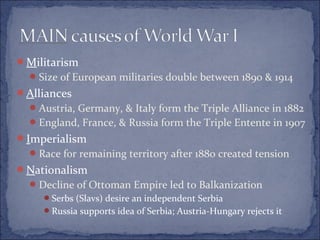
Militarism
Size of European militaries double between 1890 & 1914
Alliances
Austria, Germany, & Italy form the Triple Alliance in 1882
England, France, & Russia form the Triple Entente in 1907
Imperialism
Race for remaining territory after 1880 created tension
Nationalism
Decline of Ottoman Empire led to Balkanization
Serbs (Slavs) desire an independent Serbia
Russia supports idea of Serbia; Austria-Hungary rejects it
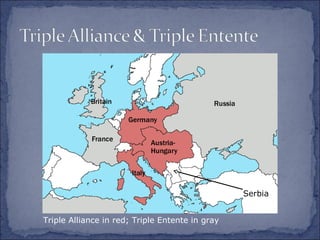
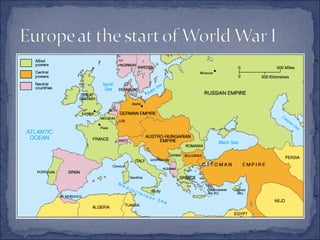
Triple Alliance in red; Triple Entente in gray
Serbia
“The entire able-bodied population is preparing
to massacre one another; though no one, it is
true, wants to attack, and everybody protests his
love of peace and determination to maintain it,
yet the whole world feels that it only requires
some unforeseen incident, some unpreventable
accident, for the spark to fall in a flash…and
blow Europe sky-high.”
Frederic Passy, 1895
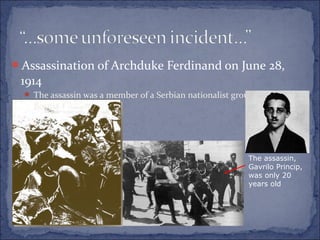
Assassination of Archduke Ferdinand on June 28,
1914
 The assassin was a member of a Serbian nationalist group called Young
Bosnia
The assassin,
Gavrilo Princip,
was only 20
years old
Austria-Hungary issued a list of ten demands to
Serbia called the July Ultimatum
Serbia accepted 9 of the 10 demands
Austria-Hungary declared war on Serbia on July
28, 1914
Russia immediately mobilized its army
“The Guns of August”
Germany declared war on Russia on August 1, 1914
Germany declared war on France on August 3, 1914
Great Britain declared war on Germany on August 4,
1914
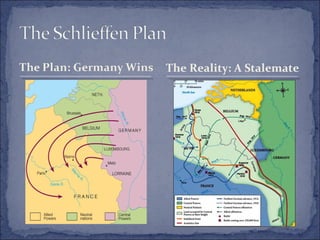
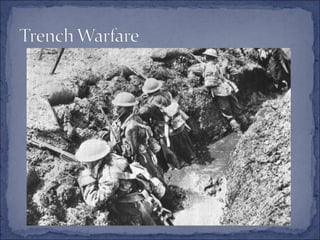
The Reality: A Stalemate
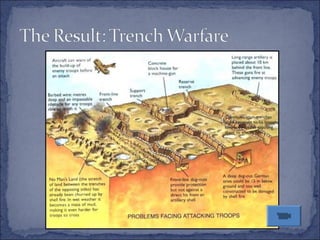
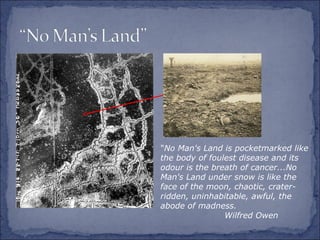
"No Man's Land is pocketmarked like
the body of foulest disease and its
odour is the breath of cancer...No
Man's Land under snow is like the
face of the moon, chaotic, crater-
ridden, uninhabitable, awful, the
abode of madness.
Wilfred Owen
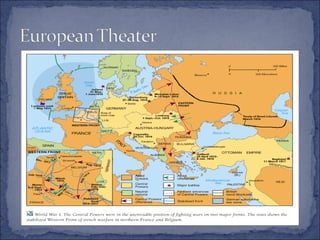
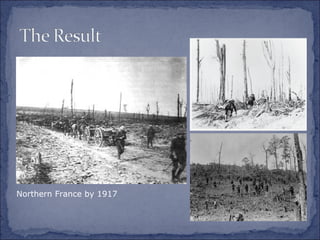
Northern France by 1917
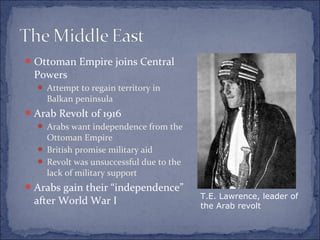
Ottoman Empire joins Central
Powers
 Attempt to regain territory in
Balkan peninsula
Arab Revolt of 1916
 Arabs want independence from the
Ottoman Empire
 British promise military aid
 Revolt was unsuccessful due to the
lack of military support
Arabs gain their “independence”
after World War I T.E. Lawrence, leader of
the Arab revolt
China was divided into spheres of influence prior
to World War I
Japan entered the war as an Allied Power
Seized German colonies in the Pacific & China
Japan issued the Twenty-One Demands to China
in 1915
Hoped to turn China into a protectorate of Japan
Chinese government did not accept or reject the
demands
Led to collapse of China’s military government
Most involved tropical dependency
Gandhi and other leaders supported the war
Hoped to achieve self-government
British promised to move towards self-government
after the war
Provided loans & materials to aid the British war effort
1.3 million Indians served as soldiers and laborers
Over 100,000 casualties
“The moment Britain gets into
trouble elsewhere, India, in her
present temper, would burst into
a blaze of rebellion.”
William Archer
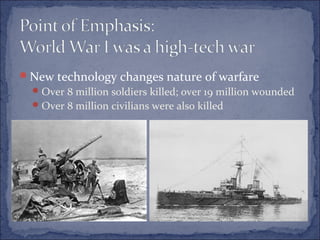
New technology changes nature of warfare
Over 8 million soldiers killed; over 19 million wounded
Over 8 million civilians were also killed
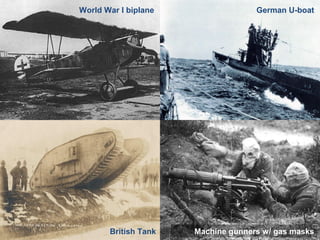
World War I biplane
Machine gunners w/ gas masksBritish Tank
German U-boat
Definition of Total War
Conflict in which the participating countries devote all
of their resources to the war effort
Aspects of Total War
Mandatory military conscription (a.k.a. the draft)
Control of the economy & nationalization of industry
Rationing of food and other essentials
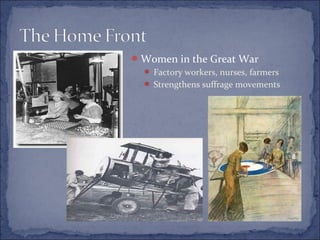
The Home Front
Women, children, ethnic minorities, etc. are considered a vital
part of the war effort
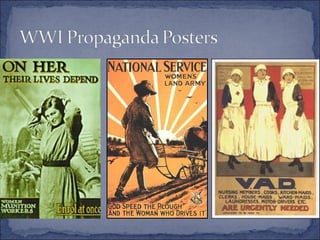
Propaganda
Women in the Great War
 Factory workers, nurses, farmers
 Strengthens suffrage movements
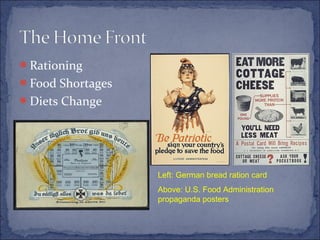
Rationing
Food Shortages
Diets Change
Left: German bread ration card
Above: U.S. Food Administration
propaganda posters
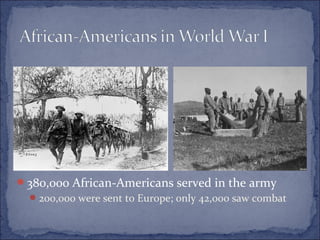
380,000 African-Americans served in the army
200,000 were sent to Europe; only 42,000 saw combat
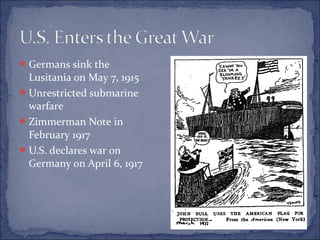
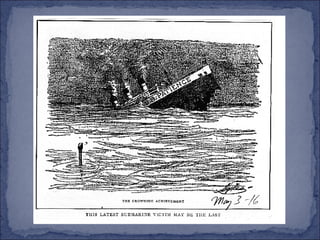
Germans sink the
Lusitania on May 7, 1915
Unrestricted submarine
warfare
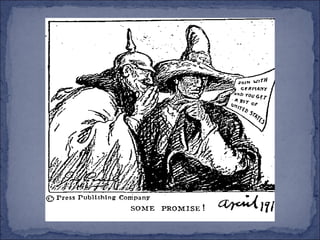
Zimmerman Note in
February 1917
U.S. declares war on
Germany on April 6, 1917
One of the most devastating outbreaks of disease
in modern times
Mass movement during World War I spread the
flu around the world
Spread to the trenches of the Great War
“Spanish” flu kills 30 million people worldwide
Kills 550,000 in the United States
Kills 12.5 million in India and China
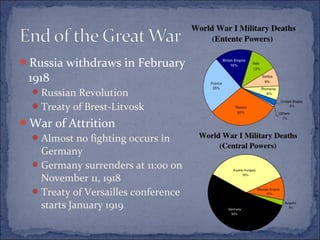
Russia withdraws in February
1918
Russian Revolution
Treaty of Brest-Litvosk
War of Attrition
Almost no fighting occurs in
Germany
Germany surrenders at 11:00 on
November 11, 1918
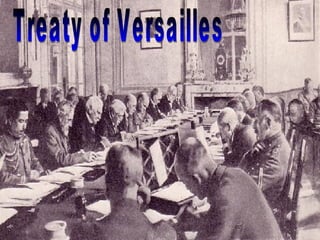
Treaty of Versailles conference
starts January 1919
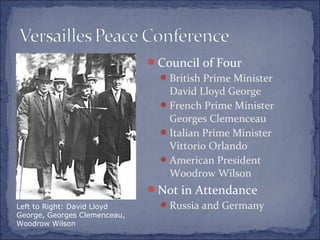
Council of Four
British Prime Minister
David Lloyd George
French Prime Minister
Georges Clemenceau
Italian Prime Minister
Vittorio Orlando
American President
Woodrow Wilson
Not in Attendance
Russia and GermanyLeft to Right: David Lloyd
George, Georges Clemenceau,
Woodrow Wilson
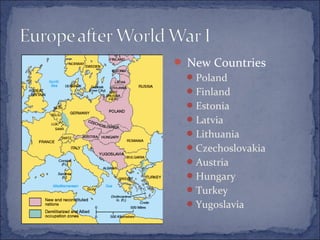
 New Countries
Poland
Finland
Estonia
Latvia
Lithuania
Czechoslovakia
Austria
Hungary
Turkey
Yugoslavia
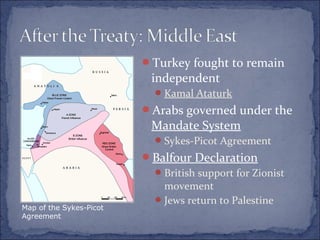
Turkey fought to remain
independent
Kamal Ataturk
Arabs governed under the
Mandate System
Sykes-Picot Agreement
Balfour Declaration
British support for Zionist
movement
Jews return to Palestine
Map of the Sykes-Picot
Agreement
Government of India Act of 1919
Granted local autonomy but not self-rule
Nationalists protested act
British responded with Rowlatt Act in 1920
Gave British unlimited search and seizure
Mohandas Gandhi called for non-violent protest
Amritsar Massacre
20,000 people gathered peacefully in Amritsar
British fired upon unarmed crowd
379 dead and more than 1200 wounded
Increased momentum for satyagraha movement
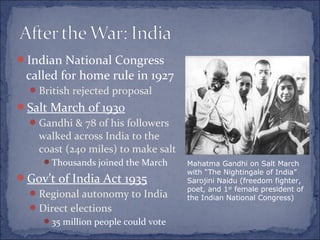
Indian National Congress
called for home rule in 1927
British rejected proposal
Salt March of 1930
Gandhi & 78 of his followers
walked across India to the
coast (240 miles) to make salt
Thousands joined the March
Gov’t of India Act 1935
Regional autonomy to India
Direct elections
35 million people could vote
Mahatma Gandhi on Salt March
with “The Nightingale of India”
Sarojini Naidu (freedom fighter,
poet, and 1st
female president of
the Indian National Congress)
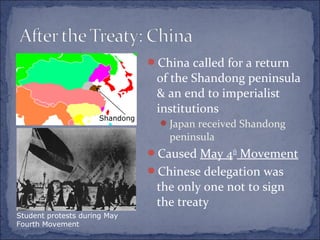
China called for a return
of the Shandong peninsula
& an end to imperialist
institutions
Japan received Shandong
peninsula
Caused May 4th
Movement
Chinese delegation was
the only one not to sign
the treaty
Shandong
Student protests during May
Fourth Movement
Wanted racial equality and Shandong peninsula
Conference rejected racial equality
Rejection fueled nationalism and militarism in Japan
Washington Conference 1921-1922
World believed control of international situation
depended upon naval power
Alfred Thayer Mahan
Conference forced Japan to accept inferior fleet
5-5-3 ratio angered Japanese delegates as well as belligerent
attitude of U.S.A.
Japan begins to expand influence in China
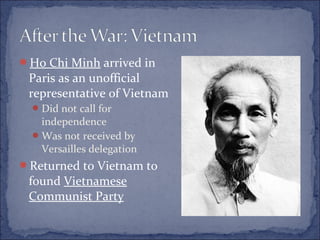
Ho Chi Minh arrived in
Paris as an unofficial
representative of Vietnam
Did not call for
independence
Was not received by
Versailles delegation
Returned to Vietnam to
found Vietnamese
Communist Party

Greatwar

  • 3.
    Militarism Size of Europeanmilitaries double between 1890 & 1914 Alliances Austria, Germany, & Italy form the Triple Alliance in 1882 England, France, & Russia form the Triple Entente in 1907 Imperialism Race for remaining territory after 1880 created tension Nationalism Decline of Ottoman Empire led to Balkanization Serbs (Slavs) desire an independent Serbia Russia supports idea of Serbia; Austria-Hungary rejects it
  • 4.
    Triple Alliance inred; Triple Entente in gray Serbia
  • 5.
    “The entire able-bodiedpopulation is preparing to massacre one another; though no one, it is true, wants to attack, and everybody protests his love of peace and determination to maintain it, yet the whole world feels that it only requires some unforeseen incident, some unpreventable accident, for the spark to fall in a flash…and blow Europe sky-high.” Frederic Passy, 1895
  • 6.
    Assassination of ArchdukeFerdinand on June 28, 1914  The assassin was a member of a Serbian nationalist group called Young Bosnia The assassin, Gavrilo Princip, was only 20 years old
  • 7.
    Austria-Hungary issued alist of ten demands to Serbia called the July Ultimatum Serbia accepted 9 of the 10 demands Austria-Hungary declared war on Serbia on July 28, 1914 Russia immediately mobilized its army “The Guns of August” Germany declared war on Russia on August 1, 1914 Germany declared war on France on August 3, 1914 Great Britain declared war on Germany on August 4, 1914
  • 10.
    The Reality: AStalemate
  • 14.
    "No Man's Landis pocketmarked like the body of foulest disease and its odour is the breath of cancer...No Man's Land under snow is like the face of the moon, chaotic, crater- ridden, uninhabitable, awful, the abode of madness. Wilfred Owen
  • 15.
  • 18.
    Ottoman Empire joinsCentral Powers  Attempt to regain territory in Balkan peninsula Arab Revolt of 1916  Arabs want independence from the Ottoman Empire  British promise military aid  Revolt was unsuccessful due to the lack of military support Arabs gain their “independence” after World War I T.E. Lawrence, leader of the Arab revolt
  • 20.
    China was dividedinto spheres of influence prior to World War I Japan entered the war as an Allied Power Seized German colonies in the Pacific & China Japan issued the Twenty-One Demands to China in 1915 Hoped to turn China into a protectorate of Japan Chinese government did not accept or reject the demands Led to collapse of China’s military government
  • 21.
    Most involved tropicaldependency Gandhi and other leaders supported the war Hoped to achieve self-government British promised to move towards self-government after the war Provided loans & materials to aid the British war effort 1.3 million Indians served as soldiers and laborers Over 100,000 casualties “The moment Britain gets into trouble elsewhere, India, in her present temper, would burst into a blaze of rebellion.” William Archer
  • 22.
    New technology changesnature of warfare Over 8 million soldiers killed; over 19 million wounded Over 8 million civilians were also killed
  • 23.
    World War Ibiplane Machine gunners w/ gas masksBritish Tank German U-boat
  • 24.
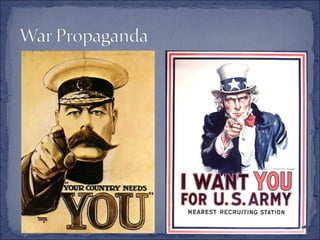
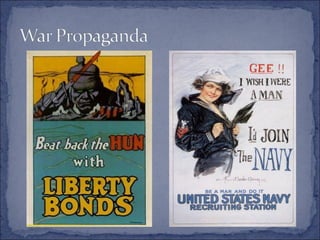
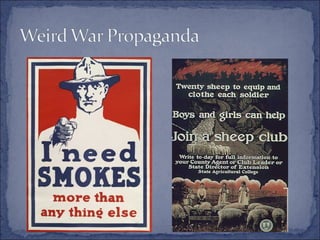
    Definition of TotalWar Conflict in which the participating countries devote all of their resources to the war effort Aspects of Total War Mandatory military conscription (a.k.a. the draft) Control of the economy & nationalization of industry Rationing of food and other essentials The Home Front Women, children, ethnic minorities, etc. are considered a vital part of the war effort Propaganda
  • 25.
    Women in theGreat War  Factory workers, nurses, farmers  Strengthens suffrage movements
  • 27.
    Rationing Food Shortages Diets Change Left:German bread ration card Above: U.S. Food Administration propaganda posters
  • 28.
    380,000 African-Americans servedin the army 200,000 were sent to Europe; only 42,000 saw combat
  • 33.
    Germans sink the Lusitaniaon May 7, 1915 Unrestricted submarine warfare Zimmerman Note in February 1917 U.S. declares war on Germany on April 6, 1917
  • 36.
    One of themost devastating outbreaks of disease in modern times Mass movement during World War I spread the flu around the world Spread to the trenches of the Great War “Spanish” flu kills 30 million people worldwide Kills 550,000 in the United States Kills 12.5 million in India and China
  • 37.
    Russia withdraws inFebruary 1918 Russian Revolution Treaty of Brest-Litvosk War of Attrition Almost no fighting occurs in Germany Germany surrenders at 11:00 on November 11, 1918 Treaty of Versailles conference starts January 1919
  • 39.
    Council of Four BritishPrime Minister David Lloyd George French Prime Minister Georges Clemenceau Italian Prime Minister Vittorio Orlando American President Woodrow Wilson Not in Attendance Russia and GermanyLeft to Right: David Lloyd George, Georges Clemenceau, Woodrow Wilson
  • 41.
  • 42.
    Turkey fought toremain independent Kamal Ataturk Arabs governed under the Mandate System Sykes-Picot Agreement Balfour Declaration British support for Zionist movement Jews return to Palestine Map of the Sykes-Picot Agreement
  • 43.
    Government of IndiaAct of 1919 Granted local autonomy but not self-rule Nationalists protested act British responded with Rowlatt Act in 1920 Gave British unlimited search and seizure Mohandas Gandhi called for non-violent protest Amritsar Massacre 20,000 people gathered peacefully in Amritsar British fired upon unarmed crowd 379 dead and more than 1200 wounded Increased momentum for satyagraha movement
  • 44.
    Indian National Congress calledfor home rule in 1927 British rejected proposal Salt March of 1930 Gandhi & 78 of his followers walked across India to the coast (240 miles) to make salt Thousands joined the March Gov’t of India Act 1935 Regional autonomy to India Direct elections 35 million people could vote Mahatma Gandhi on Salt March with “The Nightingale of India” Sarojini Naidu (freedom fighter, poet, and 1st female president of the Indian National Congress)
  • 45.
    China called fora return of the Shandong peninsula & an end to imperialist institutions Japan received Shandong peninsula Caused May 4th Movement Chinese delegation was the only one not to sign the treaty Shandong Student protests during May Fourth Movement
  • 46.
    Wanted racial equalityand Shandong peninsula Conference rejected racial equality Rejection fueled nationalism and militarism in Japan Washington Conference 1921-1922 World believed control of international situation depended upon naval power Alfred Thayer Mahan Conference forced Japan to accept inferior fleet 5-5-3 ratio angered Japanese delegates as well as belligerent attitude of U.S.A. Japan begins to expand influence in China
  • 47.
    Ho Chi Minharrived in Paris as an unofficial representative of Vietnam Did not call for independence Was not received by Versailles delegation Returned to Vietnam to found Vietnamese Communist Party

Editor's Notes

  • #11 Schlieffen Plan Devised by Germany in 1905 Germany’s plan to avoid fighting a war on two fronts Called for rapid attack on France through Belgium Rapid attack fails Result is a stalemate on Western Front characterized by trench warfare