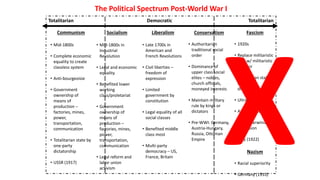
Totalitarian Democratic Totalitarian
The Political Spectrum Post-World War I
Liberalism
• Late 1700s in
American and
French Revolutions
• Civil liberties –
freedom of
expression
• Limited
government by
constitution
• Legal equality of all
social classes
• Benefited middle
class most
• Multi-party
democracy – US,
France, Britain
Conservatism
• Authoritarian
traditional social
order
• Dominance of
upper class social
elites – nobles,
church officials,
moneyed interests
• Maintain military
rule by kings or
dictators
• Pre-WWI: Germany,
Austria-Hungary,
Russia, Ottoman
Empire
Fascism
• 1920s
• Replace militaristic
king w/ militaristic
dictator
• Totalitarian state by
one-party
dictatorship
• Ultra-nationalist
• Anti-communist
• Social Darwinian
expansion
• Italy (1922)
Nazism
• Racial superiority
• Germany (1933)
Socialism
• Mid-1800s in
Industrial
Revolution
• Legal and economic
equality
• Benefited lower
working
class/proletariat
• Government
ownership of
means of
production –
factories, mines,
power,
transportation,
communication
• Legal reform and
labor union
activism
Communism
• Mid-1800s
• Complete economic
equality to create
classless system
• Anti-bourgeoisie
• Government
ownership of
means of
production –
factories, mines,
power,
transportation,
communication
• Totalitarian state by
one-party
dictatorship
• USSR (1917)
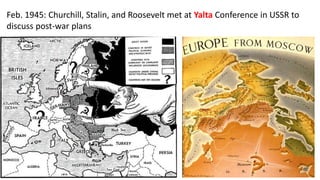
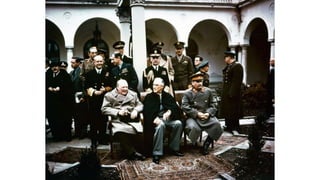
Feb. 1945: Churchill, Stalin, and Roosevelt met at Yalta Conference in USSR to
discuss post-war plans
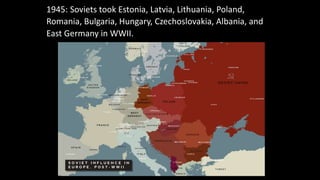
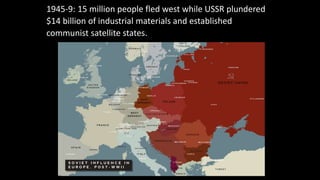
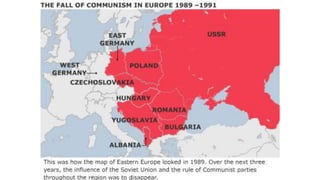
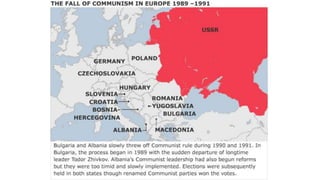
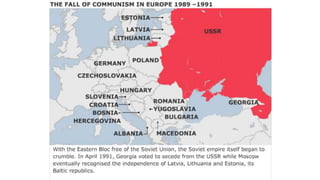
1945: Soviets took Estonia, Latvia, Lithuania, Poland,
Romania, Bulgaria, Hungary, Czechoslovakia, Albania, and
East Germany in WWII.
1945-9: 15 million people fled west while USSR plundered
$14 billion of industrial materials and established
communist satellite states.
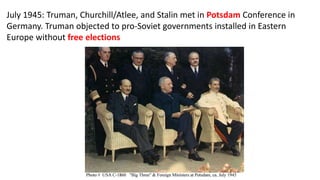
July 1945: Truman, Churchill/Atlee, and Stalin met in Potsdam Conference in
Germany. Truman objected to pro-Soviet governments installed in Eastern
Europe without free elections
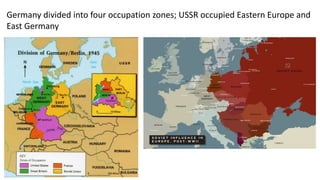
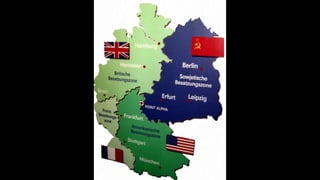
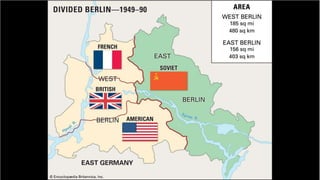
Germany divided into four occupation zones; USSR occupied Eastern Europe and
East Germany
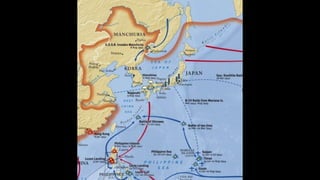
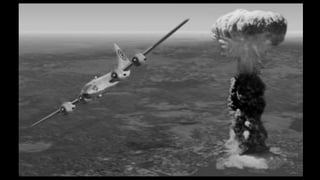
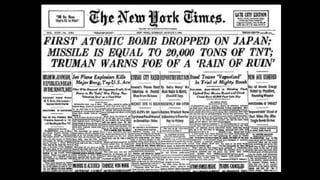
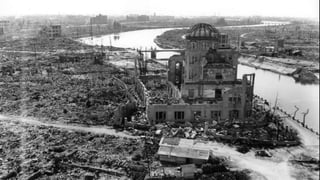
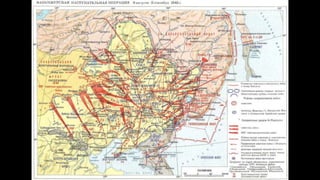
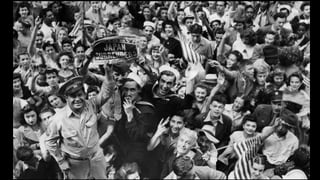
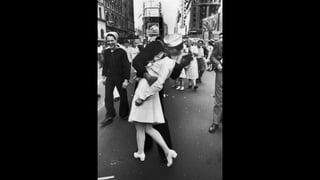
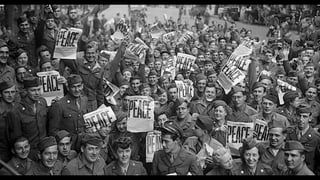
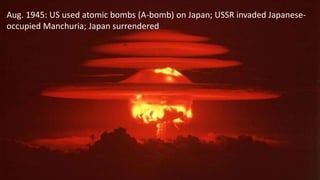
Aug. 1945: US used atomic bombs (A-bomb) on Japan; USSR invaded Japanese-
occupied Manchuria; Japan surrendered
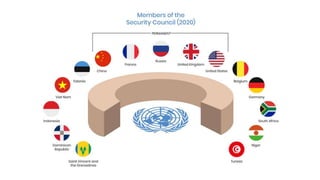
April 1945: first meeting of the United Nations
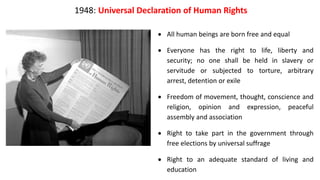
1948: Universal Declaration of Human Rights
 All human beings are born free and equal
 Everyone has the right to life, liberty and
security; no one shall be held in slavery or
servitude or subjected to torture, arbitrary
arrest, detention or exile
 Freedom of movement, thought, conscience and
religion, opinion and expression, peaceful
assembly and association
 Right to take part in the government through
free elections by universal suffrage
 Right to an adequate standard of living and
education
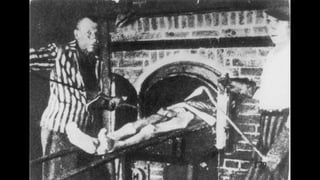
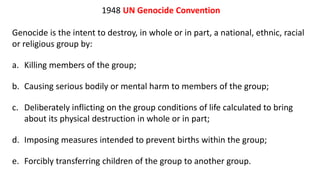
1948 UN Genocide Convention
Genocide is the intent to destroy, in whole or in part, a national, ethnic, racial
or religious group by:
a. Killing members of the group;
b. Causing serious bodily or mental harm to members of the group;
c. Deliberately inflicting on the group conditions of life calculated to bring
about its physical destruction in whole or in part;
d. Imposing measures intended to prevent births within the group;
e. Forcibly transferring children of the group to another group.
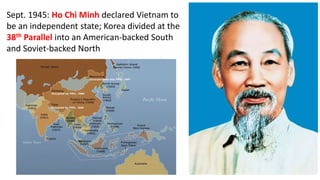
Sept. 1945: Ho Chi Minh declared Vietnam to
be an independent state; Korea divided at the
38th Parallel into an American-backed South
and Soviet-backed North
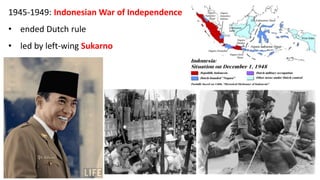
1945-1949: Indonesian War of Independence
• ended Dutch rule
• led by left-wing Sukarno
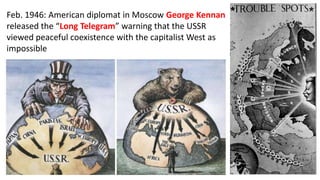
Feb. 1946: American diplomat in Moscow George Kennan
released the “Long Telegram” warning that the USSR
viewed peaceful coexistence with the capitalist West as
impossible
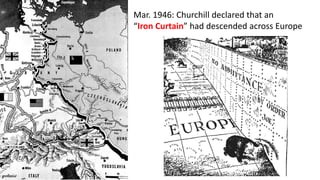
Mar. 1946: Churchill declared that an
“Iron Curtain” had descended across Europe
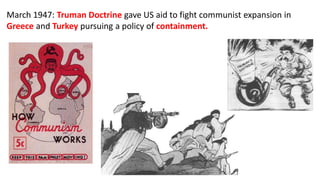
March 1947: Truman Doctrine gave US aid to fight communist expansion in
Greece and Turkey pursuing a policy of containment.
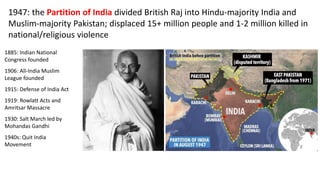
1947: the Partition of India divided British Raj into Hindu-majority India and
Muslim-majority Pakistan; displaced 15+ million people and 1-2 million killed in
national/religious violence
1885: Indian National
Congress founded
1906: All-India Muslim
League founded
1915: Defense of India Act
1919: Rowlatt Acts and
Amritsar Massacre
1930: Salt March led by
Mohandas Gandhi
1940s: Quit India
Movement
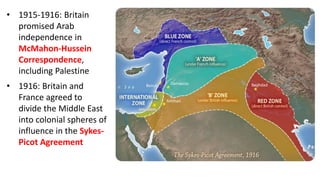
• 1915-1916: Britain
promised Arab
independence in
McMahon-Hussein
Correspondence,
including Palestine
• 1916: Britain and
France agreed to
divide the Middle East
into colonial spheres of
influence in the Sykes-
Picot Agreement
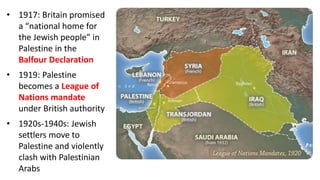
• 1917: Britain promised
a “national home for
the Jewish people” in
Palestine in the
Balfour Declaration
• 1919: Palestine
becomes a League of
Nations mandate
under British authority
• 1920s-1940s: Jewish
settlers move to
Palestine and violently
clash with Palestinian
Arabs
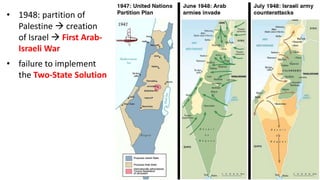
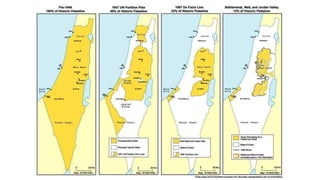
• 1948: partition of
Palestine  creation
of Israel  First Arab-
Israeli War
• failure to implement
the Two-State Solution
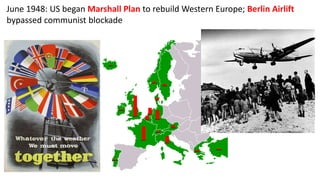
June 1948: US began Marshall Plan to rebuild Western Europe; Berlin Airlift
bypassed communist blockade
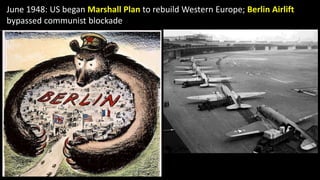
June 1948: US began Marshall Plan to rebuild Western Europe; Berlin Airlift
bypassed communist blockade
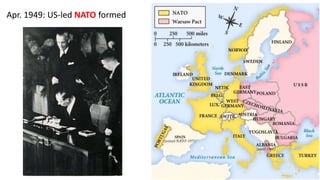
Apr. 1949: US-led NATO formed
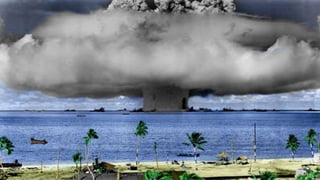
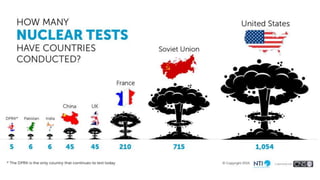
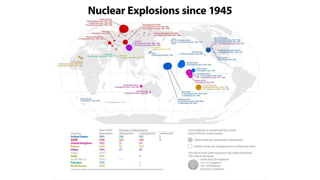
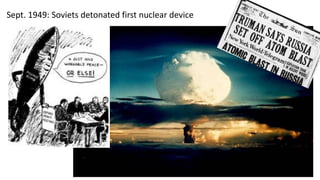
Sept. 1949: Soviets detonated first nuclear device
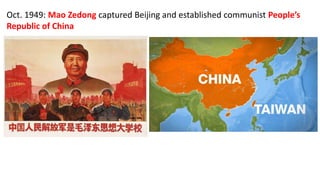
Oct. 1949: Mao Zedong captured Beijing and established communist People’s
Republic of China
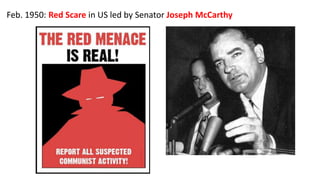
Feb. 1950: Red Scare in US led by Senator Joseph McCarthy
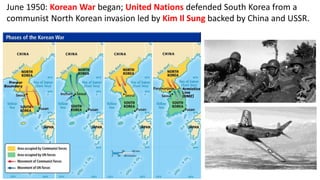
June 1950: Korean War began; United Nations defended South Korea from a
communist North Korean invasion led by Kim Il Sung backed by China and USSR.
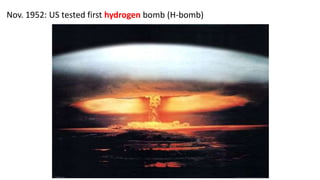
Nov. 1952: US tested first hydrogen bomb (H-bomb)
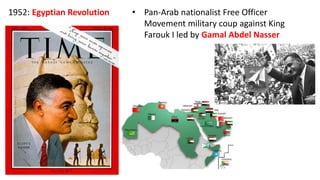
1952: Egyptian Revolution • Pan-Arab nationalist Free Officer
Movement military coup against King
Farouk I led by Gamal Abdel Nasser
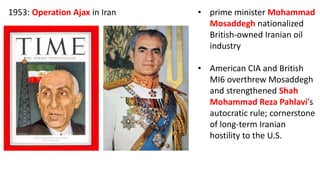
1953: Operation Ajax in Iran • prime minister Mohammad
Mosaddegh nationalized
British-owned Iranian oil
industry
• American CIA and British
MI6 overthrew Mosaddegh
and strengthened Shah
Mohammad Reza Pahlavi's
autocratic rule; cornerstone
of long-term Iranian
hostility to the U.S.
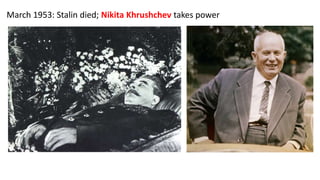
March 1953: Stalin died; Nikita Khrushchev takes power
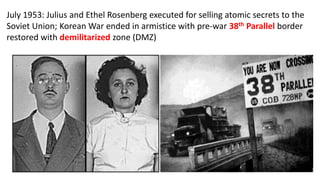
July 1953: Julius and Ethel Rosenberg executed for selling atomic secrets to the
Soviet Union; Korean War ended in armistice with pre-war 38th Parallel border
restored with demilitarized zone (DMZ)
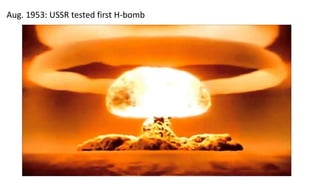
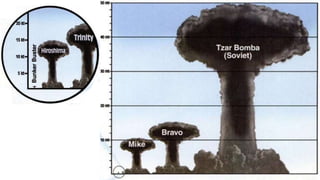
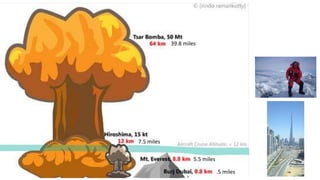
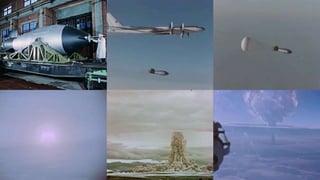
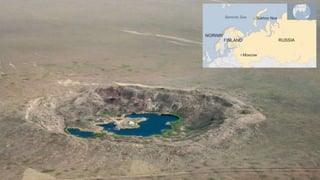
Aug. 1953: USSR tested first H-bomb
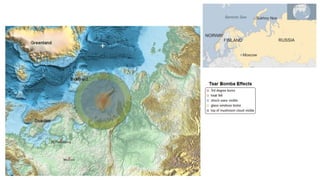
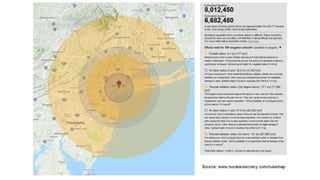
39.8 miles
7.5 miles
5.5 miles
.5 miles
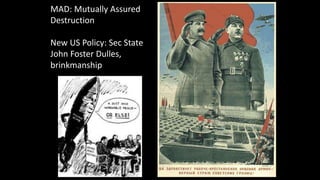
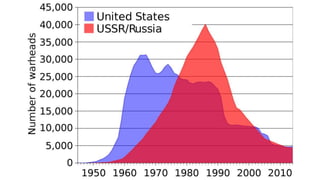
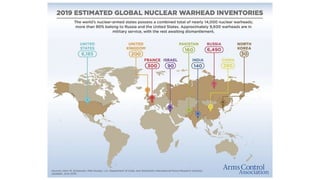
MAD: Mutually Assured
Destruction
New US Policy: Sec State
John Foster Dulles,
brinkmanship
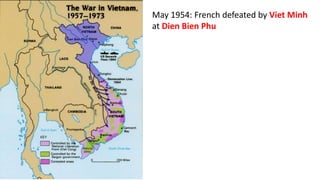
May 1954: French defeated by Viet Minh
at Dien Bien Phu
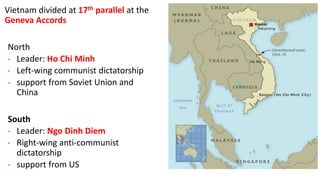
Vietnam divided at 17th parallel at the
Geneva Accords
North
• Leader: Ho Chi Minh
• Left-wing communist dictatorship
• support from Soviet Union and
China
South
• Leader: Ngo Dinh Diem
• Right-wing anti-communist
dictatorship
• support from US
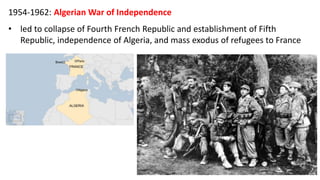
1954-1962: Algerian War of Independence
• led to collapse of Fourth French Republic and establishment of Fifth
Republic, independence of Algeria, and mass exodus of refugees to France
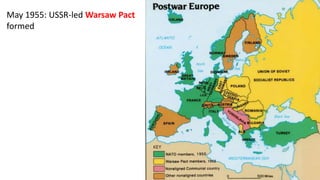
May 1955: USSR-led Warsaw Pact
formed
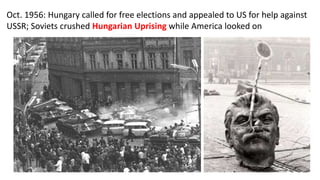
Oct. 1956: Hungary called for free elections and appealed to US for help against
USSR; Soviets crushed Hungarian Uprising while America looked on
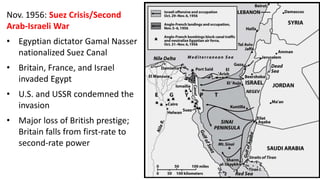
Nov. 1956: Suez Crisis/Second
Arab-Israeli War
• Egyptian dictator Gamal Nasser
nationalized Suez Canal
• Britain, France, and Israel
invaded Egypt
• U.S. and USSR condemned the
invasion
• Major loss of British prestige;
Britain falls from first-rate to
second-rate power
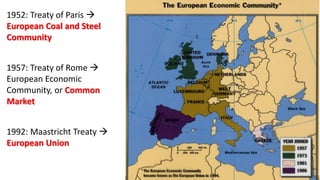
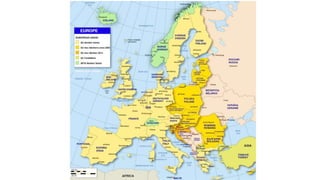
1952: Treaty of Paris 
European Coal and Steel
Community
1957: Treaty of Rome 
European Economic
Community, or Common
Market
1992: Maastricht Treaty 
European Union
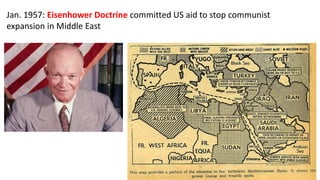
Jan. 1957: Eisenhower Doctrine committed US aid to stop communist
expansion in Middle East
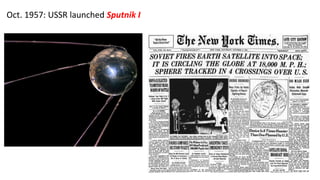
Oct. 1957: USSR launched Sputnik I
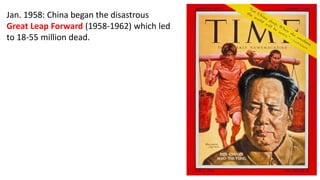
Jan. 1958: China began the disastrous
Great Leap Forward (1958-1962) which led
to 18-55 million dead.
Oct. 1958: US feared a “missile gap”; NASA formed
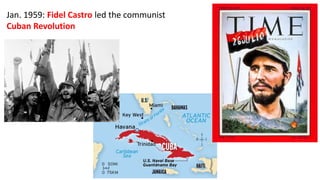
Jan. 1959: Fidel Castro led the communist
Cuban Revolution
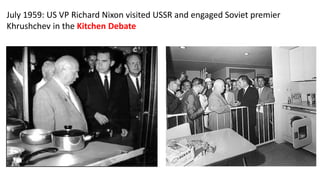
July 1959: US VP Richard Nixon visited USSR and engaged Soviet premier
Khrushchev in the Kitchen Debate
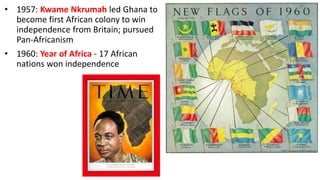
• 1957: Kwame Nkrumah led Ghana to
become first African colony to win
independence from Britain; pursued
Pan-Africanism
• 1960: Year of Africa - 17 African
nations won independence
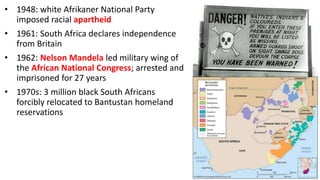
• 1948: white Afrikaner National Party
imposed racial apartheid
• 1961: South Africa declares independence
from Britain
• 1962: Nelson Mandela led military wing of
the African National Congress; arrested and
imprisoned for 27 years
• 1970s: 3 million black South Africans
forcibly relocated to Bantustan homeland
reservations
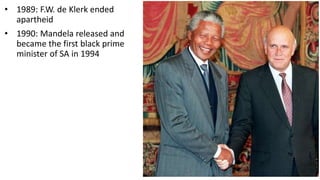
• 1989: F.W. de Klerk ended
apartheid
• 1990: Mandela released and
became the first black prime
minister of SA in 1994
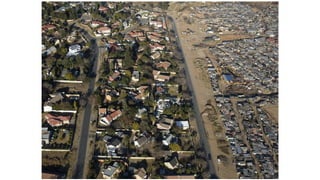
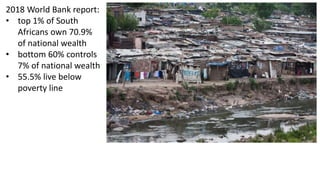
2018 World Bank report:
• top 1% of South
Africans own 70.9%
of national wealth
• bottom 60% controls
7% of national wealth
• 55.5% live below
poverty line
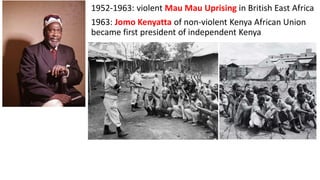
1952-1963: violent Mau Mau Uprising in British East Africa
1963: Jomo Kenyatta of non-violent Kenya African Union
became first president of independent Kenya
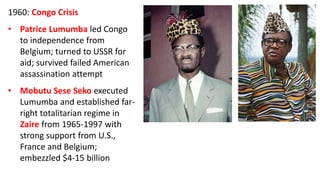
1960: Congo Crisis
• Patrice Lumumba led Congo
to independence from
Belgium; turned to USSR for
aid; survived failed American
assassination attempt
• Mobutu Sese Seko executed
Lumumba and established far-
right totalitarian regime in
Zaire from 1965-1997 with
strong support from U.S.,
France and Belgium;
embezzled $4-15 billion
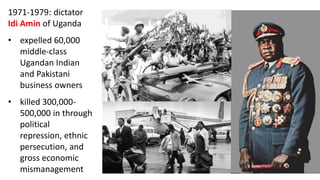
1971-1979: dictator
Idi Amin of Uganda
• expelled 60,000
middle-class
Ugandan Indian
and Pakistani
business owners
• killed 300,000-
500,000 in through
political
repression, ethnic
persecution, and
gross economic
mismanagement
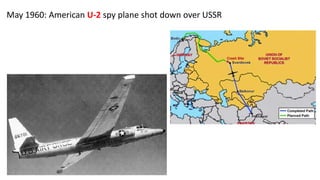
May 1960: American U-2 spy plane shot down over USSR
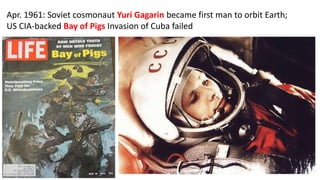
Apr. 1961: Soviet cosmonaut Yuri Gagarin became first man to orbit Earth;
US CIA-backed Bay of Pigs Invasion of Cuba failed
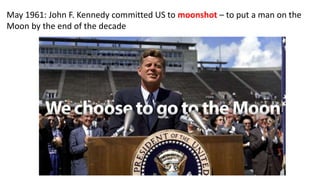
May 1961: John F. Kennedy committed US to moonshot – to put a man on the
Moon by the end of the decade
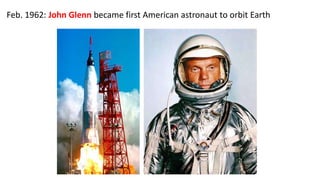
Feb. 1962: John Glenn became first American astronaut to orbit Earth
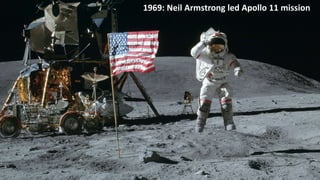
1969: Neil Armstrong led Apollo 11 mission
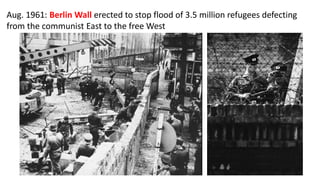
Aug. 1961: Berlin Wall erected to stop flood of 3.5 million refugees defecting
from the communist East to the free West
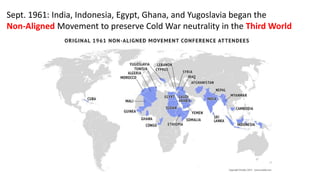
Sept. 1961: India, Indonesia, Egypt, Ghana, and Yugoslavia began the
Non-Aligned Movement to preserve Cold War neutrality in the Third World
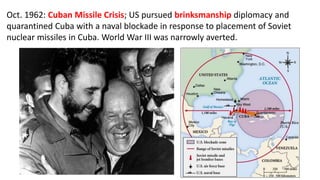
Oct. 1962: Cuban Missile Crisis; US pursued brinksmanship diplomacy and
quarantined Cuba with a naval blockade in response to placement of Soviet
nuclear missiles in Cuba. World War III was narrowly averted.
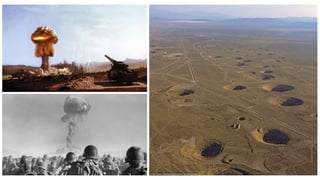
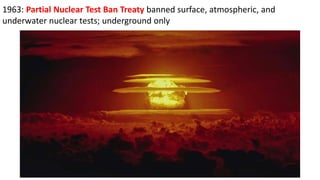
1963: Partial Nuclear Test Ban Treaty banned surface, atmospheric, and
underwater nuclear tests; underground only
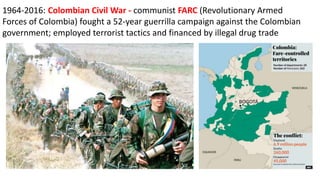
1964-2016: Colombian Civil War - communist FARC (Revolutionary Armed
Forces of Colombia) fought a 52-year guerrilla campaign against the Colombian
government; employed terrorist tactics and financed by illegal drug trade
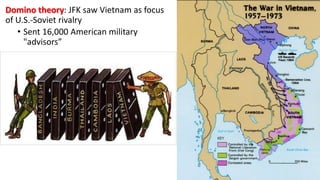
Domino theory: JFK saw Vietnam as focus
of U.S.-Soviet rivalry
• Sent 16,000 American military
"advisors”
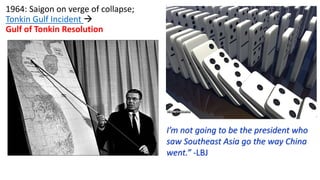
1964: Saigon on verge of collapse;
Tonkin Gulf Incident 
Gulf of Tonkin Resolution
I’m not going to be the president who
saw Southeast Asia go the way China
went.” -LBJ
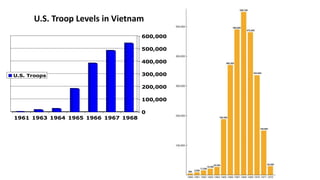
U.S. Troop Levels in Vietnam
0
100,000
200,000
300,000
400,000
500,000
600,000
1961 1963 1964 1965 1966 1967 1968
U.S. Troops
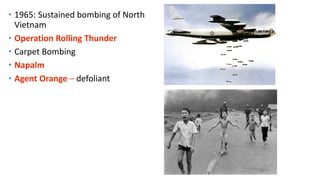
• 1965: Sustained bombing of North
Vietnam
• Operation Rolling Thunder
• Carpet Bombing
• Napalm
• Agent Orange – defoliant
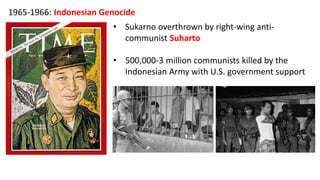
1965-1966: Indonesian Genocide
• Sukarno overthrown by right-wing anti-
communist Suharto
• 500,000-3 million communists killed by the
Indonesian Army with U.S. government support
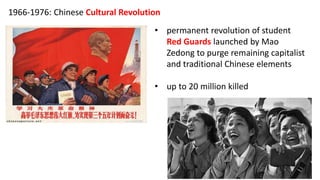
1966-1976: Chinese Cultural Revolution
• permanent revolution of student
Red Guards launched by Mao
Zedong to purge remaining capitalist
and traditional Chinese elements
• up to 20 million killed
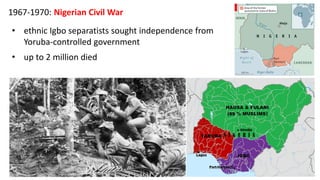
1967-1970: Nigerian Civil War
• ethnic Igbo separatists sought independence from
Yoruba-controlled government
• up to 2 million died
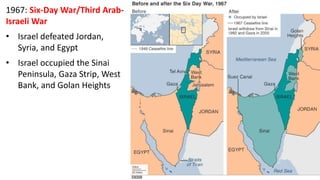
1967: Six-Day War/Third Arab-
Israeli War
• Israel defeated Jordan,
Syria, and Egypt
• Israel occupied the Sinai
Peninsula, Gaza Strip, West
Bank, and Golan Heights
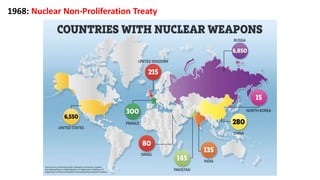
1968: Nuclear Non-Proliferation Treaty
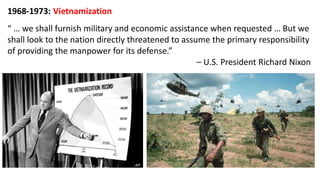
1968-1973: Vietnamization
“ … we shall furnish military and economic assistance when requested … But we
shall look to the nation directly threatened to assume the primary responsibility
of providing the manpower for its defense.”
– U.S. President Richard Nixon
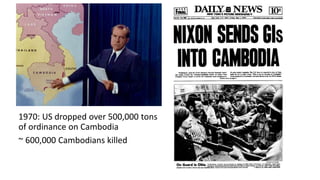
1970: US dropped over 500,000 tons
of ordinance on Cambodia
~ 600,000 Cambodians killed
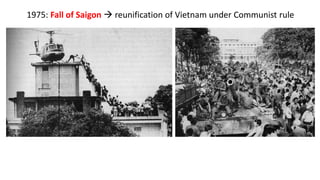
1975: Fall of Saigon  reunification of Vietnam under Communist rule
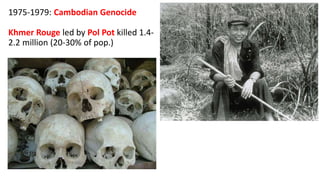
1975-1979: Cambodian Genocide
Khmer Rouge led by Pol Pot killed 1.4-
2.2 million (20-30% of pop.)
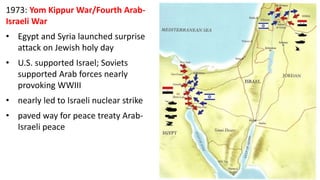
1973: Yom Kippur War/Fourth Arab-
Israeli War
• Egypt and Syria launched surprise
attack on Jewish holy day
• U.S. supported Israel; Soviets
supported Arab forces nearly
provoking WWIII
• nearly led to Israeli nuclear strike
• paved way for peace treaty Arab-
Israeli peace
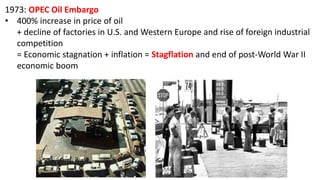
1973: OPEC Oil Embargo
• 400% increase in price of oil
+ decline of factories in U.S. and Western Europe and rise of foreign industrial
competition
= Economic stagnation + inflation = Stagflation and end of post-World War II
economic boom
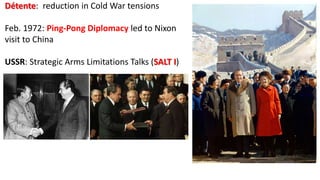
Détente: reduction in Cold War tensions
Feb. 1972: Ping-Pong Diplomacy led to Nixon
visit to China
USSR: Strategic Arms Limitations Talks (SALT I)
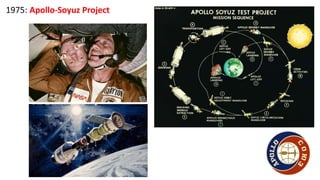
1975: Apollo-Soyuz Project
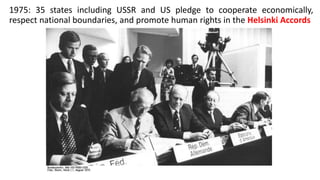
1975: 35 states including USSR and US pledge to cooperate economically,
respect national boundaries, and promote human rights in the Helsinki Accords
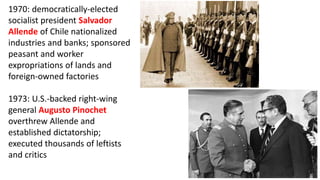
1970: democratically-elected
socialist president Salvador
Allende of Chile nationalized
industries and banks; sponsored
peasant and worker
expropriations of lands and
foreign-owned factories
1973: U.S.-backed right-wing
general Augusto Pinochet
overthrew Allende and
established dictatorship;
executed thousands of leftists
and critics
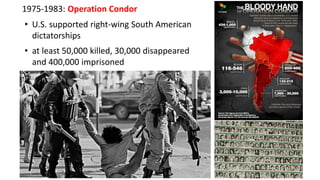
1975-1983: Operation Condor
• U.S. supported right-wing South American
dictatorships
• at least 50,000 killed, 30,000 disappeared
and 400,000 imprisoned
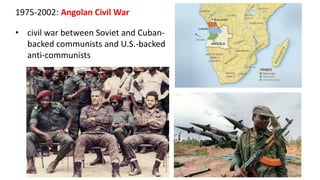
1975-2002: Angolan Civil War
• civil war between Soviet and Cuban-
backed communists and U.S.-backed
anti-communists
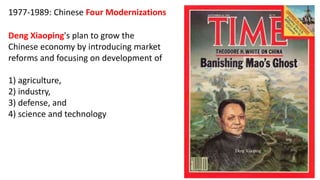
1977-1989: Chinese Four Modernizations
Deng Xiaoping's plan to grow the
Chinese economy by introducing market
reforms and focusing on development of
1) agriculture,
2) industry,
3) defense, and
4) science and technology
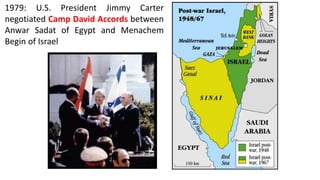
1979: U.S. President Jimmy Carter
negotiated Camp David Accords between
Anwar Sadat of Egypt and Menachem
Begin of Israel
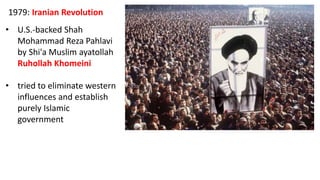
1979: Iranian Revolution
• U.S.-backed Shah
Mohammad Reza Pahlavi
by Shi'a Muslim ayatollah
Ruhollah Khomeini
• tried to eliminate western
influences and establish
purely Islamic
government
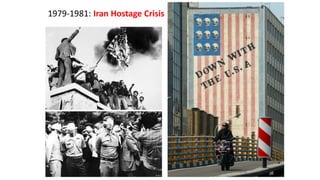
1979-1981: Iran Hostage Crisis
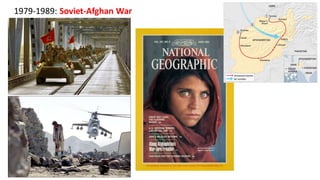
1979-1989: Soviet-Afghan War
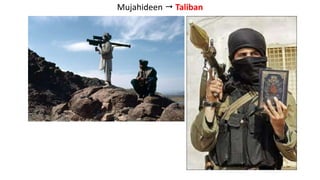
Mujahideen  Taliban
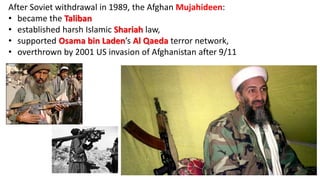
After Soviet withdrawal in 1989, the Afghan Mujahideen:
• became the Taliban
• established harsh Islamic Shariah law,
• supported Osama bin Laden’s Al Qaeda terror network,
• overthrown by 2001 US invasion of Afghanistan after 9/11
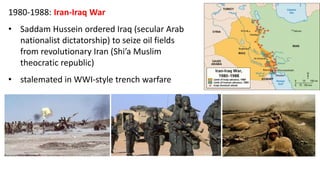
1980-1988: Iran-Iraq War
• Saddam Hussein ordered Iraq (secular Arab
nationalist dictatorship) to seize oil fields
from revolutionary Iran (Shi’a Muslim
theocratic republic)
• stalemated in WWI-style trench warfare
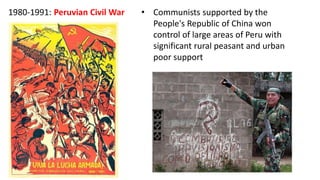
1980-1991: Peruvian Civil War • Communists supported by the
People's Republic of China won
control of large areas of Peru with
significant rural peasant and urban
poor support
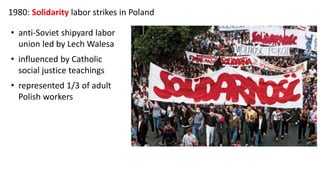
1980: Solidarity labor strikes in Poland
• anti-Soviet shipyard labor
union led by Lech Walesa
• influenced by Catholic
social justice teachings
• represented 1/3 of adult
Polish workers
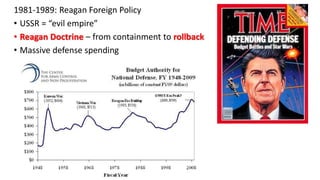
1981-1989: Reagan Foreign Policy
• USSR = “evil empire”
• Reagan Doctrine – from containment to rollback
• Massive defense spending
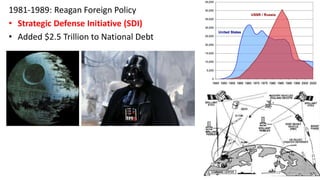
1981-1989: Reagan Foreign Policy
• Strategic Defense Initiative (SDI)
• Added $2.5 Trillion to National Debt
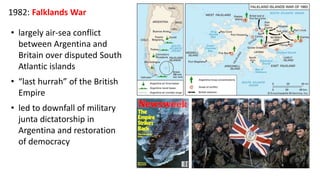
1982: Falklands War
• largely air-sea conflict
between Argentina and
Britain over disputed South
Atlantic islands
• “last hurrah” of the British
Empire
• led to downfall of military
junta dictatorship in
Argentina and restoration
of democracy
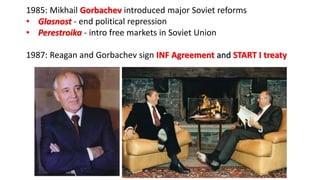
1985: Mikhail Gorbachev introduced major Soviet reforms
• Glasnost - end political repression
• Perestroika - intro free markets in Soviet Union
1987: Reagan and Gorbachev sign INF Agreement and START I treaty
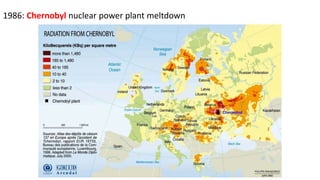
1986: Chernobyl nuclear power plant meltdown
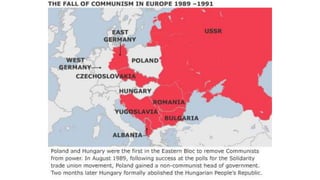
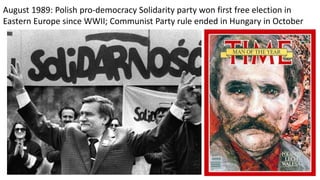
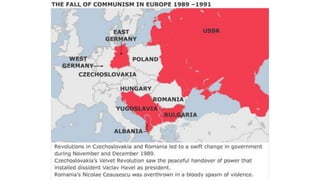
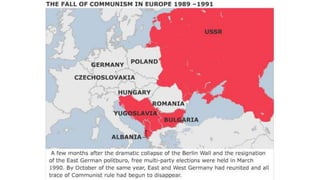
August 1989: Polish pro-democracy Solidarity party won first free election in
Eastern Europe since WWII; Communist Party rule ended in Hungary in October
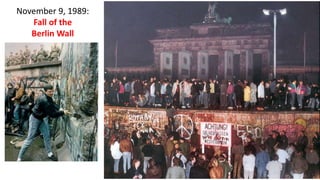
November 9, 1989:
Fall of the
Berlin Wall
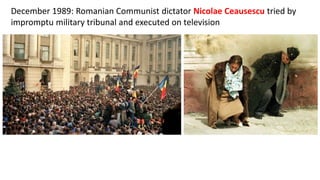
December 1989: Romanian Communist dictator Nicolae Ceausescu tried by
impromptu military tribunal and executed on television
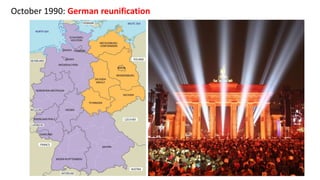
October 1990: German reunification
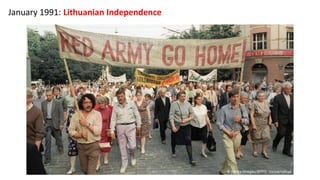
January 1991: Lithuanian Independence
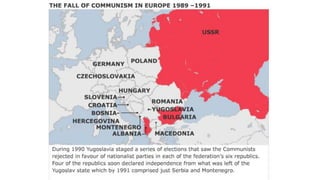
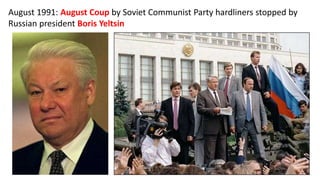
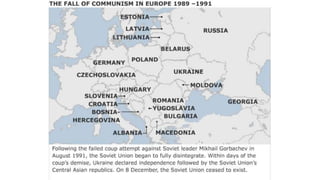
August 1991: August Coup by Soviet Communist Party hardliners stopped by
Russian president Boris Yeltsin
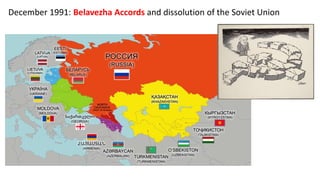
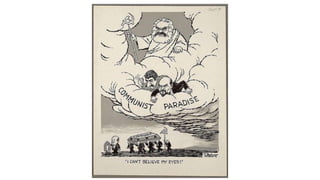
December 1991: Belavezha Accords and dissolution of the Soviet Union
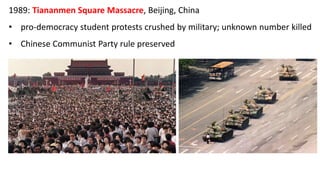
1989: Tiananmen Square Massacre, Beijing, China
• pro-democracy student protests crushed by military; unknown number killed
• Chinese Communist Party rule preserved
The cold war

The cold war

  • 17.
    Totalitarian Democratic Totalitarian ThePolitical Spectrum Post-World War I Liberalism • Late 1700s in American and French Revolutions • Civil liberties – freedom of expression • Limited government by constitution • Legal equality of all social classes • Benefited middle class most • Multi-party democracy – US, France, Britain Conservatism • Authoritarian traditional social order • Dominance of upper class social elites – nobles, church officials, moneyed interests • Maintain military rule by kings or dictators • Pre-WWI: Germany, Austria-Hungary, Russia, Ottoman Empire Fascism • 1920s • Replace militaristic king w/ militaristic dictator • Totalitarian state by one-party dictatorship • Ultra-nationalist • Anti-communist • Social Darwinian expansion • Italy (1922) Nazism • Racial superiority • Germany (1933) Socialism • Mid-1800s in Industrial Revolution • Legal and economic equality • Benefited lower working class/proletariat • Government ownership of means of production – factories, mines, power, transportation, communication • Legal reform and labor union activism Communism • Mid-1800s • Complete economic equality to create classless system • Anti-bourgeoisie • Government ownership of means of production – factories, mines, power, transportation, communication • Totalitarian state by one-party dictatorship • USSR (1917)
  • 18.
    Feb. 1945: Churchill,Stalin, and Roosevelt met at Yalta Conference in USSR to discuss post-war plans
  • 20.
    1945: Soviets tookEstonia, Latvia, Lithuania, Poland, Romania, Bulgaria, Hungary, Czechoslovakia, Albania, and East Germany in WWII.
  • 21.
    1945-9: 15 millionpeople fled west while USSR plundered $14 billion of industrial materials and established communist satellite states.
  • 22.
    July 1945: Truman,Churchill/Atlee, and Stalin met in Potsdam Conference in Germany. Truman objected to pro-Soviet governments installed in Eastern Europe without free elections
  • 23.
    Germany divided intofour occupation zones; USSR occupied Eastern Europe and East Germany
  • 26.
    Aug. 1945: USused atomic bombs (A-bomb) on Japan; USSR invaded Japanese- occupied Manchuria; Japan surrendered
  • 27.
    April 1945: firstmeeting of the United Nations
  • 29.
    1948: Universal Declarationof Human Rights  All human beings are born free and equal  Everyone has the right to life, liberty and security; no one shall be held in slavery or servitude or subjected to torture, arbitrary arrest, detention or exile  Freedom of movement, thought, conscience and religion, opinion and expression, peaceful assembly and association  Right to take part in the government through free elections by universal suffrage  Right to an adequate standard of living and education
  • 34.
    1948 UN GenocideConvention Genocide is the intent to destroy, in whole or in part, a national, ethnic, racial or religious group by: a. Killing members of the group; b. Causing serious bodily or mental harm to members of the group; c. Deliberately inflicting on the group conditions of life calculated to bring about its physical destruction in whole or in part; d. Imposing measures intended to prevent births within the group; e. Forcibly transferring children of the group to another group.
  • 36.
    Sept. 1945: HoChi Minh declared Vietnam to be an independent state; Korea divided at the 38th Parallel into an American-backed South and Soviet-backed North
  • 37.
    1945-1949: Indonesian Warof Independence • ended Dutch rule • led by left-wing Sukarno
  • 38.
    Feb. 1946: Americandiplomat in Moscow George Kennan released the “Long Telegram” warning that the USSR viewed peaceful coexistence with the capitalist West as impossible
  • 39.
    Mar. 1946: Churchilldeclared that an “Iron Curtain” had descended across Europe
  • 40.
    March 1947: TrumanDoctrine gave US aid to fight communist expansion in Greece and Turkey pursuing a policy of containment.
  • 41.
    1947: the Partitionof India divided British Raj into Hindu-majority India and Muslim-majority Pakistan; displaced 15+ million people and 1-2 million killed in national/religious violence 1885: Indian National Congress founded 1906: All-India Muslim League founded 1915: Defense of India Act 1919: Rowlatt Acts and Amritsar Massacre 1930: Salt March led by Mohandas Gandhi 1940s: Quit India Movement
  • 42.
    • 1915-1916: Britain promisedArab independence in McMahon-Hussein Correspondence, including Palestine • 1916: Britain and France agreed to divide the Middle East into colonial spheres of influence in the Sykes- Picot Agreement
  • 43.
    • 1917: Britainpromised a “national home for the Jewish people” in Palestine in the Balfour Declaration • 1919: Palestine becomes a League of Nations mandate under British authority • 1920s-1940s: Jewish settlers move to Palestine and violently clash with Palestinian Arabs
  • 44.
    • 1948: partitionof Palestine  creation of Israel  First Arab- Israeli War • failure to implement the Two-State Solution
  • 45.
    June 1948: USbegan Marshall Plan to rebuild Western Europe; Berlin Airlift bypassed communist blockade
  • 46.
    June 1948: USbegan Marshall Plan to rebuild Western Europe; Berlin Airlift bypassed communist blockade
  • 47.
    Apr. 1949: US-ledNATO formed
  • 52.
    Sept. 1949: Sovietsdetonated first nuclear device
  • 53.
    Oct. 1949: MaoZedong captured Beijing and established communist People’s Republic of China
  • 54.
    Feb. 1950: RedScare in US led by Senator Joseph McCarthy
  • 55.
    June 1950: KoreanWar began; United Nations defended South Korea from a communist North Korean invasion led by Kim Il Sung backed by China and USSR.
  • 56.
    Nov. 1952: UStested first hydrogen bomb (H-bomb)
  • 57.
    1952: Egyptian Revolution• Pan-Arab nationalist Free Officer Movement military coup against King Farouk I led by Gamal Abdel Nasser
  • 58.
    1953: Operation Ajaxin Iran • prime minister Mohammad Mosaddegh nationalized British-owned Iranian oil industry • American CIA and British MI6 overthrew Mosaddegh and strengthened Shah Mohammad Reza Pahlavi's autocratic rule; cornerstone of long-term Iranian hostility to the U.S.
  • 59.
    March 1953: Stalindied; Nikita Khrushchev takes power
  • 60.
    July 1953: Juliusand Ethel Rosenberg executed for selling atomic secrets to the Soviet Union; Korean War ended in armistice with pre-war 38th Parallel border restored with demilitarized zone (DMZ)
  • 61.
    Aug. 1953: USSRtested first H-bomb
  • 63.
  • 68.
    MAD: Mutually Assured Destruction NewUS Policy: Sec State John Foster Dulles, brinkmanship
  • 71.
    May 1954: Frenchdefeated by Viet Minh at Dien Bien Phu
  • 72.
    Vietnam divided at17th parallel at the Geneva Accords North • Leader: Ho Chi Minh • Left-wing communist dictatorship • support from Soviet Union and China South • Leader: Ngo Dinh Diem • Right-wing anti-communist dictatorship • support from US
  • 73.
    1954-1962: Algerian Warof Independence • led to collapse of Fourth French Republic and establishment of Fifth Republic, independence of Algeria, and mass exodus of refugees to France
  • 74.
    May 1955: USSR-ledWarsaw Pact formed
  • 75.
    Oct. 1956: Hungarycalled for free elections and appealed to US for help against USSR; Soviets crushed Hungarian Uprising while America looked on
  • 76.
    Nov. 1956: SuezCrisis/Second Arab-Israeli War • Egyptian dictator Gamal Nasser nationalized Suez Canal • Britain, France, and Israel invaded Egypt • U.S. and USSR condemned the invasion • Major loss of British prestige; Britain falls from first-rate to second-rate power
  • 77.
    1952: Treaty ofParis  European Coal and Steel Community 1957: Treaty of Rome  European Economic Community, or Common Market 1992: Maastricht Treaty  European Union
  • 79.
    Jan. 1957: EisenhowerDoctrine committed US aid to stop communist expansion in Middle East
  • 80.
    Oct. 1957: USSRlaunched Sputnik I
  • 81.
    Jan. 1958: Chinabegan the disastrous Great Leap Forward (1958-1962) which led to 18-55 million dead.
  • 82.
    Oct. 1958: USfeared a “missile gap”; NASA formed
  • 83.
    Jan. 1959: FidelCastro led the communist Cuban Revolution
  • 84.
    July 1959: USVP Richard Nixon visited USSR and engaged Soviet premier Khrushchev in the Kitchen Debate
  • 85.
    • 1957: KwameNkrumah led Ghana to become first African colony to win independence from Britain; pursued Pan-Africanism • 1960: Year of Africa - 17 African nations won independence
  • 86.
    • 1948: whiteAfrikaner National Party imposed racial apartheid • 1961: South Africa declares independence from Britain • 1962: Nelson Mandela led military wing of the African National Congress; arrested and imprisoned for 27 years • 1970s: 3 million black South Africans forcibly relocated to Bantustan homeland reservations
  • 87.
    • 1989: F.W.de Klerk ended apartheid • 1990: Mandela released and became the first black prime minister of SA in 1994
  • 89.
    2018 World Bankreport: • top 1% of South Africans own 70.9% of national wealth • bottom 60% controls 7% of national wealth • 55.5% live below poverty line
  • 90.
    1952-1963: violent MauMau Uprising in British East Africa 1963: Jomo Kenyatta of non-violent Kenya African Union became first president of independent Kenya
  • 91.
    1960: Congo Crisis •Patrice Lumumba led Congo to independence from Belgium; turned to USSR for aid; survived failed American assassination attempt • Mobutu Sese Seko executed Lumumba and established far- right totalitarian regime in Zaire from 1965-1997 with strong support from U.S., France and Belgium; embezzled $4-15 billion
  • 92.
    1971-1979: dictator Idi Aminof Uganda • expelled 60,000 middle-class Ugandan Indian and Pakistani business owners • killed 300,000- 500,000 in through political repression, ethnic persecution, and gross economic mismanagement
  • 93.
    May 1960: AmericanU-2 spy plane shot down over USSR
  • 94.
    Apr. 1961: Sovietcosmonaut Yuri Gagarin became first man to orbit Earth; US CIA-backed Bay of Pigs Invasion of Cuba failed
  • 95.
    May 1961: JohnF. Kennedy committed US to moonshot – to put a man on the Moon by the end of the decade
  • 96.
    Feb. 1962: JohnGlenn became first American astronaut to orbit Earth
  • 97.
    1969: Neil Armstrongled Apollo 11 mission
  • 98.
    Aug. 1961: BerlinWall erected to stop flood of 3.5 million refugees defecting from the communist East to the free West
  • 99.
    Sept. 1961: India,Indonesia, Egypt, Ghana, and Yugoslavia began the Non-Aligned Movement to preserve Cold War neutrality in the Third World
  • 101.
    Oct. 1962: CubanMissile Crisis; US pursued brinksmanship diplomacy and quarantined Cuba with a naval blockade in response to placement of Soviet nuclear missiles in Cuba. World War III was narrowly averted.
  • 102.
    1963: Partial NuclearTest Ban Treaty banned surface, atmospheric, and underwater nuclear tests; underground only
  • 103.
    1964-2016: Colombian CivilWar - communist FARC (Revolutionary Armed Forces of Colombia) fought a 52-year guerrilla campaign against the Colombian government; employed terrorist tactics and financed by illegal drug trade
  • 104.
    Domino theory: JFKsaw Vietnam as focus of U.S.-Soviet rivalry • Sent 16,000 American military "advisors”
  • 105.
    1964: Saigon onverge of collapse; Tonkin Gulf Incident  Gulf of Tonkin Resolution I’m not going to be the president who saw Southeast Asia go the way China went.” -LBJ
  • 106.
    U.S. Troop Levelsin Vietnam 0 100,000 200,000 300,000 400,000 500,000 600,000 1961 1963 1964 1965 1966 1967 1968 U.S. Troops
  • 107.
    • 1965: Sustainedbombing of North Vietnam • Operation Rolling Thunder • Carpet Bombing • Napalm • Agent Orange – defoliant
  • 108.
    1965-1966: Indonesian Genocide •Sukarno overthrown by right-wing anti- communist Suharto • 500,000-3 million communists killed by the Indonesian Army with U.S. government support
  • 109.
    1966-1976: Chinese CulturalRevolution • permanent revolution of student Red Guards launched by Mao Zedong to purge remaining capitalist and traditional Chinese elements • up to 20 million killed
  • 110.
    1967-1970: Nigerian CivilWar • ethnic Igbo separatists sought independence from Yoruba-controlled government • up to 2 million died
  • 111.
    1967: Six-Day War/ThirdArab- Israeli War • Israel defeated Jordan, Syria, and Egypt • Israel occupied the Sinai Peninsula, Gaza Strip, West Bank, and Golan Heights
  • 112.
  • 113.
    1968-1973: Vietnamization “ …we shall furnish military and economic assistance when requested … But we shall look to the nation directly threatened to assume the primary responsibility of providing the manpower for its defense.” – U.S. President Richard Nixon
  • 114.
    1970: US droppedover 500,000 tons of ordinance on Cambodia ~ 600,000 Cambodians killed
  • 115.
    1975: Fall ofSaigon  reunification of Vietnam under Communist rule
  • 116.
    1975-1979: Cambodian Genocide KhmerRouge led by Pol Pot killed 1.4- 2.2 million (20-30% of pop.)
  • 117.
    1973: Yom KippurWar/Fourth Arab- Israeli War • Egypt and Syria launched surprise attack on Jewish holy day • U.S. supported Israel; Soviets supported Arab forces nearly provoking WWIII • nearly led to Israeli nuclear strike • paved way for peace treaty Arab- Israeli peace
  • 119.
    1973: OPEC OilEmbargo • 400% increase in price of oil + decline of factories in U.S. and Western Europe and rise of foreign industrial competition = Economic stagnation + inflation = Stagflation and end of post-World War II economic boom
  • 120.
    Détente: reduction inCold War tensions Feb. 1972: Ping-Pong Diplomacy led to Nixon visit to China USSR: Strategic Arms Limitations Talks (SALT I)
  • 121.
  • 122.
    1975: 35 statesincluding USSR and US pledge to cooperate economically, respect national boundaries, and promote human rights in the Helsinki Accords
  • 123.
    1970: democratically-elected socialist presidentSalvador Allende of Chile nationalized industries and banks; sponsored peasant and worker expropriations of lands and foreign-owned factories 1973: U.S.-backed right-wing general Augusto Pinochet overthrew Allende and established dictatorship; executed thousands of leftists and critics
  • 124.
    1975-1983: Operation Condor •U.S. supported right-wing South American dictatorships • at least 50,000 killed, 30,000 disappeared and 400,000 imprisoned
  • 125.
    1975-2002: Angolan CivilWar • civil war between Soviet and Cuban- backed communists and U.S.-backed anti-communists
  • 126.
    1977-1989: Chinese FourModernizations Deng Xiaoping's plan to grow the Chinese economy by introducing market reforms and focusing on development of 1) agriculture, 2) industry, 3) defense, and 4) science and technology
  • 127.
    1979: U.S. PresidentJimmy Carter negotiated Camp David Accords between Anwar Sadat of Egypt and Menachem Begin of Israel
  • 128.
    1979: Iranian Revolution •U.S.-backed Shah Mohammad Reza Pahlavi by Shi'a Muslim ayatollah Ruhollah Khomeini • tried to eliminate western influences and establish purely Islamic government
  • 129.
  • 130.
  • 131.
  • 132.
    After Soviet withdrawalin 1989, the Afghan Mujahideen: • became the Taliban • established harsh Islamic Shariah law, • supported Osama bin Laden’s Al Qaeda terror network, • overthrown by 2001 US invasion of Afghanistan after 9/11
  • 133.
    1980-1988: Iran-Iraq War •Saddam Hussein ordered Iraq (secular Arab nationalist dictatorship) to seize oil fields from revolutionary Iran (Shi’a Muslim theocratic republic) • stalemated in WWI-style trench warfare
  • 134.
    1980-1991: Peruvian CivilWar • Communists supported by the People's Republic of China won control of large areas of Peru with significant rural peasant and urban poor support
  • 135.
    1980: Solidarity laborstrikes in Poland • anti-Soviet shipyard labor union led by Lech Walesa • influenced by Catholic social justice teachings • represented 1/3 of adult Polish workers
  • 136.
    1981-1989: Reagan ForeignPolicy • USSR = “evil empire” • Reagan Doctrine – from containment to rollback • Massive defense spending
  • 137.
    1981-1989: Reagan ForeignPolicy • Strategic Defense Initiative (SDI) • Added $2.5 Trillion to National Debt
  • 138.
    1982: Falklands War •largely air-sea conflict between Argentina and Britain over disputed South Atlantic islands • “last hurrah” of the British Empire • led to downfall of military junta dictatorship in Argentina and restoration of democracy
  • 139.
    1985: Mikhail Gorbachevintroduced major Soviet reforms • Glasnost - end political repression • Perestroika - intro free markets in Soviet Union 1987: Reagan and Gorbachev sign INF Agreement and START I treaty
  • 140.
    1986: Chernobyl nuclearpower plant meltdown
  • 143.
    August 1989: Polishpro-democracy Solidarity party won first free election in Eastern Europe since WWII; Communist Party rule ended in Hungary in October
  • 144.
    November 9, 1989: Fallof the Berlin Wall
  • 146.
    December 1989: RomanianCommunist dictator Nicolae Ceausescu tried by impromptu military tribunal and executed on television
  • 149.
    October 1990: Germanreunification
  • 152.
  • 153.
    August 1991: AugustCoup by Soviet Communist Party hardliners stopped by Russian president Boris Yeltsin
  • 155.
    December 1991: BelavezhaAccords and dissolution of the Soviet Union
  • 157.
    1989: Tiananmen SquareMassacre, Beijing, China • pro-democracy student protests crushed by military; unknown number killed • Chinese Communist Party rule preserved