The CollapseThe Collapse
CommunismCommunism
And the world watchedAnd the world watched
with wonder …with wonder …
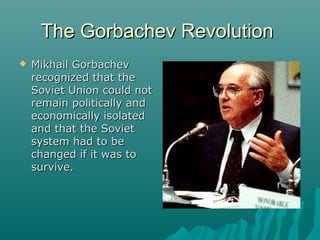
The Gorbachev RevolutionThe Gorbachev Revolution
 Mikhail GorbachevMikhail Gorbachev
recognized that therecognized that the
Soviet Union could notSoviet Union could not
remain politically andremain politically and
economically isolatedeconomically isolated
and that the Sovietand that the Soviet
system had to besystem had to be
changed if it was tochanged if it was to
survive.survive.
Gorbachev's Five-Point PlanGorbachev's Five-Point Plan
 The key pieces to Gorbachev's plan for the survivalThe key pieces to Gorbachev's plan for the survival
of the Soviet Union were a series of reforms:of the Soviet Union were a series of reforms:
1.1. GlasnostGlasnost (openness) – greater freedom of(openness) – greater freedom of
expressionexpression
2.2. PerestroikaPerestroika (restructuring) – decentralization(restructuring) – decentralization
of the Soviet economy with gradual marketof the Soviet economy with gradual market
reformsreforms
3.3. Renunciation ofRenunciation of the Brezhnev Doctrinethe Brezhnev Doctrine (armed(armed
intervention where socialism was threatened)intervention where socialism was threatened)
and the pursuit of arms control agreementsand the pursuit of arms control agreements
4.4. Reform of the KGBReform of the KGB (secret service)(secret service)
5.5. Reform of the Communist PartyReform of the Communist Party
The Objective: SurvivalThe Objective: Survival
 Gorbachev knew that the Soviet Union wouldGorbachev knew that the Soviet Union would
have to change if it was to survive.have to change if it was to survive.
 Central planningCentral planning in a modern industrialin a modern industrial
economy brought many inefficiencies.economy brought many inefficiencies.
 TheThe factory management systemfactory management system providedprovided
little incentive to make technologicallittle incentive to make technological
improvements and every incentive to hideimprovements and every incentive to hide
factory capacities to ensure low quotasfactory capacities to ensure low quotas
 TheThe socialist farm systemsocialist farm system was inefficient –was inefficient –
there were poor worker incentives andthere were poor worker incentives and
storage and transportation problems.storage and transportation problems.
 The Soviet State could no longer afford theThe Soviet State could no longer afford the
high defense spendinghigh defense spending that accompanied thethat accompanied the
Cold War.Cold War.
Insistent Calls for ChangeInsistent Calls for Change
 He believed that hisHe believed that his
reforms were necessaryreforms were necessary
and used his leadershipand used his leadership
and power to attempt toand power to attempt to
implement them.implement them.
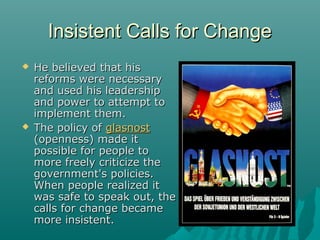
 The policy ofThe policy of glasnostglasnost
(openness) made it(openness) made it
possible for people topossible for people to
more freely criticize themore freely criticize the
government's policies.government's policies.
When people realized itWhen people realized it
was safe to speak out, thewas safe to speak out, the
calls for change becamecalls for change became
more insistent.more insistent.
Reforms Were Too SlowReforms Were Too Slow
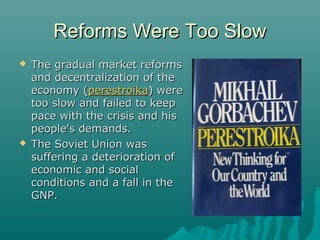
 The gradual market reformsThe gradual market reforms
and decentralization of theand decentralization of the
economy (economy (perestroikaperestroika) were) were
too slow and failed to keeptoo slow and failed to keep
pace with the crisis and hispace with the crisis and his
people's demands.people's demands.
 The Soviet Union wasThe Soviet Union was
suffering a deterioration ofsuffering a deterioration of
economic and socialeconomic and social
conditions and a fall in theconditions and a fall in the
GNP.GNP.
Party Reforms a FailureParty Reforms a Failure
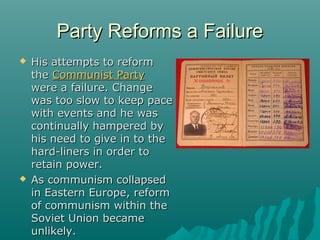
 His attempts to reformHis attempts to reform
thethe Communist PartyCommunist Party
were a failure. Changewere a failure. Change
was too slow to keep pacewas too slow to keep pace
with events and he waswith events and he was
continually hampered bycontinually hampered by
his need to give in to thehis need to give in to the
hard-liners in order tohard-liners in order to
retain power.retain power.
 As communism collapsedAs communism collapsed
in Eastern Europe, reformin Eastern Europe, reform
of communism within theof communism within the
Soviet Union becameSoviet Union became
unlikely.unlikely.
The Collapse of the Soviet UnionThe Collapse of the Soviet Union
 The renunciation of theThe renunciation of the
Brezhnev DoctrineBrezhnev Doctrine (armed(armed
intervention in support ofintervention in support of
socialism) released thesocialism) released the
Eastern European statesEastern European states
from Soviet domination.from Soviet domination.
 The communist rulers ofThe communist rulers of
these states could notthese states could not
survive without the supportsurvive without the support
of the Soviet Union.of the Soviet Union.
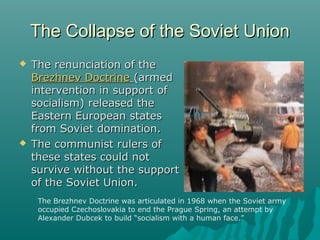
The Brezhnev Doctrine was articulated in 1968 when the Soviet army
occupied Czechoslovakia to end the Prague Spring, an attempt by
Alexander Dubcek to build “socialism with a human face.”
Reagan’s Brandenburg Gate SpeechReagan’s Brandenburg Gate Speech
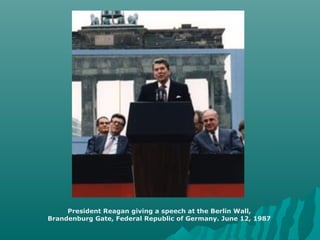
 President Ronald Reagan called uponPresident Ronald Reagan called upon
Gorbachev to tear down the Berlin Wall: "InGorbachev to tear down the Berlin Wall: "In
the Communist world, we see failure,the Communist world, we see failure,
technological backwardness, decliningtechnological backwardness, declining
standards... Even today, the Soviet Unionstandards... Even today, the Soviet Union
cannot feed itself. The inescapablecannot feed itself. The inescapable
conclusion is that freedom is the victor.conclusion is that freedom is the victor.
General Secretary Gorbachev, if you seekGeneral Secretary Gorbachev, if you seek
peace, if you seek prosperity for the Sovietpeace, if you seek prosperity for the Soviet
Union, if you seek liberalization: Come hereUnion, if you seek liberalization: Come here
to this gate! Mr. Gorbachev, open this gate!to this gate! Mr. Gorbachev, open this gate!
Mr. Gorbachev, tear down this wall!"Mr. Gorbachev, tear down this wall!"
President Reagan giving a speech at the Berlin Wall,
Brandenburg Gate, Federal Republic of Germany. June 12, 1987
The Wall Came DownThe Wall Came Down
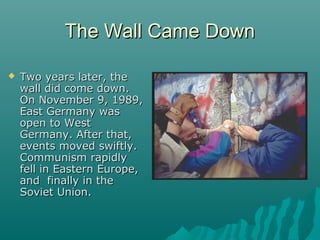
 Two years later, theTwo years later, the
wall did come down.wall did come down.
On November 9, 1989,On November 9, 1989,
East Germany wasEast Germany was
open to Westopen to West
Germany. After that,Germany. After that,
events moved swiftly.events moved swiftly.
Communism rapidlyCommunism rapidly
fell in Eastern Europe,fell in Eastern Europe,
and finally in theand finally in the
Soviet Union.Soviet Union.
The Rise of NationalismThe Rise of Nationalism
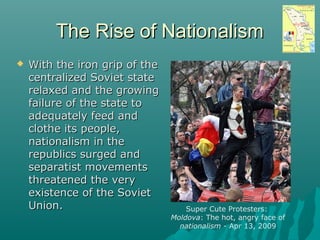
 With the iron grip of theWith the iron grip of the
centralized Soviet statecentralized Soviet state
relaxed and the growingrelaxed and the growing
failure of the state tofailure of the state to
adequately feed andadequately feed and
clothe its people,clothe its people,
nationalism in thenationalism in the
republics surged andrepublics surged and
separatist movementsseparatist movements
threatened the verythreatened the very
existence of the Sovietexistence of the Soviet
Union.Union. Super Cute Protesters:
Moldova: The hot, angry face of
nationalism - Apr 13, 2009
The End of the Cold WarThe End of the Cold War
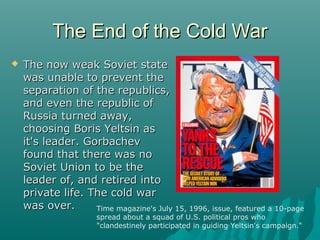
 The now weak Soviet stateThe now weak Soviet state
was unable to prevent thewas unable to prevent the
separation of the republics,separation of the republics,
and even the republic ofand even the republic of
Russia turned away,Russia turned away,
choosing Boris Yeltsin aschoosing Boris Yeltsin as
it's leader. Gorbachevit's leader. Gorbachev
found that there was nofound that there was no
Soviet Union to be theSoviet Union to be the
leader of, and retired intoleader of, and retired into
private life. The cold warprivate life. The cold war
was over.was over. Time magazine's July 15, 1996, issue, featured a 10-page
spread about a squad of U.S. political pros who
"clandestinely participated in guiding Yeltsin's campaign.“
Nobel Peace PrizeNobel Peace Prize
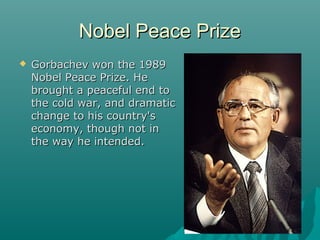
 Gorbachev won the 1989Gorbachev won the 1989
Nobel Peace Prize. HeNobel Peace Prize. He
brought a peaceful end tobrought a peaceful end to
the cold war, and dramaticthe cold war, and dramatic
change to his country'schange to his country's
economy, though not ineconomy, though not in
the way he intended.the way he intended.
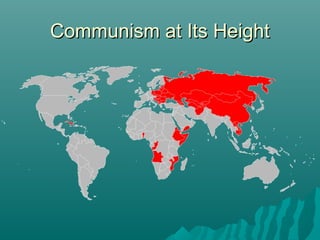
Communism at Its HeightCommunism at Its Height
Remaining Communist CountriesRemaining Communist Countries
 At its peak, communism was practiced in dozens ofAt its peak, communism was practiced in dozens of
countries:countries:
 Soviet UnionSoviet Union: Armenia, Azerbaijan, Belarus, Estonia,: Armenia, Azerbaijan, Belarus, Estonia,
Georgia, Kazakhstan, Kyrgyzstan, Latvia, Lithuania,Georgia, Kazakhstan, Kyrgyzstan, Latvia, Lithuania,
Moldova, Russia, Tajikistan, Turkmenistan, Ukraine, andMoldova, Russia, Tajikistan, Turkmenistan, Ukraine, and
UzbekistanUzbekistan
 Other Asian CountriesOther Asian Countries: Afghanistan, Cambodia, Mongolia,: Afghanistan, Cambodia, Mongolia,
and Yemenand Yemen
 Soviet Controlled Eastern bloc countriesSoviet Controlled Eastern bloc countries: Bulgaria, Czech: Bulgaria, Czech
Republic, East Germany, Hungary, Poland, Romanoa,Republic, East Germany, Hungary, Poland, Romanoa,
Slovakia.Slovakia.
 The BalkansThe Balkans: Albania, Bosnia, Herzegovina, Bulgaria,: Albania, Bosnia, Herzegovina, Bulgaria,
Croatia, Macedonia, Montenegro, Serbia, and Slovenia.Croatia, Macedonia, Montenegro, Serbia, and Slovenia.
 AfricaAfrica: Angola, Benin, Congo, Ethiopia, Somalia, Eritrea, and: Angola, Benin, Congo, Ethiopia, Somalia, Eritrea, and
Mozambique.Mozambique.
 CurrentlyCurrently only a handful of countries identified as communistonly a handful of countries identified as communist
remain: Laos, North Korea, Vietnam, China, and Cuba.remain: Laos, North Korea, Vietnam, China, and Cuba.

Collapse

  • 1.
    The CollapseThe Collapse CommunismCommunism Andthe world watchedAnd the world watched with wonder …with wonder …
  • 2.
    The Gorbachev RevolutionTheGorbachev Revolution  Mikhail GorbachevMikhail Gorbachev recognized that therecognized that the Soviet Union could notSoviet Union could not remain politically andremain politically and economically isolatedeconomically isolated and that the Sovietand that the Soviet system had to besystem had to be changed if it was tochanged if it was to survive.survive.
  • 3.
    Gorbachev's Five-Point PlanGorbachev'sFive-Point Plan  The key pieces to Gorbachev's plan for the survivalThe key pieces to Gorbachev's plan for the survival of the Soviet Union were a series of reforms:of the Soviet Union were a series of reforms: 1.1. GlasnostGlasnost (openness) – greater freedom of(openness) – greater freedom of expressionexpression 2.2. PerestroikaPerestroika (restructuring) – decentralization(restructuring) – decentralization of the Soviet economy with gradual marketof the Soviet economy with gradual market reformsreforms 3.3. Renunciation ofRenunciation of the Brezhnev Doctrinethe Brezhnev Doctrine (armed(armed intervention where socialism was threatened)intervention where socialism was threatened) and the pursuit of arms control agreementsand the pursuit of arms control agreements 4.4. Reform of the KGBReform of the KGB (secret service)(secret service) 5.5. Reform of the Communist PartyReform of the Communist Party
  • 4.
    The Objective: SurvivalTheObjective: Survival  Gorbachev knew that the Soviet Union wouldGorbachev knew that the Soviet Union would have to change if it was to survive.have to change if it was to survive.  Central planningCentral planning in a modern industrialin a modern industrial economy brought many inefficiencies.economy brought many inefficiencies.  TheThe factory management systemfactory management system providedprovided little incentive to make technologicallittle incentive to make technological improvements and every incentive to hideimprovements and every incentive to hide factory capacities to ensure low quotasfactory capacities to ensure low quotas  TheThe socialist farm systemsocialist farm system was inefficient –was inefficient – there were poor worker incentives andthere were poor worker incentives and storage and transportation problems.storage and transportation problems.  The Soviet State could no longer afford theThe Soviet State could no longer afford the high defense spendinghigh defense spending that accompanied thethat accompanied the Cold War.Cold War.
  • 5.
    Insistent Calls forChangeInsistent Calls for Change  He believed that hisHe believed that his reforms were necessaryreforms were necessary and used his leadershipand used his leadership and power to attempt toand power to attempt to implement them.implement them.  The policy ofThe policy of glasnostglasnost (openness) made it(openness) made it possible for people topossible for people to more freely criticize themore freely criticize the government's policies.government's policies. When people realized itWhen people realized it was safe to speak out, thewas safe to speak out, the calls for change becamecalls for change became more insistent.more insistent.
  • 6.
    Reforms Were TooSlowReforms Were Too Slow  The gradual market reformsThe gradual market reforms and decentralization of theand decentralization of the economy (economy (perestroikaperestroika) were) were too slow and failed to keeptoo slow and failed to keep pace with the crisis and hispace with the crisis and his people's demands.people's demands.  The Soviet Union wasThe Soviet Union was suffering a deterioration ofsuffering a deterioration of economic and socialeconomic and social conditions and a fall in theconditions and a fall in the GNP.GNP.
  • 7.
    Party Reforms aFailureParty Reforms a Failure  His attempts to reformHis attempts to reform thethe Communist PartyCommunist Party were a failure. Changewere a failure. Change was too slow to keep pacewas too slow to keep pace with events and he waswith events and he was continually hampered bycontinually hampered by his need to give in to thehis need to give in to the hard-liners in order tohard-liners in order to retain power.retain power.  As communism collapsedAs communism collapsed in Eastern Europe, reformin Eastern Europe, reform of communism within theof communism within the Soviet Union becameSoviet Union became unlikely.unlikely.
  • 8.
    The Collapse ofthe Soviet UnionThe Collapse of the Soviet Union  The renunciation of theThe renunciation of the Brezhnev DoctrineBrezhnev Doctrine (armed(armed intervention in support ofintervention in support of socialism) released thesocialism) released the Eastern European statesEastern European states from Soviet domination.from Soviet domination.  The communist rulers ofThe communist rulers of these states could notthese states could not survive without the supportsurvive without the support of the Soviet Union.of the Soviet Union. The Brezhnev Doctrine was articulated in 1968 when the Soviet army occupied Czechoslovakia to end the Prague Spring, an attempt by Alexander Dubcek to build “socialism with a human face.”
  • 9.
    Reagan’s Brandenburg GateSpeechReagan’s Brandenburg Gate Speech  President Ronald Reagan called uponPresident Ronald Reagan called upon Gorbachev to tear down the Berlin Wall: "InGorbachev to tear down the Berlin Wall: "In the Communist world, we see failure,the Communist world, we see failure, technological backwardness, decliningtechnological backwardness, declining standards... Even today, the Soviet Unionstandards... Even today, the Soviet Union cannot feed itself. The inescapablecannot feed itself. The inescapable conclusion is that freedom is the victor.conclusion is that freedom is the victor. General Secretary Gorbachev, if you seekGeneral Secretary Gorbachev, if you seek peace, if you seek prosperity for the Sovietpeace, if you seek prosperity for the Soviet Union, if you seek liberalization: Come hereUnion, if you seek liberalization: Come here to this gate! Mr. Gorbachev, open this gate!to this gate! Mr. Gorbachev, open this gate! Mr. Gorbachev, tear down this wall!"Mr. Gorbachev, tear down this wall!"
  • 10.
    President Reagan givinga speech at the Berlin Wall, Brandenburg Gate, Federal Republic of Germany. June 12, 1987
  • 11.
    The Wall CameDownThe Wall Came Down  Two years later, theTwo years later, the wall did come down.wall did come down. On November 9, 1989,On November 9, 1989, East Germany wasEast Germany was open to Westopen to West Germany. After that,Germany. After that, events moved swiftly.events moved swiftly. Communism rapidlyCommunism rapidly fell in Eastern Europe,fell in Eastern Europe, and finally in theand finally in the Soviet Union.Soviet Union.
  • 12.
    The Rise ofNationalismThe Rise of Nationalism  With the iron grip of theWith the iron grip of the centralized Soviet statecentralized Soviet state relaxed and the growingrelaxed and the growing failure of the state tofailure of the state to adequately feed andadequately feed and clothe its people,clothe its people, nationalism in thenationalism in the republics surged andrepublics surged and separatist movementsseparatist movements threatened the verythreatened the very existence of the Sovietexistence of the Soviet Union.Union. Super Cute Protesters: Moldova: The hot, angry face of nationalism - Apr 13, 2009
  • 13.
    The End ofthe Cold WarThe End of the Cold War  The now weak Soviet stateThe now weak Soviet state was unable to prevent thewas unable to prevent the separation of the republics,separation of the republics, and even the republic ofand even the republic of Russia turned away,Russia turned away, choosing Boris Yeltsin aschoosing Boris Yeltsin as it's leader. Gorbachevit's leader. Gorbachev found that there was nofound that there was no Soviet Union to be theSoviet Union to be the leader of, and retired intoleader of, and retired into private life. The cold warprivate life. The cold war was over.was over. Time magazine's July 15, 1996, issue, featured a 10-page spread about a squad of U.S. political pros who "clandestinely participated in guiding Yeltsin's campaign.“
  • 14.
    Nobel Peace PrizeNobelPeace Prize  Gorbachev won the 1989Gorbachev won the 1989 Nobel Peace Prize. HeNobel Peace Prize. He brought a peaceful end tobrought a peaceful end to the cold war, and dramaticthe cold war, and dramatic change to his country'schange to his country's economy, though not ineconomy, though not in the way he intended.the way he intended.
  • 15.
    Communism at ItsHeightCommunism at Its Height
  • 16.
    Remaining Communist CountriesRemainingCommunist Countries  At its peak, communism was practiced in dozens ofAt its peak, communism was practiced in dozens of countries:countries:  Soviet UnionSoviet Union: Armenia, Azerbaijan, Belarus, Estonia,: Armenia, Azerbaijan, Belarus, Estonia, Georgia, Kazakhstan, Kyrgyzstan, Latvia, Lithuania,Georgia, Kazakhstan, Kyrgyzstan, Latvia, Lithuania, Moldova, Russia, Tajikistan, Turkmenistan, Ukraine, andMoldova, Russia, Tajikistan, Turkmenistan, Ukraine, and UzbekistanUzbekistan  Other Asian CountriesOther Asian Countries: Afghanistan, Cambodia, Mongolia,: Afghanistan, Cambodia, Mongolia, and Yemenand Yemen  Soviet Controlled Eastern bloc countriesSoviet Controlled Eastern bloc countries: Bulgaria, Czech: Bulgaria, Czech Republic, East Germany, Hungary, Poland, Romanoa,Republic, East Germany, Hungary, Poland, Romanoa, Slovakia.Slovakia.  The BalkansThe Balkans: Albania, Bosnia, Herzegovina, Bulgaria,: Albania, Bosnia, Herzegovina, Bulgaria, Croatia, Macedonia, Montenegro, Serbia, and Slovenia.Croatia, Macedonia, Montenegro, Serbia, and Slovenia.  AfricaAfrica: Angola, Benin, Congo, Ethiopia, Somalia, Eritrea, and: Angola, Benin, Congo, Ethiopia, Somalia, Eritrea, and Mozambique.Mozambique.  CurrentlyCurrently only a handful of countries identified as communistonly a handful of countries identified as communist remain: Laos, North Korea, Vietnam, China, and Cuba.remain: Laos, North Korea, Vietnam, China, and Cuba.