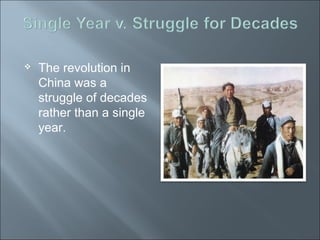
 The revolution in
China was a
struggle of decades
rather than a single
year.
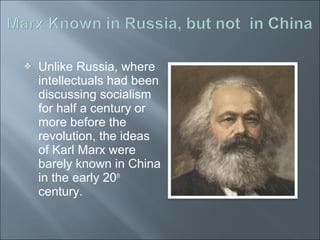
 Unlike Russia, where
intellectuals had been
discussing socialism
for half a century or
more before the
revolution, the ideas
of Karl Marx were
barely known in China
in the early 20th
century.
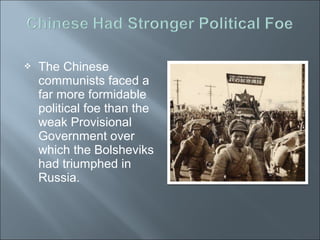
 The Chinese
communists faced a
far more formidable
political foe than the
weak Provisional
Government over
which the Bolsheviks
had triumphed in
Russia.
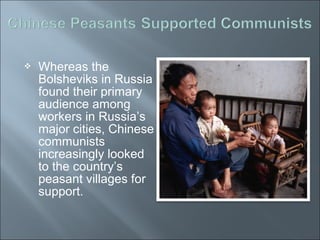
 Whereas the
Bolsheviks in Russia
found their primary
audience among
workers in Russia’s
major cities, Chinese
communists
increasingly looked
to the country’s
peasant villages for
support.
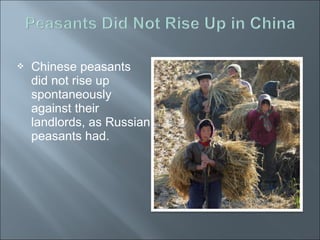
 Chinese peasants
did not rise up
spontaneously
against their
landlords, as Russian
peasants had.
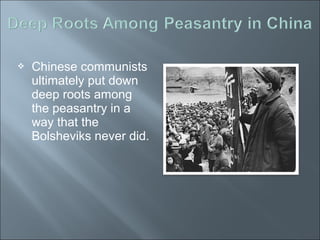
 Chinese communists
ultimately put down
deep roots among
the peasantry in a
way that the
Bolsheviks never did.
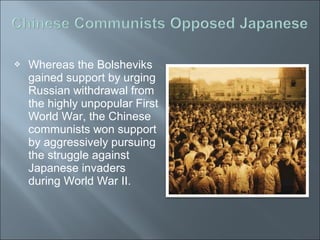
 Whereas the Bolsheviks
gained support by urging
Russian withdrawal from
the highly unpopular First
World War, the Chinese
communists won support
by aggressively pursuing
the struggle against
Japanese invaders
during World War II.
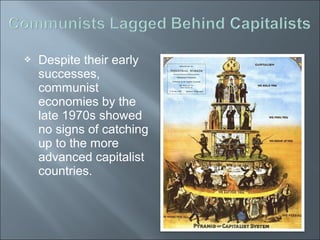
 Despite their early
successes,
communist
economies by the
late 1970s showed
no signs of catching
up to the more
advanced capitalist
countries.
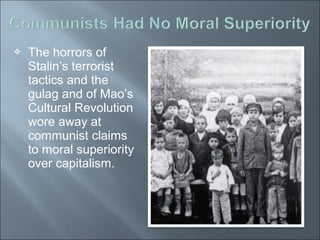
 The horrors of
Stalin’s terrorist
tactics and the
gulag and of Mao’s
Cultural Revolution
wore away at
communist claims
to moral superiority
over capitalism.
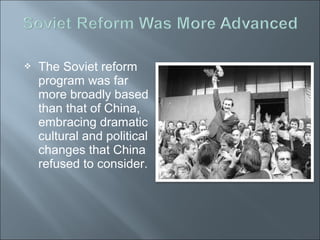
 The Soviet reform
program was far
more broadly based
than that of China,
embracing dramatic
cultural and political
changes that China
refused to consider.
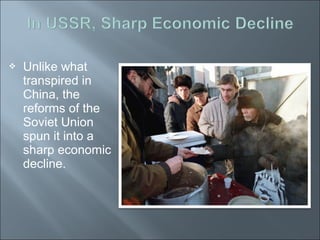
 Unlike what
transpired in
China, the
reforms of the
Soviet Union
spun it into a
sharp economic
decline.
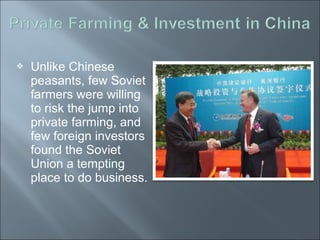
 Unlike Chinese
peasants, few Soviet
farmers were willing
to risk the jump into
private farming, and
few foreign investors
found the Soviet
Union a tempting
place to do business.
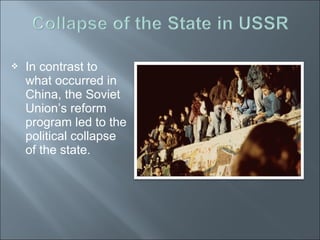
 In contrast to
what occurred in
China, the Soviet
Union’s reform
program led to the
political collapse
of the state.

R&c

  • 2.
     The revolutionin China was a struggle of decades rather than a single year.
  • 3.
     Unlike Russia,where intellectuals had been discussing socialism for half a century or more before the revolution, the ideas of Karl Marx were barely known in China in the early 20th century.
  • 4.
     The Chinese communistsfaced a far more formidable political foe than the weak Provisional Government over which the Bolsheviks had triumphed in Russia.
  • 5.
     Whereas the Bolsheviksin Russia found their primary audience among workers in Russia’s major cities, Chinese communists increasingly looked to the country’s peasant villages for support.
  • 6.
     Chinese peasants didnot rise up spontaneously against their landlords, as Russian peasants had.
  • 7.
     Chinese communists ultimatelyput down deep roots among the peasantry in a way that the Bolsheviks never did.
  • 8.
     Whereas theBolsheviks gained support by urging Russian withdrawal from the highly unpopular First World War, the Chinese communists won support by aggressively pursuing the struggle against Japanese invaders during World War II.
  • 9.
     Despite theirearly successes, communist economies by the late 1970s showed no signs of catching up to the more advanced capitalist countries.
  • 10.
     The horrorsof Stalin’s terrorist tactics and the gulag and of Mao’s Cultural Revolution wore away at communist claims to moral superiority over capitalism.
  • 11.
     The Sovietreform program was far more broadly based than that of China, embracing dramatic cultural and political changes that China refused to consider.
  • 12.
     Unlike what transpiredin China, the reforms of the Soviet Union spun it into a sharp economic decline.
  • 13.
     Unlike Chinese peasants,few Soviet farmers were willing to risk the jump into private farming, and few foreign investors found the Soviet Union a tempting place to do business.
  • 14.
     In contrastto what occurred in China, the Soviet Union’s reform program led to the political collapse of the state.