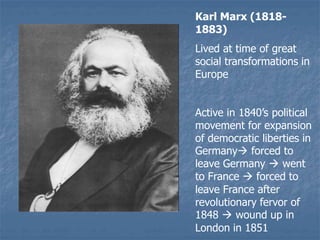
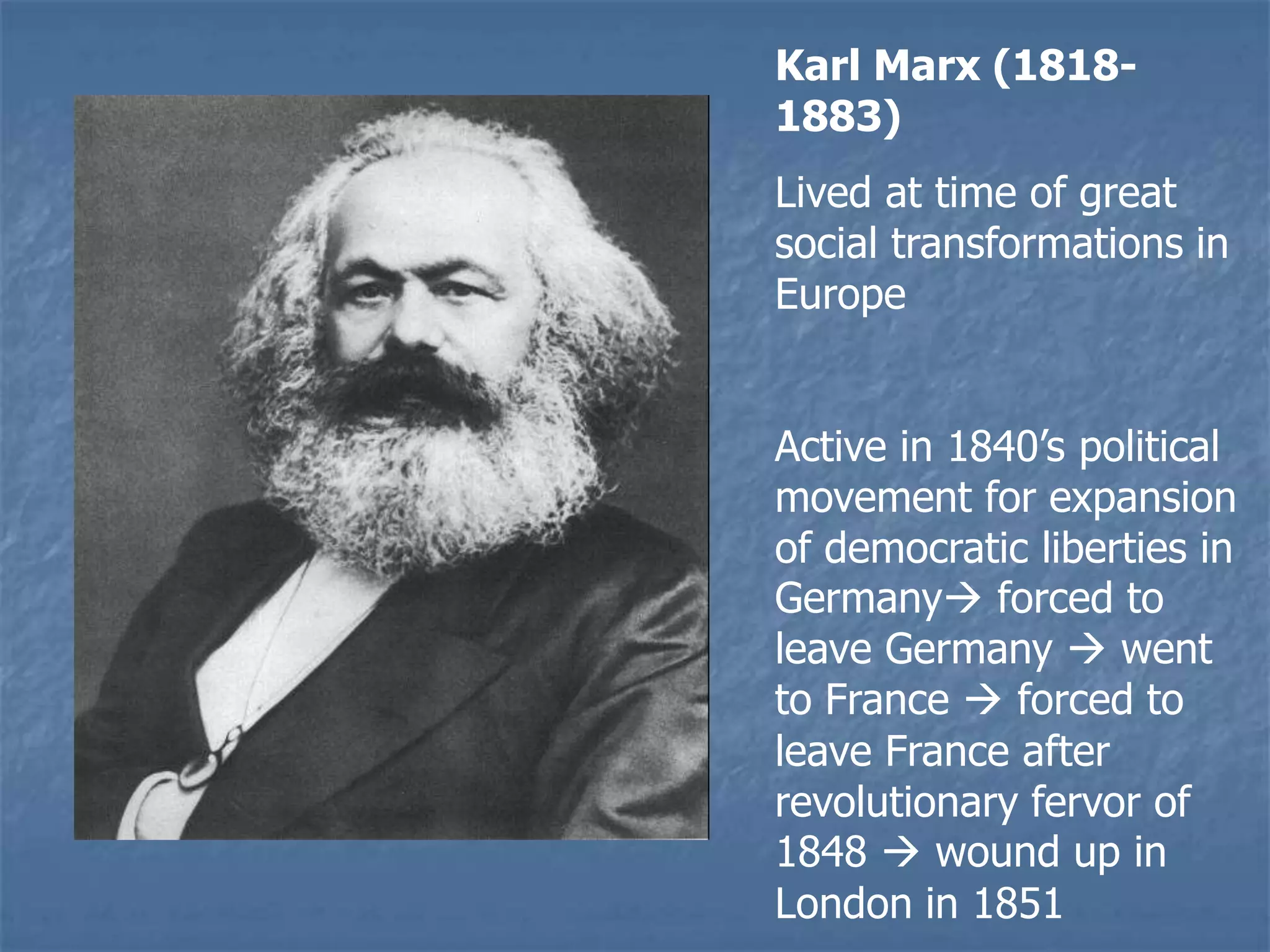
Karl Marx (1818-
1883)
Lived at time of great
social transformations in
Europe
Active in 1840’s political
movement for expansion
of democratic liberties in
Germany forced to
leave Germany  went
to France  forced to
leave France after
revolutionary fervor of
1848  wound up in
London in 1851
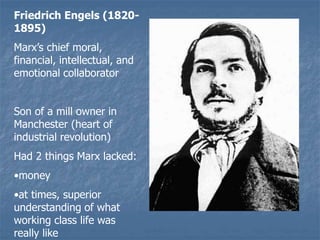
Friedrich Engels (1820-
1895)
Marx’s chief moral,
financial, intellectual, and
emotional collaborator
Son of a mill owner in
Manchester (heart of
industrial revolution)
Had 2 things Marx lacked:
•money
•at times, superior
understanding of what
working class life was
really like
An overview of marxism
 Marx and Engels writing at time of industrial
revolution, transitions away from feudal past
 To understand Marx, must understand the
transitions he lived and predicted: feudalism
capitalism communism
 Marx talks about these systems as “modes of
production” ( a system by which society
determines who does what and who gets what)
What is the feudal mode of
production?
 Two classes: lords and serfs
 Lords control means of production (land); serfs
labor to produce agricultural products
 Serfs bound to land, not free
 Serfs not paid in wages, merely allowed to
subsist on lord’s land in exchange for tribute of
product (crops), labor, or money
What is the feudal mode of
production?
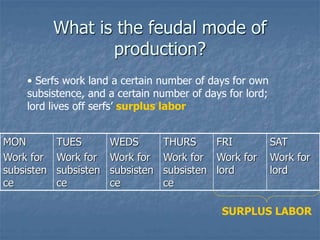
MON
Work for
subsisten
ce
TUES
Work for
subsisten
ce
WEDS
Work for
subsisten
ce
THURS
Work for
subsisten
ce
FRI
Work for
lord
SAT
Work for
lord
SURPLUS LABOR
• Serfs work land a certain number of days for own
subsistence, and a certain number of days for lord;
lord lives off serfs’ surplus labor
What is the feudal mode of
production?
 Under feudalism, surplus labor generated
by serf and given to lord is visible
What is the capitalist mode of
production?
 Two classes: bourgeoisie (capitalists) and
proletariat (workers)
 Bourgeoisie controls means of production
(factories); proletariat works in factories for
wages
 Workers free to work for different employers
 The value of the worker’s labor (what s/he
produces) is greater than the value of his wages
(what s/he is paid); this is the capitalist’s profit
What is the capitalist mode of
production?
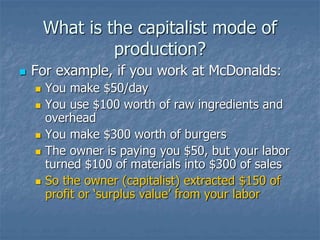
 For example, if you work at McDonalds:
 You make $50/day
 You use $100 worth of raw ingredients and
overhead
 You make $300 worth of burgers
 The owner is paying you $50, but your labor
turned $100 of materials into $300 of sales
 So the owner (capitalist) extracted $150 of
profit or ‘surplus value’ from your labor
How is this vision different from
Adam Smith’s?
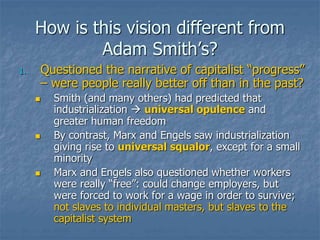
1. Questioned the narrative of capitalist “progress”
– were people really better off than in the past?
 Smith (and many others) had predicted that
industrialization  universal opulence and
greater human freedom
 By contrast, Marx and Engels saw industrialization
giving rise to universal squalor, except for a small
minority
 Marx and Engels also questioned whether workers
were really “free”: could change employers, but
were forced to work for a wage in order to survive;
not slaves to individual masters, but slaves to the
capitalist system
How is this vision different from
Adam Smith’s?
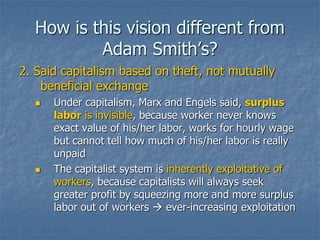
2. Said capitalism based on theft, not mutually
beneficial exchange
 Under capitalism, Marx and Engels said, surplus
labor is invisible, because worker never knows
exact value of his/her labor, works for hourly wage
but cannot tell how much of his/her labor is really
unpaid
 The capitalist system is inherently exploitative of
workers, because capitalists will always seek
greater profit by squeezing more and more surplus
labor out of workers  ever-increasing exploitation
How is this vision different from
Adam Smith’s?
3. Agreed that in capitalism, markets bound
to expand, but thought this would
eventually lead to its downfall
 the capitalist system sows the seeds of its
own destruction (Communist Manifesto)
Key concepts in Marxism:
historical materialism
 Hegel said humans uniquely able to
reason and reflect, and over time the
unfolding of the human spirit was leading
to ever-greater development of human
consciousness
 Marx, Engels criticized this celebration of
ideas unmatched by real, material
changes
Key concepts in Marxism:
historical materialism
 “The materialist conception of history starts from the
proposition that the production of the means to support
human life and, next to production, the exchange of
things produced, is the basis of all social structure; that
in every society that has appeared in history, the
manner in which wealth is distributed and society
divided into classes or orders is dependent upon what is
produced, how it is produced, and how the products are
exchanged. From this point of view, the final causes of
all social changes and political revolutions are to be
sought, not in men's brains, not in men's better insights
into eternal truth and justice, but in changes in the
modes of production and exchange.” From Socialism:
Utopian and Scientific (written entirely by Engels after
Marx’s death)
Key concepts in Marxism:
historical materialism
 Ideas always reflect a material basis
 For Marx and Engels, ideology is an
illusory set of ideas which dominate in
society
 For example: German ideology: illusory notion
that ideas make history, historical change is
propelled by new ideas
Key concepts in Marxism:
historical materialism
 Another way this concept is expressed is
through notion of base and
superstructure
 Social reality is grounded in an economic
base (who does what, who gets what);
built upon this is a legal and political
superstructure. This superstructure
reflects the realities of the base
Key concepts in Marxism:
commodity fetishism
 In capitalist societies, exchange of
commodities is an abstraction, concealing
the social relationships behind it
 Decisions appear to be made by the
market, rather than by society
 Commodities and markets seem to take on
lives of their own

M xs

  • 1.
    Karl Marx (1818- 1883) Livedat time of great social transformations in Europe Active in 1840’s political movement for expansion of democratic liberties in Germany forced to leave Germany  went to France  forced to leave France after revolutionary fervor of 1848  wound up in London in 1851
  • 2.
    Friedrich Engels (1820- 1895) Marx’schief moral, financial, intellectual, and emotional collaborator Son of a mill owner in Manchester (heart of industrial revolution) Had 2 things Marx lacked: •money •at times, superior understanding of what working class life was really like
  • 3.
    An overview ofmarxism  Marx and Engels writing at time of industrial revolution, transitions away from feudal past  To understand Marx, must understand the transitions he lived and predicted: feudalism capitalism communism  Marx talks about these systems as “modes of production” ( a system by which society determines who does what and who gets what)
  • 4.
    What is thefeudal mode of production?  Two classes: lords and serfs  Lords control means of production (land); serfs labor to produce agricultural products  Serfs bound to land, not free  Serfs not paid in wages, merely allowed to subsist on lord’s land in exchange for tribute of product (crops), labor, or money
  • 5.
    What is thefeudal mode of production? MON Work for subsisten ce TUES Work for subsisten ce WEDS Work for subsisten ce THURS Work for subsisten ce FRI Work for lord SAT Work for lord SURPLUS LABOR • Serfs work land a certain number of days for own subsistence, and a certain number of days for lord; lord lives off serfs’ surplus labor
  • 6.
    What is thefeudal mode of production?  Under feudalism, surplus labor generated by serf and given to lord is visible
  • 7.
    What is thecapitalist mode of production?  Two classes: bourgeoisie (capitalists) and proletariat (workers)  Bourgeoisie controls means of production (factories); proletariat works in factories for wages  Workers free to work for different employers  The value of the worker’s labor (what s/he produces) is greater than the value of his wages (what s/he is paid); this is the capitalist’s profit
  • 8.
    What is thecapitalist mode of production?  For example, if you work at McDonalds:  You make $50/day  You use $100 worth of raw ingredients and overhead  You make $300 worth of burgers  The owner is paying you $50, but your labor turned $100 of materials into $300 of sales  So the owner (capitalist) extracted $150 of profit or ‘surplus value’ from your labor
  • 9.
    How is thisvision different from Adam Smith’s? 1. Questioned the narrative of capitalist “progress” – were people really better off than in the past?  Smith (and many others) had predicted that industrialization  universal opulence and greater human freedom  By contrast, Marx and Engels saw industrialization giving rise to universal squalor, except for a small minority  Marx and Engels also questioned whether workers were really “free”: could change employers, but were forced to work for a wage in order to survive; not slaves to individual masters, but slaves to the capitalist system
  • 10.
    How is thisvision different from Adam Smith’s? 2. Said capitalism based on theft, not mutually beneficial exchange  Under capitalism, Marx and Engels said, surplus labor is invisible, because worker never knows exact value of his/her labor, works for hourly wage but cannot tell how much of his/her labor is really unpaid  The capitalist system is inherently exploitative of workers, because capitalists will always seek greater profit by squeezing more and more surplus labor out of workers  ever-increasing exploitation
  • 11.
    How is thisvision different from Adam Smith’s? 3. Agreed that in capitalism, markets bound to expand, but thought this would eventually lead to its downfall  the capitalist system sows the seeds of its own destruction (Communist Manifesto)
  • 12.
    Key concepts inMarxism: historical materialism  Hegel said humans uniquely able to reason and reflect, and over time the unfolding of the human spirit was leading to ever-greater development of human consciousness  Marx, Engels criticized this celebration of ideas unmatched by real, material changes
  • 13.
    Key concepts inMarxism: historical materialism  “The materialist conception of history starts from the proposition that the production of the means to support human life and, next to production, the exchange of things produced, is the basis of all social structure; that in every society that has appeared in history, the manner in which wealth is distributed and society divided into classes or orders is dependent upon what is produced, how it is produced, and how the products are exchanged. From this point of view, the final causes of all social changes and political revolutions are to be sought, not in men's brains, not in men's better insights into eternal truth and justice, but in changes in the modes of production and exchange.” From Socialism: Utopian and Scientific (written entirely by Engels after Marx’s death)
  • 14.
    Key concepts inMarxism: historical materialism  Ideas always reflect a material basis  For Marx and Engels, ideology is an illusory set of ideas which dominate in society  For example: German ideology: illusory notion that ideas make history, historical change is propelled by new ideas
  • 15.
    Key concepts inMarxism: historical materialism  Another way this concept is expressed is through notion of base and superstructure  Social reality is grounded in an economic base (who does what, who gets what); built upon this is a legal and political superstructure. This superstructure reflects the realities of the base
  • 16.
    Key concepts inMarxism: commodity fetishism  In capitalist societies, exchange of commodities is an abstraction, concealing the social relationships behind it  Decisions appear to be made by the market, rather than by society  Commodities and markets seem to take on lives of their own