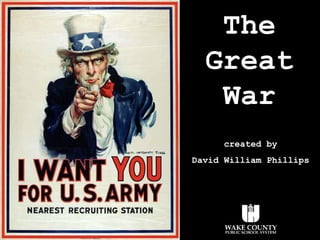
The Great War created by David William Phillips
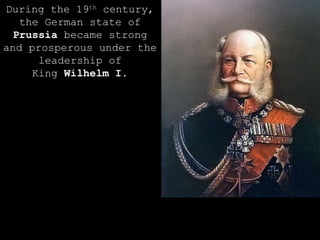
During the 19 th  century, the German state of  Prussia  became strong and prosperous under the leadership of King  Wilhelm I .
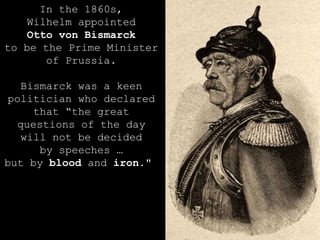
In the 1860s, Wilhelm appointed Otto von Bismarck to be the Prime Minister of Prussia. Bismarck was a keen politician who declared that “the great questions of the day will not be decided by speeches … but by  blood  and  iron ."
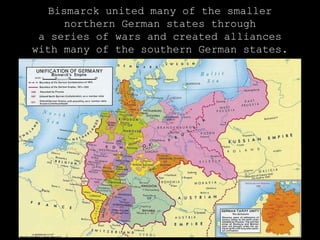
Bismarck united many of the smaller northern German states through a series of wars and created alliances with many of the southern German states.
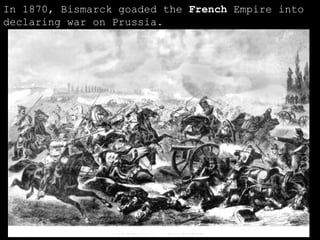
In 1870, Bismarck goaded the  French  Empire into declaring war on Prussia.
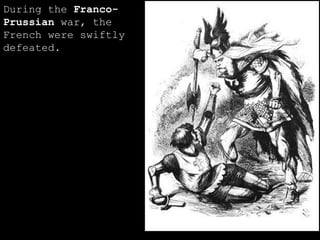
During the  Franco-Prussian  war, the French were swiftly defeated.
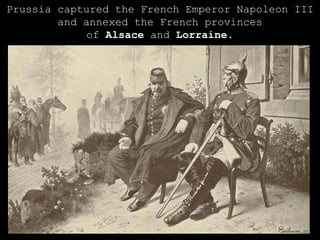
Prussia captured the French Emperor Napoleon III and annexed the French provinces of  Alsace  and  Lorraine .
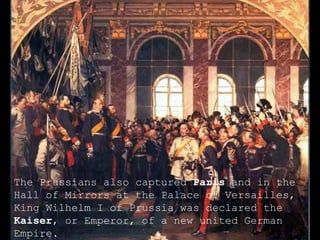
The Prussians also captured  Paris  and in the Hall of Mirrors at the Palace of Versailles, King Wilhelm I of Prussia was declared the  Kaiser , or Emperor, of a new united German Empire.
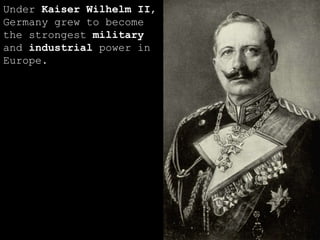
Under  Kaiser Wilhelm II , Germany grew to become the strongest  military  and  industrial  power in Europe.
Like Britain and France, Germany had imperial ambitions and Wilhelm II declared that Germany too, would have “ a   place in the sun .”
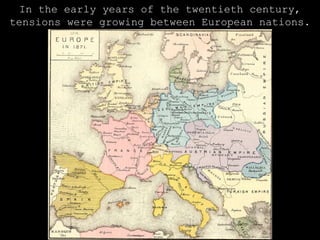
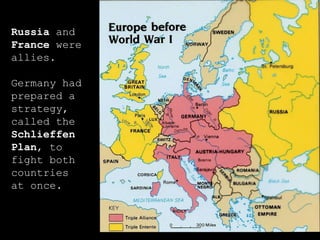
In the early years of the twentieth century, tensions were growing between European nations.
This was due to: 1.  Imperialism European empires, especially  Britain ,  France , and  Germany,  competed for control of  trade  and  colonies .
British Empire in 1914
French Empire in 1914 (dark blue)
German Empire in 1914
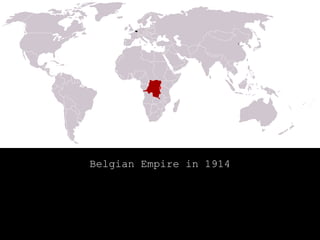
Belgian Empire in 1914
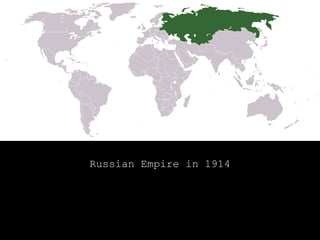
Russian Empire in 1914
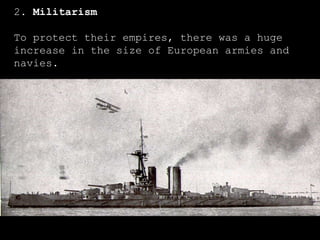
2.  Militarism To protect their empires, there was a huge increase in the size of European armies and navies.
Between 1890 and 1914 European military forces  doubled  in size in a tense arms race.
3.  Alliances Empires needed allies to help preserve their power.
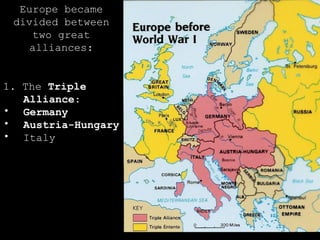
1. The  Triple  Alliance : Germany Austria-Hungary Italy Europe became divided between two great alliances:
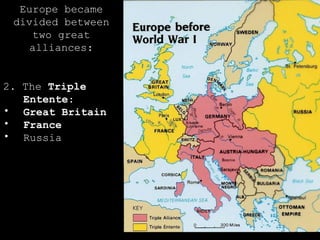
2. The  Triple Entente : Great   Britain France Russia Europe became divided between two great alliances:
4.  Socialism Meanwhile, most European nations also faced  internal social strife . Conservatism Socialism Liberalism Proletariat Bourgeoisie Elites
As  Socialist labor  movements gained greater power, workers went on frequent  strikes  to achieve their goals.  Conservative  European leaders feared the outbreak of a  Marxist  revolution.
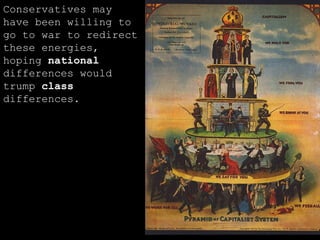
Conservatives may have been willing to go to war to redirect these energies, hoping  national  differences would trump  class  differences.
5.  Nationalism Several European  nations  dreamed gaining  independence  and creating their own nation-states, such as the  Irish  in the  British  Empire …
…  and the  Slavs  in the  Austro-Hungarian  and  Ottoman  Empires.
Finally, these tension erupted into a great and terrible war in August, 1914: 4  years and  3  months (1 Aug 1914 – 11 Nov 1918) 8.5  million dead,  21.2  million   wounded,  7.8  million   missing in action 17  million dead from a worldwide flu epidemic $186  billion (approx.  $2.5  trillion today)
The Great War was caused by five MAIN factors: M A I N S Militarism Alliances Imperialism Nationalism Socialism
Or, in chronological order: N I M A S Militarism –  increased after 1890s to protect new colonies and prove national superiority Alliances –  become necessary by early 1900s in militarized environment Imperialism –  increased after 1870s in part due to rivalries compelled by nationalism Nationalism –  developed early-mid 1800s  Socialism –  Were conservative leaders willing to go to war in order to draw focus away from international brotherhood to patriotic duty and use lower class soldiers as cannon fodder to reduce threat of socialist revolution by reducing the working class population?
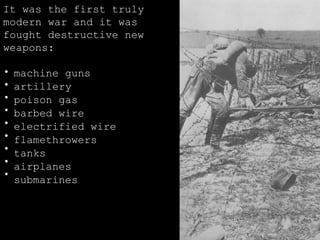
It was the first truly modern war and it was fought destructive new weapons: machine guns artillery poison gas barbed wire electrified wire flamethrowers tanks airplanes submarines
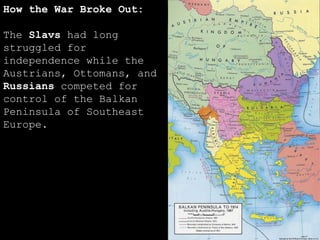
How the War Broke Out: The  Slavs  had long struggled for independence while the Austrians, Ottomans, and  Russians  competed for control of the Balkan Peninsula of Southeast Europe.
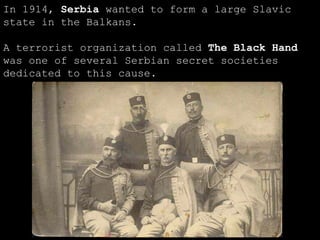
In 1914,  Serbia  wanted to form a large Slavic state in the Balkans. A terrorist organization called  The Black Hand  was one of several Serbian secret societies dedicated to this cause.
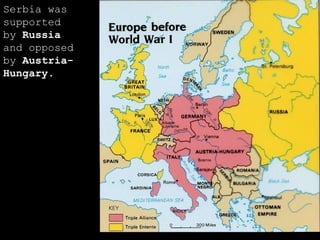
Serbia was supported by  Russia  and opposed by  Austria-Hungary .
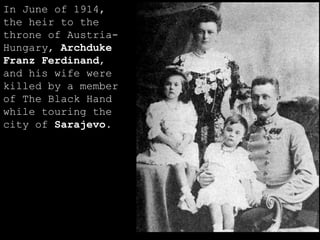
In June of 1914, the heir to the throne   of Austria-Hungary,  Archduke   Franz Ferdinand , and his wife were killed by a member of The Black Hand while touring the city of  Sarajevo .
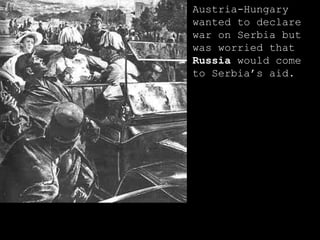
Austria-Hungary wanted to declare war on Serbia but was worried that  Russia  would come to Serbia’s aid.
Austrian leaders asked for help from its  German  allies. Kaiser Wilhelm II  agreed to give Germany’s full support.
In July, 1914  Austria-Hungary  declared war on  Serbia . Russia responded by  mobilizing  the Russian army.
Austria-Hungary and Germany considered Russian mobilization to be an act of war. Germany  declared war on  Russia  on  August 1 .
Russia  and  France  were allies. Germany had prepared a strategy, called the  Schlieffen Plan , to fight both countries at once.
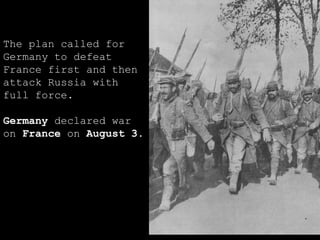
The plan called for Germany to defeat France first and then attack Russia with full force. Germany  declared war on  France  on  August 3 .
The Germans demanded that  Belgium  — a neutral country — allow German armies to pass through on the way to France.
The violation of Belgian neutrality drew  Great Britain , who was allied with  France  and  Russia , into the war. On  August 4 ,  Britain  declared war on  Germany  and  World War I  had begun.
É ultimatum Serbia (10) Austria-Hungary (6) Russia (5) Germany (1) France (4) Belgium (9) Britain (2) Ottoman Turks (8) Italy (7) Italy (7) Ì assassination » back-up ¼ support º mobilizes (WAR!) ¹ É É WAR! Schlieffen Plan Schlieffen Plan » has treaty Î WAR! » alliance Î switches sides » joins » alliance Bulgaria(12) » joins É WAR!
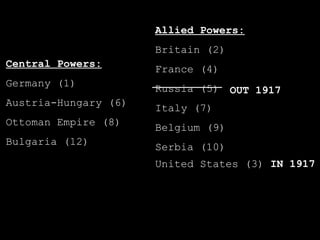
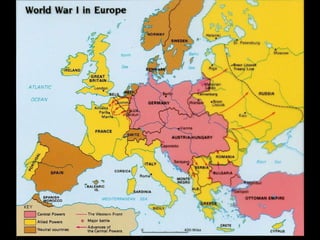
Allied Powers: Britain (2) France (4) Russia (5) Italy (7) Belgium (9) Serbia (10) Central Powers: Germany (1) Austria-Hungary (6) Ottoman Empire (8) Bulgaria (12) OUT 1917 United States (3)  IN 1917 _____________
 
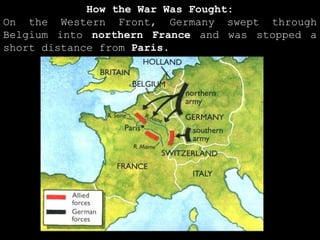
How the War Was Fought: On the Western Front, Germany swept through Belgium into  northern France  and was stopped a short distance from  Paris.
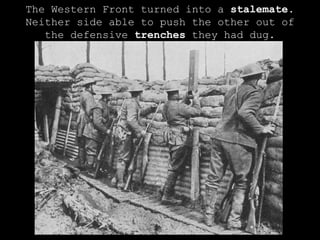
The Western Front turned into a  stalemate . Neither side able to push the other out of the defensive  trenches  they had dug.
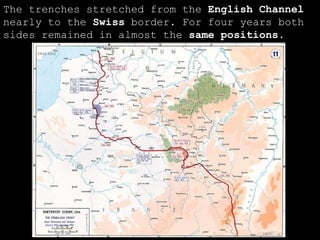
The trenches stretched from the  English Channel  nearly to the  Swiss  border. For four years both sides remained in almost the  same positions .
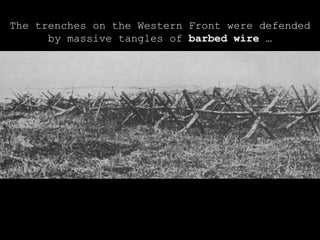
The trenches on the Western Front were defended by massive tangles of  barbed wire  …
…  machinegun nests  …
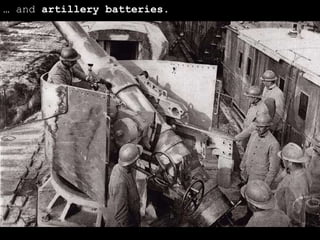
…  and  artillery batteries .
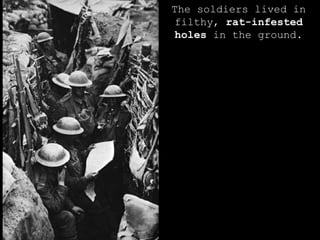
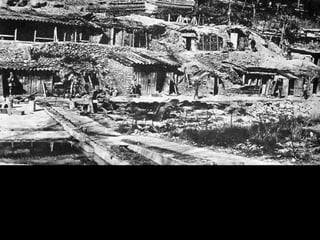
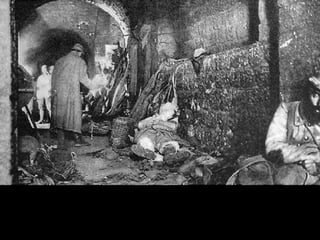
The soldiers lived in filthy,  rat-infested   holes  in the ground.
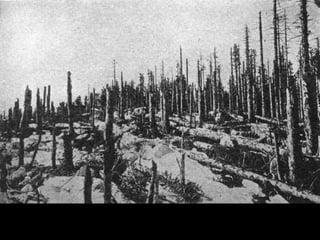
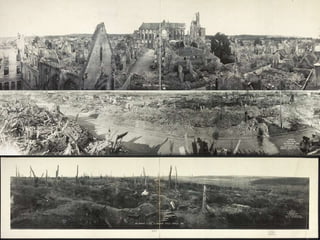
The devastated territory between the two sides was called  No-Man’s-Land .


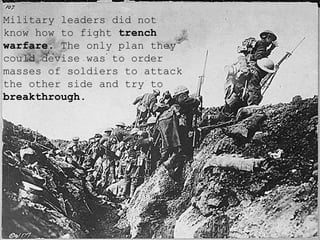
Military leaders did not know how to fight  trench warfare . The only plan they could devise was to order masses of soldiers to attack the other side and try to  breakthrough .
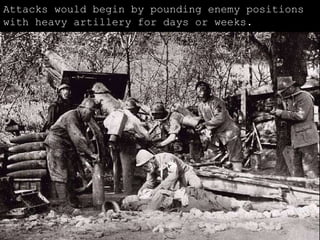
Attacks would begin by pounding enemy positions with heavy artillery for days or weeks.
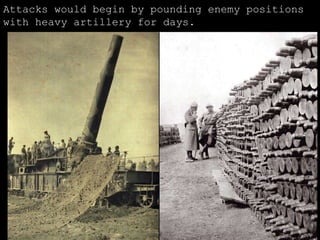
Attacks would begin by pounding enemy positions with heavy artillery for days.
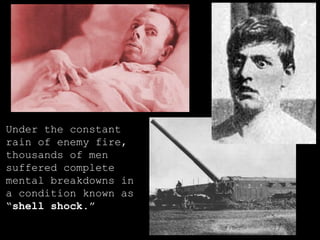
Under the constant rain of enemy fire, thousands of men suffered complete mental breakdowns in a condition known as “ shell shock .”
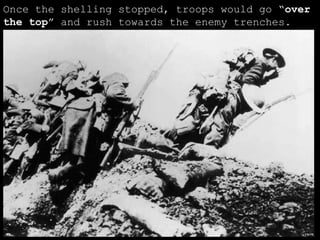
Once the shelling stopped, troops would go “ over the top ” and rush towards the enemy trenches.
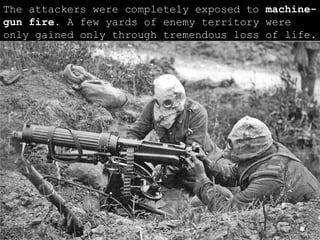
The attackers were completely exposed to  machine-gun fire . A few yards of enemy territory were only gained only through tremendous loss of life.
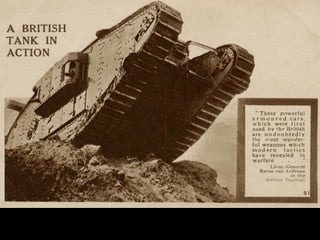
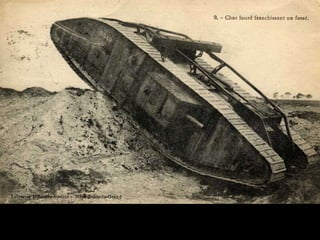
New weapons were developed to overcome the stalemate:  flamethrowers  …
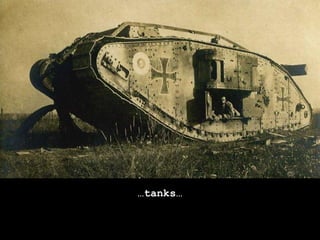
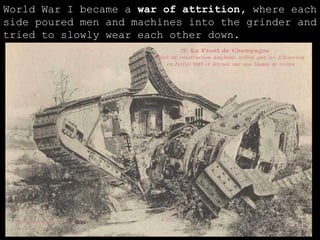
… tanks …
 
 
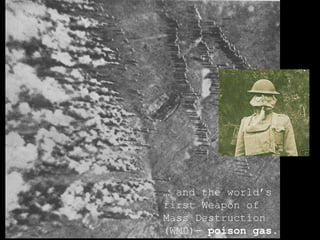
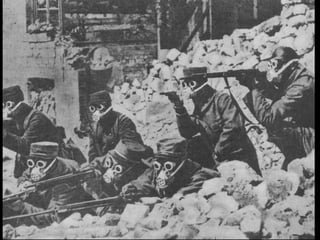
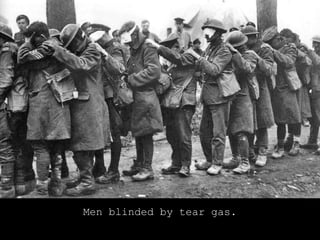
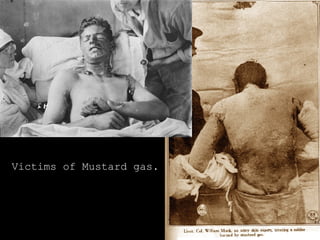
…  and the world’s first Weapon of Mass Destruction (WMD)-  poison gas.
 
Men blinded by tear gas.
Victims of Mustard gas.
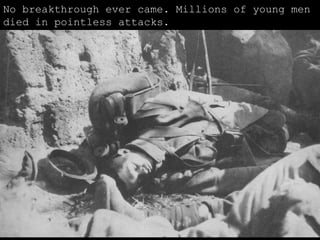
No breakthrough ever came. Millions of young men died in pointless attacks.
World War I became a  war of attrition,  where each side poured men and machines into the grinder and tried to slowly wear each other down.
 
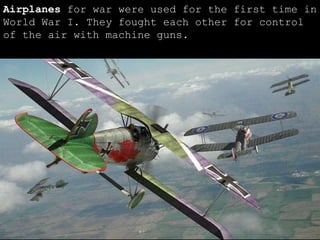
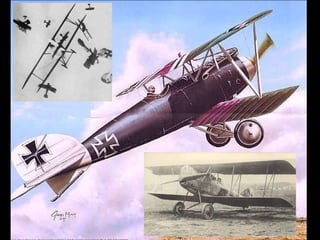
Airplanes  for war were used for the first time in World War I. They fought each other for control of the air with machine guns.
 
 
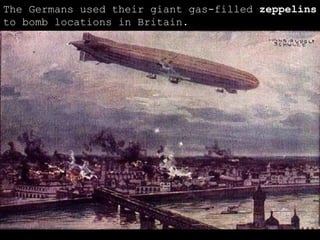
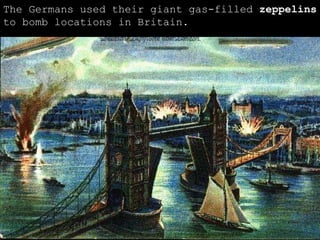
The Germans used their giant gas-filled  zeppelins  to bomb locations in Britain.
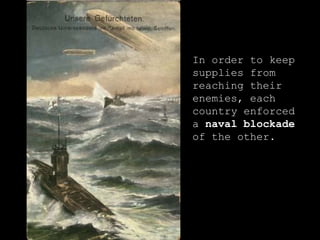
In order to keep supplies from reaching their enemies, each country enforced a  naval blockade  of the other.
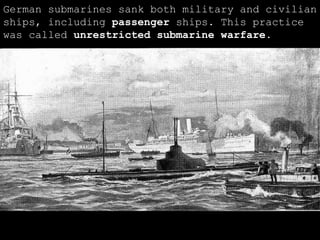
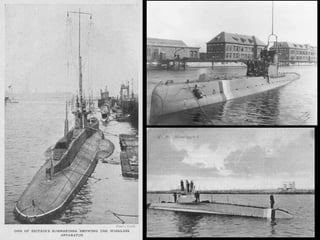
German submarines sank both military and civilian ships, including  passenger  ships. This practice was called  unrestricted submarine warfare .
 
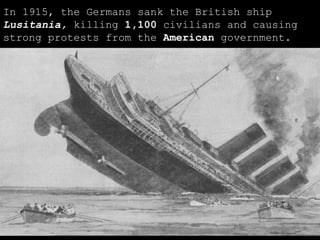
In 1915, the Germans sank the British ship  Lusitania ,  killing  1,100  civilians and causing strong protests from the  American  government.
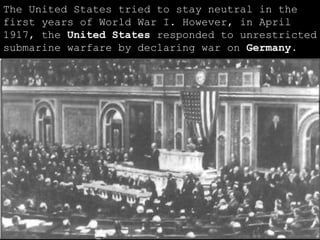
The United States tried to stay neutral in the first years of World War I. However, in April 1917, the  United States  responded to unrestricted submarine warfare by declaring war on  Germany .
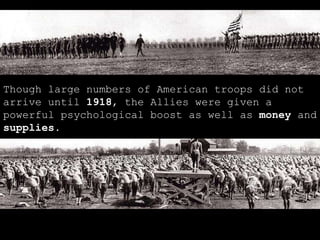
Though large numbers of American troops did not arrive until  1918 , the Allies were given a powerful psychological boost as well as  money  and  supplies .
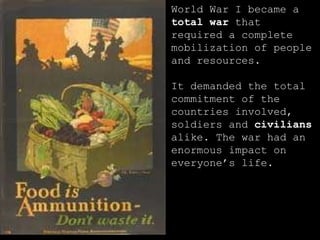
World War I became a  total war  that required a complete mobilization of people and resources. It demanded the total commitment of the countries involved, soldiers and  civilians  alike. The war had an enormous impact on everyone’s life.
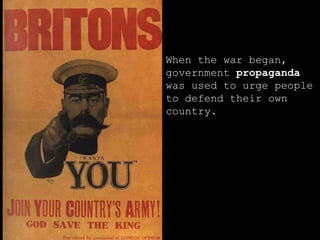
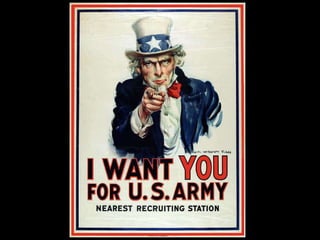
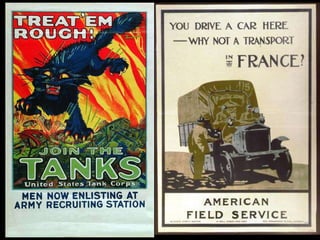
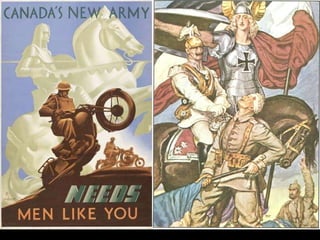
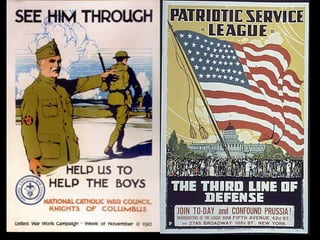
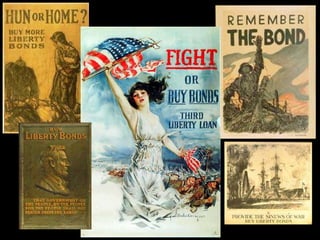
When the war began, government  propaganda  was used to urge people to defend their own country.
 
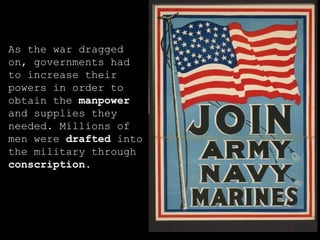
As the war dragged on, governments had to increase their powers in order to obtain the  manpower  and supplies they needed. Millions of men were  drafted  into the military through  conscription .


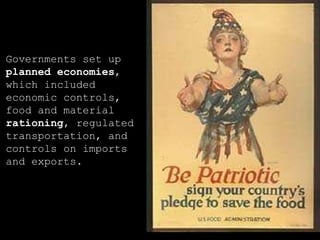
Governments set up  planned economies , which included economic controls, food and material  rationing , regulated transportation, and controls on imports and exports.
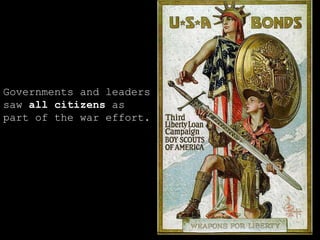
Governments and leaders saw  all citizens  as part of the war effort.
 
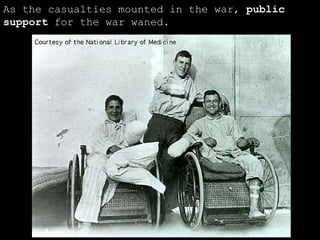
As the casualties mounted in the war,  public support  for the war waned.
Authoritarian governments used  force  to keep people working. Other governments passed new laws to severely restrict  dissent  and took increased  control of news  sources.
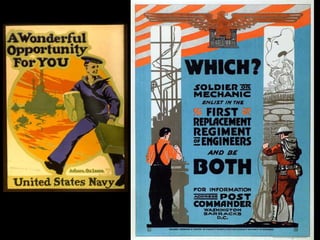
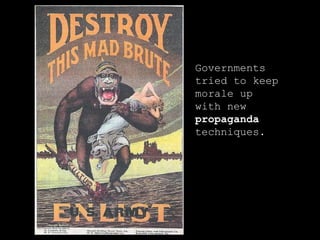
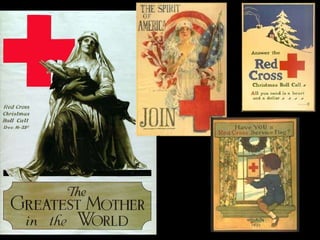
Governments tried to keep morale up with new  propaganda  techniques.
 
Women  assumed new roles during World War I, taking over jobs previously held only by men, including  factory  and trucking jobs.


The great war

  • 1.
    The Great Warcreated by David William Phillips
  • 2.
    During the 19th century, the German state of Prussia became strong and prosperous under the leadership of King Wilhelm I .
  • 3.
    In the 1860s,Wilhelm appointed Otto von Bismarck to be the Prime Minister of Prussia. Bismarck was a keen politician who declared that “the great questions of the day will not be decided by speeches … but by blood and iron ."
  • 4.
    Bismarck united manyof the smaller northern German states through a series of wars and created alliances with many of the southern German states.
  • 5.
    In 1870, Bismarckgoaded the French Empire into declaring war on Prussia.
  • 6.
    During the Franco-Prussian war, the French were swiftly defeated.
  • 7.
    Prussia captured theFrench Emperor Napoleon III and annexed the French provinces of Alsace and Lorraine .
  • 8.
    The Prussians alsocaptured Paris and in the Hall of Mirrors at the Palace of Versailles, King Wilhelm I of Prussia was declared the Kaiser , or Emperor, of a new united German Empire.
  • 9.
    Under KaiserWilhelm II , Germany grew to become the strongest military and industrial power in Europe.
  • 10.
    Like Britain andFrance, Germany had imperial ambitions and Wilhelm II declared that Germany too, would have “ a place in the sun .”
  • 11.
    In the earlyyears of the twentieth century, tensions were growing between European nations.
  • 12.
    This was dueto: 1. Imperialism European empires, especially Britain , France , and Germany, competed for control of trade and colonies .
  • 13.
  • 14.
    French Empire in1914 (dark blue)
  • 15.
  • 16.
  • 17.
  • 18.
    2. MilitarismTo protect their empires, there was a huge increase in the size of European armies and navies.
  • 19.
    Between 1890 and1914 European military forces doubled in size in a tense arms race.
  • 20.
    3. AlliancesEmpires needed allies to help preserve their power.
  • 21.
    1. The Triple Alliance : Germany Austria-Hungary Italy Europe became divided between two great alliances:
  • 22.
    2. The Triple Entente : Great Britain France Russia Europe became divided between two great alliances:
  • 23.
    4. SocialismMeanwhile, most European nations also faced internal social strife . Conservatism Socialism Liberalism Proletariat Bourgeoisie Elites
  • 24.
    As Socialistlabor movements gained greater power, workers went on frequent strikes to achieve their goals. Conservative European leaders feared the outbreak of a Marxist revolution.
  • 25.
    Conservatives may havebeen willing to go to war to redirect these energies, hoping national differences would trump class differences.
  • 26.
    5. NationalismSeveral European nations dreamed gaining independence and creating their own nation-states, such as the Irish in the British Empire …
  • 27.
    … andthe Slavs in the Austro-Hungarian and Ottoman Empires.
  • 28.
    Finally, these tensionerupted into a great and terrible war in August, 1914: 4 years and 3 months (1 Aug 1914 – 11 Nov 1918) 8.5 million dead, 21.2 million wounded, 7.8 million missing in action 17 million dead from a worldwide flu epidemic $186 billion (approx. $2.5 trillion today)
  • 29.
    The Great Warwas caused by five MAIN factors: M A I N S Militarism Alliances Imperialism Nationalism Socialism
  • 30.
    Or, in chronologicalorder: N I M A S Militarism – increased after 1890s to protect new colonies and prove national superiority Alliances – become necessary by early 1900s in militarized environment Imperialism – increased after 1870s in part due to rivalries compelled by nationalism Nationalism – developed early-mid 1800s Socialism – Were conservative leaders willing to go to war in order to draw focus away from international brotherhood to patriotic duty and use lower class soldiers as cannon fodder to reduce threat of socialist revolution by reducing the working class population?
  • 31.
    It was thefirst truly modern war and it was fought destructive new weapons: machine guns artillery poison gas barbed wire electrified wire flamethrowers tanks airplanes submarines
  • 32.
    How the WarBroke Out: The Slavs had long struggled for independence while the Austrians, Ottomans, and Russians competed for control of the Balkan Peninsula of Southeast Europe.
  • 33.
    In 1914, Serbia wanted to form a large Slavic state in the Balkans. A terrorist organization called The Black Hand was one of several Serbian secret societies dedicated to this cause.
  • 34.
    Serbia was supportedby Russia and opposed by Austria-Hungary .
  • 35.
    In June of1914, the heir to the throne of Austria-Hungary, Archduke Franz Ferdinand , and his wife were killed by a member of The Black Hand while touring the city of Sarajevo .
  • 36.
    Austria-Hungary wanted todeclare war on Serbia but was worried that Russia would come to Serbia’s aid.
  • 37.
    Austrian leaders askedfor help from its German allies. Kaiser Wilhelm II agreed to give Germany’s full support.
  • 38.
    In July, 1914 Austria-Hungary declared war on Serbia . Russia responded by mobilizing the Russian army.
  • 39.
    Austria-Hungary and Germanyconsidered Russian mobilization to be an act of war. Germany declared war on Russia on August 1 .
  • 40.
    Russia and France were allies. Germany had prepared a strategy, called the Schlieffen Plan , to fight both countries at once.
  • 41.
    The plan calledfor Germany to defeat France first and then attack Russia with full force. Germany declared war on France on August 3 .
  • 42.
    The Germans demandedthat Belgium — a neutral country — allow German armies to pass through on the way to France.
  • 43.
    The violation ofBelgian neutrality drew Great Britain , who was allied with France and Russia , into the war. On August 4 , Britain declared war on Germany and World War I had begun.
  • 44.
    É ultimatum Serbia(10) Austria-Hungary (6) Russia (5) Germany (1) France (4) Belgium (9) Britain (2) Ottoman Turks (8) Italy (7) Italy (7) Ì assassination » back-up ¼ support º mobilizes (WAR!) ¹ É É WAR! Schlieffen Plan Schlieffen Plan » has treaty Î WAR! » alliance Î switches sides » joins » alliance Bulgaria(12) » joins É WAR!
  • 45.
    Allied Powers: Britain(2) France (4) Russia (5) Italy (7) Belgium (9) Serbia (10) Central Powers: Germany (1) Austria-Hungary (6) Ottoman Empire (8) Bulgaria (12) OUT 1917 United States (3) IN 1917 _____________
  • 46.
  • 47.
    How the WarWas Fought: On the Western Front, Germany swept through Belgium into northern France and was stopped a short distance from Paris.
  • 48.
    The Western Frontturned into a stalemate . Neither side able to push the other out of the defensive trenches they had dug.
  • 49.
    The trenches stretchedfrom the English Channel nearly to the Swiss border. For four years both sides remained in almost the same positions .
  • 50.
    The trenches onthe Western Front were defended by massive tangles of barbed wire …
  • 51.
    … machinegunnests …
  • 52.
    … and artillery batteries .
  • 53.
    The soldiers livedin filthy, rat-infested holes in the ground.
  • 54.
    The devastated territorybetween the two sides was called No-Man’s-Land .
  • 55.
  • 56.
  • 57.
  • 58.
  • 59.
  • 60.
    Military leaders didnot know how to fight trench warfare . The only plan they could devise was to order masses of soldiers to attack the other side and try to breakthrough .
  • 61.
    Attacks would beginby pounding enemy positions with heavy artillery for days or weeks.
  • 62.
    Attacks would beginby pounding enemy positions with heavy artillery for days.
  • 63.
    Under the constantrain of enemy fire, thousands of men suffered complete mental breakdowns in a condition known as “ shell shock .”
  • 64.
    Once the shellingstopped, troops would go “ over the top ” and rush towards the enemy trenches.
  • 65.
    The attackers werecompletely exposed to machine-gun fire . A few yards of enemy territory were only gained only through tremendous loss of life.
  • 66.
    New weapons weredeveloped to overcome the stalemate: flamethrowers …
  • 67.
  • 68.
  • 69.
  • 70.
    … andthe world’s first Weapon of Mass Destruction (WMD)- poison gas.
  • 71.
  • 72.
    Men blinded bytear gas.
  • 73.
  • 74.
    No breakthrough evercame. Millions of young men died in pointless attacks.
  • 75.
    World War Ibecame a war of attrition, where each side poured men and machines into the grinder and tried to slowly wear each other down.
  • 76.
  • 77.
    Airplanes forwar were used for the first time in World War I. They fought each other for control of the air with machine guns.
  • 78.
  • 79.
  • 80.
    The Germans usedtheir giant gas-filled zeppelins to bomb locations in Britain.
  • 81.
    The Germans usedtheir giant gas-filled zeppelins to bomb locations in Britain.
  • 82.
    The Germans usedtheir giant gas-filled zeppelins to bomb locations in Britain.
  • 83.
    In order tokeep supplies from reaching their enemies, each country enforced a naval blockade of the other.
  • 84.
    German submarines sankboth military and civilian ships, including passenger ships. This practice was called unrestricted submarine warfare .
  • 85.
  • 86.
    In 1915, theGermans sank the British ship Lusitania , killing 1,100 civilians and causing strong protests from the American government.
  • 87.
    The United Statestried to stay neutral in the first years of World War I. However, in April 1917, the United States responded to unrestricted submarine warfare by declaring war on Germany .
  • 88.
    Though large numbersof American troops did not arrive until 1918 , the Allies were given a powerful psychological boost as well as money and supplies .
  • 89.
    World War Ibecame a total war that required a complete mobilization of people and resources. It demanded the total commitment of the countries involved, soldiers and civilians alike. The war had an enormous impact on everyone’s life.
  • 90.
    When the warbegan, government propaganda was used to urge people to defend their own country.
  • 91.
  • 92.
    As the wardragged on, governments had to increase their powers in order to obtain the manpower and supplies they needed. Millions of men were drafted into the military through conscription .
  • 93.
  • 94.
  • 95.
  • 96.
    Governments set up planned economies , which included economic controls, food and material rationing , regulated transportation, and controls on imports and exports.
  • 97.
    Governments and leaderssaw all citizens as part of the war effort.
  • 98.
  • 99.
    As the casualtiesmounted in the war, public support for the war waned.
  • 100.
    Authoritarian governments used force to keep people working. Other governments passed new laws to severely restrict dissent and took increased control of news sources.
  • 101.
    Governments tried tokeep morale up with new propaganda techniques.
  • 102.
  • 103.
    Women assumednew roles during World War I, taking over jobs previously held only by men, including factory and trucking jobs.
  • 104.
  • 105.
  • 106.
  • 107.