World War I
Tension in Imperial Europe
 During Imperial Age, European nations
sought power through acquisition of colonies
 Countries competed with each other for relative
power
 They began to get paranoid about their
neighbors—If a war broke out, would they be
strong enough to survive?
 Nations began to look for ways to ensure their
security
Militarism
 Policy of aggressively building up a
nation’s armed forces in preparation
for war
Alliances
 Secret treaties
or informal
understandings
between nations
that promised
they would side
together in the
event of war
Gavrilo Princip
 Bosnian-Serb terrorist and nationalist
who assassinated Franz Ferdinand
Archduke Franz Ferdinand
 Heir to the Austria-
Hungarian throne.
His assassination
was the spark that
ignited the war.
Brinksmanship
 A strategy where a country seeks an
advantage by creating the impression
that they are willing and able to push
a situation to the point of war in
order to get their demands
Mobilization
 The readying of troops for war
Ultimatum
 A statement, especially in diplomatic
negotiations, that expresses or
implies the threat of serious penalties
if the terms are not accepted
Road to war
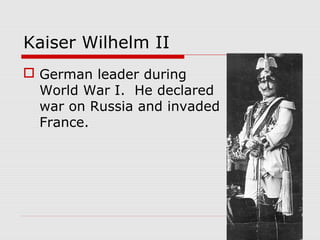
Kaiser Wilhelm II
 German leader during
World War I. He declared
war on Russia and invaded
France.
Allied Forces
 The group of nations that opposed
the Central Powers; originally
consisting of Great Britain, France
and Russia and later joined by the
U.S., Italy and others
Central Powers
 The group of nations--led by
Germany, Austria-Hungary and the
Ottoman Empire--that opposed the
Allied Forces
Military Alliances before the war
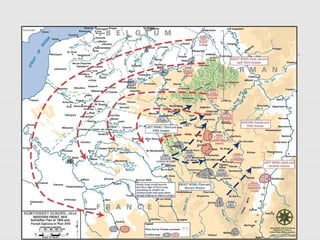
Schlieffen Plan
 German plan of attack to avoid a 2-
front war: first quickly take out
France, then focus troops on Russia
“Rape of Belgium”
 German war crimes
committed during the
march through neutral
Belgium on the way to
Paris
Race for the Sea
 Early in the war when both sides tried
to outflank each other; resulted in a
front line of trenches over 200 miles
long
Trench warfare
 A form of warfare where opponents
occupy static (non-moving) fighting
lines, especially fortified trenches in
the ground.
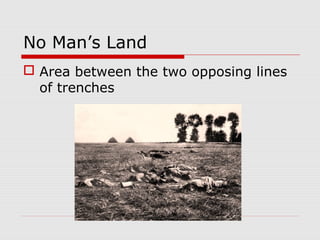
No Man’s Land
 Area between the two opposing lines
of trenches
Barbed wire
 Formed a barrier to attacking soldiers
attempting to cross no man's land
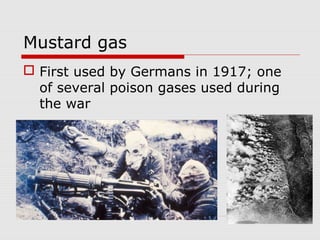
Mustard gas
 First used by Germans in 1917; one
of several poison gases used during
the war
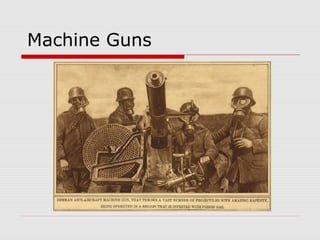
Machine Guns
Tanks
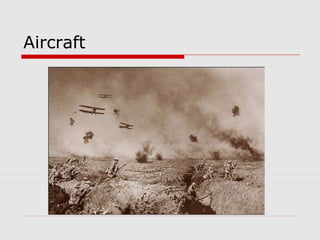
Aircraft
Manfred von Richthofen
 a.k.a. The "Red Baron," a
German fighter pilot who shot
down 80 enemy planes and
commanded the Flying Circus
Stalemate
 A situation in which neither side can
gain the advantage
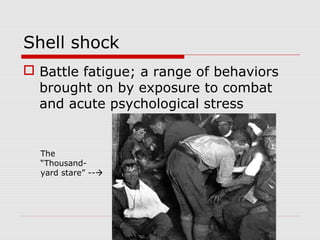
Shell shock
 Battle fatigue; a range of behaviors
brought on by exposure to combat
and acute psychological stress
The
“Thousand-
yard stare” --
Total war
 The organization
of entire
societies for war
in a social,
economic, and
even spiritual
sense.
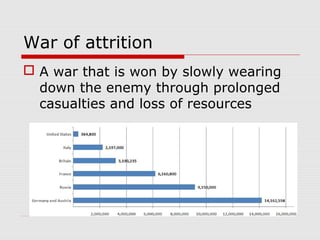
War of attrition
 A war that is won by slowly wearing
down the enemy through prolonged
casualties and loss of resources
Woodrow Wilson
 U.S. President during World War I
Isolationism
 Foreign policy of neutrality and non-
involvement
 Wilson made a declaration of
neutrality just days into the war
Blockade
 An effort to cut off food, supplies, war
material or communications from a
particular area by force
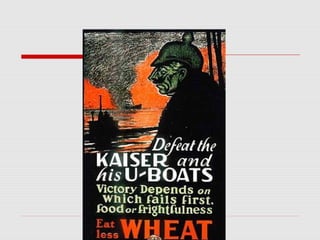
 England used their powerful navy to cut off
Germany
 Some estimate 750,000 Germans died of
starvation
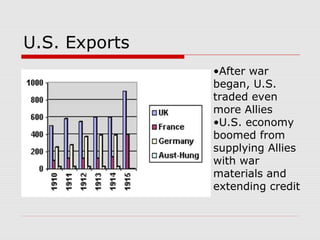
U.S. Exports
•After war
began, U.S.
traded even
more Allies
•U.S. economy
boomed from
supplying Allies
with war
materials and
extending credit
U-boat
 German submarine (Unterseeboot)
 Germany began targeting merchant ships
Lusitania
 British passenger ship sunk off coast
of Ireland by German submarine; 128
Americans dead, led to U.S. outrage
American Reaction
 Wilson issues warning to
Germany
 He affirms Britain’s right to
blockade Germany but
demands Germany stop
attacks on ships
 Secretary of State, William
Jennings Bryan, resigned in
protest of U.S. non-neutrality
Germany Resumes Attacks
 Germany declares they will attack
without warning after all
 Submarine attacks seen as unfair
tactic by Americans
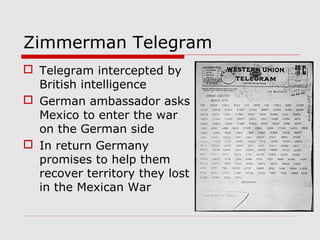
Zimmerman Telegram
 Telegram intercepted by
British intelligence
 German ambassador asks
Mexico to enter the war
on the German side
 In return Germany
promises to help them
recover territory they lost
in the Mexican War
Autocrat
 A ruler with unlimited power
 Russian Revolution ends their autocracy
 Makes it easier for U.S. to justify war “to make the
world safe for democracy”
 Russia out of war, leaving France and Britain
vulnerable
 Wilson declares war on April 6, 1917
American Expeditionary Force
 American forces sent to Europe
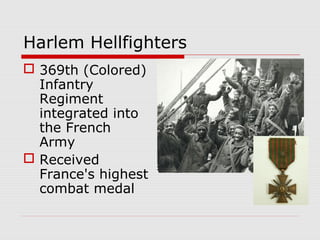
Harlem Hellfighters
 369th (Colored)
Infantry
Regiment
integrated into
the French
Army
 Received
France's highest
combat medal
Selective Service Act of 1917
 Act that
authorized the
draft
 Draft began
almost
immediately
"Four Minute Men"
 75,000 volunteers
recruited by the
Committee on Public
Information
 Gave 4-minute
speeches in support of
the war effort
 Helped turn public
opinion
Espionage Act of 1917
 Made it illegal to oppose the draft
Sedition
 Speech or actions meant to incite
rebellion against a government
Sedition Act of 1918
 Made it illegal to
obstruct the sale
of Liberty Bonds
or to discuss
anything
"disloyal" to the
U.S. government
Charles Schenck
 Anti-war activist who was arrested for
distributing pamphlets urging men to
avoid the draft.
Schenck v. United States
 Established restrictions of freedom of
speech in cases of "clear and present
danger"
Oliver
Wendell
Holmes
Liberty bonds
 Bonds sold to promote the war effort;
heavily-promoted by the government
Women on the Homefront
 Shortage of
male labor
led to
women
being hired
to do work
traditionally
done by
men
Workers were
especially needed
to produce war
supplies
Great Migration
 Massive
numbers of
African-
Americans
also migrated
North for jobs
previously
closed to
them
Armistice
 Cease-fire
 November 11, 1918
Fourteen Points
 President Woodrow Wilson
drafted 14-point plan for
peace in 1918
 First presented to joint
session of Congress before
war to justify entry in moral
terms
 Later presented at Versailles
peace conference after the
war, but failed to win
approval of all 14 points
into final treaty
 Wilson advocated “Peace
without victory”
Main Points
 No secret alliances
 Freedom of the seas
 Removal of trade barriers
(tariffs, etc.)
 Reduce military to just
what’s necessary to protect
your own country
 Let go of some colonies
 Create a League of Nations
Treaty of Versailles
 Treaty that
ended the
war
 June 28,
1919
Big Four
 Countries at
the table:
*U.S.
*Italy
*France
*Great Britain
 Germany and
Russia
excluded
Reparations
 Payments from an
enemy for economic
costs of war
Terms of the Treaty
 Germany humiliated:
--Charged with war crimes
--Forced to accept guilt for the war
--Must drastically reduce military
--Allow France to occupy the
Rhineland for 15 years
--Give up territory
--Pay reparations
 France wanted revenge and security
against any future German threat
League of Nations
 International body
proposed by
Woodrow Wilson to
ensure peace and
stability after the
war through
cooperation and
accountability
Ratification
 Congressional
approval of a
bill
 Wilson tours
country
making
speeches
Failure to Ratify
 Congress fails to
ratify
 League is weak
without U.S.
 Wilson collapses
from stroke
Irreconcilables
 Would not accept U.S. membership in
the League of Nations, no matter
what
Reservationists
 Would accept the League of Nations
with reservations
Henry Cabot Lodge
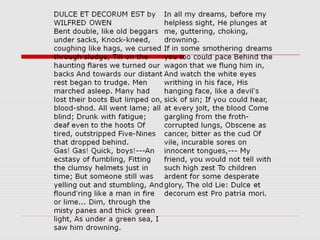
Dulce Et Decorum Est
 Poem written by
British poet and
solider Wilfred
Owen, famous for
its horrific imagery
of war
 Owen died in battle
shortly before the
armistice
World War I terms

World War I terms

  • 1.
  • 2.
    Tension in ImperialEurope  During Imperial Age, European nations sought power through acquisition of colonies  Countries competed with each other for relative power  They began to get paranoid about their neighbors—If a war broke out, would they be strong enough to survive?  Nations began to look for ways to ensure their security
  • 3.
    Militarism  Policy ofaggressively building up a nation’s armed forces in preparation for war
  • 4.
    Alliances  Secret treaties orinformal understandings between nations that promised they would side together in the event of war
  • 6.
    Gavrilo Princip  Bosnian-Serbterrorist and nationalist who assassinated Franz Ferdinand
  • 7.
    Archduke Franz Ferdinand Heir to the Austria- Hungarian throne. His assassination was the spark that ignited the war.
  • 8.
    Brinksmanship  A strategywhere a country seeks an advantage by creating the impression that they are willing and able to push a situation to the point of war in order to get their demands
  • 9.
  • 10.
    Ultimatum  A statement,especially in diplomatic negotiations, that expresses or implies the threat of serious penalties if the terms are not accepted
  • 11.
  • 12.
    Kaiser Wilhelm II German leader during World War I. He declared war on Russia and invaded France.
  • 13.
    Allied Forces  Thegroup of nations that opposed the Central Powers; originally consisting of Great Britain, France and Russia and later joined by the U.S., Italy and others
  • 14.
    Central Powers  Thegroup of nations--led by Germany, Austria-Hungary and the Ottoman Empire--that opposed the Allied Forces
  • 15.
  • 16.
    Schlieffen Plan  Germanplan of attack to avoid a 2- front war: first quickly take out France, then focus troops on Russia
  • 18.
    “Rape of Belgium” German war crimes committed during the march through neutral Belgium on the way to Paris
  • 19.
    Race for theSea  Early in the war when both sides tried to outflank each other; resulted in a front line of trenches over 200 miles long
  • 21.
    Trench warfare  Aform of warfare where opponents occupy static (non-moving) fighting lines, especially fortified trenches in the ground.
  • 26.
    No Man’s Land Area between the two opposing lines of trenches
  • 27.
    Barbed wire  Formeda barrier to attacking soldiers attempting to cross no man's land
  • 28.
    Mustard gas  Firstused by Germans in 1917; one of several poison gases used during the war
  • 30.
  • 31.
  • 32.
  • 33.
    Manfred von Richthofen a.k.a. The "Red Baron," a German fighter pilot who shot down 80 enemy planes and commanded the Flying Circus
  • 34.
    Stalemate  A situationin which neither side can gain the advantage
  • 35.
    Shell shock  Battlefatigue; a range of behaviors brought on by exposure to combat and acute psychological stress The “Thousand- yard stare” --
  • 36.
    Total war  Theorganization of entire societies for war in a social, economic, and even spiritual sense.
  • 37.
    War of attrition A war that is won by slowly wearing down the enemy through prolonged casualties and loss of resources
  • 39.
    Woodrow Wilson  U.S.President during World War I
  • 40.
    Isolationism  Foreign policyof neutrality and non- involvement  Wilson made a declaration of neutrality just days into the war
  • 41.
    Blockade  An effortto cut off food, supplies, war material or communications from a particular area by force  England used their powerful navy to cut off Germany  Some estimate 750,000 Germans died of starvation
  • 43.
    U.S. Exports •After war began,U.S. traded even more Allies •U.S. economy boomed from supplying Allies with war materials and extending credit
  • 45.
    U-boat  German submarine(Unterseeboot)  Germany began targeting merchant ships
  • 46.
    Lusitania  British passengership sunk off coast of Ireland by German submarine; 128 Americans dead, led to U.S. outrage
  • 47.
    American Reaction  Wilsonissues warning to Germany  He affirms Britain’s right to blockade Germany but demands Germany stop attacks on ships  Secretary of State, William Jennings Bryan, resigned in protest of U.S. non-neutrality
  • 49.
    Germany Resumes Attacks Germany declares they will attack without warning after all  Submarine attacks seen as unfair tactic by Americans
  • 51.
    Zimmerman Telegram  Telegramintercepted by British intelligence  German ambassador asks Mexico to enter the war on the German side  In return Germany promises to help them recover territory they lost in the Mexican War
  • 52.
    Autocrat  A rulerwith unlimited power  Russian Revolution ends their autocracy  Makes it easier for U.S. to justify war “to make the world safe for democracy”  Russia out of war, leaving France and Britain vulnerable  Wilson declares war on April 6, 1917
  • 53.
    American Expeditionary Force American forces sent to Europe
  • 54.
    Harlem Hellfighters  369th(Colored) Infantry Regiment integrated into the French Army  Received France's highest combat medal
  • 55.
    Selective Service Actof 1917  Act that authorized the draft  Draft began almost immediately
  • 56.
    "Four Minute Men" 75,000 volunteers recruited by the Committee on Public Information  Gave 4-minute speeches in support of the war effort  Helped turn public opinion
  • 57.
    Espionage Act of1917  Made it illegal to oppose the draft
  • 58.
    Sedition  Speech oractions meant to incite rebellion against a government
  • 59.
    Sedition Act of1918  Made it illegal to obstruct the sale of Liberty Bonds or to discuss anything "disloyal" to the U.S. government
  • 60.
    Charles Schenck  Anti-waractivist who was arrested for distributing pamphlets urging men to avoid the draft.
  • 61.
    Schenck v. UnitedStates  Established restrictions of freedom of speech in cases of "clear and present danger" Oliver Wendell Holmes
  • 62.
    Liberty bonds  Bondssold to promote the war effort; heavily-promoted by the government
  • 63.
    Women on theHomefront  Shortage of male labor led to women being hired to do work traditionally done by men
  • 64.
  • 66.
    Great Migration  Massive numbersof African- Americans also migrated North for jobs previously closed to them
  • 68.
  • 69.
    Fourteen Points  PresidentWoodrow Wilson drafted 14-point plan for peace in 1918  First presented to joint session of Congress before war to justify entry in moral terms  Later presented at Versailles peace conference after the war, but failed to win approval of all 14 points into final treaty  Wilson advocated “Peace without victory”
  • 70.
    Main Points  Nosecret alliances  Freedom of the seas  Removal of trade barriers (tariffs, etc.)  Reduce military to just what’s necessary to protect your own country  Let go of some colonies  Create a League of Nations
  • 71.
    Treaty of Versailles Treaty that ended the war  June 28, 1919
  • 72.
    Big Four  Countriesat the table: *U.S. *Italy *France *Great Britain  Germany and Russia excluded
  • 73.
    Reparations  Payments froman enemy for economic costs of war
  • 74.
    Terms of theTreaty  Germany humiliated: --Charged with war crimes --Forced to accept guilt for the war --Must drastically reduce military --Allow France to occupy the Rhineland for 15 years --Give up territory --Pay reparations  France wanted revenge and security against any future German threat
  • 75.
    League of Nations International body proposed by Woodrow Wilson to ensure peace and stability after the war through cooperation and accountability
  • 76.
    Ratification  Congressional approval ofa bill  Wilson tours country making speeches
  • 77.
    Failure to Ratify Congress fails to ratify  League is weak without U.S.  Wilson collapses from stroke
  • 78.
    Irreconcilables  Would notaccept U.S. membership in the League of Nations, no matter what
  • 79.
    Reservationists  Would acceptthe League of Nations with reservations Henry Cabot Lodge
  • 80.
    Dulce Et DecorumEst  Poem written by British poet and solider Wilfred Owen, famous for its horrific imagery of war  Owen died in battle shortly before the armistice