Asia and Africa in the 20th
Century
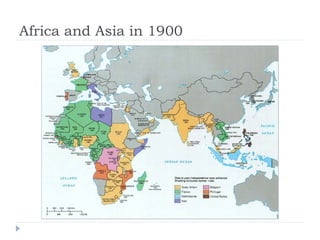
Africa and Asia in 1900
Road to Independence
 Pre-World War I
 Nationalism
 Indian National Congress &
Muslim League
 Egyptian Nationalism
 Dinshawai Incident
 “Save the King” movement in
Vietnam
 Violence
 Boer Wars
 Islamic Fundamentalism
 the Mahdi in Egypt
 Guerilla Warfare in Vietnam
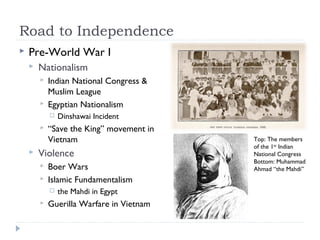
Top: The members
of the 1st
Indian
National Congress
Bottom: Muhammad
Ahmad “the Mahdi”
Road to Independence: World War I
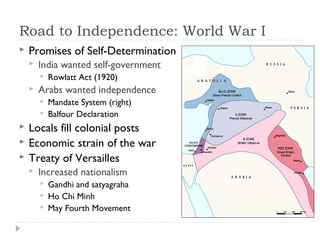
 Promises of Self-Determination
 India wanted self-government
 Rowlatt Act (1920)
 Arabs wanted independence
 Mandate System (right)
 Balfour Declaration
 Locals fill colonial posts
 Economic strain of the war
 Treaty of Versailles
 Increased nationalism
 Gandhi and satyagraha
 Ho Chi Minh
 May Fourth Movement
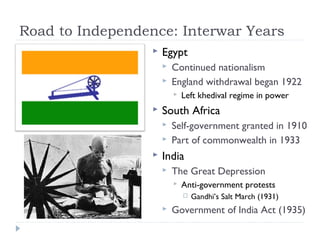
Road to Independence: Interwar Years
 Egypt
 Continued nationalism
 England withdrawal began 1922
 Left khedival regime in power
 South Africa
 Self-government granted in 1910
 Part of commonwealth in 1933
 India
 The Great Depression
 Anti-government protests
 Gandhi’s Salt March (1931)
 Government of India Act (1935)
Road to Independence: World War II
 Cost of Empire
 Need to rebuild home
country
 Declining support for
colonialism
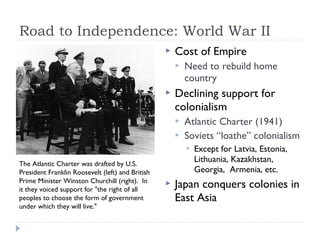
 Atlantic Charter (1941)
 Soviets “loathe” colonialism
 Except for Latvia, Estonia,
Lithuania, Kazakhstan,
Georgia, Armenia, etc.
 Japan conquers colonies in
East Asia
The Atlantic Charter was drafted by U.S.
President Franklin Roosevelt (left) and British
Prime Minister Winston Churchill (right). In
it they voiced support for "the right of all
peoples to choose the form of government
under which they will live."
Post-World War II Independence
 Three routes to independence
 Negotiated Independence
 Parts of Asia and Africa gained their independence without much
bloodshed
 India & Pakistan
 Japan & Korea
 Ghana & the Congo
 Incomplete Independence
 Places with sizeable settler populations or Cold War importance
struggled to gain their independence
 South Africa, Kenya, & Algeria
 Vietnam
 Civil War
 China resumed civil war between nationalists and communists
Negotiated Independence: India
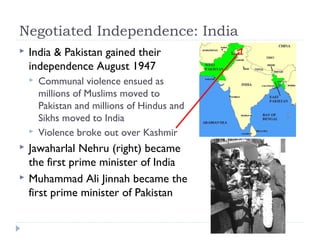
 India & Pakistan gained their
independence August 1947
 Communal violence ensued as
millions of Muslims moved to
Pakistan and millions of Hindus and
Sikhs moved to India
 Violence broke out over Kashmir
 Jawaharlal Nehru (right) became
the first prime minister of India
 Muhammad Ali Jinnah became the
first prime minister of Pakistan
Negotiated Independence: Japan
 United States occupied Japan from August 1945-1952
 Feared Soviets would influence Japan
 Japanese cooperated with the U.S.
 Political and social changes
 Military disbanded and military spending limited
 Shintoism was abolished as state religion
 New parliamentary system with constitution
 Women received the right to vote
 Large estates were divided and redistributed to farmers
 Zaibatsu combines were temporarily dissolved
Negotiated Independence: Korea, et al.
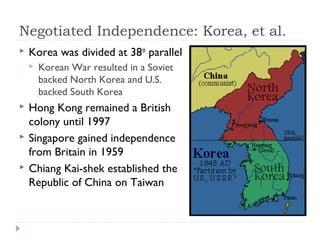
 Korea was divided at 38th
parallel
 Korean War resulted in a Soviet
backed North Korea and U.S.
backed South Korea
 Hong Kong remained a British
colony until 1997
 Singapore gained independence
from Britain in 1959
 Chiang Kai-shek established the
Republic of China on Taiwan
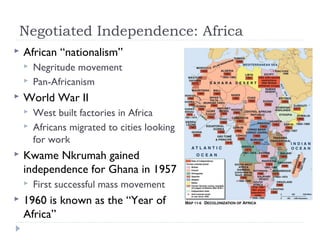
Negotiated Independence: Africa
 African “nationalism”
 Negritude movement
 Pan-Africanism
 World War II
 West built factories in Africa
 Africans migrated to cities looking
for work
 Kwame Nkrumah gained
independence for Ghana in 1957
 First successful mass movement
 1960 is known as the “Year of
Africa”
Incomplete Independence: South Africa
 Gained home rule in 1910
 Had over 4 million white residents
 Denied civil rights to black population
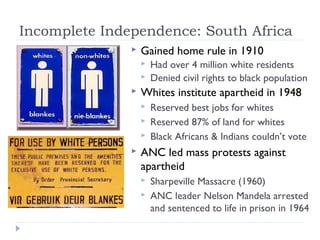
 Whites institute apartheid in 1948
 Reserved best jobs for whites
 Reserved 87% of land for whites
 Black Africans & Indians couldn’t vote
 ANC led mass protests against
apartheid
 Sharpeville Massacre (1960)
 ANC leader Nelson Mandela arrested
and sentenced to life in prison in 1964
Incomplete Independence: South Africa
 Black protests of apartheid
increased in the 1980s
 Bishop Desmond Tutu encouraged
international embargo of South Africa
 Gained worldwide attention due to
TV
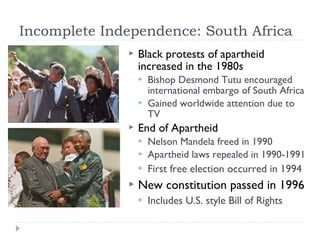
 End of Apartheid
 Nelson Mandela freed in 1990
 Apartheid laws repealed in 1990-1991
 First free election occurred in 1994
 New constitution passed in 1996
 Includes U.S. style Bill of Rights
Incomplete Independence: Kenya
 White coffee planters felt
ethnic Kenyans were not
ready for self-government
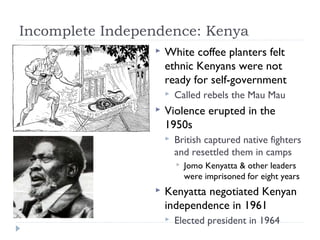
 Called rebels the Mau Mau
 Violence erupted in the
1950s
 British captured native fighters
and resettled them in camps
 Jomo Kenyatta & other leaders
were imprisoned for eight years
 Kenyatta negotiated Kenyan
independence in 1961
 Elected president in 1964
Incomplete Independence: Algeria
 Algeria was viewed as an extension of France
 One million settlers created a maintain at all costs attitude
 France dependent upon Algerian oil & gas fields and vineyards
 National Liberation Front (FLN) made up of Berbers and
Arabs demanded independence
 Settlers and rich Arabs and Berbers continue fight against
the FLN
 Form the Secret Army Organization (OAS)
 After 8 years of violence and thousand of casualties,
France eventually negotiated independence in 1962
 Millions of French settlers and wealthy Arabs and Berbers
emigrated to France
Incomplete Independence: Vietnam
 World War II
 Viet Minh (communists) successfully
resisted Japanese occupation
 Provided assistance during famine
 Instituted communist reforms
 Ho Chi Minh declared Vietnam
independent from France in 1945
 French refused to recognize
independence and tried to
reoccupy the region
 Defeat the French at Dien Bien Phu
in 1954
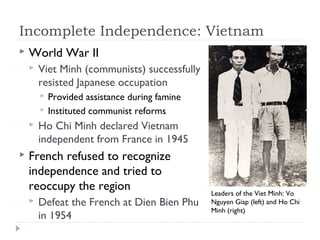
Leaders of the Viet Minh: Vo
Nguyen Giap (left) and Ho Chi
Minh (right)
Vietnam War (1954-1973)
 France leaves after being defeated at Dien Bien Phu
 Ho Chi Minh agrees to divide Vietnam into two parts
 Communists dominated northern Vietnam
 Elections were promised within two years to decide who
should rule a united Vietnam
 U.S. sends in “advisors” to help South Vietnam in 1954
 U.S. viewed conflict as part of the Cold War
 U.S. supported anti-communist dictator Ngo Dinh Diem
 Diem attempted to suppress communists in South Vietnam
 Viet Minh (Viet Cong) sent military supplies to aid southern
communists (National Liberation Front)
Vietnam War (1954-1973)
 Richard Nixon continued to
escalate U.S. presence in
Vietnam
 Resort to carpet bombing &
chemical warfare
 Some historian argue the bombing
of Cambodia triggered the Khmer
Rouge
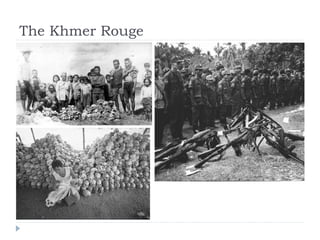
 Pol Pot killed approximately 20% of
the Cambodian population
 U.S. ended involvement in 1973
 Communists unite Vietnam in
1975
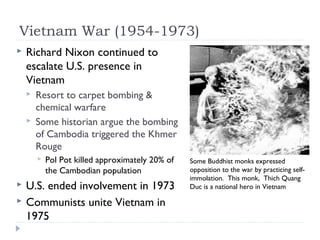
Some Buddhist monks expressed
opposition to the war by practicing self-
immolation. This monk, Thich Quang
Duc is a national hero in Vietnam
The Khmer Rouge
Africa & Asia After Independence
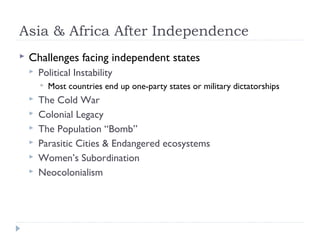
Asia & Africa After Independence
 Challenges facing independent states
 Political Instability
 Most countries end up one-party states or military dictatorships
 The Cold War
 Colonial Legacy
 The Population “Bomb”
 Parasitic Cities & Endangered ecosystems
 Women’s Subordination
 Neocolonialism
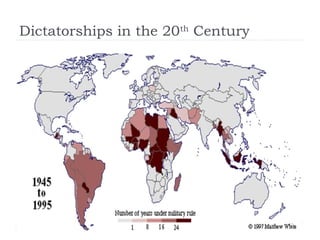
Dictatorships in the 20th
Century
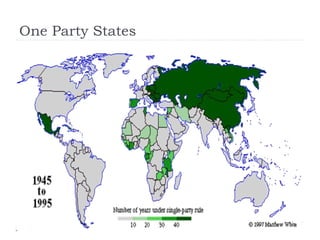
One Party States
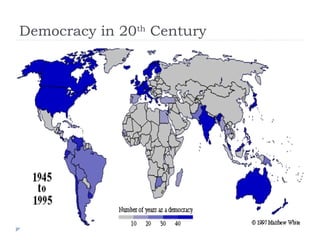
Democracy in 20th
Century
Military Dictatorships
 Why military dictatorships?
 Military is more resistant to
religious and ethnic rivalries
 Military used to suppress ethnic
and religious tensions
 A monopoly of force
 A degree of technical training
 Most are staunchly
anticommunist
 Military dictatorships often
bring political stability but
economic development is rare
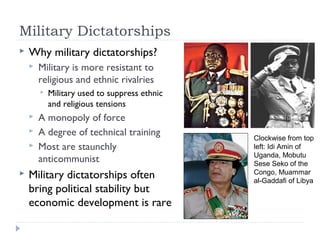
Clockwise from top
left: Idi Amin of
Uganda, Mobutu
Sese Seko of the
Congo, Muammar
al-Gaddafi of Libya
Military Dictatorship: Egypt
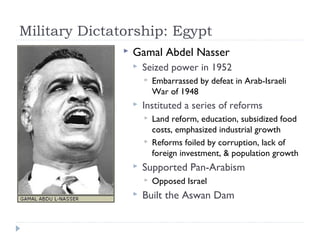
 Gamal Abdel Nasser
 Seized power in 1952
 Embarrassed by defeat in Arab-Israeli
War of 1948
 Instituted a series of reforms
 Land reform, education, subsidized food
costs, emphasized industrial growth
 Reforms foiled by corruption, lack of
foreign investment, & population growth
 Supported Pan-Arabism
 Opposed Israel
 Built the Aswan Dam
One-Party State: Ghana
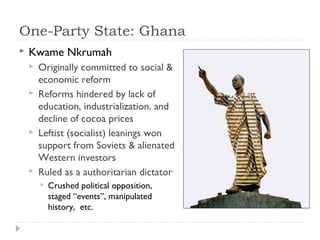
 Kwame Nkrumah
 Originally committed to social &
economic reform
 Reforms hindered by lack of
education, industrialization, and
decline of cocoa prices
 Leftist (socialist) leanings won
support from Soviets & alienated
Western investors
 Ruled as a authoritarian dictator
 Crushed political opposition,
staged “events”, manipulated
history, etc.
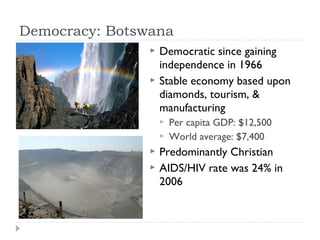
Democracy: Botswana
 Democratic since gaining
independence in 1966
 Stable economy based upon
diamonds, tourism, &
manufacturing
 Per capita GDP: $12,500
 World average: $7,400
 Predominantly Christian
 AIDS/HIV rate was 24% in
2006
Democracy: India
 Advantages
 Military defends secular democracy
 Came to independence with a larger industrial and scientific
center, better communication systems, and a larger, more
skilled middle class
 Disadvantages
 Population growth, poverty, unemployment, religious & ethnic
diversity, and natural disasters
 Military conflicts with Pakistan over Kashmir
 Early Government
 Reforms to help lower castes and women
 Spearheaded the nonalignment movement
Democracy: India
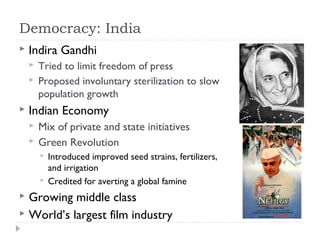
 Indira Gandhi
 Tried to limit freedom of press
 Proposed involuntary sterilization to slow
population growth
 Indian Economy
 Mix of private and state initiatives
 Green Revolution
 Introduced improved seed strains, fertilizers,
and irrigation
 Credited for averting a global famine
 Growing middle class
 World’s largest film industry
The Cold War
 U.S. and Soviet Union attempted to influence new states
 Bandung Conference 1955
 Conference participants claimed to be “non-aligned”
 Nasser and Nkrumah attended the conference
 Many independence movements received help from the
Soviet Union or Cuba
 United States often interfered in these nations
 The Congo and the Cold War
 Nkrumah overthrown by C.I.A. in 1966
 Proxy wars fueled ethnic tension & genocide
 Hutus in Rwanda massacred 750,000 ethnic Tutsis in 1995
Colonial Legacy
 All new nations were “artificial nations”
 European colonial boundaries rarely took into account the
ethnicities, interests, and histories of the people
 European control often intensified existing divisions
 Minority Tutsi were favored over the majority Hutu in Rwanda
 Europe often “cut-and-run” at the end of colonial rule
 Often led to ethnic strife in new nations
 India, Nigeria, the Congo, Palestine, etc.
 Pakistan quickly divided into two nations – Pakistan & Bangladesh
 New rulers create a national identity
 Separatist movements emerged and led to civil war in Morocco,
India, the Sudan, & Nigeria
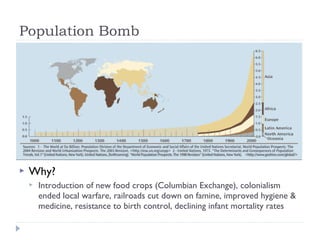
Population Bomb
 Why?
 Introduction of new food crops (Columbian Exchange), colonialism
ended local warfare, railroads cut down on famine, improved hygiene &
medicine, resistance to birth control, declining infant mortality rates
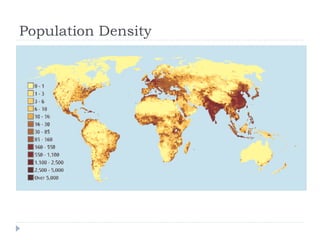
Population Density
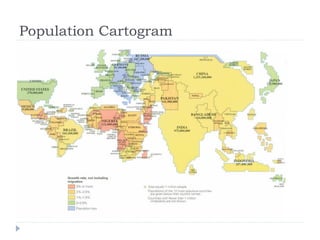
Population Cartogram
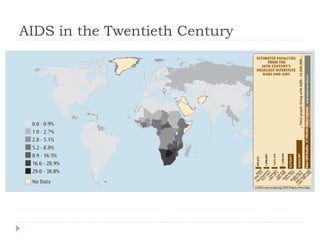
AIDS in the Twentieth Century
Parasitic Cities
 Massive post-independence urbanization occurred in
most countries
 No expanding industrial centers meant few jobs & low wages
 Urban poor could become politically volatile
 Little or no urban planning
 Slum areas with no electricity, running water, or basic sewage
 Cities are not productive thus “parasitic”
 Puts pressure on rural areas
 Draw food and resources from depleted countryside
 Contributes to soil depletion, deforestation, desertification,
etc.
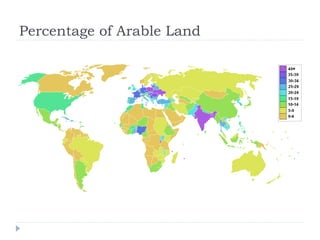
Percentage of Arable Land
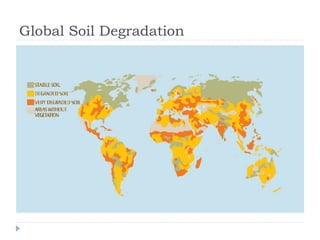
Global Soil Degradation
Women’s Subordination
 New nations often supported women’s suffrage, equal
legal rights, education, & occupational opportunities (in
theory)
 In reality, most societies remained patriarchal
 Men dominated most political positions
 Prominent female leaders were often related to powerful men
 Indira Gandhi, Benazir Bhutto, Corazon Aquino
 Arranged marriages, early marriage ages, and large families
 Dietary customs increase chances of malnutrition
 Female infanticide is common in many places
 China, India, East Africa
 Religious revivalism erodes women’s rights
 Saudi Arabia, Afghanistan, India, the Sudan
Neocolonialism
 Most nations continued to rely upon trading cash crops
or raw materials to industrialized nations in return for
manufactured goods
 Price of commodities (cash crops and minerals) often fluctuate
 One or two bad years could destroy an emerging nation’s economy
 Some organizations have been formed to limit fluctuation
 OPEC – Organization of Petroleum Exporting Countries
 Government corruption and lack of reforms also
contribute to neocolonialism
 Nations turn to international organizations or industrial
nations for help
 International Monetary Fund (IMF) or the World Bank
Middle East after World War II
Arab Independence
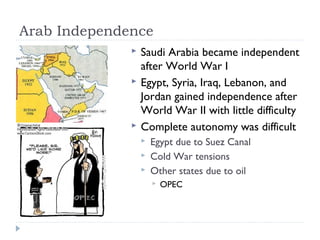
 Saudi Arabia became independent
after World War I
 Egypt, Syria, Iraq, Lebanon, and
Jordan gained independence after
World War II with little difficulty
 Complete autonomy was difficult
 Egypt due to Suez Canal
 Cold War tensions
 Other states due to oil
 OPEC
Creation of Israel
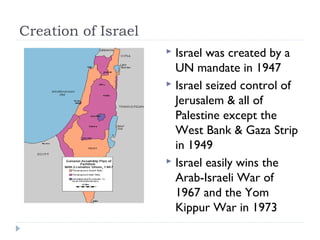
 Israel was created by a
UN mandate in 1947
 Israel seized control of
Jerusalem & all of
Palestine except the
West Bank & Gaza Strip
in 1949
 Israel easily wins the
Arab-Israeli War of
1967 and the Yom
Kippur War in 1973
Arab Nationalism
 Problems facing Arab nationalism
 Cold War splits nations as some allied with the U.S. and
others the USSR
 Differing government types (monarchy, military dictatorships,
Islamic revolutionary)
 Sunni-Shi’a split
 Anwar Sadat facilitated peace process between Arab
world & Israel (1978-1980)
 His reward? He was assassinated in 1981
 Sadat’s assassination made Saddam Hussein leader of the
Arab world
Palestinian Liberation Organization
 Created in 1964 by Yasser
Arafat to promote
Palestinian rights
 Often resorted to
“terrorism” against Israel
 Negotiated limited
Palestinian self-rule in 1993
and 1995
 PLO was replaced by Hamas
as the leading anti-Israeli
organization in Palestine
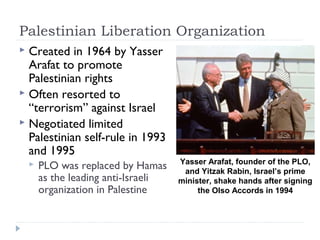
Yasser Arafat, founder of the PLO,
and Yitzak Rabin, Israel’s prime
minister, shake hands after signing
the Olso Accords in 1994
Iranian Revolution
 Preliminary Phase
 Iran was never colonized
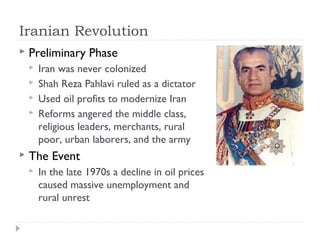
 Shah Reza Pahlavi ruled as a dictator
 Used oil profits to modernize Iran
 Reforms angered the middle class,
religious leaders, merchants, rural
poor, urban laborers, and the army
 The Event
 In the late 1970s a decline in oil prices
caused massive unemployment and
rural unrest
Iranian Revolution
 Initial Phase
 Sit-ins, riots, urban protests
 Government exiled religious leaders
 Military was unwilling to defend the
Shah
 Radical Phase
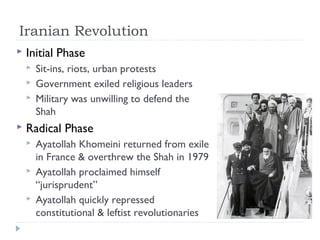
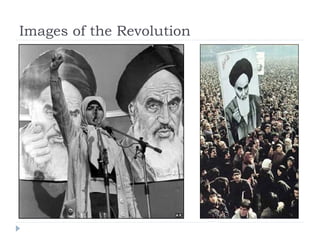
 Ayatollah Khomeini returned from exile
in France & overthrew the Shah in 1979
 Ayatollah proclaimed himself
“jurisprudent”
 Ayatollah quickly repressed
constitutional & leftist revolutionaries
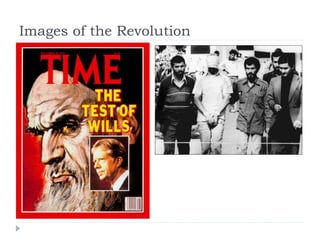
Images of the Revolution
Recovery Phase
 Shiite Fundamentalism
 Purge Iran of the “satanic” influences of the U.S. & Europe
 Banned alcohol, coeducational classrooms, mixed swimming, &
western entertainment
 Institute Sharia law
 Iran Hostage Crisis
 Iranians stormed the U.S. embassy taking 70 Americans captive
 Government Reforms
 Nationalized banks, insurance companies, & large farms
 Attempts at land reform and economic development
were minimal due to the Iran – Iraq War (1980-1988)

Asia africa20th

  • 1.
    Asia and Africain the 20th Century
  • 2.
  • 3.
    Road to Independence Pre-World War I  Nationalism  Indian National Congress & Muslim League  Egyptian Nationalism  Dinshawai Incident  “Save the King” movement in Vietnam  Violence  Boer Wars  Islamic Fundamentalism  the Mahdi in Egypt  Guerilla Warfare in Vietnam Top: The members of the 1st Indian National Congress Bottom: Muhammad Ahmad “the Mahdi”
  • 4.
    Road to Independence:World War I  Promises of Self-Determination  India wanted self-government  Rowlatt Act (1920)  Arabs wanted independence  Mandate System (right)  Balfour Declaration  Locals fill colonial posts  Economic strain of the war  Treaty of Versailles  Increased nationalism  Gandhi and satyagraha  Ho Chi Minh  May Fourth Movement
  • 5.
    Road to Independence:Interwar Years  Egypt  Continued nationalism  England withdrawal began 1922  Left khedival regime in power  South Africa  Self-government granted in 1910  Part of commonwealth in 1933  India  The Great Depression  Anti-government protests  Gandhi’s Salt March (1931)  Government of India Act (1935)
  • 6.
    Road to Independence:World War II  Cost of Empire  Need to rebuild home country  Declining support for colonialism  Atlantic Charter (1941)  Soviets “loathe” colonialism  Except for Latvia, Estonia, Lithuania, Kazakhstan, Georgia, Armenia, etc.  Japan conquers colonies in East Asia The Atlantic Charter was drafted by U.S. President Franklin Roosevelt (left) and British Prime Minister Winston Churchill (right). In it they voiced support for "the right of all peoples to choose the form of government under which they will live."
  • 7.
    Post-World War IIIndependence  Three routes to independence  Negotiated Independence  Parts of Asia and Africa gained their independence without much bloodshed  India & Pakistan  Japan & Korea  Ghana & the Congo  Incomplete Independence  Places with sizeable settler populations or Cold War importance struggled to gain their independence  South Africa, Kenya, & Algeria  Vietnam  Civil War  China resumed civil war between nationalists and communists
  • 8.
    Negotiated Independence: India India & Pakistan gained their independence August 1947  Communal violence ensued as millions of Muslims moved to Pakistan and millions of Hindus and Sikhs moved to India  Violence broke out over Kashmir  Jawaharlal Nehru (right) became the first prime minister of India  Muhammad Ali Jinnah became the first prime minister of Pakistan
  • 9.
    Negotiated Independence: Japan United States occupied Japan from August 1945-1952  Feared Soviets would influence Japan  Japanese cooperated with the U.S.  Political and social changes  Military disbanded and military spending limited  Shintoism was abolished as state religion  New parliamentary system with constitution  Women received the right to vote  Large estates were divided and redistributed to farmers  Zaibatsu combines were temporarily dissolved
  • 10.
    Negotiated Independence: Korea,et al.  Korea was divided at 38th parallel  Korean War resulted in a Soviet backed North Korea and U.S. backed South Korea  Hong Kong remained a British colony until 1997  Singapore gained independence from Britain in 1959  Chiang Kai-shek established the Republic of China on Taiwan
  • 11.
    Negotiated Independence: Africa African “nationalism”  Negritude movement  Pan-Africanism  World War II  West built factories in Africa  Africans migrated to cities looking for work  Kwame Nkrumah gained independence for Ghana in 1957  First successful mass movement  1960 is known as the “Year of Africa”
  • 12.
    Incomplete Independence: SouthAfrica  Gained home rule in 1910  Had over 4 million white residents  Denied civil rights to black population  Whites institute apartheid in 1948  Reserved best jobs for whites  Reserved 87% of land for whites  Black Africans & Indians couldn’t vote  ANC led mass protests against apartheid  Sharpeville Massacre (1960)  ANC leader Nelson Mandela arrested and sentenced to life in prison in 1964
  • 13.
    Incomplete Independence: SouthAfrica  Black protests of apartheid increased in the 1980s  Bishop Desmond Tutu encouraged international embargo of South Africa  Gained worldwide attention due to TV  End of Apartheid  Nelson Mandela freed in 1990  Apartheid laws repealed in 1990-1991  First free election occurred in 1994  New constitution passed in 1996  Includes U.S. style Bill of Rights
  • 14.
    Incomplete Independence: Kenya White coffee planters felt ethnic Kenyans were not ready for self-government  Called rebels the Mau Mau  Violence erupted in the 1950s  British captured native fighters and resettled them in camps  Jomo Kenyatta & other leaders were imprisoned for eight years  Kenyatta negotiated Kenyan independence in 1961  Elected president in 1964
  • 15.
    Incomplete Independence: Algeria Algeria was viewed as an extension of France  One million settlers created a maintain at all costs attitude  France dependent upon Algerian oil & gas fields and vineyards  National Liberation Front (FLN) made up of Berbers and Arabs demanded independence  Settlers and rich Arabs and Berbers continue fight against the FLN  Form the Secret Army Organization (OAS)  After 8 years of violence and thousand of casualties, France eventually negotiated independence in 1962  Millions of French settlers and wealthy Arabs and Berbers emigrated to France
  • 16.
    Incomplete Independence: Vietnam World War II  Viet Minh (communists) successfully resisted Japanese occupation  Provided assistance during famine  Instituted communist reforms  Ho Chi Minh declared Vietnam independent from France in 1945  French refused to recognize independence and tried to reoccupy the region  Defeat the French at Dien Bien Phu in 1954 Leaders of the Viet Minh: Vo Nguyen Giap (left) and Ho Chi Minh (right)
  • 17.
    Vietnam War (1954-1973) France leaves after being defeated at Dien Bien Phu  Ho Chi Minh agrees to divide Vietnam into two parts  Communists dominated northern Vietnam  Elections were promised within two years to decide who should rule a united Vietnam  U.S. sends in “advisors” to help South Vietnam in 1954  U.S. viewed conflict as part of the Cold War  U.S. supported anti-communist dictator Ngo Dinh Diem  Diem attempted to suppress communists in South Vietnam  Viet Minh (Viet Cong) sent military supplies to aid southern communists (National Liberation Front)
  • 18.
    Vietnam War (1954-1973) Richard Nixon continued to escalate U.S. presence in Vietnam  Resort to carpet bombing & chemical warfare  Some historian argue the bombing of Cambodia triggered the Khmer Rouge  Pol Pot killed approximately 20% of the Cambodian population  U.S. ended involvement in 1973  Communists unite Vietnam in 1975 Some Buddhist monks expressed opposition to the war by practicing self- immolation. This monk, Thich Quang Duc is a national hero in Vietnam
  • 19.
  • 20.
    Africa & AsiaAfter Independence
  • 21.
    Asia & AfricaAfter Independence  Challenges facing independent states  Political Instability  Most countries end up one-party states or military dictatorships  The Cold War  Colonial Legacy  The Population “Bomb”  Parasitic Cities & Endangered ecosystems  Women’s Subordination  Neocolonialism
  • 22.
  • 23.
  • 24.
  • 25.
    Military Dictatorships  Whymilitary dictatorships?  Military is more resistant to religious and ethnic rivalries  Military used to suppress ethnic and religious tensions  A monopoly of force  A degree of technical training  Most are staunchly anticommunist  Military dictatorships often bring political stability but economic development is rare Clockwise from top left: Idi Amin of Uganda, Mobutu Sese Seko of the Congo, Muammar al-Gaddafi of Libya
  • 26.
    Military Dictatorship: Egypt Gamal Abdel Nasser  Seized power in 1952  Embarrassed by defeat in Arab-Israeli War of 1948  Instituted a series of reforms  Land reform, education, subsidized food costs, emphasized industrial growth  Reforms foiled by corruption, lack of foreign investment, & population growth  Supported Pan-Arabism  Opposed Israel  Built the Aswan Dam
  • 27.
    One-Party State: Ghana Kwame Nkrumah  Originally committed to social & economic reform  Reforms hindered by lack of education, industrialization, and decline of cocoa prices  Leftist (socialist) leanings won support from Soviets & alienated Western investors  Ruled as a authoritarian dictator  Crushed political opposition, staged “events”, manipulated history, etc.
  • 28.
    Democracy: Botswana  Democraticsince gaining independence in 1966  Stable economy based upon diamonds, tourism, & manufacturing  Per capita GDP: $12,500  World average: $7,400  Predominantly Christian  AIDS/HIV rate was 24% in 2006
  • 29.
    Democracy: India  Advantages Military defends secular democracy  Came to independence with a larger industrial and scientific center, better communication systems, and a larger, more skilled middle class  Disadvantages  Population growth, poverty, unemployment, religious & ethnic diversity, and natural disasters  Military conflicts with Pakistan over Kashmir  Early Government  Reforms to help lower castes and women  Spearheaded the nonalignment movement
  • 30.
    Democracy: India  IndiraGandhi  Tried to limit freedom of press  Proposed involuntary sterilization to slow population growth  Indian Economy  Mix of private and state initiatives  Green Revolution  Introduced improved seed strains, fertilizers, and irrigation  Credited for averting a global famine  Growing middle class  World’s largest film industry
  • 31.
    The Cold War U.S. and Soviet Union attempted to influence new states  Bandung Conference 1955  Conference participants claimed to be “non-aligned”  Nasser and Nkrumah attended the conference  Many independence movements received help from the Soviet Union or Cuba  United States often interfered in these nations  The Congo and the Cold War  Nkrumah overthrown by C.I.A. in 1966  Proxy wars fueled ethnic tension & genocide  Hutus in Rwanda massacred 750,000 ethnic Tutsis in 1995
  • 32.
    Colonial Legacy  Allnew nations were “artificial nations”  European colonial boundaries rarely took into account the ethnicities, interests, and histories of the people  European control often intensified existing divisions  Minority Tutsi were favored over the majority Hutu in Rwanda  Europe often “cut-and-run” at the end of colonial rule  Often led to ethnic strife in new nations  India, Nigeria, the Congo, Palestine, etc.  Pakistan quickly divided into two nations – Pakistan & Bangladesh  New rulers create a national identity  Separatist movements emerged and led to civil war in Morocco, India, the Sudan, & Nigeria
  • 33.
    Population Bomb  Why? Introduction of new food crops (Columbian Exchange), colonialism ended local warfare, railroads cut down on famine, improved hygiene & medicine, resistance to birth control, declining infant mortality rates
  • 34.
  • 35.
  • 36.
    AIDS in theTwentieth Century
  • 37.
    Parasitic Cities  Massivepost-independence urbanization occurred in most countries  No expanding industrial centers meant few jobs & low wages  Urban poor could become politically volatile  Little or no urban planning  Slum areas with no electricity, running water, or basic sewage  Cities are not productive thus “parasitic”  Puts pressure on rural areas  Draw food and resources from depleted countryside  Contributes to soil depletion, deforestation, desertification, etc.
  • 38.
  • 39.
  • 40.
    Women’s Subordination  Newnations often supported women’s suffrage, equal legal rights, education, & occupational opportunities (in theory)  In reality, most societies remained patriarchal  Men dominated most political positions  Prominent female leaders were often related to powerful men  Indira Gandhi, Benazir Bhutto, Corazon Aquino  Arranged marriages, early marriage ages, and large families  Dietary customs increase chances of malnutrition  Female infanticide is common in many places  China, India, East Africa  Religious revivalism erodes women’s rights  Saudi Arabia, Afghanistan, India, the Sudan
  • 41.
    Neocolonialism  Most nationscontinued to rely upon trading cash crops or raw materials to industrialized nations in return for manufactured goods  Price of commodities (cash crops and minerals) often fluctuate  One or two bad years could destroy an emerging nation’s economy  Some organizations have been formed to limit fluctuation  OPEC – Organization of Petroleum Exporting Countries  Government corruption and lack of reforms also contribute to neocolonialism  Nations turn to international organizations or industrial nations for help  International Monetary Fund (IMF) or the World Bank
  • 42.
    Middle East afterWorld War II
  • 43.
    Arab Independence  SaudiArabia became independent after World War I  Egypt, Syria, Iraq, Lebanon, and Jordan gained independence after World War II with little difficulty  Complete autonomy was difficult  Egypt due to Suez Canal  Cold War tensions  Other states due to oil  OPEC
  • 44.
    Creation of Israel Israel was created by a UN mandate in 1947  Israel seized control of Jerusalem & all of Palestine except the West Bank & Gaza Strip in 1949  Israel easily wins the Arab-Israeli War of 1967 and the Yom Kippur War in 1973
  • 45.
    Arab Nationalism  Problemsfacing Arab nationalism  Cold War splits nations as some allied with the U.S. and others the USSR  Differing government types (monarchy, military dictatorships, Islamic revolutionary)  Sunni-Shi’a split  Anwar Sadat facilitated peace process between Arab world & Israel (1978-1980)  His reward? He was assassinated in 1981  Sadat’s assassination made Saddam Hussein leader of the Arab world
  • 46.
    Palestinian Liberation Organization Created in 1964 by Yasser Arafat to promote Palestinian rights  Often resorted to “terrorism” against Israel  Negotiated limited Palestinian self-rule in 1993 and 1995  PLO was replaced by Hamas as the leading anti-Israeli organization in Palestine Yasser Arafat, founder of the PLO, and Yitzak Rabin, Israel’s prime minister, shake hands after signing the Olso Accords in 1994
  • 47.
    Iranian Revolution  PreliminaryPhase  Iran was never colonized  Shah Reza Pahlavi ruled as a dictator  Used oil profits to modernize Iran  Reforms angered the middle class, religious leaders, merchants, rural poor, urban laborers, and the army  The Event  In the late 1970s a decline in oil prices caused massive unemployment and rural unrest
  • 48.
    Iranian Revolution  InitialPhase  Sit-ins, riots, urban protests  Government exiled religious leaders  Military was unwilling to defend the Shah  Radical Phase  Ayatollah Khomeini returned from exile in France & overthrew the Shah in 1979  Ayatollah proclaimed himself “jurisprudent”  Ayatollah quickly repressed constitutional & leftist revolutionaries
  • 49.
    Images of theRevolution
  • 50.
    Images of theRevolution
  • 51.
    Recovery Phase  ShiiteFundamentalism  Purge Iran of the “satanic” influences of the U.S. & Europe  Banned alcohol, coeducational classrooms, mixed swimming, & western entertainment  Institute Sharia law  Iran Hostage Crisis  Iranians stormed the U.S. embassy taking 70 Americans captive  Government Reforms  Nationalized banks, insurance companies, & large farms  Attempts at land reform and economic development were minimal due to the Iran – Iraq War (1980-1988)