GRAVITATION
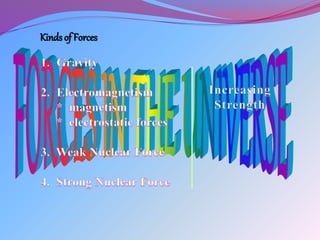
Kinds of Forces
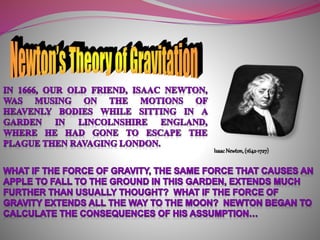
IsaacNewton, (1642-1727)
+ 38
10
ForcenalGravitatio
ForceneticElectromag

proton
electron
rˆ
r
mm
GF 2
21


r
MmG
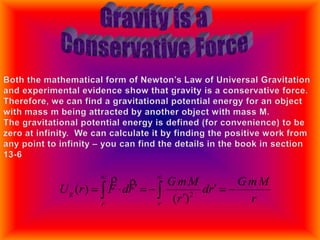
)r(Ug 
1.Newton’s Law of Universal Gravitation
2.Gravitational Potential Energy (long-range form)
r
MmG
rd
r
MmG
rdFrU
rr
g 



 2
)(
)(

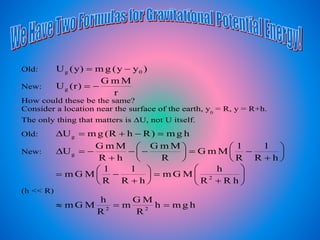
Old: )yy(gm)y(U 0g 
New:
r
MmG
)r(Ug 
How could these be the same?
Consider a location near the surface of the earth, y0
= R, y = R+h.
The only thing that matters is U, not U itself.
Old: hgm)RhR(gmUg +
New: 





+







+

hR
1
R
1
MmG
R
MmG
hR
MmG
Ug






+






+

hRR
h
MGm
hR
1
R
1
MGm 2
(h << R)
hgmh
R
MG
m
R
h
MGm 22

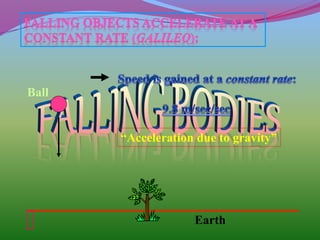
“Acceleration due to gravity”
Ball
Earth
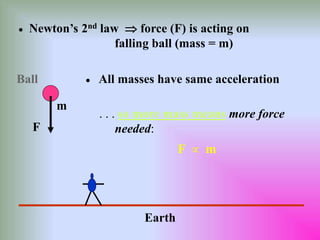
 Newton’s 2nd law  force (F) is acting on
falling ball (mass = m)
 All masses have same acceleration
. . . so more mass means more force
needed:
mF 
F
m
Ball
Earth
F
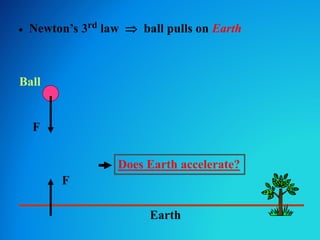
 Newton’s 3rd law  ball pulls on Earth
Ball
F
Does Earth accelerate?
Earth
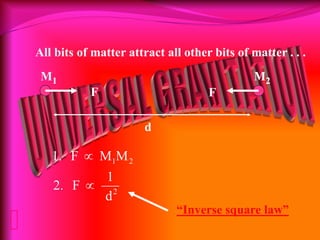
All bits of matter attract all other bits of matter . . .
M1 M2
d
F F
“Inverse square law”
d
1
F2.
MMF1.
2
21


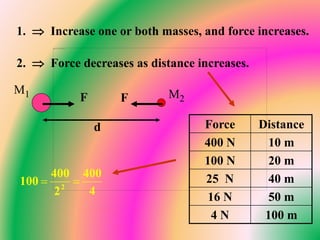
1.  Increase one or both masses, and force increases.
2.  Force decreases as distance increases.
Force Distance
400 N 10 m
100 N 20 m
25 N 40 m
16 N 50 m
4 N 100 m
d
M1 M2F F
4
400
2
400
100 2

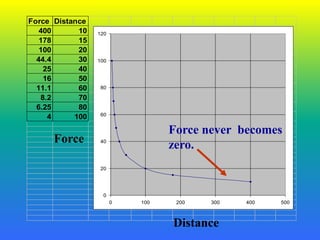
Force Distance
400 10
178 15
100 20
44.4 30
25 40
16 50
11.1 60
8.2 70
6.25 80
4 100
0
20
40
60
80
100
120
0 100 200 300 400 500
Distance
Force
Force never becomes
zero.
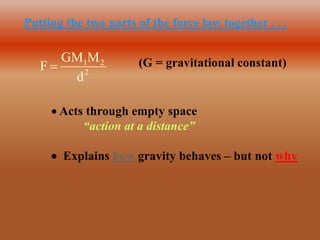
Putting the two parts of the force law together . . .
2
21
d
MGM
F  (G = gravitational constant)
 Acts through empty space
“action at a distance”
 Explains how gravity behaves – but not why
p. 83
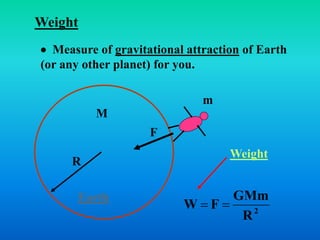
Weight
 Measure of gravitational attraction of Earth
(or any other planet) for you.
Earth
R
F
m
M
Weight
2
R
GMm
FW 
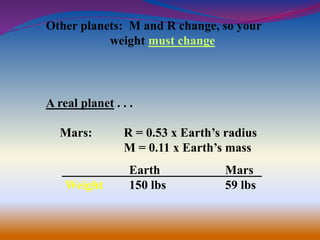
Other planets: M and R change, so your
weight must change
Mars: R = 0.53 x Earth’s radius
M = 0.11 x Earth’s mass
Earth Mars
Weight 150 lbs 59 lbs
A real planet . . .
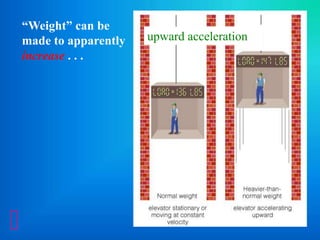
“Weight” can be
made to apparently
increase . . .
upward acceleration
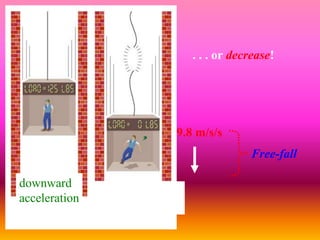
. . . or decrease!
downward
acceleration
“Weightlessness”
9.8 m/s/s
Free-fall
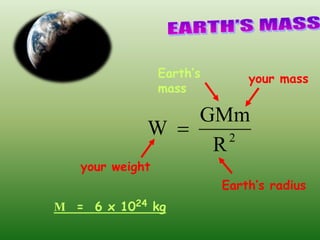
2
R
GMm
W 
your weight
your mass
Earth’s radius
Earth’s
mass
M = 6 x 1024 kg
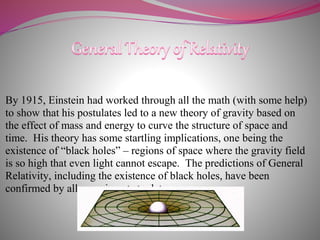
By 1915, Einstein had worked through all the math (with some help)
to show that his postulates led to a new theory of gravity based on
the effect of mass and energy to curve the structure of space and
time. His theory has some startling implications, one being the
existence of “black holes” – regions of space where the gravity field
is so high that even light cannot escape. The predictions of General
Relativity, including the existence of black holes, have been
confirmed by all experiments to date.
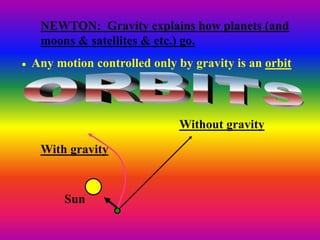
 Any motion controlled only by gravity is an orbit
Without gravity
With gravity
NEWTON: Gravity explains how planets (and
moons & satellites & etc.) go.
Sun
.
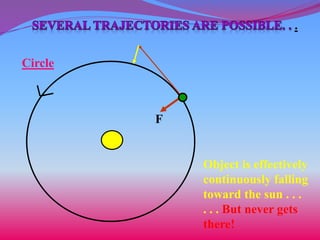
Object is effectively
continuously falling
toward the sun . . .
. . . But never gets
there!
Circle
F
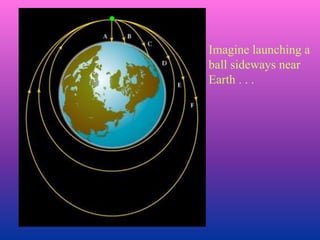
Imagine launching a
ball sideways near
Earth . . .
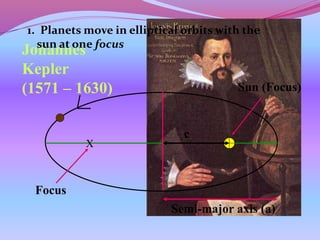
Johannes
Kepler
(1571 – 1630)
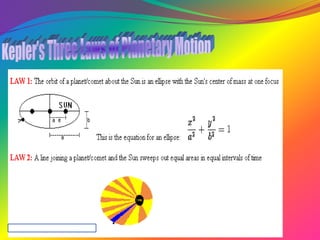
1. Planets move in elliptical orbits with the
sun at one focus
X
Sun (Focus)
Focus
Semi-major axis (a)
c
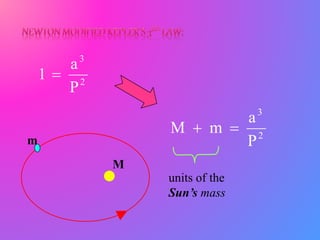
M
m
2
3
P
a
1 
2
3
P
a
mM +
units of the
Sun’s mass
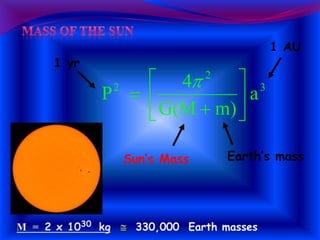
3
2
2
a
m)G(M
4
P 





+


1 yr
1 AU
Earth’s massSun’s Mass
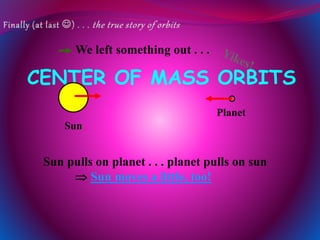
CENTER OF MASS ORBITS
We left something out . . .
Sun
Planet
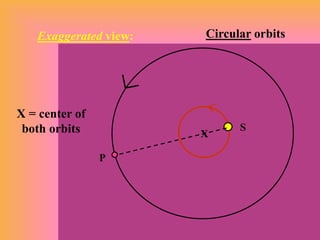
Sun pulls on planet . . . planet pulls on sun
 Sun moves a little, too!
Exaggerated view:
X
S
P
X = center of
both orbits
Circular orbits
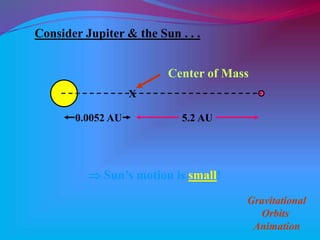
Consider Jupiter & the Sun . . .
X
5.2 AU0.0052 AU
 Sun’s motion is small!
Center of Mass
Gravitational
Orbits
Animation
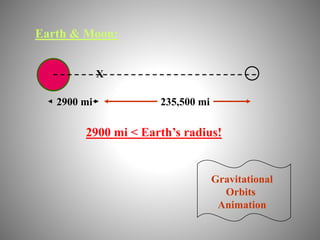
Earth & Moon:
X
2900 mi 235,500 mi
2900 mi < Earth’s radius!
Gravitational
Orbits
Animation
SHAILESH RAJ

SHAILESH RAJ

  • 1.
  • 2.
  • 3.
  • 4.
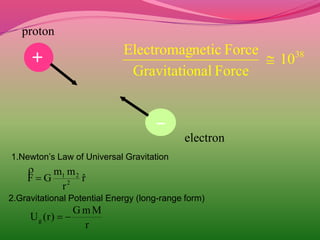
    + 38 10 ForcenalGravitatio ForceneticElectromag  proton electron rˆ r mm GF 2 21   r MmG )r(Ug 1.Newton’s Law of Universal Gravitation 2.Gravitational Potential Energy (long-range form)
  • 5.
  • 6.
    Old: )yy(gm)y(U 0g New: r MmG )r(Ug  How could these be the same? Consider a location near the surface of the earth, y0 = R, y = R+h. The only thing that matters is U, not U itself. Old: hgm)RhR(gmUg + New:       +        +  hR 1 R 1 MmG R MmG hR MmG Ug       +       +  hRR h MGm hR 1 R 1 MGm 2 (h << R) hgmh R MG m R h MGm 22 
  • 7.
    “Acceleration due togravity” Ball Earth
  • 8.
     Newton’s 2ndlaw  force (F) is acting on falling ball (mass = m)  All masses have same acceleration . . . so more mass means more force needed: mF  F m Ball Earth
  • 9.
    F  Newton’s 3rdlaw  ball pulls on Earth Ball F Does Earth accelerate? Earth
  • 10.
    All bits ofmatter attract all other bits of matter . . . M1 M2 d F F “Inverse square law” d 1 F2. MMF1. 2 21  
  • 11.
    1.  Increaseone or both masses, and force increases. 2.  Force decreases as distance increases. Force Distance 400 N 10 m 100 N 20 m 25 N 40 m 16 N 50 m 4 N 100 m d M1 M2F F 4 400 2 400 100 2 
  • 12.
    Force Distance 400 10 17815 100 20 44.4 30 25 40 16 50 11.1 60 8.2 70 6.25 80 4 100 0 20 40 60 80 100 120 0 100 200 300 400 500 Distance Force Force never becomes zero.
  • 13.
    Putting the twoparts of the force law together . . . 2 21 d MGM F  (G = gravitational constant)  Acts through empty space “action at a distance”  Explains how gravity behaves – but not why
  • 14.
  • 15.
    Weight  Measure ofgravitational attraction of Earth (or any other planet) for you. Earth R F m M Weight 2 R GMm FW 
  • 16.
    Other planets: Mand R change, so your weight must change Mars: R = 0.53 x Earth’s radius M = 0.11 x Earth’s mass Earth Mars Weight 150 lbs 59 lbs A real planet . . .
  • 17.
    “Weight” can be madeto apparently increase . . . upward acceleration
  • 18.
    . . .or decrease! downward acceleration “Weightlessness” 9.8 m/s/s Free-fall
  • 19.
    2 R GMm W  your weight yourmass Earth’s radius Earth’s mass M = 6 x 1024 kg
  • 20.
    By 1915, Einsteinhad worked through all the math (with some help) to show that his postulates led to a new theory of gravity based on the effect of mass and energy to curve the structure of space and time. His theory has some startling implications, one being the existence of “black holes” – regions of space where the gravity field is so high that even light cannot escape. The predictions of General Relativity, including the existence of black holes, have been confirmed by all experiments to date.
  • 21.
     Any motioncontrolled only by gravity is an orbit Without gravity With gravity NEWTON: Gravity explains how planets (and moons & satellites & etc.) go. Sun
  • 22.
    . Object is effectively continuouslyfalling toward the sun . . . . . . But never gets there! Circle F
  • 23.
    Imagine launching a ballsideways near Earth . . .
  • 24.
    Johannes Kepler (1571 – 1630) 1.Planets move in elliptical orbits with the sun at one focus X Sun (Focus) Focus Semi-major axis (a) c
  • 26.
  • 27.
  • 28.
    CENTER OF MASSORBITS We left something out . . . Sun Planet Sun pulls on planet . . . planet pulls on sun  Sun moves a little, too!
  • 29.
    Exaggerated view: X S P X =center of both orbits Circular orbits
  • 30.
    Consider Jupiter &the Sun . . . X 5.2 AU0.0052 AU  Sun’s motion is small! Center of Mass Gravitational Orbits Animation
  • 31.
    Earth & Moon: X 2900mi 235,500 mi 2900 mi < Earth’s radius! Gravitational Orbits Animation