Name: Dhananjay Kapse
Class: 9th
‘B’
Roll.No: 02
Sub: Science
Topic: Gravitation
Guided By: Tribhuvan Sir
Early Astronomy
As far as we know, humans have
always been interested in the motions of
objects in the sky.
Not only did early humans navigate by
means of the sky, but the motions of
objects in the sky predicted the changing
of the seasons, etc.
Early Astronomy
There were many early attempts
both to describe and explain the
motions of stars and planets in the
sky.
All were unsatisfactory, for one
reason or another.
Newton’s dreams
Hmmmmm
The Moon is in free-fall
around the Earth
It’s acceleration is only
1/3600 g (accel at the
Earth’s surface)
Newton’s
big idea
The force of gravity
gets weaker as
distance squaredThe moon is 60x
further from
the Earth’s center
than objects on
(near) the Earth’s
surface
The strength of
Earth’s gravity
near the Moon is
(1/60)2
t=1/3600
times weaker
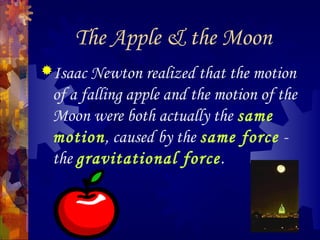
The Apple & the Moon
Isaac Newton realized that the motion
of a falling apple and the motion of the
Moon were both actually the same
motion, caused by the same force -
the gravitational force.
Universal Gravitation
Equation
This equation describes the force
between any two objects in the universe:
 In the equation:
 F is the force of gravity (measured in Newtons, N)
 G is the gravitational constant of the universe and
is always the same number
 M is the mass of one object (measured in
kilograms, kg)
 m is the mass of the other object (measured in
kilograms, kg)
 r is the distance those objects are apart (measured
in meters, m)
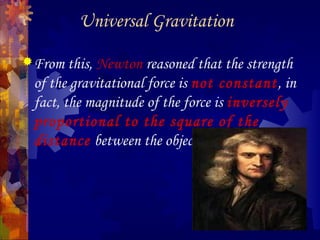
Universal Gravitation
From this, Newton reasoned that the strength
of the gravitational force is not constant, in
fact, the magnitude of the force is inversely
proportional to the square of the
distance between the objects.
Universal Gravitation
Newton’s idea was that gravity was a
universal force acting between any two
objects.
Universal law of gravity
m Mr
F ∝ m
F ∝ M
F ∝
1
r2
combine: F ∝
mM
r2 F = G
mM
r2
Proportionality constant:
“Newton’s Constant”
At the Earth’s Surface
Newton knew that the
gravitational force on the apple
equals the apple’s weight, mg,
where g = 9.8 m/s2
.
W = mg
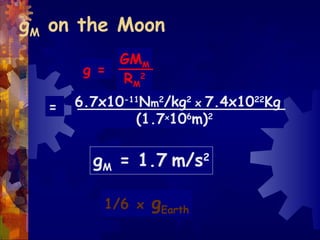
gM on the Moon
g =
GMM
RM
2
6.7x10⁻¹¹
Nm2
/kg2
x 7.4x1022
Kg
(1.7x
106
m)2
=
gM = 1.7 m/s2
1/6 x gEarth
Weight of the Moon
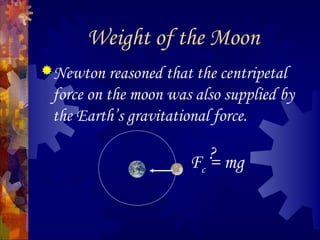
Newton reasoned that the centripetal
force on the moon was also supplied by
the Earth’s gravitational force.
Fc = mg?
Weight of the Moon
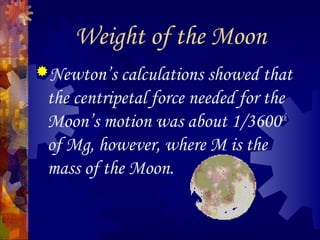
Newton’s calculations showed that
the centripetal force needed for the
Moon’s motion was about 1/3600th
of Mg, however, where M is the
mass of the Moon.
Weight of the Moon
Newton knew, though, that the
Moon was about 60 times
farther from the center of the
Earth than the apple.
And 602
= 3600
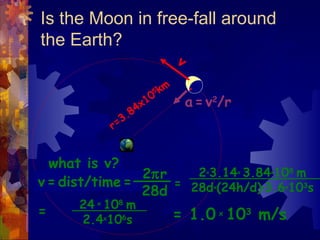
Is the Moon in free-fall around
the Earth?
r=3.84x10
5 km
v
a=v2
/r
what is v?
v = dist/time=
2πr
28d
=
2x
3.14x
3.84x
108
m
28dx
(24h/d)x
3.6x
103
s
=
24 x
108
m
2.4x
106
s = 1.0 x
103
m/s
Universal Gravitation
From this, Newton reasoned that
the strength of the gravitational
force is not constant, in fact, the
magnitude of the force is inversely
proportional to the square of
the distance between the objects.
Universal Gravitation
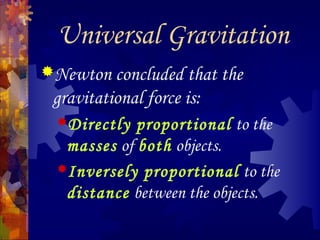
Newton concluded that the
gravitational force is:
Directly proportional to the
masses of both objects.
Inversely proportional to the
distance between the objects.
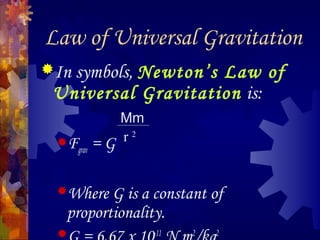
Law of Universal Gravitation
In symbols, Newton’s Law of
Universal Gravitation is:
Fgrav = G
Where G is a constant of
proportionality.
 -11 2 2
Mm
r 2
Inverse Square Law
Newton’s Law of Universal
Gravitation is often called an
inverse square law, since the
force is inversely proportional to
the square of the distance.
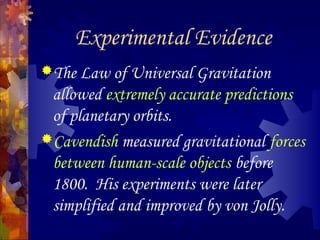
Experimental Evidence
The Law of Universal Gravitation
allowed extremely accurate predictions
of planetary orbits.
Cavendish measured gravitational forces
between human-scale objects before
1800. His experiments were later
simplified and improved by von Jolly.
Action at a Distance
In Newton’s time, there was much
discussion about HOW gravity worked -
how does the Sun, for instance, reach
across empty space, with no actual
contact at all, to exert a force on the
Earth?
This spooky notion was called “action at
a distance.”
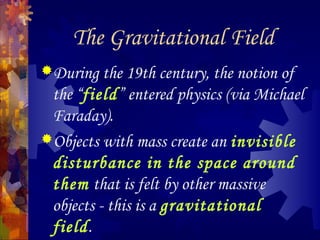
The Gravitational Field
During the 19th century, the notion of
the “field” entered physics (via Michael
Faraday).
Objects with mass create an invisible
disturbance in the space around
them that is felt by other massive
objects - this is a gravitational
field.
The Gravitational Field
So, since the Sun is very massive,
it creates an intense gravitational
field around it, and the Earth
responds to the field. No
more “action at a distance.”
Gravitational Field
Strength
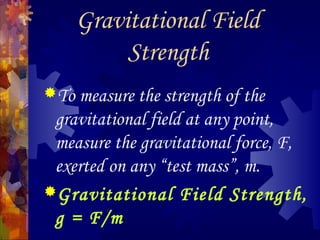
To measure the strength of the
gravitational field at any point,
measure the gravitational force, F,
exerted on any “test mass”, m.
Gravitational Field Strength,
g = F/m
Gravitational Field Strength
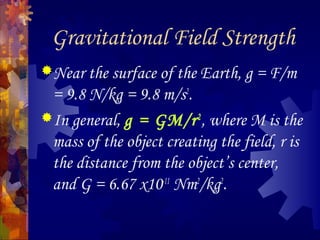
Near the surface of the Earth, g = F/m
= 9.8 N/kg = 9.8 m/s2
.
In general, g = GM/r2
, where M is the
mass of the object creating the field, r is
the distance from the object’s center,
and G = 6.67 x10⁻¹¹
Nm2
/kg2
.
Gravitational Force
If g is the strength of the gravitational
field at some point, then the
gravitational force on an object of mass
m at that point is Fgrav = mg.
If g is the gravitational field strength at
some point (in N/kg), then the free fall
acceleration at that point is also g (in
m/s2
).
Gravitational Field Inside a
Planet
If you are located a distance r from the
center of a planet:
 all of the planet’s mass inside a sphere of
radius r pulls you toward the center of the
planet.
All of the planet’s mass outside a sphere
of radius r exerts no net gravitational
force on you.
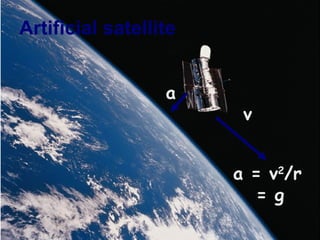
Artificial satellite
a
v
a = v2
/r
= g
Black Holes
When a very massive star gets old
and runs out of fusionable material,
gravitational forces may cause it to
collapse to a mathematical point - a
singularity. All normal matter is
crushed out of existence. This is a
black hole.
Black Hole Gravitational
Force
The black hole’s gravity is the same as
the original star’s at distances greater
than the star’s original radius.
Black hole’s don’t magically “suck
things in.”
The black hole’s gravity is intense
because you can get really, really close to
it!
The End

universal gravitation

  • 1.
    Name: Dhananjay Kapse Class:9th ‘B’ Roll.No: 02 Sub: Science Topic: Gravitation Guided By: Tribhuvan Sir
  • 3.
    Early Astronomy As faras we know, humans have always been interested in the motions of objects in the sky. Not only did early humans navigate by means of the sky, but the motions of objects in the sky predicted the changing of the seasons, etc.
  • 4.
    Early Astronomy There weremany early attempts both to describe and explain the motions of stars and planets in the sky. All were unsatisfactory, for one reason or another.
  • 5.
    Newton’s dreams Hmmmmm The Moonis in free-fall around the Earth It’s acceleration is only 1/3600 g (accel at the Earth’s surface)
  • 8.
    Newton’s big idea The forceof gravity gets weaker as distance squaredThe moon is 60x further from the Earth’s center than objects on (near) the Earth’s surface The strength of Earth’s gravity near the Moon is (1/60)2 t=1/3600 times weaker
  • 9.
    The Apple &the Moon Isaac Newton realized that the motion of a falling apple and the motion of the Moon were both actually the same motion, caused by the same force - the gravitational force.
  • 10.
    Universal Gravitation Equation This equationdescribes the force between any two objects in the universe:
  • 11.
     In theequation:  F is the force of gravity (measured in Newtons, N)  G is the gravitational constant of the universe and is always the same number  M is the mass of one object (measured in kilograms, kg)  m is the mass of the other object (measured in kilograms, kg)  r is the distance those objects are apart (measured in meters, m)
  • 12.
    Universal Gravitation From this,Newton reasoned that the strength of the gravitational force is not constant, in fact, the magnitude of the force is inversely proportional to the square of the distance between the objects.
  • 13.
    Universal Gravitation Newton’s ideawas that gravity was a universal force acting between any two objects.
  • 14.
    Universal law ofgravity m Mr F ∝ m F ∝ M F ∝ 1 r2 combine: F ∝ mM r2 F = G mM r2 Proportionality constant: “Newton’s Constant”
  • 15.
    At the Earth’sSurface Newton knew that the gravitational force on the apple equals the apple’s weight, mg, where g = 9.8 m/s2 . W = mg
  • 16.
    gM on theMoon g = GMM RM 2 6.7x10⁻¹¹ Nm2 /kg2 x 7.4x1022 Kg (1.7x 10⁶ m)2 = gM = 1.7 m/s2 1/6 x gEarth
  • 17.
    Weight of theMoon Newton reasoned that the centripetal force on the moon was also supplied by the Earth’s gravitational force. Fc = mg?
  • 18.
    Weight of theMoon Newton’s calculations showed that the centripetal force needed for the Moon’s motion was about 1/3600th of Mg, however, where M is the mass of the Moon.
  • 19.
    Weight of theMoon Newton knew, though, that the Moon was about 60 times farther from the center of the Earth than the apple. And 602 = 3600
  • 20.
    Is the Moonin free-fall around the Earth? r=3.84x10 5 km v a=v2 /r what is v? v = dist/time= 2πr 28d = 2x 3.14x 3.84x 108 m 28dx (24h/d)x 3.6x 10³ s = 24 x 108 m 2.4x 10⁶ s = 1.0 x 10³ m/s
  • 21.
    Universal Gravitation From this,Newton reasoned that the strength of the gravitational force is not constant, in fact, the magnitude of the force is inversely proportional to the square of the distance between the objects.
  • 22.
    Universal Gravitation Newton concludedthat the gravitational force is: Directly proportional to the masses of both objects. Inversely proportional to the distance between the objects.
  • 23.
    Law of UniversalGravitation In symbols, Newton’s Law of Universal Gravitation is: Fgrav = G Where G is a constant of proportionality.  -11 2 2 Mm r 2
  • 24.
    Inverse Square Law Newton’sLaw of Universal Gravitation is often called an inverse square law, since the force is inversely proportional to the square of the distance.
  • 25.
    Experimental Evidence The Lawof Universal Gravitation allowed extremely accurate predictions of planetary orbits. Cavendish measured gravitational forces between human-scale objects before 1800. His experiments were later simplified and improved by von Jolly.
  • 26.
    Action at aDistance In Newton’s time, there was much discussion about HOW gravity worked - how does the Sun, for instance, reach across empty space, with no actual contact at all, to exert a force on the Earth? This spooky notion was called “action at a distance.”
  • 27.
    The Gravitational Field Duringthe 19th century, the notion of the “field” entered physics (via Michael Faraday). Objects with mass create an invisible disturbance in the space around them that is felt by other massive objects - this is a gravitational field.
  • 28.
    The Gravitational Field So,since the Sun is very massive, it creates an intense gravitational field around it, and the Earth responds to the field. No more “action at a distance.”
  • 29.
    Gravitational Field Strength To measurethe strength of the gravitational field at any point, measure the gravitational force, F, exerted on any “test mass”, m. Gravitational Field Strength, g = F/m
  • 30.
    Gravitational Field Strength Nearthe surface of the Earth, g = F/m = 9.8 N/kg = 9.8 m/s2 . In general, g = GM/r2 , where M is the mass of the object creating the field, r is the distance from the object’s center, and G = 6.67 x10⁻¹¹ Nm2 /kg2 .
  • 31.
    Gravitational Force If gis the strength of the gravitational field at some point, then the gravitational force on an object of mass m at that point is Fgrav = mg. If g is the gravitational field strength at some point (in N/kg), then the free fall acceleration at that point is also g (in m/s2 ).
  • 32.
    Gravitational Field Insidea Planet If you are located a distance r from the center of a planet:  all of the planet’s mass inside a sphere of radius r pulls you toward the center of the planet. All of the planet’s mass outside a sphere of radius r exerts no net gravitational force on you.
  • 33.
  • 34.
    Black Holes When avery massive star gets old and runs out of fusionable material, gravitational forces may cause it to collapse to a mathematical point - a singularity. All normal matter is crushed out of existence. This is a black hole.
  • 35.
    Black Hole Gravitational Force Theblack hole’s gravity is the same as the original star’s at distances greater than the star’s original radius. Black hole’s don’t magically “suck things in.” The black hole’s gravity is intense because you can get really, really close to it!
  • 36.