PHYSICS PROJECT ON-
GRAVITATION
GUIDED BY- PRESENTED BY-
MR. L.S. CHOUHAN DEEPESH PREMCHANDANI
(XI- ‘B’)
INTRODUCTION
• Gravitation, is the natural phenomena by which physical bodies appear to attract each
other with a force proportional to their masses. It is most commonly experienced as the
agent that gives weight to objects with mass and causes them to fall to the ground when
dropped. The phenomenon of gravitation itself, however, is a by product of a more
fundamental phenomenon described by general relativity, which suggests that space-time
is curved according to the presence of matter through a yet to be discovered mechanism
• Gravitation is one of the four fundamental of nature, along with electromagnetism, and
the nuclear strong force and weak force. In modern physics, the phenomenon of
gravitation is most accurately described by the general theory of relativity by Einstein, in
which the phenomenon itself is a consequence of the curvature of space time governing
the motion of inertial objects. The simpler Newton’s law of gravitation, provides an
accurate approximation for most physical situations including calculations as critical as
spacecraft trajectory.
• From a cosmological perspective, gravitation causes dispersed matter to coalesce, and
coalesced matter to remain intact, thus accounting for the existence of planets, stars,
galaxies and most of the macroscopic objects in the universe. It is responsible for
keeping the Earth and the other planets in their orbits around the Sun; for keeping
the Moon in its orbit around the Earth; for the formation of tides; for natural convection,
by which fluid flow occurs under the influence of a density gradient and gravity; for
heating the interiors of forming stars and planets to very high temperatures; and for
various other phenomena observed on Earth and throughout the universe.
KEPLER’S LAW OF PLANETARY MOTION
• KEPLER’S FIRST LAW -
Every planet revolves around the sun in an elliptical orbit. The sun is situated
at one foci of ellipse.
• KEPLER’S SECOND LAW(LAW OF AREAS)-
The line joining a planet to the sun sweeps out equal area in equal interval
of time, i.e., the areal velocity of the planet around the sun is constant.
Area P1SP2 Area P3SP
Since, SP1 > SP3 , therefore, P1P2 < P3P4
P1P2 < P3P4
t t
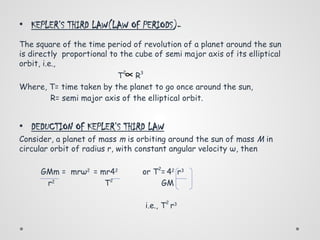
• KEPLER’S THIRD LAW(LAW OF PERIODS)-
The square of the time period of revolution of a planet around the sun
is directly proportional to the cube of semi major axis of its elliptical
orbit, i.e.,
T
2
R3
Where, T= time taken by the planet to go once around the sun,
R= semi major axis of the elliptical orbit.
• DEDUCTION OF KEPLER’S THIRD LAW
Consider, a planet of mass m is orbiting around the sun of mass M in
circular orbit of radius r, with constant angular velocity ω, then
GMm = mrω2
= mr42
or T2
= 42
r3
r2
T2
GM
i.e., T
2
r3
∝
DEDUCTION OF NEWTON’S LAW OF GRAVITATION FROM KEPLER’S LAW
Suppose a planet of mass m is revolving around the sun of mass M in a nearly
circular orbit of radius r, with a constant angular velocity ω. Let T be the
time period of revolution of planet around the sun.
.∙. ω=2T
The centripetal force acting on the planet for its circular motion is
F=mrω2
= mr 2
2
= 42
mr
T T2
According to Kepler’s third law,
T
2
r3
or T
2
=Kr3
(where K is constant of proportionality)
F=42
mr
Kr3
=42
m
K r2
or F m
r2
NEWTON’S LAW OF GRAVITATION
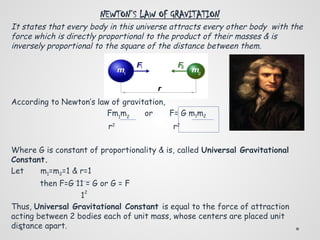
It states that every body in this universe attracts every other body with the
force which is directly proportional to the product of their masses & is
inversely proportional to the square of the distance between them.
According to Newton’s law of gravitation,
Fm1
m2
or F= G m1m2
r2
r2
Where G is constant of proportionality & is, called Universal Gravitational
Constant.
Let m1=m2=1 & r=1
then F=G 11 = G or G = F
1
2
Thus, Universal Gravitational Constant is equal to the force of attraction
acting between 2 bodies each of unit mass, whose centers are placed unit
distance apart.
VECTOR FORM OF NEWTON’S LAW OF GRAVITATION
GRAVITY
Gravity is the force of attraction exerted by earth towards its centre on
a body lying on or near the surface of earth. Gravity is merely a special
case of gravitation & is also called earth’s gravitational pull.
DIFFERNCE BETWEEN GRAVITATION & GRAVITY
GRAVITATION GRAVITY
1. Gravitation is the force of attraction acting
between any 2 bodies of the universe.
1. Gravity is the earth's gravitational pull
on a body, lying on or near the surface of
earth.
2. The gravitational force on body A of mass m1
due to a body of mass m2 placed distance r apart
is,
F=Gm1m2/r2
; where G is a universal gravitational
constant.
2. The force of gravity on a body of mass m
is F=mg, where g is the acceleration due to
gravity.
3. The direction of gravitational force on a body
is along the line joining the body & the centre of
the earth.
3. The direction of force of gravity on a
body is along the line joining the body & the
centre of the earth & is directed towards
the centre of earth.
4. The force of gravitation between 2 bodies can
be zero if the separation between 2 bodies
becomes infinity.
4. The force of gravity on a body is zero at
the centre of the earth.
ACCELERATION DUE TO GRAVITY
Acceleration due to gravity is defined as the force of gravity acting on
unit mass of a body placed on or near the surface of earth.
If the body is falling freely, under the effect of gravity, then the
acceleration in the body is also called acceleration due to gravity. It is
denoted by ‘g’.
SI unit of g is m/s2
or N/kg. The dimensional formula of g is [M0
L1
T -2
]
RELATION BETWEEN g & G
Consider, Mass of earth= M
Radius of earth= R with centre O
Mass of body place on surface on earth=m
Acceleration due to gravity=g
Let F be the force of attraction between body & earth
According to Newton’s law of gravitation,
F=GMm/R2
From gravity pull, F=mg
mg =GMm/R2
or g=GM/R2
VARIATION OF ACCELERATION DUE TO GRAVITY
(a)Effect of altitude: Consider earth to be a sphere of mass , radius R with centre
at O. Let g be the value of acceleration due to gravity at a point A on the surface of
earth.
g=GM/R2
…(1)
If g/
is the acceleration due to gravity at a point above earth
surface at height ‘h’ then the force on the body at ‘h’ is due to
earth whose mass M is concentrated at the centre at the centre
O of earth.
g/
= GM/(R+h)2
…(2)
Dividing (2) by (1), we get
g/
= GM R2
= R2
g (R+h)2
GM (R+h)2
= R2
= [1+h/R]-2
R
2
(1+h/R)2
h<<R then h/R is very small as compared to (1) therefore neglecting the
square & high powers of h/R
g/
=1- 2h or g/
= g 1- 2h
g R R
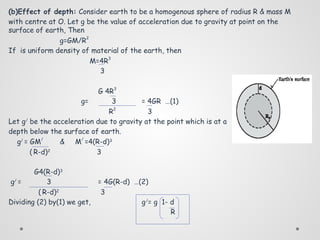
(b)Effect of depth: Consider earth to be a homogenous sphere of radius R & mass M
with centre at O. Let g be the value of acceleration due to gravity at point on the
surface of earth, Then
g=GM/R
2
If is uniform density of material of the earth, then
M=4R
3
3
G 4R3
g= 3 = 4GR …(1)
R2
3
Let g/
be the acceleration due to gravity at the point which is at a
depth below the surface of earth.
g/
= GM/
& M/
=4(R-d)3
( R-d)2
3
G4(R-d)3
g/
= 3 = 4G(R-d) …(2)
( R-d)2
3
Dividing (2) by(1) we get, g/
= g 1- d
R
GARVITATIONAL FIELD
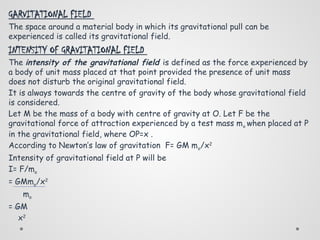
The space around a material body in which its gravitational pull can be
experienced is called its gravitational field.
INTENSITY OF GRAVITATIONAL FIELD
The intensity of the gravitational field is defined as the force experienced by
a body of unit mass placed at that point provided the presence of unit mass
does not disturb the original gravitational field.
It is always towards the centre of gravity of the body whose gravitational field
is considered.
Let M be the mass of a body with centre of gravity at O. Let F be the
gravitational force of attraction experienced by a test mass mo when placed at P
in the gravitational field, where OP=x .
According to Newton’s law of gravitation F= GM mo/x2
Intensity of gravitational field at P will be
I= F/mo
= GMmo/x2
mo
= GM
x2
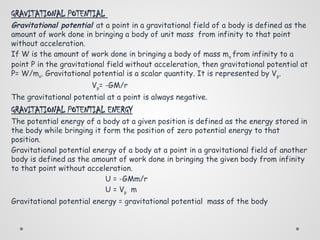
GRAVITATIONAL POTENTIAL
Gravitational potential at a point in a gravitational field of a body is defined as the
amount of work done in bringing a body of unit mass from infinity to that point
without acceleration.
If W is the amount of work done in bringing a body of mass mo from infinity to a
point P in the gravitational field without acceleration, then gravitational potential at
P= W/mo. Gravitational potential is a scalar quantity. It is represented by Vp.
Vp= -GM/r
The gravitational potential at a point is always negative.
GRAVITATIONAL POTENTIAL ENERGY
The potential energy of a body at a given position is defined as the energy stored in
the body while bringing it form the position of zero potential energy to that
position.
Gravitational potential energy of a body at a point in a gravitational field of another
body is defined as the amount of work done in bringing the given body from infinity
to that point without acceleration.
U = -GMm/r
U = Vp m
Gravitational potential energy = gravitational potential mass of the body
CENTRE OF GRAVITY
Centre of gravity of a body placed in the gravitational field is that point
where the net gravitational field is that point where the net gravitational
force of the field acts.
SATELLITE
A satellite is a body which is revolving continuously in an orbit around a
comparatively much larger body. In our solar planet each planet is a satellite
of sun. Moon is natural satellite of our planet earth.
ORBITAL SPEED, TIME PERIOD & HEIGHT OF SATELLITE
(1) Orbital speed: Orbital speed of a satellite is the minimum speed required
to put the satellite into a given orbit around earth.
The value of orbital speed is different for different orbits around earth & is
independent of the mass of satellite. Let
M= mass of earth, R= radius of earth
m= mass of the satellite , v= orbital speed of satellite
h= height of satellite above the surface of earth
r= radius of orbit of satellite= R+h
The centripetal force required to the satellite in its orbit,
F=mv2
/r
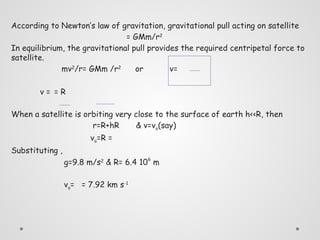
According to Newton’s law of gravitation, gravitational pull acting on satellite
= GMm/r2
In equilibrium, the gravitational pull provides the required centripetal force to
satellite.
mv2
/r= GMm /r2
or v=
v = = R
When a satellite is orbiting very close to the surface of earth h<<R, then
r=R+hR & v=vo(say)
vo=R =
Substituting ,
g=9.8 m/s2
& R= 6.4 106
m
vo= = 7.92 km s-1
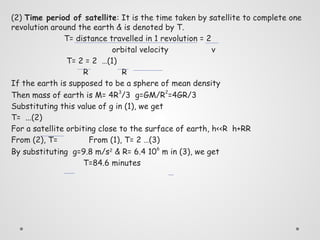
(2) Time period of satellite: It is the time taken by satellite to complete one
revolution around the earth & is denoted by T.
T= distance travelled in 1 revolution = 2
orbital velocity v
T= 2 = 2 …(1)
R R
If the earth is supposed to be a sphere of mean density
Then mass of earth is M= 4R3
/3 g=GM/R2
=4GR/3
Substituting this value of g in (1), we get
T= ...(2)
For a satellite orbiting close to the surface of earth, h<<R h+RR
From (2), T= From (1), T= 2 …(3)
By substituting g=9.8 m/s2
& R= 6.4 106
m in (3), we get
T=84.6 minutes
ENERGY OF AN ORBITIN G SATELLITE
The total mechanical energy (E) of a satellite revolving around the earth
is the sum of its potential energy(U) & kinetic energy(K)
U= -GMm/r
K= mv2
/2= GMm/2r [v2
=GM/r]
E= U+K= -GMm/2r
E= -GMm = -GMm
2r 2(R+h)
Since, a satellite is always at finite distance from earth, its total energy
is negative & can never be positive or zero.
BINDING ENERGY OF A SATELLITE
The energy required to remove the satellite from its orbit around the earth
to infinity is called Binding energy of the satellite. Binding energy is equal to
negative value of total mechanical energy of a satellite in its orbit.
Thus, binding energy = -E = GMm = GMm
2r 2(R+h)
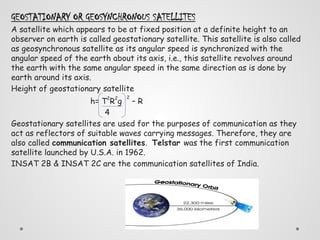
GEOSTATIONARY OR GEOSYNCHRONOUS SATELLITES
A satellite which appears to be at fixed position at a definite height to an
observer on earth is called geostationary satellite. This satellite is also called
as geosynchronous satellite as its angular speed is synchronized with the
angular speed of the earth about its axis, i.e., this satellite revolves around
the earth with the same angular speed in the same direction as is done by
earth around its axis.
Height of geostationary satellite
h= T
2
R
2
g
2
– R
4
Geostationary satellites are used for the purposes of communication as they
act as reflectors of suitable waves carrying messages. Therefore, they are
also called communication satellites. Telstar was the first communication
satellite launched by U.S.A. in 1962.
INSAT 2B & INSAT 2C are the communication satellites of India.
IMPORTANT USES OF SATELLITES
1. In communicating radio, T.V. & telephone signals across the oceans.
2. In forecasting weather.
3. In studying the upper region of atmosphere.
4. To determine the exact shape & dimensions of earth.
5. In the study of cosmic rays & solar radiations.
INDIA LEAD INTO SPACE
• In 1975, India launched its first low orbit satellite Arya bhatt.
• The first Indian experimental satellite, i.e., Apple was launched on
June 19 , 1981
• In 1984, Rakesh Sharma become the first Indian to go into space.
ESCAPE SPEED
Escape speed on earth is defined as the minimum speed with which a body
has to be projected vertically upwards from the surface of earth so that
it just crosses the gravitational field of earth & never returns on its own.
It is denoted by ve.
ve= = For earth, ve= 11.2 km s-1
WEIGHTLESSNESS
It is a situation in which the observed weight of the body becomes zero.
Problems of weightlessness
• If an astronaut is walking in space craft, he may be pushed away from
the floor & may crash against the ceiling of the space craft.
• The space-flight for a long time, adversely affects the human organism.
• The experiment of simple pendulum can not be performed in the
weightlessness state because
T=2 = as g=0
×

class xi physics gravitation chapter.pptx

  • 1.
    PHYSICS PROJECT ON- GRAVITATION GUIDEDBY- PRESENTED BY- MR. L.S. CHOUHAN DEEPESH PREMCHANDANI (XI- ‘B’)
  • 2.
    INTRODUCTION • Gravitation, isthe natural phenomena by which physical bodies appear to attract each other with a force proportional to their masses. It is most commonly experienced as the agent that gives weight to objects with mass and causes them to fall to the ground when dropped. The phenomenon of gravitation itself, however, is a by product of a more fundamental phenomenon described by general relativity, which suggests that space-time is curved according to the presence of matter through a yet to be discovered mechanism • Gravitation is one of the four fundamental of nature, along with electromagnetism, and the nuclear strong force and weak force. In modern physics, the phenomenon of gravitation is most accurately described by the general theory of relativity by Einstein, in which the phenomenon itself is a consequence of the curvature of space time governing the motion of inertial objects. The simpler Newton’s law of gravitation, provides an accurate approximation for most physical situations including calculations as critical as spacecraft trajectory. • From a cosmological perspective, gravitation causes dispersed matter to coalesce, and coalesced matter to remain intact, thus accounting for the existence of planets, stars, galaxies and most of the macroscopic objects in the universe. It is responsible for keeping the Earth and the other planets in their orbits around the Sun; for keeping the Moon in its orbit around the Earth; for the formation of tides; for natural convection, by which fluid flow occurs under the influence of a density gradient and gravity; for heating the interiors of forming stars and planets to very high temperatures; and for various other phenomena observed on Earth and throughout the universe.
  • 3.
    KEPLER’S LAW OFPLANETARY MOTION • KEPLER’S FIRST LAW - Every planet revolves around the sun in an elliptical orbit. The sun is situated at one foci of ellipse.
  • 4.
    • KEPLER’S SECONDLAW(LAW OF AREAS)- The line joining a planet to the sun sweeps out equal area in equal interval of time, i.e., the areal velocity of the planet around the sun is constant. Area P1SP2 Area P3SP Since, SP1 > SP3 , therefore, P1P2 < P3P4 P1P2 < P3P4 t t
  • 5.
    • KEPLER’S THIRDLAW(LAW OF PERIODS)- The square of the time period of revolution of a planet around the sun is directly proportional to the cube of semi major axis of its elliptical orbit, i.e., T 2 R3 Where, T= time taken by the planet to go once around the sun, R= semi major axis of the elliptical orbit. • DEDUCTION OF KEPLER’S THIRD LAW Consider, a planet of mass m is orbiting around the sun of mass M in circular orbit of radius r, with constant angular velocity ω, then GMm = mrω2 = mr42 or T2 = 42 r3 r2 T2 GM i.e., T 2 r3 ∝
  • 6.
    DEDUCTION OF NEWTON’SLAW OF GRAVITATION FROM KEPLER’S LAW Suppose a planet of mass m is revolving around the sun of mass M in a nearly circular orbit of radius r, with a constant angular velocity ω. Let T be the time period of revolution of planet around the sun. .∙. ω=2T The centripetal force acting on the planet for its circular motion is F=mrω2 = mr 2 2 = 42 mr T T2 According to Kepler’s third law, T 2 r3 or T 2 =Kr3 (where K is constant of proportionality) F=42 mr Kr3 =42 m K r2 or F m r2
  • 7.
    NEWTON’S LAW OFGRAVITATION It states that every body in this universe attracts every other body with the force which is directly proportional to the product of their masses & is inversely proportional to the square of the distance between them. According to Newton’s law of gravitation, Fm1 m2 or F= G m1m2 r2 r2 Where G is constant of proportionality & is, called Universal Gravitational Constant. Let m1=m2=1 & r=1 then F=G 11 = G or G = F 1 2 Thus, Universal Gravitational Constant is equal to the force of attraction acting between 2 bodies each of unit mass, whose centers are placed unit distance apart.
  • 8.
    VECTOR FORM OFNEWTON’S LAW OF GRAVITATION
  • 9.
    GRAVITY Gravity is theforce of attraction exerted by earth towards its centre on a body lying on or near the surface of earth. Gravity is merely a special case of gravitation & is also called earth’s gravitational pull. DIFFERNCE BETWEEN GRAVITATION & GRAVITY GRAVITATION GRAVITY 1. Gravitation is the force of attraction acting between any 2 bodies of the universe. 1. Gravity is the earth's gravitational pull on a body, lying on or near the surface of earth. 2. The gravitational force on body A of mass m1 due to a body of mass m2 placed distance r apart is, F=Gm1m2/r2 ; where G is a universal gravitational constant. 2. The force of gravity on a body of mass m is F=mg, where g is the acceleration due to gravity. 3. The direction of gravitational force on a body is along the line joining the body & the centre of the earth. 3. The direction of force of gravity on a body is along the line joining the body & the centre of the earth & is directed towards the centre of earth. 4. The force of gravitation between 2 bodies can be zero if the separation between 2 bodies becomes infinity. 4. The force of gravity on a body is zero at the centre of the earth.
  • 10.
    ACCELERATION DUE TOGRAVITY Acceleration due to gravity is defined as the force of gravity acting on unit mass of a body placed on or near the surface of earth. If the body is falling freely, under the effect of gravity, then the acceleration in the body is also called acceleration due to gravity. It is denoted by ‘g’. SI unit of g is m/s2 or N/kg. The dimensional formula of g is [M0 L1 T -2 ] RELATION BETWEEN g & G Consider, Mass of earth= M Radius of earth= R with centre O Mass of body place on surface on earth=m Acceleration due to gravity=g Let F be the force of attraction between body & earth According to Newton’s law of gravitation, F=GMm/R2 From gravity pull, F=mg mg =GMm/R2 or g=GM/R2
  • 11.
    VARIATION OF ACCELERATIONDUE TO GRAVITY (a)Effect of altitude: Consider earth to be a sphere of mass , radius R with centre at O. Let g be the value of acceleration due to gravity at a point A on the surface of earth. g=GM/R2 …(1) If g/ is the acceleration due to gravity at a point above earth surface at height ‘h’ then the force on the body at ‘h’ is due to earth whose mass M is concentrated at the centre at the centre O of earth. g/ = GM/(R+h)2 …(2) Dividing (2) by (1), we get g/ = GM R2 = R2 g (R+h)2 GM (R+h)2 = R2 = [1+h/R]-2 R 2 (1+h/R)2 h<<R then h/R is very small as compared to (1) therefore neglecting the square & high powers of h/R g/ =1- 2h or g/ = g 1- 2h g R R
  • 12.
    (b)Effect of depth:Consider earth to be a homogenous sphere of radius R & mass M with centre at O. Let g be the value of acceleration due to gravity at point on the surface of earth, Then g=GM/R 2 If is uniform density of material of the earth, then M=4R 3 3 G 4R3 g= 3 = 4GR …(1) R2 3 Let g/ be the acceleration due to gravity at the point which is at a depth below the surface of earth. g/ = GM/ & M/ =4(R-d)3 ( R-d)2 3 G4(R-d)3 g/ = 3 = 4G(R-d) …(2) ( R-d)2 3 Dividing (2) by(1) we get, g/ = g 1- d R
  • 13.
    GARVITATIONAL FIELD The spacearound a material body in which its gravitational pull can be experienced is called its gravitational field. INTENSITY OF GRAVITATIONAL FIELD The intensity of the gravitational field is defined as the force experienced by a body of unit mass placed at that point provided the presence of unit mass does not disturb the original gravitational field. It is always towards the centre of gravity of the body whose gravitational field is considered. Let M be the mass of a body with centre of gravity at O. Let F be the gravitational force of attraction experienced by a test mass mo when placed at P in the gravitational field, where OP=x . According to Newton’s law of gravitation F= GM mo/x2 Intensity of gravitational field at P will be I= F/mo = GMmo/x2 mo = GM x2
  • 14.
    GRAVITATIONAL POTENTIAL Gravitational potentialat a point in a gravitational field of a body is defined as the amount of work done in bringing a body of unit mass from infinity to that point without acceleration. If W is the amount of work done in bringing a body of mass mo from infinity to a point P in the gravitational field without acceleration, then gravitational potential at P= W/mo. Gravitational potential is a scalar quantity. It is represented by Vp. Vp= -GM/r The gravitational potential at a point is always negative. GRAVITATIONAL POTENTIAL ENERGY The potential energy of a body at a given position is defined as the energy stored in the body while bringing it form the position of zero potential energy to that position. Gravitational potential energy of a body at a point in a gravitational field of another body is defined as the amount of work done in bringing the given body from infinity to that point without acceleration. U = -GMm/r U = Vp m Gravitational potential energy = gravitational potential mass of the body
  • 15.
    CENTRE OF GRAVITY Centreof gravity of a body placed in the gravitational field is that point where the net gravitational field is that point where the net gravitational force of the field acts. SATELLITE A satellite is a body which is revolving continuously in an orbit around a comparatively much larger body. In our solar planet each planet is a satellite of sun. Moon is natural satellite of our planet earth.
  • 16.
    ORBITAL SPEED, TIMEPERIOD & HEIGHT OF SATELLITE (1) Orbital speed: Orbital speed of a satellite is the minimum speed required to put the satellite into a given orbit around earth. The value of orbital speed is different for different orbits around earth & is independent of the mass of satellite. Let M= mass of earth, R= radius of earth m= mass of the satellite , v= orbital speed of satellite h= height of satellite above the surface of earth r= radius of orbit of satellite= R+h The centripetal force required to the satellite in its orbit, F=mv2 /r
  • 17.
    According to Newton’slaw of gravitation, gravitational pull acting on satellite = GMm/r2 In equilibrium, the gravitational pull provides the required centripetal force to satellite. mv2 /r= GMm /r2 or v= v = = R When a satellite is orbiting very close to the surface of earth h<<R, then r=R+hR & v=vo(say) vo=R = Substituting , g=9.8 m/s2 & R= 6.4 106 m vo= = 7.92 km s-1
  • 18.
    (2) Time periodof satellite: It is the time taken by satellite to complete one revolution around the earth & is denoted by T. T= distance travelled in 1 revolution = 2 orbital velocity v T= 2 = 2 …(1) R R If the earth is supposed to be a sphere of mean density Then mass of earth is M= 4R3 /3 g=GM/R2 =4GR/3 Substituting this value of g in (1), we get T= ...(2) For a satellite orbiting close to the surface of earth, h<<R h+RR From (2), T= From (1), T= 2 …(3) By substituting g=9.8 m/s2 & R= 6.4 106 m in (3), we get T=84.6 minutes
  • 19.
    ENERGY OF ANORBITIN G SATELLITE The total mechanical energy (E) of a satellite revolving around the earth is the sum of its potential energy(U) & kinetic energy(K) U= -GMm/r K= mv2 /2= GMm/2r [v2 =GM/r] E= U+K= -GMm/2r E= -GMm = -GMm 2r 2(R+h) Since, a satellite is always at finite distance from earth, its total energy is negative & can never be positive or zero. BINDING ENERGY OF A SATELLITE The energy required to remove the satellite from its orbit around the earth to infinity is called Binding energy of the satellite. Binding energy is equal to negative value of total mechanical energy of a satellite in its orbit. Thus, binding energy = -E = GMm = GMm 2r 2(R+h)
  • 20.
    GEOSTATIONARY OR GEOSYNCHRONOUSSATELLITES A satellite which appears to be at fixed position at a definite height to an observer on earth is called geostationary satellite. This satellite is also called as geosynchronous satellite as its angular speed is synchronized with the angular speed of the earth about its axis, i.e., this satellite revolves around the earth with the same angular speed in the same direction as is done by earth around its axis. Height of geostationary satellite h= T 2 R 2 g 2 – R 4 Geostationary satellites are used for the purposes of communication as they act as reflectors of suitable waves carrying messages. Therefore, they are also called communication satellites. Telstar was the first communication satellite launched by U.S.A. in 1962. INSAT 2B & INSAT 2C are the communication satellites of India.
  • 21.
    IMPORTANT USES OFSATELLITES 1. In communicating radio, T.V. & telephone signals across the oceans. 2. In forecasting weather. 3. In studying the upper region of atmosphere. 4. To determine the exact shape & dimensions of earth. 5. In the study of cosmic rays & solar radiations. INDIA LEAD INTO SPACE • In 1975, India launched its first low orbit satellite Arya bhatt. • The first Indian experimental satellite, i.e., Apple was launched on June 19 , 1981 • In 1984, Rakesh Sharma become the first Indian to go into space.
  • 22.
    ESCAPE SPEED Escape speedon earth is defined as the minimum speed with which a body has to be projected vertically upwards from the surface of earth so that it just crosses the gravitational field of earth & never returns on its own. It is denoted by ve. ve= = For earth, ve= 11.2 km s-1 WEIGHTLESSNESS It is a situation in which the observed weight of the body becomes zero. Problems of weightlessness • If an astronaut is walking in space craft, he may be pushed away from the floor & may crash against the ceiling of the space craft. • The space-flight for a long time, adversely affects the human organism. • The experiment of simple pendulum can not be performed in the weightlessness state because T=2 = as g=0 ×