PowerPoint® Lectures for
University Physics, 14th Edition
– Hugh D. Young and Roger A. Freedman Lectures by Jason Harlow
Gravitation
Chapter 13
© 2016 Pearson Education Inc.
Learning Goals for Chapter 13
Looking forward at …
• how to calculate the gravitational forces that any two bodies
exert on each other.
• how to relate the weight of an object to the general
expression for gravitational force.
• how to calculate the speed, orbital period, and mechanical
energy of a satellite in a circular orbit.
• how to apply and interpret Kepler’s three laws that describe
the motion of planets.
• what black holes are, how to calculate their properties, and
how astronomers discover them.
© 2016 Pearson Education Inc.
Introduction
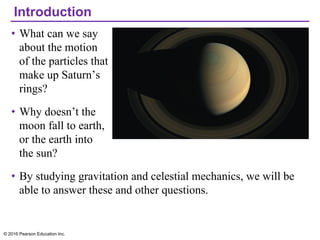
• What can we say
about the motion
of the particles that
make up Saturn’s
rings?
• Why doesn’t the
moon fall to earth,
or the earth into
the sun?
• By studying gravitation and celestial mechanics, we will be
able to answer these and other questions.
© 2016 Pearson Education Inc.
Newton’s law of gravitation
© 2016 Pearson Education Inc.
Newton’s law of gravitation
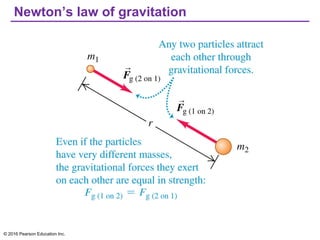
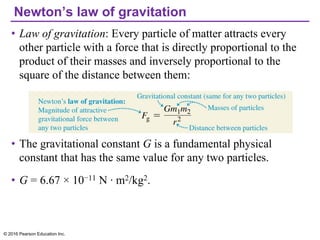
• Law of gravitation: Every particle of matter attracts every
other particle with a force that is directly proportional to the
product of their masses and inversely proportional to the
square of the distance between them:
• The gravitational constant G is a fundamental physical
constant that has the same value for any two particles.
• G = 6.67 × 10⁻¹¹ N · m2/kg2.
© 2016 Pearson Education Inc.
Gravitation and spherically symmetric bodies
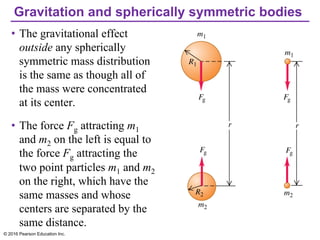
• The gravitational effect
outside any spherically
symmetric mass distribution
is the same as though all of
the mass were concentrated
at its center.
• The force Fg attracting m1
and m2 on the left is equal to
the force Fg attracting the
two point particles m1 and m2
on the right, which have the
same masses and whose
centers are separated by the
same distance.
© 2016 Pearson Education Inc.
Gravitational attraction
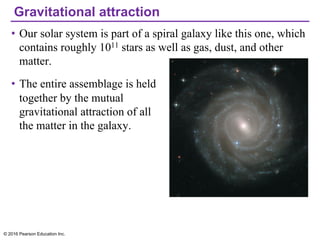
• Our solar system is part of a spiral galaxy like this one, which
contains roughly 1011 stars as well as gas, dust, and other
matter.
• The entire assemblage is held
together by the mutual
gravitational attraction of all
the matter in the galaxy.
© 2016 Pearson Education Inc.
Weight
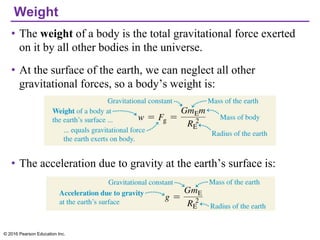
• The weight of a body is the total gravitational force exerted
on it by all other bodies in the universe.
• At the surface of the earth, we can neglect all other
gravitational forces, so a body’s weight is:
• The acceleration due to gravity at the earth’s surface is:
© 2016 Pearson Education Inc.
Walking and running on the moon
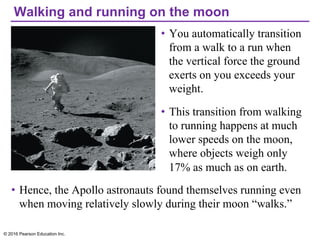
• You automatically transition
from a walk to a run when
the vertical force the ground
exerts on you exceeds your
weight.
• This transition from walking
to running happens at much
lower speeds on the moon,
where objects weigh only
17% as much as on earth.
• Hence, the Apollo astronauts found themselves running even
when moving relatively slowly during their moon “walks.”
© 2016 Pearson Education Inc.
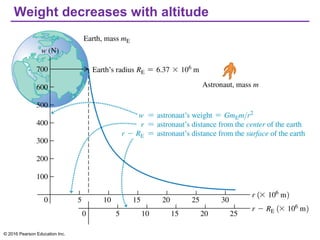
Weight decreases with altitude
© 2016 Pearson Education Inc.
Interior of the earth
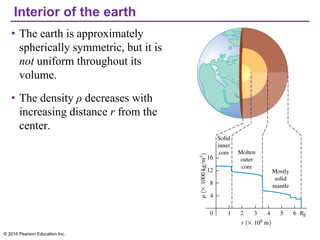
• The earth is approximately
spherically symmetric, but it is
not uniform throughout its
volume.
• The density ρ decreases with
increasing distance r from the
center.
© 2016 Pearson Education Inc.
Gravitational potential energy
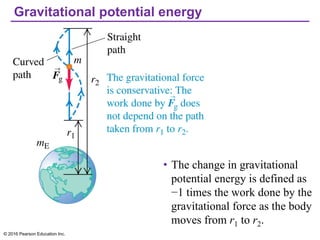
• The change in gravitational
potential energy is defined as
−1 times the work done by the
gravitational force as the body
moves from r1 to r2.
© 2016 Pearson Education Inc.
Gravitational potential energy
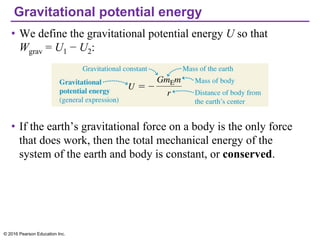
• We define the gravitational potential energy U so that
Wgrav = U1 − U2:
• If the earth’s gravitational force on a body is the only force
that does work, then the total mechanical energy of the
system of the earth and body is constant, or conserved.
© 2016 Pearson Education Inc.
Gravitational potential energy depends on
distance
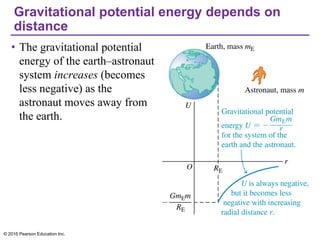
• The gravitational potential
energy of the earth–astronaut
system increases (becomes
less negative) as the
astronaut moves away from
the earth.
© 2016 Pearson Education Inc.
The motion of satellites
© 2016 Pearson Education Inc.
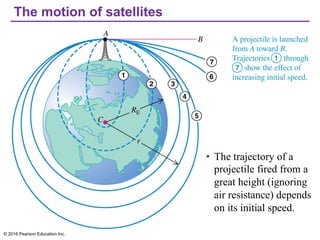
• The trajectory of a
projectile fired from a
great height (ignoring
air resistance) depends
on its initial speed.
Circular satellite orbits
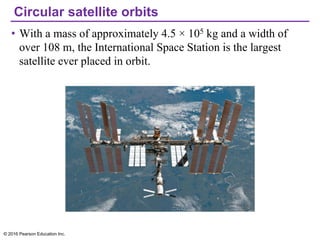
• With a mass of approximately 4.5 × 10⁵ kg and a width of
over 108 m, the International Space Station is the largest
satellite ever placed in orbit.
© 2016 Pearson Education Inc.
Circular satellite orbits
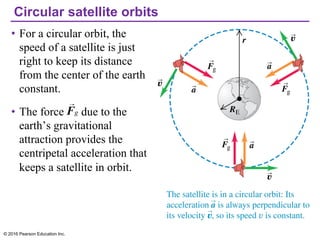
• For a circular orbit, the
speed of a satellite is just
right to keep its distance
from the center of the earth
constant.
• The force due to the
earth’s gravitational
attraction provides the
centripetal acceleration that
keeps a satellite in orbit.
© 2016 Pearson Education Inc.
Circular satellite orbits
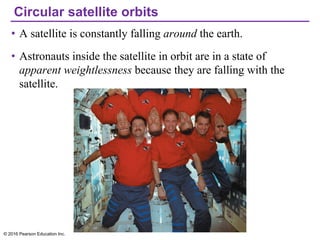
• A satellite is constantly falling around the earth.
• Astronauts inside the satellite in orbit are in a state of
apparent weightlessness because they are falling with the
satellite.
© 2016 Pearson Education Inc.
Kepler’s first law
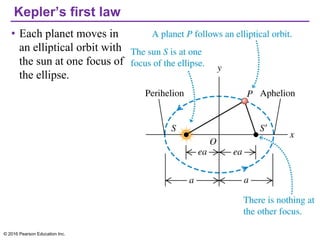
• Each planet moves in
an elliptical orbit with
the sun at one focus of
the ellipse.
© 2016 Pearson Education Inc.
Kepler’s second law
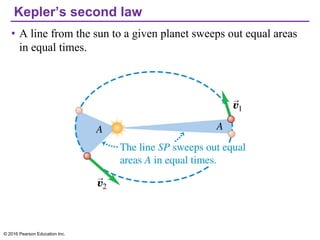
• A line from the sun to a given planet sweeps out equal areas
in equal times.
© 2016 Pearson Education Inc.
Kepler’s second law
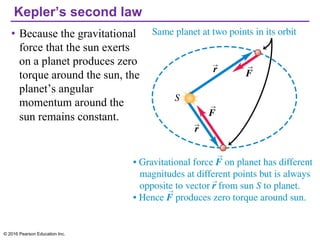
• Because the gravitational
force that the sun exerts
on a planet produces zero
torque around the sun, the
planet’s angular
momentum around the
sun remains constant.
© 2016 Pearson Education Inc.
Kepler’s third law
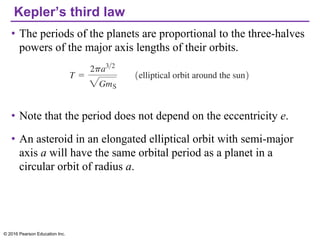
• The periods of the planets are proportional to the three-halves
powers of the major axis lengths of their orbits.
• Note that the period does not depend on the eccentricity e.
• An asteroid in an elongated elliptical orbit with semi-major
axis a will have the same orbital period as a planet in a
circular orbit of radius a.
© 2016 Pearson Education Inc.
Comet Halley
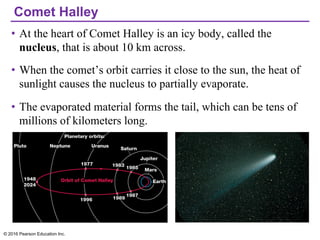
• At the heart of Comet Halley is an icy body, called the
nucleus, that is about 10 km across.
• When the comet’s orbit carries it close to the sun, the heat of
sunlight causes the nucleus to partially evaporate.
• The evaporated material forms the tail, which can be tens of
millions of kilometers long.
© 2016 Pearson Education Inc.
Planetary motions and the center of mass
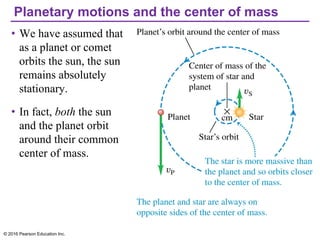
• We have assumed that
as a planet or comet
orbits the sun, the sun
remains absolutely
stationary.
• In fact, both the sun
and the planet orbit
around their common
center of mass.
© 2016 Pearson Education Inc.
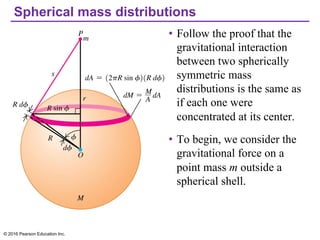
Spherical mass distributions
• Follow the proof that the
gravitational interaction
between two spherically
symmetric mass
distributions is the same as
if each one were
concentrated at its center.
• To begin, we consider the
gravitational force on a
point mass m outside a
spherical shell.
© 2016 Pearson Education Inc.
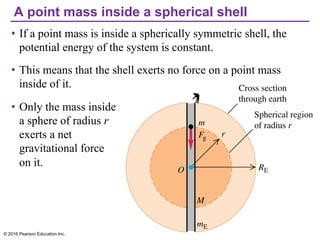
A point mass inside a spherical shell
• If a point mass is inside a spherically symmetric shell, the
potential energy of the system is constant.
• This means that the shell exerts no force on a point mass
inside of it.
• Only the mass inside
a sphere of radius r
exerts a net
gravitational force
on it.
© 2016 Pearson Education Inc.
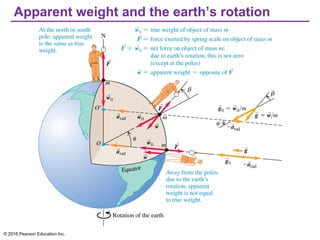
Apparent weight and the earth’s rotation
© 2016 Pearson Education Inc.
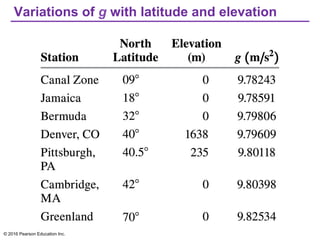
Variations of g with latitude and elevation
© 2016 Pearson Education Inc.
Black holes
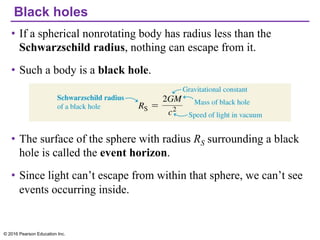
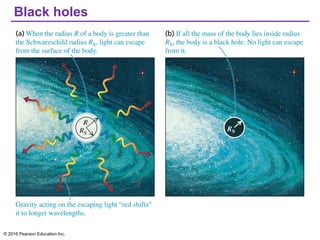
• If a spherical nonrotating body has radius less than the
Schwarzschild radius, nothing can escape from it.
• Such a body is a black hole.
• The surface of the sphere with radius RS surrounding a black
hole is called the event horizon.
• Since light can’t escape from within that sphere, we can’t see
events occurring inside.
© 2016 Pearson Education Inc.
Black holes
© 2016 Pearson Education Inc.
Detecting black holes
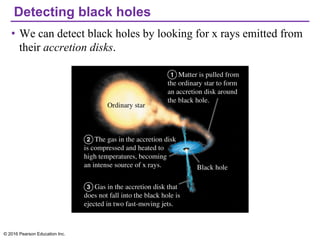
• We can detect black holes by looking for x rays emitted from
their accretion disks.
© 2016 Pearson Education Inc.

Physics 1321 Chapter 13 Lecture Slides.pdf

  • 1.
    PowerPoint® Lectures for UniversityPhysics, 14th Edition – Hugh D. Young and Roger A. Freedman Lectures by Jason Harlow Gravitation Chapter 13 © 2016 Pearson Education Inc.
  • 2.
    Learning Goals forChapter 13 Looking forward at … • how to calculate the gravitational forces that any two bodies exert on each other. • how to relate the weight of an object to the general expression for gravitational force. • how to calculate the speed, orbital period, and mechanical energy of a satellite in a circular orbit. • how to apply and interpret Kepler’s three laws that describe the motion of planets. • what black holes are, how to calculate their properties, and how astronomers discover them. © 2016 Pearson Education Inc.
  • 3.
    Introduction • What canwe say about the motion of the particles that make up Saturn’s rings? • Why doesn’t the moon fall to earth, or the earth into the sun? • By studying gravitation and celestial mechanics, we will be able to answer these and other questions. © 2016 Pearson Education Inc.
  • 4.
    Newton’s law ofgravitation © 2016 Pearson Education Inc.
  • 5.
    Newton’s law ofgravitation • Law of gravitation: Every particle of matter attracts every other particle with a force that is directly proportional to the product of their masses and inversely proportional to the square of the distance between them: • The gravitational constant G is a fundamental physical constant that has the same value for any two particles. • G = 6.67 × 10⁻¹¹ N · m2/kg2. © 2016 Pearson Education Inc.
  • 6.
    Gravitation and sphericallysymmetric bodies • The gravitational effect outside any spherically symmetric mass distribution is the same as though all of the mass were concentrated at its center. • The force Fg attracting m1 and m2 on the left is equal to the force Fg attracting the two point particles m1 and m2 on the right, which have the same masses and whose centers are separated by the same distance. © 2016 Pearson Education Inc.
  • 7.
    Gravitational attraction • Oursolar system is part of a spiral galaxy like this one, which contains roughly 1011 stars as well as gas, dust, and other matter. • The entire assemblage is held together by the mutual gravitational attraction of all the matter in the galaxy. © 2016 Pearson Education Inc.
  • 8.
    Weight • The weightof a body is the total gravitational force exerted on it by all other bodies in the universe. • At the surface of the earth, we can neglect all other gravitational forces, so a body’s weight is: • The acceleration due to gravity at the earth’s surface is: © 2016 Pearson Education Inc.
  • 9.
    Walking and runningon the moon • You automatically transition from a walk to a run when the vertical force the ground exerts on you exceeds your weight. • This transition from walking to running happens at much lower speeds on the moon, where objects weigh only 17% as much as on earth. • Hence, the Apollo astronauts found themselves running even when moving relatively slowly during their moon “walks.” © 2016 Pearson Education Inc.
  • 10.
    Weight decreases withaltitude © 2016 Pearson Education Inc.
  • 11.
    Interior of theearth • The earth is approximately spherically symmetric, but it is not uniform throughout its volume. • The density ρ decreases with increasing distance r from the center. © 2016 Pearson Education Inc.
  • 12.
    Gravitational potential energy •The change in gravitational potential energy is defined as −1 times the work done by the gravitational force as the body moves from r1 to r2. © 2016 Pearson Education Inc.
  • 13.
    Gravitational potential energy •We define the gravitational potential energy U so that Wgrav = U1 − U2: • If the earth’s gravitational force on a body is the only force that does work, then the total mechanical energy of the system of the earth and body is constant, or conserved. © 2016 Pearson Education Inc.
  • 14.
    Gravitational potential energydepends on distance • The gravitational potential energy of the earth–astronaut system increases (becomes less negative) as the astronaut moves away from the earth. © 2016 Pearson Education Inc.
  • 15.
    The motion ofsatellites © 2016 Pearson Education Inc. • The trajectory of a projectile fired from a great height (ignoring air resistance) depends on its initial speed.
  • 16.
    Circular satellite orbits •With a mass of approximately 4.5 × 10⁵ kg and a width of over 108 m, the International Space Station is the largest satellite ever placed in orbit. © 2016 Pearson Education Inc.
  • 17.
    Circular satellite orbits •For a circular orbit, the speed of a satellite is just right to keep its distance from the center of the earth constant. • The force due to the earth’s gravitational attraction provides the centripetal acceleration that keeps a satellite in orbit. © 2016 Pearson Education Inc.
  • 18.
    Circular satellite orbits •A satellite is constantly falling around the earth. • Astronauts inside the satellite in orbit are in a state of apparent weightlessness because they are falling with the satellite. © 2016 Pearson Education Inc.
  • 19.
    Kepler’s first law •Each planet moves in an elliptical orbit with the sun at one focus of the ellipse. © 2016 Pearson Education Inc.
  • 20.
    Kepler’s second law •A line from the sun to a given planet sweeps out equal areas in equal times. © 2016 Pearson Education Inc.
  • 21.
    Kepler’s second law •Because the gravitational force that the sun exerts on a planet produces zero torque around the sun, the planet’s angular momentum around the sun remains constant. © 2016 Pearson Education Inc.
  • 22.
    Kepler’s third law •The periods of the planets are proportional to the three-halves powers of the major axis lengths of their orbits. • Note that the period does not depend on the eccentricity e. • An asteroid in an elongated elliptical orbit with semi-major axis a will have the same orbital period as a planet in a circular orbit of radius a. © 2016 Pearson Education Inc.
  • 23.
    Comet Halley • Atthe heart of Comet Halley is an icy body, called the nucleus, that is about 10 km across. • When the comet’s orbit carries it close to the sun, the heat of sunlight causes the nucleus to partially evaporate. • The evaporated material forms the tail, which can be tens of millions of kilometers long. © 2016 Pearson Education Inc.
  • 24.
    Planetary motions andthe center of mass • We have assumed that as a planet or comet orbits the sun, the sun remains absolutely stationary. • In fact, both the sun and the planet orbit around their common center of mass. © 2016 Pearson Education Inc.
  • 25.
    Spherical mass distributions •Follow the proof that the gravitational interaction between two spherically symmetric mass distributions is the same as if each one were concentrated at its center. • To begin, we consider the gravitational force on a point mass m outside a spherical shell. © 2016 Pearson Education Inc.
  • 26.
    A point massinside a spherical shell • If a point mass is inside a spherically symmetric shell, the potential energy of the system is constant. • This means that the shell exerts no force on a point mass inside of it. • Only the mass inside a sphere of radius r exerts a net gravitational force on it. © 2016 Pearson Education Inc.
  • 27.
    Apparent weight andthe earth’s rotation © 2016 Pearson Education Inc.
  • 28.
    Variations of gwith latitude and elevation © 2016 Pearson Education Inc.
  • 29.
    Black holes • Ifa spherical nonrotating body has radius less than the Schwarzschild radius, nothing can escape from it. • Such a body is a black hole. • The surface of the sphere with radius RS surrounding a black hole is called the event horizon. • Since light can’t escape from within that sphere, we can’t see events occurring inside. © 2016 Pearson Education Inc.
  • 30.
    Black holes © 2016Pearson Education Inc.
  • 31.
    Detecting black holes •We can detect black holes by looking for x rays emitted from their accretion disks. © 2016 Pearson Education Inc.