TABA'S GRASSROOT
RATIONAL MODEL
Presentation by Nikka Ella B. Cristobal
The Teacher and the School Curriculum
BACKGROUND
STEPS
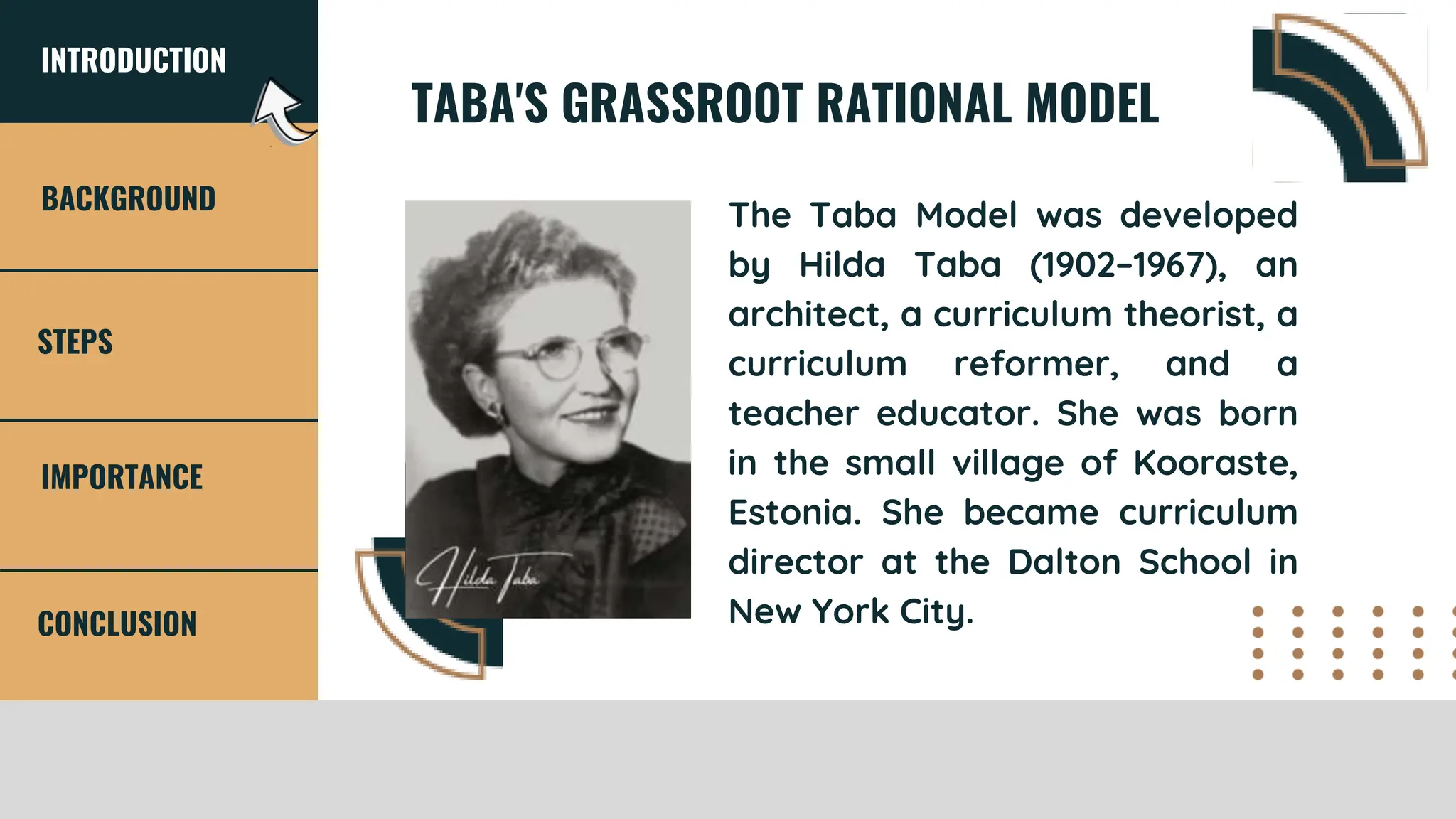
The Taba Model was developed
by Hilda Taba (1902–1967), an
architect, a curriculum theorist, a
curriculum reformer, and a
teacher educator. She was born
in the small village of Kooraste,
Estonia. She became curriculum
director at the Dalton School in
New York City.
IMPORTANCE
INTRODUCTION
CONCLUSION
TABA'S GRASSROOT RATIONAL MODEL
BACKGROUND
STEPS
IMPORTANCE
● She advocated that teachers take an inductive
approach to curriculum development.
● She also followed the grassroots approach in
developing curriculum.
● The Taba model was an attempt to ensure that
decisions about curriculum are made on the basis
of valid criteria and not whim or fancy (Khwaja,
Akhtar and Mizra)
INTRODUCTION
CONCLUSION
TABA'S GRASSROOT RATIONAL MODEL
STEPS
BACKGROUND
IMPORTANCE
CONCLUSION
INTRODUCTION
STEPS
BACKGROUND
IMPORTANCE
CONCLUSION
INTRODUCTION
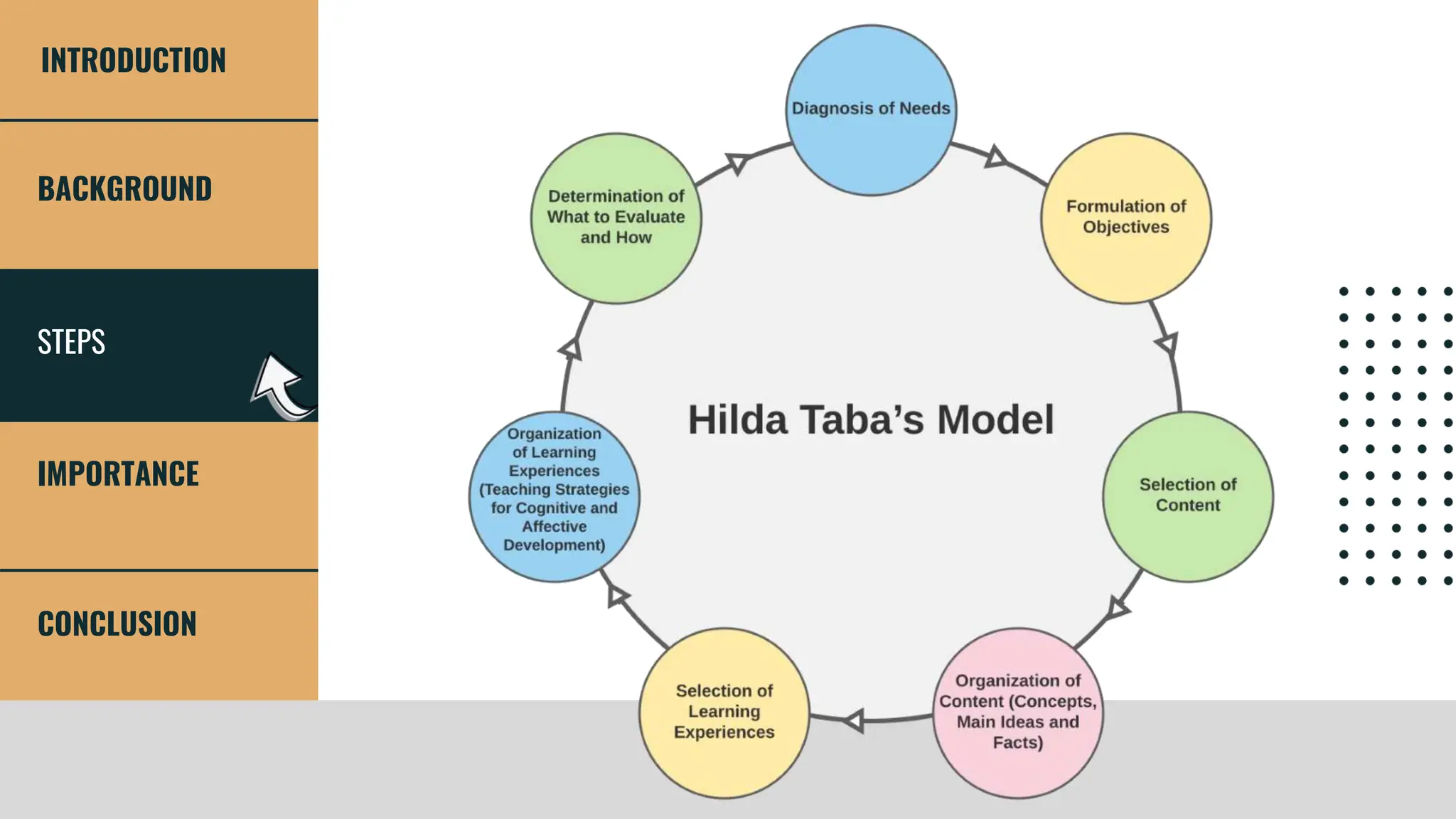
DIAGNOSIS OF NEEDS
THE TEACHER (CURRICULUM DESIGNER)
STARTS THE PROCESS BY IDENTIFYING THE
NEEDS OF THE STUDENTS FOR WHOM THE
CURRICULUM IS TO BE PLANNED.
STEPS
BACKGROUND
IMPORTANCE
CONCLUSION
INTRODUCTION
FORMULATION OF LEARNING
OBJECTIVES
AFTER THE TEACHER HAS IDENTIFIED THE
NEEDS THAT REQUIRE ATTENTION, HE OR SHE
SPECIFIES OBJECTIVES TO BE ACCOMPLISHED.
STEPS
BACKGROUND
IMPORTANCE
CONCLUSION
INTRODUCTION
SELECTION OF LEARNING CONTENT
THE OBJECTIVES SELECTED OR CREATED
SUGGEST THE SUBJECT MATTER OR CONTENT
OF THE CURRICULUM. NOT ONLY SHOULD
OBJECTIVES AND CONTENT MATCH BUT ALSO
THE VALIDITY AND SIGNIFICANCE OF THE
CONTENT CHOSEN NEEDS TO BE DETERMINED.
STEPS
BACKGROUND
IMPORTANCE
CONCLUSION
INTRODUCTION
ORGANIZATION OF LEARNING
CONTENT
A TEACHER CANNOT JUST SELECT CONTENT,
BUT MUST ORGANIZE IT IN SOME TYPE OF
SEQUENCE, TAKING INTO CONSIDERATION THE
MATURITY OF THE LEARNERS, ACADEMIC
ACHIEVEMENT AND THEIR INTERESTS.
STEPS
BACKGROUND
IMPORTANCE
CONCLUSION
INTRODUCTION
SELECTION OF LEARNING
EXPERIENCES
CONTENT MUST BE PRESENTED TO PUPILS AND
PUPILS MUST ENGAGE THE CONTENT. AT THIS
POINT, THE TEACHER SELECT INSTRUCTIONAL
METHODS THAT WILL INVOLVE STUDENTS
WITH THE CONTENT.
STEPS
BACKGROUND
IMPORTANCE
CONCLUSION
INTRODUCTION
ORGANIZATION OF LEARNING
ACTIVITIES
JUST AS CONTENT MUST BE SEQUENCED AND
ORGANIZED, SO MUST THE LEARNING
ACTIVITIES. OFTEN THE SEQUENCE OF THE
LEARNING ACTIVITIES IS DETERMINED BY THE
CONTENT.
STEPS
BACKGROUND
IMPORTANCE
CONCLUSION
INTRODUCTION
EVALUATION AND MEANS OF
EVALUATION
THE CURRICULUM PLANNER MUST DETERMINE
JUST WHAT OBJECTIVES HAVE BEEN
ACCOMPLISHED. EVALUATION PROCEDURES
NEED TO BE CONSIDERED BY THE STUDENTS
AND TEACHERS.
IMPORTANCE
STEPS
CONCLUSION
BACKGROUND
INTRODUCTION
STRENGTHS OF USING THE TABA MODEL
• This model taps into higher-order thinking skills.
• Builds comprehension skills such as inference,
synthesizing and summarizing.
• Gifted learners will thrive with the opportunities
to explore questions with multiple correct answer.
• When grouped together, students work
collaboratively with others to build speaking and
listening skills.
• Provides an opportunity for healthy classroom
discussions before and after generalizations are
made.
IMPORTANCE
STEPS
CONCLUSION
BACKGROUND
INTRODUCTION
LIMITATIONS OF USING THE TABA MODEL
• Can be difficult for some students to handle
the open-ended aspect of the model.
• Without clear direction, it may be difficult for
teachers to plan and prepare questions for the
path of students take.
• Difficult to adapt for all subjects, or at least
for some types of texts.
• Texts must be chosen in advance.
IMPORTANCE
STEPS
BACKGROUND
CONCLUSION
INTRODUCTION
Hilda Taba’s model is based on grass root
approach. The model emphasizes a
collaborative and democratic approach to
curriculum development that involves all
stakeholders, including teachers, students,
administrators, and community members.
THANK YOU
Presented by Nikka Ella B. Cristobal

GRASSROOT-MODEL GRASSROOT-MODEL GRASSROOT-MODEL.pptx