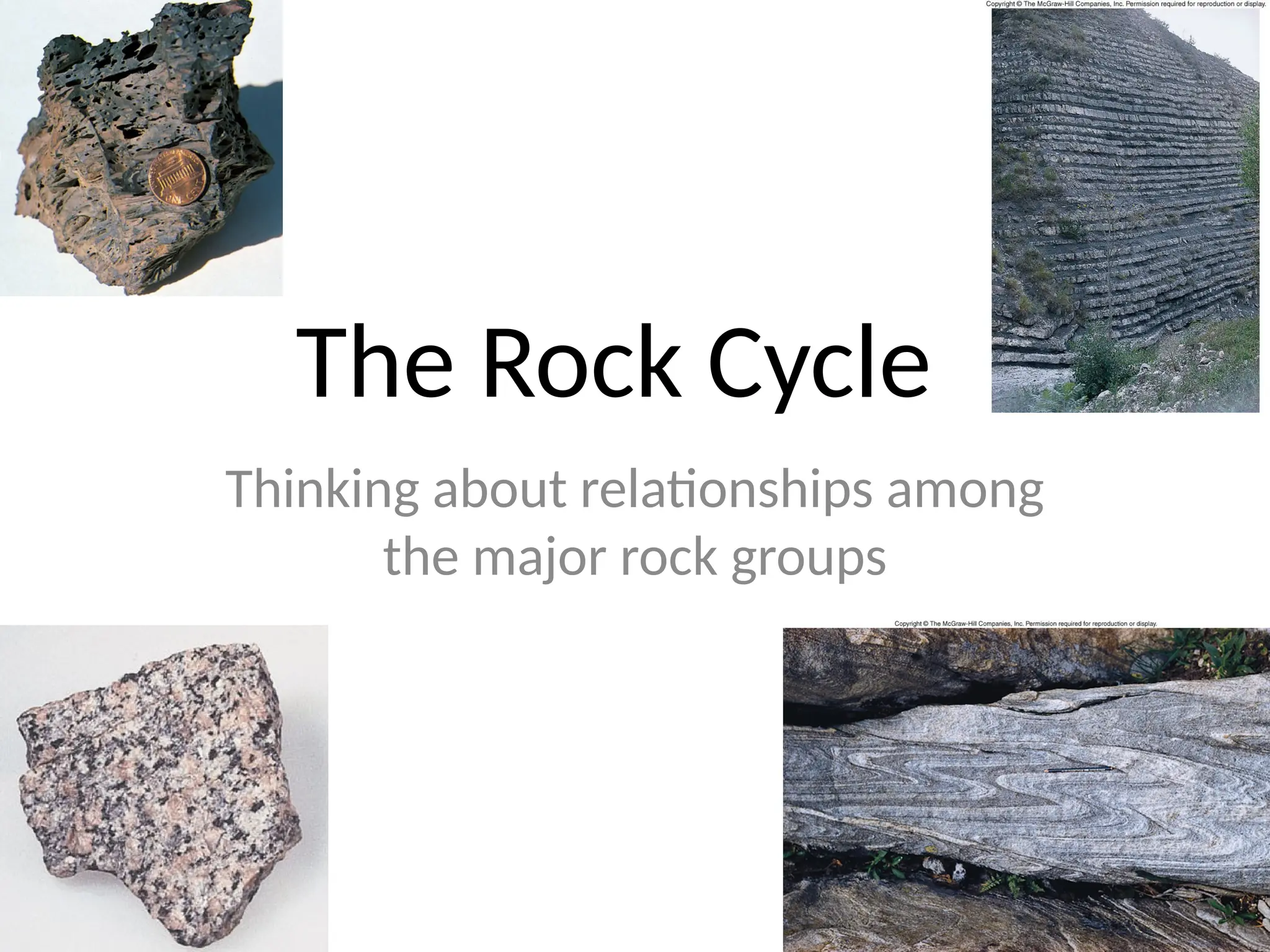
The Rock Cycle
Thinking about relationships among
the major rock groups
2
Major Rock Groups
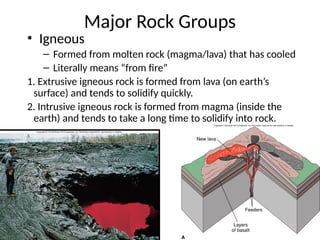
• Igneous
– Formed from molten rock (magma/lava) that has cooled
– Literally means “from fire”
1. Extrusive igneous rock is formed from lava (on earth’s
surface) and tends to solidify quickly.
2. Intrusive igneous rock is formed from magma (inside the
earth) and tends to take a long time to solidify into rock.
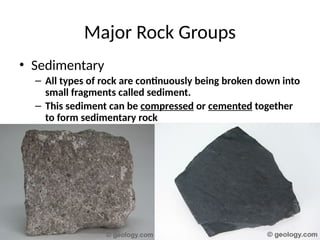
• Sedimentary
– All types of rock are continuously being broken down into
small fragments called sediment.
– This sediment can be compressed or cemented together
to form sedimentary rock
Major Rock Groups
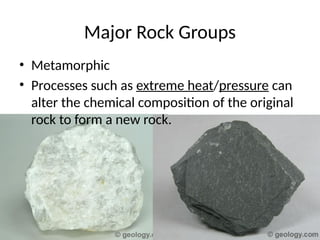
• Metamorphic
• Processes such as extreme heat/pressure can
alter the chemical composition of the original
rock to form a new rock.
Major Rock Groups
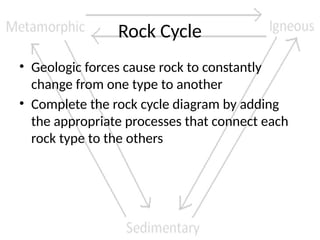
Rock Cycle
• Geologic forces cause rock to constantly
change from one type to another
• Complete the rock cycle diagram by adding
the appropriate processes that connect each
rock type to the others
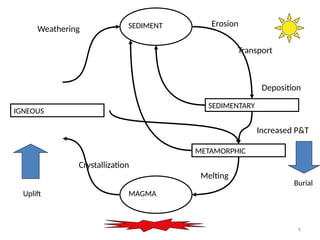
6
MAGMA
SEDIMENT
SEDIMENTARY
METAMORPHIC
Uplift
Burial
Increased P&T
Melting
Crystallization
Weathering
Erosion
Transport
Deposition
IGNEOUS
Crystal Formation
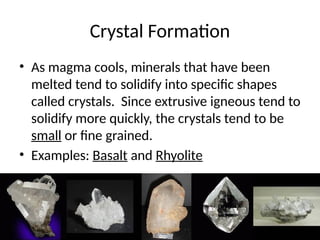
• As magma cools, minerals that have been
melted tend to solidify into specific shapes
called crystals. Since extrusive igneous tend to
solidify more quickly, the crystals tend to be
small or fine grained.
• Examples: Basalt and Rhyolite
Crystal Formation
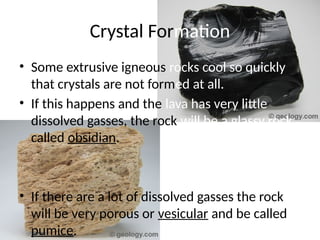
• Some extrusive igneous rocks cool so quickly
that crystals are not formed at all.
• If this happens and the lava has very little
dissolved gasses, the rock will be a glassy rock
called obsidian.
• If there are a lot of dissolved gasses the rock
will be very porous or vesicular and be called
pumice.
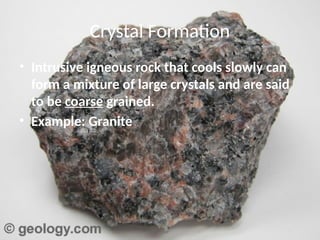
Crystal Formation
• Intrusive igneous rock that cools slowly can
form a mixture of large crystals and are said
to be coarse grained.
• Example: Granite
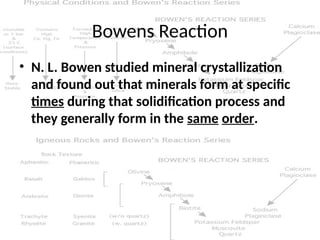
Bowens Reaction
• N. L. Bowen studied mineral crystallization
and found out that minerals form at specific
times during that solidification process and
they generally form in the same order.
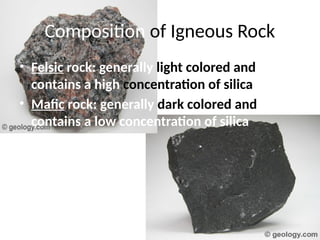
Composition of Igneous Rock
• Felsic rock: generally light colored and
contains a high concentration of silica
• Mafic rock: generally dark colored and
contains a low concentration of silica
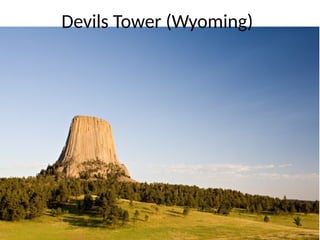
Intrusive Rock Structures
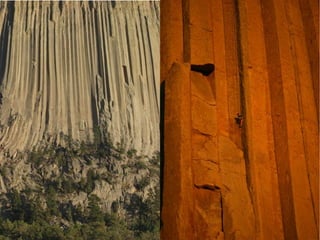
•Volcanic Neck: Magma that solidifies in the
main vent of a volcano is much harder than the
surrounding rock.
•Eventually the surrounding rock is eroded
leaving the harder intrusive igneous rock
exposed.
Devils Tower (Wyoming)
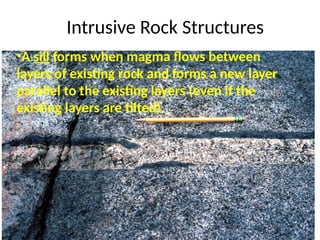
Intrusive Rock Structures
•A sill forms when magma flows between
layers of existing rock and forms a new layer
parallel to the existing layers (even if the
existing layers are tilted).
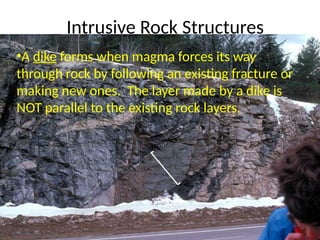
Intrusive Rock Structures
•A dike forms when magma forces its way
through rock by following an existing fracture or
making new ones. The layer made by a dike is
NOT parallel to the existing rock layers.
Formation of Sedimentary Rock
•Compaction: is when pieces of sediment are
squeezed together by the weight of overlying
layers (including water)
•Cementation of sediment occurs when minerals
are deposited in a bed of sediment and as the
water evaporates the dissolved minerals form
crystals that “glue” the sediment particles to
each other.
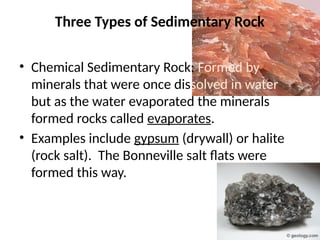
Three Types of Sedimentary Rock
• Chemical Sedimentary Rock: Formed by
minerals that were once dissolved in water
but as the water evaporated the minerals
formed rocks called evaporates.
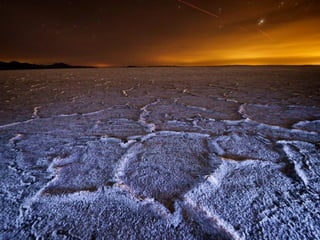
• Examples include gypsum (drywall) or halite
(rock salt). The Bonneville salt flats were
formed this way.
Three Types of Sedimentary Rock
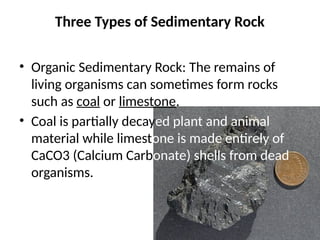
• Organic Sedimentary Rock: The remains of
living organisms can sometimes form rocks
such as coal or limestone.
• Coal is partially decayed plant and animal
material while limestone is made entirely of
CaCO3 (Calcium Carbonate) shells from dead
organisms.
Three Types of Sedimentary Rock
• Clastic Sedimentary Rock: Made of rock
fragments that are carried away from their
source by water wind or ice and left as
deposits. Over time these fragments become
cemented/compacted together.
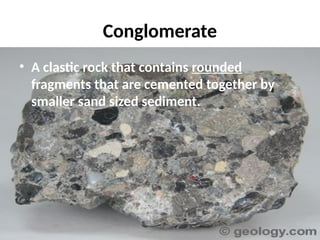
Conglomerate
• A clastic rock that contains rounded
fragments that are cemented together by
smaller sand sized sediment.
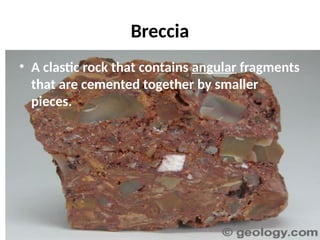
Breccia
• A clastic rock that contains angular fragments
that are cemented together by smaller
pieces.
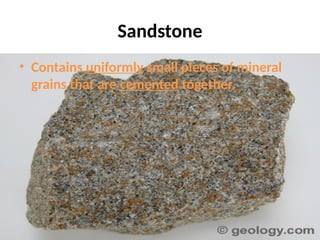
Sandstone
• Contains uniformly small pieces of mineral
grains that are cemented together.
Shale
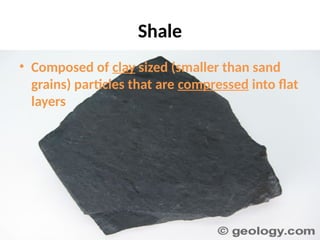
• Composed of clay sized (smaller than sand
grains) particles that are compressed into flat
layers
Metamorphic Rocks
• Metamorphic rocks are formed from existing
rock that is subjected to pressure and heat
(but not melted) into a new type of rock.
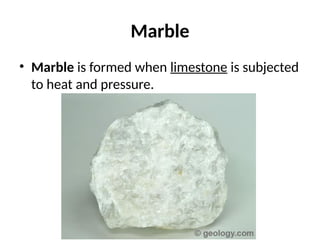
Marble
• Marble is formed when limestone is subjected
to heat and pressure.
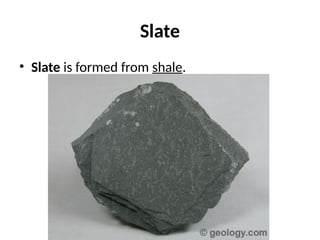
Slate
• Slate is formed from shale.
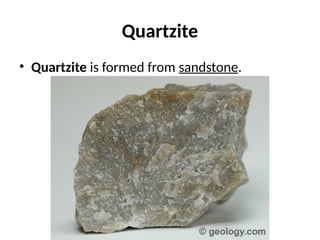
Quartzite
• Quartzite is formed from sandstone.
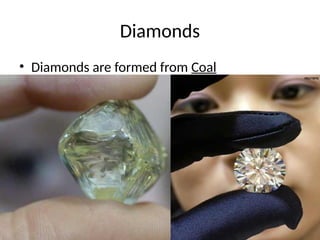
Diamonds
• Diamonds are formed from Coal

Rock CycleRock CycleRock CycleRock CycleRock Cycle.pptx

  • 1.
    The Rock Cycle Thinkingabout relationships among the major rock groups
  • 2.
    2 Major Rock Groups •Igneous – Formed from molten rock (magma/lava) that has cooled – Literally means “from fire” 1. Extrusive igneous rock is formed from lava (on earth’s surface) and tends to solidify quickly. 2. Intrusive igneous rock is formed from magma (inside the earth) and tends to take a long time to solidify into rock.
  • 3.
    • Sedimentary – Alltypes of rock are continuously being broken down into small fragments called sediment. – This sediment can be compressed or cemented together to form sedimentary rock Major Rock Groups
  • 4.
    • Metamorphic • Processessuch as extreme heat/pressure can alter the chemical composition of the original rock to form a new rock. Major Rock Groups
  • 5.
    Rock Cycle • Geologicforces cause rock to constantly change from one type to another • Complete the rock cycle diagram by adding the appropriate processes that connect each rock type to the others
  • 6.
  • 7.
    Crystal Formation • Asmagma cools, minerals that have been melted tend to solidify into specific shapes called crystals. Since extrusive igneous tend to solidify more quickly, the crystals tend to be small or fine grained. • Examples: Basalt and Rhyolite
  • 8.
    Crystal Formation • Someextrusive igneous rocks cool so quickly that crystals are not formed at all. • If this happens and the lava has very little dissolved gasses, the rock will be a glassy rock called obsidian. • If there are a lot of dissolved gasses the rock will be very porous or vesicular and be called pumice.
  • 9.
    Crystal Formation • Intrusiveigneous rock that cools slowly can form a mixture of large crystals and are said to be coarse grained. • Example: Granite
  • 10.
    Bowens Reaction • N.L. Bowen studied mineral crystallization and found out that minerals form at specific times during that solidification process and they generally form in the same order.
  • 11.
    Composition of IgneousRock • Felsic rock: generally light colored and contains a high concentration of silica • Mafic rock: generally dark colored and contains a low concentration of silica
  • 12.
    Intrusive Rock Structures •VolcanicNeck: Magma that solidifies in the main vent of a volcano is much harder than the surrounding rock. •Eventually the surrounding rock is eroded leaving the harder intrusive igneous rock exposed.
  • 13.
  • 15.
    Intrusive Rock Structures •Asill forms when magma flows between layers of existing rock and forms a new layer parallel to the existing layers (even if the existing layers are tilted).
  • 16.
    Intrusive Rock Structures •Adike forms when magma forces its way through rock by following an existing fracture or making new ones. The layer made by a dike is NOT parallel to the existing rock layers.
  • 17.
    Formation of SedimentaryRock •Compaction: is when pieces of sediment are squeezed together by the weight of overlying layers (including water) •Cementation of sediment occurs when minerals are deposited in a bed of sediment and as the water evaporates the dissolved minerals form crystals that “glue” the sediment particles to each other.
  • 18.
    Three Types ofSedimentary Rock • Chemical Sedimentary Rock: Formed by minerals that were once dissolved in water but as the water evaporated the minerals formed rocks called evaporates. • Examples include gypsum (drywall) or halite (rock salt). The Bonneville salt flats were formed this way.
  • 20.
    Three Types ofSedimentary Rock • Organic Sedimentary Rock: The remains of living organisms can sometimes form rocks such as coal or limestone. • Coal is partially decayed plant and animal material while limestone is made entirely of CaCO3 (Calcium Carbonate) shells from dead organisms.
  • 21.
    Three Types ofSedimentary Rock • Clastic Sedimentary Rock: Made of rock fragments that are carried away from their source by water wind or ice and left as deposits. Over time these fragments become cemented/compacted together.
  • 22.
    Conglomerate • A clasticrock that contains rounded fragments that are cemented together by smaller sand sized sediment.
  • 23.
    Breccia • A clasticrock that contains angular fragments that are cemented together by smaller pieces.
  • 24.
    Sandstone • Contains uniformlysmall pieces of mineral grains that are cemented together.
  • 25.
    Shale • Composed ofclay sized (smaller than sand grains) particles that are compressed into flat layers
  • 26.
    Metamorphic Rocks • Metamorphicrocks are formed from existing rock that is subjected to pressure and heat (but not melted) into a new type of rock.
  • 27.
    Marble • Marble isformed when limestone is subjected to heat and pressure.
  • 28.
    Slate • Slate isformed from shale.
  • 29.
    Quartzite • Quartzite isformed from sandstone.
  • 30.
    Diamonds • Diamonds areformed from Coal