Submitted By:
MANISHA CHAUDHARY
Seminar
On
Graphics Processing
Unit
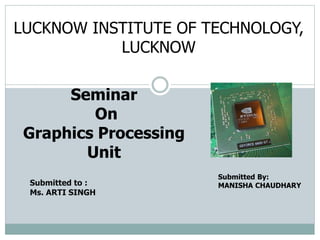
LUCKNOW INSTITUTE OF TECHNOLOGY,
LUCKNOW
Submitted to :
Ms. ARTI SINGH
INTRODUCTION
DEFINITION
COMPONENTS OF GPU
COMPARISON WITH CPU
ARCHITECTURE
CONCLUSION
Content
Introduction
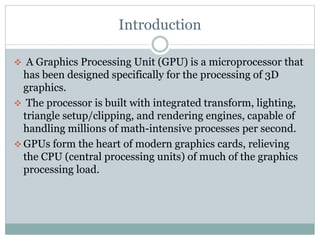
 A Graphics Processing Unit (GPU) is a microprocessor that
has been designed specifically for the processing of 3D
graphics.
 The processor is built with integrated transform, lighting,
triangle setup/clipping, and rendering engines, capable of
handling millions of math-intensive processes per second.
 GPUs form the heart of modern graphics cards, relieving
the CPU (central processing units) of much of the graphics
processing load.
Why GPU?
 To provide a separate dedicated graphics
resources including a graphics processor and
memory.
 To relieve some of the burden of the main system
resources, namely the Central Processing Unit,
Main Memory, and the System Bus, which would
otherwise get saturated with graphical operations
and I/O requests.
What is a GPU?
 A Graphics Processing Unit or GPU (also
occasionally called Visual Processing Unit or
VPU) is a dedicated processor efficient at
manipulating and displaying computer graphics .
 Like the CPU (Central Processing Unit), it is a
single-chip processor.
HOWEVER,
The abstract goal of a GPU, is to enable a
representation of a 3D world as realistically as
possible. So these GPUs are designed to provide
additional computational power that is customized
specifically to perform these 3D tasks.
GPU vs CPU
 A GPU is tailored for highly parallel operation
while a CPU executes programs serially.
 For this reason, GPUs have many parallel
execution units , while CPUs have few execution
units .
 GPUs have singificantly faster and more
advanced memory interfaces as they need to shift
around a lot more data than CPUs.
 GPUs have much deeper pipelines (several
thousand stages vs 10-20 for CPUs).
BRIEF HISTORY
 First-Generation GPUs
 Up to 1998; Nvidia’s TNT2, ATi’s Rage, and 3dfx’s Voodoo3;DX6 feature set.
 Second-Generation GPUs
 1999 -2000; Nvidia’s GeForce256 and GeForce2, ATi’s Radeon7500, and S3’s
Savage3D; T&L; OpenGL and DX7;Configurable.
 Third-Generation GPUs
 2001; GeForce3/4Ti, Radeon8500, MS’s Xbox; OpenGL ARB, DX7/8; Vertex
Programmability + ASM
 Fourth-Generation GPUs
 2002 onwards; GeForce FX family, Radeon 9700; OpenGL+extensions, DX9;
Vertex/Pixel Programability + HLSL; 0.13μ Process, 125M T/C, 200M T/S.
 Fifth-Generation GPUs
- GeForce 8X:DirectX10.
COMPONENTS OF GPU
 Graphics Processor
 Graphics co-processor
 Graphics accelerator
 Frame buffer
 Memory
 Graphics BIOS
 Digital-to-Analog Converter (DAC)
 Display Connector
 Computer (Bus) Connector
GPU Architecture
How many processing units?
 Lots.
How many ALUs?
 Hundreds.
Do you need a cache?
 Sort of.
What kind of memory?
 very fast.
The difference…….
Without GPU With GPU
The GPU pipeline
 The GPU receives geometry information from the
CPU as an input and provides a picture as an
output
 Let’s see how that happens…
host
interface
vertex
processing
triangle
setup
pixel
processing
memory
interface
Host Interface
 The host interface is the communication bridge
between the CPU and the GPU.
 It receives commands from the CPU and also
pulls geometry information from system memory.
 It outputs a stream of vertices in object space
with all their associated information (texture
coordinates, per vertex color etc) .
host
interface
vertex
processing
triangle
setup
pixel
processing
memory
interface
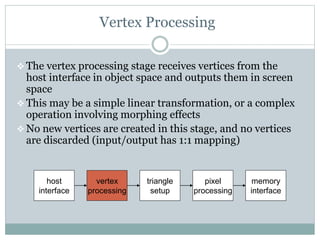
Vertex Processing
 The vertex processing stage receives vertices from the
host interface in object space and outputs them in screen
space
 This may be a simple linear transformation, or a complex
operation involving morphing effects
 No new vertices are created in this stage, and no vertices
are discarded (input/output has 1:1 mapping)
host
interface
vertex
processing
triangle
setup
pixel
processing
memory
interface
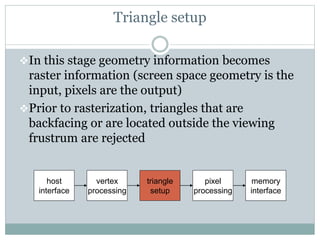
Triangle setup
In this stage geometry information becomes
raster information (screen space geometry is the
input, pixels are the output)
Prior to rasterization, triangles that are
backfacing or are located outside the viewing
frustrum are rejected
host
interface
vertex
processing
triangle
setup
pixel
processing
memory
interface
Triangle Setup (cont…..)
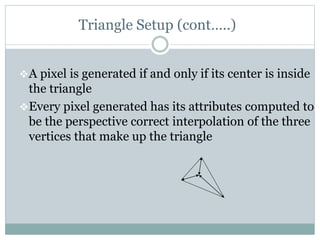
A pixel is generated if and only if its center is inside
the triangle
Every pixel generated has its attributes computed to
be the perspective correct interpolation of the three
vertices that make up the triangle
Pixel Processing
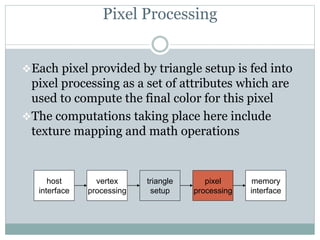
Each pixel provided by triangle setup is fed into
pixel processing as a set of attributes which are
used to compute the final color for this pixel
The computations taking place here include
texture mapping and math operations
host
interface
vertex
processing
triangle
setup
pixel
processing
memory
interface
Memory Interface
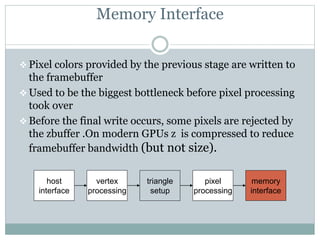
 Pixel colors provided by the previous stage are written to
the framebuffer
 Used to be the biggest bottleneck before pixel processing
took over
 Before the final write occurs, some pixels are rejected by
the zbuffer .On modern GPUs z is compressed to reduce
framebuffer bandwidth (but not size).
host
interface
vertex
processing
triangle
setup
pixel
processing
memory
interface
Programmability in GPU pipeline
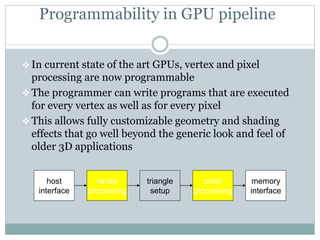
 In current state of the art GPUs, vertex and pixel
processing are now programmable
 The programmer can write programs that are executed
for every vertex as well as for every pixel
 This allows fully customizable geometry and shading
effects that go well beyond the generic look and feel of
older 3D applications
host
interface
vertex
processing
triangle
setup
pixel
processing
memory
interface
Conclusion
 Graphics Processing Unit is not a wonder that this
piece of hardware is often referred to as an exotic
product as far as computer peripherals are
concerned.
 By observing the current pace at which work is going
on in developing GPUs we can surely come to a
conclusion that we will be able to see better and
faster GPUs in the near future.
Reference
 www.google.com
 www.wikipedia.com
 www.studymafia.org
Thanks

graphics processing unit ppt

  • 1.
    Submitted By: MANISHA CHAUDHARY Seminar On GraphicsProcessing Unit LUCKNOW INSTITUTE OF TECHNOLOGY, LUCKNOW Submitted to : Ms. ARTI SINGH
  • 2.
    INTRODUCTION DEFINITION COMPONENTS OF GPU COMPARISONWITH CPU ARCHITECTURE CONCLUSION Content
  • 3.
    Introduction  A GraphicsProcessing Unit (GPU) is a microprocessor that has been designed specifically for the processing of 3D graphics.  The processor is built with integrated transform, lighting, triangle setup/clipping, and rendering engines, capable of handling millions of math-intensive processes per second.  GPUs form the heart of modern graphics cards, relieving the CPU (central processing units) of much of the graphics processing load.
  • 4.
    Why GPU?  Toprovide a separate dedicated graphics resources including a graphics processor and memory.  To relieve some of the burden of the main system resources, namely the Central Processing Unit, Main Memory, and the System Bus, which would otherwise get saturated with graphical operations and I/O requests.
  • 5.
    What is aGPU?  A Graphics Processing Unit or GPU (also occasionally called Visual Processing Unit or VPU) is a dedicated processor efficient at manipulating and displaying computer graphics .  Like the CPU (Central Processing Unit), it is a single-chip processor.
  • 6.
    HOWEVER, The abstract goalof a GPU, is to enable a representation of a 3D world as realistically as possible. So these GPUs are designed to provide additional computational power that is customized specifically to perform these 3D tasks.
  • 7.
    GPU vs CPU A GPU is tailored for highly parallel operation while a CPU executes programs serially.  For this reason, GPUs have many parallel execution units , while CPUs have few execution units .  GPUs have singificantly faster and more advanced memory interfaces as they need to shift around a lot more data than CPUs.  GPUs have much deeper pipelines (several thousand stages vs 10-20 for CPUs).
  • 8.
    BRIEF HISTORY  First-GenerationGPUs  Up to 1998; Nvidia’s TNT2, ATi’s Rage, and 3dfx’s Voodoo3;DX6 feature set.  Second-Generation GPUs  1999 -2000; Nvidia’s GeForce256 and GeForce2, ATi’s Radeon7500, and S3’s Savage3D; T&L; OpenGL and DX7;Configurable.  Third-Generation GPUs  2001; GeForce3/4Ti, Radeon8500, MS’s Xbox; OpenGL ARB, DX7/8; Vertex Programmability + ASM  Fourth-Generation GPUs  2002 onwards; GeForce FX family, Radeon 9700; OpenGL+extensions, DX9; Vertex/Pixel Programability + HLSL; 0.13μ Process, 125M T/C, 200M T/S.  Fifth-Generation GPUs - GeForce 8X:DirectX10.
  • 9.
    COMPONENTS OF GPU Graphics Processor  Graphics co-processor  Graphics accelerator  Frame buffer  Memory  Graphics BIOS  Digital-to-Analog Converter (DAC)  Display Connector  Computer (Bus) Connector
  • 10.
    GPU Architecture How manyprocessing units?  Lots. How many ALUs?  Hundreds. Do you need a cache?  Sort of. What kind of memory?  very fast.
  • 11.
  • 12.
    The GPU pipeline The GPU receives geometry information from the CPU as an input and provides a picture as an output  Let’s see how that happens… host interface vertex processing triangle setup pixel processing memory interface
  • 13.
    Host Interface  Thehost interface is the communication bridge between the CPU and the GPU.  It receives commands from the CPU and also pulls geometry information from system memory.  It outputs a stream of vertices in object space with all their associated information (texture coordinates, per vertex color etc) . host interface vertex processing triangle setup pixel processing memory interface
  • 14.
    Vertex Processing  Thevertex processing stage receives vertices from the host interface in object space and outputs them in screen space  This may be a simple linear transformation, or a complex operation involving morphing effects  No new vertices are created in this stage, and no vertices are discarded (input/output has 1:1 mapping) host interface vertex processing triangle setup pixel processing memory interface
  • 15.
    Triangle setup In thisstage geometry information becomes raster information (screen space geometry is the input, pixels are the output) Prior to rasterization, triangles that are backfacing or are located outside the viewing frustrum are rejected host interface vertex processing triangle setup pixel processing memory interface
  • 16.
    Triangle Setup (cont…..) Apixel is generated if and only if its center is inside the triangle Every pixel generated has its attributes computed to be the perspective correct interpolation of the three vertices that make up the triangle
  • 17.
    Pixel Processing Each pixelprovided by triangle setup is fed into pixel processing as a set of attributes which are used to compute the final color for this pixel The computations taking place here include texture mapping and math operations host interface vertex processing triangle setup pixel processing memory interface
  • 18.
    Memory Interface  Pixelcolors provided by the previous stage are written to the framebuffer  Used to be the biggest bottleneck before pixel processing took over  Before the final write occurs, some pixels are rejected by the zbuffer .On modern GPUs z is compressed to reduce framebuffer bandwidth (but not size). host interface vertex processing triangle setup pixel processing memory interface
  • 19.
    Programmability in GPUpipeline  In current state of the art GPUs, vertex and pixel processing are now programmable  The programmer can write programs that are executed for every vertex as well as for every pixel  This allows fully customizable geometry and shading effects that go well beyond the generic look and feel of older 3D applications host interface vertex processing triangle setup pixel processing memory interface
  • 20.
    Conclusion  Graphics ProcessingUnit is not a wonder that this piece of hardware is often referred to as an exotic product as far as computer peripherals are concerned.  By observing the current pace at which work is going on in developing GPUs we can surely come to a conclusion that we will be able to see better and faster GPUs in the near future.
  • 21.
  • 22.