
What Is a CPU?
Constructed from millions of transistors, the CPU can
have multiple processing cores and is commonly
referred to as the brain of the computer. It is essential to
all modern computing systems as it executes the
commands and processes needed for your computer
and operating system. The CPU is also important in
determining how fast programs can run, from surfing
the web to building spreadsheets.
What Is a GPU?
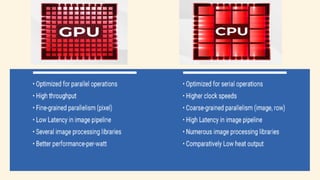
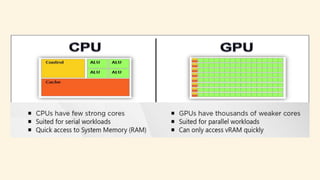
The GPU is a processor that is made up of many smaller and
more specialized cores. By working together, the cores deliver
massive performance when a processing task can be divided up
and processed across many cores. The clock speed of a GPU may be
lower than modern CPUs (normally in the range of 500-800 MHz), but the
number of cores on each chip is much denser. This is one of the most distinct
differences between a graphics card vs CPU. This allows a GPU to perform a
lot of basic tasks at the same time.
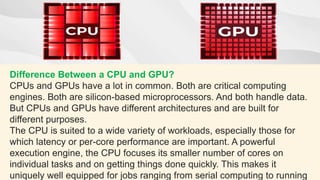
Difference Between a CPU and GPU?
CPUs and GPUs have a lot in common. Both are critical computing
engines. Both are silicon-based microprocessors. And both handle data.
But CPUs and GPUs have different architectures and are built for
different purposes.
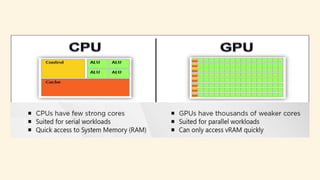
The CPU is suited to a wide variety of workloads, especially those for
which latency or per-core performance are important. A powerful
execution engine, the CPU focuses its smaller number of cores on
individual tasks and on getting things done quickly. This makes it
uniquely well equipped for jobs ranging from serial computing to running
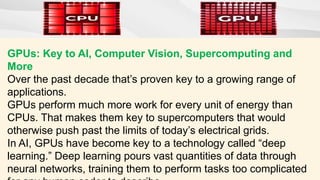
GPUs: Key to AI, Computer Vision, Supercomputing and
More
Over the past decade that’s proven key to a growing range of
applications.
GPUs perform much more work for every unit of energy than
CPUs. That makes them key to supercomputers that would
otherwise push past the limits of today’s electrical grids.
In AI, GPUs have become key to a technology called “deep
learning.” Deep learning pours vast quantities of data through
neural networks, training them to perform tasks too complicated
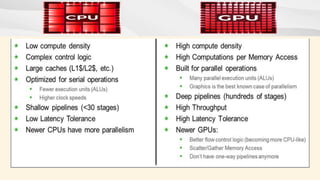
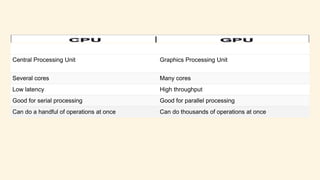
Central Processing Unit Graphics Processing Unit
Several cores Many cores
Low latency High throughput
Good for serial processing Good for parallel processing
Can do a handful of operations at once Can do thousands of operations at once
Why Have Two Different Processor Types?
Everyone is somewhat familiar with CPUs. Known as the “brain” of a computer, they
are composed of millions upon millions of tiny transistors with multiple “cores.” It is
critical for handling the main processing functions of a computer. Actions like running
the operating system and applications would not be possible without it. The CPU is
also what determines the general speed of a computer.
GPUs are more specialized in nature. Originally designed to help with 3D rendering,
they can do more processing in parallel. This is perfect for use in graphic-intensive
applications that rely on displaying dynamic content for gaming, or
compressing/decompressing streaming videos. GPUs are also being used in many
other areas beyond rendering and image processing, like Artificial
Intelligence and Bitcoin mining.
The main difference between a CPU and a GPU is how they process the instructions
given to them. In human terms, you could say that a CPU is the master of taking on
one task at a time, whereas a GPU can take on many tasks at once. While there are
some that work better doing things in sequential order, others can multitask.
Summary
The CPU is responsible for the serial processing while the GPU is
responsible for the parallel processing of tasks. Thus for the high
performance of the computer both CPU and GPU are required.
This will make parallel portions of code run on GPU and serial
portions on the CPU.
If seen individually both have their own limitations. A CPU has
heavy-weight instruction sets, slow switch latency, and defy
Moore’s law. While GPU has less powerful cores, can focus on
only one task at a time, has limited APIs.
THANK YOU
Like the Video and Subscribe the Channel

CPU vs GPU Comparison

  • 2.
    What Is aCPU? Constructed from millions of transistors, the CPU can have multiple processing cores and is commonly referred to as the brain of the computer. It is essential to all modern computing systems as it executes the commands and processes needed for your computer and operating system. The CPU is also important in determining how fast programs can run, from surfing the web to building spreadsheets.
  • 3.
    What Is aGPU? The GPU is a processor that is made up of many smaller and more specialized cores. By working together, the cores deliver massive performance when a processing task can be divided up and processed across many cores. The clock speed of a GPU may be lower than modern CPUs (normally in the range of 500-800 MHz), but the number of cores on each chip is much denser. This is one of the most distinct differences between a graphics card vs CPU. This allows a GPU to perform a lot of basic tasks at the same time.
  • 5.
    Difference Between aCPU and GPU? CPUs and GPUs have a lot in common. Both are critical computing engines. Both are silicon-based microprocessors. And both handle data. But CPUs and GPUs have different architectures and are built for different purposes. The CPU is suited to a wide variety of workloads, especially those for which latency or per-core performance are important. A powerful execution engine, the CPU focuses its smaller number of cores on individual tasks and on getting things done quickly. This makes it uniquely well equipped for jobs ranging from serial computing to running
  • 6.
    GPUs: Key toAI, Computer Vision, Supercomputing and More Over the past decade that’s proven key to a growing range of applications. GPUs perform much more work for every unit of energy than CPUs. That makes them key to supercomputers that would otherwise push past the limits of today’s electrical grids. In AI, GPUs have become key to a technology called “deep learning.” Deep learning pours vast quantities of data through neural networks, training them to perform tasks too complicated
  • 9.
    Central Processing UnitGraphics Processing Unit Several cores Many cores Low latency High throughput Good for serial processing Good for parallel processing Can do a handful of operations at once Can do thousands of operations at once
  • 11.
    Why Have TwoDifferent Processor Types? Everyone is somewhat familiar with CPUs. Known as the “brain” of a computer, they are composed of millions upon millions of tiny transistors with multiple “cores.” It is critical for handling the main processing functions of a computer. Actions like running the operating system and applications would not be possible without it. The CPU is also what determines the general speed of a computer. GPUs are more specialized in nature. Originally designed to help with 3D rendering, they can do more processing in parallel. This is perfect for use in graphic-intensive applications that rely on displaying dynamic content for gaming, or compressing/decompressing streaming videos. GPUs are also being used in many other areas beyond rendering and image processing, like Artificial Intelligence and Bitcoin mining. The main difference between a CPU and a GPU is how they process the instructions given to them. In human terms, you could say that a CPU is the master of taking on one task at a time, whereas a GPU can take on many tasks at once. While there are some that work better doing things in sequential order, others can multitask.
  • 12.
    Summary The CPU isresponsible for the serial processing while the GPU is responsible for the parallel processing of tasks. Thus for the high performance of the computer both CPU and GPU are required. This will make parallel portions of code run on GPU and serial portions on the CPU. If seen individually both have their own limitations. A CPU has heavy-weight instruction sets, slow switch latency, and defy Moore’s law. While GPU has less powerful cores, can focus on only one task at a time, has limited APIs.
  • 13.
    THANK YOU Like theVideo and Subscribe the Channel