Seminar
On
Graphics Processing
Unit
1
introduction
 A Graphics Processing Unit (GPU) is a microprocessor
that has been designed specifically for the processing of
3Dgraphics.
 The processor is built with integrated transform, lighting,
triangle clipping, and rendering engines. capable of
handling millions of math-intensive processes per second.
 Graphics Processing Units, are like the powerhouses of
modern graphics cards. They take on the heavy work of
creating images and videos, which helps the CPU (the
main brain of the computer) focus on other tasks. This
makes everything run smoother, especially in games and
graphics-heavy programs.
2
• 1980's - No GPU. PC used VGA controller
• 1990's- Add more function into VGA controller
• 1997-3D acceleration functions:
Hardware for triangle setup and rasterization
Texture mapping
Shading
• 2000-A single chip graphics processor
(beginning of GPU term)
• 2005- Massively parallel programmable processors
• 2007- CUDA (Compute Unified Device Architecture)
HISTORY OF GPU
3
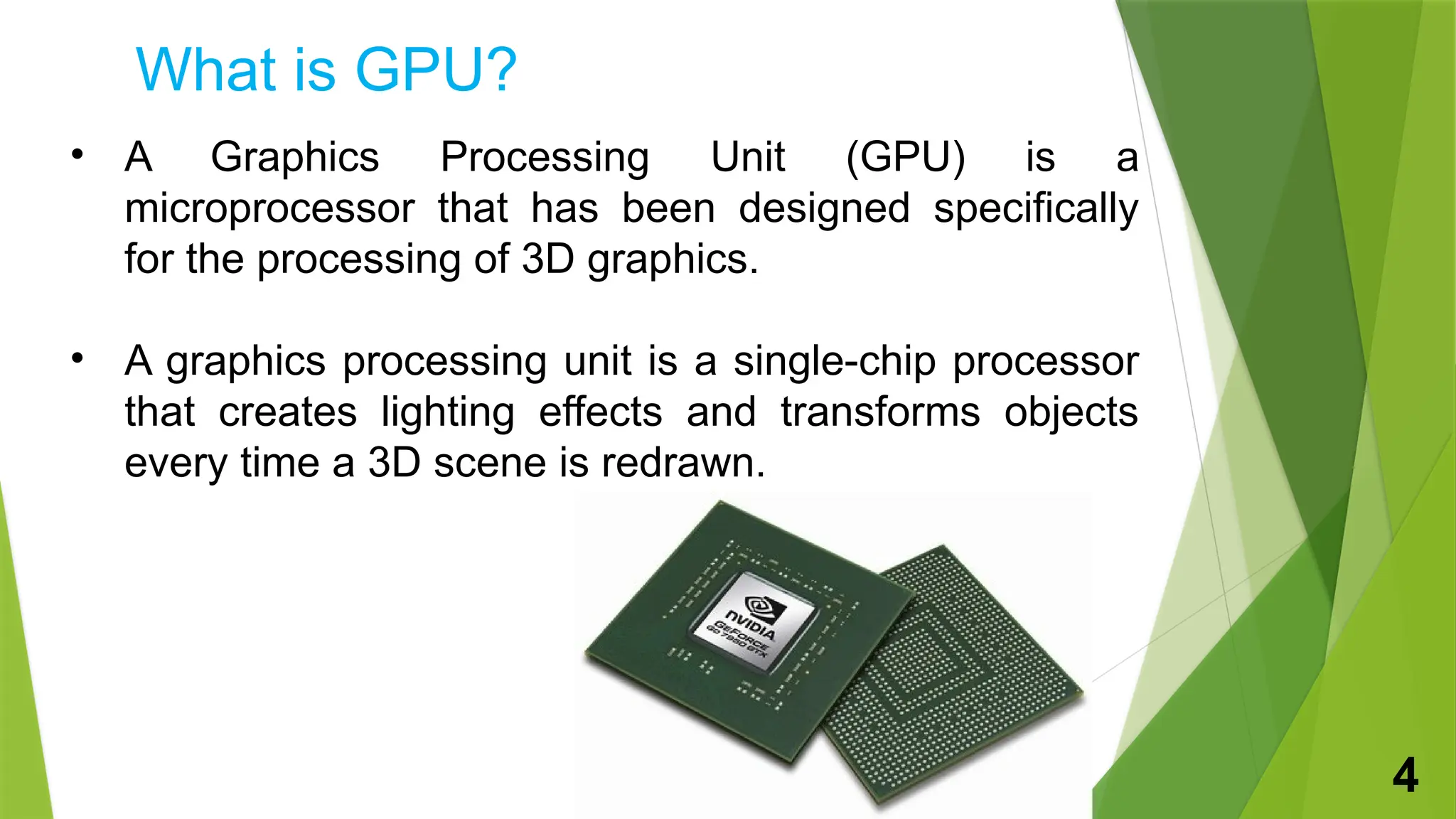
• A Graphics Processing Unit (GPU) is a
microprocessor that has been designed specifically
for the processing of 3D graphics.
• A graphics processing unit is a single-chip processor
that creates lighting effects and transforms objects
every time a 3D scene is redrawn.
What is GPU?
4
 Graphics Processor
 Graphics co-processor
 Graphics accelerator
 Frame buffer
 Memory
 Graphics BIOS
 Digital-to-Analog Converter (DAC)
 Computer Connector (Bus)
COMPONENTS OF GPU
5
1. Graphics Processor: The main chip in the GPU that does the
work of creating images and effects.
2. Graphics Co-processor: A helper processor that assists the main
graphics processor to speed things up.
3. Graphics Accelerator: Special hardware that speeds up certain
graphics tasks, making rendering faster and smoother.
4. Frame Buffer: A temporary storage area that holds images right
before they’re displayed on the screen.
5. Memory (VRAM): Fast memory dedicated to storing textures, images,
and data that the GPU needs quickly.
6. Graphics BIOS: The GPU’s startup software that helps it
communicate with the computer and controls basic settings.
6
7. Digital-to-Analog Converter (DAC): Converts digital signals
to analog for older screens (used less in modern GPUs).
8. Computer Connector (Bus) : This part connects the GPU to
the computer’s motherboard through a slot allowing it to receive
information from the CPU.
7
characteristics of GPU
1. Parallel Processing
Does many things at once: A GPU can handle thousands
of small tasks simultaneously, which makes it super fast for
jobs like image and video processing.
2. Cores (Processing Units)
Many small processors: GPUs have lots of tiny
processors (called CUDA cores for NVIDIA or Stream
Processors for AMD) that do the work. More cores mean
better performance, especially for graphics-heavy tasks.
8
3. Clock Speed
Speed of processing: The clock speed tells how fast the
GPU can process data. Higher clock speeds usually mean
better performance, but it also depends on other factors like
power and heat.
4. Power and Heat
Energy and cooling: GPUs use a lot of power and can get
hot. They need good cooling systems (fans or heatsinks) to
prevent overheating, and they also need enough power from
the computer to run properly.
5.Cooling
Keeping it cool: GPUs need good cooling systems (fans or
liquid cooling) to work efficiently without getting too hot.
9
LATEST TECHNOLOGY USE
NVIDIA
Tesla HPC specific GPUs have evolved from GeForce
series
AMD
Fire Stream HPC specific GPUs have evolved from (ATI)
Radeon series
 Intel
many-core x86 chip is like hybrid
between a GPU and many-core CPU
10
Applications of Graphics Processing Units (GPUs)
GPUs are mainly used in gaming to create high-quality graphics and
smooth gameplay. Modern games use techniques like real-time ray
tracing, which makes lighting and shadows look more realistic. GPUs
are also important for video editing and animation because they help
creators quickly render complex scenes and effects.
1. Gaming and Entertainment
11
GPUs are used in science fields like physics, chemistry, and biology
for simulations and modeling. They help researchers run complex
calculations, like studying molecules or predicting climate, which
would take too long with just CPUs. GPUs can handle a lot of data at
once, making research faster and more accurate.
2. Scientific Computing
12
3. Image and Video Processing
GPUs process images and videos quickly, helping with tasks like
enhancing images, detecting objects, and video conversion. They're
key for things like security cameras, self-driving cars, and augmented
reality.
13
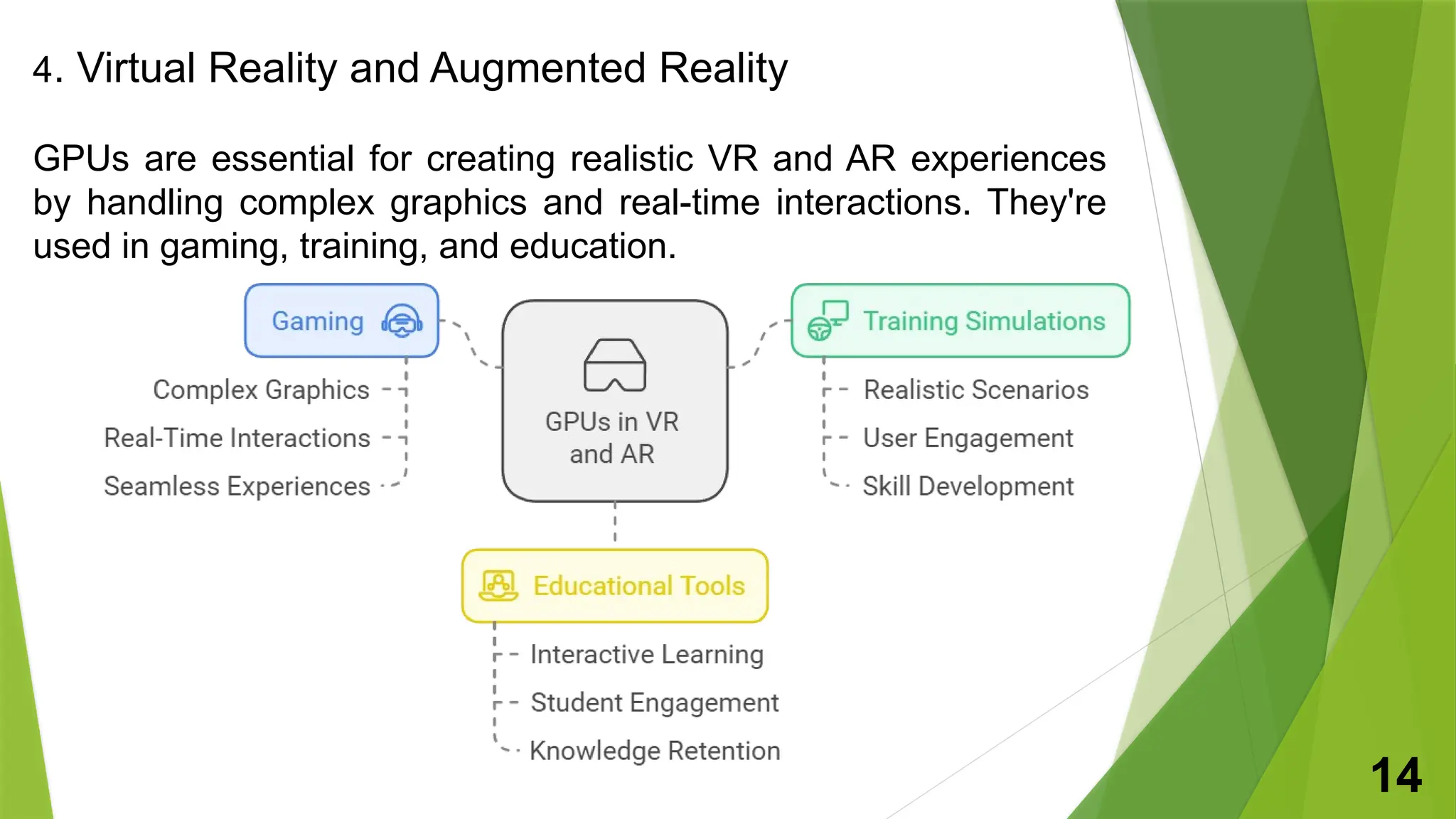
4. Virtual Reality and Augmented Reality
GPUs are essential for creating realistic VR and AR experiences
by handling complex graphics and real-time interactions. They're
used in gaming, training, and education.
14
Feature CPU (Central Processing
Unit)
GPU (Graphics
Processing Unit)
Primary Function
General computing (running
software, OS)
Graphics rendering,
parallel data processing
Speed Faster for single tasks Faster for parallel tasks
Cost Generally cheaper
More expensive for high-
performance
Power Consumption Lower for general use
Higher, especially under
heavy load
Performance
Best for single, complex
tasks
Best for parallel tasks
Purpose
General tasks,
sequential processing
Parallel tasks, mainly for
graphics
CPU VS GPU
Instruction Sets General-purpose
Specialized for parallel
computing
15
Without GPU With GPU
The difference…….
16
• Graphics Processing Unit is not a wonder that this piece
of hardware is often referred to as an exotic product as
far as computer peripherals are concerned.
• By observing the current pace at which work is going on
in developing GPUs we can surely come to a conclusion
that we will be able to see better and faster GPUs in the
near future.
CONCLUSION
17
 www.google.com
 www.wikipedia.com
 www.studymafia.org
Reference
18
19

presentaion on graphic process unit.pptx

  • 1.
  • 2.
    introduction  A GraphicsProcessing Unit (GPU) is a microprocessor that has been designed specifically for the processing of 3Dgraphics.  The processor is built with integrated transform, lighting, triangle clipping, and rendering engines. capable of handling millions of math-intensive processes per second.  Graphics Processing Units, are like the powerhouses of modern graphics cards. They take on the heavy work of creating images and videos, which helps the CPU (the main brain of the computer) focus on other tasks. This makes everything run smoother, especially in games and graphics-heavy programs. 2
  • 3.
    • 1980's -No GPU. PC used VGA controller • 1990's- Add more function into VGA controller • 1997-3D acceleration functions: Hardware for triangle setup and rasterization Texture mapping Shading • 2000-A single chip graphics processor (beginning of GPU term) • 2005- Massively parallel programmable processors • 2007- CUDA (Compute Unified Device Architecture) HISTORY OF GPU 3
  • 4.
    • A GraphicsProcessing Unit (GPU) is a microprocessor that has been designed specifically for the processing of 3D graphics. • A graphics processing unit is a single-chip processor that creates lighting effects and transforms objects every time a 3D scene is redrawn. What is GPU? 4
  • 5.
     Graphics Processor Graphics co-processor  Graphics accelerator  Frame buffer  Memory  Graphics BIOS  Digital-to-Analog Converter (DAC)  Computer Connector (Bus) COMPONENTS OF GPU 5
  • 6.
    1. Graphics Processor:The main chip in the GPU that does the work of creating images and effects. 2. Graphics Co-processor: A helper processor that assists the main graphics processor to speed things up. 3. Graphics Accelerator: Special hardware that speeds up certain graphics tasks, making rendering faster and smoother. 4. Frame Buffer: A temporary storage area that holds images right before they’re displayed on the screen. 5. Memory (VRAM): Fast memory dedicated to storing textures, images, and data that the GPU needs quickly. 6. Graphics BIOS: The GPU’s startup software that helps it communicate with the computer and controls basic settings. 6
  • 7.
    7. Digital-to-Analog Converter(DAC): Converts digital signals to analog for older screens (used less in modern GPUs). 8. Computer Connector (Bus) : This part connects the GPU to the computer’s motherboard through a slot allowing it to receive information from the CPU. 7
  • 8.
    characteristics of GPU 1.Parallel Processing Does many things at once: A GPU can handle thousands of small tasks simultaneously, which makes it super fast for jobs like image and video processing. 2. Cores (Processing Units) Many small processors: GPUs have lots of tiny processors (called CUDA cores for NVIDIA or Stream Processors for AMD) that do the work. More cores mean better performance, especially for graphics-heavy tasks. 8
  • 9.
    3. Clock Speed Speedof processing: The clock speed tells how fast the GPU can process data. Higher clock speeds usually mean better performance, but it also depends on other factors like power and heat. 4. Power and Heat Energy and cooling: GPUs use a lot of power and can get hot. They need good cooling systems (fans or heatsinks) to prevent overheating, and they also need enough power from the computer to run properly. 5.Cooling Keeping it cool: GPUs need good cooling systems (fans or liquid cooling) to work efficiently without getting too hot. 9
  • 10.
    LATEST TECHNOLOGY USE NVIDIA TeslaHPC specific GPUs have evolved from GeForce series AMD Fire Stream HPC specific GPUs have evolved from (ATI) Radeon series  Intel many-core x86 chip is like hybrid between a GPU and many-core CPU 10
  • 11.
    Applications of GraphicsProcessing Units (GPUs) GPUs are mainly used in gaming to create high-quality graphics and smooth gameplay. Modern games use techniques like real-time ray tracing, which makes lighting and shadows look more realistic. GPUs are also important for video editing and animation because they help creators quickly render complex scenes and effects. 1. Gaming and Entertainment 11
  • 12.
    GPUs are usedin science fields like physics, chemistry, and biology for simulations and modeling. They help researchers run complex calculations, like studying molecules or predicting climate, which would take too long with just CPUs. GPUs can handle a lot of data at once, making research faster and more accurate. 2. Scientific Computing 12
  • 13.
    3. Image andVideo Processing GPUs process images and videos quickly, helping with tasks like enhancing images, detecting objects, and video conversion. They're key for things like security cameras, self-driving cars, and augmented reality. 13
  • 14.
    4. Virtual Realityand Augmented Reality GPUs are essential for creating realistic VR and AR experiences by handling complex graphics and real-time interactions. They're used in gaming, training, and education. 14
  • 15.
    Feature CPU (CentralProcessing Unit) GPU (Graphics Processing Unit) Primary Function General computing (running software, OS) Graphics rendering, parallel data processing Speed Faster for single tasks Faster for parallel tasks Cost Generally cheaper More expensive for high- performance Power Consumption Lower for general use Higher, especially under heavy load Performance Best for single, complex tasks Best for parallel tasks Purpose General tasks, sequential processing Parallel tasks, mainly for graphics CPU VS GPU Instruction Sets General-purpose Specialized for parallel computing 15
  • 16.
    Without GPU WithGPU The difference……. 16
  • 17.
    • Graphics ProcessingUnit is not a wonder that this piece of hardware is often referred to as an exotic product as far as computer peripherals are concerned. • By observing the current pace at which work is going on in developing GPUs we can surely come to a conclusion that we will be able to see better and faster GPUs in the near future. CONCLUSION 17
  • 18.
     www.google.com  www.wikipedia.com www.studymafia.org Reference 18
  • 19.

Editor's Notes

  • #2 1. A GPU is type of microprocessor and its designed for 3D graphics processing It used to process graphical images. 2.The GPU is build with integrated transform, lighting , triangle clipping ,and rendering engines. . integrated transform is used for performing various types of data transformation. .lighting on GPU’s that enables realistic and dynamic visuals .triangle clipping it is used for 3D graphics rendering .rendering engines it is designed for generate realistic and high quality images. 3.Gpu is powerhouse of modern graphics card Gpu take heavy work like creating images and videos it help GPU to focus on other tasks It helps to run heavy graphics program smoothly
  • #3 1980’s VGA means(video graphics array) In 2000 it the beginning of Gpu term .in that time GPU used for general purpose computing In 2007 Nvidia released CUDA it is used to speed up compute intensive application
  • #4 2.A GPU Is single chip processor and it create a lighting effect and transform object into 3D scene. Here the image that showing gpu chip and graphics card the gpu chip The gpu chip is placed in the center of graphics card.
  • #5 BIOS (BASIC INPUT OUTPUT SYSTEM)
  • #6 1.Graphics processor – it is the main chip of GPU.it create images and effects. 2. Graphics co processor- it assist the main graphic processor and speed up things 3. Graphics accelerator- it is special hardware that speed up certain graphics task and make the rendering faster. 4.Frame buffer is known as temporary storage .it hold an image right before displayed on the screen. 5.Memory- VRAM means video ram it is fastest memory that store texrures ,images and data 6.Graphics BIOS – it is the startup part helps to communicate with computer it control the basic settings
  • #7 7.Digital to analog –convert digital signal to analog modern gpu is not using DAC. 8.Computer conncetor-The ports connect the gpu to computer’s motherboard it allows to receive information from gpu.
  • #8 1.Parallel processing – a gpu can handle thousands of small task It is super fast for image and video processing 2.Cores –it is a processing unit GPU have lots of small processors Nvidia release CUDA AMD release stream processors It has more core so it can provide better performance
  • #9 3.Clock speed means the processing speed .it shows how fast a gpu can process data .if a system have high clock speed it can provide better performance. 4.Power and heat –gpu use a lots of power because of that it have a good cooling system. That prevent overheating 5.Cooling –it will keep the gpu cool. Fans and liquid are used for cooling It helps to reduces over heat.
  • #10 NVIDIA – HPC stands for high performance computing AMD – amd use ATI technology that means advanced technology international INTEL – X86 is type of computer processor developed by intel.
  • #11 1.Gaming and entertainment-GPU has an important roll in gaming. in gaming sector GPU is mainly used for high quality graphics and smooth gameplay. Modern games use real time raytracing that helps make game more realistic. Gpu is also important for video editing and animation because it can render efficiently.
  • #12 2.Scientific computing – gpus are also used in science fields like physics,chemistry and biology. It helps to solve complex calculations Gpu can handle lots of data that makes research fast.
  • #13 3.Image and video processing –gpu can process images and videos quickly . It can helps for enhancing images ,detecting objects and video conversion. It has perform an important roll in security cameras and self driving cars.
  • #14 4.VR and AR –GPU are important for creating VR and AR.it can handle complex graphics .They are used in gaming ,training and education sector. In gaming sector GPU handle complex graphics, real-time interactions ,seamless experiences.
  • #15 Primary function